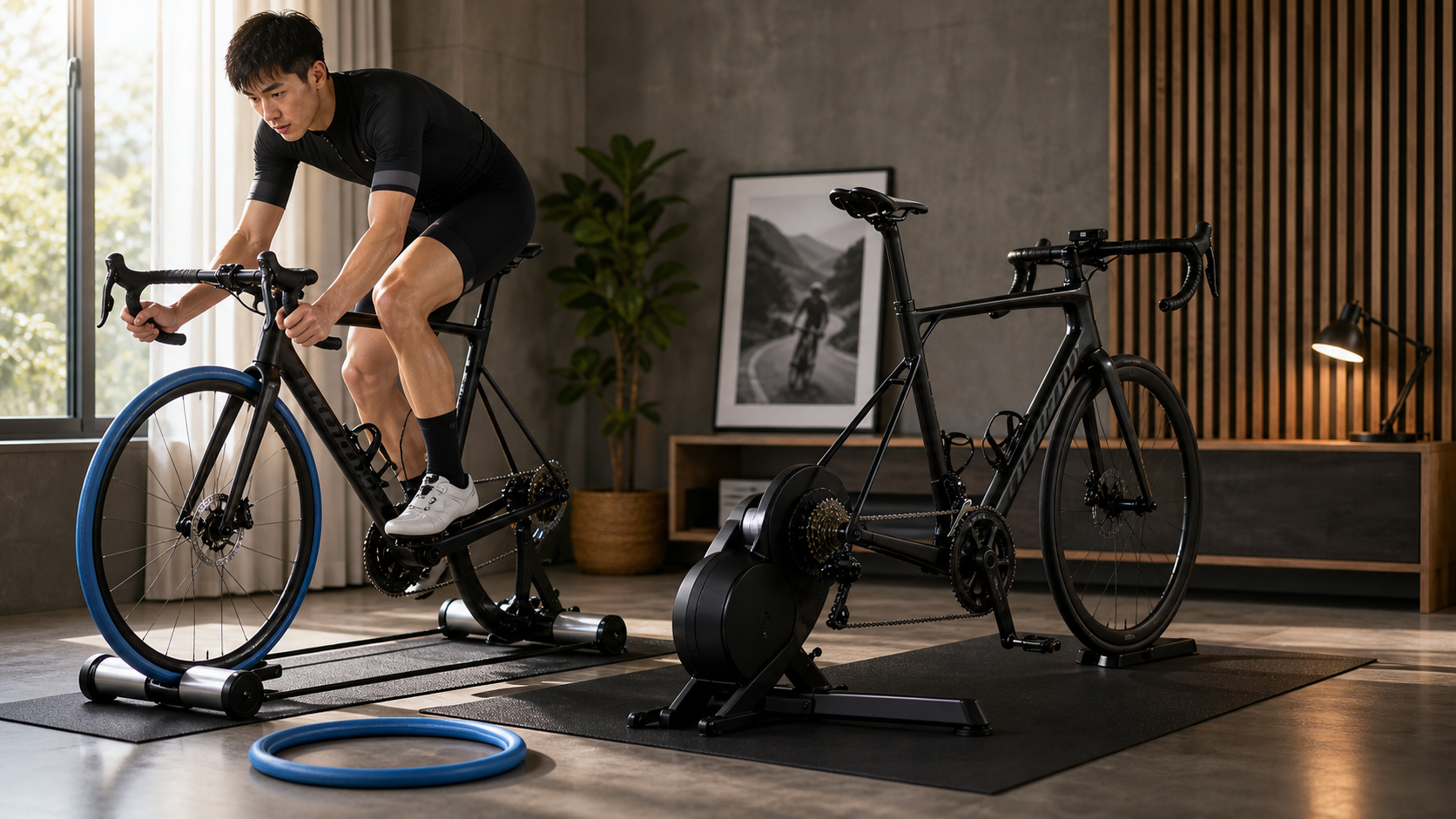
Trainer Tire vs. Direct Drive Trainer: Complete Comparison and Buying Guide
Choosing an indoor trainer is an important decision for many cyclists. The market options can be broadly divided into two camps: wheel-on trainers that require a trainer-specific tire, and direct drive trainers that connect directly to the cassette. Each option has its own pros and cons, and which one you choose depends on your budget, training needs, and usage environment.
Wheel-On Trainers: A Great Entry-Level Choice
How They Work
Wheel-on trainers press a roller against the rear tire tread, using magnetic, fluid, or electromagnetic resistance to generate resistance. The bike’s rear wheel stays mounted, and the tire rotates in direct contact with the roller.
The Necessity of Trainer-Specific Tires
When using a wheel-on trainer, it is strongly recommended to switch to a trainer-specific tire:
Why can’t you use a regular tire?
- Accelerated wear: The continuous high-pressure contact between the trainer roller and the tire can severely wear down a regular tire within weeks
- Rubber debris: Regular tires produce large amounts of black rubber dust, dirtying floors and equipment
- Increased noise: The tread pattern of regular tires creates noticeable noise on the roller
- Slippage risk: The rubber compound of some high-performance tires tends to slip on the trainer
- Heat issues: Sustained high-power riding can cause the tire to overheat
Features of trainer-specific tires:
- Special rubber compound: Heat-resistant, wear-resistant custom rubber
- Smooth tread: Treadless design reduces noise and debris
- Stiffer construction: Extends service life
- Blue or special colors: Easy to identify and prevents accidental outdoor use
Comparison of Mainstream Trainer-Specific Tire Brands
| Brand | Model | Size | Approximate Price | Features |
|---|---|---|---|---|
| Continental | Hometrainer | 700×23-25c | NT$ 600-900 | Most common choice, good durability |
| Tacx | Trainer Tire | 700×23-25c | NT$ 500-800 | Low-noise design |
| Vittoria | Zaffiro Pro Home Trainer | 700×23-25c | NT$ 700-1,000 | Good grip, less slippage |
| Schwalbe | Insider | 700×23-35c | NT$ 600-900 | Wide range of sizes |
| Elite | Trainer Tire | 700×25c | NT$ 500-700 | Affordable price |
Advantages of Wheel-On Trainers
- Lower price: Entry-level models cost about NT$ 3,000-8,000; smart trainers about NT$ 8,000-20,000
- Easy setup: Just place the rear wheel on the trainer; done in minutes
- Quick switching: Conveniently switch between indoor training and outdoor riding (if using quick-release tires)
- Lightweight and portable: Usually much lighter than direct drive trainers, easy to store
- High compatibility: Works with almost all bikes (as long as you have the correct wheel)
Disadvantages of Wheel-On Trainers
- More noise: The noise from tire-to-roller contact is noticeably louder than direct drive trainers
- Lower power accuracy: Affected by tire pressure, roller pressure, and other factors; accuracy is typically ±3-5%
- Tire wear cost: Even with trainer-specific tires, they need regular replacement
- Tire pressure sensitivity: Tire pressure must be checked before each session, otherwise power readings become unstable
- Slippage issues: Slipping can occur during high-power output or after sweating
- Riding feel: Pedaling feels “softer” and less realistic than direct drive trainers
Direct Drive Trainers: The Top Choice for Serious Training
How They Work
Direct drive trainers remove the bike’s rear wheel, with the chain connecting directly to the trainer’s cassette and resistance unit. This eliminates all the issues caused by the tire acting as an intermediary.
Installation Process
- Remove the bike’s rear wheel
- Mount the bike’s rear dropouts onto the trainer’s quick-release or thru-axle
- Hang the chain onto the cassette body included with the trainer
- Adjust chain tension (if necessary)
Note that direct drive trainers require a cassette body compatible with your drivetrain system (Shimano, SRAM, or Campagnolo). Most trainers come with a basic cassette body, but you may need to purchase a cassette with your desired gear ratios separately.
Advantages of Direct Drive Trainers
- High power accuracy: Typically ±1-2%, with some high-end models reaching ±0.5%
- Extremely low noise: No tire friction noise; many models are nearly silent
- Excellent riding feel: A large flywheel simulates real inertia, providing a more natural pedaling sensation
- Zero tire wear: No need to worry about tire replacement
- High stability: Power readings are unaffected by tire pressure or slippage
- Grade simulation: High-end models can simulate grades up to 20-25%
- Fast ERG mode response: Resistance adjustments are more precise and immediate
Disadvantages of Direct Drive Trainers
- Higher price: Entry-level models cost about NT$ 15,000-25,000; mid-to-high-end NT$ 25,000-50,000
- Size and weight: Typically 15-25 kg, less convenient to move and store
- Inconvenient switching: Each switch between indoor and outdoor requires removing and reinstalling the rear wheel
- Additional cassette needed: You may need to purchase an extra cassette body and cassette
- Compatibility considerations: Need to confirm quick-release/thru-axle specifications and cassette system compatibility
Complete Comparison of Key Metrics
Noise Comparison
| Type | Noise Level | Approximate Decibels | Suitable Environment |
|---|---|---|---|
| Wheel-on (regular tire) | High | 75-85 dB | Garage, detached house |
| Wheel-on (trainer tire) | Medium-high | 65-75 dB | Separate room |
| Direct drive (entry-level) | Medium-low | 55-65 dB | Regular residence |
| Direct drive (high-end) | Low | 45-55 dB | Apartment, late-night training |
Power Accuracy Comparison
| Type | Accuracy Range | Consistency | Calibration Needs |
|---|---|---|---|
| Wheel-on (no power meter) | None | None | Not applicable |
| Wheel-on (smart) | ±3-5% | Affected by tire pressure | Before every session |
| Direct drive (entry-level) | ±2-3% | Good | Once a week |
| Direct drive (mid-to-high-end) | ±1-2% | Excellent | Monthly or when temperature changes |
| Direct drive (top-tier) | ±0.5-1% | Outstanding | Occasionally is enough |
Long-Term Cost Analysis (Based on 3 Years)
Wheel-on option:
- Smart trainer: NT$ 12,000
- Trainer-specific tire (replaced every 6 months): NT$ 700 × 6 = NT$ 4,200
- Rear tire pressure gauge: NT$ 500
- 3-year total: approximately NT$ 16,700
Direct drive option:
- Mid-range direct drive trainer: NT$ 28,000
- Additional cassette set: NT$ 2,000 (one-time)
- 3-year total: approximately NT$ 30,000
Direct drive trainers have a higher initial investment, but long-term consumable costs approach zero. If you train 4-5 times per week or more, the riding experience advantages of direct drive become even more apparent.
Buying Recommendations
When to Choose a Wheel-On Trainer
- Limited budget, looking to start indoor training at the lowest cost
- Low training frequency (1-2 times per week)
- Need to switch frequently between indoor and outdoor riding
- Limited space, requiring easy storage
- As an entry-level option to try indoor training
When to Choose a Direct-Drive Trainer
- Serious about indoor training and pursuing training quality
- Training 3 or more times per week
- Living in an apartment, needing low noise
- Valuing the accuracy of power data
- Long-term use, willing to invest in quality equipment
- Participating in Zwift races or using ERG mode training
A Compromise Option
If your budget falls between the two, consider:
- Mid-range smart wheel-on trainers: Equipped with ERG mode and more accurate power readings
- Entry-level direct-drive trainers: Sacrificing some features but gaining the core advantages of direct-drive
Conclusion
No matter which trainer you choose, what matters most is how often you actually use it. An entry-level trainer you use regularly is more valuable than a top-tier trainer gathering dust. Make a choice that suits your budget, training habits, and environmental conditions, then focus on the training itself. Equipment is always just a tool—your legs and determination are the real engine.
Related Reading
- In-Depth Bike Trainer Review: Full Comparison of Ride Feel, Noise, and Training Benefits—Direct-Drive vs. Wheel-On
- Trainer Buying Guide: Comparing Wheel-On, Direct-Drive, and Smart Trainers
- Bike Trainer Installation and Maintenance: Rollers and Direct-Drive
- 2026 Smart Trainer Buying Guide: Full Breakdown of Direct-Drive, Wheel-On, and Interactive Differences
訓練台體驗) 2019台北自行車展 三大家 訓練台體驗 Tacx Neo Flux 2 Xepdo Apx Wahoo Kickr
7 年前
碟煞公路車 銑面器 !? 原來銑完差這麼多! 降低蹭碟機率! | TIME 公路車 保養小記錄 | CT Yeh
3 年前
鉅齒紋輪組!? ControlTech MEG-T50 EVO 碳纖維幅條輪組/ 功率對比實驗 / 公路車 / CT Yeh
2 年前
再一組! 全碳幅條 碟煞/無內胎輪組 開箱! 到底好騎嗎? UNAAS X40 | 公路車 | CT Yeh
4 年前
碟煞公路車 優缺點?換車一年半實際經驗分享 / 公路車 / CT Yeh
2 年前
邁金 T500 訓練台開箱!有下坡輔助、路感模擬、不用插電、直驅電機 !兩萬級距頂規享受新選擇!/ 公路車 / 室內訓練 / CT Yeh
1 年前
Unaas X50 全碳纖幅條輪 數據實測對比PK | Lun Hyper 的高階版 | 板輪爬坡也可以很厲害? ! 武嶺2小時大師一起親測! CP值超高 | 公路車 | CT Yeh
4 年前
Nepest NOVA 碳條輪組:輕量、空力、舒適一次滿足!/ 公路車 / CT Yeh
7 個月前