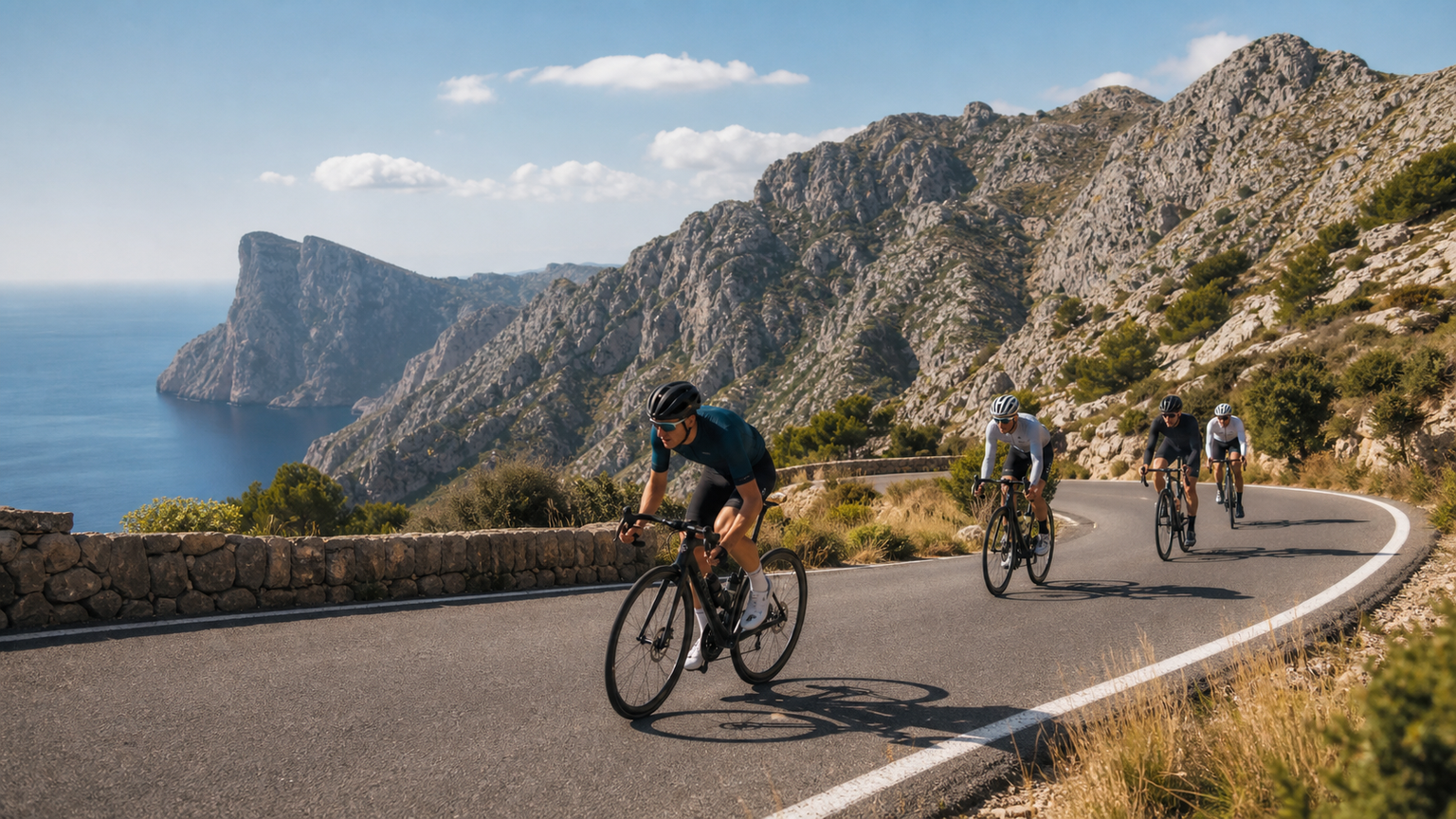
Mallorca: European Pro Teams’ Secret Training Ground
Why Do Pro Riders Love Mallorca?
Mallorca, located in Spain’s Balearic Islands in the western Mediterranean, covers an area of about 3,640 square kilometers—roughly one-tenth the size of Taiwan. Yet this seemingly modest island has everything that road cyclists around the world could dream of.
First, there’s the climate. Mallorca’s winters are mild and pleasant, with average January temperatures between 10-15°C, and sunny days far outnumbering those on the European mainland. While riders in the Alps and Northern Europe are stuck on indoor trainers, Mallorca already allows for comfortable outdoor riding in short sleeves and shorts.
Second, there’s the terrain. The Serra de Tramuntana mountain range in northern Mallorca (a UNESCO World Heritage Site) offers superb climbing routes, with the highest point, Puig Major, reaching 1,445 meters. Meanwhile, the southern and central parts of the island feature flat or gently rolling agricultural areas, ideal for speed training and recovery rides. One island can satisfy every training need—that’s exactly why pro teams love it.
Classic Climbing Routes
1. Sa Calobra (The Serpentine Road)
- Distance: 9.4 km (one way, from the Ma-10 junction to the port)
- Elevation gain: 682 meters (on the return climb)
- Average gradient: 7.1%
- Maximum gradient: 12%
Sa Calobra is Mallorca’s most legendary route and one of the most famous cycling climbs in the world. The road branches off the Ma-10 highway, descending along the cliffs to a hidden little port, passing through 26 hairpin turns and a 270-degree spiral loop (known as “the tie knot”).
The key point: you must descend to the port first, then climb all the way back up the same road. This means that while you’re enjoying the thrilling descent, you must always keep in mind—every one of these roads will have to be climbed back up.
The return climb from the port is the real test. The first 3 kilometers hold a sustained gradient of 8-10%, with no shade whatsoever, and summer temperatures can soar above 35°C. But when you gasp through the final hairpin and return to the Ma-10 junction, the sense of accomplishment is beyond words.
2. Cap de Formentor
- Distance: 18 km (from Port de Pollença to the lighthouse)
- Elevation gain: Approximately 450 meters
- Difficulty: Moderate
The Formentor Peninsula is Mallorca’s northernmost point and home to the island’s most spectacular coastline. Starting from Port de Pollença, the road runs along the peninsula’s ridge, flanked by sheer cliffs and the azure Mediterranean. The rolling route keeps you constantly shifting between climbs and descents, with every turn revealing new seascapes.
The final few kilometers leading to the Formentor lighthouse are especially breathtaking. The lighthouse stands on a 200-meter cliff, with the endless blue of the Mediterranean below. It’s a prime spot for watching the sunrise—many local cyclists ride up in the early morning to enjoy a coffee by the lighthouse as the sun rises above the horizon.
3. Puig Major Loop
- Distance: Approximately 90 km (loop route starting from Sóller)
- Elevation gain: Approximately 1,800 meters
- Difficulty: High
This is Mallorca’s most classic long-distance mountain route. Starting from Sóller, you follow the Ma-10 highway through the heart of the Serra de Tramuntana, pass through the Puig Major tunnel (the summit hosts military facilities and is not open to the public), then descend to the Sa Calobra junction, continue along the Ma-10 to the Lluc Monastery, and finally return to Sóller.
This route combines the finest mountain scenery Mallorca has to offer: gorges, olive terraces, stone-walled farmhouses, and cliffside seascapes. The road surface is excellent, the corners are well designed, and even the descents can be ridden with confidence.
Flat Training
Central Plain Loop
- Distance: Approximately 80-120 km (adjustable)
- Elevation gain: 200-400 meters
- Difficulty: Beginner to Moderate
Mallorca’s central region is the “Es Pla” plain, a traditional agricultural area planted with almond trees, olive trees, and vineyards. The roads are straight and quiet, with good surfaces, making them ideal for speed training or long-distance endurance rides.
From late February to early March, the almond trees burst into bloom, covering the entire plain in pinkish-white blossoms—a dreamlike sight. This period also coincides with the peak of pro team training camps, so you’re likely to encounter professional riders in Team Visma-Lease a Bike or UAE Team Emirates kit whizzing past on the road.
Cycling Services and Facilities
Mallorca’s cycling tourism industry is highly mature. In major towns such as Alcúdia, Port de Pollença, and Palma, there are dozens of professional bike rental shops offering everything from entry-level to top-end models. A carbon road bike rents for about €40-60 per day, or €180-300 per week. Most rental shops also provide GPS navigation and route suggestions.
Many hotels have recognized the cycling market opportunity and introduced the “Cycling Hotel” concept: secure bike storage, workshop facilities, high-protein breakfasts, customized route planning, on-site professional mechanics, and even support vehicles and guided rides.
Best Time to Visit
- Best: Late February to May, September to November
- Good: June, December
- Avoid: July-August (too hot, too many tourists, crowded roads)
Getting There
From Taiwan, the most convenient way is to fly to Barcelona, then take a domestic flight to Palma de Mallorca, with a total travel time of about 18-20 hours. European low-cost carriers such as Ryanair and Vueling offer frequent flights between Barcelona and Palma, with fares sometimes as low as €20-30.
Bicycles can be checked as sports equipment; regulations vary by airline, so it’s advisable to confirm in advance.
Conclusion
Mallorca is the kind of place that, once you’ve been, you’ll want to return to again and again. Its road quality, scenic diversity, well-developed services, and riding atmosphere are hard to match anywhere else in the world.
When you’re gasping for air on the final hairpin of Sa Calobra, or watching the sunset sink into the Mediterranean beside the Formentor lighthouse, you’ll understand why this small island draws the world’s best riders back year after year. Mallorca isn’t just a place to ride—it’s the promised land for road cyclists.
Related Reading
- Mallorca: Winter Training Paradise for European Pro Riders
- Spain’s Mallorca: Analysis of the Cycling Paradise of Choice for European Pro Teams’ Winter Training
- All of Europe’s Teams Come Here for Winter Training: A Complete Multi-Day Riding Guide to Mallorca’s Sa Calobra and Cap de Formentor
- From the Atlantic Coast to the Volcanic Crater: Teide—The Secret Winter Training Base of Pro Teams Worldwide
南竿 單車 | 老婆公路車首航 | 偽出國體驗 | 4K 高畫質 | 綠色騎跡低碳輕旅遊 | #公路車
5 年前
公路車 | 塔塔加驚險員工旅遊 | 還好手腳快沒被抓交替!
5 年前
馬祖北竿單車體驗遊 | 被歐兜賣集體80差點摧不動 | 兩台公路車上飛機超重費...? 4K高畫質
5 年前
台北闊瀨陡坡 騎旅 / 日本單車雜誌編輯車友臨時加入!/ 髮香才是最強的 / feat. 北迴歸線小隊 / 公路車 CT Yeh
6 個月前
嘉義大埔、阿婆灣挑戰賽,美到以為在日本!ft. 環騎5 Cool 西拉雅188 / 公路車 / CT Yeh
7 個月前
一個測試有沒有認真練車的方法😂 #公路車
10 個月前
#北橫 + #北進武嶺 最硬的員工旅遊 EP1 | #公路車 #拉拉山 | 明池 | 武嶺 | 武陵農場 | 雲海 | Taiwan Cycling Route Wulin
6 年前
太平山單車員工旅遊 | 這樣玩CP值最高!| 公路車
5 年前