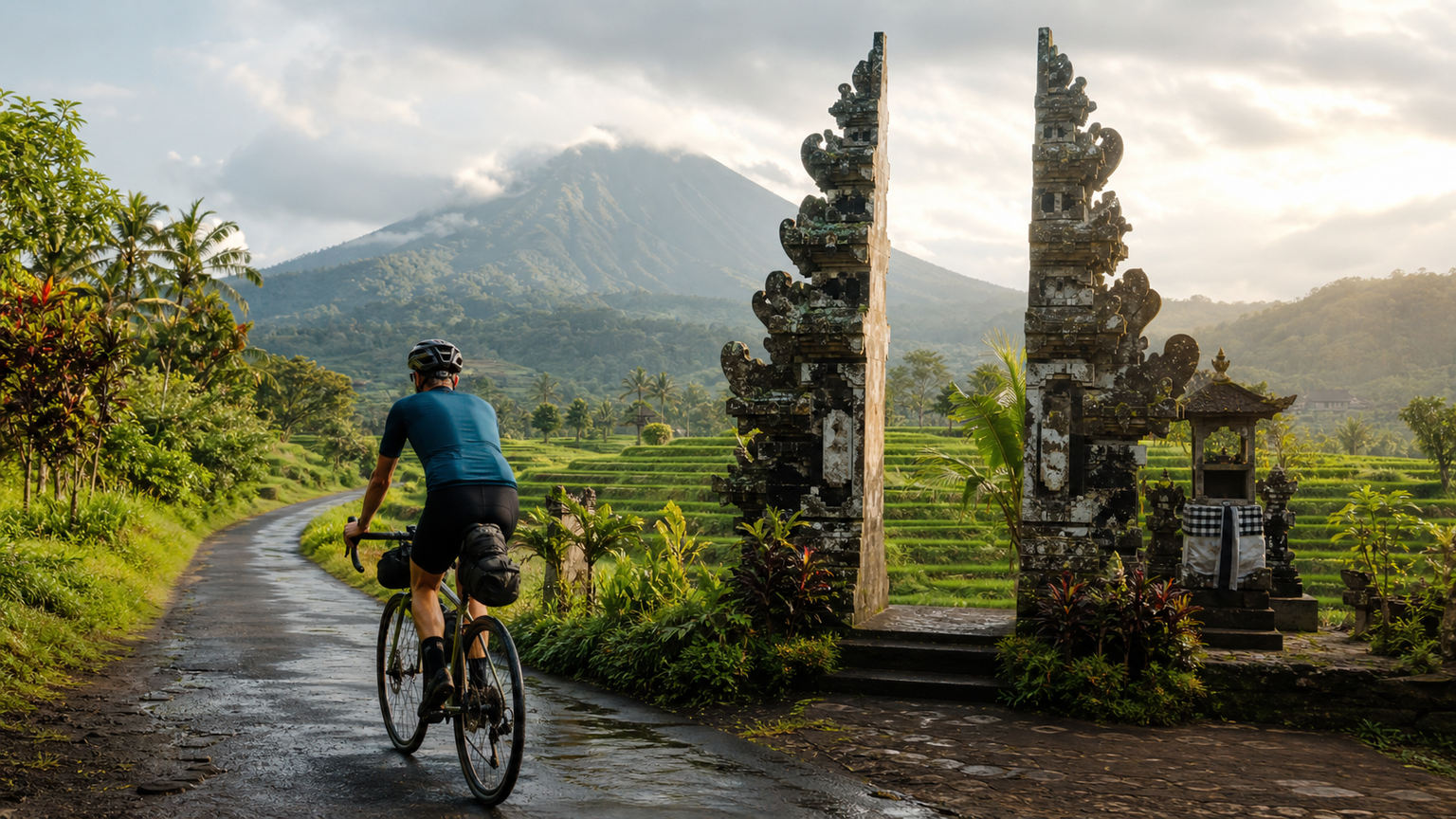
Bali Bike Slow Travel: Finding Your Cycling Rhythm Between Temples and Rice Terraces
Bali Beyond the Tourist Trail
For most visitors, Bali is defined by the beaches of Kuta, the bars of Seminyak, and the yoga studios of Ubud. But if you’re willing to throw a leg over a bike and leave these tourist hotspots behind, you’ll discover a completely different Bali—a sacred island ringed by volcanoes, blanketed in rice terraces, and steeped in faith.
Bali covers roughly 5,780 square kilometers, with the active volcano Mount Agung (3,142 meters) at its center. The terrain drops dramatically from the volcanic summit to the coastline. This means riding routes offer both challenging climbs and exhilarating descents, as well as gentle, winding paths through the rice paddies.
Best Season for Cycling
Bali’s dry season runs from April to October, when rainfall is lower and road conditions are better—the ideal time for cycling. However, even during the dry season, an occasional tropical downpour can hit in the afternoon, so rain gear is still essential.
As for temperatures, coastal areas hover between 27-33°C year-round, but the inland highlands are much cooler—Ubud’s early morning temperatures sometimes drop to around 20°C, which is perfect for riding.
Route 1: The Kintamani Volcano Descent
Route Overview
- Start: Kintamani (elevation 1,500m)
- End: Ubud (elevation 300m)
- Distance: Approximately 35 km
- Climbing: Nearly zero (predominantly downhill)
- Difficulty: Beginner
This is Bali’s most popular cycling route and a tour offered by nearly every travel agency. In the morning, you take a car up to the Kintamani caldera viewpoint, where you take in the magnificent panorama of the active Mount Batur and its crater lake before hopping on your bike for a downhill ride all the way back to Ubud.
Although the “difficulty” of this route is very low (after all, it’s almost entirely downhill), its charm lies in the extraordinary variety of landscapes you pass through. The first few kilometers from the caldera traverse barren volcanic rock terrain, then gradually give way to coffee and spice plantations. As you enter the mid-elevation zone, lush green rice terraces unfold along both sides of the road. Some of these terraces are over a thousand years old and still use the traditional “Subak” irrigation system—a water-management community institution recognized as a UNESCO World Heritage Site.
Along the way, you’ll pass several traditional Balinese villages. The stone split-gates (Candi Bentar) at village entrances are iconic structures of Balinese Hindu temples, and scenes of villagers in traditional dress making daily offerings are everywhere. If you ride in the morning, you might even encounter spectacular processions of villagers walking in long lines, balancing offerings on their heads as they head to the temple.
Route 2: The Ubud Rice Terrace Loop
Route Overview
- Start/End: Ubud town center
- Route: Ubud → Tegallalang Rice Terraces → Sebatu → Tampaksiring → Ubud
- Distance: Approximately 40 km
- Climbing: Approximately 600 meters
- Difficulty: Moderate
This loop route takes you through the most beautiful rice terraces around Ubud and to its most sacred water temples.
Starting from Ubud, head north for about 10 km to reach the Tegallalang Rice Terraces—Bali’s most photogenic terrace landscape. Layers upon layers of green rice paddies sweep along the curves of the valley, dotted with coconut palms. This scene has become one of Bali’s iconic images. As you ride past, I recommend stopping at a roadside café to order a cup of Bali’s signature civet coffee (Kopi Luwak) and enjoy the terrace views while you sip.
Continue north to Sebatu, where you’ll find the little-known holy spring temple of Gunung Kawi Sebatu—far more peaceful than the tourist-packed Tampaksiring Holy Spring Temple. Surrounded by tropical rainforest, spring water wells up from the rock face to form crystal-clear pools. Many locals come here to perform purification rituals.
From Sebatu, turn southeast to reach the Tampaksiring royal tombs (Gunung Kawi)—an 11th-century monument with massive rock-cut memorials standing in a river gorge, surrounded by spectacular rice terraces. After exploring, follow the country lanes back to Ubud.
Route 3: Eastern Hidden Gem—The Mount Agung Loop
Route Overview
- Start/End: Amed
- Route: Amed → Tulamben → Kubu → Bebandem → Amed
- Distance: Approximately 55 km
- Climbing: Approximately 800 meters
- Difficulty: Moderate to challenging
Eastern Bali is the least visited region, and for that reason it retains the most unspoiled character. Amed is a quiet seaside fishing village where colorful traditional outrigger boats (Jukung) rest on black sand beaches. This loop takes you from the coast up the slopes of Mount Agung, through dry scrubland and traditional farming villages, before descending back to the sea.
Traffic on this road is extremely light; for most of the ride, you’ll only encounter local farmers on motorbikes and the occasional truck. Road quality is inconsistent—some sections are smooth tarmac, while others are potholed gravel, so wider tires (at least 28mm) will give you more peace of mind.
Food
Balinese food is among the most refined in the Indonesian archipelago. You won’t go hungry on the ride:
- Nasi Goreng (Indonesian fried rice): A national staple, available at nearly every small stall
- Mie Goreng (Indonesian fried noodles): Another classic, generous portions and cheap
- Babi Guling (roast suckling pig): A Balinese specialty with crispy skin and tender meat
- Lawar: A traditional salad of mixed vegetables and minced meat, with a distinctive flavor
- Fresh coconut water: A natural sports drink found everywhere by the roadside, costing just 10,000-15,000 Indonesian rupiah (about NT$20-30)
Accommodation
Accommodation in Bali ranges from backpacker hostels at US$5 per night to top-tier resorts at US$500 per night. For cycle tourists, Ubud and Amed are the most ideal bases. Homestays in Ubud typically cost US$15-30 per night including breakfast, with clean rooms and friendly hosts. Most homestays will let you park your bike in the courtyard.
Safety and Things to Keep in Mind
- Traffic: Road traffic in Bali is pure Southeast Asian style—motorbikes everywhere, very few traffic lights, and overtaking happens at any moment. Stay alert and don’t ride with earphones.
- Monkeys: Especially when riding near the Ubud Monkey Forest, beware that monkeys may try to snatch your belongings (water bottles, sunglasses, etc.).
- Dogs: There are many free-roaming dogs on country roads. Most won’t attack, but occasionally one will chase your bike. Stay calm, don’t speed up (that triggers their chase instinct), and simply ride past slowly.
- Religious etiquette: Bali is a deeply religious society. When riding past temples, dress modestly, and don’t enter temple grounds wearing overly revealing cycling kit.
Conclusion
Cycling in Bali teaches you one thing: riding doesn’t always have to be about speed and distance. On this Island of the Gods, slow down, immerse yourself in the green of the rice terraces, the sandalwood incense of the temples, and the smiles of the villagers—you’ll discover a whole new cycling philosophy: not about reaching a destination, but about feeling every moment along the way.
Bali is waiting for you—bring your bike and an open heart.
Related Reading
- Riding to the Edge of an Active Volcano: Bali’s Kintamani and Lake Batur, a Climb Woven Through Rice Fields, Volcanoes, and Dawn
- Penghu Island-Hopping by Bike: Inter-Island Riding from the Main Island to Jibei and the Cross-Sea Bridge
- Penghu Cycling Travel: Offshore Island Charm and Township Routes
- Penghu Bike Circumnavigation: The Offshore Riding Character of the Cross-Sea Bridge and Fishing Village Routes
金門 ! 我騎過最棒的離島了 / 最後可以騎車上金門大橋的機會!?/ 公路車 / CT Yeh
1 年前
觀霧 變好騎了! | 北高車友爆笑大會師 | 公路車 | 單車旅遊 Taiwan Cycling Route GuanWu
6 年前
密境!雙灣自行車道 / 環法日月潭 x YAKIMA 百人大約騎 / 公路車 / CT Yeh
11 個月前
[海外單車] 日本 茨城 霞之浦單車 銀杏 慢遊體驗
7 年前
嘉義大埔、阿婆灣挑戰賽,美到以為在日本!ft. 環騎5 Cool 西拉雅188 / 公路車 / CT Yeh
7 個月前
南竿 單車 | 老婆公路車首航 | 偽出國體驗 | 4K 高畫質 | 綠色騎跡低碳輕旅遊 | #公路車
5 年前
宇老大滿貫(改)/ UBike神人 / 太離譜了!出大景 差點被擊落 / feat. 神秘密境單車團 / 公路車 / CT Yeh
2 年前
4K單車實境) 舊陽金P字道 第1P 仰德大道至小油坑 誤跟武嶺神人們 被拉爆爽飛天 Taiwan Cycling Climb Route Recommend
7 年前