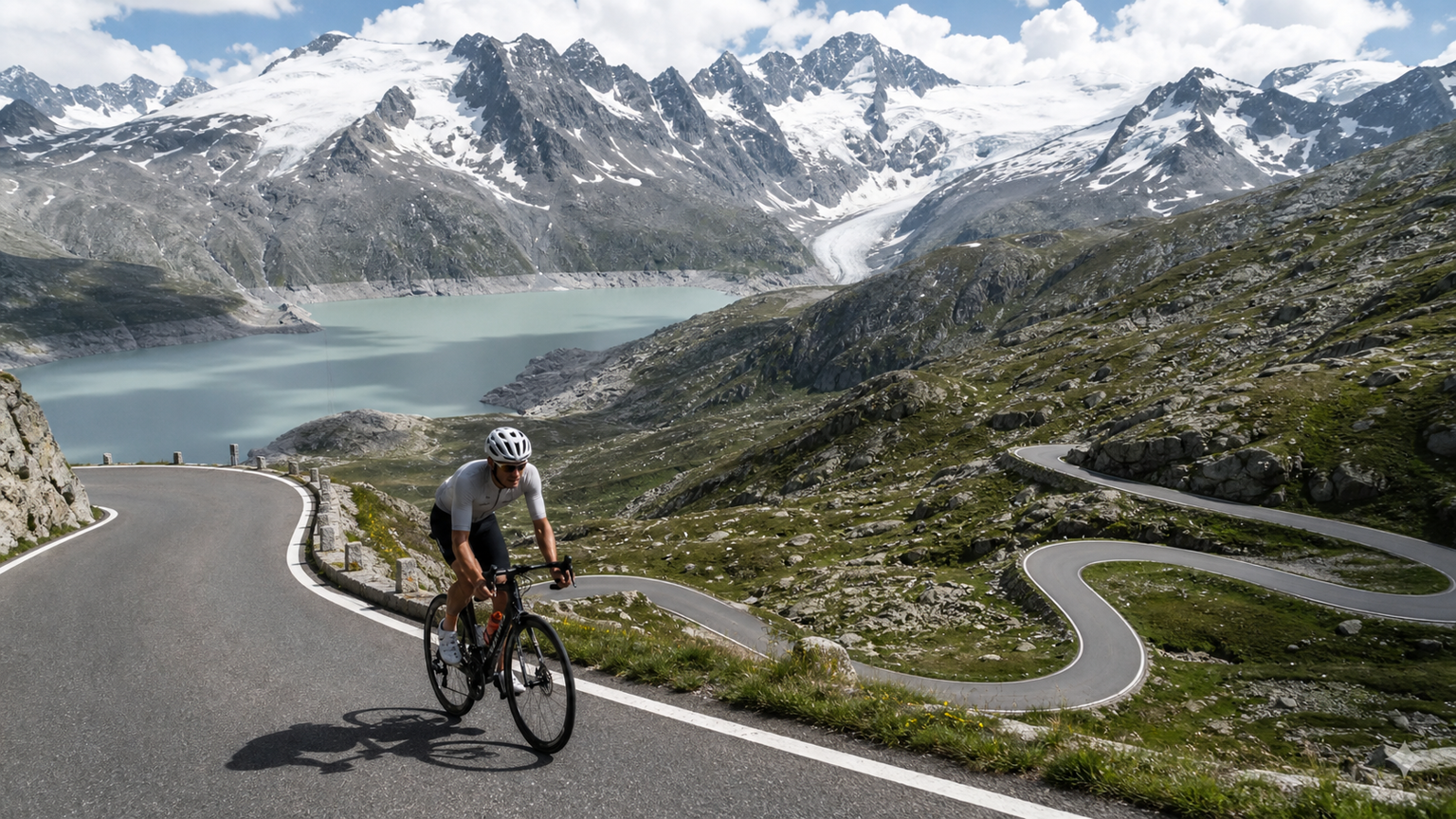
A Pilgrimage Through the Swiss Alpine Passes: The Ultimate Climbing Experience on the Roof of Europe
Switzerland: The Ultimate Sanctuary for Alpine Road Cycling
If the French Alps are the stage for the Tour de France, then the Swiss Alps are the masterclass in cycling climbs. Switzerland boasts over 50 road passes above 1,500 meters in elevation, many exceeding 2,000 meters, yet the road quality is maintained to an astonishing standard. The Swiss are almost obsessive about road maintenance—even on the most remote mountain roads, you’ll be hard-pressed to find a single pothole.
Most Swiss mountain roads are open between June and October (depending on snow conditions). Summer temperatures in the pass areas hover around 10-20 degrees Celsius, making for the most comfortable riding conditions. Moreover, the air quality in Switzerland is exceptional, and every breath at high altitude is refreshingly crisp and clean.
Must-Ride Passes
1. Furka Pass
- Elevation: 2,429 meters
- Distance: 12.5 km from Gletsch
- Average Gradient: 7.9%
- Maximum Gradient: 11%
Furka Pass is arguably Switzerland’s most cinematic mountain road. The iconic chase scene in the James Bond film Goldfinger, featuring the Aston Martin DB5, was filmed right here. The pass sits directly above the Rhone Glacier, and from the viewpoint at the summit, you can see the glacier’s icy blue terminus—though in recent years, due to global warming, the glacier has been retreating at an alarming rate.
The northern climb from Gletsch is the more classic route. The first half features a moderate gradient (5-7%), crossing a desolate expanse of alpine meadows. The second half suddenly steepens, with several consecutive sections above 10% that will make your thighs burn. The final two kilometers are the most spectacular—the road winds along cliff edges, with a bottomless gorge on your right and snow-capped peaks ahead.
2. Grimsel Pass
- Elevation: 2,165 meters
- Distance: 26 km from Innertkirchen
- Average Gradient: 6%
- Maximum Gradient: 11%
Grimsel Pass sits on the border between the Bernese Oberland and the canton of Valais, offering a route that is both spectacular and industrial in its aesthetic. Along the way, you’ll pass numerous dams and reservoirs—Switzerland is a major hydroelectric power producer in Europe, and the Grimsel region lies at the heart of its hydraulic engineering. Massive concrete dams tower within granite gorges, and the reservoir waters display a deep green hue, creating a stark contrast with the surrounding grey rock.
Near the summit, the historic Grimsel Hospiz hotel perches on a rocky ridge between two lakes—the perfect spot to enjoy a hot chocolate after completing the climb.
3. Gotthard Pass
- Elevation: 2,091 meters
- Distance: 13 km from Airolo (south side)
- Average Gradient: 7.8%
- Maximum Gradient: 12%
Gotthard Pass is historically Switzerland’s most important north-south corridor, connecting the German-speaking and Italian-speaking regions for centuries. Today, most traffic uses the Gotthard Tunnel, leaving cyclists with a quiet and magnificent ancient mountain road.
The climb from the south side (starting in Airolo) includes the famous “Tremola”—a stretch of ancient cobblestone road featuring 24 tight hairpin turns. This stone-paved section is over 200 years old; riding it is bumpy but steeped in history. If you prefer to avoid the vibration of the cobblestones, a modern asphalt road runs alongside as an alternative.
4. Susten Pass
- Elevation: 2,224 meters
- Distance: 19 km from Wassen
- Average Gradient: 7.3%
- Maximum Gradient: 9%
Susten Pass is considered by many cyclists to be one of Switzerland’s most beautiful passes. The eastern climb threads through a long gorge flanked by sheer rock walls and waterfalls. Near the summit lies a small glacial lake (Steinsee), whose water shimmers in an incredible azure blue, as if nature had placed a giant sapphire high in the mountains.
The gradient on this pass is relatively consistent, with no exceptionally steep sections, making it a thoroughly enjoyable ride for cyclists with some climbing experience.
5. Nufenen Pass
- Elevation: 2,478 meters
- Distance: 13.5 km from Ulrichen
- Average Gradient: 8.6%
- Maximum Gradient: 13%
Nufenen Pass is the second-highest road pass entirely within Switzerland (second only to a branch road of the Great St. Bernard Pass) and a hidden gem visited by far fewer tourists. Traffic on this road is extremely light, and for most of the time, you can have the entire mountain road to yourself. The final few kilometers approach a 10% gradient, demanding exceptional willpower in the thin air.
Classic Combination Route: The Four Pass Challenge
Route Overview
- Route: Andermatt → Furka Pass → Grimsel Pass → Susten Pass → Andermatt
- Total Distance: Approximately 125 km
- Total Elevation Gain: Approximately 4,500 meters
- Suggested Time: One day (for the strong) or two days (for those who want to savor it)
This loop, known as the “Four Pass Tour,” is Switzerland’s most classic one-day challenge. Starting from Andermatt, you conquer Furka, Grimsel, and Susten passes in sequence before returning to Andermatt. In a single day, you accumulate over 4,000 meters of climbing while experiencing four distinctly different landscapes: glaciers, dams, gorges, and alpine lakes.
This route is also a classic stage of the Tour de Suisse, and completing it is definitely something to be proud of.
Practical Information
Transportation
Switzerland’s public transportation system is arguably the best in the world. The SBB Swiss Federal Railways allows bicycles on most trains (a bike day pass is required, costing 16 Swiss francs per day). You can take a train to a town at the foot of a pass, ride over the summit, and then catch a train on the other side to return to your starting point. This flexible “train + bike” combination lets you easily tackle any pass without having to ride back the way you came.
Costs
Switzerland is one of the most expensive countries in the world. A bottle of water costs 2-3 Swiss francs (approximately NT$70-100) at a convenience store, and a simple lunch will set you back 20-30 Swiss francs (approximately NT$700-1,050). For accommodation, even the cheapest hostel will cost 40-50 Swiss francs per night. It’s advisable to bring your own food for the climbs and make good use of supermarkets (Migros and Coop are Switzerland’s two major supermarket chains) for supplies.
Safety
Weather in the Swiss mountains can change extremely rapidly, and temperatures at the summit can be 15-20 degrees Celsius lower than at the base. On long descents, cold and fatigue can impair your reaction time and braking power. Be sure to carry warm clothing and stay alert while descending.
Conclusion
Switzerland’s mountain roads are a perfect fusion of nature and human engineering. As you push the pedals round after round toward the summit, crossing century-old stone bridges, passing through mist-shrouded gorges, and gazing up at snow-capped peaks, you’ll feel a profound sense of how small humanity is in the face of the Alps—and how great it is to overcome them.
Every pass is a form of training. And Switzerland is the finest training ground of all.
Related Reading
- Swiss Alps Cycling Guide: The Complete Guide to the Most Beautiful Mountain Roads in the Land of Peaks
- Furka Pass: The Wild Road Where Bond Drifted, Two Distinctly Different Climbing Faces
- Grossglockner High Alpine Road: 19 km, Over 30 Hairpin Turns, Climbing to the Roof of Europe to See the Highest Peak in the Alps
- Nufenen Pass: Switzerland’s Highest Point Within Its Borders, a Relentless Endurance Test Steep from the First Kilometer to the Last
萬年峽谷! 30% 超激陡坡 里佳部落DAY2 還是很硬! | 公路車 | CT Yeh
3 年前
荷蘭 Rapha 租公路車 騎 阿姆斯特丹 Amsterdam Rapha Cycling Club Bike Hiring
6 年前
里佳部落 阿里山單車深度旅遊! | 竹山/草嶺/來吉/奮起湖 | 無敵銀河絕景 全新路線探索! 驚險狀況百出! | 4K沉浸式畫質 | 公路車 | CT Yeh
3 年前
秘境雪場 日本 八甲田 冰樹探險與滑雪體驗 ft. Q老師 & 運動生活
7 年前
2025 乘鞍 KOM 登山賽挑戰實錄 / 日本公路最高 ! 賽前探路篇 / 比富士山厲害,無敵絕景!/ 40週年 / 中文YT首發 / 公路車 / CT Yeh #乘鞍ヒルクライム
11 個月前
太平山單車員工旅遊 | 這樣玩CP值最高!| 公路車
5 年前
北宜騎車⋯好刺激 差點被🐒尻 / 露營單車旅 / 公路車後背攜車架開箱!/ 百人大團露 / YAKIMA 設備開箱儀式感都來了 / 公路車 / CT Yeh
12 個月前
4K單車實境) 舊陽金P字道 第1P 仰德大道至小油坑 誤跟武嶺神人們 被拉爆爽飛天 Taiwan Cycling Climb Route Recommend
7 年前