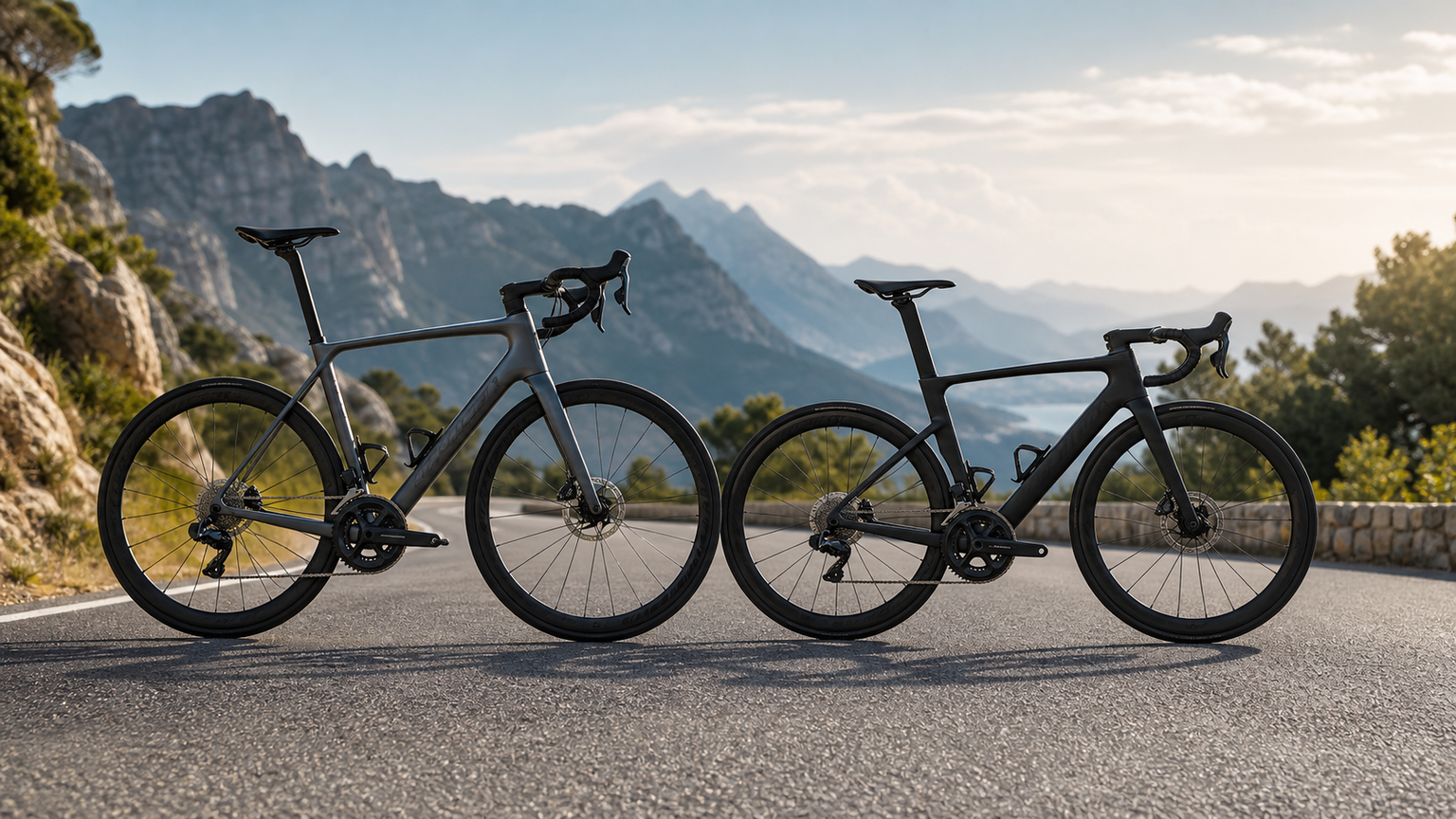
Endurance Road Bike vs Race Road Bike: Choosing the Frame Type That Suits You Best
Walk into a bike shop, and you’ll find road bikes divided into several categories: race, endurance, aero, and climbing. Among them, “Endurance” and “Race” are the two most frequently compared approaches. Many riders find themselves torn between the two, unsure which one to choose. This article will help you sort things out, from design philosophy to real-world riding differences.
The Fundamental Difference in Design Philosophy
Race Road Bikes: Built for Speed
Every aspect of a race bike frame is designed around one core goal—reaching the finish line as fast as possible within a limited time. It assumes the rider has good fitness and flexibility, capable of sustaining high power output in an aggressive riding position.
Representative models: Specialized Tarmac, Trek Emonda, Cervélo R5, Giant TCR
Endurance Road Bikes: Built for Long Miles
The design goal of an endurance frame is to keep the rider comfortable and efficient even after long hours in the saddle. It doesn’t sacrifice all performance for comfort; instead, it seeks the best balance between the two.
Representative models: Specialized Roubaix, Trek Domane, Cervélo Caledonia, Giant Defy
Detailed Geometry Differences
Using a 56cm size as an example, comparing typical race and endurance geometry:
| Parameter | Race (Typical) | Endurance (Typical) | Difference Explanation |
|---|---|---|---|
| Stack | 555mm | 585mm | Endurance is 30mm higher, more upright riding position |
| Reach | 395mm | 385mm | Endurance is 10mm shorter, less forward stretch needed |
| Head Tube Length | 145mm | 175mm | Endurance has a longer head tube |
| Seat Tube Angle | 73.5° | 73° | Minimal difference |
| Head Tube Angle | 73° | 72.5° | Endurance is slightly slacker, adding stability |
| Chainstay Length | 405mm | 415mm | Endurance is longer, increasing comfort |
| Wheelbase | 980mm | 1000mm | Endurance is longer, more stable in a straight line |
| Trail | 58mm | 62mm | Endurance is larger, more stable at speed |
| BB Drop | 70mm | 72mm | Endurance has a slightly lower center of gravity |
What Do These Numbers Mean?
A 30mm Stack difference means your handlebar position is about 3cm higher. That may not seem like much, but it has a significant impact on pelvic angle and back curvature. A more upright position means:
- Less lower back strain
- Less neck extension required
- Easier diaphragm expansion, smoother breathing
- But frontal area increases by about 5-8%
A 10mm longer chainstay moves the rear wheel slightly further from the rider. This provides a longer lever arm to absorb road impacts, but also makes acceleration response slightly less immediate.
A 20mm longer wheelbase makes the whole bike more stable, especially on high-speed descents or in crosswinds, where you’ll feel a noticeable sense of reassurance.
Differences in Comfort Design
Modern endurance frames achieve comfort not just through geometry, but also through clever structural design choices:
Rear Stay Compliance Design
Many endurance frames use special rear stay designs to absorb vertical vibration:
- Trek Domane IsoSpeed: The rear triangle uses a separate decoupling device that allows the seat tube to flex to a limited degree relative to the frame
- Specialized Roubaix Future Shock: A hydraulic damper built into the top of the fork
- Cervélo Caledonia: The fork is designed with a slimmer profile to increase vertical compliance
Tire Clearance
| Type | Typical Max Tire Width | Recommended Tire Width |
|---|---|---|
| Race | 28-30mm | 25-28mm |
| Endurance | 32-38mm | 28-32mm |
Wider tires can be ridden at lower pressures, which is the simplest and most effective way to improve comfort. Endurance frames generally accommodate tires of 32mm or wider, with some models even supporting 38mm, letting you ride confidently on gravel surfaces as well.
Carbon Fiber Layup Design
Even with the same grade of carbon fiber, endurance frames make different choices in layup design:
- More unidirectional carbon cloth in the seat tube area (increasing longitudinal compliance)
- Thinner seat stays or different cross-sections
- An overall pursuit of “soft in the vertical direction, stiff in the lateral direction”
Performance Differences: How Much Does It Really Matter?
This is the question most people care about. Here are some real-world data points for reference:
Weight
With the same grade of carbon fiber, an endurance frame is typically 100-300g heavier than a race frame. The impact of this difference when climbing:
- Calculated for a 70kg rider, 5% grade, 200W output
- A 200g difference affects speed by approximately 0.05 km/h
- Climbing 1000m of elevation gain takes roughly 15-20 seconds longer
For non-professional riders, this difference is essentially negligible.
Stiffness
The bottom bracket stiffness of a race frame is typically 10-20% higher than an endurance frame. This means:
- When sprinting out of the saddle, the race frame delivers more direct feedback
- At high power outputs (400W+), the race frame has slightly better pedaling efficiency
- At cruising power of 200-300W, the difference is barely perceptible
Aerodynamics
Due to the riding position difference, the same rider on a race bike has a CdA (drag coefficient × frontal area) about 3-5% lower than on an endurance bike. At a 40km/h cruising speed, this equates to roughly a 5-10W difference.
Real-World Selection Considerations
Scenarios for Choosing a Race Bike
- You regularly participate in bike races or time trials
- Your typical ride distance is within 100km
- You have good flexibility and core strength
- You’ve had a professional Bike Fitting and can adapt to a low, aggressive position
- The road surfaces you ride on are in good condition
Scenarios for Choosing an Endurance Bike
- Your weekend long rides often exceed 100-150km
- You value comfort during long hours of riding
- Your flexibility is average, and you don’t want to endure excessive lower back strain
- The road surfaces you ride on are inconsistent in quality
- You occasionally want to ride gravel or mixed surfaces
- You want one bike that can handle a variety of riding situations
The Best Choice for 90% of Riders
If you’re not an actively competing racer, an endurance road bike is the better choice in almost every scenario. The reasons are simple:
- Comfort directly determines how far you ride: An uncomfortable bike sends you home early; no amount of performance matters then
- The performance difference is smaller than you think: At the power outputs of typical recreational riders, the difference between the two is negligible
- More versatile: Wide tires, long wheelbase, and stable handling let you explore more routes
- Kinder to your body in the long run: Ten years from now, your knees and lumbar spine will thank you for your choice
Mix-and-Match Strategy: Getting the Best of Both Worlds
If you want a more race-like feel from an endurance frame, you can make these adjustments:
- Remove head tube spacers: Lower the handlebar by 10-20mm
- Use a longer stem: Add 10-20mm of reach
- Choose narrower tires: 25-28mm offers lower rolling resistance
- Use a shallower drop handlebar: Reduce the drop
Conversely, to make a race frame more comfortable:
- Add head tube spacers: But limited by steerer tube length
- Use a shorter stem: But this will affect handling
- Fit wider tires at lower pressure: The most effective method
- Swap to a more compliant seatpost: Such as a carbon or vibration-damping seatpost
Ultimately, regardless of which type you choose, ensuring you’ve had a professional Bike Fitting is the most important thing. The comfort and performance gains from a proper Fitting far exceed the differences between frame types.
Related Topic Reading
- Road Bike Frame Geometry: Riding Differences Between Aggressive Geometry vs Comfort Geometry
- Gravel Bike vs Road Bike: A Comprehensive Analysis of the Differences and Buying Guide
- Top-Tier Road Bike Frame Geometry Analysis: How Race Geo vs Endurance Geo Affects Riding Feel
- Road Bike Frame Material Showdown: Carbon Fiber vs Aluminum vs Titanium Buying Decisions
鉅齒紋輪組!? ControlTech MEG-T50 EVO 碳纖維幅條輪組/ 功率對比實驗 / 公路車 / CT Yeh
2 年前
公路車 BB培林大升級! / 備戰海鷗繞圈賽 Canyon Aerod & TIME 一起改 / MIT大廠 CEMA對鎖式陶瓷培林BB & 導輪 / 公路車 / CT Yeh
2 年前
RAMP FTP Test 直播 究竟能撐到幾瓦 訓練台 Gravat Zwift
6 年前
一個測試有沒有認真練車的方法😂 #公路車
10 個月前
碟煞公路車 優缺點?換車一年半實際經驗分享 / 公路車 / CT Yeh
2 年前
Garmin Edge 1040 重大韌體更新!! / 1050功能全下放!? / 坡度反應變快了嗎?/ 快速對比實測 / 公路車 / CT Yeh
1 年前
Unaas X50 全碳纖幅條輪 數據實測對比PK | Lun Hyper 的高階版 | 板輪爬坡也可以很厲害? ! 武嶺2小時大師一起親測! CP值超高 | 公路車 | CT Yeh
4 年前
多到選擇障礙... 換個單車把帶想一個小時 / BTP / 編織&軟木特有材質超吸睛! / 公路車 / CT Yeh
1 年前