Custom Build vs. Complete Bike: Which Way of Buying Gets You More Value?
The Question Every Rider Has Asked
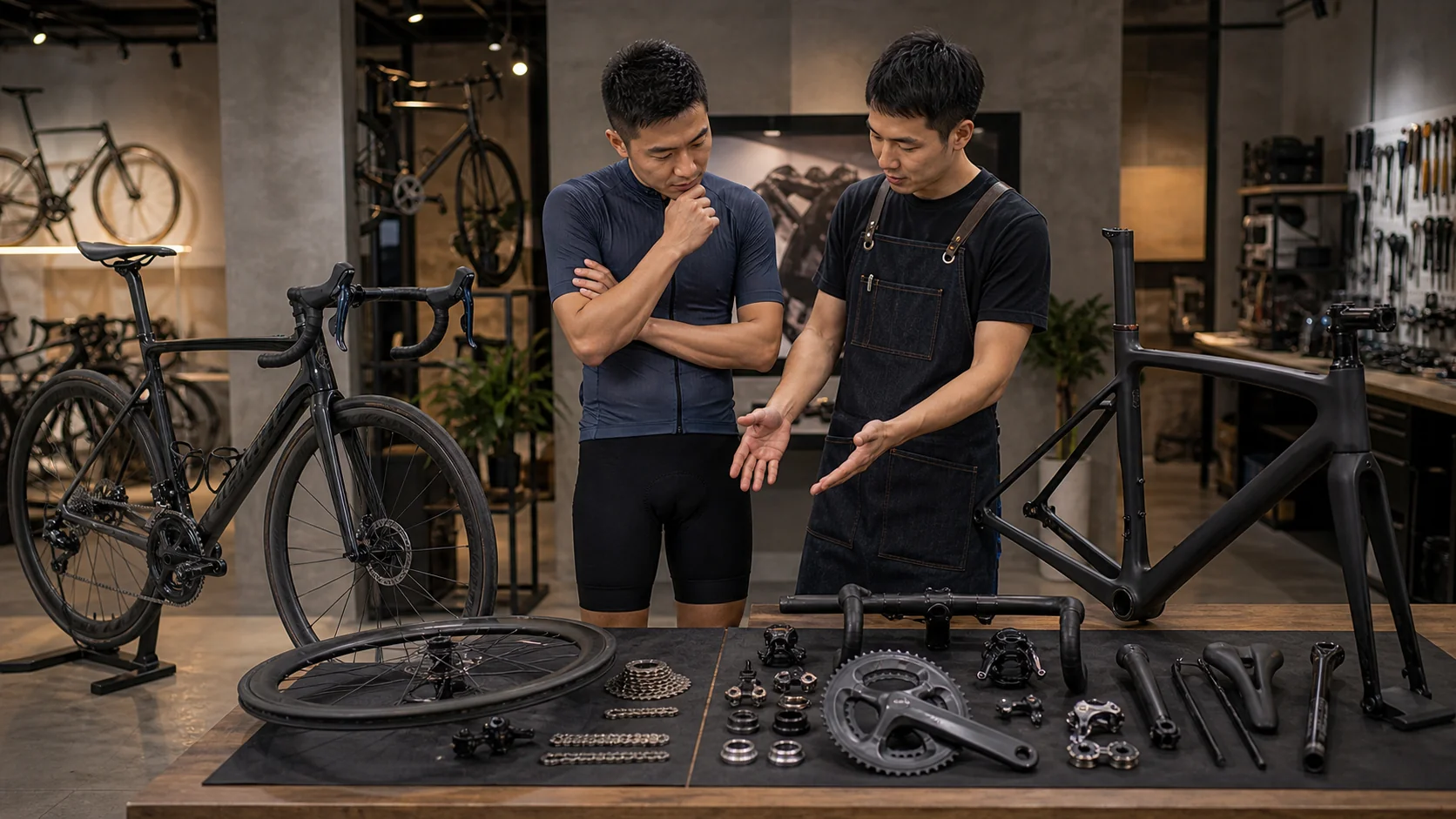
Standing in a bike shop, looking at the complete bikes on the display rack, has this thought ever crossed your mind: “If I picked the parts myself and built it, could I end up with a better bike?”
Or maybe, while picking parts one by one online, hitting the calculator until your thumb hurts, you start to wonder: “Wouldn’t it just be simpler — and cheaper — to buy a complete bike?”
This is a classic cycling debate, and the answer isn’t black and white. Let’s break it down from every angle.
What Is a Complete Bike? What Is a Custom Build?
Complete Bike
A fully assembled bicycle spec’d by the brand itself. What you see is what you get — open the box, do a bit of assembly, and you’re ready to ride. The Giant TCR Advanced, Specialized Tarmac SL7, and Merida Scultura are all classic examples of complete bikes.
Custom Build
You choose the frameset and every component yourself, then have a shop assemble it (or build it yourself). You have complete control — from the frame down to every last bolt is your decision.
The Advantages of a Complete Bike
1. Price Is Usually More Competitive
This is the biggest advantage of a complete bike, and also the most surprising fact for many riders.
Major brands (Giant, Specialized, Trek, and others) buy components in bulk, letting them secure prices far below retail. Combined with the economies of scale of packaging a whole bike together, a complete bike at a given spec level is typically 10-30% cheaper than building the same spec yourself.
A real-world comparison:
Take a carbon road bike at the Shimano Ultegra Di2 level as an example:
| Item | Complete Bike Price | Custom Build Price |
|---|---|---|
| Frame + fork | (included in complete bike price) | NT$45,000-70,000 |
| Ultegra Di2 groupset | (included in complete bike price) | NT$45,000-55,000 |
| Wheelset | (included in complete bike price) | NT$15,000-30,000 |
| Saddle, seatpost, stem, handlebar | (included in complete bike price) | NT$8,000-15,000 |
| Bar tape, pedals, bottle cages, etc. | (included in complete bike price) | NT$2,000-4,000 |
| Assembly labor | — | NT$2,000-5,000 |
| Total | NT$100,000-150,000 | NT$117,000-179,000 |
The complete bike is clearly cheaper. And its price usually also includes the brand’s frame warranty and after-sales service from the shop.
2. Spec Tested by the Manufacturer
When a brand specs a complete bike, it considers overall balance and compatibility. Stem and seatpost length matched to the frame geometry, aerodynamic pairing between wheelset and frame, brake system compatibility with the wheels — all of this has been calculated and tested by engineers.
A poorly matched custom build can run into component incompatibility (for example, a cassette and hub that don’t match, or inconsistent disc brake standards) or an overall imbalance in performance (for example, a very light frame paired with a heavy wheelset).
3. Warranty and After-Sales Support
Complete bikes usually come with the brand’s full warranty — frames typically carry a lifetime warranty or at least five years, and components come with a one- or two-year warranty. If something goes wrong, you simply bring it to an authorized dealer.
Warranty on a custom build has to be handled separately: the frame is covered by the frame brand, components by their respective brands, and some brands’ warranty terms don’t cover use with non-original component pairings.
4. Saves Time and Effort
Choosing a complete bike might take just half a day: visit the shop, test ride a few models, decide, pay, ride home.
Building a bike can take weeks or even months: researching frames, comparing groupsets, choosing wheels, waiting for parts to arrive, finding a shop to assemble it, breaking it in and adjusting it. For some people this process is part of the fun; for others, it’s a grind.
The Advantages of a Custom Build
1. Complete Customization
This is the biggest appeal of a custom build, and something a complete bike simply can’t match.
You control every single component precisely:
- Choose the frame in your favorite brand and paint scheme
- Mix and match different brands or tiers within the drivetrain (for example, Dura-Ace shifters paired with an Ultegra derailleur)
- Choose a specialist wheel brand instead of whatever wheels came bundled with the complete bike
- Get the saddle and handlebar sizing right from the very start
- Set your gear ratios to exactly match your own riding style
To control cost and inventory, complete bikes typically only come in a handful of fixed configurations. You might love a particular brand’s frame but not be satisfied with the wheels or saddle it comes with. If you buy the complete bike and swap parts afterward, you not only spend more money (the original parts rarely resell for much) but also waste the components you removed.
2. Avoiding Weak-Link Components
Almost every complete bike has what’s called “cost-optimized” spec — to keep the overall price competitive, brands cut corners on certain less conspicuous components.
Common weak points on complete bikes:
- Wheelset: This is the most commonly downgraded item. A complete bike with an Ultegra groupset might come with the brand’s most entry-level aluminum wheelset.
- Saddle: Usually the brand’s basic in-house model, which may not suit you.
- Handlebar and stem: Often heavier aluminum models.
- Brake rotors: May use a lower-tier rotor.
A custom build lets you allocate your budget precisely to every component, avoiding any obvious weak spots.
3. A One-of-a-Kind Sense of Achievement
The process of building a bike is itself enjoyable. From concept to completion, every choice reflects your effort and taste. When you ride a bike you built (or at least personally specified) with your own hands, the satisfaction is something a complete bike simply cannot replicate.
Not to mention, within the cycling community, a carefully spec’d custom build often turns more heads than a complete bike.
4. Better Understanding for Maintenance
The process of building a bike makes you intimately familiar with every component. When it’s time for future maintenance and upgrades, you’ll know exactly the specs and compatibility of each part, making servicing and upgrades far more efficient.
Recommendations for Different Situations
Scenario 1: Your First Road Bike
Recommendation: Complete bike
Why: You’re not yet sure of your own preferences and needs. A complete bike gives you a balanced starting point to build up riding experience. Once you clearly know what you need, you can consider a custom build or targeted upgrades.
Scenario 2: Limited Budget, Want to Maximize Performance
Recommendation: Complete bike
Why: The price advantage of a complete bike is especially pronounced here. For the same budget, a complete bike usually gets you a higher-tier spec.
Scenario 3: You’ve Been Riding for Years and Know Exactly What You Want
Recommendation: Consider a custom build
Why: You’ve already built up enough experience to know exactly what size, geometry, and spec suits you best. A custom build lets you get it right the first time, avoiding the extra cost of swapping parts after buying a complete bike.
Scenario 4: Chasing Top-Tier Spec with a Generous Budget
Recommendation: Custom build
Why: Even at the top end of the market, complete bikes often still involve compromises. Building your own ensures every single component is top-tier, creating a true dream bike.
Scenario 5: You Want a Special Spec or a Boutique Brand
Recommendation: Custom build
Why: Some frame brands only sell framesets, not complete bikes (such as certain titanium or hand-brazed steel brands), or you want a non-mainstream setup (such as a 1x road bike or a wide-tire road bike) — these are only achievable through a custom build.
Hybrid Strategy: Buy a Complete Bike, Then Upgrade Selectively
There’s actually a third strategy: buy a reasonably spec’d complete bike, then upgrade the weak-link components. This approach combines the price advantage of a complete bike with the customization power of a build.
Suggested upgrade order:
- Wheelset: The most common weak point on complete bikes, and the upgrade with the most noticeable impact
- Saddle: Finding the saddle that fits you is key to a comfortable ride
- Tires: A cheap upgrade with a significant effect
- Bar tape: Improves grip feel and comfort
- Others: Decide based on your own needs
Note: The original components you remove can be sold on the secondhand market to recoup some cost. However, original-equipment parts usually don’t fetch a great resale price, which is a hidden cost of this strategy.
Cost Estimate: A NT$120,000 Budget Example
Option A: NT$120,000 Complete Bike
Spec you could get:
- Carbon fiber frame
- Shimano 105 Di2 (12-speed electronic shifting)
- Brand’s own aluminum wheelset (about 1,700g)
- Brand’s own saddle and cockpit
Option B: NT$120,000 Custom Build
Spec you could get:
- Carbon fiber frameset: NT$50,000
- Shimano 105 mechanical groupset: NT$20,000
- Mid-tier carbon fiber wheelset: NT$25,000
- Saddle, cockpit, bar tape, etc.: NT$15,000
- Assembly labor: NT$3,000
- Small parts (cables, rotors, etc.): NT$7,000
Comparison
Option A wins on the drivetrain (Di2 electronic shifting), Option B wins on the wheelset (carbon fiber vs. aluminum). Which is more worthwhile? It depends on whether you value shifting feel or riding performance more. There’s no absolute right answer — only what fits you best.
Conclusion
A custom build and a complete bike each have their own strengths, and neither is absolutely “better.” A complete bike offers convenience, price advantage, and manufacturer-backed assurance; a custom build offers customization, precise spec, and a unique sense of satisfaction.
Most importantly, whichever way you choose, the ultimate goal is the same: to own a good bike that you enjoy riding. Don’t be bound by ideas like “only building your own bike means you really know bikes” or “buying a complete bike means you’re not a real cyclist.” Find the approach that suits you best, and then fully enjoy the freedom of two wheels.
After all, no one on the road is going to ask whether your bike was built or bought — they’ll just see a happy rider, flying through the wind.
Related Reading
TIME 公路車 Alpe d'Huez 21 開箱實錄! 購車/Fitting/組車/心得 | 新車入艙 | 時間的主人 CT Yeh
3 年前
Fitting訓練兩用功率車 ! Thinkrider ST900 完整實測!/ 坡度升降 / 鄰居測試/ smart bike/公路車/ CT Yeh
2 年前
多到選擇障礙... 換個單車把帶想一個小時 / BTP / 編織&軟木特有材質超吸睛! / 公路車 / CT Yeh
1 年前
#公路車 #Fitting 靠人工智慧APP 幫你調整單車
6 年前
公路車 BB培林大升級! / 備戰海鷗繞圈賽 Canyon Aerod & TIME 一起改 / MIT大廠 CEMA對鎖式陶瓷培林BB & 導輪 / 公路車 / CT Yeh
2 年前
碟煞公路車 優缺點?換車一年半實際經驗分享 / 公路車 / CT Yeh
2 年前
鉅齒紋輪組!? ControlTech MEG-T50 EVO 碳纖維幅條輪組/ 功率對比實驗 / 公路車 / CT Yeh
2 年前
再一組! 全碳幅條 碟煞/無內胎輪組 開箱! 到底好騎嗎? UNAAS X40 | 公路車 | CT Yeh
4 年前