Swimming Stroke Rate and Stroke Length: SWOLF and Efficiency Optimization — Coaches Help You Swim Every Lap Smarter
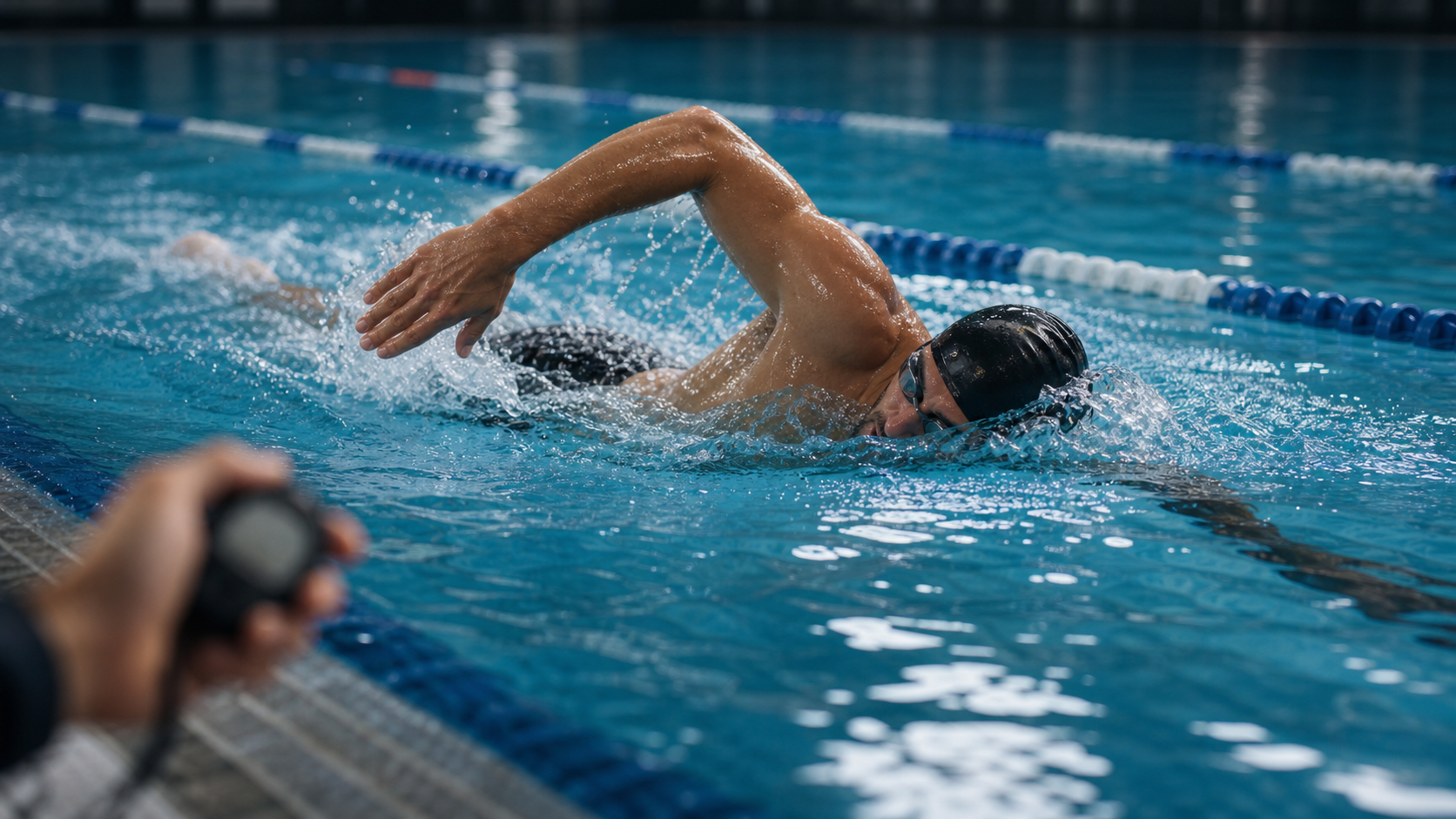
Coach’s Opening: The Student Who Ran Out of Steam Mid-Lap
Let me start with a real situation I coached. A student who had just transitioned from road running to triathlon, nicknamed A-Zhe, proudly told me the first time we met: “Coach, I can sprint 50 meters in 40 seconds!” I asked him to jump in and swim a lap for me. And what happened? His first 25 meters were indeed fierce — arms spinning like a windmill, water splashing across the entire lane. But by the middle of the second lap, his arms felt like they were filled with lead, his speed dropped off significantly, and the final 25 meters were almost done by floating to the wall.
After he got out, I asked him one question: “That lap you just swam — do you know how many strokes you took?” He froze. I told him: “You took 28 strokes. The lady in the next lane swam the same distance in only 16 strokes, and she hit the wall before you did.”
That’s the core of what we’re talking about today. In swimming, speed has never been about who swings their arms the most, but about who can propel their body the farthest with the fewest movements and the least effort. And the most useful tool for measuring this — one that’s also the most overlooked by triathletes — is the trade-off between “stroke rate and stroke length,” condensed into a single number: SWOLF.
I’ve coached athletes ranging from first-time finishers to those chasing Kona slots. Over these ten-plus years, I’ve become increasingly certain of one thing: among the three abilities in freestyle (fitness, technique, and mentality), the investment with the highest return for amateur triathletes is always technique, and the quantitative gateway to technique is stroke rate and stroke length. In this article, I’ll lay out the concepts, the scientific basis, practical workouts, common mistakes, and actionable advice for different levels — all in one go. By the end, you’ll be able to calculate your own numbers poolside and know exactly what to work on next.
Foundational Concepts: Speed Equals Stroke Rate Times Stroke Length
The One Formula You’ll Remember for the Rest of Your Swimming Life
The physical essence of swimming speed is actually very simple and can be condensed into one multiplication:
Swimming speed (meters/second) = Stroke rate (strokes per second) × Stroke length (meters advanced per stroke)
In plainer terms: if you want to swim faster, there are only two paths — either your arms move faster (increase stroke rate), or each stroke carries you farther (increase stroke length). There is no third path.
The key to this multiplication is: these two factors often pull against each other. When you deliberately speed up your stroke rate, the quality of your catch typically drops, your body’s glide time gets compressed, and stroke length shrinks accordingly. Conversely, when you stretch out each stroke’s glide to chase an ultra-long stroke length, your stroke rate naturally falls, and speed may not rise — it could even drop. This is the trade-off between stroke rate and stroke length, and it’s why “frantic arm swinging” usually doesn’t make you faster — you’re just pushing stroke rate up while sacrificing stroke length. The product of the two might stay flat, and you’ll be exhausted to boot.
What the Research Says: Different Distances, Different Answers
Here I’m citing a 2025 study published in Frontiers in Sports and Active Living that analyzed the dynamic relationship between stroke rate and stroke length in elite freestyle swimmers. The conclusions are highly practical:
- Short distances (e.g., 50-meter sprints): Stroke length has the strongest positive correlation with speed (men’s correlation coefficient ~0.57, women’s ~0.50), while stroke rate’s correlation is relatively weak. In other words, speed over short distances comes mainly from “each stroke covering enough ground.”
- Long distances (e.g., men’s 1500 meters, women’s 800 meters): As distance increases, stroke rate’s correlation with speed gradually strengthens (reaching a moderate level), while stroke length’s correlation weakens. To maintain speed over long distances, stroke rate plays an increasingly important role.
The study also had a very interesting observation: gold medalists in short distances often “maintain a stroke rate no lower than average while not sacrificing stroke length,” whereas in middle-to-long distances they tend to “raise stroke rate and slightly reduce stroke length.” In other words, elite swimmers don’t cling to a single pattern — they dynamically adjust this trade-off based on distance.
For us triathletes, the implication is straightforward: the rhythm you need for a 1.5 km swim in a 51.5 Olympic-distance race, a 1.9 km in a 113 half, or a 3.8 km in a 226 full is completely different from the 50-meter sprints you do in the pool. What you need to train is a stroke rate/stroke length combination that leans “longer distance, more endurance-oriented.”
Stroke Length Isn’t Always Better
Many people hear “stroke length matters” and go overboard, chasing exaggerated glides — gliding until nearly stopped before taking the next stroke. This is a classic overcorrection.
I often tell my students: stroke length should be “long enough,” but not “excessive.” When you glide too long, your body starts to decelerate, because water resistance is constantly pulling you back. Once speed drops, you have to expend more energy to re-accelerate, which is actually more draining. A truly good stroke length finds the sweet spot between “propulsive catch” and “riding the glide” — push solidly, glide just enough, and connect the next stroke before your body noticeably slows down.
I often use an analogy to help students understand: gliding in swimming is like coasting on a flat road on a bike. You can pedal once and coast for a stretch, but if you wait until you’re nearly stopped to pedal again, your overall speed is slower and it takes more effort. If you add the next pedal while you still have plenty of momentum, you can maintain speed smoothly and quickly. The principle of stroke length in swimming is exactly the same — you want to take over “while you still have speed,” not wait until your body stops and then frantically restart. That sense of timing is the essence of stroke length training.
Stroke Rate and Stroke Length Are Also Tied to Your Body Type and Flexibility
There’s another often-overlooked dimension: each person’s optimal stroke rate/stroke length combination is related to body size, shoulder joint mobility, and core strength. People with long arms, good shoulder mobility, and the ability to keep a long, straight body line have a higher ceiling for stroke length. Those who are more compact but have good muscular power may swim just as fast and efficiently using a slightly higher stroke rate paired with a solid catch.
That’s why I never give students a “standard answer” for stroke count. What I give is a method for finding it: in baseline testing, try swimming the same pace at different stroke rates and see which combination gives you the lowest SWOLF and feels smoothest in your body. That combination is the sweet spot for your physique. Forcing someone else’s pattern often leads to painful training with no results.
What Is SWOLF: Turning Efficiency into a Number You Can Understand
SWOLF’s Definition and Origin
SWOLF is a combination of “SWim + gOLF (swimming golf).” Its spirit is the same as golf: the lower the score, the better.
The calculation is almost absurdly simple:
SWOLF = Seconds to complete one lap + Number of strokes taken in that lap
For example: in a 25-meter pool, you complete a lap in 20 seconds and take 15 strokes. Your SWOLF for that lap is 20 + 15 = 35.
Why does this addition make sense? Because it captures both speed (seconds) and efficiency (stroke count) at the same time. You can lower your SWOLF by swimming faster (reducing seconds) or by taking fewer strokes (improving stroke-length efficiency). Someone who can cover the same distance with fewer strokes in less time is, by definition, a more efficient swimmer.
Conversion and Normalization: Different Pool Lengths Cannot Be Directly Compared
Here’s a pitfall that tons of people fall into, and I need to make it crystal clear: SWOLF must be calculated per “length” (single pool length). If you record the total distance of a set, you must first divide by the number of lengths to normalize it.
For example: You swim 100 meters in a 25-meter pool, taking 80 seconds and 60 strokes. You can’t simply say your SWOLF is 80 + 60 = 140; that’s wrong. The correct approach is to first divide by the number of lengths (100 ÷ 25 = 4 lengths):
- Seconds per length: 80 ÷ 4 = 20 seconds
- Strokes per length: 60 ÷ 4 = 15 strokes
- SWOLF = 20 + 15 = 35
Even more important: Pool length significantly impacts the SWOLF value. Because the longer the distance, the more seconds and strokes accumulate, so a SWOLF from a 50-meter pool will naturally be higher than one from a 25-meter pool. SWOLF values from different pool lengths cannot be directly compared. If you usually train in a 25-meter pool and one day go to a long-course pool and see your number spike, don’t panic—that’s normal; it’s just a different baseline for calculation.
Most public pools and sports centers in Taiwan are 25-meter short-course pools; only a few, like the National Sports Training Center or some universities, have 50-meter long-course pools. When tracking your own data, consistently use the same pool length to monitor trends—that’s the only way it makes sense.
SWOLF Reference Ranges for Freestyle in a 25-Meter Pool
Here’s a rough reference standard for you (based on freestyle, 25-meter pool):
| SWOLF Range (25m pool) | Skill Level | Plain-Language Interpretation |
|---|---|---|
| Below 36 | Excellent | Very efficient, close to a swimmer with training foundation |
| 36 – 42 | Good | Already has solid technical fundamentals |
| 42 – 50 | Average | Where most recreational swimmers fall |
| Above 50 | Significant room for improvement | Efficiency is clearly low; technique is the primary investment |
But I want to emphasize: this table is for “understanding where you currently stand,” not for causing anxiety. What I care about more is always your own trend—if this month is 2 points lower than last month, that’s real progress, and it’s a hundred times more meaningful than comparing who’s higher or lower with someone else.
SWOLF’s Limitations: It’s Not a Silver Bullet
Here I want to be very honest about SWOLF’s ceiling, because too many people treat it as gospel.
SWOLF cannot directly measure physiological efficiency in the laboratory sense. It doesn’t include drag coefficient, body size, VO₂ uptake, or these factors. A tall person with long arms and legs naturally has an advantage in stroke length, so their SWOLF will look good; a petite female swimmer might have a higher stroke rate and a less impressive SWOLF number, but her actual oxygen uptake efficiency and economy aren’t necessarily worse.
So the correct way to use SWOLF is: as a long-term tracking metric for “the same person, the same pool length, the same stroke,” and as a verification tool after technique changes. Don’t use it to compare yourself with others, and don’t assume that a lower SWOLF means your race results will definitely improve—it’s just a very convenient reference dashboard, not the finish line.
Distance Per Stroke (DPS) and Its Relationship with SWOLF
Often looked at alongside SWOLF is DPS (Distance Per Stroke). The calculation is:
DPS = Distance of that length ÷ Number of strokes
In a 25-meter pool with 15 strokes, DPS is 25 ÷ 15 ≈ 1.67 meters/stroke. DPS directly tells you “how far you propel yourself with each stroke,” and it’s the most straightforward representation of stroke length. I usually recommend that students record SWOLF and DPS together, because SWOLF mixes both speed and efficiency—sometimes when the number drops, you don’t know which side improved; pairing it with DPS lets you break it down: If SWOLF drops because DPS rises (covering more distance per stroke), that’s solid technical progress; if it’s from aggressively increasing stroke rate to shave off seconds while DPS actually drops, that’s just burning energy and won’t last.
Practical Methods: How to Train to Bring the Numbers Down
Step 1: Establish Your Personal Baseline
Before training anything, measure first. I require every new student to do this “baseline test” in the first lesson:
- After a proper warm-up, swim 4 lengths of freestyle at race pace in your usual pool length (let’s say 25 meters), with 20 seconds of rest in between.
- Record the time and stroke count for each length (how to count strokes? Start counting from the first stroke entering the water, count both arms, and count until the last stroke before touching the wall).
- Calculate the SWOLF and DPS for each length, then take the average.
This set of numbers is your starting point. Retest every 4 to 6 weeks, and you’ll be able to see the trend. Without a baseline, all your training is like feeling an elephant in the dark.
Three Stroke Rate/Length Rhythms: Which One Should You Train?
I divide training rhythms into three gears, corresponding to different purposes:
| Gear | Stroke Rate | Stroke Length | Primary Use | Suggested Training Proportion |
|---|---|---|---|---|
| Long Stroke Gear (Technique Gear) | Low | Maximized | Build catch feel, elongate body line, reduce drag | 30% |
| Cruise Gear (Race Gear) | Moderate | Medium-Long | Realistic race pace for the swim leg of triathlon | 50% |
| High Stroke Rate Gear (Sprint Gear) | High | Slightly Shorter | Starts, rounding buoys, overtaking, final sprint | 20% |
Triathletes spend over 80% of their race time in the “cruise gear,” so this gear needs the most training. But many people dive in and only train cruise, ending up with no technical foundation and no gear to shift into for sprints—that’s why you need to touch all three gears.
Four-Week Stroke Rate & Stroke Length Optimization Plan
The following is a four-week training framework I often give to intermediate swimmers. It includes three in-water sessions per week, each around 2000 to 2500 meters. You can adjust the number of repeats based on your own capacity.
Week 1: Rebuilding Stroke Length (Technical Focus)
- Warm-up: 400 meters freestyle, easy swimming
- Main set:
- 8 × 25 meters “stroke counting”: complete each repeat with 2 fewer strokes than usual, focusing on the catch and glide. Rest 20 seconds.
- 4 × 50 meters “fingertip drag” drill: during the recovery, lightly drag your fingertips across the water surface, forcing a high elbow. Rest 30 seconds.
- 6 × 50 meters cruise pace, recording SWOLF. Rest 25 seconds.
- Cool-down: 200 meters easy swimming + 100 meters with a kickboard
Week 2: Stabilizing Cruise Gear
- Warm-up: 300 meters freestyle + 100 meters kicking
- Main set:
- 6 × 100 meters cruise pace, aiming for a SWOLF difference of no more than 2 between repeats (stability training). Rest 20 seconds.
- 4 × 50 meters “breathe every three strokes”: breathe every third stroke to practice bilateral breathing and body rotation. Rest 25 seconds.
- 8 × 25 meters progressive: gradually transition from a long stroke length gear to cruise gear. Rest 15 seconds.
- Cool-down: 200 meters easy swimming
Week 3: Adding Gear Shifts
- Warm-up: 400 meters mixed
- Main set:
- 4 × 75 meters “25 cruise + 25 high stroke rate + 25 cruise”: practice smooth gear changes. Rest 30 seconds.
- 6 × 50 meters negative split (second 25 faster than the first): practice accelerating in the latter half without falling apart. Rest 25 seconds.
- 4 × 100 meters cruise, recording SWOLF throughout. Rest 20 seconds.
- Cool-down: 150 meters easy swimming
Week 4: Simulation & Validation
- Warm-up: 400 meters
- Main set:
- 1 × 400 meters continuous swim (simulating the triathlon swim leg), recording overall average SWOLF and DPS.
- Rest 3 minutes.
- 8 × 50 meters race pace, recording SWOLF for each repeat to observe efficiency decay under fatigue. Rest 30 seconds.
- Cool-down: 200 meters easy swimming
- After the session, redo the baseline test and compare it with Week 1.
The core logic of this plan is: rebuild stroke length (Week 1) → stabilize cruise pace (Week 2) → add gear-shifting ability (Week 3) → simulate and validate (Week 4). After completing the four weeks, most swimmers can lower their cruise SWOLF by 2 to 4 points, with DPS increasing—that’s solid, tangible progress.
Why “Count Strokes” Instead of “Count Seconds”
Many swimmers see “8 × 25 stroke counting” for the first time and ask: why not just practice swimming faster? My answer is: because stroke count is the only variable you can directly control, while speed is the outcome.
You can’t precisely control “I want to swim this repeat in 18.5 seconds” while you’re in the water, but you can clearly tell yourself “I’m only allowed 14 strokes this repeat.” When you set stroke count as the constraint, your body will automatically search for a more efficient movement pattern to achieve the goal—it will naturally lengthen your bodyline, strengthen the catch, and improve body roll, because that’s the only way to cover the distance with fewer strokes. This is a clever form of “constrained learning,” a hundred times more effective than just telling yourself to “be efficient.”
I often tell my swimmers: counting strokes isn’t the goal; it’s a tool to force your body to find its own answers. When you can consistently complete the same pace with 2 fewer strokes, your technique has genuinely improved—not just held together by willpower.
Advanced: Adding “Critical Pace” Efficiency Validation
If you’ve already completed the four weeks above and want to take it a step further, I’d suggest adding a “SWOLF validation at critical pace” session:
- After a 400-meter warm-up, swim 5 × 200 meters at a pace you can sustain at a “somewhat hard but not falling apart” critical intensity, resting 20 seconds between repeats.
- Record the SWOLF for each repeat.
- Key observation: from the first repeat to the fifth, how much does your SWOLF increase?
This test examines one thing: how stable your efficiency remains when you’re near race intensity and progressively fatigued. Elite swimmers’ SWOLF barely moves across all five repeats; those with less stable technique might see the fifth repeat score 5 points or more higher than the first. If you’re the latter, it means your training focus should be on “technique maintenance under fatigue,” rather than blindly chasing faster paces. This information is extremely valuable—it helps you invest your limited training time into your true weakness.
A Great Homework Assignment: Freestyle Metronome
If you want to quantify stroke rate further, download a metronome app on your phone, or use the “stroke rate alert” function on your waterproof sports watch. Set a fixed strokes-per-minute rate and swim to that rhythm. This helps you:
- Find your most comfortable and efficient stroke rate sweet spot at different paces.
- “Anchor” yourself with a fixed rhythm when fatigued late in a race, preventing your form from unconsciously falling apart.
Many triathletes panic in open water and their stroke rate spikes while stroke length collapses. Having a built-in rhythm can save you a significant amount of time.
Common Mistakes & Fixes: Pitfalls I’ve Seen Too Many Times at Poolside
Mistake 1: Treating “Fewer Strokes” as the Only Goal
Some swimmers hear the SWOLF concept and start obsessively chasing fewer strokes, swimming a length in only 10 strokes—but each stroke glides to a near stop, and their time balloons. SWOLF is the sum of “seconds + strokes.” You might save 5 strokes, but if you add 8 seconds, your total score is actually worse.
Fix: Remember that SWOLF is a sum; stroke length and speed must be managed together. The goal is “using just the right number of strokes to maintain the required speed,” not “the fewer strokes, the better.”
Mistake 2: Only Training 25-Meter Sprints, Then Racing Long Distances
Many people only train 25-meter and 50-meter sprints, thinking they’re building speed. But based on the research cited earlier, short distances rely on stroke length, while long distances rely on the ability to sustain stroke rate—the optimal rhythms for the two are different. If your triathlon swim is 1.5 kilometers or more, but you only train 50-meter sprints, you’ve never practiced the endurance rhythm you’ll need on race day.
Fix: Cruise gear (continuous swimming of 100 to 400 meters) should form the bulk of your training. Repeatedly rehearse your race distance at race pace in practice.
Mistake 3: Ignoring Body Rotation and Bodyline
The biggest enemy of stroke length is drag, and one of the largest sources of drag is a lack of body rotation and a crooked bodyline. No matter how hard you pull with your arms, if your body plows through the water like a flat board, your stroke length will never extend.
Fix: Spend time practicing body rotation (rotating around your spine’s axis with each stroke), head position (eyes looking at the pool bottom, the back of your head pressing against the water surface), and a braced core. These invisible elements are the true engine of stroke length.
Mistake 4: Letting Technique Collapse When Fatigued
This is the most fatal mistake for triathletes. Your SWOLF looks great for the first 100 meters, but by the 1000-meter mark, your stroke rate falls apart, stroke length collapses, and SWOLF jumps by 8 points. Races are raced under fatigue, not when you’re at your freshest.
Fix: Deliberately practice technique under fatigue in training. Like the Week 4 session, use “8 × 50 after fatigue” to observe your efficiency decay, and specifically train the ability to “maintain rhythm even when tired.”
Mistake 5: Only Watching Numbers, Not Feeling the Water
With watches that automatically calculate SWOLF, some swimmers become fixated on the numbers and lose their feel for the water. Numbers are a validation tool, not the goal.
Fix: In every session, keep a few repeats where you “close off your senses and just feel the water,” experiencing the solid catch and the smooth glide. Numbers help confirm your direction, but real technique lives in your feel for the water.
Actionable Advice for Swimmers of Different Levels
First-Tri Finish Group (Goal: Swim safely, don’t panic)
Your primary task right now is not to get faster, but to conserve energy. Because after the swim leg of a triathlon, you still have to bike and run—the more energy you save in the water, the more you’ll have in reserve for what’s ahead.
- Build up your stroke length first. Spend at least a third of each session counting strokes and practicing gliding.
- Track SWOLF with a goal of a downward trend—don’t worry about comparing yourself to others.
- In open water, first practice sighting without disrupting your rhythm—this matters far more than shaving one point off your SWOLF.
- Great venues for Taiwanese beginners: the Sun Moon Lake Mass Swim is technically an event rather than a race, but the water is enclosed and well-patrolled, making it an excellent opportunity to experience long-distance open water; for regular practice, build a solid foundation at a National Sports Center with lifeguards on duty.
Advanced Age-Group Group (Goal: Set a PB, improve swim split)
You already have a foundation—now it’s about refining the efficiency and stability of your cruising pace.
- Do a full benchmark test every 4 to 6 weeks, tracking both SWOLF and DPS (distance per stroke).
- Focus on maintaining efficiency under fatigue and gear changes (start, turning buoys, sprinting).
- Prepare for Taiwan’s race water temperatures: venues like Taitung’s Living Lake (home to Puyuma, Challenge Taiwan, etc.) run warm in summer, so train buoyancy and rhythm without a wetsuit; in northern Longdong and Fulong open water, adapt to saltwater’s greater buoyancy and the possibility of swells.
- Add core and shoulder/back strength training on land—your stroke length ceiling is often limited by core stability and shoulder mobility.
Podium/Record-Chasing Group (Goal: Age-group podium, Kona slot)
At this level, every second in the swim leg is a resource.
- SWOLF and DPS are already daily monitoring metrics—you need to be keenly aware of subtle efficiency drops that signal “something’s off today.”
- Adjust pacing dynamically: learn to do what elite athletes do—hold stroke length on short distances, fine-tune stroke rate on longer ones, and even switch strategies between different segments of the same race.
- Consider video analysis: have someone film you from underwater and from the side to examine your catch path, high-elbow position, and body roll angle. At this level, SWOLF numbers point you in the right direction; video lets you fine-tune the details.
- Taiwan’s training environment gets noticeably hot and humid in summer—in long-course pool training, pay attention to hydration and electrolytes so dehydration doesn’t degrade your workout quality.
A Frequently Asked Questions Section
Q: I measure SWOLF with my sports watch, but the numbers jump around every time. Is it accurate?
A: Watches rely on accelerometers to detect strokes and turns, and they’re prone to misreads with butterfly, breaststroke, or when breathing causes a pronounced pause. Freestyle is relatively accurate, but don’t obsess over a single reading—look at the average and trend over multiple sessions for reliability. Swimmers with clean turns and smooth technique will get more stable watch readings.
Q: My SWOLF went down, but my race times didn’t improve. What’s going on?
A: SWOLF is an efficiency metric, not a fitness metric. You may have improved your technique, but your aerobic engine (cardio, endurance) hasn’t caught up yet; or your SWOLF looks good at an easy pace but falls apart at race intensity. Train efficiency and fitness together—you need both.
Q: Can I calculate SWOLF for breaststroke and butterfly?
A: Yes, the formula is the same. But stroke counts and rhythms vary greatly between strokes, so you can only compare within the same stroke. Triathlons are almost always freestyle, so just use freestyle as your primary monitoring stroke.
Q: How many times a week should I swim?
A: For amateur triathletes, 2 to 3 water sessions per week is a reasonable balance between benefit and time commitment. For technical work, prefer smaller, more frequent doses over one long session per week. Swimming technique is built through repeated neuromuscular imprinting—if you wait too long between sessions, the feel from the last one fades.
Q: I naturally have a high stroke rate. Is that bad?
A: Not necessarily. Some swimmers (especially smaller-framed women) pair a higher stroke rate with solid stroke length and are still very efficient. The research cited earlier also shows that speed differences between men and women mainly come from stroke length. The point isn’t to copy someone else’s pattern—it’s to find the optimal combination for your body and ability.
Q: Will wearing a wetsuit affect my SWOLF?
A: Yes, and in a good way. Wetsuits provide extra buoyancy, keeping your body flatter with a better bodyline—stroke length typically increases, stroke count drops, and SWOLF improves. But note: Taiwan’s summer races (like those at Taitung’s Living Lake) often have water temperatures too warm for wetsuits, or they’re moved to a non-competitive “wetsuit division.” So don’t rely entirely on a wetsuit in training—you must practice “skin swimming” (without a wetsuit) technique and rhythm so race day doesn’t catch you off guard.
Q: My open-water SWOLF is much worse than in the pool. Is that normal?
A: Completely normal. Open water has no walls to push off, requires sighting, may have swells, and you might get disturbed by others’ splashing—efficiency naturally drops. Don’t compare open-water numbers to pool numbers. I recommend using the pool to build efficiency and open water to practice “transferring what you’ve built in the pool” as an adaptation skill—track them separately. In northern Taiwan, Longdong and Fulong, and in the south, Sizihwan, are all good open-water practice spots, but always go with supervision and in good weather conditions—safety first.
Q: Do I need to pay for underwater video analysis?
A: It depends on your stage. For the first-tri finish group, focus on getting basic stroke length, bodyline, and breathing rhythm solid—a downward SWOLF trend is enough; no need to spend the money yet. But if you’ve been stuck for a while and the numbers won’t budge no matter what you try, video analysis can often pinpoint problems you can’t feel yourself (like an over-the-shoulder catch path, insufficient body roll, or excessive kicking). At the advanced and podium-chasing stages, it’s a very worthwhile investment.
Conclusion: Make Every Lap Smarter
Let’s go back to A-Zhe from the beginning. I trained him for a little over two months—rebuilding stroke length, stabilizing his cruising pace, and learning to maintain rhythm under fatigue. Three months later, he retested 50 meters: his time was about the same, but his stroke count dropped from 28 to 19, and his SWOLF improved dramatically. More importantly, for the first time he could swim 1,500 meters continuously at a steady pace without falling apart. He told me: “Coach, I didn’t know swimming could be this effortless.”
That’s the sentence I’ve most wanted to hear in my fifteen years in this field. Progress in swimming isn’t about how many strokes you take—it’s about whether every stroke counts. The trade-off between stroke rate and stroke length, and tracking SWOLF, are all about turning “feel” into something “verifiable and improvable.”
Before your next swim, here’s your homework: swim one lap, count your strokes, note your time, and calculate your SWOLF. That number isn’t good or bad—it’s just your starting point. From today, let it trend downward month by month. You’ll find that the more efficiently you swim, the easier the second half of your triathlon—the bike and the run—will suddenly feel. After all, a triathlon is one overall race, and every bit of energy you save in the swim will pay you back double the moment you clip into your pedals and step onto the run course.
Make every lap just a little smarter. That’s the core idea I want to leave you with.
This article is for educational purposes and does not replace individual assessment by a physician, physical therapist, or nutritionist. If you have concerns about shoulder joint or other sports injuries, please consult a qualified medical professional before undertaking high-intensity swim training.
References
- SWOLF definition, calculation, and reference ranges: SWOLF: What is it and How it Can Help You Swim Efficiently (SwimSwam)
- SWOLF calculation and pool-length normalization: SWOLF Score Calculator | Swim Efficiency, Stroke Index (Swimming Regimen)
- Study on the dynamic relationship between stroke rate and stroke length across distances: Stroke rate–stroke length dynamics in elite freestyle swimming (Frontiers in Sports and Active Living, 2025)
Related Reading
- Swim Efficiency Test: Strokes per 100 Meters and the SWOLF Metric
- Swim Stroke Efficiency Calculation: Optimizing Stroke Rate (SR) × Stroke Length (SL)
- Swim Efficiency Metric SWOLF: Calculation Method and Improvement Strategies
- The SWOLF Metric Fully Explained: Using One Number to Optimize Your Swimming Technique
西進武嶺 免費訓練分析服務 Intervals | 練不夠還是練過頭?你哪一種類型選手?AI模型告訴你! | 備戰神器 | 公路車 訓練 | CT Yeh
4 年前
CT 喇低賽) 武嶺牽車 才是王道 西進牽車四小時內秘訣 攝手位置 如何判斷 防抽筋小秘訣
7 年前
戰略) Zwift Race 如何咬在第一集團 如何評估自己要開多少推力 (請開1.5倍速看)
7 年前
滑雪新手們慘摔學習全紀錄(請開字幕),滑雪好好玩 | Snowboard + Ski | 岩原 スキー場 | 滑雪APP使用 | GoPro Max
6 年前
一日北高前的西濱集訓 | 跟著11小時軍團 | 300W踩不動的大逆風 | 輪車破風差幾瓦?
6 年前
#公路車 #西進武嶺 配速配瓦實驗 坡度分析 四小時內攻略 建大盃 NeverStop #西進武嶺攻略
6 年前
西進武嶺 自製新版AI配速表產生器 x 賽前攻略 抱佛腳! 沒有功率計也可以產生配速表嗎?有什麼其他眉角賽前要注意的呢? | 西進武嶺 / 東進武嶺 KOM 攻略 | 公路車 | CT Yeh
4 年前
一起升級!海鷗盃LSD團練...JJSC Zone2招待 騎到手抖 / 公路車 / CT Yeh
1 天前