Treadmill Training Fully Explained: The 1% Incline Debate, Sport-Specific Workouts, and the Mindset for Transitioning Outdoors
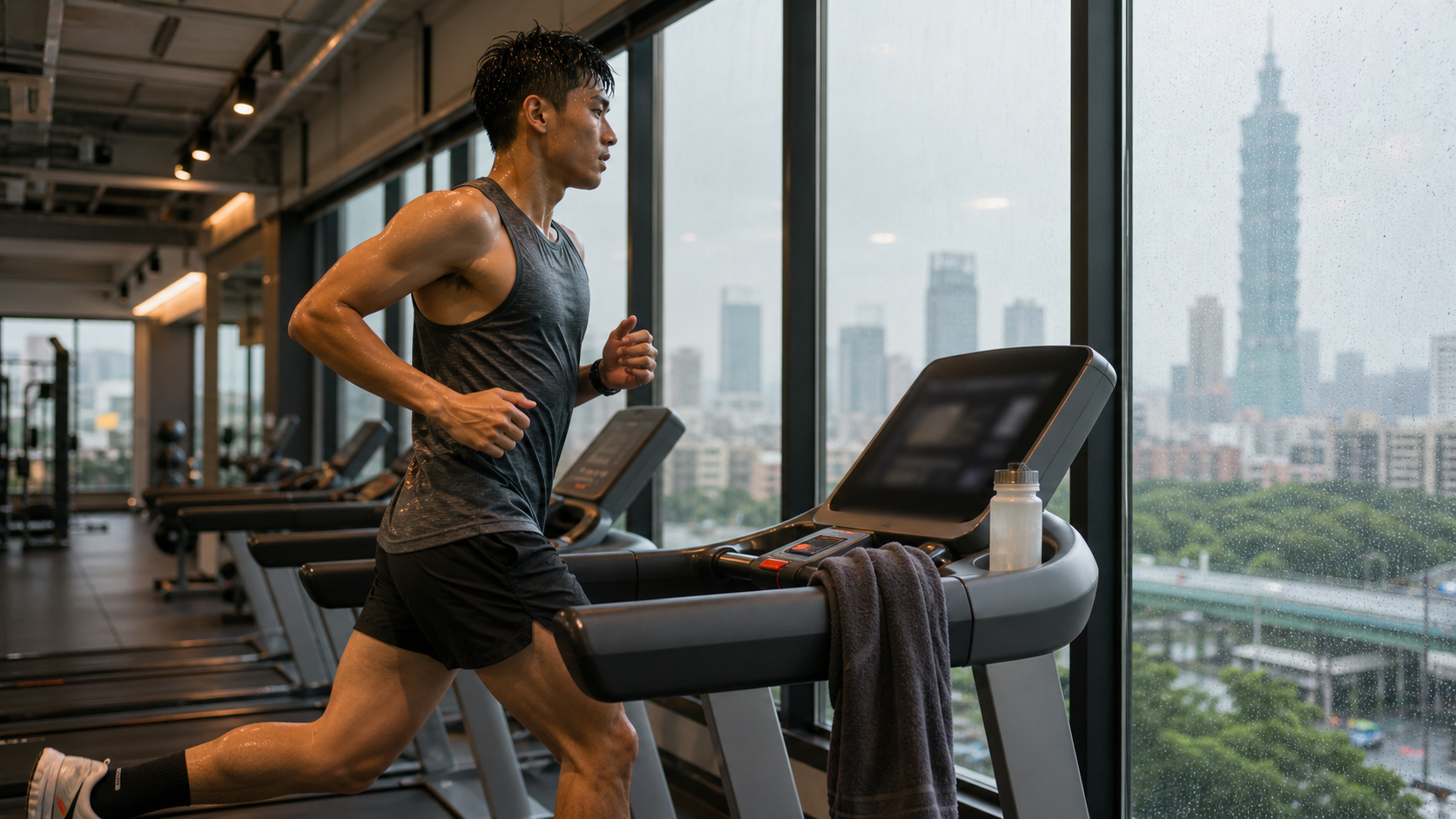
Coach’s Opening: That Treadmill Isn’t Your Enemy
After coaching athletes for so many years, every time Taiwan’s rainy season hits, or that muggy, suffocating heat of July and August afternoons rolls around, my inbox gets flooded with the same question: “Coach, I can’t run outside—if I train on the treadmill, is it all for nothing?” “The pace on a treadmill feels way easier than on the road—does that count as cheating?”
Let me state the conclusion first: The treadmill has never been your enemy; it’s a severely underrated training tool. What will actually make your training “for nothing” is treating the treadmill as a carbon copy of road running—the same pace, the same incline, the same mindset—and then wondering why you fall apart on an actual race course in Taiwan.
I once coached a runner named Xiao Lin, an engineer working in the Hsinchu Science Park, who was a textbook “treadmill expert.” All winter, he trained at the gym and got his 10K treadmill pace down to 4:40 per kilometer, with impressive numbers across the board. Then the following March, he ran the Tianzhong Marathon. In the second half of the half-marathon, he dropped straight to 5:40 pace and barely gutted it out to the finish. After the race, he messaged me: “Coach, did the treadmill lie to me?”
He wasn’t lied to—he just didn’t understand transition. In this article, I want to lay out everything I’ve learned about treadmills over the past 15 years in one go: whether that 1% incline debate, which has raged for nearly three decades, is worth believing, how to structure specific workouts on the machine, and most crucially—how to “translate” treadmill training into results on outdoor race courses.
Concepts and Scientific Foundations: Why Does the Treadmill Feel “Easier”?
To understand everything, you first need to grasp a physiological fact: at the same pace, energy expenditure on a flat treadmill is indeed slightly lower than outdoors.
There are two main reasons:
- No air resistance: Outdoors, you have to actively push through the air ahead of you—the faster you go, the greater the resistance. On a treadmill, you’re stationary; the belt moves beneath your feet, so you don’t need to overcome headwind.
- The surface moves for you: The treadmill belt “helps” pull your foot backward, slightly reducing your need to push off.
So how big is this difference? That’s the core of the famous 1% incline debate.
The Origin of the 1% Incline: A Classic Study Often Misused
In 1996, British researchers Jones and Doust published a classic study in the Journal of Sports Sciences with a charmingly straightforward title: “1% treadmill grade most accurately reflects the energetic cost of outdoor running.” They had 9 trained male runners test oxygen uptake at various speeds (approximately 2.92 to 5.0 meters per second, which translates to a pace range of roughly 5:33 to 3:20 per kilometer) on different inclines, and compared it to outdoor road running.
The conclusion: within this speed range, setting the treadmill to a 1% incline produced energy expenditure closest to flat outdoor running.
This “1% rule” has since become gospel passed around in running circles. But I want to pump the brakes here, because it’s been misused far too often. Here are the key points I need to flag as a coach:
- The 1% only applies to “faster” paces. The lower speed limit in the original study was about 5:33 per kilometer. When you’re running slower than that (e.g., easy or recovery runs at 6:30 or 7:00 per kilometer), wind resistance has minimal impact anyway, so forcing a 1% incline is “overkill” and makes an easy run less easy.
- The sample was 9 trained men. This isn’t a massive study covering everyone. For beginners, women, or runners with significantly different body weights, don’t treat it as an ironclad rule.
- It’s about “energy expenditure,” not “muscle loading patterns.” Even if energy matches, your impact forces, gait, and eccentric contraction patterns still differ from outdoor running.
It’s also worth noting that subsequent research on high-level distance runners has observed that in some cases, field (outdoor) running economy can even be superior to treadmill running—showing this isn’t as simple as “the treadmill is always easier.” Individual running form, machine characteristics, and wind conditions all influence the outcome. So rather than blindly memorizing a number, understand the principle behind it and calibrate based on your own body. This is what I always emphasize: Don’t be a slave to numbers; be the master of your own body.
So here’s the practical reference table I give my athletes:
Recommended Treadmill Incline Settings
| Training Purpose | Pace Range (per km) | Recommended Incline | Coach’s Notes |
|---|---|---|---|
| Recovery / Easy Run | 6:00 or slower | 0% | At slow speeds, wind resistance is minimal; adding incline defeats the purpose of recovery |
| Aerobic Base / Long Run | 5:00 – 6:00 | 0.5% – 1% | Closer to outdoor running; builds a solid aerobic foundation |
| Tempo / Lactate Threshold | 4:20 – 5:00 | 1% | The sweet spot of the classic 1% rule |
| Intervals / High Speed | Faster than 4:20 | 1% – 1.5% | Wind resistance is greatest at high speeds; a slight incline increase can simulate it |
| Specific Hill Simulation | Depends on course | 3% – 8% | For hill races like Wuling or Yangmingshan |
Key reminder: The table is a starting point, not the finish line. Your goal should always be that the “feel” matches, not that the numbers match. If a 1% incline keeps your heart rate noticeably lower than outdoors at the same pace, that means you can nudge the incline up a bit more.
Practical Methods: How to Structure Specific Treadmill Workouts?
The treadmill’s biggest advantage is absolute control: pace, incline, and time—down to the second. For workouts that need to precisely target specific physiological systems, this is unmatched outdoors. Most treadmills in Taiwan’s gyms or at home can adjust speed to 0.1 km/h increments—precision that’s impossible outdoors with traffic lights and crowds.
Below is a sample one-week treadmill workout plan I designed for “intermediate runners with an established aerobic base who want to break through.” Assume this athlete runs a marathon in about 4 hours, with a marathon pace of roughly 5:40 per kilometer.
Sample One-Week Treadmill Plan for Intermediate Runners
| Day | Workout | Incline | Target Heart Rate (bpm) | Training Focus |
|---|---|---|---|---|
| Mon | Recovery run 40 min @ 6:30 | 0% | 120–135 | Promote circulation, flush fatigue |
| Tue | Tempo run: 15 min warm-up + 25 min main set @ 5:10 + 10 min cool-down | 1% | 155–165 | Improve lactate threshold |
| Wed | Rest or cross-training (swimming / cycling) | — | — | Active recovery |
| Thu | Intervals: 6 × 3 min @ 4:30, 2 min easy jog between reps | 1% | 170–180 | VO2max stimulus |
| Fri | Recovery run 30 min @ 6:40 | 0% | 115–130 | Easy sweat |
| Sat | Long run 90–110 min @ 5:50, last 20 min pick up to 5:20 | 0.5% | 140–160 | Aerobic endurance + late-run load |
| Sun | Complete rest | — | — | Physical and mental recovery |
There are a few design principles in this plan I specifically want to highlight:
- Keep the incline fixed at 1% on interval day: Wind resistance has the greatest impact at high speeds, so 1% makes the high-intensity intervals on the machine closer to real outdoor load.
- The long run deliberately includes a “late-run pick-up”: This is the treadmill’s killer feature. Outdoors, it’s hard to force yourself to pick up the pace precisely when fatigued, but on the machine, you just press a button and the pace goes up. This is extremely effective for training the ability to “not fade in the second half.” This is exactly the trick Xiao Lin later used to fix his second-half slowdown at the Tianzhong Marathon.
- Set incline to zero on recovery runs: Don’t add incline on recovery days just to “feel more like outdoors.” The only job of a recovery day is to recover—the lower the intensity, the better.
Advanced Application: Simulating Taiwan’s Climbing Races on the Treadmill
If your target race is a climbing route like Yangmingshan or Fengguizui, or even running events around Wuling, the pilgrimage site of the cycling world, the treadmill’s incline function is your secret weapon.
In Taiwan’s summer, doing long climbing workouts outdoors comes with not just heat but also traffic risks. This is when I have my athletes do “incline ladders” on the machine:
- Warm up for 10 minutes @ 0% incline, easy pace
- Main set: Start at 2% incline, increase by 1% every 5 minutes until reaching 6%–7%, maintaining a steady pace
- Maintain the same rate of perceived exertion (RPE) at each incline step, not the same pace
- After reaching the top, gradually decrease back to 0%, and cool down for 10 minutes
This type of workout is highly effective for strengthening the glutes, calves, and cardiovascular load during climbs, and it completely avoids the risk of heat injury from Taiwan’s summer outdoors. Gyms in Taiwan usually have air conditioning, allowing you to complete climbing stimulus in a comfortable environment around 26°C, which might require outdoor temperatures exceeding 33°C to achieve.
Common Mistakes and Fixes: Tragedies I’ve Seen at the Gym
Having coached so many athletes, I’ve seen almost every mistake possible on the treadmill. Here are the most common and most damaging ones:
Mistake 1: Treating Treadmill Pace as Outdoor Pace
This is the number one killer. Because the treadmill is more efficient, many people run impressive paces on the machine and assume they can run that fast outdoors, only to blow up on the race course—this is Xiao Lin’s story.
Fix: Accept that “machine pace” and “outdoor pace” are two different numbers. I usually advise athletes to add a 1% incline on the machine and then use heart rate as the primary reference, rather than staring at the pace. Heart rate is an internal load indicator that doesn’t lie.
Mistake 2: Holding onto the Handrails
The moment you grab the handrails, your arm swing, core engagement, and energy expenditure all change, and your entire running form is compromised. You think you ran 10 kilometers, but the actual training effect is halved.
Fix: Let go of the handrails and swing your arms naturally. If you can’t run without holding on, it means your pace is set too fast—slow down. Better to be slow and correct than fast and broken.
Mistake 3: Going to the Race Without Any Transition
Training only on the treadmill and never going outdoors is the most dangerous preparation method I’ve seen. The treadmill lacks: undulating terrain, turns, wind, uneven surfaces, and most importantly—the eccentric loading of downhill running.
Fix: At least 6–8 weeks before the race, make sure to schedule regular outdoor workouts. I’ll detail the transition in the next section.
Mistake 4: Ignoring Indoor Heat Accumulation and Hydration
Many people assume that because it’s cool indoors, they don’t need to hydrate—this is completely wrong. If the gym has poor ventilation, and you’re running in place without relative wind to help cool you down, your core temperature actually accumulates faster than you think. Gyms in Taiwan are also often crowded with insufficient air conditioning.
Fix: Always keep water by the machine. During longer workouts, take a few sips every 15–20 minutes (based on sweat rate, roughly 400–800 ml per hour as a reference range), and use a towel and fan to aid cooling.
Mistake 5: Ramping Up the Incline Relentlessly, Thinking It’s More Effective
Some overly ambitious athletes crank the incline straight to 8% or 10% while maintaining a fast pace, thinking this is “maximum efficiency.” The result is either a compromised, forward-leaning running form or excessive strain on the Achilles tendon and calves, leading to injury within a few weeks.
Fix: Incline is a tool, not a badge of honor. Only raise the incline when doing specific work for climbing races, and be sure to reduce your pace to maintain a reasonable effort, allowing your body to adapt progressively.
Outdoor Transition: “Translating” Treadmill Performance into Race Performance
This is the most critical section of the entire article, and it’s where Xiao Lin learned the most from his failure.
Training well on the treadmill doesn’t equal running well outdoors; there’s a bridge between the two. Here’s the complete framework I use to transition athletes outdoors.
Difference 1: Energy Cost and Pace
As mentioned earlier, the treadmill is more efficient at the same pace. So establish this expectation: your outdoor pace will typically be about 10–20 seconds per kilometer slower than the machine pace at the same effort. This isn’t a regression; it’s physical reality. Adding a 1% incline can narrow this gap, but it won’t eliminate it entirely.
Difference 2: Terrain and Muscle Recruitment
Outdoors, there are uphills, downhills, and turns. Especially the eccentric contractions on downhills, which place a damaging load on the quadriceps that the treadmill can hardly replicate. This is why many pure treadmill athletes end up with severe delayed-onset muscle soreness the day after finishing a course with downhills (such as certain mountain trail runs).
Transition practice: At least one outdoor workout per week before the race, and it must include real uphill and downhill sections. While Taiwan’s riverside paths are flat and easy to run on, if your target race has elevation gain, you need to deliberately seek out hilly routes for training—for example, Elephant Mountain or Maokong in Taipei, Dakeng in Taichung, or Shoushan in Kaohsiung.
Difference 3: Self-Pacing Ability
The treadmill “maintains” your pace for you; you just have to keep up with the belt. But outdoors, there’s no belt pushing you—pacing relies entirely on your own feel and discipline. Many treadmill athletes, once outdoors, either start too fast or lag too slow, with their pace riding a rollercoaster.
Transition practice: Deliberately practice “watchless pacing” during outdoor workouts, using feel to gauge your target pace, then verify against your GPS watch. This ability is extremely important for popular Taiwanese races like the Standard Chartered Taipei Marathon, Tanaka Marathon, and Wan Jin Shi Marathon, which require steady pacing.
Difference 4: Environment and Psychology
The treadmill has air conditioning, videos, and a stable surface. Outdoors, there’s sun, wind, humidity, and fluctuating mental states. Almost all races in Taiwan take place in hot, humid conditions. Even though Wan Jin Shi is on the northern coast in March, it can still be muggy at noon; summer races are an even harsher test of your cooling capacity.
Transition practice: Schedule your pre-race outdoor long runs as close as possible to the time of day and weather conditions of your race. If your race starts at 6 AM, don’t always train in the cool evening—get your body used to the early morning rhythm and the timing of digesting breakfast. Taiwan has a wide variety of breakfast options; find a pre-race meal that your stomach can handle and that provides steady energy (such as rice balls, toast with banana), and test it repeatedly on your outdoor long run days. I often tell my athletes that race day is not a day for “trying new things”—your shoes, clothes, breakfast, and fueling strategy should all have been validated countless times in training. The treadmill can help you build the engine, but these details on the course can only be vetted through real outdoor practice.
There’s another psychological transition that Taiwanese runners often overlook: on the treadmill, you can stop anytime; outdoors, you can’t. The machine gives you a “quit anytime” escape hatch, which is protective during training, but it can also breed a habit of slowing down at the first sign of heavy breathing or hitting stop when tired. On an outdoor course, with no support in sight, you have to rely on yourself to push through every low point where you want to give up. So I deliberately include “no stopping” segments in outdoor workouts, teaching athletes to coexist with discomfort—this mental toughness is what the treadmill can never provide, yet it’s the ability that most determines success in the latter half of a race.
Suggested Transition Timeline
| Race Distance | Machine : Outdoor Ratio | Key Focus |
|---|---|---|
| 8+ weeks out | 70 : 30 | Build the base, machine-primary |
| 4–8 weeks out | 50 : 50 | Gradually increase outdoor, adapt to terrain |
| 2–4 weeks out | 30 : 70 | Outdoor-primary, simulate race scenarios |
| 2 weeks before race | 10 : 90 | Almost all outdoor, fine-tune pacing feel |
Going Deeper: Running Economy, Cadence, and Biomechanics
Everything discussed so far has been at the “energy” level, but as a coach, I need to take you one layer deeper: biomechanics. Because even if the energy expenditure on the treadmill and outdoors is corrected to be similar with a 1% incline, how your body runs is still different between the two.
Subtle Changes in Cadence and Stride Length
The treadmill belt actively pulls your feet backward, and many runners unconsciously shorten their stride and increase their cadence on the machine, or conversely—overstriding to keep up with the belt. Neither is good.
My approach is to have athletes use a stopwatch or the metronome function on their watch while on the treadmill, deliberately maintaining a cadence similar to their outdoor one (most mature runners fall in the 170–185 steps per minute range, but this is individual—don’t blindly chase a specific number). The key is to make the movement pattern on the machine consistent with your natural outdoor rhythm, so the training effect transfers seamlessly.
Ground Impact and Eccentric Load
Treadmill belts typically have some cushioning and are relatively joint-friendly, which is a major advantage for runners recovering from injury or heavier beginners. However, excessive cushioning is a double-edged sword: your calves, plantar fascia, and Achilles tendon will lack adaptation to real hard surfaces if you run on “too comfortable” ground for a long time.
This is why I never let my athletes train 100% on the machine only. Most race courses in Taiwan are asphalt or concrete, which are much harder on impact than a treadmill. If you accumulate zero mileage on hard surfaces before race day, your risk of calf soreness, plantar fascia pain, or even injury after the race will increase significantly.
A Practical Biomechanics Checklist
| Check Item | Ideal State | Common Mistakes |
|---|---|---|
| Hands | Natural arm swing, not touching the handrails | Gripping the handrails, stiff arms |
| Upper Body | Slight forward lean, stable core | Excessive forward lean or leaning back |
| Foot Strike Position | Near directly under the center of gravity | Foot reaching too far forward (braking effect) |
| Gaze | Looking straight ahead | Constantly looking down at the screen data |
| Cadence | Consistent with outdoor running | Losing rhythm trying to match the belt |
Coach’s Tip: Occasionally use your phone to record yourself running on the treadmill from the side. You’ll be surprised to notice many posture issues you never realized you had. This is another hidden advantage of the treadmill—you can be clearly filmed from a fixed point.
Choosing and Setting Up: How to Pick and Adjust That Gym Treadmill
There are many ways to access treadmills in Taiwan: gyms, community facilities, or even buying one for home. Different machines vary greatly in characteristics. Here are some practical points for you to evaluate.
Key Points for Choosing a Machine
- Maximum Speed and Incline Range: If you do intervals or hill-specific workouts, the machine’s top speed should ideally reach 18–20 km/h and incline at least 12%, so the machine doesn’t limit your workout plan.
- Belt Length and Width: At high speeds, your stride lengthens. A belt that’s too short will make you unconsciously shorten your stride or feel psychological pressure about falling off.
- Cushioning and Stability: If the machine wobbles noticeably at high speed, it’s not only dangerous but also disrupts your running form.
- Data Display: A machine that can simultaneously show pace, incline, time, and heart rate is very helpful for executing structured workouts.
Real-World Considerations for Home Treadmills
Living spaces in Taiwan are generally not large, and many athletes ask me whether a home treadmill is worth buying. My view is: if it gets you moving on rainy days, red-alert air pollution days, or late nights after work, then it’s worth it. Taiwan’s winter air quality, summer afternoon thunderstorms, and the time pressure of commuting in urban areas are all real reasons people abandon training. The greatest value of a machine sitting at home, ready whenever you are, is “lowering the barrier to starting.”
But a word of caution: home machines usually have lower incline and speed limits. If you’re an advanced runner chasing times, you may still need to combine it with professional gym machines or outdoor workouts.
Second Case Study: Triathlete Yijun’s Treadmill Transition Training
Besides runners, I also coach many triathletes, and the treadmill plays an even more unique role in their training. Let me share the example of Yijun, a standard-distance triathlete.
Yijun’s biggest problem wasn’t that she couldn’t run fast—it was that the first 2 km after getting off the bike felt like running with lead legs. This is what triathletes know as the “brick effect”: the quadriceps recruitment pattern while cycling differs from running, causing severe stiffness in the legs during the transition. When she practiced bricks outdoors, finding safe cycling routes and transition spaces was a hassle, especially in urban areas.
So I designed an indoor brick workout for her: setting up the trainer (roller/smart trainer) right next to the treadmill.
Yijun’s Indoor Brick Workout Example
| Segment | Content | Intensity/Setting | Purpose |
|---|---|---|---|
| Ride 1 | 20 minutes on trainer | Near race power (based on FTP, in watts) | Simulate race fatigue |
| Transition | Change shoes and get on treadmill within 30 seconds | Quick switch | Practice transition rhythm |
| Run 1 | 10 minutes on treadmill @ target pace, 1% incline | Maintain pace with lead legs | Adapt to brick |
| Ride 2 | 15 minutes on trainer | Race power | Secondary fatigue |
| Run 2 | 8 minutes on treadmill @ target pace | Pacing under deep fatigue | Strengthen neuromuscular system |
The power of this workout lies in: full control, zero traffic risk, and executable in any harsh weather in Taiwan. The treadmill’s precise pacing let Yijun clearly know how fast she could actually maintain with “lead legs,” rather than running by feel. Three months later, she no longer fell apart at the start of the run segment in standard-distance races—and even set a personal best.
But the same reminder applies: during Yijun’s specific preparation phase, I still took her outdoors for real bricks, because race-day sun, wind, road surface, and aid station rhythm can never be simulated indoors. Indoor training builds the foundation and refines technique; outdoor training is the final calibration. Both are indispensable.
Heat Adaptation: The Hidden Key to Winning in Taiwan Races
I want to dedicate a section specifically to heat adaptation, because it’s the aspect Taiwanese runners most often overlook yet has the biggest impact on performance.
How harsh is Taiwan’s race environment? Even at the March Wanjinshi Marathon or November Tanaka Marathon, once the sun comes out and humidity rises, the perceived temperature skyrockets. Summer races go without saying. When core body temperature rises, heart rate is forced up, pace naturally drops, and decision-making declines—this is why many people “train well but blow up on race day.”
Treadmill training has an inherent contradiction: gyms are too cool, leaving you without heat stimulus. So here’s how I arrange it:
- Base phase: Use the machine’s cool environment to accumulate mileage and protect your body.
- 3–4 weeks before race day: Deliberately schedule “heat adaptation workouts.” These can be low-to-moderate intensity long runs during hot, humid outdoor periods, teaching your body to sweat profusely and maintain plasma volume in high temperatures.
- Hydration and electrolytes: Sweat loss during hot long workouts can be substantial. Besides water, you also need electrolytes (primarily sodium). Sports drinks and salt candies from Taiwan’s convenience stores are convenient options, but adjust concentration and dosage based on your individual sweating patterns and body weight—don’t just chug blindly.
Heat adaptation typically requires one to two weeks of consistent stimulation to show noticeable effects, and it gradually fades once you stop. So timing must be before the race. This is why “only using a treadmill in an air-conditioned room to prepare for Taiwan’s summer races” is dangerous—your engine is trained, but your cooling system isn’t ready.
FAQ
Q1: Will running on a treadmill for a long time actually make me worse outdoors?
No, as long as you do the transition. The cardiovascular fitness, muscular strength, and aerobic base built on a treadmill are all real and will carry over 100% to outdoor running. What actually makes you worse outdoors is “training only on the machine with zero transition.” Put outdoor workouts back into your schedule, and the problem is solved.
Q2: I don’t have a heart rate monitor. Is pace alone enough?
It’s a fine starting point, but I strongly recommend investing in a heart rate monitor. Treadmill pace is “external load,” while heart rate is “internal load.” At the same machine pace, your body’s actual burden is completely different when you’re fatigued, in hot weather, or sleep-deprived—only heart rate can honestly reflect that.
Q3: Can I train for a full marathon on a treadmill?
Cardiovascular and aerobic aspects are entirely possible—many people have completed impressive long distances on machines. But I don’t recommend “preparing for a full marathon using only a treadmill,” because a 42 km course demands downhill eccentric load, pacing discipline, and environmental adaptation that a machine can’t provide. At minimum, you need sufficient outdoor long runs in the weeks before the race.
Q4: Does watching videos while running affect training quality?
Watching videos during easy runs and recovery runs is totally fine—it can even help you get through the boredom. But for intervals and tempo runs that require focused feel, I recommend turning off the video and bringing your attention back to breathing, cadence, and body signals. That’s where the real value of these high-intensity workouts lies.
Q5: In Taiwan’s hot, humid weather, is indoor training always better than outdoor?
It depends on the purpose. If the goal is “accumulate mileage, protect the body, avoid heat injury,” indoor is indeed safer and more efficient. But if your target race is in a hot, humid environment (which most Taiwan races are), you still need deliberate heat adaptation—schedule some outdoor workouts during hot, muggy periods in the weeks before the race, teaching your body to dissipate heat and pace in high temperatures. That’s an ability indoor training cannot develop.
Q6: Is there a big difference in calorie expenditure (kcal) between a treadmill and running outdoors?
At the same pace and duration, running outdoors generally burns slightly more energy than running on a flat treadmill, because you have to contend with wind resistance and terrain variations. However, this difference isn’t as dramatic as many people think, and it becomes even closer when you add a 1% incline. Rather than obsessing over the kcal number displayed on the machine (which is only an estimate anyway, with considerable error), focus on whether your training is delivering the intended stimulus. The core of weight loss and body composition management is always overall energy balance and long-term consistency, not the number that pops up on the machine after a single session.
Q7: Is a treadmill a good choice during injury rehabilitation?
Generally, yes. The treadmill’s flat surface, better shock absorption, and precisely controllable pace are very helpful for gradually returning to running and avoiding sudden excessive load. However, rehabilitation varies greatly from person to person. Be sure to have a physical therapist or sports medicine physician assess your injury and tolerable load first, then decide on the training plan. Don’t just push through based on how you feel.
Actionable Advice for Runners of Different Levels
Beginner Runners (Just starting, goal is to finish)
The treadmill is actually a great entry-level tool for you, because it’s stable, controllable, has low psychological pressure, and lets you avoid Taiwan’s hot, humid weather and traffic risks.
- Start with a 0% incline and focus on building up to “running continuously for 30 minutes without stopping.”
- Don’t rush to chase pace; first focus on “not holding the handrails, maintaining good form, and breathing smoothly.”
- Run outdoors at least once a week (riverside park, regular park) to let your body get familiar with real ground early.
- In the 6 weeks leading up to your goal race, gradually increase the proportion of outdoor running.
Intermediate Runners (Can finish a race, aiming for a PB)
Your challenge is to break out of the machine’s comfort zone and translate your data into race-day performance.
- Start using a 1% incline for tempo runs and intervals, and cross-validate intensity with heart rate.
- Use the machine’s “speed-up in the latter half” feature to practice maintaining pace in the second half of a race.
- Be sure to do terrain-specific training before race day, especially if your goal race has elevation gain.
- Build your own personal “treadmill pace vs. outdoor pace” reference chart, and stop being fooled by flattering numbers.
Advanced Runners (Chasing times, doing triathlon)
For you, the treadmill is a laboratory for precise control.
- Use the machine for precise threshold and VO2max workouts, keeping error to a minimum.
- Triathletes can use the treadmill for “T-runs (brick runs after cycling)” transition training—hop off the indoor trainer and get straight on the treadmill to perfectly simulate that heavy-legged feeling in transition.
- Use incline ladder workouts for specific race course elevation preparation.
- But during the race-specific phase before competition, you must still go outdoors. No exceptions. The run leg of a triathlon is almost always done outdoors in the heat, so heat dissipation and pacing discipline must be honed in a real-world environment.
Coach’s Conclusion: Tools Are Neither Good Nor Bad; It’s the User That Matters
Back to Xiao-Lin’s story. After his disappointing race at Tanaka Marathon, we spent an entire season readjusting his training philosophy. In winter, he still used the treadmill for aerobic base building and precise intervals, but we added two things: a weekly hill session at Maokong, and gradually shifting his outdoor training ratio to 90% in the 6 weeks before the race.
The next year, he took on the full marathon again. Not only did he smash his PB, but he also overtook a bunch of runners who had gone out too fast in the second half. I still have the message he sent me: “Coach, the treadmill wasn’t lying to me. I just didn’t know how to use it before.”
That’s the message I want to leave you with: The treadmill is a mirror, reflecting both your training discipline and your understanding of your own body. It can give you precision, safety, and the opportunity to keep building consistently even in Taiwan’s harsh weather. But it can’t give you the wind, the hills, and the crowds of the race course. Those, you have to go out the door and earn.
Next time you step on that treadmill, don’t ask “Is this training useful?” Instead, ask yourself “What do I want to train today, and how do I bring it back to the race course?” Once you’ve figured that out, your relationship with the machine will never be the same.
Use that machine well, and then, remember to get back out on the road. See you at the starting line.
This article is for educational purposes and does not replace individual assessment by a physician, physical therapist, or nutritionist.
References
- Jones, A.M. & Doust, J.H. (1996). A 1% treadmill grade most accurately reflects the energetic cost of outdoor running. Journal of Sports Sciences. PubMed Link
- Better economy in field running than on the treadmill: evidence from high-level distance runners. PMC Link
Related Reading
- Treadmill vs. Outdoor Running: Mechanical Differences, Incline Compensation, and Proper Usage
- The Science of Treadmills: Speed Calibration and Outdoor Transition Guide for Treadmill Training
- Treadmill vs. Outdoor Road Running: The Scientific Basis of the 1% Incline Compensation and Training Differences
- Treadmill vs. Outdoor Road Running: Biomechanical Differences Between the Two Training Environments and Strategy Choices for Taiwanese Runners
一個測試有沒有認真練車的方法😂 #公路車
10 個月前
西進武嶺 免費訓練分析服務 Intervals | 練不夠還是練過頭?你哪一種類型選手?AI模型告訴你! | 備戰神器 | 公路車 訓練 | CT Yeh
4 年前
ThinkRider 智騎 XXPRO 訓練台,高階機種功能 只要 1/3價格!? 實測功率對比、噪音實測 / 公路車 / CT Yeh
1 年前
單車AI教練!全新 ChatGPT4o 幫你分析訓練成果!排武嶺課表,分析騎車姿勢! 太神了! / 公路車 / CT Yeh / feat. 緯緯
2 年前
FTL 與 SYB 車隊專訪 西進武嶺 實用攻略分享! 2小時 如何練?!你不知道的眉角!新手準備武嶺必看 EP1 | 實力派女車友 | 精華版 | 公路車 | CTYeh
4 年前
#公路車 #Fitting 靠人工智慧APP 幫你調整單車
6 年前
沉浸室內單車練功房開箱! 100吋大畫面,最便宜的花費? 居然還能K歌!? | 公路車 | CT Yeh
3 年前
RAMP FTP Test 直播 究竟能撐到幾瓦 訓練台 Gravat Zwift
6 年前