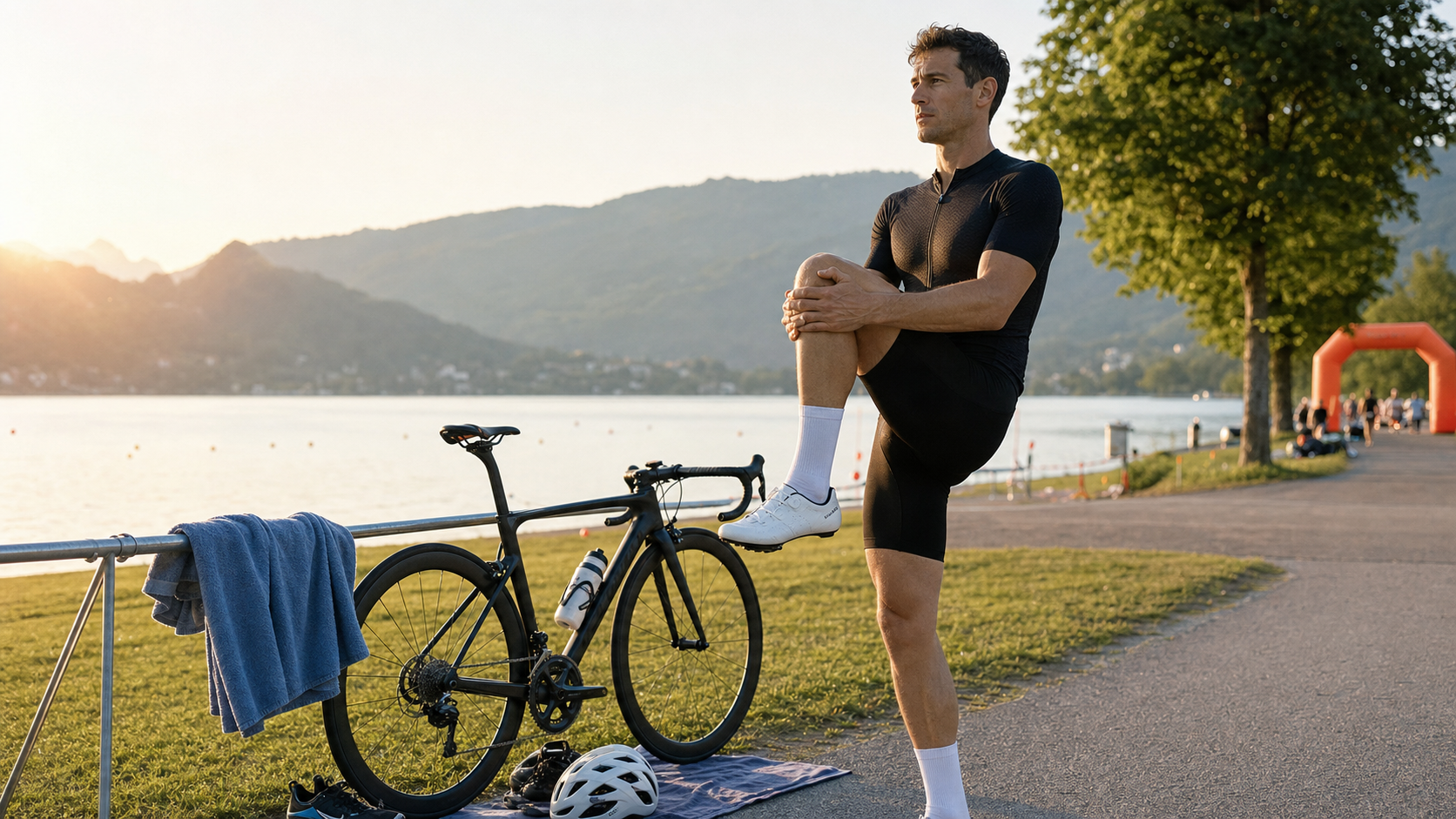
Coach’s Opening: The Athlete Shivering on the Start Line
I once coached an athlete—let’s call him A-Kai. It was his first 51.5 standard-distance triathlon, and he was nervous as hell. He laid out his gear in transition at 5:30 AM, then—just sat there. For nearly an hour, waiting for the swim start. By the time he finally jumped into Sun Moon Lake, his body was still “cold”: his breathing fell apart in the first 400 meters, his heart rate spiked to 180 bpm, his stroke had zero rhythm, and his legs were jelly when he got out of the water. He told me afterward: “Coach, I trained for this—why did I blow up right at the start?”
The problem wasn’t fitness—it was the warm-up. He spent that golden pre-race window being anxious instead of switching his body from “standby” to “combat mode.”
In 15 years as a triathlon coach, from getting first-timers across the finish line to sending athletes after Kona slots, I’ve become more and more certain of one thing: a warm-up isn’t a ritual—it’s physiological engineering. How you use those 20 minutes before the race determines whether you fall apart in the first 10. And triathlon has its own unique challenge here—you can’t just jog for ten minutes before the start like a runner, because you have to get in the water first.
In this article, I want to clarify two things: what actually happens physiologically during a warm-up, and how to do it well within the constraints of race day. Plus one thing everyone does but the evidence is actually murky on—the cool-down.
1. The Physiological Purpose of a Warm-Up: What Are You Actually “Warming”?
Most people think a warm-up is just “move around a bit, break a sweat.” That’s not wrong, but it’s too superficial. The real question is: what does a warm-up actually change physiologically that makes you perform better?
1. Raising Muscle Temperature: The Core Mechanism
The most direct effect of a warm-up is raising muscle temperature. This isn’t pseudoscience. Research reviews show that for movements requiring high power output (e.g., vertical jumps, sprint pedaling), every 1°C rise in muscle temperature boosts power output by roughly 4–6%; one study using passive heating (hot water immersion) even observed an increase in maximal power of about 5.1%. (Sources at the end of the article)
Warm muscles bring a cascade of benefits:
- Increased enzyme activity: The chemical reactions of energy metabolism run faster in a warm environment, making ATP regeneration more efficient.
- Reduced muscle viscosity: A cold muscle is like maltose straight from the fridge—stiff and hard to pull. A warm muscle contracts and relaxes more smoothly, with less internal friction.
- Faster nerve conduction: Signals travel from the brain to the muscles more quickly, sharpening reaction time.
For triathletes, this means: warmed-up legs give you more power and efficiency in the first few kilometers of the ride, instead of spending five kilometers just “booting up.”
2. Priming the Cardiopulmonary and Circulatory Systems
The second goal is getting the cardiovascular system online early. At rest, your cardiac output is low and most blood flow goes to the internal organs. When you start high-intensity exercise, your body needs time to redirect blood to the working muscles, raise heart rate, and open up oxygen-carrying capacity.
Here’s a key term: oxygen uptake kinetics. Simply put, it’s how fast your body “mobilizes” oxygen. A good warm-up speeds up this response, effectively bringing your aerobic system online sooner. Conversely, if you go hard without warming up, your body can’t deliver oxygen fast enough, forcing you to rely heavily on anaerobic metabolism—lactate builds up early, and you feel inexplicably winded and heavy-legged in the opening stretch. A big part of why A-Kai’s heart rate blew up early in the swim was exactly this.
3. “Preheating” the Neuromuscular System
The third layer is more advanced and relates to neural recruitment. A few efforts close to race intensity can improve motor unit recruitment efficiency, making your muscles “more responsive and more powerful” when the race officially starts.
This ties into a pair of frequently discussed terms: PAP (post-activation potentiation) and PAPE (post-activation performance enhancement). The theory is that after a set of high-intensity contractions, the same stimulus can produce greater force afterward. But I want to be honest here: recent literature is actually debated on whether “PAPE adds any extra benefit.” One randomized crossover trial found that after a full active warm-up, adding a PAPE protocol on top did not further improve jump performance—meaning most of the benefit likely comes from the solid warm-up itself, not some magical explosive set. (Sources at the end of the article)
This gives us a very practical takeaway: Don’t obsess over flashy explosive protocols. Nail the basic progressive active warm-up, and you’ve already captured 80–90% of the benefit.
I had another athlete, Xiao-Ting, who loved following trends. She learned a flashy explosive warm-up from an online video—weighted jump squats, medicine ball slams, box jumps. After the whole routine she was drenched in sweat and felt “thoroughly warmed up.” In that race, the swim was fine, but the moment she got on the bike, her legs felt heavy. The problem was she’d turned her “warm-up” into a “workout”—burning through muscle glycogen and neural excitement before the race even started. I had her switch back to a simple progressive dynamic warm-up with just a few gentle accelerations. At the next race, she reported back: “Turns out simple made me stronger at the start.” That’s exactly what the literature is saying—a solid basic warm-up captures all the benefits; extra gimmicks are usually a burden, not a bonus.
4. The Psychological Layer: Flipping the Switch to “Race Mode”
The last often-overlooked goal: a warm-up is mental priming. A fixed warm-up routine stabilizes emotions, builds rhythm, and reduces pre-start anxiety. Half of A-Kai’s problem was psychological—he sat in transition doing nothing, letting anxiety ferment for an hour. I later had him lock his pre-race routine into a standard SOP. Just having “something to do, a body in motion” steadied his starting heart rate and breathing considerably.
2. What to Do and What Not to Do in a Warm-Up
Now that we’ve covered the physiology, let’s get practical. First, a mistake many people make: don’t do long static stretching before the race.
The Evidence on Static Stretching: It’s a Penalty Before Racing
The research here is quite clear. Prolonged static stretching before competition (holding a position still) temporarily reduces maximal strength and power. A widely cited 2012 meta-analysis found that prolonged pre-race static stretching may reduce strength by roughly 10%. (Sources at the end of the article)
Key points to remember:
- The effect is highly correlated with duration. Holding a single muscle group for more than 60 seconds is more likely to cause a temporary drop in strength and power.
- This decrease is temporary, lasting only a few minutes, and won’t harm your long-term strength gains.
- If you keep each stretch to under 60 seconds, flexibility improves while strength is typically maintained or even slightly enhanced.
- Interestingly, long-term regular static stretching training may actually improve strength and power—this is completely different from “doing a big stretch session right before the race.”
So the conclusion isn’t “static stretching is bad”—it’s that the timing and dosage are wrong, and that’s what costs you. Before a race, you want dynamic movement, not muscles pulled soft.
What to Do Before the Race: Dynamic Warm-Up
A dynamic warm-up uses rhythmic, sport-specific movements to bring the body up to speed—leg swings, walking lunges, jumping jacks, running-form drills, shoulder circles, and knee hugs. These movements increase range of motion while raising muscle temperature and heart rate, and they also awaken the neuromuscular system, hitting all four physiological goals mentioned earlier.
Here is the basic dynamic warm-up menu I give my athletes. It works for swimming, cycling, and running, just with different areas of emphasis:
| Movement | Reps/Duration | Primary Purpose | Triathlon Focus |
|---|---|---|---|
| Jog in place / Jumping jacks | 1–2 minutes | Raise heart rate, increase muscle temperature | General |
| Leg swings (front-back + side-to-side) | 10 each side | Hip mobility | Running/Cycling |
| Walking lunges | 8–10 steps | Dynamic lower-body stretching | Running |
| Knee hugs + heel-to-glute walks | 8 steps each | Glutes, quadriceps | Running |
| Shoulder circles + arm swings | 15 seconds each direction | Shoulder mobility | Swimming |
| Band external/internal rotation | 12 each side | Rotator cuff activation | Swimming |
| High knees / Butt kicks | 20 meters each | Neuromuscular activation for running form | Running |
This routine takes about 8–10 minutes. Follow it with a sport-specific progression: do a few minutes of the actual sport at low intensity, then insert a few short accelerations near race pace (e.g., for running, do 3–4 x 20m progressive sprints; for cycling, do 3 x 15-second high-cadence accelerations on a stationary trainer or on the road). Those short accelerations are the “neural priming” mentioned earlier—they improve recruitment efficiency without tiring you out.
3. Warm-Up Limitations in Triathlon: The Reality On-Site Isn’t Ideal
If triathlon allowed you to warm up like a running race, things would be simple. But the reality is—triathlon warm-ups are constrained at every turn, and that’s exactly where experience matters most.
Limitation 1: Swimming Goes First, But You Often Can’t Get in the Water
The first leg is swimming, which theoretically needs an in-water warm-up the most. However, many races don’t allow open-water warm-ups before the start due to safety, logistics, or time restrictions—or they only give you a very short window. In Taiwan, water races at venues like Sun Moon Lake, Chengcing Lake, and Dapeng Bay often have this issue. If you jump in cold, your breathing will easily fall apart in the first 200–400 meters and your heart rate will spike—the classic script from A-Kai’s story.
How to work around it:
- 15–20 minutes before the start, do a dry-land warm-up on shore: band pulls to simulate the pull phase, shoulder circles, chest-openers and lat stretches, brisk walking or light jogging to get your heart rate up to slightly breathless.
- If a brief in-water warm-up is allowed, even just 2 minutes, get in. Do a few acceleration strokes and several deep breaths with your face in the water to acclimate to the water temperature and reduce the hyperventilation caused by “cold-water shock.”
- If you absolutely cannot get in the water, actively slow down and lengthen your breathing for the first 200 meters after the start, treating that segment as your “in-water warm-up.” Don’t sprint from the gun. That’s strategy, not cowardice.
Limitation 2: A Long Gap Between Warm-Up and Start
Triathlons often use wave starts, so after you finish warming up, you might wait 10–20 minutes in the marshalling area. That gap causes the warm-up benefits to fade—muscle temperature drops, heart rate comes down, and it’s like you never warmed up at all.
Research also reminds us that the longer the interval between warm-up and the actual event, the more benefit is lost.
How to work around it:
- Save the key accelerations for the moment closest to your start. The earlier dynamic drills can be done sooner, but try to squeeze those short accelerations into the 3–5 minutes before you enter the water.
- During the gap, don’t stand completely still. March in place, swing your arms, shrug your shoulders—keep some muscle activity and body heat going.
- In cold weather or early-morning races (common for Taiwan’s autumn/winter events), stay warm until the last second. Don’t take off your old jacket or heat blanket until just before entering the water, so the body heat you worked to build isn’t blown away by the wind.
Limitation 3: Transitions Aren’t Rest—They’re “Warm-Up on the Move”
Many people overlook this: T1 and T2 transitions are actually natural warm-up zones for the bike and run. Just out of the swim, blood flow to your legs is still adjusting; just off the bike and starting to run, your calves are stiff and your nervous system is still in “pedaling mode.”
How to use transitions wisely:
- In T1, for the first 2–3 km on the bike, don’t rush to push a big gear. Use a slightly higher cadence and slightly lower power to open up your legs, letting blood flow redistribute from the swimming-focused upper body back to the lower body.
- In T2, when you start running, the first 400–800 meters will bring the infamous “jelly legs”—running immediately after cycling, before the neuromuscular system has switched over. At this point, shorten your stride and increase cadence. Using quick, short steps to establish rhythm is safer and gets you into the groove faster than forcing long strides. You must train bricks (bike-to-run) regularly precisely to get your body used to this switch.
Limitation 4: Long-Distance vs. Short-Distance—Different Warm-Up Strategies
Many beginners get this backwards:
| Race Type | Warm-Up Logic | Reason |
|---|---|---|
| Short distance (Sprint / 51.5 Olympic) | Warm-up should be thorough, including high-intensity short accelerations | You’re near lactate threshold from the gun, so the body must be switched on first |
| Long distance (113 Half / 226 Full) | Warm-up should be minimal and conservative—don’t waste energy | The early intensity is naturally low; the first few kilometers of the race are the warm-up. Over-warming just burns glycogen |
For my 226 Full Ironman athletes, I deliberately keep the pre-race warm-up very light—a few minutes of dynamic drills and a few gentle accelerations, just enough to wake the body up. Because the first 40 km of the bike in a 226 is itself low intensity, that’s the best warm-up there is. Why burn the glycogen you’ll need all day before the start? Conversely, for Sprint distance, I require athletes to warm up until they’re “slightly breathless, slightly sweaty, with heart rate near the lower edge of the race zone,” because you have to go all-out the moment the gun fires.
4. The Evidence on Cool-Down: Honestly, It’s Not as Magical as You Think
Now it’s time to face the part everyone does, but the evidence is actually quite ambiguous—the cool-down.
The traditional belief is that gradually slowing down and stretching after exercise can “flush lactate,” “reduce soreness,” and “speed recovery.” As a coach, I have to be honest with you: some of these claims hold up, and some are overrated.
Myth 1: Does a Cool-Down “Flush Lactate”?
This is the most common misconception. Within a few dozen minutes after you stop exercising, your body clears lactate on its own anyway. Low-intensity active cool-down can slightly speed up the decline of blood lactate, because blood flow is maintained and muscles keep using lactate as fuel—but this makes almost no practical difference to next-day performance or soreness. Lactate itself isn’t the culprit behind next-day muscle soreness either (that’s delayed onset muscle soreness, DOMS, whose mechanism is micro-damage and inflammation of muscle fibers—not directly related to lactate).
Myth 2: Can a Cool-Down Significantly Reduce Soreness (DOMS)?
The overall evidence leans toward: a cool-down has very limited effect on reducing delayed onset muscle soreness—at best, a slight one. How sore you are the next day depends far more on the race’s intensity and eccentric load (e.g., downhill running) than on a few minutes of stretching afterward. I often remind my athletes: if you’re so sore after a race that climbing stairs hurts, that’s not “a bad cool-down”—it’s “the race itself was very hard with heavy eccentric load.” You need to distinguish the two, or you’ll mistakenly think a few extra minutes of stretching makes you immune, and you’ll be putting effort in the wrong place.
Does Cooling Down Actually Work? Yes, But the Reason Needs to Change
I’m not telling you to skip your cool-down. I’m telling you to do it for the right reasons:
- Smooth Transition for the Circulatory System: Coming to a complete stop after high-intensity exercise causes a sudden drop in venous return, which can easily lead to dizziness or even fainting (especially in hot-weather triathlons—standing still right after crossing the finish line is dangerous). Walk slowly for 3–5 minutes after crossing the line to let your heart rate and blood pressure gradually decrease. This benefit is real and very important.
- Mental and Neurological Wind-Down: Gradually transitioning from a high-arousal race state back to calm helps your emotions settle and allows your parasympathetic nervous system to take over. This aids the mental and physical shift after long-distance races.
- Maintaining Mobility: Do gentle static stretching after a race or daily training (this is the right time for static stretching because you don’t need explosive power afterward) to maintain flexibility and feel relaxed. Note that this is about feeling good and long-term flexibility—don’t expect it to magically prevent soreness the next day.
So my advice to athletes is straightforward: Do cool down, but don’t mythologize it. Don’t collapse or stand rigid immediately after crossing the line. Walk slowly for a few minutes, hydrate, and do some gentle stretching. Focus on a “safe transition” rather than “flushing lactate.” What truly determines your recovery speed is post-race nutrition, sleep, and your tapering plan over the next few days—those are the main events.
Supplement: The Benefits of Warming Up “Decay”—The Most Overlooked Detail in Triathlon
I want to highlight this separately because it’s the most critical difference between triathlon and single-sport events. A runner warms up, the gun goes off, and they run—the warm-up benefits are immediately realized. But triathletes often warm up and then have to wait in the transition area or before their wave start for a significant amount of time. During this period, the physiological state built by the warm-up gradually fades:
- Muscle Temperature Drops: Warmed-up muscles, when stationary and exposed to cooling, gradually return to near-resting temperature, and the power advantage you built up is lost.
- Heart Rate and Oxygen Uptake Decline: The cardiovascular system goes back to “napping,” meaning you’ll have to spend effort waking it up again after the start.
- Neural Excitability Fades: The recruitment advantage built by those short accelerations also has a time limit; leave it too long and it’s gone.
This is why I always emphasize—save the high-intensity short accelerations for the moment closest to the swim/race start. You can do the earlier dynamic drills sooner (those lose their effect more slowly), but the true “ignition” accelerations should be done as late as possible, ideally 3–5 minutes before entering the water. If the wave start wait is long, fill the gap with marching in place, arm swings, shoulder shrugs, and a few squat stands. Use low-cost activities to “maintain” muscle temperature and heart rate—don’t let it cool down completely.
Internalize this concept, and you’ll have a completely different judgment on “when to warm up and how much.” This is also why experienced athletes arrive at the venue, first observe the wave times, course flow, and whether they can get into the water, then work backward to plan their warm-up—warming up isn’t a fixed routine; it’s a strategy dynamically adjusted to on-site conditions.
Five: Common Mistakes and Corrections
Having coached many athletes, I’ve compiled the most common warm-up/cool-down mistakes into a comparison table:
| Common Mistake | Why It’s Wrong | Coach’s Correction |
|---|---|---|
| Sitting and waiting for the swim start without moving | Muscle temperature and heart rate aren’t elevated; you’ll blow up in the first segment | Do dry-land warm-up on shore + stay warm, keep your body “warm” |
| Doing a long session of static stretching before the race | Temporarily reduces muscle strength/power by up to ~10% | Switch to dynamic warm-up; save static stretching for cool-down |
| Waiting too long after warming up before starting | Benefits diminish with the interval | Push high-intensity short accelerations to 3–5 minutes before the swim/start |
| Warming up fully even for long-distance races | Wastes glycogen | Streamline warm-up for long distances; treat the first segment as the warm-up |
| Getting off the bike at T2 and forcing long strides | Jelly legs + injury risk | Shorten stride, increase cadence, use quick steps to establish rhythm first |
| Standing still or collapsing immediately after crossing the line | Sudden drop in venous return, dizziness, fainting | Walk slowly for 3–5 minutes before stopping |
| Relying on cool-down to “flush lactate, prevent heavy legs” | Limited evidence supports this | Cool down for safe transition; recovery relies on nutrition and sleep |
| Pre-race warm-up too intense or too long | Premature fatigue, glycogen depletion | Warm-up is to “wake up,” not to “train” |
Six: Actionable Advice for Athletes of Different Levels
There’s no one-size-fits-all warm-up formula; it depends on your level, race distance, and on-site conditions. Here are the specific versions I typically give to three types of athletes.
First-Timers/Newbies: Prioritize “Just Doing It”
The biggest issue for beginners is usually anxiety and unfamiliarity with the process, not warm-up technique. My advice for you:
- Establish a fixed SOP: Arrive → set up transition area → hydrate → 8–10 minutes of dynamic drills → 2–3 gentle accelerations → stay warm before the swim. Follow the checklist to reduce on-site panic.
- Pre-race warm-up should be light rather than heavy; your goal is to finish, not to exhaust yourself in the first 500 meters.
- Actively slow down and lengthen your breathing in the early part of the swim, treating it as an in-water warm-up. This one tip can save half your race.
- After crossing the line, walk slowly for a few minutes before stopping; don’t force yourself to stand still.
Intermediate Age-Groupers: Warm-Up Should “Match Intensity”
For athletes with some experience who are chasing results, your warm-up needs to align with your target pace:
- Short distance (Sprint/Olympic): Warm up until slightly breathless and sweaty, bring heart rate to the lower edge of your race zone, including 3–4 short accelerations near race intensity.
- Actively use T1/T2: Spin the legs for the first 2–3 km after mounting the bike, and shorten cadence before dismounting—treat transitions as segmented warm-ups.
- Manage warm-up timing: Pay attention to the wave start gap; save the key accelerations for last.
- In training, master the brick (bike-to-run) session so your neuromuscular system gets used to the switch, preventing jelly legs at T2 on race day.
Long-Distance/Elite-Oriented: “Saving Energy” Is the Top Principle
For athletes racing 113, 226, or chasing a Kona slot, the warm-up philosophy flips—conserve whenever possible:
- Pre-race, only do light dynamic drills plus a few gentle accelerations to wake the body up; absolutely do not burn glycogen.
- The early part of the bike/swim is itself the warm-up; allow the first 20–40 minutes to be conservative.
- Spend your energy on stabilizing the pre-race routine and getting your nutrition rhythm started, not on warm-up volume.
- Keep the cool-down equally minimal: safe transition after crossing the line, then get into nutrition and cooling down as soon as possible (cooling is especially important for Taiwan’s summer races). Focus recovery on the following 48–72 hours.
Seven: Three Practical Tips for Racing in Taiwan
Finally, here are a few details specific to Taiwan’s race environment that foreign textbooks won’t tell you:
- Low Temperatures on Autumn/Winter Mornings: Many races in Taiwan start in the early morning, and temperatures near mountainous areas or water bodies can be low. Warm up more thoroughly and ensure proper insulation—don’t let the body heat you worked hard to build be blown away by the cold wind.
- Summer Heat and Humidity: Conversely, races from June to September are often hot and humid. In this case, don’t overdo the warm-up, to avoid spiking your core temperature before the start and exhausting your heat-dissipation buffer; focus instead on adequate hydration and post-race cooling.
- The Reality of Eating Out: Finding food before a race in Taiwan is easy, but convenience stores and breakfast shops can be a minefield (too oily, too high in fiber, unfamiliar foods). For your pre-race meal, stick to combinations you’ve tested in training and that your gut has proven it can handle—don’t experiment on race day. This is the same “reduce variables” mindset as warming up. I’ve seen too many athletes grab an untested rice ball or high-fiber bread before a race, only to have their stomach churn mid-swim, ruining the entire event over a “seemingly harmless” small decision. The race-day principle is always: familiar, predictable, zero surprises—whether it’s your warm-up, your nutrition, or even the gear you wear and the Vaseline you apply, everything should be what you’ve used in practice. Minimize all variables so you can save your attention for the race itself.
8. A Ready-to-Use 20-Minute Pre-Swim Countdown
After all these principles, I know what you really want is “so what exactly should I do minute by minute.” Here is my pre-swim 20-minute countdown for sprint triathlon (51.5) athletes. You can use it directly and fine-tune it to on-site conditions:
| Countdown | Action | Purpose |
|---|---|---|
| T-20 ~ T-18 | Final gear check, sip of water, 3 deep breaths | Mental anchoring, reduce anxiety |
| T-18 ~ T-14 | Jog in place + jumping jacks + leg swings + shoulder rotations, dynamic drills | Raise muscle temperature, open range of motion |
| T-14 ~ T-11 | Knee hugs, walking lunges, resistance band swim-stroke simulation | Sport-specific activation (swim shoulders + lower body) |
| T-11 ~ T-8 | 3–4 x 20m progressive accelerations, intensity building toward race pace | Neuromuscular recruitment priming |
| T-8 ~ T-5 | If water access allowed: 2 minutes water acclimation + a few accelerated strokes | Adapt to water temperature, reduce cold-water shock |
| T-5 ~ T-2 | Stay warm, march in place to maintain body temperature, focus breathing | Prevent warm-up decay, stabilize emotions |
| T-2 ~ T-0 | Remove outer layer, get into position, final deep breaths | Enter race mode |
The soul of this table lies in two things: high-intensity accelerations are placed in the latter half (to avoid warm-up decay), and never come to a complete standstill during the gaps. You’ll notice the entire flow is “progressively rising then maintained,” not a single burst followed by cooling down.
9. FAQ
Over the years of coaching, here are the most frequently asked questions from athletes:
Q1: I actually feel tired after warming up. Should I skip it?
Usually it’s not “shouldn’t warm up,” it’s “warmed up too hard.” Warming up is about waking the body up, not doing a mini race. If you feel tired after warming up, the intensity was too high or the duration too long. Cut the volume in half—especially for longer races, be more conservative. You have a full day’s worth of glycogen to protect.
Q2: It’s very cold out. Do I need to warm up longer?
You need to warm up more thoroughly, but what matters even more is staying warm so you don’t lose it. In cold weather, muscle temperature drops quickly. If you work hard to warm up and then stand around in the wind for a few minutes, it’s all wasted. The strategy is: do your dynamic drills thoroughly, then wear insulating layers to maintain body temperature, and only strip down at the very last moment before entering the water/starting.
Q3: I can’t get in the water at all before the race. Will my swim definitely blow up?
Not necessarily—the key is your swim-start strategy. Treat the first 200–400 meters as an “in-water warm-up.” Deliberately slow down, intentionally lengthen your breathing rhythm, and for the first few dozen meters you can even lift your head to sight and steady your breathing. Once your body adapts to the water temperature and breathing, gradually build your speed. That’s not being slow; that’s being smart.
Q4: How long should my cool-down actually be?
Aim for a “safe transition.” After crossing the finish line, walk slowly for 3–5 minutes to let your heart rate and blood pressure settle—that’s enough. After that, a few minutes of gentle static stretching if it feels relaxing is fine, but don’t expect it to prevent heavy legs. The real recovery focus is the 30–60 minute post-race nutrition window, that night’s sleep, and the reduced training volume over the following days.
Q5: Should I warm up like this before regular training too?
Same principles, but you can streamline it. For daily training, 5–8 minutes of dynamic warm-up plus a few progressive accelerations is enough. The full protocol is worth investing in for “high-intensity workout days” and “race days”—those are the occasions where your body needs to output high power from the start, and the marginal benefit of warming up is greatest.
Q6: Can jelly legs be completely avoided?
It’s hard to eliminate entirely, but you can significantly shorten it. Two prescriptions: first, regularly train bricks (run immediately after riding, even just 1–2 km) so your neuromuscular system gets used to the “pedaling → running” transition; second, at T2, shorten your stride and increase cadence—use quick, short steps to establish rhythm first, and it usually eases within 400–800 meters.
Conclusion: Treat the Pre-Race 20 Minutes as a Skill to Train
Back to A-Kai. I redesigned his pre-race routine: a fixed SOP, dry-land warm-up on shore, staying warm until the last moment, deliberately slowing down the first part of the swim as an in-water warm-up, and using quick short steps for the T2 transition. At his next sprint triathlon, he told me his breathing held steady through the first 400 meters, his legs weren’t jelly coming out of the water, and he felt “in control the entire time.” He improved his time by over three minutes, but what made him happiest was—he no longer feared the moment the gun went off.
Warm-up and cool-down, in the end, come down to two sentences:
- Warm-up: Use dynamic movement to switch on the four switches—muscle temperature, cardiovascular system, nervous system, and psychology. In a triathlon setting, know how to adapt within constraints (dry-land warm-up, in-water warm-up, transition-as-warm-up). Long and short distances call for different strategies; don’t always warm up to the max.
- Cool-down: Do it, but for safe transition and mental/physical closure—don’t mythologize its ability to flush lactate or prevent heavy legs. Real recovery comes from nutrition, sleep, and reduced training load.
Treat those 20 minutes before the race as a skill that can be practiced and optimized, not a dispensable warm-up act. You’ll find that with the same fitness, the version of you at the start line can be very different.
Next time you stand on the start line, don’t shiver and wait—go wake your body up. You’ve spent months sweating through training; don’t let those 20 minutes before the start go to waste. Master it, and it will repay you by multiplying the fitness you’ve worked so hard to build. That’s the thing I’m most certain of in fifteen years of coaching athletes.
This article is for educational purposes and does not replace individual assessment by a physician, physical therapist, or nutritionist.
References
- Warm-Up Strategies for Sport and Exercise: Mechanisms and Applications(Sports Medicine / Springer):https://link.springer.com/article/10.1007/s40279-015-0376-x
- Post-activation performance enhancement (PAPE) protocols do not further increase jumping performance beyond warm-up effects(Frontiers in Physiology):https://www.frontiersin.org/journals/physiology/articles/10.3389/fphys.2024.1447421/full
- Acute Effects of Static Stretching on Muscle Strength and Power: An Attempt to Clarify Previous Caveats(Frontiers in Physiology / PMC):https://www.ncbi.nlm.nih.gov/pmc/articles/PMC6895680/
- Post-activation Potentiation Versus Post-activation Performance Enhancement in Humans(Frontiers in Physiology / PMC):https://pmc.ncbi.nlm.nih.gov/articles/PMC6838751/
Related Reading
- Warm-Up and Cool-Down for Long Rides: A 20-Minute Pre-Ride and 15-Minute Post-Ride Routine
- The Right Way to Warm Up and Cool Down: The Key Step 90% of Cyclists Overlook
- The Science of Warming Up: How to Warm Up Without Wasting Your Effort
- Climbing Warm-Up Strategies: Activating Muscles and the Nervous System Before the Race
FTL 與 SYB 車隊專訪 西進武嶺 實用攻略分享! 2小時 如何練?!你不知道的眉角!新手準備武嶺必看 EP1 | 實力派女車友 | 精華版 | 公路車 | CTYeh
4 年前
CT 喇低賽) 武嶺牽車 才是王道 西進牽車四小時內秘訣 攝手位置 如何判斷 防抽筋小秘訣
7 年前
西進武嶺 免費訓練分析服務 Intervals | 練不夠還是練過頭?你哪一種類型選手?AI模型告訴你! | 備戰神器 | 公路車 訓練 | CT Yeh
4 年前
實景訓練台) 彰化經典百K 高強度喵團 90分鐘 跟著一起練功 2019 Indoor workout Changhua Classic 100 Taiwan
7 年前
Live) 備戰2019彰化經典百K 賽前攻略 (已完賽請看新影片
7 年前
2019 夏季KOM 5小 完賽心得 準備攻略 東進武嶺 夏季登山王之路 Taiwan KOM Challenge
7 年前
西進武嶺 自製新版AI配速表產生器 x 賽前攻略 抱佛腳! 沒有功率計也可以產生配速表嗎?有什麼其他眉角賽前要注意的呢? | 西進武嶺 / 東進武嶺 KOM 攻略 | 公路車 | CT Yeh
4 年前
福隆鐵人團練隨拍
8 年前