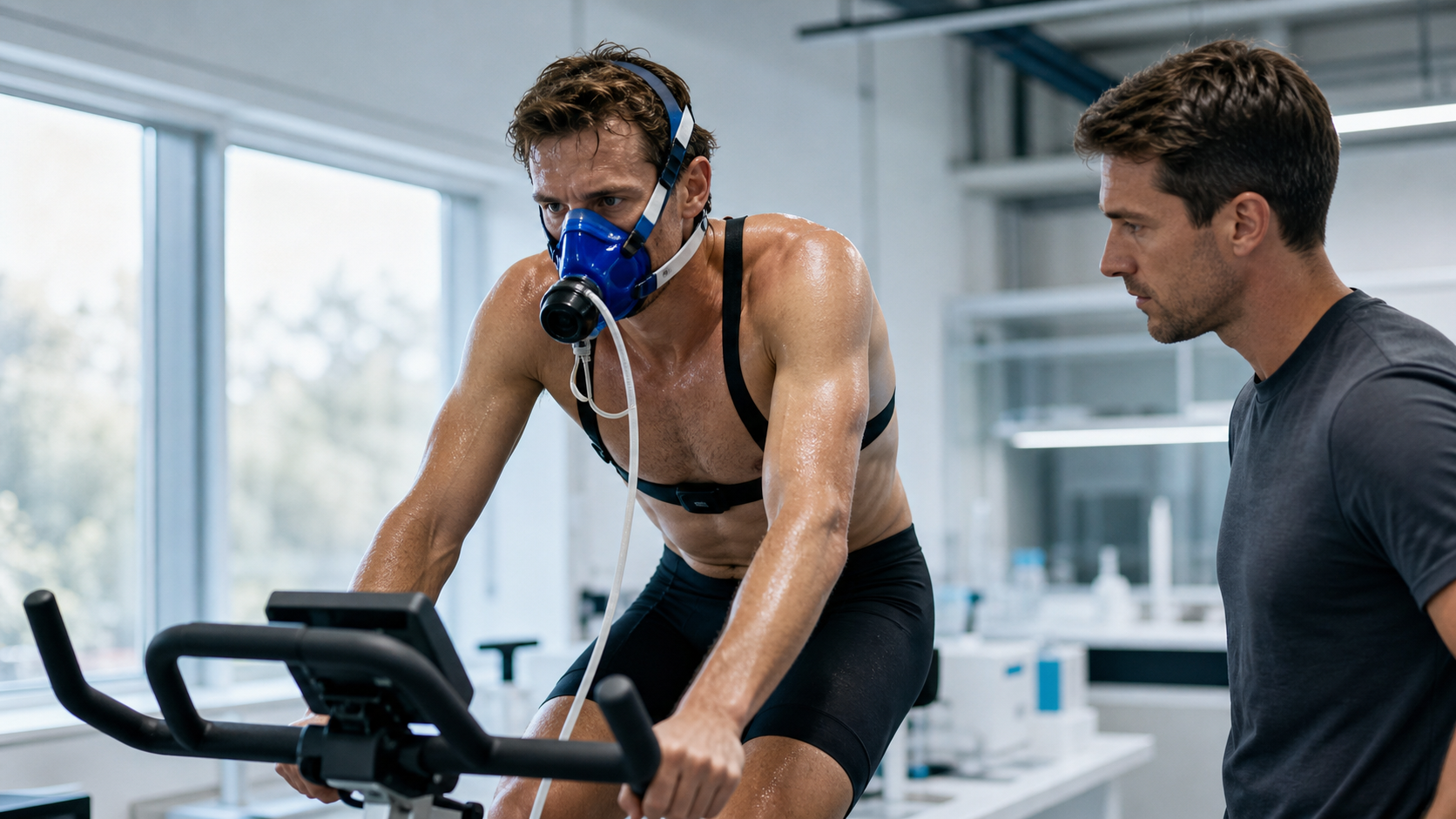
Coach’s Opening: The Athlete Held Hostage by His VO2max Number
Years ago, I coached an athlete—let’s call him A-Zhe. He was an engineer with a numbers-driven mind. When the testing equipment first spat out a VO2max of 52 mL/kg/min, he looked like he’d been handed a life sentence. “Coach, the internet says Kona qualifiers are all 70 and up. Is my life just over?”
I remember I didn’t answer him right away. Instead, I asked, “What was your finishing time at your last Ironman 226?” He said 11 hours 40 minutes. I said, “You know what? With your VO2max, if we refine your pacing strategy, nutrition, and running form, you have a shot at going under 11 hours. And that guy next to you with a VO2max of 58? He blew up at the 40K mark and walked to the finish in 13 hours.”
This is the first thing I want to make clear after fifteen years of coaching athletes—from first-timers crossing their first finish line to those earning Kona slots: VO2max is an important physiological metric, but it is far from a verdict on your performance. It’s the engine’s maximum displacement, but racing is about how long you can run that engine, how efficiently, and how well you manage the throttle.
In this article, I want to walk you through the complete picture of VO2max: what determines it, how high the ceiling is, whether you can train it up, how long that takes, and—most importantly—what it actually means for your finish time. I’ll give you sample workouts, common training mistakes, and specific action plans for athletes at different levels. By the end, I hope you’ll be like A-Zhe and shift your focus from “that number” back to “how to race better.”
Foundational Concepts: What Exactly Is VO2max Measuring?
A One-Sentence Definition
VO2max, or maximal oxygen uptake, is the maximum amount of oxygen your body can take in, transport, and utilize per minute during exercise at maximal intensity. The unit is typically mL/kg/min (milliliters of oxygen per kilogram of body weight per minute), though some use the absolute value in L/min (liters per minute).
Why oxygen? Because aerobic metabolism—combining carbohydrates and fat with oxygen to produce ATP for muscle contraction—is your primary energy source during prolonged endurance exercise. The more oxygen you can take in and use, the higher the power or pace you can theoretically sustain. That’s why VO2max is often described as the “maximum displacement of your aerobic engine.”
What Parts Make Up This Engine?
VO2max isn’t the achievement of a single organ; it’s the combined performance of an entire “oxygen delivery chain.” Here’s how I break it down for my athletes:
- Heart (the pump): Maximal cardiac output is the number one factor determining VO2max. Cardiac output = stroke volume × heart rate. Elite endurance athletes have larger left ventricles and pump more blood per beat—this is the core reason their engines are so big.
- Blood (the carrier): Hemoglobin concentration and total blood volume. Hemoglobin carries the oxygen; the greater your total blood volume and red blood cell count, the more oxygen you can transport per trip. This is also why altitude training—and certain banned blood manipulations—can affect this number.
- Blood vessels and microcirculation (the delivery pipeline): Capillary density in the muscles determines whether oxygen can be effectively delivered to the working muscle fibers.
- Muscle (the end-user factory): Mitochondrial density and quality, aerobic enzyme activity, and muscle fiber type. Even if oxygen is delivered, you need a capable factory to utilize it.
- Lungs (the air intake): For the vast majority of healthy people and amateur athletes, the lungs are not the bottleneck. A few elite athletes experience exercise-induced arterial hypoxemia at maximal efforts, but that’s a different level of problem.
Key point: For most people, the VO2max ceiling is primarily limited by “how much blood the heart can pump” and “how much oxygen the blood can carry,” not “how much air the lungs can breathe in.” This also explains why training to improve VO2max is essentially about forcing the heart and circulatory system to adapt.
I often use this analogy with athletes: imagine a water pipeline running from a reservoir (the heart) through a main trunk line (large blood vessels), branching pipes (capillaries), and finally irrigating a field (the muscles). If any section is blocked, the maximum flow of the entire line is limited by that section. The point of training is to expand the reservoir, thicken and multiply the pipes, and open more irrigation gates in the field. This is also why a single type of training stimulus is rarely enough to push VO2max all the way to your ceiling—you need to address every link in the chain, which takes time, periodization, and patience.
Why Is Body Weight the Denominator?
Because in sports like running and climbing that require fighting gravity, you have to move your own body weight. The same 5.5 L/min engine, placed in a 55 kg person, yields 100 mL/kg/min; in a 75 kg person, it drops to 73 mL/kg/min. This is why mountain bikers, climbers, and marathoners tend to be lean—not because their engines are particularly large, but because their “displacement divided by vehicle weight” is especially favorable.
In triathlon, this is interesting: swimming is horizontal with buoyancy support, so body weight matters less; cycling on flat terrain mainly depends on absolute power and aerodynamics; only in running and climbing does body weight significantly amplify or diminish your relative VO2max. That’s why I never tell athletes to mindlessly cut weight to chase that mL/kg/min number—that’s often penny-wise and pound-foolish.
How High Is the Ceiling? Let’s Look at Human Extremes
Let’s establish some coordinates first. According to records circulating in sports science, the highest VO2max values measured in laboratories belong to endurance athletes, and the numbers are almost absurdly high:
| Subject | VO2max (mL/kg/min) | Sport |
|---|---|---|
| Average sedentary adult male | 35–45 | — |
| Average sedentary adult female | 27–38 | — |
| Serious amateur triathlete | 50–60 | Triathlon |
| Professional endurance athlete (male) | 70–85 | Cycling / Marathon |
| Greg LeMond (Tour de France champion) | ~92.5 | Road cycling |
| Bjørn Dæhlie (cross-country skiing legend) | ~96 | Cross-country skiing |
| Oskar Svendsen (Norwegian, measured at age 18) | ~97.5 | Road cycling |
| Highest female record (Joan Benoit, 1984 Olympic marathon champion) | ~78.6 | Marathon |
(Values compiled from the topendsports world VO2max records list; see references at the end.)
There are a few observations worth remembering:
First, the highest values almost all come from cross-country skiers. The reason is simple—cross-country skiing heavily engages both upper and lower body muscle groups simultaneously. The more muscle mass recruited, the more oxygen is needed, and the higher the measured VO2max. This also reminds us that VO2max is partly a function of “how much muscle your test movement can recruit,” not just the engine itself.
Second, that 97.5 was measured at age 18. I often bring this up with younger athletes: a large portion of your engine’s potential is written into your genes at birth. Youth, talent, and systematic training are what give you a chance to touch that kind of ceiling.
Third, the female record is around 78.6. This isn’t about women being weaker; physiologically, women have lower hemoglobin concentrations and naturally higher body fat percentages, both of which depress mL/kg/min. Given the same training stimulus, the absolute ceilings for men and women are inherently different. Holding female athletes to male records is neither fair nor scientific.
For us mere mortals, the point of this table isn’t to chase 90—it’s to help you recognize: your absolute ceiling might be 55, 65, or 75, and a large part of that is genetically determined; but how far you currently are from your own ceiling—that’s the part training can change.
Trainability: Can You Improve It? Yes, But the Magnitude Varies
This is the most critical and most misunderstood part of this entire article. Let me illustrate with a famous large-scale study.
What the HERITAGE Family Study Tells Us
A study called HERITAGE had a large group of previously sedentary subjects complete 20 weeks of standardized aerobic training, then observed changes in their VO2max. The results were highly illuminating:
- On average, VO2max increased by about 400 mL/min (absolute value)—a solid improvement.
- But individual variation was enormous: some people barely improved, while others improved by more than 1000 mL/min (1.0 L/min). The same training program produced wildly different responses.
- The study also found that this “trainability” itself shows clear familial clustering—variation between families was 2.5 times greater than variation within families. In other words, whether you respond to training is partly inherited.
- The study estimated the heritability of VO2max training response at approximately 47%.
Putting these points together, here’s what I want to convey:
First, almost everyone can improve their VO2max with training—that’s the good news. As long as you weren’t exercising before and start training regularly, a bigger engine is almost guaranteed.
Second, the magnitude of improvement varies from person to person—that’s a reality you must accept. Some people are naturally “high responders” who improve dramatically with a little training; others are “low responders” who have to work much harder to squeeze out the same gains. That’s not your fault, and it’s not a lack of effort—it’s the genetic lottery.
Third, the ceiling is also inherited. Your starting point and your upper limit both have genetic input. That’s why some people score 60+ on their first test, while others can only reach the low 50s no matter how hard they try.
From Average to Elite: The Scale of Trainability
Based on my experience coaching athletes, here’s a rough coordinate system for you (ranges, not precise guarantees):
| Starting State | Possible Relative Improvement After 6–12 Months of Systematic Training | Notes |
|---|---|---|
| Completely sedentary, just starting | +15% to +25% | Biggest beginner gains; most noticeable in the first six months |
| Amateur athlete with some base | +5% to +15% | Requires more structured high-intensity stimulus |
| Veteran athlete with years of training | +1% to +5%, or even plateau | Approaching personal ceiling; diminishing marginal returns |
The most brutal and most important row is the last one. The longer you’ve trained and the closer you are to your ceiling, the harder it becomes to push VO2max higher. An athlete who has trained for five years and is stuck at 62 might need to put in more effort to reach 65 than a beginner needs to go from 45 to 55—and it still might not happen.
What does a smart coach do then? Not keep grinding away at those 3 points of VO2max, but shift to optimizing “what percentage of your VO2max you can sustain”—in other words, lactate threshold and exercise economy. That’s the focus of the next section.
Altitude, Heat, and Blood: Variables That “Move” the Number
There are also several factors that cause VO2max to fluctuate, and it’s worth knowing them so you don’t get spooked by short-term swings:
- Altitude: The partial pressure of oxygen drops with elevation. The same person measured at Wuling (about 3,275 meters) will show a lower VO2max than at sea level. This is why many elite athletes use “live high, train low”—living at altitude to stimulate red blood cell production, then training back at lower elevations to maintain intensity. But altitude adaptation varies by individual; going up blindly without monitoring can actually hurt your training.
- Blood volume and hydration status: Dehydration directly reduces plasma volume and stroke volume. If you don’t drink enough the day before a test, the number will look bad. This is especially important to watch in Taiwan’s summer.
- Anemia or iron deficiency: Low hemoglobin means low oxygen-carrying capacity, and VO2max drops accordingly. Endurance athletes—especially women and vegetarians—are at higher risk of iron loss. If you have unexplained long-term performance decline, it’s worth asking a doctor to check your ferritin levels.
- Current fatigue and illness: A bad cold or a week of poor sleep will make the day’s test number come in low. Single measurements are heavily influenced by your state; trends are always more reliable than single data points.
The core takeaway from these reminders: VO2max is not a number carved in stone; it moves with your blood volume, hydration, altitude, and overall state. Don’t treat a single day’s measurement as a verdict on your fate.
The Real Relationship Between VO2max and Performance: Stop Using It as a Report Card
Three Factors That Determine Endurance Performance
Sports physiology has a widely accepted framework: long-distance endurance performance is determined by three factors working together:
- VO2max: The engine’s maximum displacement.
- Lactate threshold (or functional threshold): The percentage of your VO2max you can sustain without falling apart. This determines your “sustainable” pace ceiling in a race.
- Exercise economy: How much oxygen and energy you consume at a given pace. Better economy means the same engine runs more fuel-efficiently and goes farther.
I like the driving analogy: VO2max is the engine’s maximum horsepower, lactate threshold is the RPM ceiling you can cruise at for a long time, and exercise economy is the car’s fuel efficiency. Missing any one of the three means you won’t go fast.
Why a High VO2max Doesn’t Always Mean You’re Fast
Back to A-Zhe from the opening. He beat the athlete with a VO2max of 58 because of the other two factors. Elite marathoners can sustain about 80% to 90% of VO2max for an entire race, while an undertrained person might start accumulating lactate and falling apart at 70% of VO2max. With the same 60-point engine, one person can sustain 85% (equivalent to 51) while another can only sustain 72% (equivalent to 43)—the race results are worlds apart.
This is why, among athletes of similar ability, VO2max often can’t predict who finishes faster. When everyone’s engine is roughly the same size, the race comes down to who has the higher threshold and who runs more economically. VO2max is more like an “entry ticket”—it determines whether you’re qualified to be in the arena, but once you’re in, your ranking depends on other things.
Core concept: VO2max determines your potential ceiling; lactate threshold and exercise economy determine how much of that potential you can cash in. The common mistake amateur athletes make is putting all their attention on raising the ceiling while leaving the “developed percentage” pitifully low.
Practical Methods: How to Train to Improve VO2max
Okay, concepts done—now for the practical stuff. If you’ve assessed and genuinely need to raise your VO2max (typically because your engine is clearly small, or you’re a veteran athlete trying to break through a plateau), the core principle is one sentence: You must actually spend enough time at an intensity close to VO2max to force your heart and circulatory system to adapt.
Where Should the Intensity Be?
The most effective intensity zone for improving VO2max is approximately 90% to 100% of VO2max, which translates to about 90% to 95% of maximum heart rate. Subjectively, it’s that “very breathless, can only sustain for 3 to 8 minutes” kind of suffering. Too easy and the stimulus is insufficient; too hard (like pure sprinting) and it becomes anaerobic and you can’t sustain it long enough.
The key is accumulated time in this zone. Both research and practice point to: if you can accumulate 15 to 25 minutes of effective time near VO2max intensity in a single session, that’s sufficient stimulus. This is usually achieved through intervals, because no one can sustain continuous effort at this intensity for 20 minutes.
Classic VO2max Interval Workout Examples
Here are workouts I actually prescribe to athletes in different disciplines, with intensity described in terms of perceived exertion and heart rate zones (adjust based on your own test data; values are examples):
| Workout Name | Discipline | Content | Target Zone | Suitable For |
|---|---|---|---|---|
| 5×3 minutes | Running | 3 min fast + 3 min easy jog recovery, 5 sets | 90–95% max HR | Runners/triathletes with a base |
| 4×4 minutes (Norwegian) | Run/Bike | 4 min high intensity + 3 min recovery, 4 sets | 90–95% max HR | Intermediate athletes looking to build the engine |
| 30/30 intervals | Run/Bike | 30 sec hard + 30 sec easy, 10–20 reps per set | 95–100% VO2max | Advanced, needs high total stimulus |
| 6×5 minutes (cycling) | Bike | 5 min high power + 3–5 min recovery, 6 sets | Near VO2max power | Road/triathlon bike leg |
| 8×2 minutes | Run/Bike | 2 min all-out + 2 min recovery, 8 sets | Approaching 100% VO2max | Peak phase before race season |
Operational guidelines:
- Frequency: 1 to 2 VO2max interval sessions per week is enough—never do them daily. These workouts place heavy stress on the nervous and circulatory systems; insufficient recovery will backfire.
- Recovery: Don’t stand completely still between intervals. A light jog or easy spin helps you get back to the target zone faster on the next rep.
- Periodization: VO2max work is typically concentrated in the “engine-building” phase 4 to 8 weeks before the race season, then shifts to threshold and race-pace work closer to competition.
- Base first: If you’re doing high-intensity work even when 80% of your training volume should be easy, that’s the real problem. An aerobic base (lots of low-intensity Zone 2) is the foundation that supports these high-intensity sessions. If the foundation is unstable, intervals are just digging a hole for yourself.
Real-World Scenarios in Taiwan
When training VO2max in Taiwan, here’s how I typically set things up:
- Running intervals: Find a flat riverside path (Dajia, Xindian River, or along the Love River all work) or a track, and go in the morning or evening to avoid the midday sun. Taiwan’s summers are hot and humid; at the same heart rate, perceived effort is elevated by heat stress, so you must adjust your pace downward—don’t stubbornly chase winter numbers.
- Hill intervals: In the north, Fengguizui and Yangjin Highway; in central Taiwan, Nenggao Cross-Ridge; in the south, Zhongliao Mountain—these are natural VO2max training grounds. Find a climb you can sustain steadily for 4 to 5 minutes and use the “4×4” concept to repeat it; the gradient will automatically keep you at high intensity.
- Cycling: Long climbs like Wuling or Tatajia are excellent for building the engine, but on regular weekdays I more often have athletes do structured intervals on a trainer, because outdoor traffic lights and road conditions disrupt interval continuity.
Taiwan climate warning: The heat and humidity from May to September are a hidden killer. High temperature and humidity cause heart rate to spike at the same pace and core temperature to rise faster. You think you’re training VO2max, but you might actually be training “heat tolerance plus dehydration.” For high-intensity intervals in summer, shorten the number of reps, increase hydration and electrolytes, and prioritize early morning sessions.
Common Mistakes and Fixes
Having coached so many athletes, I encounter these mistakes almost every season. Let me break them down one by one.
Mistake 1: Treating VO2max as the Only KPI
Symptoms: Every test, you only look at that one number. If it doesn’t go up, you get anxious and even doubt your training is working.
Fix: Demote it to “one of several” metrics. Track your threshold pace, pace at a given heart rate (a proxy for economy), and most importantly—your actual race results. I often tell athletes: VO2max is one item on a physical exam report, not your final grade.
Mistake 2: Turning Every Workout into High Intensity
Symptoms: You think building the engine means being breathless every day, and easy runs feel like “wasting time.”
Fix: This is the most fatal mistake for amateur athletes. Elite athletes do about 80% of their training volume at low intensity and only about 20% at moderate to high intensity (the concept of polarized training). Training everything at high intensity results in—you’re always in the gray zone: too hard to effectively develop the aerobic base, too easy to truly stimulate VO2max, and you end up plateauing while accelerating overtraining. Slow needs to be slow enough, so that fast can be fast.
Mistake 3: Desperately Cutting Weight to Improve mL/kg/min
Symptoms: You see body weight in the denominator and think losing weight is the way to make the number look better.
Fix: Moderate body composition optimization helps, but excessive calorie restriction leads to muscle loss, suppressed hormones, degraded training quality, and can even lead to Relative Energy Deficiency in Sport (RED-S). A shrinking engine is worse than a lighter car. Weight management should be done long-term and sustainably with a nutritionist and coach—not through self-destructive crash dieting a month before a race.
Mistake 4: Getting the Interval Intensity Wrong
Symptoms: VO2max intervals turn into sprints (too fast, becomes anaerobic, can’t sustain) or turn into tempo runs (too slow, insufficient stimulus).
Fix: The correct feel for VO2max intervals is “by the 2nd or 3rd rep you really want to quit, but you grit your teeth and hold the target pace through the last rep.” If you’re puking from an all-out effort on the first rep, you’re going too hard; if you finish all eight reps with ease, you’re going too easy. Confirm with both heart rate and pace—don’t rely on feel alone.
Mistake 5: Ignoring Recovery and Sleep
Symptoms: Your schedule is packed—three high-intensity sessions a week, six hours of sleep—and you wonder why you’re not improving.
Fix: VO2max improvements happen during recovery, not during the workout itself. Cardiac adaptations and blood volume expansion require sleep and nutritional support. When sleep-deprived, the same workouts only accumulate fatigue and fail to build the engine. Recovery isn’t laziness; it’s part of training.
Action Plans for Athletes at Different Levels
There’s no one-size-fits-all answer. Let me give you specific directions based on your level.
If You’re a Beginner (First Triathlon, Finish-Line Oriented)
- Don’t rush into VO2max intervals. Your biggest gains right now are in the aerobic base. Spend the first 3 to 6 months accumulating lots of easy, conversational low-intensity mileage, and the engine will grow on its own.
- At this stage, VO2max improvement is the largest of any phase (possibly +15% to +25%), and most of it comes from “regular exercise” itself—no complex workouts needed.
- Focus on building habits, learning to control intensity with heart rate or feel, and developing solid technique in swim, bike, and run. Finishing a race depends on endurance and pacing, not explosive power.
If You’re an Intermediate Amateur Athlete with a Base
- You can start scheduling 1 VO2max interval session per week (like 5×3 minutes or 4×4 minutes), placed in the base-building phase before race season.
- But at the same time, seriously invest in lactate threshold training (tempo runs, sweet-spot cycling). The marginal benefit to your performance is often higher than squeezing out more VO2max.
- Start tracking “pace at a given heart rate”—this is a practical indicator of whether your exercise economy is improving. If economy improves, you’ll get faster even if VO2max doesn’t budge.
If You’re a Veteran Athlete Approaching Your Ceiling
- Accept a reality: your VO2max is likely near your personal limit, and the marginal benefit of forcing it higher is very low.
- Shift your training focus to: raising the percentage of VO2max you can sustain at threshold, optimizing race-pace execution, refining nutrition strategies, and strengthening sport-specific muscular strength and economy.
- Keep VO2max intervals in your schedule as a “maintenance stimulus to prevent regression,” but it’s no longer your primary battleground for breakthroughs.
- At this stage, performance breakthroughs come more from “using the engine you already have to its fullest” than from “making the engine bigger.”
General Principles for Everyone
| Training Priority | Beginner | Intermediate | Veteran |
|---|---|---|---|
| Aerobic base (Zone 2) | ★★★ Top priority | ★★★ Foundation | ★★★ Always the foundation |
| VO2max intervals | ★ (hold off) | ★★ 1x per week | ★★ Maintenance |
| Lactate threshold training | ★ | ★★★ High return | ★★★ Main battleground |
| Exercise economy/technique | ★★★ | ★★★ | ★★★ |
| Recovery and sleep | ★★★ | ★★★ | ★★★ |
A FAQ Section for Common Questions
Q: Is the VO2max estimated by my watch accurate?
A: Consumer watches “estimate” VO2max from the relationship between heart rate and pace, which is a different thing from laboratory respiratory gas analysis—absolute values often have errors. But the “trend” is useful—if you use the same watch with the same measurement habits and the number keeps trending up, it usually means your fitness is improving. Watch the trend, don’t obsess over the absolute value.
Q: Does VO2max decline with age? Can it be recovered?
A: Yes, it naturally declines by a certain percentage per decade after adulthood. But the good news is—regular endurance training can significantly slow this decline. Many veteran endurance athletes in their 50s and 60s still have VO2max values far higher than sedentary people in their 20s. Age is a headwind, but training is the strongest paddle you have.
Q: Do triathletes need to train VO2max separately for each of the three disciplines?
A: Part of VO2max is central (heart, blood) and shared across disciplines, while another part is peripheral (specific muscle groups) and sport-specific. In practice, your running VO2max and cycling VO2max won’t be identical. I recommend allocating high-intensity stimulus to your weakest discipline that needs the most improvement, while maintaining base volume in the other two.
Q: Can I improve VO2max with strength training alone?
A: Pure strength training has limited direct impact on VO2max; its main contributions are to strength, economy, and injury prevention. Improving VO2max still requires training that actually places aerobic stress on your cardiorespiratory system. But strength training is a component endurance athletes shouldn’t skip—don’t misunderstand.
Q: How often should I measure VO2max?
A: For amateur athletes, once per training cycle (about 8 to 12 weeks) is plenty. Measuring too frequently is meaningless because short-term fluctuations (hydration, fatigue, daily state) will mask true training adaptations. I typically schedule a baseline test before the base-building phase and another at the end of the cycle to see the trend. Rather than obsessing over weekly numbers, use practical metrics like “timed effort on a fixed course” or “pace at a given heart rate”—those are closer to the race performance you actually care about.
Q: My VO2max is decent, but I always fall apart in the back half of races. What’s the problem?
A: This is almost the most common complaint I hear, and the answer is almost never the engine. It’s three things: first, pacing is too greedy—you start at an intensity above threshold, and the bill always comes due; second, nutrition isn’t on point—late-race slowdowns are often glycogen depletion and dehydration, not an underpowered engine; third, your aerobic base isn’t deep enough—your engine is big but lacks endurance. Fix these three things, and you’ll often see more performance gains than from raising VO2max further. A big engine that falls apart late is usually a “fuel tank design” and “driving technique” problem, not a “horsepower” problem.
Conclusion: Put the Number Back in Its Proper Place
Back to A-Zhe. That season, I didn’t have him do more VO2max intervals to chase that number. We focused on raising his threshold pace, fixing his habit of starting too fast, and dialing in his nutrition so he stopped fading in races. His VO2max only crept up from 52 to 54, but his 226 time improved from 11 hours 40 minutes to 10 hours 52 minutes.
That improvement came almost entirely not from “a bigger engine,” but from “using the engine better.”
That’s the one sentence I want to leave you with: VO2max determines how high your ceiling is, but what determines how high you actually stand is how you train, pace, fuel, and recover. Half of the ceiling is written in your genes, and you can’t change that; but how far you are from your ceiling and how much of that engine you can actually use—that’s entirely in your hands.
Once you understand this, you’ll live with less anxiety and train smarter. Stop being held hostage by a number—go build that threshold, fix that technique, and get that sleep. You’ll find that your race results will answer the question of “can I still get faster” for you.
Next time you test, if the number doesn’t go up, don’t be disappointed. Look at your race results. That’s the real final grade. And if you can only remember one sentence today, I hope it’s this: build the foundation thick, raise the threshold, refine the technique, and get enough sleep. The VO2max number will find its own place once you’ve done all the right things.
This article is educational content and does not replace individual assessment by a physician, physical therapist, or nutritionist. Please adjust training intensity and workouts according to your personal health status and professional guidance.
References
- World VO2max records compilation (values for Oskar Svendsen, Bjørn Dæhlie, Greg LeMond, Joan Benoit, etc.): https://www.topendsports.com/testing/records/vo2max.htm
- HERITAGE Family Study—familial aggregation and heritability of VO2max training response (~47%, average improvement ~400 mL/min, large individual variation): https://pubmed.ncbi.nlm.nih.gov/10484570/
- Why cross-country skiers have particularly high VO2max (the effect of recruited muscle mass): https://velo.outsideonline.com/road/road-training/cold-climate-big-engines-why-do-scandinavians-have-such-high-vo2max-scores/
Related Reading
- Complete Guide to VO2max: Measurement, Meaning, and Trainability
- Improving Cycling VO2max: A Complete Analysis of Mechanisms and Training Strategies
- VO2max Fully Explained: What It Measures, How Much You Can Train It, and Why It Doesn’t Decide Your Ranking
- VO2max Training Methods: What Maximal Oxygen Uptake Means for Road Cyclists
#公路車 #Vo2Max #最大攝氧量 測驗 體驗 | 心肺測試
6 年前
如果Pogačar騎西進武嶺可以多快?會破2嗎?各種情況深度推估探討 / 公路車 / CT Yeh
2 年前
西進武嶺 免費訓練分析服務 Intervals | 練不夠還是練過頭?你哪一種類型選手?AI模型告訴你! | 備戰神器 | 公路車 訓練 | CT Yeh
4 年前
一日北高 11小時 賽後心得分享篇 | TWB北高360 | 一日雙城 | 單車 | 公路車
6 年前
一個測試有沒有認真練車的方法😂 #公路車
10 個月前
一日北高前的西濱集訓 | 跟著11小時軍團 | 300W踩不動的大逆風 | 輪車破風差幾瓦?
6 年前
一日北高 11小時 挑戰實錄 原來北高半天就騎完了... 2020 twb360
6 年前
實景訓練台) 彰化經典百K 高強度喵團 90分鐘 跟著一起練功 2019 Indoor workout Changhua Classic 100 Taiwan
7 年前