Running Biomechanics: Footstrike Patterns, Loading Rate, and Injury Risk—A Coach's Guide to Understanding the Truth Behind the Data
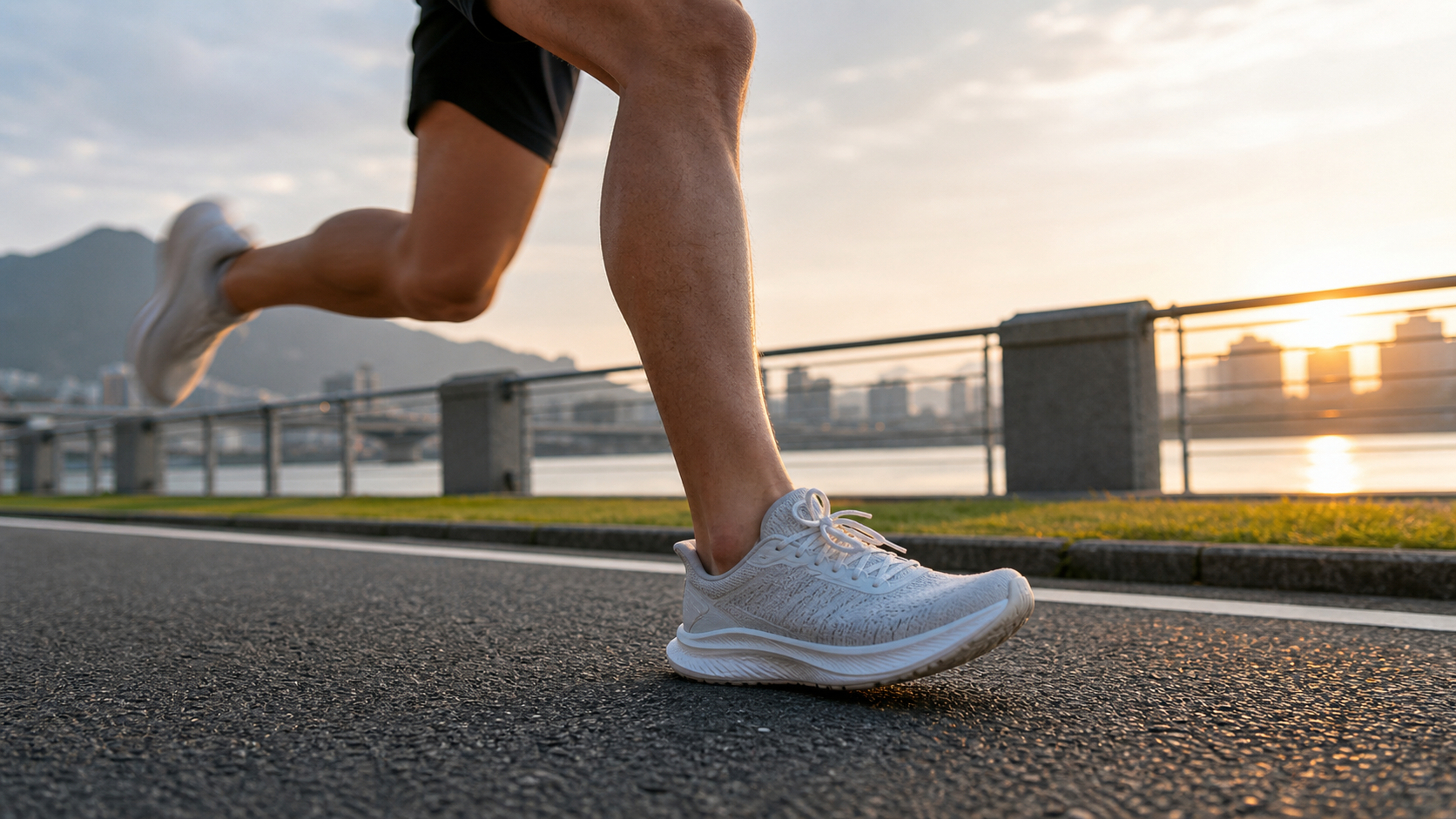
Coach’s Opening: The Runner with Shin Pain in Guandu
Let me start with a real scenario (the person is fictional, but I encounter this situation several times a year).
Last winter, a runner named A-Kai came to me, preparing for the Taipei Marathon while also training for a 51.5 triathlon. His running ability was actually decent—he could hold a 10K under 45 minutes—but he had a recurring issue: whenever his weekly mileage crept past 50 kilometers, he’d feel a dull ache along the middle-to-lower section of the tibia on the inside of his right leg. A few days of rest would ease it, but adding volume brought it right back. He’d done his own research online and reached a conclusion—“Coach, should I switch to forefoot striking? I heard heel striking is bad for you.”
I’ve heard this exact statement no fewer than a hundred times over the years. Online, in running shoe ads, and even from some coaches, there’s a dangerously oversimplified belief floating around: heel striking = injury, forefoot striking = efficient and healthy. In this article, I want to break this down for you using my fifteen years of experience coaching athletes, plus the sports science literature I continuously read.
Let me give you the conclusion up front so you’re not left confused by the end: The foot strike pattern itself isn’t the key issue—“loading rate” is—and changing your foot strike is just one of several ways to influence it, while simultaneously shifting the risk from one body part to another. No single foot strike pattern is best for everyone. This article will walk you through why.
1. Let’s Clarify the Terms: Foot Strike Patterns and Loading Rate
Three Types of Foot Strike
The part of the foot that first contacts the ground while running can be broadly divided into three categories:
- Rearfoot Strike (RFS): The heel lands first. This is the natural pattern for most recreational and amateur runners wearing modern cushioned shoes. Research estimates that roughly 80–90% of runners in the back half of a marathon fall into this category.
- Midfoot Strike (MFS): The middle of the foot contacts the ground nearly simultaneously, with the landing point typically closer to directly beneath the body’s center of mass.
- Forefoot Strike (FFS): The ball of the foot (near the metatarsal heads) lands first, with the heel coming down afterward or not fully touching down at all. This is common in sprinting, speed workouts, and among some elite distance runners.
Let’s bust the first myth here: Foot strike is not a black-and-white classification but a continuous spectrum. The same person may be a rearfoot striker during easy runs, then naturally shift to a midfoot or forefoot strike at a 4:00/km pace. Speed, incline, fatigue, and shoe type can all change it.
What Exactly Is Loading Rate
This is the most important concept in this entire article, so please make sure you understand it.
When your foot lands, the ground exerts a reaction force on your body (Ground Reaction Force, GRF). Loading rate doesn’t refer to how large this force is, but rather how quickly it “rises”—that is, the rate at which force is applied to the body between initial ground contact and the first impact peak.
Here’s an analogy to make it clear: if 100 kilograms of weight is placed on you, “slowly lowering it onto you” versus “dropping it on you” causes completely different levels of harm. Loading rate measures that “dropping” abruptness, typically expressed in body weights per second (BW/s).
Two metrics are commonly used in research:
- Average Vertical Loading Rate (AVLR)
- Instantaneous Vertical Loading Rate (IVLR)
Both measure how steeply the impact force rises. According to multiple systematic reviews and prospective studies, excessively high loading rates are associated with overuse injuries such as tibial stress fractures. This is a conclusion with relatively solid evidence behind it, and the table below will lay it out more clearly.
Why Rearfoot Striking Is Often Said to Be “More Harmful”
The key lies in something called the “impact peak.”
When you land directly on your heel, and the landing point is also ahead of your body’s center of mass (overstriding), a sharp first peak appears on the vertical ground reaction force curve, followed by a second peak as your center of mass passes over. This sharp first peak represents force being driven into the lower leg and foot in an extremely short time—in other words, a high loading rate.
In contrast, with a forefoot or midfoot strike, the ankle and calf muscles (especially the triceps surae) perform an eccentric contraction first to absorb the shock, “smoothing out” that sharp first peak, and the loading rate consequently drops. A consistent finding across multiple systematic reviews is: habitual rearfoot strikers do have higher vertical loading rates than forefoot strikers.
At this point you might say: “Well then, that settles it—just switch to forefoot striking!” Hold on, because this is exactly where most people fall into the trap.
Understanding Loading Rate with a Real-Life Example
Many runners still find “loading rate” too abstract, so here’s how I usually explain it. When you jump off a flight of stairs and land stiffly on your whole foot with straight knees, you feel a “thud” that rattles your head—that jolt is a high loading rate. But if you let your knees and ankles bend naturally on landing to absorb the force, it feels much softer—that’s a low loading rate. Every step of running is essentially a mini “jump off the stairs,” and over the course of a long run, you repeat this motion thousands of times. The difference in a single step is imperceptible, but multiply it by ten thousand steps, then by your weekly, monthly, and full-season accumulation, and tiny differences in loading rate will determine whether your bones and soft tissues can hold up.
This is also why overuse injuries are different from acute sprains. They’re not “caused by one bad step” but rather “the accumulation of thousands of steps of micro-overload exceeding the tissue’s repair rate.” Understanding this, you’ll see why I always emphasize that “load management” matters more than “perfecting the posture of any single step.”
2. The Scientific Foundation: What the Evidence Actually Says and Doesn’t Say
I’ve organized the points where the sports science community currently has relative consensus into the table below. Please pay attention to the differences in “evidence strength” in each row—this is the biggest divide between professional coaches and internet rumors.
Table 1: Evidence Comparison of Foot Strike Patterns and Injury
| Claim | Direction of Evidence | Evidence Strength and Caveats |
|---|---|---|
| Rearfoot strikers have higher vertical loading rates than forefoot strikers | Supported | Consistently supported by multiple systematic reviews and meta-analyses; relatively reliable |
| High vertical loading rate is associated with tibial stress fractures | Supported | Supported by prospective studies (tracking uninjured individuals for subsequent injury); association is clear |
| Forefoot striking = lower overall injury risk | Inconclusive | Forefoot reduces impact-type loading but shifts the load to the Achilles tendon, calf, and metatarsals, trading for a different category of injury |
| Switching to forefoot striking cures all running injuries | Not supported | Oversimplified; changing foot strike is a risky intervention that requires gradual progression |
| Total ground reaction force “magnitude” differs between those with and without stress fractures | Tends toward not supported | Meta-analyses show the difference lies mainly in “loading rate” rather than total force magnitude |
Please pay special attention to rows three and four. Forefoot striking does indeed smooth out the sharp impact peak, but the price of smoothing it is placing greater eccentric load on your triceps surae and Achilles tendon. This is why many people experience severe Achilles and calf pain right after switching to a forefoot strike—you’ve simply relocated the risk from the knee and tibia to the Achilles tendon and metatarsals.
Table 1-2: The “Injury Relocation” Comparison of Different Footstrike Patterns
This is the table I most want everyone to remember. It clearly shows that changing your footstrike isn’t about eliminating risk—it’s about “swapping one set of risks for another.”
| Tendency | Areas Typically Unloaded | Areas Typically Loaded More | Who Should Consider This |
|---|---|---|---|
| Rearfoot strike bias | Achilles tendon, calves, metatarsals | Front of knee, tibia (if overstriding causes high impact peaks) | Those with prior calf/Achilles injuries |
| Forefoot/midfoot strike bias | Front of knee, tibial impact peaks | Achilles tendon, triceps surae, metatarsals | Those with anterior knee pain or tibial stress reactions (provided calves are strong enough) |
See the pattern? There is no column where “everything becomes easier.” So the right question isn’t “which is better,” but rather “Given my current injury location and strength status, where should I shift the load?” — this requires individual assessment, not a one-size-fits-all formula.
This Matters Especially for Triathletes
In triathlon, the run comes third, after swimming and cycling. When you dismount, with your legs already drained from a bike leg dominated by quadriceps and gluteal work, your calf and ankle control during those first few kilometers of the run is compromised. If you normally rely on a forefoot strike with calf-based shock absorption, fatigue will cause that cushioning mechanism to fail, and your loading rate may quietly spike in the later stages.
When coaching 226 Ironman athletes, what I emphasize isn’t “which footstrike to use,” but rather “maintaining stable landing mechanics under fatigue.” That’s the real battleground in endurance sports.
An Often-Overlooked Variable: Tissue Adaptation Takes Time
Here, I want to establish a critical concept for you—bones, tendons, and ligaments adapt far more slowly than your cardiovascular system.
Your heart, lungs, and muscles adapt to training within weeks; but bone remodeling to withstand new loading patterns often takes weeks to months. This is why so many people feel “I could still keep running,” yet their bones break down first. When you change your footstrike, switch to new shoes, or suddenly increase mileage, you’re essentially giving your bones a new load they aren’t prepared for—and their protest is often delayed by weeks. By the time you notice, it’s already a stress reaction or even a fracture.
I often tell my athletes: “Your heart and lungs want to run a marathon, but your tibia might only want to run five kilometers. Train according to the slowest-adapting tissue.” That sentence has saved more of my athletes’ seasons than any running form theory.
III. Practical Methods: How to Actually Reduce Your Injury Risk
Alright, enough theory—let’s get to something actionable. I want to emphasize one core idea:
Don’t fixate on “changing your footstrike”—focus on “reducing your loading rate.” There are several paths to lowering loading rate, and changing footstrike is just one of them—and not the safest one.
Four Paths to Lower Loading Rate (Ranked by Safety)
Path One: Increase Cadence—Safest, Highest Value
This is my first prescription for about 90% of athletes with mild impact-related pain. Most recreational runners have a low cadence (around 160 steps per minute), landing with their foot too far in front of their center of mass, causing overstriding and sharp impact peaks.
The method is simple: increase your current cadence by about 5 to 10%. If you’re at 166 steps per minute now, try bringing it up to around 175. Your stride length will automatically shorten, your landing point will move closer to your center of mass, the impact peak will naturally blunt, and your loading rate will drop—all without you having to consciously “think” about which part of your foot lands first. Using your watch’s metronome or finding a song at 175 BPM is highly effective.
Path Two: Shorten Stride, Land Closer to Center of Mass—Addressing Overstriding
This is really two sides of the same coin as increasing cadence. Overstriding (landing with your foot ahead of your knee/center of mass, with a straight leg acting as a “brake”) is the number one culprit for high loading rates. Imagine running along an imaginary straight line, letting your foot land roughly beneath your pelvis, with a slight bend in the knee to “catch” the ground rather than “stomp” it.
Path Three: Lean Forward Slightly, Land Softly—Use Your Ears, Not Just Feel
Here’s a great self-check: the sound of your running. If your footfalls are loud and heavy—“slap, slap, slap”—that usually means your landing is hard and your loading rate is high. Try to run more “quietly.” This auditory feedback is surprisingly effective.
Path Four: Only Then, Change Footstrike—Highest Risk, Requires the Most Gradual Progression
Only after you’ve adjusted the first three, and you (or your physical therapist) still assess that moving toward a midfoot strike is necessary, should you take this step. And it must be extremely gradual—the next section covers how.
Table 2: Sample 8-Week Progressive Landing Mechanics Adjustment Plan
Below is a progressive adjustment example I designed for a recreational runner with ~40km weekly mileage and mild tibial soreness. This is an example, not a prescription—actual plans must be tailored to the individual.
| Week | Primary Goal | Specific Actions | Weekly Mileage Adjustment |
|---|---|---|---|
| Weeks 1-2 | Establish cadence awareness | During the middle 10 minutes of each run, use a metronome to increase cadence by 5% | Maintain current volume or reduce by 10% |
| Weeks 3-4 | Extend high-cadence periods | Extend metronome sessions to 20-30 minutes; aim for “quiet” footfalls | Maintain |
| Weeks 5-6 | Add short technical runs | 2x per week, 6-8 x 100m, focusing on light, quick, landing near center of mass | May increase slightly |
| Weeks 7-8 | Integrate into normal pace | Remove the metronome, let the new cadence become natural; add tempo run testing | Return to 90% of target volume |
If pain increases rather than decreases during this process, stop immediately and seek professional assessment—don’t push through. Changing landing mechanics affects the entire kinetic chain and requires time for tissues to adapt.
If You Really Must Adjust Toward Forefoot/Midfoot: Pay Your Calves’ “Overtime” First
Changing footstrike significantly increases eccentric load on the Achilles tendon and calves. Before I have any athlete make this adjustment, I always schedule at least 4 to 6 weeks of calf and Achilles strength preparation, with key exercises including:
- Calf raises: Both straight-knee and bent-knee versions—the bent-knee version targets the soleus, which is crucial for running shock absorption.
- Eccentric calf lowers: Raise on both feet, lower slowly on one foot, to build Achilles tendon tolerance.
- Single-leg balance and ankle stability work: Triathletes have compromised ankle control after the bike leg, so this needs extra emphasis.
A Realistic Progressive Case Study: Xiao-Min’s Midfoot Transition
Here’s a scenario for you (fictional person, real methods). Xiao-Min is a female runner with three years of experience aiming to break 4 hours in the marathon. Her issue was recurrent lateral patellar pain in her right knee. After assessment, her physical therapist determined she had significant overstriding and knee valgus (inward collapse) at landing. We didn’t start by telling her to “switch to a midfoot strike.” Instead, we did this:
Month one: Only cadence training and gluteus medius strengthening (side planks, clamshells, single-leg squats)—we didn’t touch footstrike at all. Month two: After her knee pain significantly decreased, we added short technical runs, allowing her to naturally bring her landing point back under her body. At this point, her footstrike naturally shifted from an exaggerated heel slam to something closer to a whole-foot midfoot landing—note that we never told her to “land on her forefoot”; the midfoot pattern was a natural result of shortening stride and increasing cadence, not a deliberate toe-tapping motion. In month three, she ran a 3:57 marathon with zero knee pain throughout.
The key takeaway from this case: Changes in footstrike are best achieved as a natural byproduct of adjusting cadence and stride—not as a goal you force by staring at your feet. For every ten runners who force a forefoot strike, eight end up with Achilles injuries.
IV. Common Mistakes and Corrections
After years of coaching athletes, I’ve compiled the most common mistakes people make regarding landing mechanics into a checklist. See if any of these hit home.
Mistake One: Going Full Barefoot/Minimalist Overnight
A few years ago, the minimalist shoe trend swept through, and plenty of people bought a pair and immediately started running 10km daily in them—resulting in a wave of metatarsal stress fractures. The problem isn’t the shoe; it’s too much, too soon. Minimalist shoes force you to change your landing mechanics, but your calves, arches, and metatarsals aren’t ready. If you want to use them, you have to start with a few hundred meters per session and build up gradually over weeks.
Mistake 2: Confusing “Forefoot Strike” with “Running on Your Toes”
Many people, upon hearing about forefoot striking, immediately start running on their tiptoes with their heels never touching the ground. This is a catastrophic misunderstanding. In a true forefoot/midfoot strike, the ball of the foot contacts the ground first, but the heel still gently lowers, allowing the Achilles tendon to perform eccentric cushioning. Running on your toes the entire time will cause your calves to cramp and feel like lead within a few kilometers, and your Achilles tendon will be sent straight to the ICU.
Mistake 3: Only Adjusting Upper Body Posture, Ignoring Cadence
Some people aggressively thrust their chest forward and lean, but fail to address the core issue of overstriding, resulting in zero reduction in loading rate. Remember the priority order: Cadence and foot strike position > strike pattern > upper body details.
Mistake 4: Ignoring Mechanical Breakdown Under Fatigue
Your perfect foot strike on a treadmill when you’re fresh is a completely different thing from your foot strike at the 35km mark of the Taipei Marathon when your legs are turning to jelly. Injuries often happen in those final kilometers when your form collapses. The goal of endurance training is to make good mechanics last until the finish line, which is achieved through strength and accumulated long-distance mileage, not by staring at your feet.
Mistake 5: Treating Foot Strike as a Performance Panacea
Let me be clear on this final point: There is currently no reliable evidence supporting that any single foot strike pattern will make everyone “run faster.” Among elite runners, you’ll find heel, midfoot, and forefoot strikers. Changing your foot strike is primarily for managing injury risk and personal comfort, not a magic guarantee of speed.
5. The Interaction Between Shoes and Mechanics
Running shoe technology has changed dramatically in recent years, with carbon-plated, thick-soled shoes dominating the market. I must discuss how shoes and landing mechanics influence each other.
How Shoe Drop Guides Your Foot Strike
Shoe drop refers to the difference between the heel height and the forefoot height. Traditional running shoes have a higher drop (10-12mm), and the elevated heel “encourages” you to land heel-first; low-drop shoes (0-6mm) tend to induce a midfoot strike.
But here’s a crucial point that’s often overlooked: The cushioning of a shoe changes the impact you “feel,” but doesn’t necessarily change the actual loading rate transmitted to your bones. Thick, soft midsoles dampen your proprioception, and some people actually land harder in them (because they can’t feel the hardness, so they confidently slam down). This is why some people develop new aches and pains shortly after switching to ultra-thick carbon-plated shoes.
Performance Shoes vs. Daily Trainers: Use Them Separately
My advice to athletes has always been “have two or three pairs in your rotation”:
- Daily trainers: Moderate cushioning, moderate drop, durable. For easy runs and long distances.
- Carbon-plated race shoes: Only for key speed workouts and race day. Their propulsion benefits are real, but they place higher stress on the calves and Achilles tendon, and wearing them daily can lead to cumulative injuries.
- The purpose of rotation: Different shoes distribute the load across different tissues, preventing one area from repeatedly absorbing the exact same loading pattern. This helps reduce overuse injuries.
Table 3: Mechanical Role and Usage Timing of Three Shoe Types
| Shoe Type | Drop Tendency | Mechanical Characteristics | Recommended Usage |
|---|---|---|---|
| High-cushion trainers | Medium-high (8-12mm) | Thick cushioning, good protection, weaker proprioception | Easy runs, long distances, recovery runs |
| Low-drop/natural shoes | Low (0-6mm) | Induces midfoot strike, trains feet and calves, requires adaptation period | Technique runs, short distances, progressive strengthening |
| Carbon-plated race shoes | Varies by model | Excellent energy return and propulsion, high calf/Achilles load | Key speed workouts, race day |
Don’t Wear New Shoes for the First Time on Race Day
This is a lesson learned through blood and tears. Every year before the Taipei Marathon, Tanaka Marathon, and Taroko Marathon, I encounter students who’ve excitedly bought new carbon-plated shoes and want to “bless” them on race day. Please don’t. New shoes must be worn in training at least a few times, accumulating 20-30 kilometers or more before racing in them, allowing your body to adapt to the changes in landing mechanics they introduce. Wearing brand-new shoes on race day is like deliberately introducing an untrained variable to your body on the very day you need consistent performance. I’ve seen too many cases of Achilles cramps, blisters, and even completely broken-down running form. Taiwan’s autumn and winter marathon season is packed with races, so your shoe plan should be scheduled together with your training cycle.
Factor in Taiwan’s Hot and Humid Environment
This point resonates especially with Taiwanese athletes. Running long distances along the riverside in summer (like Dajia, Guandu, or the Xindian River bike paths), where temperatures often exceed 32°C and humidity tops 80%, causes feet to swell, shoes to get wet, and socks to slip. A wet, slippery shoe environment makes your landing unstable and causes you to subconsciously tense your calves, which in itself alters your mechanics. Recommendations:
- Choose shoes with good drainage and breathability for summer long runs, and use lacing techniques to keep the heel stable and prevent slipping.
- Stay on top of fueling; dehydration and electrolyte loss accelerate muscle fatigue, and once fatigue sets in, your landing mechanics collapse. Sweat rates are high outdoors in Taiwan, so consuming 500-800ml of fluid per hour with electrolytes is a common range (adjust based on your individual sweat rate).
- Athletes who eat out regularly should note that Taiwan’s convenient convenience stores and street food can quickly provide carbs, but don’t forget sodium and potassium. An onigiri plus a banana is a solid pre-race combination.
6. Actionable Advice for Runners of Different Levels
After all that discussion, here are concrete steps you can start today, categorized by experience level.
Beginner Runners / Those Who Just Finished Their First Triathlon
- Don’t touch foot strike yet. Your top priority is safely building mileage, following the general principle of not increasing weekly volume by more than about 10%.
- Work on cadence. This is the highest value-for-effort thing you can do. Find a song at 175 beats per minute and make your landings lighter and quicker.
- Aim for “quiet” landings. Use your ears as feedback—the quieter you run, the better.
- Build foundational strength. Do calf raises, squats, and single-leg balance twice a week to build your foundation.
Advanced Runners / Preparing for a PB or Your First 226
- Get a landing mechanics assessment. Work with a professional coach or physical therapist, using slow-motion video to check for overstriding and how your mechanics change under fatigue.
- Focus on “stability under fatigue.” Schedule strides at the end of your long runs to practice maintaining good mechanics when you’re tired.
- Systematize your shoe rotation. Separate training shoes from race shoes; don’t wear carbon-plated shoes every day.
- If you plan to change your foot strike, follow the full eight-week progressive protocol, and first complete the calf strength preparation phase.
Those with Recurring Injuries / A History of Chronic Pain
- See a medical professional first. Recurring pain in the same spot, especially localized tenderness on the tibia or metatarsals, warrants caution for stress fractures—this requires a physician’s evaluation, not self-treatment through changing your running form.
- Load management takes priority over technique modification. Many chronic injuries are actually “too much volume, too little recovery,” not a posture problem.
- Landing mechanics adjustments must be done under professional supervision, treating it as part of rehabilitation, not something you copy from the internet. Generic online advice won’t save your specific situation; what will save you is a plan tailored to you that adjusts as your recovery progresses.
7. Frequently Asked Questions (FAQ)
Q1: So should I switch to forefoot striking or not?
A: Most people don’t need to proactively change. If you first nail down cadence, overstriding, and strength, your loading rate will usually come down on its own. Only consider adjusting your foot-strike pattern after a professional assessment and when the aforementioned methods have failed—and even then, do it gradually.
Q2: I’m naturally a forefoot striker. Do I need to switch back to heel striking?
A: No, don’t change just for the sake of changing. If you run comfortably with a forefoot strike and don’t have recurring Achilles or calf issues, just go with it and focus on strength and recovery. Your body finds its own economical way of moving. Unless it’s causing you repeated injuries, don’t mess with a system that’s working fine.
Q3: Is landing different on a treadmill versus outdoors?
A: There are some differences. The belt feedback on a treadmill differs from outdoor asphalt or riverside PU tracks. In training, try to cover the surfaces you’ll encounter in your races.
Q4: Will carbon-plated shoes injure me?
A: Carbon-plated shoes aren’t the problem per se—the issue is “wearing them every day with excessive mileage.” Save them for key workouts and race day, and use cushioned training shoes for daily runs. That way you get the benefits while managing the risk.
Q5: Is higher cadence always better? Is 180 the magic number?
A: 180 is just a commonly cited reference value, not a commandment. The point is to moderately increase your cadence relative to where you are now and to correct overstriding—not to force yourself into some arbitrary number. Height, leg length, and pace all affect your optimal cadence.
Q6: Does the “vertical oscillation” shown on my running watch relate to loading rate?
A: Indirectly, yes. Excessive vertical oscillation (bouncing up and down) is usually accompanied by larger landing impacts. Most advanced running watches also provide metrics like ground contact time and cadence. You can use these data as trend references, but they’re estimates, not lab-grade force-plate data. Don’t obsess over any single number—looking at “your own trends over time” is more meaningful.
Q7: My landing differs on uphills and downhills. Anything I should pay special attention to?
A: Yes. On uphills, you naturally shift toward the mid/forefoot and shorten your stride, which is usually good. What you really need to watch is downhills. Taiwan has many trail and mountain races (e.g., various mountain marathons, bridge climb sections in triathlons). On descents, if you slam your heel down with a straight knee, your loading rate can spike to several times what it is on flat ground. On downhills, deliberately increase your cadence, shorten your stride, and keep your knees slightly bent to absorb the impact. This is key to protecting your knees and shins.
A Simple Self-Checklist
Next time you run, check yourself against these five questions:
- How loud is my running? (The quieter, the better.)
- Is my foot landing too far in front of my knee? (Overstriding)
- When I’m tired in the later stages, does my cadence drop noticeably?
- Do I keep getting soreness in the same spot repeatedly? (A warning sign)
- Has my weekly mileage increased by more than 10% compared to last week?
If you answer “yes” to two or more questions, it’s worth your time to make adjustments or get a professional assessment.
8. Conclusion: Don’t Chase the Perfect Foot Strike—Chase Smart Load Management
Let’s go back to A-Kai, the guy with the sore shin from the beginning. The prescription I finally gave him wasn’t “switch to forefoot striking.” It was: raise his cadence from 164 to about 175 steps per minute, bring his weekly mileage increases back into a safe range, do calf and glute strength work twice a week, and separate his training shoes from his racing shoes. Six weeks later, his dull shin pain had almost disappeared, he finished the Taipei Marathon without issues, and he even set a PB by three minutes.
He never “changed his foot strike,” but he successfully lowered his loading rate and managed his training load. That’s what actually works.
I hope this article helps you put oversimplified—and potentially dangerous—claims like “heel striking is bad” into proper context. Foot-strike pattern is a spectrum and a means to an end; loading rate is the metric you should actually be watching. And smart load management plus strength will always get you to that final kilometer healthier than chasing some “perfect running form.”
One last thing I often tell my athletes: Your body doesn’t exist to “run by the book”—it exists to “run for the long haul.” Those veterans who are still running along the riverside, around the island, or up Wuling at age sixty never relied on some perfect running form. They relied on decades of listening to their bodies, adding mileage intelligently, and taking recovery seriously. Technique matters, but it always serves the goal of “running for the long haul”—not the other way around, where you grind yourself into injury chasing some form you saw online. Keep that order straight, and you’ll save yourself a lot of detours.
See you at the riverside.
This article is for educational purposes and does not replace individual assessment by a physician, physical therapist, or nutritionist. If you have recurring or persistent pain, please seek professional medical diagnosis.
References
- Almeida MO, et al. Biomechanical Differences of Foot-Strike Patterns During Running: A Systematic Review With Meta-analysis. Journal of Orthopaedic & Sports Physical Therapy. https://www.jospt.org/doi/10.2519/jospt.2015.6019
- Effects of Foot Strike Techniques on Running Biomechanics: A Systematic Review and Meta-analysis. PMC. https://pmc.ncbi.nlm.nih.gov/articles/PMC7734358/
- Tibial stress fractures: an evidence-based approach. Lower Extremity Review Magazine. https://lermagazine.com/article/tibial-stress-fractures-an-evidence-based-approach
- Biomechanical factors associated with tibial stress fracture in female runners. PubMed. https://pubmed.ncbi.nlm.nih.gov/16531902/
- Influence of Sudden Changes in Foot Strikes on Loading Rate Variability in Runners. MDPI Sensors. https://www.mdpi.com/1424-8220/24/24/8163
Related Reading
- Running Form Analysis: Research on Forefoot vs. Heel Striking
- Running Foot-Strike Analysis: The Biomechanical Trade-offs of Heel, Midfoot, and Forefoot
- Forefoot, Midfoot, or Heel? The Foot-Strike Debate Has No Single Answer—The Key Is Whether You Should Change
- Running Foot-Strike Patterns: A Biomechanical Comparison of Forefoot, Midfoot, and Heel
CT 喇低賽) 武嶺牽車 才是王道 西進牽車四小時內秘訣 攝手位置 如何判斷 防抽筋小秘訣
7 年前
#公路車 #Fitting 靠人工智慧APP 幫你調整單車
6 年前
Never Stop 西進武嶺 前後雙機 完整全程錄影 訓練台 實境
8 年前
大禹嶺 到 武嶺牌樓 全程前後實況錄影 | 北進武嶺 | 東進武嶺 | KOM | 訓練台 | 坡度分析 | Taiwan KOM Last 10 km HARD | 公路車
6 年前
單車AI教練!全新 ChatGPT4o 幫你分析訓練成果!排武嶺課表,分析騎車姿勢! 太神了! / 公路車 / CT Yeh / feat. 緯緯
2 年前
一日北高常見問題大集合 | 攻略 | 路線 | 訓練 | 補給 | 自行車 單車 | 一日雙城 | 雙塔 | TWB北高360 | 屁股痛
6 年前
滑雪新手們慘摔學習全紀錄(請開字幕),滑雪好好玩 | Snowboard + Ski | 岩原 スキー場 | 滑雪APP使用 | GoPro Max
6 年前
一日北高/長距離團騎 常見問題補充篇 / 組團或跟團的眉角 / 壯車友容易被瘦車友慢性拉爆 / 原來屁股痛可能是這個原因...? / 風場配速法 / 公路車 / CT Yeh
2 年前