The Science of Recovery Tools: Massage Guns, Ice Baths, Compression and Foam Rollers — Which Actually Work?
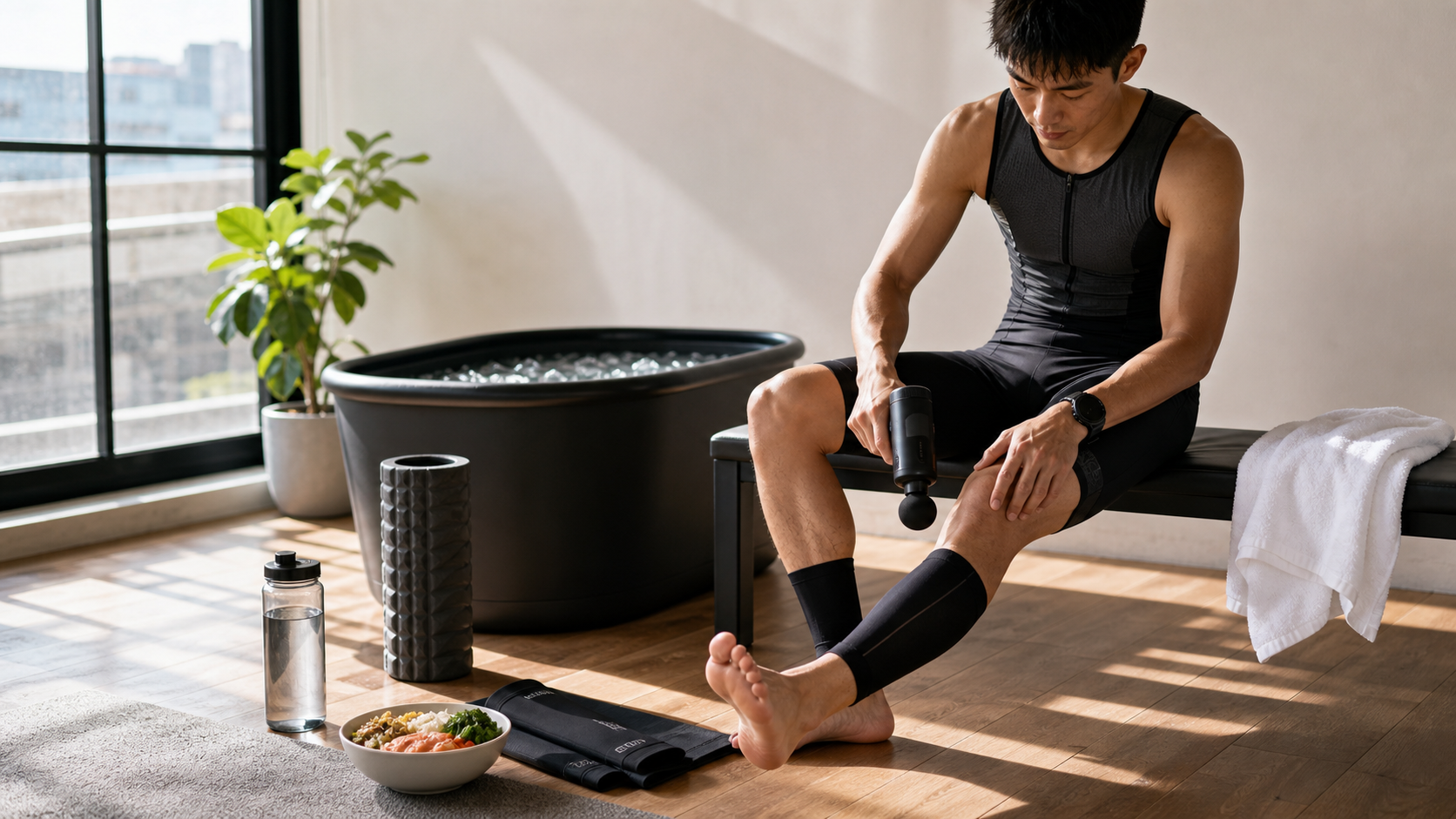
Coach’s Opening: Is That Two-Thousand-Dollar Massage Gun Really More Useful Than a Good Night’s Sleep?
Last month, a student preparing for the Taitung Puyuma Ironman sent me a message asking: “Coach, my legs are super sore after training lately. Should I buy an ice barrel for ice baths? And that fascia gun all the influencers are pushing—do you think it’s worth getting?”
I didn’t directly answer whether to buy them. Instead, I asked him three questions: How many hours did you sleep last night? Did you secretly add more training volume this week? Have you been eating enough carbs before your race? He paused and replied, “About five and a half hours I guess… and I did squeeze in an extra interval session this week…”
That’s the core of the problem. In fifteen years, I’ve seen too many athletes focus on the peripheral details of recovery tools while neglecting the foundation of recovery. They’re willing to spend two thousand dollars on a massage gun, but not willing to go to bed an hour earlier; willing to soak in an ice bath for ten minutes daily, yet eating fried chicken with bubble tea a week before a race.
In this article, I’ll use actual research evidence to put the four most popular recovery tools on the market—massage guns, ice baths, compression gear, and foam rollers—on the scientific scale. Which ones have solid evidence? Which ones have minimal effects? Which ones might even hold you back in certain situations? And there’s one fact many people don’t want to admit: even a placebo has real value.
I’m not telling you to throw away all your tools. I’m telling you to understand the recovery pyramid—what should be done first, what’s just icing on the cake—so you know where your money and time should go.
Conceptual Foundation: Recovery Isn’t a Tool, It’s a Whole System
First, Understand How “Training Adaptation” Happens
Many people think you get stronger during the workout itself. That’s not true. You’re breaking your body down during training; you actually get stronger during the recovery period. This process is called supercompensation: training causes fatigue and micro-damage → the body repairs → repairs to a level slightly stronger than before → the next training session starts from a higher baseline.
If recovery is insufficient, you stay stuck at the bottom of the fatigue trough, digging deeper—that’s the beginning of overtraining. If recovery is adequate, you can climb step by step.
So the core question for recovery tools is only this: Can it accelerate your return to a “ready to train again” state without interfering with long-term adaptation? These two conditions are both essential. Some tools can make you feel less sore today, but at the cost of sacrificing long-term muscle adaptation—this trade-off will be crucial when we discuss ice baths shortly.
“Feeling Better” Doesn’t Equal “Recovering Better”
This is a preventive shot I want to give you first. In recovery research, there are two types of indicators that often don’t align:
- Subjective indicators: Soreness (DOMS, delayed onset muscle soreness), fatigue perception, whether your legs feel looser.
- Objective indicators: Degree of strength recovery, power output, blood markers of inflammation and muscle damage (such as creatine kinase, CK), actual sports performance.
Many recovery tools can improve your subjective feelings, but their impact on objective performance is minimal or even nonexistent. This doesn’t mean the tools are useless—feeling good has value in itself, and I’ll discuss that specifically later. But you must distinguish: are you buying “feeling better” or “performing better”? These two things should have different price tags.
The Concept of Evidence Grading in Research
In sports science, not all “studies say” carries the same weight. When guiding athletes, I have a yardstick in mind:
- Systematic reviews and meta-analyses: Pooling many studies together for analysis—highest level of evidence.
- Randomized controlled trials (RCTs): With groups and controls—good evidence.
- Single small-sample studies: Reference only; could just be noise.
- Personal testimonials, influencer unboxings: Lowest level; basically only useful as inspiration.
Below, when I discuss each tool, I’ll try to cite meta-analysis conclusions, because those are the more reliable signals after filtering out the noise.
Examining the Four Tools One by One
Tool One: Foam Rolling—Actually the One with the Most Solid Evidence
Many people think foam rolling is basic and old-school, not as flashy as a vibrating massage gun. But when it comes to evidence, foam rolling is actually the tool with the most complete research and the most consistent conclusions among the four.
According to a meta-analysis published in Frontiers in Physiology (Wiewelhove et al., 2019), the overall effects of foam rolling are “small, partially negligible,” but it does have meaningful effects in certain contexts:
- As a warm-up (pre-rolling): Can slightly improve flexibility (approximately +4.0%), and unlike static stretching, it doesn’t impair subsequent power output.
- As recovery (post-rolling): Can slightly reduce muscle soreness (approximately 6% reduction in soreness).
- Optimal dosage: About 90 to 120 seconds per body part.
Note the key word here: “slight.” Foam rolling won’t make your strength recovery skyrocket, but it’s cheap, safe, has almost no side effects, and it genuinely works for “feeling looser and having a greater range of motion.”
Its mechanism of action is primarily neurological, not structural. In other words, foam rolling doesn’t actually “squash open” or “knead apart” your fascia (your body weight can’t mechanically compress deep fascia anyway); rather, it changes how your nervous system processes pain and stretching—reducing the sensitivity of muscle tension receptors, making you feel looser and less tight.
My practical approach: I tell athletes to put foam rolling in their warm-up routine, not as the main event of recovery. Spending five to eight minutes before training rolling the front and back of the thighs, glutes, and calves, combined with dynamic stretching, is a very worthwhile investment.
Tool Two: Massage Guns (Percussive Therapy)—The Most Popular, but with the Thinnest Evidence
Massage guns have become incredibly popular in Taiwan in recent years—everyone at the gym, in running clubs, and in triathlon groups has one. But I have to be honest: it’s the tool with the least high-quality research and the most uncertain effectiveness among the four.
The principle behind massage guns is actually similar to foam rolling—both use mechanical stimulation to affect nerves and local blood flow—except it uses high-frequency vibration instead of body weight for pressure. By mechanism, it’s reasonable to infer it should achieve effects similar to foam rolling—reducing soreness in the short term and slightly improving mobility. Current small-scale studies generally point in this direction, but sample sizes are typically small and study designs are inconsistent; there hasn’t yet been enough accumulation to reach the reliable meta-analysis level of conclusions like those for foam rolling or compression.
So my stance on massage guns is: it “might be useful” as a tool for improving subjective feelings, especially for warming up specific areas before a race or quick relaxation after one. But if you expect it to significantly accelerate your objective recovery or have your strength fully back the next day, there’s currently insufficient evidence to support that.
A few practical reminders:
- Don’t use it on bony prominences, joints, the sides of the neck, the abdomen, the groin, or any area dense with nerves and blood vessels. Stick to the large muscle bellies.
- Don’t press with all your might, and don’t use it for too long. One to two minutes per area is enough; longer isn’t better.
- If a spot hurts intensely when you hit it, or the pain radiates, it might be an injury—see a physical therapist rather than continuing to pound it.
Tool Three: Ice Baths / Cold Water Immersion (CWI)—A Double-Edged Sword
Ice baths are the tool among the four that most requires “using it situationally,” because there’s a very important trade-off that many people simply don’t know about.
The good side: According to multiple studies and meta-analyses, post-exercise ice baths can effectively reduce the severity of muscle soreness, lessen subjective fatigue, shorten the perceived recovery time, and lower some blood markers of muscle damage. For athletes who need to “compete again tomorrow” or are in multi-day events, this is a genuinely tangible benefit.
The bad side (here’s the key point): A meta-analysis published in the European Journal of Sport Science (Piñero et al., 2024) is literally titled “Throwing cold water on muscle growth.” The research indicates that taking an ice bath within 15 minutes after resistance training weakens muscle hypertrophy adaptations. The mechanism is that ice baths suppress anabolic signaling, reduce local blood flow, and dampen the inflammatory response—yet inflammation is precisely the necessary signal for the body to initiate repair and get stronger. When you suppress inflammation, you’re also suppressing part of the “get stronger” signal along with it.
This is the double-edged sword: ice baths make you feel good today, but if your goal is to build strength and muscle mass long-term, immediately jumping into an ice bath after training might actually hold you back.
How do I guide athletes on ice baths? In one sentence: match it to your goals and the season.
| Situation | Ice Bath or Not? | Reason |
|---|---|---|
| In-season, race period, multi-day events | Yes, soak as soon as possible after racing | Goal is “ready to compete tomorrow”; rapid fatigue reduction takes priority over long-term adaptation |
| Building phase, dedicated strength and muscle work | Avoid soaking immediately after key strength sessions | Don’t let ice baths blunt the adaptations you worked hard to build |
| Taiwan’s sweltering summer, post-exercise core temperature too high | Can be used to lower body temperature and prevent heat illness | Purpose here is cooling and safety, not recovery adaptation |
| After general aerobic endurance sessions | Optional | Aerobic adaptations are less affected by ice baths; use it if you enjoy it |
Dosage reference (giving a range, not false precision): Water temperature around 10 to 15°C, soaking about 10 to 15 minutes is a common operating range. The colder the water and the longer the soak, the higher the subjective satisfaction might be, but the risk of suppressing adaptations may also be greater. When taking ice baths in Taiwan’s summer, be mindful of cardiovascular responses; anyone with heart disease or hypertension should consult a physician first.
Tool Four: Compression Garments—Moderate Evidence, Easiest to Use
Compression pants, compression calf sleeves, and similar gear have moderately positive evidence, and their biggest advantage is—almost no side effects; you just wear them, and they don’t take up training time.
According to a 2025 meta-analysis published in the journal Life (including 27 studies), compression garments have a significant positive effect on post-exercise strength and power recovery. An earlier meta-analysis (Hill et al., 2014) including 12 studies found that compression garments had moderate effects on reducing DOMS, restoring strength, restoring power, and lowering creatine kinase (CK).
To be honest though, the evidence is still somewhat divided—some individual studies found no clear benefit, and early studies predominantly used male subjects, so applying the results to women or older populations requires some caution.
My practical judgment: Compression gear falls into the “low cost, low risk, possibly moderate benefit” category. It doesn’t have the concern of blunting adaptations like ice baths, and it doesn’t require extra time to operate—wearing it after long rides or runs, during flights for races, or even while sleeping, many athletes report it genuinely helps with “feeling less swollen and heavy in the legs.” As a finishing touch at the top of the recovery pyramid, I think it’s a better investment than a massage gun.
Comparing the Four Tools Side by Side
I’ve organized the above into a table so you can see at a glance where to spend your money and time:
| Tool | Evidence Level | Effect on “Subjective Feelings” | Effect on “Objective Performance Recovery” | Main Risks / Side Effects | Coach’s Recommended Role |
|---|---|---|---|---|---|
| Foam Roller | High (multiple meta-analyses) | Effective (slight soreness reduction) | Small effect | Almost none | Warm-up staple, recovery aid |
| Massage Gun | Low (mostly small samples) | Possibly effective | Insufficient evidence | Injury if used on wrong areas | Convenient local relaxation; don’t overhype it |
| Ice Bath | Medium-High | Effective (noticeable soreness and fatigue reduction) | Helps short-term, but may blunt long-term muscle adaptation | Cardiovascular stress, interference with strength gains | Use by season and goal, not a cure-all |
| Compression Gear | Medium | Effective (reduces swelling and heaviness) | Moderately positive | Almost none | Low-risk finishing touch |
Reading this table, you’ll notice one thing: no tool is a “miracle device.” The tool with the most solid evidence (foam roller) only has “small” effects, and the tool with the most noticeable effects (ice bath) comes with the side effect of blunting adaptations. This brings us to the most important concept of the entire article—the recovery pyramid.
The Recovery Pyramid: Secure the Foundation First, Then Talk Tools
When I guide athletes, this pyramid is always on my desk. Every time someone asks me whether to buy a recovery miracle device, I point to it and ask: “Have you done the lower layers properly?”
           ▲
          ╱ ╲        Layer 4: Recovery Tools
         ╱tools╲      (Ice baths/massage guns/compression/foam rollers) ← Icing on the cake
        ╱─────╲
       ╱ Active Recovery ╲     Layer 3: Easy movement, stretching, massage
      ╱───────────╲
     ╱   Nutrition    ╲   Layer 2: Calories, carbs, protein, hydration
    ╱───────────────╲
   ╱      Sleep        ╲ Layer 1: The foundation, most important
  ╱───────────────────╲
 ▔▔▔▔▔▔▔▔▔▔▔▔▔▔▔▔▔▔▔▔▔
Layer 1: Sleep (The Foundation of Foundations)
If you can only change one thing, change your sleep. No massage gun, no bucket of ice, can make up for the two hours of sleep you lost. Sleep is the golden window for growth hormone secretion, tissue repair, and nervous system resetting.
I once coached a triathlete stuck at a performance plateau for six months. His training volume and nutrition were fine. Then I asked—he was only sleeping five to six hours a night and staying up late watching race broadcasts. I didn’t change his training plan at all; I just told him to sleep one more hour each day and keep a fixed bedtime. Six weeks later, his interval pace improved on its own. The performance gains I got from sleep exceeded all the recovery tools I’ve ever recommended in my career combined.
For endurance athletes, the sleep target is usually 7 to 9 hours per night, and even more during high-volume training periods.
Layer 2: Nutrition (Stock Up the Raw Materials for Repair)
For the body to repair, it needs raw materials. This layer includes:
- Sufficient total calories: Training for triathlon in a long-term caloric deficit will stall recovery.
- Protein: The building material for muscle repair. Endurance athletes should aim for about 1.4 to 2.0 grams per kilogram of body weight per day, distributed across meals.
- Carbohydrates: To replenish glycogen. During high training volume or multi-day events, carbs are especially critical.
- Hydration and electrolytes: Taiwan’s summers are hot and humid. A single long ride or run produces a staggering amount of sweat. If you don’t manage water and sodium intake, both recovery and performance will collapse.
Taiwan’s eating-out environment deserves special attention. It’s convenient and offers many choices, but many athletes just grab a chicken cutlet bento with a sugary drink after training—not enough protein, not enough vegetables, and too much refined sugar. I often advise athletes to consume an easily absorbable carb-plus-protein snack within 30 to 60 minutes after training (for example, an onigiri with a tea egg and unsweetened soy milk, or a scoop of whey protein), then eat a proper meal afterward.
Layer 3: Active Recovery (Let the Body Clean Up on Its Own)
- Easy movement: Schedule low-intensity cycling or jogging the next day (it really needs to be “easy” enough that you can hold a conversation), promoting blood circulation and helping clear metabolic byproducts. This often leads to better recovery than lying around all day.
- Stretching and mobility: Maintain joint range of motion to prevent tightness from accumulating.
- Foam rolling belongs here: It fits perfectly as a supplement at this layer.
Layer 4: Recovery Tools (The Icing on the Cake at the Top of the Pyramid)
See that? Ice baths, massage guns, compression gear, and foam rollers are all in that small section at the very top. They are “icing on the cake,” not “fuel in the tank.”
If you’ve done the lower three layers well, these tools at the top can help you squeeze out a little extra. But if your lower three layers are broken, buying even the most expensive tools is like pouring water into a leaking bucket.
The Value of the Placebo: Why “Feeling Like It Works” Counts Too
This is a piece that many hardcore science types overlook. When I say a tool’s “effect is mainly subjective,” it sounds like I’m saying it’s “useless”—but that’s not actually the case.
The placebo effect in sports recovery is real and can be leveraged. If an athlete finishes an ice bath, feels refreshed in body and mind, approaches training with confidence the next day, and the training quality is therefore better—then that “feeling” has translated into real performance. Recovery is largely a matter of the nervous system and psychological state. When you believe you’re ready, your sympathetic nervous system relaxes, and that in itself has physiological meaning.
So my attitude toward athletes is: if a tool is low-risk, affordable, and it makes you feel good physically and mentally and more confident facing training—then use it, without feeling guilty that “the evidence is only moderate.” Compression pants, foam rollers, and in-season ice baths all fall into this category.
The only boundary is: don’t let the placebo replace the foundation, and don’t pay a real price for the placebo. Spending money on a massage gun for peace of mind is fine; but if you sacrifice the adaptations from a key strength session just to take an ice bath, that’s putting the cart before the horse. Distinguishing between “harmless comfort” and “costly trade-offs” is a required course for smart athletes.
Common Mistakes and Corrections
After all these years, I’ve seen the same mistakes countless times. Here are the most common ones—check how many you’ve made:
Mistake 1: Using tools as a license for overtraining
“I’ll ice bath and use my massage gun after training anyway, so I can add one more interval set.”—Completely wrong. Recovery tools cannot justify overtraining. The capacity of your recovery foundation (sleep and nutrition) determines how much training you can absorb.
Correction: First ensure your recovery foundation can support your current training volume before talking about adding more. Tools are never a reason to increase volume.
Mistake 2: Taking ice baths immediately after training during the strength-building phase
Many people don’t know ice baths blunt muscle adaptation. During winter base training, they work hard on strength but soak in ice baths after every session—it’s like building a house with one hand and tearing it down with the other.
Correction: During the building phase, avoid immediate ice baths after key strength sessions; save ice baths for race season and multi-day events.
Mistake 3: Using massage guns recklessly, on the wrong spots
Pounding the sides of the neck, joints, or spine, or hitting wherever it hurts. Some “trigger points” are actually inflammation or injury, and the more you hit them, the worse they get.
Correction: Only hit large muscle bellies, avoid areas dense with nerves and blood vessels, one to two minutes per area, and stop if there’s radiating pain—seek professional assessment.
Mistake 4: Rolling until you’re in agony, thinking more pain means more effectiveness
Pressing your body weight onto the roller until your face contorts in pain, believing that’s how you “knead it open.” Excessive force actually makes muscles more tense and defensive.
Correction: Roll to a “comfortable discomfort.” You should be able to breathe normally and your muscles should relax. 90 to 120 seconds per area.
Mistake 5: Focusing only on tools while neglecting sleep and nutrition
Spending a fortune on a full set of miracle devices while sleeping five hours a night and eating junk after training. This is the most expensive and least effective mistake.
Correction: Take part of your tool budget and invest it in improving your sleep environment (blackout curtains, consistent schedule) and post-training nutrition.
Actionable Advice for Athletes at Different Levels
For Beginners / Just Getting into Triathlon
Don’t buy any recovery miracle devices yet. Put 100% of your money and attention into the bottom three layers of the pyramid: sleep enough, eat right, and do easy movement after training. If you really want to buy one thing, get a cheap foam roller (a few hundred dollars) and use it in your warm-up routine. At this stage, your room for improvement is enormous. Master the fundamentals, and your performance will rise on its own.
For Intermediate / Chasing a PB
Once your foundation is solid, you can start selectively adding top-tier tools:
| Training Phase | Recommended Tool Combination |
|---|---|
| Winter building phase (strength work) | Foam roller (warm-up) + compression (wear after training); avoid ice baths after key strength sessions |
| Pre-race intensity phase | Foam roller + compression + selective massage gun for local relaxation |
| Race week / multi-day events | All in: post-race ice bath for fatigue reduction + compression + foam rolling |
For Advanced / Preparing for Kona or Long-Distance Triathlon
You already understand training; at this stage, the difference lies in detail management. Treat recovery as a quantifiable, monitorable system: track morning heart rate (bpm) and heart rate variability, sleep quality, and subjective fatigue scores, and use the data to decide whether to push or hold back today. Configure your tools according to the seasonal logic above, but the real deciding factors remain—sleep, nutrition, and knowing when to hit the brakes. Taiwan has many races in summer, with harsh heat and humidity (think Penghu Bay, Taitung’s afternoon highs). Core temperature management and hydration/sodium strategies will determine your race quality far more than any massage gun.
Practical Example: How to Schedule a Week of Recovery
Principles alone are too abstract. Let me give you a concrete weekly recovery schedule I actually give to intermediate athletes (using the pre-season building phase as an example). The training content here is illustrative; the key is seeing how each day’s recovery actions pair with the training.
| Day | Main Training Content | Post-Training / Same-Day Recovery | Sleep Target | Notes |
|---|---|---|---|---|
| Monday | Swim technique + lower body strength | Wear compression pants for 1 hour after training; no ice bath (preserve strength adaptations) | 8 hours | Most important: never ice bath immediately after strength work |
| Tuesday | Bike intervals (high intensity) | Foam roll lower body for 10 minutes; whey protein + banana | 8 hours | Replenish carbs and protein within 60 minutes post-training |
| Wednesday | Active recovery day: easy 60-min ride | Dynamic stretching + foam rolling; go to bed early | 8.5 hours | Deliberately easy day to let the body absorb |
| Thursday | Run tempo session | Compression calf sleeves; massage gun on calves for 1–2 minutes | 8 hours | Massage gun only on large muscle bellies |
| Friday | Swim endurance + upper body strength | General stretching is sufficient | 8 hours | Upper body sessions are less demanding; lower recovery needs |
| Saturday | Long bike ride (3–4 hours) | Replenish carbs after; wear compression pants until bedtime | 9 hours | Heavy sweating; hydration and sodium are key |
| Sunday | Long run (brick session) | Ice bath allowed 10–15 min (race simulation) + compression | 9 hours | Ice bath permitted after the big weekend session to reduce fatigue |
Looking at this table, you’ll see three scheduling logics:
- Never ice bath after strength sessions (Monday); save ice baths for Sunday’s race-simulation long session.
- The active recovery day (Wednesday) is the key to the whole week. Many people think you need to “train more” to improve; in reality, knowing when to “hold back” is what separates the experts.
- Sleep targets are written into the schedule because it’s the foundation. It can’t be left to feeling; it must be executed like part of the training plan.
In-Depth Case Studies: Two Athletes, the Same Tools, Different Results
I want to use two real scenarios (data is illustrative) to show you clearly: the same set of recovery tools, used in the right place, is a help; used in the wrong place, it’s a hindrance.
Case A: Xiao Lin, preparing for a 113 half-Ironman, heavy ice bathing during winter base
Xiao Lin was very dedicated. During winter base, he jumped into the ice barrel after every ride and run, thinking he was doing recovery perfectly. But after three months, his bike power (watts) had barely improved, and his strength training weights had stalled. He was confused: “I’m doing so much recovery—why can’t I get stronger?”
The problem was—during the critical period for building strength and power, he was using ice baths daily to suppress the “get stronger” inflammatory signals. I had him remove all ice baths during the winter base period and switch to compression pants plus adequate sleep. Over the next six weeks, his functional threshold power (FTP) rose by about 5% on its own. It wasn’t that he got stronger; it was that he finally stopped hindering himself from getting stronger.
Case B: A-Zhe, two consecutive days of racing, using ice baths wisely
A-Zhe signed up for a weekend stage race spanning two days. After the first day, he immediately took an ice bath, wore compression pants, replenished carbs and protein, and went to bed early. The next day, his legs felt noticeably lighter than competitors in his age group who didn’t do recovery, and he held his performance.
The same ice bath was a hindrance for Xiao Lin and a help for A-Zhe. The only difference: A-Zhe’s goal was “I need to be able to race again tomorrow,” where rapid fatigue reduction takes priority over long-term adaptation; Xiao Lin’s goal was “build my body stronger,” where suppressing adaptation signals is counterproductive. Tools themselves are neither good nor bad; it’s how you use them that matters.
Cost-Benefit: If You Only Have a Ten-Thousand-Dollar Budget
Many athletes ask me: “Coach, I have limited money to spend on recovery. How should I allocate it?” I usually prioritize it this way (amounts are conceptual illustrations):
| Priority | Investment Item | Approximate Cost | Why It’s Ranked Here |
|---|---|---|---|
| 1 | Improve sleep environment (blackout curtains, earplugs, adjust schedule) | Low | Highest return on investment; directly strengthens the foundation |
| 2 | Post-training nutrition (whey, quality meals) | Medium (ongoing) | Raw materials for repair; needed every day |
| 3 | A foam roller | Low | Most solid evidence, most versatile |
| 4 | Compression pants / calf sleeves | Medium | Low risk, moderate benefit |
| 5 | Massage gun | Medium-High | Convenient but thin evidence; buy only if you have extra budget |
| 6 | Ice barrel / ice bath equipment | High | Double-edged effect; not essential |
Notice that the top three cost almost nothing, yet deliver the highest benefit. This is the recovery pyramid in miniature: the most useful things are often the cheapest. The most expensive, flashiest devices rank last with the most uncertain benefits.
FAQ: Questions Athletes Ask Me Most Often
Q1: Which is better—ice baths or heat therapy (sauna)?
A: They serve different purposes. Ice baths tend to “suppress” inflammation and soreness, suitable for rapidly reducing fatigue during race season; heat stimulation (like saunas or warm baths) tends to “promote” blood flow and relaxation, with less interference on long-term adaptations. During the building phase, I lean toward warm heat or no special treatment, saving ice baths for race season.
Q2: Can I use a massage gun every day? Will it damage muscles?
A: As long as you only hit large muscle bellies, use moderate force, and keep it to one to two minutes per area, daily use is generally fine. But don’t hammer away at the same “trigger point”—if it’s inflammation or a strain, the more you hit it, the worse it gets. Stop if there’s radiating pain, bruising, or numbness.
Q3: Is it normal to be sorer the day after foam rolling?
A: If it’s a “comfortable tightness” that resolves the next day, that’s normal. If you rolled too hard and have new bruise-like soreness the next day, that’s overdoing it. Foam rolling should be “comfortable discomfort,” not self-torture.
Q4: Is it okay to sleep in compression pants?
A: For most people, wearing recovery-specific compression pants with appropriate pressure while sleeping is fine, and many athletes report their legs feel less heavy the next day. But if you have circulatory system disease, diabetic peripheral neuropathy, or if they cause numbness or uncomfortable tightness, don’t sleep in them—consult a physician first.
Q5: If I don’t have any tools, am I already behind?
A: Absolutely not. If you just do the three layers of sleep, nutrition, and active recovery properly, you’re already ahead of 80% of people who throw money at tools but don’t sleep. Tools are the top few percent; the foundation is what determines success or failure.
Q6: Taiwan’s summers are too hot, and I’m super sore after outdoor training. Do I especially need ice baths?
A: During extreme summer heat, ice baths (or cold showers) are reasonable and important for rapidly lowering core body temperature and preventing heat illness. In this case, their role is “safety” rather than “recovery adaptation.” Once you’ve cooled down and feel comfortable, that’s enough—no need to soak for a long time in very cold water just for “recovery.” In Taiwan’s summer training, the risk of heatstroke is far more urgent than the risk of insufficient recovery.
Conclusion: Secure the Foundation, and Tools Will Have Meaning
Back to the athlete at the beginning who asked whether he should buy an ice barrel and a massage gun. My final advice to him was: “Buy the massage gun if you want—a thousand-plus dollars as a little pre-race relaxation toy is fine. But this week, first remove that extra interval session you secretly added, then sleep one more hour every day, and stop eating fried chicken three days before the race. Do these three things, and your performance improvement will far exceed anything any gun can give you.”
Three weeks later, he messaged me: he finished the race and even broke his personal record in one discipline. He said: “Coach, it turns out the most useful recovery tool is my pillow.”
That’s the message I want to leave you with. There are no miracle recovery tools—only what’s suitable, what’s worth it, and whether you’ve secured your foundation. Foam rollers have the most solid evidence but small effects; massage guns are the most popular but have the thinnest evidence; ice baths are effective but a double-edged sword; compression gear is low-risk and can be a finishing touch. Put them back in their proper place at the top of the recovery pyramid—sleep well, eat right, move correctly first; only then can the remaining tools be considered icing on the cake.
Next time someone tries to sell you a “recovery miracle device,” remember this pyramid and ask yourself: is my foundation solid?
This article is educational content and does not replace individual assessment by a physician, physical therapist, or nutritionist.
References
- Meta-analysis on cold water immersion and muscle hypertrophy adaptations (Piñero et al., 2024, European Journal of Sport Science): https://pmc.ncbi.nlm.nih.gov/articles/PMC11235606/
- Study on post-exercise ice baths blunting resistance training anabolic signaling and long-term adaptations (PMC): https://pmc.ncbi.nlm.nih.gov/articles/PMC4594298/
- Meta-analysis on foam rolling effects on performance and recovery (Wiewelhove et al., 2019, Frontiers in Physiology): https://pmc.ncbi.nlm.nih.gov/articles/PMC6465761/
- Meta-analysis on compression garments and strength/power recovery (2025, Life): https://pmc.ncbi.nlm.nih.gov/articles/PMC11944185/
- Meta-analysis on compression garments and exercise-induced muscle damage recovery (Hill et al., PubMed): https://pubmed.ncbi.nlm.nih.gov/23757486/
Related Reading
- The Scientific Examination of Massage and Foam Rolling: Mechanisms, Effect Sizes, and the Overlooked Placebo Components
- Evidence-Based Comparison of Recovery Methods: Sleep, Nutrition, Massage, Cold Water Immersion, Compression Wear—Which Are Worth Investing In?
- The Practical Benefits of Massage for Sports Recovery: Which Claims Are Supported, Which Are Exaggerated, and the Correct Use of Foam Rollers and Massage Guns
- Comparing Recovery Tools for Running: When to Use Foam Rollers, Massage Guns, and Compression Socks
摔車後補裝備: 好市多新款單車安全帽& Specialized Romin 北高整路屁股都不痛的坐墊 | 一千元居然有MIPS | CT Yeh | 公路車
4 年前
沉浸室內單車練功房開箱! 100吋大畫面,最便宜的花費? 居然還能K歌!? | 公路車 | CT Yeh
3 年前
洗單車神器 吹水機! 實際洗車用用看 暴力洗鍊條大法 | 公路車 | CT Yeh
4 年前
西進武嶺 免費訓練分析服務 Intervals | 練不夠還是練過頭?你哪一種類型選手?AI模型告訴你! | 備戰神器 | 公路車 訓練 | CT Yeh
4 年前
詳測) 小米 電動打氣筒 公路車胎要充多久? 值得買嗎? 米家充氣寶 小心燙手!
7 年前
碟煞公路車 銑面器 !? 原來銑完差這麼多! 降低蹭碟機率! | TIME 公路車 保養小記錄 | CT Yeh
3 年前
GoPro Hero 10 過熱救星?GoPro Volta 開箱! 這麼坑爹的配件,值不值得買? | CT Yeh
4 年前
單車AI教練!全新 ChatGPT4o 幫你分析訓練成果!排武嶺課表,分析騎車姿勢! 太神了! / 公路車 / CT Yeh / feat. 緯緯
2 年前