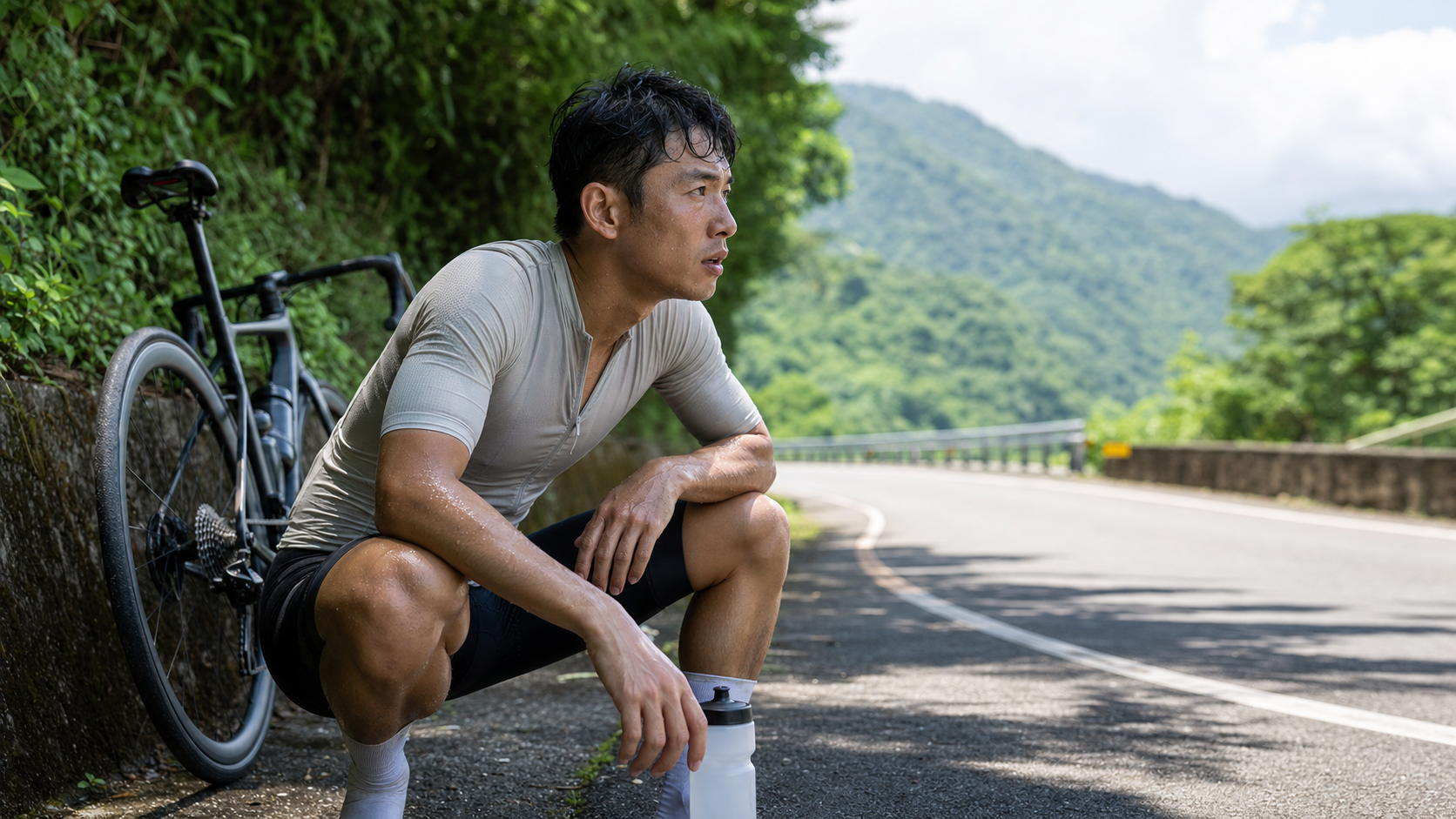
Starting with a Student Who “Blew Up” on Yangmingshan
I once coached a tech executive in his early forties—let’s call him Ade. Ade had been cycling for over two years, weighed about 72 kilograms, trained regularly along the riverside, and his power output was steadily improving. One summer weekend, he asked me to climb Yangmingshan with him, starting from Shilin onto Yangde Avenue and then up to Balaka. Before we set off, he confidently told me, “Coach, I’ve brought plenty of water today—two big bottles. There’s no way I’ll get thirsty.”
But halfway up the climb, he started slowing down noticeably. On sections where he could normally hold a steady 210 watts, he was struggling at 160 watts, his face was pale, and he was speaking weakly. I called him over to rest in the shade by the roadside. When I asked, it turned out—both his water bottles were indeed there, but he’d barely touched them, because he “wasn’t that thirsty.” The temperature that day was around 33°C, with humidity near 80%. He was sweating profusely the whole way but had taken in almost no fluid. I had him weigh himself when he got home, comparing it to his pre-ride weight: he’d lost nearly 2.4 kilograms, about 3.3% of his body weight.
This is the classic double trap of “only drinking when thirsty” combined with “assuming you can’t be dehydrated.” Ade wasn’t slacking off—he was fooled by his own sense of thirst. In this article, I want to lay out one thing clearly for you: What exactly is fluid balance during exercise? At what level of dehydration does performance really take a hit? And why can overhydrating be more dangerous than dehydration?
In my more than a decade of coaching, this is one of the most misunderstood and highest-risk topics. Taiwan’s summers are humid and hot, which makes this issue especially important for us.
First, Understand: What Is the Water in Your Body Actually Doing?
Before we talk about how much dehydration affects performance, we need to know what role water plays during exercise. The human body is roughly 55% to 65% water, and muscle tissue has an even higher water content. When you exercise, water is doing several jobs at once:
- Regulating body temperature: This is the most critical one during exercise. Your muscle contractions generate a huge amount of heat, and the body relies primarily on “sweat evaporation” to dissipate it. Sweating is essentially trading water for cooling—which is why exercising and sweating dehydrate you.
- Maintaining blood volume: Blood is mostly water. Dehydration reduces plasma volume and makes the blood thicker, so the heart pumps out less blood per beat and has to compensate by raising heart rate.
- Transporting nutrients and metabolic waste: Delivering oxygen and glucose, and clearing metabolic byproducts like lactate, all require adequate blood flow.
- Maintaining electrolyte and osmotic balance: Electrolytes like sodium, potassium, and chloride are dissolved in body fluids, and their concentrations determine how water is distributed inside and outside cells.
So you can imagine that when the body starts running low on water, this entire system is affected. And the first things to go wrong—which also best explain a drop in pace—are thermoregulation and cardiovascular compensation.
Why Hot Weather Is Especially Prone to Trouble
Taiwan’s summer isn’t just hot—the bigger problem is humidity. For sweat to cool you down, it relies on “evaporation,” not just “dripping off.” When ambient humidity is high, sweat can’t evaporate effectively and simply drips off like water—you’re drenched in sweat, but you haven’t gotten the equivalent cooling effect. This means in muggy, humid weather, you sweat more (dehydrate faster) while your cooling efficiency is worse (core temperature spikes more easily). That’s why the same riding intensity feels far more brutal on a summer afternoon in the Taipei Basin than on a cool, dry mountain.
The Dose-Response of Dehydration: It’s Not “Whether,” but “How Much”
This is the most central concept of the entire article, so please remember it: Dehydration’s effect on performance is a dose-response, not an on-off switch.
Many people think dehydration works like a light switch: no dehydration means no problem, dehydration means collapse. Wrong. It’s more like a dimmer dial—the more water you lose, the more performance drops, and once you cross a certain threshold, the decline becomes rapid and pronounced.
The key threshold widely adopted in exercise physiology is: body weight loss exceeding 2%. According to the American College of Sports Medicine (ACSM) position stand, when exercise-induced body water loss exceeds 2% of body weight, endurance performance typically begins to show measurable declines, and the effect is amplified in hot environments. This is also why the field operationally defines “hypohydration” as a body water deficit greater than 2% of body weight.
Let me put that in concrete numbers for you: if you weigh 70 kilograms, 2% is 1.4 kilograms. In other words, during a high-intensity workout or race, if sweating causes you to lose more than 1.4 kilograms of water, your performance may already be quietly slipping. And Ade lost 3.3% that day—far beyond the threshold. It’s no surprise he “blew up.”
Approximate Physical Responses at Different Dehydration Levels
The table below is compiled from general principles in exercise physiology. The values are given as “ranges” (because individual variation is large—don’t treat this as a precise scale):
| Dehydration Level (% of body weight) | Approximate Loss for a 70 kg Person | Typical Body Response |
|---|---|---|
| < 1% | < 0.7 kg | Usually no noticeable effect; most people don’t even feel thirsty yet |
| 1–2% | 0.7–1.4 kg | Thirst begins; focus, mood, and endurance may already be mildly affected |
| 2–3% | 1.4–2.1 kg | Endurance clearly declines, heart rate rises, perceived effort increases, core temperature rises |
| 3–5% | 2.1–3.5 kg | Performance drops significantly, cooling capacity impaired, heat injury risk increases |
| > 5% | > 3.5 kg | High-risk zone; severe discomfort or heat exhaustion possible, requires immediate attention |
One thing is especially worth noting: research indicates that even mild dehydration of just 1% to 2% can impair cognitive function, mood, and aerobic endurance before you even feel thirsty. This is exactly why thirst is unreliable—which we’ll get to in the next section.
An Easily Overlooked Detail: Dehydration Isn’t the Only Variable
More rigorous studies in recent years (for example, infusing water directly into the gastrointestinal tract to prevent subjects from being psychologically influenced by knowing whether they drank) have found that dehydration’s impact on performance is most pronounced and most consistent in hot environments. In other words, in cool weather or during shorter exercise sessions, the actual impact of mild dehydration may not be as dramatic as commonly believed.
But please don’t let your guard down because of this—in Taiwan, summer training and racing conditions are practically synonymous with “hot environments.” For us, treating 2% as a red line to take seriously is both pragmatic and safe.
The Thirst Alarm: It’s Often “Running Late”
“I’m not thirsty, so I must not be dehydrated, right?”—This is one of the most common and most dangerous myths I’ve ever heard.
Thirst is a protective mechanism of the body, but it has an inherent flaw: it responds slowly, and its threshold is set high. For many people, by the time you actually feel clearly thirsty, your body is often already at or past 1% to 2% dehydration. In other words, if you wait for thirst as your alarm, you’re often already standing at the threshold of performance decline.
The reliability of thirst is also disrupted by many factors:
- Age: Older individuals have a blunted thirst sensation, which is one reason elderly people are especially prone to heatstroke in summer.
- Focus: During a race or high-intensity training, your attention is entirely on pacing, road conditions, and opponents, and the brain “doesn’t get around to” the thirst signal. That’s exactly what happened to Ade that day—he was so busy grinding up the climb that he forgot to drink.
- Beverage temperature and palatability: Warm, flavorless water doesn’t make you “want” to drink as much, so you unconsciously drink less than you need.
- Environment: In cool weather or when there’s a breeze, you don’t feel as hot and therefore don’t feel as thirsty—but you’re still sweating.
So when I coach athletes, I don’t tell them to “drink when thirsty”; I teach them to build a “fixed time, fixed amount” hydration routine. This is especially important for exercise lasting over an hour in hot weather.
Isn’t “drinking to thirst” also recommended by experts?
Yes, it is, and this represents an important conceptual update. After 2007, the sports medicine community began emphasizing the risks on both sides—“under-drinking” and “over-drinking”—and came to view “drink to thirst” as a relatively safe approach for most people, in most situations. The reasoning behind this is mainly to avoid another, more deadly problem: hyponatremia caused by over-hydration (which we’ll discuss in detail in the next section).
But there’s an important nuance to grasp here: “Drink to thirst” is meant to prevent you from drinking too much, not to give you license to drink too little. For people who exercise for long durations, at high intensity, and sweat heavily in hot, humid environments (such as riding long distances or running a full marathon in a Taiwanese summer), my position is: use thirst as the baseline, but proactively establish a hydration rhythm to avoid falling into the trap of “being so focused that you completely ignore thirst.” The two are not contradictory—the key is to neither become dehydrated beyond 2% nor drink so much that your blood sodium gets diluted.
The Other Extreme: Over-Hydration Can Be More Dangerous Than Dehydration
If dehydration is the enemy everyone knows, then exercise-associated hyponatremia (EAH) is a hidden killer that many have never heard of—yet it can be fatal.
First, let’s clarify what hyponatremia is: when the sodium concentration in your blood drops below 135 mmol/L, it meets the definition of hyponatremia. Its most common cause is drinking too much hypotonic fluid (plain water or sports drinks) during exercise, which “dilutes” the sodium in your blood.
You might think: how could drinking more water be a problem? The issue is that when you chug large volumes of fluid in a short period without replacing sodium proportionally, your blood sodium concentration gets diluted. Sodium is critical for maintaining osmotic pressure inside and outside cells. When blood sodium drops, water moves into cells, causing cellular edema. The most dangerous form is cerebral edema, which can lead to headache, nausea, vomiting, confusion, seizures, and even death.
What makes it trickier is that symptoms of hyponatremia may not appear until up to 24 hours after exercise, and the early symptoms (dizziness, nausea, fatigue) closely resemble dehydration or heat exhaustion, making them easy to misdiagnose. Research has also found that “vomiting” is a clue that can help distinguish hyponatremia from other forms of exertional collapse.
Who Is at High Risk?
According to relevant research and guidelines, typical high-risk scenarios for hyponatremia from over-hydration include:
- Those with longer finish times: Slower runners who spend more time on the course and keep drinking throughout accumulate more excess fluid. Studies have found that “excessive fluid intake” and “longer finish times” are major risk factors for marathon hyponatremia.
- Ultramarathon and long-distance endurance events: Screening of asymptomatic ultramarathon participants found that up to about half tested positive for hyponatremia.
- Smaller, lighter individuals: The same excess fluid has a more pronounced dilution effect on lighter people.
- Overly cautious beginners: Afraid of dehydration, they instead chug several cups of water at every aid station.
There’s an important misconception to clear up here: relying solely on “eating salty foods or drinking sodium-containing beverages” does not guarantee prevention of hyponatremia—if you’re over-drinking in the first place, no amount of sodium can stop the dilution. The real key is “don’t drink more than you lose.” Sodium intake is a supplement; controlling total fluid intake is the fundamental solution.
Practical Methods: How Do You Know How Much to Drink?
After all that theory, here’s something you can use right away. When I work with athletes, the core of my hydration strategy boils down to one sentence: try to make what you “take in” close to what you “lose,” without deviating too far in either direction.
Method 1: Calculate Your Personal Sweat Rate (Most Recommended)
This is what I consider the most practical and personalized method. Here’s how it works:
- Empty your bladder before exercise, then weigh yourself nude (in kilograms).
- Exercise for a fixed duration (e.g., 1 hour) at an intensity close to your usual training, and record how much water you drink (in milliliters) during that time.
- After exercise, dry off your sweat and weigh yourself nude again.
- Calculate your sweat rate:
Sweat volume (mL) ≈ (pre-exercise weight − post-exercise weight) × 1000 + (water consumed during exercise in mL)
Example: Ade did a 1-hour test. He weighed 72.0 kg before exercise and 71.3 kg after, and drank 500 mL of water in between. His sweat volume is approximately (72.0 − 71.3) × 1000 + 500 = 700 + 500 = 1200 mL/hour. This means that under similar weather and intensity conditions, he needs to replace close to 1200 mL per hour to avoid falling into the dehydration zone.
I recommend testing this a few times across different seasons and intensities—you’ll find that your summer sweat rate can be more than double your winter rate. In Taiwan’s hot, humid summer afternoons, many people’s sweat rates easily exceed 1000 to 1500 mL per hour.
Method 2: Check Urine Color (Easiest Daily Self-Check)
If you can’t weigh yourself every time, look at your urine. This is the simplest at-home indicator:
| Urine Color | Approximate Hydration Status | Recommendation |
|---|---|---|
| Clear and colorless | Possibly over-hydrated | No need to chug more right away |
| Pale yellow (like diluted lemon juice) | Well hydrated | Maintain current status; ideal |
| Medium yellow | Starting to be mildly dehydrated | Time to drink some water |
| Dark yellow | Clearly dehydrated | Rehydrate as soon as possible |
| Amber/tea-colored | Severely dehydrated | Rehydrate immediately; watch for accompanying discomfort |
A note: certain vitamins (especially B-complex) can turn urine very yellow, which will throw off color interpretation—factor that in.
Method 3: Scheduled, Measured Hydration Rhythm (For Long-Duration Exercise)
For exercise lasting over an hour in hot conditions, I ask athletes to adopt a “small sips, frequent” strategy rather than “wait until desperately thirsty, then chug a whole bottle.” Drinking too much at once doesn’t give the stomach time to empty, leading to bloating, nausea, and stomach issues.
A common general reference rhythm is: about 150 to 250 mL every 15 to 20 minutes, adjusted based on your sweat rate, weather, and intensity. For exercise lasting over an hour, start considering sports drinks containing electrolytes (especially sodium) and carbohydrates, rather than plain water only.
Electrolytes: It’s Not Just Water—Sodium Is the Key for Long-Duration Exercise
Sweat isn’t just water; it also contains salt (mainly sodium). When you sweat heavily for a long time, replacing only water without sodium creates two problems: first, your blood sodium gets diluted (the hyponatremia risk mentioned earlier); second, you’ll never feel truly “quenched”—because when the body detects diluted blood sodium, it actually suppresses thirst and speeds up urination, flushing out the water you worked so hard to drink.
So for exercise lasting beyond roughly 60 to 90 minutes, or for people who sweat heavily and leave white salt crystals on their clothes (commonly called “salty sweaters”), it’s time to seriously consider sodium replacement.
The table below is a general reference I give to athletes. Please note these are ranges—actual needs vary greatly by individual, weather, and intensity:
| Exercise Duration | Hydration Focus | Sodium/Carbs Needed? |
|---|---|---|
| < 60 minutes | Plain water is usually sufficient; drink to thirst | Generally no extra electrolytes needed |
| 60–90 minutes | Start hydrating on a schedule | Consider sports drinks depending on sweat volume |
| 90 minutes–3 hours | Scheduled, measured intake with sodium-containing drinks | Sodium and carbs needed to maintain blood sugar and electrolytes |
| > 3 hours (ultramarathon/long-distance) | Strictly control rhythm; balance avoiding dehydration and over-drinking | Must replace sodium, and be careful not to over-drink and cause hyponatremia |
Taiwan’s convenience store culture is actually quite friendly to us—sports drinks, salt candies, Pocari Sweat, and舒跑 are readily available. For long rides or runs, I often suggest athletes carry a few packets of salt candy or electrolyte powder in their packs and top up when stopping at aid stations or convenience stores—it’s much safer than only drinking plain water.
Common Mistakes and Corrections
After years of coaching athletes, I’ve compiled the most common hydration mistakes. See how many you’ve made.
Mistake 1: Waiting Until You’re Thirsty to Drink
This is the classic one. As mentioned earlier, thirst lags behind—by the time you feel thirsty, you’re often already near the dehydration threshold. Fix: During long, hot exercise, establish a scheduled hydration rhythm instead of relying entirely on thirst.
Mistake 2: Chugging water for fear of dehydration
This is the other extreme, especially common among beginners who have just started running marathons and have been scared by the “you must drink lots of water” advice. They down two or three cups at every aid station, and end up taking in far more than they lose, putting themselves at risk of hyponatremia. Fix: Base your intake on your sweat rate, drink close to what you lose, and don’t overdo it. For longer efforts, remember to replace sodium rather than just drinking plain water.
Mistake 3: Using only plain water for all long-distance exercise
If you’re exercising for more than an hour or two and only drinking plain water, you’re constantly diluting your blood sodium without replacing electrolytes. Fix: For exercise lasting over 60 to 90 minutes, switch to a sports drink containing sodium and carbohydrates.
Mistake 4: Only thinking about hydration right before exercise
Hydration is a “reservoir” concept, not something you start at the moment of exercise. If you’re already mildly dehydrated when you head out (e.g., you drank alcohol the night before, or your urine was dark yellow this morning and you haven’t topped up), you’re starting at a disadvantage. Fix: Start hydrating moderately 2 to 4 hours before exercise so you can start in good shape, indicated by “pale yellow urine.”
Mistake 5: Being happy that the scale shows weight loss, thinking you’ve “slimmed down”
If you lose one or two kilograms on the scale after exercise, that’s almost entirely water, not fat. Some people deliberately avoid drinking to “see the number,” which is very dangerous. Fix: The weight you lose after exercise should be gradually replaced over the next few hours. A general rule is that for every 1 kg lost, you should take in about 1.2 to 1.5 liters of electrolyte-containing fluid (because some will be lost through urination).
Actionable advice for readers of different levels
There is no one-size-fits-all hydration strategy. I’ll break down the advice by level.
For beginners / weekend riders
- Build the habit first, don’t chase precision: Carry enough water when you head out, and get into a rhythm of “taking a few sips every 20 minutes”—that alone gets you halfway there.
- For exercise under an hour, plain water is enough, drink according to thirst, and don’t obsess over electrolytes.
- Learn to check urine color: This is the most painless self-check; just aim to keep it pale yellow.
- Be extra careful in summer: In Taiwan, try to avoid the hottest hours from 12 p.m. to 3 p.m. in the afternoon. If you must go out, reduce the volume, slow down, and carry more water.
For advanced athletes with a training base
- Measure your sweat rate: Do it at least once in summer and once in winter; you’ll gain a completely different understanding of your hydration needs.
- For long sessions (>90 minutes), make sure to take in sodium: Choose one of sports drinks, salt tablets, or electrolyte powder—don’t rely only on plain water.
- Rehearse your race hydration during practice races: Don’t wait until race day to try a new product for the first time; your stomach might protest.
For advanced athletes targeting long distances / ultramarathons
- Guard against both ends: Avoid both dehydration beyond 2% and overhydration leading to hyponatremia, especially if you have a longer finish time or a lighter build.
- Manage total volume, sip frequently: Rather than gulping down a lot at a single aid station, take small sips on a regular rhythm.
- Know the warning signs of hyponatremia: Headache, nausea, vomiting, confusion, feeling bloated the more you drink yet feeling worse—if these appear, be immediately alert; this may not be dehydration but overdrinking.
- Have a plan to seek medical care: If you experience severe headache, persistent vomiting, or altered consciousness during or after a long-distance event, don’t tough it out alone. Most events in Taiwan have medical stations on site—ask for help when needed. If these symptoms occur after a regular training session, seek medical attention promptly and proactively tell the medical staff, “I just finished prolonged exercise and drank a lot of water.” This is critical for their assessment.
Second case study: The marathoner who “over-hydrated”
Earlier, A-De was a classic case of dehydration. Here, I’ll share a case in the opposite direction so you can see what “over-hydrating” looks like.
One of my female students, Xiao-Min, weighed about 52 kg and was attempting her first full marathon. She was very diligent in her homework, reading a bunch of articles about “you must drink lots of water when running a marathon,” and was terrified. On race day, the weather wasn’t actually that hot—around 22 degrees and slightly overcast—but from the first aid station onward, she stopped at every single one, downing two to three cups of water each time, terrified of dehydration.
Around the 32 km mark, she started feeling her head was bloated, nauseous, and her fingers were slightly swollen. Her pace dropped dramatically, but she thought, “I must be dehydrated,” and so she chugged even more water—which was the most dangerous thing she could have done. Fortunately, the medical station near the finish line had experienced staff. Seeing her small build, longer finish time, alarming water intake, nausea, vomiting, and swollen fingers, they immediately suspected hyponatremia rather than dehydration. They stopped her from drinking more and referred her for further evaluation.
Xiao-Min’s story has two lessons: First, being light, finishing slowly, and chugging water even when it’s not hot is exactly the high-risk combination for hyponatremia. Second, the early symptoms of hyponatremia and dehydration are too similar—if you misread the situation, think it’s dehydration, and chug even more, you’re making things worse. Later, I helped her redesign her hydration plan—estimating based on sweat rate, switching to sodium-containing sports drinks for long distances, and no longer mindlessly chugging at every station—and the following year she finished comfortably with a much better experience.
I put A-De and Xiao-Min together to show you this: Fluid balance is truly a ridge with cliffs on both sides. Too little and you slow down; too much and it can be life-threatening. What you want is the middle path—the just-right route.
Debunking common myths (FAQ)
Over the years of coaching, I’ve been asked the same questions countless times. I’ve compiled them into an FAQ to answer them all at once.
Q1: How many liters of water should I drink per day?
There’s no universal number. The “8 glasses a day” or “2 liters a day” you see online are just rough general guidelines. Your actual needs depend on your weight, activity level, weather, and diet (soups, broths, and fruits all count as fluid sources). Rather than memorizing a fixed number, learn to check your urine color and pay attention to thirst, and let your body’s feedback guide you. On training days, your needs will be much higher than on rest days.
Q2: Can I “pre-load” by chugging a huge amount before exercise?
Your body can’t “store water” like a water tower. If you chug too much in a short period, the excess will quickly be flushed out through urine, and it may even dilute your blood sodium. The right approach is to hydrate “moderately” 2 to 4 hours before exercise, so you start in a well-hydrated state (pale yellow urine), rather than chugging a big bottle ten minutes before you head out.
Q3: Will drinking coffee or tea dehydrate me more?
This is a widely circulated myth. Moderate caffeine does have a mild diuretic effect, but for people who regularly drink coffee, the body adapts, and the net dehydrating effect is very limited. The water in a cup of coffee or tea usually still outweighs what the diuretic effect flushes out. So your morning coffee won’t dehydrate you. Of course, during exercise, you should mainly rely on water and sports drinks—don’t treat coffee as your primary hydration source.
Q4: How do I choose between sports drinks and plain water?
It depends on the duration of the exercise and how much you sweat. For under an hour in a cool environment, plain water is completely sufficient. Beyond 60 to 90 minutes, or with heavy sweating, switch to a sports drink with sodium and carbohydrates to replace electrolytes and top up energy. In Taiwan, drinks like Supau and Pocari Sweat are generally formulated at concentrations suitable for typical exercise. If they’re too sweet for you, you can dilute them slightly with water, or use electrolyte powder to mix your own.
Q5: I sweat a lot and have white salt stains on my clothes—is something wrong?
This is called being a “salty sweater,” and it’s a physiological difference, not a medical condition. These people lose more sodium per liter of sweat, so during prolonged exercise, they need to be more aggressive about sodium replacement; otherwise, they’re prone to cramping and find that “the more they drink, the less quenched they feel.” If you’re this type, make sure to prepare electrolyte supplies for long-distance efforts—don’t rely only on plain water.
Q6: Does cramping mean I’m short on water and electrolytes?
The causes of exercise-associated muscle cramps are actually still debated, and you can’t simply attribute them to “definitely a lack of water or sodium.” Fatigue, neuromuscular control, electrolytes, and hydration status may all play a role. Maintaining good hydration and electrolyte replacement helps, but it doesn’t guarantee you won’t cramp at all. If you have recurrent severe cramps, in addition to hydrating and replacing electrolytes, you should also review whether your training load exceeds your capacity and whether your strength is sufficient.
Q7: I don’t sweat much when cycling in winter, so do I not need to worry about hydration?
No. In winter, you do sweat less and feel less thirsty, but dry, cold air plus respiratory water loss means you’ll still slowly dehydrate—just more slowly and less noticeably. Add to that the fact that you don’t feel thirsty in cold weather, and many people go through an entire long ride without drinking, only to find their urine is very dark when they get home. In winter, you still need to hydrate on a schedule, just in smaller amounts than in summer.
Practical reminders for the Taiwanese context
Finally, a few practical reminders specifically for Taiwan’s environment, drawn from my experience coaching local athletes.
- The muggy heat before summer afternoon thunderstorms is the worst: During that window when the sky is overcast, pressure is low, humidity is extreme, but rain hasn’t fallen yet, heat dissipation is at its worst and problems are most likely. Be especially conservative with training in this kind of weather.
- Make good use of the convenience store supply network: Taiwan’s convenience store density ranks among the highest in the world. When planning long rides, use convenience stores as supply points—you can top up water, sodium, and ice for cooling at any time. This is a unique advantage we have. Don’t waste it.
- People who eat out often need to pay attention to the sodium–water pairing: Eating out in Taiwan tends to be salty, so daily sodium intake is usually not lacking. But that doesn’t mean you don’t need sodium during exercise, because the sodium lost through sweat during exercise is additional—it’s a separate matter from how salty your regular meals are.
- Heat advisories and air quality: In summer, when heat warnings are issued or air quality is poor, the risks of prolonged outdoor training stack up. Cut back when you should, move indoors when you should—don’t push through.
- Healthcare is easily accessible, but don’t take it lightly or use it as an excuse to overdo it: Taiwan’s NHI system makes medical access highly convenient, which is a good thing. But don’t use “I have health insurance anyway” as an excuse to push through. If you experience severe headache, persistent vomiting, or altered consciousness after exercise, go to the emergency room, and proactively tell the medical staff about your exercise and fluid intake.
A simple mnemonic to carry with you
If there’s only one thing you remember from this article, I hope it’s this sense of balance:
Don’t get so thirsty that your pace drops (dehydration > 2%), and don’t drink so much that your head feels swollen (overhydration diluting blood sodium). The goal is “intake ≈ loss.”
Think of hydration as a dimmer dial rather than an on/off switch, and you’ll better find that sweet spot between “too little” and “too much.”
Conclusion: Fluid balance is a craft of “just right”
Back to Ade at the beginning. He later followed my method and first measured his sweat rate, only then discovering that in summer he needed nearly 1,200 mL per hour—far more than he had assumed. He dropped the habit of “drinking only when thirsty” and switched to scheduled, measured intake with added sodium on long rides. That summer, climbing Yangmingshan again, his power no longer collapsed on the same stretches, and he felt far more alert. He told me: “Turns out I never had poor fitness—I just wasn’t drinking properly.”
Fluid balance sounds basic, yet it’s the aspect most people get wrong, and the one most easily squeezed between two extremes. Dehydration will drag down your performance, overhydration can endanger your life, and thirst—that built-in alarm—often lags behind. The real craft lies in knowing your own body, measuring your own numbers, and building a rhythm that suits you. This isn’t something you can copy from someone else, but you can absolutely start practicing it today.
Taiwan’s climate adds extra difficulty, but it also forces us to hone this skill more thoroughly. Next time you head out to train, don’t drink by feel anymore—weigh yourself once, check your urine color, and bring enough water and electrolytes. Your body will reward you with more consistent performance.
This article is educational content and cannot replace individual diagnosis and treatment advice from a physician, physical therapist, or nutritionist. If you have diabetes, hypertension, heart disease, kidney disease, or are taking medications such as diuretics, your fluid and electrolyte regulation will be more sensitive and complex. Be sure to consult your primary care physician for an individualized assessment before starting a hydration plan for high-intensity or prolonged exercise. If you experience severe headache, persistent vomiting, confusion, or seizures during or after exercise, seek medical attention immediately.
References
- Gatorade Sports Science Institute (GSSI) article on dehydration and endurance performance: https://www.gssiweb.org/sports-science-exchange/article/does-dehydration-really-impair-endurance-performance-recent-methodological-advances-helping-to-clarify-an-old-question
- Hypohydration impairs endurance performance: a blinded study (PMC): https://www.ncbi.nlm.nih.gov/pmc/articles/PMC5492205/
- Exercise-Associated Hyponatremia: Updated Guidelines from the Wilderness Medical Society (AAFP): https://www.aafp.org/pubs/afp/issues/2021/0215/p252.html
- Exercise-Associated Hyponatremia in Marathon Runners (PMC): https://pmc.ncbi.nlm.nih.gov/articles/PMC9699060/
- Exercise-associated hyponatremia: 2017 Update (Frontiers in Medicine): https://www.frontiersin.org/journals/medicine/articles/10.3389/fmed.2017.00021/full
Related reading
- Fluid Loss and Running Performance: Quantifying the Impact of Losing 1% of Body Weight
- Practical Hydration Status Assessment: Urine, Body Weight, and Thirst—Three Key Signals to Read Your Body’s Fluid Ledger
- The Science of Fluid Replacement: How to Calculate Your Personal Sweat Rate and Hydration Needs
- Recognizing and Managing Exercise Dehydration: A Complete Guide to Severity Levels, Symptoms, and Rehydration Strategies
2016/05/13 單車 冷水坑下滑
10 年前
#公路車 #Fitting 靠人工智慧APP 幫你調整單車
6 年前
靠單車減肥35公斤 心得分享與整理
7 年前
CT暗黑廚房) 車友必備 宇宙無敵鮮蚵湯 幫助訓練恢復 天然食補 好市多 超肥鮮蚵 破PR
7 年前
單車 一日北高 ( 雙城 ) 肥宅雙人瘋狂行 紀錄片 REACTO
10 年前
半日 小台灣 極限單車路線挑戰實錄
7 年前
4K 東眼山 x 水蜜桃冰沙 百人單車約騎! 操完再吃冰 多爽快
7 年前
雨戰! 西進武嶺員工旅遊 加料 各路段大數據分析 | 同事端出5公斤的公路車來挑戰!? EP1
4 年前