Tendon and Ligament Adaptation: Why Connective Tissue Is Slower Than Muscle, and How to Train Accordingly
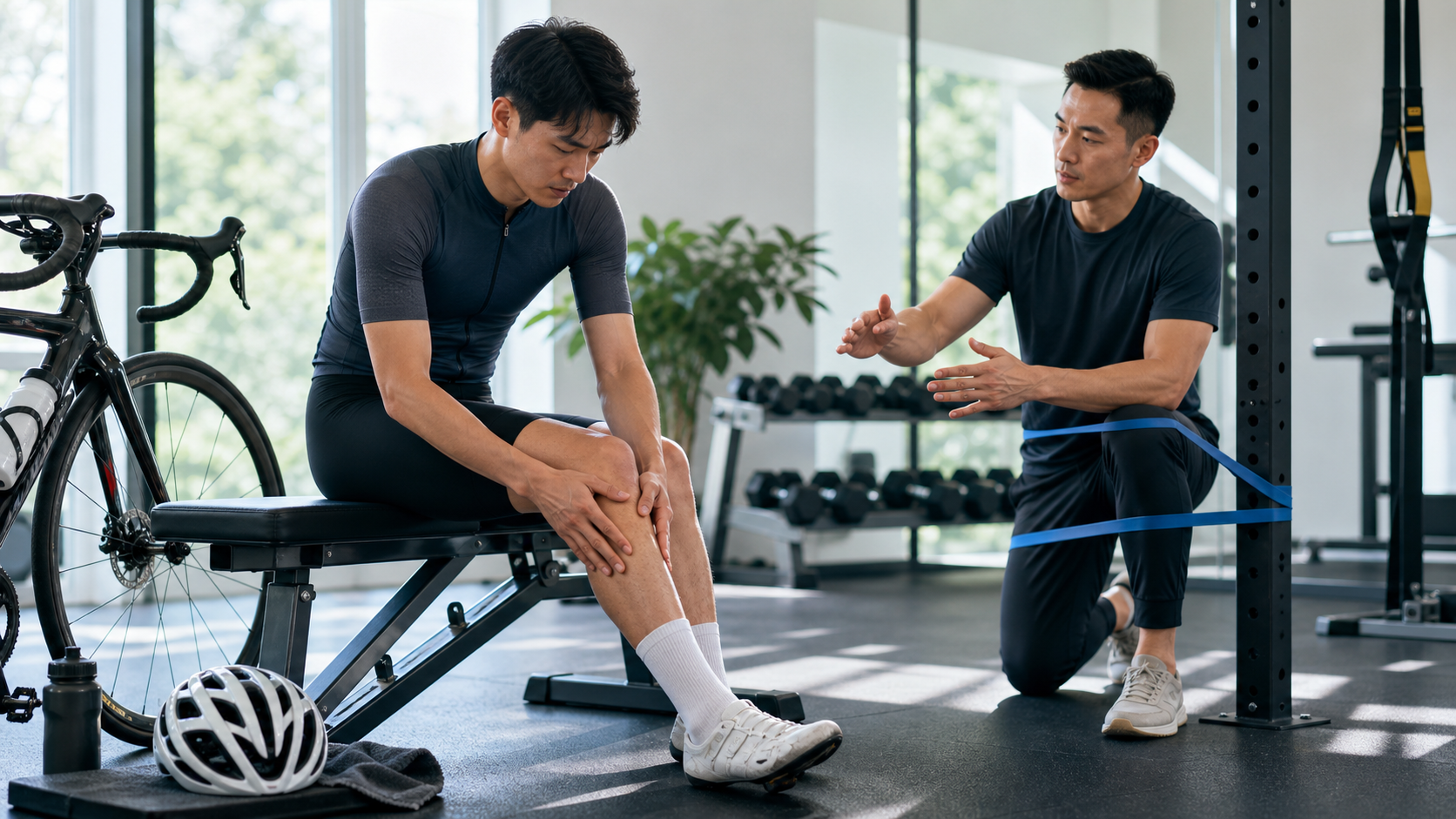
Opening: The Student Who “Gained Strength Fast but His Knee Hurt More the More He Rode”
I once coached an engineer in his early forties; let’s call him A-Kai. He was driven. Over about three months in the winter, he took his squat from bodyweight to 1.5 times bodyweight in the gym. His legs got bigger, and his climbing wattage went up. He told me proudly, “Coach, my strength is progressing really fast.”
But when spring arrived and he started racking up miles on Yangmingshan and the Beiyi Highway, the front of his knee—that tendon just below the kneecap—began to ache dully. At first, it was just tightness the day after a ride. Then it became a pulling sensation along a line every time he pushed a hard gear. He was confused: “My muscles are clearly so much stronger now—how did I get injured instead?”
I asked him just one thing: “Over these three months, your muscles have been improving. Did you give your tendons the same time to catch up?” He was stunned.
That is the core concept I want to talk about today—muscle and connective tissue (tendons, ligaments) adapt on completely different timescales. If you train your tendons at the pace of muscle training, the muscle gets stronger first and pours greater force into a tendon that isn’t ready for it. Injury happens in that gap of “capability mismatch.”
In fifteen years of coaching, from pro athletes to total beginners who just bought a road bike, a large share of the injury cases I’ve seen weren’t about muscle at all—they were about that overlooked, quiet, slow-adapting connective tissue. In this article, I want to lay out clearly something that’s important but rarely explained well.
Conceptual Foundation: What Tendons and Ligaments Actually Are, and Why They’re So Slow
First, Distinguish Tendons, Ligaments, and Muscle
Many people lump these three together, but they are three different things:
- Muscle: Tissue that actively contracts to produce force. It has rich blood flow and high metabolic activity, and it adapts fastest of the three.
- Tendon: The “rope” connecting muscle to bone, responsible for transmitting the force generated by muscle to the skeleton—for example, the Achilles tendon and patellar tendon.
- Ligament: The “strap” connecting bone to bone, responsible for stabilizing joints—for example, the anterior cruciate ligament (ACL) and medial collateral ligament of the knee.
The main component of both tendons and ligaments is collagen (primarily type I). According to exercise physiology literature, collagen makes up about 60–80% of a tendon’s dry weight and is the key determinant of tendon strength and stiffness. They both belong to “connective tissue,” and their shared characteristics are—low blood flow, slow metabolism, and low cell density. This is the fundamental reason they adapt so slowly.
Why “Collagen Turnover” Is Slow: The Internal Renewal Rate of a Rope
Here’s a counterintuitive finding that research consistently supports: collagen turnover in the core of mature tendons is extremely slow—almost stagnant.
In plain terms: the collagen fibers in the “core” of your Achilles tendon may not have been replaced much since your twenties. Researchers have even used isotope labeling to estimate that the half-life of collagen in the tendon core is measured in “years” or even “decades.” That’s a completely different world from muscle protein, which turns over in days to weeks.
So what does training actually change? Based on current human research, exercise-induced collagen synthesis is more likely to occur at the “periphery” of the tendon rather than the “core.” In other words, the new collagen you stimulate through training mainly wraps around the outside of the tendon, slowly accumulating inward, slowly rearranging, slowly cross-linking, gradually making the whole tendon thicker, denser, and stiffer. This is a project measured in “months,” not “weeks.”
I often use this analogy with my students: muscle is like a rented house—you can repaint it anytime. Tendon is like a load-bearing steel beam—to reinforce it, you have to wrap it layer by layer from the outside. There’s no rushing it.
What “Stiffness” Is, and Why It Matters More Than “Getting Thicker”
When talking about tendon training, you have to know one term: tendon stiffness.
Stiffness refers to how much a tendon lengthens under a given tensile load. The higher the stiffness, the less the tendon stretches under the same force, the more efficient the energy transfer, and the better it can handle high loads. The literature consistently shows that appropriate resistance training increases tendon stiffness and elastic modulus, and that heavy loads are more effective than light-to-moderate loads at improving stiffness—this holds true even in middle-aged and older populations.
For cyclists, a stiffer patellar tendon means that when you stomp on the pedals or sprint out of the saddle, the force from your leg muscles is delivered to the pedal more directly, while also being less prone to accumulating micro-damage under repeated loading. For runners, and for any athlete who repeatedly absorbs impact, stiffness is a key asset for protecting joints and improving efficiency.
Ligaments: Even Slower and Harder to Train Than Tendons
Most of what we’ve discussed so far concerns tendons, but don’t forget the even quieter player—ligaments. Ligaments connect bone to bone and are responsible for joint stability. They have even less blood flow than tendons and even slower metabolism. Their remodeling rate is the slowest of all connective tissue in the body.
This leads to two practically important conclusions:
First, recovery from ligament injuries is measured in seasons and years. For major ligament injuries like an ACL tear, the full rehabilitation period before returning to high-intensity sport often approaches a year or more. This is a physiological fact that willpower cannot accelerate. Rushing back only raises the risk of re-injury.
Second, ligaments can’t be “trained bigger” the way muscles can. What you can do is mainly strengthen the “dynamic stabilization system” around the joint through overall strength training, balance training, and proprioceptive training, so that muscles and nerves help share the load with the ligaments. For cyclists, protecting the knee ligaments largely comes from correct pedaling alignment, proper cleat setup, and saddle height—a misaligned pedaling line creates chronic shear forces on the medial and lateral knee ligaments over time. That’s why I always emphasize: get the bike fit right first, then talk about adding volume.
The Timescale: The Most Important Table in This Entire Article
If you remember only one thing from this article, I want it to be this timescale table. It’s the underlying logic of “load management”—you have to know how long each tissue takes to catch up before you can plan your progression.
| Tissue / Capacity | First Measurable Adaptation | Noticeable Improvement | Approaching Mature Stability | Relative Speed |
|---|---|---|---|---|
| Neuromuscular coordination | Days to 1 week | 2–4 weeks | 4–6 weeks | Fastest |
| Muscle strength / hypertrophy | 2–3 weeks | 6–8 weeks | 3–6 months | Fast |
| Cardiorespiratory / aerobic capacity | 1–2 weeks | 4–8 weeks | 3–6 months | Moderate |
| Tendon stiffness / structure | Only noticeable at ~8 weeks | 3–6 months | 12+ months | Slow |
| Ligament strength remodeling | Several months | 6–12 months | 1–2+ years | Slowest |
(These are general ranges compiled from exercise physiology literature and clinical observation. Individual variation is large; use this only to understand timescales.)
Look carefully at the gap in this table: when your muscles have already clearly gotten stronger by weeks 6–8 and you feel “bigger and stronger,” your tendons may just be starting to show “noticeable” structural adaptation. There is a dangerous window of capability mismatch in between—the force your muscles can output exceeds what your tendons can safely absorb at that moment. A-Kai’s knee fell right into that window.
Research supports this: with appropriate stimulation, tendons begin to show measurable changes in mechanical properties at around eight weeks, but truly remodeling the entire tendon structure (cross-sectional area, fiber density, cross-linking) is a project measured in seasons and years.
What Actually Happened to A-Kai: Laying Out the Timeline
Let’s use A-Kai’s example to make this table concrete. Over three winter months, he took his squat from bodyweight to 1.5 times bodyweight. His muscle strength entered its noticeable improvement phase around weeks 6–8, and that’s when he started feeling “legs getting stronger, watts going up fast.” The problem was that his patellar tendon, at that same point in time, was only just beginning to show noticeable structural adaptation—there was a gap of several weeks between the two.
When spring came, he took this pair of “strong muscles, just-starting tendons” legs straight up Yangmingshan, and his weekly riding volume jumped from a low winter baseline to two or three times his normal amount in one week. Two bad things happened at once: capability mismatch (muscle output far exceeding tendon capacity) plus acute load spike (this week’s training volume far exceeding the recent monthly average). Stacked together, that line in the front of his knee started pulling.
I want to emphasize: A-Kai wasn’t too weak, and his form wasn’t wrong. He was “too strong, too fast.” This is the most common trap for serious, disciplined athletes—precisely because they’re disciplined and progress quickly, the muscle surges ahead and leaves the tendon behind. Once you understand this, you’ll see why I always emphasize pacing, not intensity.
Practical Methods: How to Train Tendons—“Heavy, Slow, Long-Term”
Okay, concepts are covered. Now let’s get to what you really want to know—how exactly do you train to effectively improve tendon stiffness without getting injured?
The training modality with the most consensus in sports science for tendon adaptation is “Heavy Slow Resistance” (HSR). Its three keywords:
1. Heavy: The Load Must Be Sufficient
Tendons are mechanosensitive tissue—what they “feel” is the magnitude of tension. Loads that are too light don’t stimulate them. The literature consistently shows that heavy loads improve stiffness more than light-to-moderate loads. In practice, tendon training weights should fall in the moderate-to-high intensity range of your capacity (roughly a weight you can lift for 6–15 reps to failure), not light loads with high rep counts.
2. Slow: The Tempo Must Be Slow
The hallmark of HSR is a slow tempo, typically 3 seconds concentric, 3 seconds eccentric (about 6 seconds per rep). Slow speed extends the time the tendon is under tension. This “time under tension” is considered key to stimulating collagen synthesis and stiffness gains, and the slow tempo also reduces the injury risk from swinging momentum and compensatory movement.
3. Long-Term: Patience Measured in Months
This is what most people fail at. Since tendon structural remodeling takes 3–6 months or longer, you can’t give up after 3 weeks because you don’t feel anything, and you can’t suddenly spike the load after 3 weeks because you do feel something. Consistency, regularity, and the long haul are the soul of tendon training.
A Basic HSR Program for Cyclists/Runners (12 Weeks)
Here’s the introductory tendon-strengthening program I often give my students, targeting the two lower-limb tendons that most commonly cause problems: the patellar tendon (front of knee) and the Achilles tendon (back of ankle). Do it 2–3 times per week, on non-consecutive days.
| Week | Primary Exercises | Load Intensity | Tempo | Sets × Reps | Notes |
|---|---|---|---|---|---|
| Weeks 1–2 | Bodyweight/light-load squats, calf raises | Low (learn the movement first) | 3s up, 3s down | 3×12 | Establish tempo and neuromuscular connection |
| Weeks 3–4 | Barbell/dumbbell squats, weighted calf raises | Moderate (15 reps to failure) | 3s up, 3s down | 3×12 | Start adding weight |
| Weeks 5–8 | Squats, leg press, weighted calf raises | Moderate-high (10–12 reps to failure) | 3s up, 3s down | 4×8–10 | Enter the effective stimulation zone |
| Weeks 9–12 | Squats, leg press, single-leg calf raises | High (6–8 reps to failure) | 3s up, 3s down | 4×6–8 | Maximize stiffness gains |
Key reminder: For the pace of adding weight, my principle is “increase by no more than about 10% per week”—this applies equally to gym loads and to riding/running volume. This isn’t an exact law; it’s a conservative guardrail. Better slow than sorry. When a tendon is over its head, it doesn’t protest immediately—it often settles the bill with pain weeks later.
Load Management: Where Tendon Training Is Really Won or Lost
If HSR is the “gas pedal,” then load management is the “steering wheel and brakes.” I’ve seen too many people with beautiful training plans die on load management.
Acute:Chronic Load Ratio—Don’t Let This Week Spike
Sports medicine commonly uses this concept: the ratio of acute load (training volume over roughly the last week) to chronic load (average training volume over roughly the last four weeks). When this week’s volume far exceeds your recent monthly average (say, riding three times your normal mileage over a long weekend), injury risk rises noticeably.
For cyclists, this explains a common phenomenon: on normal workdays you can only ride a little, then on a weekend or holiday you blast out 100+ km in one go, and a few days later the tendon acts up. It’s not that you’re not strong enough—it’s that this week’s acute load has left your chronic baseline far behind, and the tendon can’t adapt in time.
Real-World Load Traps in the Taiwan Context
In Taiwan, there are several very local load-management traps I specifically warn my students about:
- Holiday spikes: Over Lunar New Year, Tomb-Sweeping Day, or Dragon Boat Festival long weekends, riders do Wuling, Taipei–Kaohsiung, or the Hualien–Taitung loop in one go, while their normal training volume is very low. This is the most classic acute load spike.
- Summer heat wrecking recovery: Taiwan’s summers are hot and humid, with apparent temperatures often above 35°C. Training in high heat increases overall physiological stress, slows recovery, and worsens the environment for tissue repair. In summer, you need to control intensity even more and make sure to hydrate and sleep enough.
- The climbing culture: Taiwan loves climbing (Yangmingshan, Beiyi, Wuling). Long-duration high-tension pedaling is a huge load on the patellar tendon. Schedule adequate recovery after climbing days.
- Insufficient recovery from eating out: Taiwan’s food culture is convenient, but it’s often high in oil and sodium with uneven protein distribution. Tissue repair needs adequate protein as raw material. If you eat out a lot, pay special attention to having a protein source at every meal.
Load Management Practical Principles Table
| Situation | What to Do | What to Avoid |
|---|---|---|
| Just starting tendon training | Build tempo with low loads; prioritize consistency first | Going heavy immediately, chasing extreme soreness |
| Adding volume each week | Keep increases within about 10% | Spiking mileage or weight in a single week |
| Before a long weekend | Gradually raise chronic load over several weeks prior | Slacking during normal weeks, then blasting on the holiday |
| Mild discomfort appears | Reduce volume, extend recovery, monitor the trend | Pushing through pain, masking it with painkillers |
| Summer heat | Lower intensity, increase hydration and sleep | Hard training during midday heat |
Collagen Supplementation: Does It Work? Dosage and Timing
This is one of the questions students ask me most: “Coach, does collagen supplementation actually work?”
My stance has always been conservative and honest: some human studies suggest that hydrolyzed collagen intake combined with resistance exercise may have a positive effect on tendon-related synthetic responses and adaptation. But it’s not a miracle cure, and it absolutely cannot replace training itself. Collagen is the “raw material”; mechanical loading is the “instruction”—without the instruction of training, no matter how much raw material you take, your tendon won’t know where to reinforce.
Based on current research directions, the approaches most commonly discussed are roughly as follows (this is a general summary, not a personalized prescription):
| Item | General Direction | Notes |
|---|---|---|
| Form | Hydrolyzed collagen | Most commonly used in relevant studies |
| Dosage range | About 15–30 grams | Some studies show more pronounced synthetic responses at higher doses |
| Combination | Often paired with vitamin C | C is a cofactor for collagen synthesis |
| Timing | About 30–60 minutes before training | So the raw material is available when the loading stimulus occurs |
Please note: these numbers are “ranges” that have appeared in studies, not a prescription for you to copy exactly. Everyone’s constitution, dietary baseline, and goals differ. Rather than obsessing over supplements, get the three fundamentals right first: training, sleep, and protein at every meal—these three things have a far greater impact on connective tissue than any supplement.
Protein: A Practical Calculation for Taiwan’s Eating-Out Crowd
Since we’re talking about raw materials, protein is the one thing you should take care of most. Tissue repair needs adequate protein, but the common problem for people who eat out in Taiwan is “uneven distribution”—breakfast is a bread with milk tea and almost no protein, lunch bento is okay, and then dinner tries to make up for it all at once. This pattern of concentrating intake in one meal isn’t ideal for ongoing tissue repair.
The simple principle I give my students: every meal should have a clear protein source. Taiwan actually has plenty of options—eggs and tuna at breakfast shops, soy milk; chicken legs, fish, tofu, and braised eggs at buffet restaurants; tea eggs, chicken breast, unsweetened soy milk, and yogurt at convenience stores. You don’t need to obsess over grams, but you should develop the awareness of “where’s my protein in this meal?” For people who exercise regularly, distributing protein evenly across three meals is far more practical than fixating on any supplement.
Common Mistakes and Corrections: The Landmines I Keep Seeing
After all these years, the error patterns in tendon injury cases are highly repetitive. I’ve organized them into a table—check how many you recognize in yourself.
| Common Mistake | Why It’s Harmful | Correct Approach |
|---|---|---|
| Only training muscle, ignoring tendon | Creates a capability gap between strength and tendon | Include slow-tempo tendon stimulation alongside strength training |
| Giving up after 3 weeks with no results | Tendon adaptation is measured in months; 3 weeks is too short | Give it at least 3–6 months of patience |
| Spiking load as soon as you see progress | Muscle gets stronger first; tendon can’t keep up | Keep weekly increases within about 10% |
| Fast, jerky movement | Reduces time under tension, increases injury risk | Slow tempo, about 3 seconds each for concentric and eccentric |
| Taking painkillers and riding through pain | Masks warning signs, allows damage to accumulate | Reduce volume, monitor, see a doctor if needed |
| Rushing through warm-up | Cold tissue has poor stiffness and extensibility | Especially in winter, warm up thoroughly before pushing intensity |
| Chronically insufficient sleep and protein | Lacks raw materials, poor recovery environment | Prioritize sleep and protein at every meal |
A Special Note on “Pain”
The most troublesome thing about tendon problems is that the pain signals are often delayed and vague. Muscle soreness is usually most noticeable the next day and fades within a few days; tendon dull pain, however, can surface weeks after you thought everything was fine, and once it becomes chronic tendinopathy, it’s very stubborn to deal with.
My principle is to teach students to distinguish two types of pain:
- Acceptable pain: Mild tightness during or immediately after training that resolves with rest and doesn’t affect daily activities the next day.
- Warning pain: Pain that becomes increasingly noticeable, affects daily movements (stairs, pain at the start of a pedal stroke), doesn’t subside much with rest, or comes with swelling.
When the second type appears, don’t tough it out with painkillers. Medical access in Taiwan is actually very convenient—under the National Health Insurance, seeing an orthopedist, rehabilitation specialist, or sports medicine clinic is quite accessible. If you need evaluation by a doctor or physical therapist, go get it. Early intervention has far better outcomes than letting it drag into a chronic condition.
Warm-Up and Taiwan’s Climate: Details Often Overlooked
Many people just swing their legs around a bit and start riding, but for connective tissue, warming up has real physiological meaning. When tissue temperature rises, the viscoelastic properties of tendons change—they become more “compliant” and better able to absorb impact. Going straight into high tension with cold tissue is the backdrop for many sudden strains.
This is especially important for early-morning climbs in Taiwan’s winter. On winter mornings starting up Yangmingshan or Beiyi, temperatures can be around 10°C. When you first head out, your tendons are cold, with poorer stiffness and extensibility. If you start stomping and sprinting out of the gate, the risk rises noticeably. My principle for students: treat the first 10–15 minutes as a formal warm-up. Use an easy gear and low intensity to gradually bring your legs and heart rate up, and only enter the intensity zone after the tissue has warmed.
Summer is the other extreme. Taiwan’s summer heat and humidity don’t just affect immediate performance—they also wreck the “recovery” component. Training in high heat and humidity increases overall physiological stress, tends to degrade sleep quality, and causes more fluid and electrolyte loss. All of this worsens the environment for tissue repair. For summer training, I recommend: avoid midday heat, move intensity days to early morning or evening, hydrate and replace electrolytes, and treat sleep as part of your training.
| Season / Situation | Effect on Connective Tissue | Response Principle |
|---|---|---|
| Winter early-morning climbs | Cold tissue, poor stiffness, higher risk of acute strain | Extend warm-up to 10–15 minutes before pushing intensity |
| Summer humid afternoon heat | High physiological stress, slower recovery | Avoid hot periods, hydrate, prioritize sleep |
| Long holiday rides | Acute load spike | Build chronic load gradually over several weeks beforehand |
| Early season transition | Body still adapting | Stay conservative for the first two weeks, observe responses |
FAQ
After years of coaching, there are a few questions about tendons and ligaments that almost everyone asks. I’ve compiled them all here.
Q1: Can stretching train the tendons?
Stretching mainly changes the extensibility and range of motion of muscles and tissue—that’s a different thing from the “improving tendon stiffness” we’re talking about. To improve stiffness and make tendons stronger, the key is resistance training under tension, not passive stretching. Stretching has its value (mobility, warm-up, relaxation), but don’t expect to strengthen tendons by stretching.
Q2: I’m older now—can my tendons still adapt?
Yes. Research shows that older populations can also improve tendon mechanical properties through resistance training, and heavy loads are even more effective. It’s just that the older you are, the slower the adaptation, the more patience and conservative progression you need, and the more you need to prioritize warm-up and recovery. Age isn’t a reason not to train—it’s a reason to train even more.
Q3: Cycling itself uses the legs—do I still need to train tendons separately?
Yes. Cycling is a relatively high-frequency, moderate-to-low single-tension activity. The stimulus it gives tendons is different from the “high tension, slow tempo” stimulus of HSR. If you want to specifically improve stiffness and keep injuries at bay, adding dedicated heavy slow resistance training is a worthwhile investment, especially for high-mileage riders or those who love climbing.
Q4: If I’m injured, should I rest completely and not move?
For most chronic tendon problems, doing nothing at all is actually not the best approach. The mainstream direction in modern sports medicine is “progressive loading”—providing appropriate load within a controlled range that doesn’t worsen symptoms actually helps repair. But this must be done under evaluation and guidance from a doctor or physical therapist—don’t just train or rest based on how you feel.
Q5: How often should I take rest days, and how do I schedule recovery?
There’s no one-size-fits-all answer, but the principle is: leave recovery between high-tension days (climbing, intervals, heavy lifting)—don’t stack them consecutively; sleep and protein are the foundation of recovery; and judge by “trends” rather than “how you feel on a single day”—if things get progressively tighter and more painful over several days, that’s your body telling you to cut back. Rather than pushing through to chase your plan, proactively scheduling a deload week is often far more cost-effective than being forced to stop for months after an injury.
Actionable Advice for Readers at Different Levels
I’ve given you the concepts and the methods. Finally, let me make it concrete with things “you can start doing tomorrow,” divided into three levels.
For Beginners (Just Starting to Exercise, or Just Bought a Bike)
- Don’t rush to add volume. Right now, your muscles and cardiovascular system will improve quickly, but tendons are the slowest—deliberately “hold back” your progression.
- Schedule 2 basic strength sessions per week, doing squats and calf raises at a slow tempo. Focus on correct form and consistency first, not weight.
- Keep weekly increases in mileage/training volume within about 10%, and don’t spike on holidays.
- Take care of sleep and protein at every meal—this is the cheapest and most effective “nutrition.”
For Intermediate Riders (Training Regularly, Wanting to Break Through)
- Formally adopt an HSR program (see the 12-week table in this article) and treat tendon stiffness as a specific training goal to manage.
- Start consciously monitoring your acute:chronic load ratio, using a simple training log or sports app to track trends and avoid single-week spikes.
- If you want to try collagen supplementation, remember it’s a supporting player—get the fundamentals of training and diet right first.
- Periodize your schedule: separate high-tension climbing days and interval days from tendon recovery, don’t cram them together.
For Advanced Athletes / Those Who Have Been Injured
- What you need most is patience and a long-term mindset. A previously injured tendon remodels even more slowly—you can’t just return to “your old volume” directly.
- If you have a history of chronic tendinopathy, I strongly recommend progressive-load rehabilitation under the guidance of a physical therapist, rather than training by feel on your own.
- Lengthen your annual plan to give tendons a full multi-season adaptation window. Don’t treat a tissue that works on a yearly timescale with a single-season short-term view.
- Regularly review: pain trends, training volume trends, recovery quality. Make decisions with data, not feelings.
Conclusion: Learn to See Your Body Through the Lens of “Slow”
Back to A-Kai. What I did for him wasn’t complicated: pulled back the spiked riding volume, introduced slow-tempo tendon training, kept weekly increases under 10%, and repeated the same sentence to him over and over—“Your tendons need to be measured in months, not weeks.”
A little over three months later, his knee didn’t hurt anymore, and his climbing pedal stroke felt more solid than ever. He told me, “So it wasn’t that I wasn’t working hard enough—I was using the wrong pace.”
That’s the concept I most want to leave you with: muscles repay your effort in weeks, but tendons and ligaments repay your patience in months, even years. In an era that demands instant results and everything fast, choosing to view those quiet, slow, load-bearing connective tissues with a “slow” lens is actually the smartest thing—and the thing that will let you go furthest in your athletic journey.
Slow and steady wins the race. When it comes to tendon training, that’s no cliché.
If you want to start today, here are three minimum actions: first, cap your weekly training volume increase at about 10%—you can set that guardrail right now; second, schedule two slow-tempo squat and calf raise sessions per week, about 3 seconds each for concentric and eccentric, not chasing weight but chasing consistency; third, take sleep and protein at every meal seriously. None of these three things cost money, require equipment, or can’t be done today—and their impact on that quiet tendon of yours is far greater than any supplement or gadget.
Remember that timescale: muscles in weeks, tendons in months, ligaments in years. Follow that rhythm, and you’ll find fewer injuries, a more solid pedal stroke, and the ability to keep riding and running without being forced out in your thirties or forties by recurring pain. That’s what true long-termism looks like.
This article is educational content and cannot replace individual diagnosis and treatment advice from a physician, physical therapist, or nutritionist. If you have persistent pain, swelling, or functional limitations, seek medical evaluation promptly.
References
- Role of Extracellular Matrix in Adaptation of Tendon and Skeletal Muscle to Mechanical Loading, Physiological Reviews. https://journals.physiology.org/doi/full/10.1152/physrev.00031.2003
- Mechanical, Material and Morphological Adaptations of Healthy Lower Limb Tendons to Mechanical Loading: A Systematic Review and Meta-Analysis. https://www.ncbi.nlm.nih.gov/pmc/articles/PMC9474511/
- Effect of aging and exercise on the tendon, Journal of Applied Physiology. https://journals.physiology.org/doi/full/10.1152/japplphysiol.00328.2016
- Load magnitude affects patellar tendon mechanical properties but not collagen or collagen cross-linking after long-term strength training in older adults. https://www.ncbi.nlm.nih.gov/pmc/articles/PMC6357404/
- The Collagen Synthesis Response to an Acute Bout of Resistance Exercise Is Greater when Ingesting 30 g Hydrolyzed Collagen Compared with 15 g and 0 g. https://pmc.ncbi.nlm.nih.gov/articles/PMC11282471/
- Hydrolysed Collagen Supplementation Enhances Patellar Tendon Adaptations to 12 Weeks’ Resistance Training in Middle-Aged Men. https://www.ncbi.nlm.nih.gov/pmc/articles/PMC11917387/
Related Reading
- The Timescale of Training Adaptation: Why Cardiorespiratory, Muscle, and Connective Tissue Progress at Different Speeds
- How Strength Training Makes You Run Faster and Ride Harder: Three Pathways Through Nerves, Tendons, and Economy
- Collagen and Vitamin C: A Nutritional Repair Strategy for Tendons and Ligaments
- Strength Training Basics for Endurance Athletes: Why Runners and Cyclists Should Both Be in the Gym
一日北高/長距離團騎 常見問題補充篇 / 組團或跟團的眉角 / 壯車友容易被瘦車友慢性拉爆 / 原來屁股痛可能是這個原因...? / 風場配速法 / 公路車 / CT Yeh
2 年前
西進武嶺 免費訓練分析服務 Intervals | 練不夠還是練過頭?你哪一種類型選手?AI模型告訴你! | 備戰神器 | 公路車 訓練 | CT Yeh
4 年前
#公路車 #Fitting 靠人工智慧APP 幫你調整單車
6 年前
CT 喇低賽) 單車 比賽總是沒照片? 攝影師的觀點大公開 姿勢就是力量! 請加速1.25倍收看
7 年前
滑雪新手們慘摔學習全紀錄(請開字幕),滑雪好好玩 | Snowboard + Ski | 岩原 スキー場 | 滑雪APP使用 | GoPro Max
6 年前
一日北高常見問題大集合 | 攻略 | 路線 | 訓練 | 補給 | 自行車 單車 | 一日雙城 | 雙塔 | TWB北高360 | 屁股痛
6 年前
CT暗黑廚房) 車友必備 宇宙無敵鮮蚵湯 幫助訓練恢復 天然食補 好市多 超肥鮮蚵 破PR
7 年前
福隆鐵人團練隨拍
8 年前