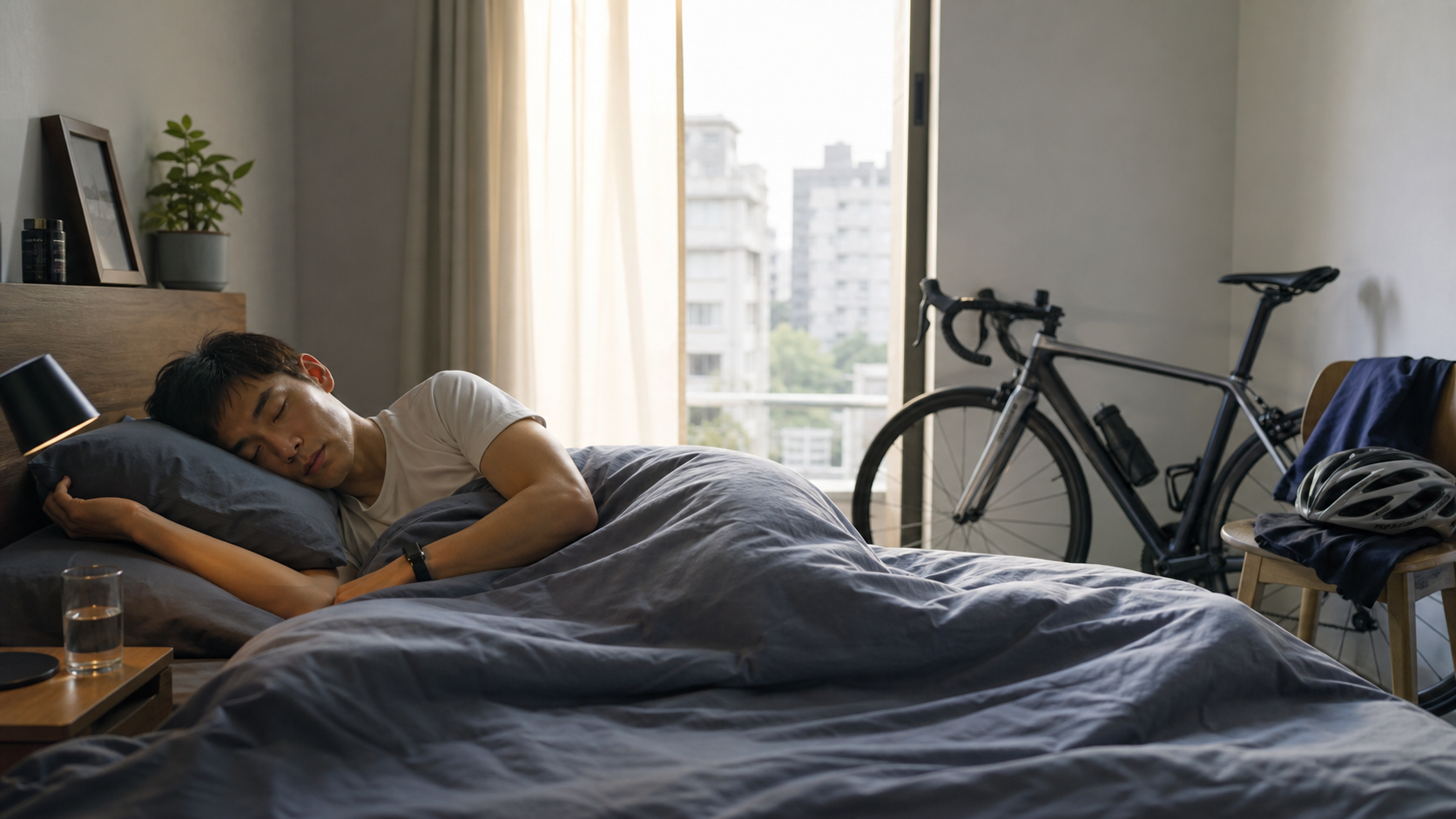
Starting with a Trainee Who Couldn’t Improve No Matter What
I once coached an amateur road cyclist—let’s call him A-Zhe. He was 34, a tech engineer, and his functional threshold power (FTP) had been stuck at around 240 watts for a full year. I reviewed his training plan: intensity, volume, and periodization were all fine. His nutrition was decent too, with his weight holding steady around 70 kg. But he had one habit: he slept only about five and a half hours on weekdays, then caught up by sleeping until noon on weekends—and he was proud of it, saying “sleeping too much is a waste of life.”
I asked him to do one thing: for two months, change nothing about his training plan, but extend his time in bed to eight and a half hours each day, keeping his bedtime and wake-up time as consistent as possible. He was reluctant at first, thinking it sounded too mystical. Eight weeks later, his FTP had risen to 258 watts. The same interval workouts felt noticeably easier (lower RPE), and his morning resting heart rate had dropped from 58 bpm to around 52 bpm.
He asked me: “Coach, I didn’t train more these two months—how did I improve?”
My answer has never changed: Training merely delivers the “stimulus” that tells your body to get stronger; the actual process that makes you stronger happens almost entirely while you’re asleep. Sleep isn’t one part of recovery—it is recovery. In this article, I want to lay out clearly why this severely underrated factor matters.
Why Sleep Is “Recovery,” Not Just “Rest”
Let’s bust a myth first: many people think of sleep as “shutting down”—the body goes still and nothing happens. The truth is the opposite. Once you lie down, close your eyes, and your conscious mind steps aside, a dense sequence of repair work truly begins—muscle fiber rebuilding, glycogen replenishment, immune system preparation, nervous system recalibration, and the consolidation of memory and motor skills. The vast majority of it happens during sleep.
Think of training and recovery as a balance scale. On the training side sits “breakdown”: micro-tears in muscle fibers, depleted energy stores, central nervous system fatigue, and elevated inflammation. On the recovery side, the goal is “supercompensation”—not just repairing back to baseline, but rebuilding slightly stronger than before. The accumulation of that “slightly stronger” is the source of all your progress. And the most critical window for supercompensation is deep sleep.
If training keeps increasing while sleep stays insufficient, the scale tips permanently toward breakdown. You enter a state many serious athletes know all too well: the harder you train, the weaker you feel; performance stagnates or declines; niggling injuries keep appearing; mood sinks; and you lose passion for training. This isn’t a lack of effort—it’s the classic picture of a recovery deficit.
I often use this analogy with my athletes: training is like “withdrawing” from the bank, while sleep and nutrition are “deposits.” You can overdraw in the short term to squeeze in a hard training block, but your account can’t stay negative forever. Many people think progress comes from constant withdrawals, but what actually raises the balance (your fitness) is the steady nightly deposits of sleep. That’s why professional athletes treat sleep management as part of their craft—they know that being able to sleep, and sleeping well, is itself a competitive edge.
Sleep Stages: What Your Body Does Through the Night
To understand how sleep repairs the body, you first need to know that sleep isn’t one uniform block—it’s a cycle made up of alternating “stages.” A healthy adult’s sleep cycle lasts about 90 minutes, repeating four to six times per night. Each cycle includes the following states:
Light Sleep (N1, N2 Stages)
This is the transitional and maintenance phase of falling asleep, taking up the largest share of the night—roughly half. Here you slide from wakefulness into sleep, heart rate and breathing gradually slow, and body temperature drops. Don’t underestimate light sleep: a large portion of motor memory consolidation—“saving” the pedaling technique, running form, or shifting rhythm you practiced today—happens during N2.
Deep Sleep (N3 Stage, Slow-Wave Sleep)
This is the most critical stage for an athlete’s physical recovery, typically concentrated in the first half of the night. During this stage, brain waves become slow and large (hence “slow-wave sleep”), and the body enters its deepest repair mode: growth hormone is secreted in large amounts, promoting tissue repair and muscle synthesis; glycogen replenishment, immune cell preparation, and clearance of inflammatory byproducts mostly happen intensively in this window. Deep sleep is the body’s repair shop. If you go to bed too late or your sleep gets fragmented, this is usually the first thing sacrificed and the hardest to make up.
REM Sleep (Rapid Eye Movement)
This is the main dreaming stage, mostly occurring in the second half of the night, with its proportion increasing toward morning. REM is especially important for the brain, emotions, and learning: it organizes memories, stabilizes mood, and consolidates complex cognitive and motor skills. For athletes, insufficient REM directly impairs next-day focus, decision-making speed, and emotional stability—which is why when you sleep poorly, it’s not just your legs that feel weak; your “brain” for reading the road, handling the bike, and pacing also turns sluggish.
Here’s a key point many overlook: deep sleep dominates the first half of the night, while REM dominates the second half. So “sleeping late but getting eight hours” and “sleeping early and getting eight hours” aren’t fully equivalent—staying up late compresses your early-night deep sleep; and being woken too early by an alarm (say, getting up at 5 a.m. for a morning ride) often cuts into precious late-night REM. Neither end should be casually sacrificed.
The table below lays out how each stage relates to athletic recovery:
| Sleep Stage | Approximate Share of the Night | Typical Timing | Core Function for Athletes |
|---|---|---|---|
| Light N1/N2 | About 45–55% | Spread throughout the night | Maintaining sleep, motor skill storage (pedaling/running form memory) |
| Deep N3 (slow-wave) | About 15–25% | More in the first half of the night | Tissue repair, muscle synthesis, immune preparation, fatigue clearance—body repair |
| REM (rapid eye movement) | About 20–25% | More in the second half of the night | Memory integration, emotional stability, consolidation of cognitive and complex skills—brain repair |
(Percentages are general ranges for healthy adults and vary with age, training load, and individual differences—no need to chase exact numbers.)
The Cost of Sleep Deprivation: Not Just “Being a Bit Tired”
Many people treat insufficient sleep as a minor issue—“I’ll just grab a coffee tomorrow and push through.” But from a sports science perspective, the cost of sleep deprivation is systemic, and many effects are already happening while you still “feel fine.”
Performance Declines Directly
The most obvious impact is on athletic performance itself. Sleep deprivation slows reaction time, reduces maximal strength and power, impairs aerobic performance, and makes the same workout “feel harder” (higher RPE). This is especially dangerous for road cyclists who need to ride for hours in hot, humid conditions while constantly reading the road and the dynamics of the pack—a half-second slower reaction can be the difference between safety and disaster in a downhill corner or a sprint finish.
Recovery Slows, and You Get Weaker the More You Train
As mentioned earlier, deep sleep is the body’s repair shop. Not sleeping enough means cutting repair time. The growth hormone secretion window is compressed, glycogen replenishes slowly, and inflammation isn’t cleared—so when you show up the next day, your body gets broken down again before it’s fully fixed. Over time, this leads to chronic fatigue, stagnant performance, or even regression.
Injury Risk Rises
This is the point I most want to emphasize, yet the least appreciated. Research is quite consistent in showing that chronic sleep deprivation is linked to a higher risk of sports injuries. A systematic review and meta-analysis of adolescent athletes found that those who regularly slept fewer than eight hours per night, or had sleep difficulties, had a significantly higher risk of sports and musculoskeletal injuries; related studies also observed that adolescent elite athletes who averaged more than eight hours of sleep on weekdays had about a 60% lower rate of new injuries compared to shorter sleepers (see references at the end).
The logic isn’t hard to grasp: not enough sleep means slower reactions, reduced focus, incomplete muscle repair, and worse neuromuscular coordination—add these together, and you’re pushing yourself toward the edge of strains, sprains, crashes, and poor running landings. Many so-called “unlucky injuries” are, at their root, a setup laid by a sleep deficit.
The Chain Reaction of Hormonal, Metabolic, and Immune Imbalance
Sleep deprivation also disrupts appetite and metabolism-related hormones, elevates stress hormones, and suppresses immunity. In practical terms, what you’ll see is: increased cravings for high-sugar, high-fat foods (even harder to resist for those who eat out often), difficulty managing weight, catching colds easily, and slow recovery from wounds and minor illnesses. For athletes pursuing body composition and long-term health, these are hidden but real costs.
Below is a comparison table of “adequate sleep” versus “chronic sleep deprivation” so you can see the differences at a glance:
| Aspect | Adequate Sleep (Adults ~7–9 hours) | Chronic Sleep Deprivation (Chronic < 6–7 hours) |
|---|---|---|
| Maximal Strength / Power | Maintained or improved | Decreased |
| Reaction Time / Focus | Sharp | Slower, easily distracted |
| Perceived Exertion (Same Workout) | Lower, feels easier | Higher, increasingly tiring |
| Recovery Speed | Fast, supercompensation proceeds smoothly | Slow, recovery deficit accumulates |
| Injury Risk | Lower | Significantly higher |
| Immunity & Illness Frequency | Stable | Prone to colds, slow recovery |
| Mood & Training Motivation | Stable, motivated | Low, irritable, tempted to quit |
(These ranges are general principles; individual variation is significant. Please rely on your own long-term status.)
Practical Methods for Sleep Optimization: A Taiwan-Appropriate Version
Now that the concepts are covered, let’s get to the most practical part: how to actually sleep better and more efficiently. I’ve broken the methods down into four aspects—“Sleep Quantity,” “Sleep Timing,” “Sleep Quality,” and “Environment”—and tailored them to fit the Taiwanese lifestyle as closely as possible.
Step 1: Get the ‘Quantity’ Right First
The recommended sleep duration for the average adult is about seven to nine hours per night. For those who train regularly, because recovery demands are higher, they often need to be closer to the upper limit, or even more. Here, I want to introduce a classic and practical concept—sleep extension. Stanford University conducted a study on its men’s basketball team: players were asked to extend their time in bed to as close to ten hours per night as possible over several weeks. The results showed faster sprint times, and improvements of about nine percentage points in both free-throw and three-point shooting percentages, along with better reaction times and reduced fatigue (see references at the end).
This tells us: for many athletes who are chronically sleep-deprived, the room for improvement isn’t in squeezing in another set of intervals, but in first catching up on the long-term sleep debt. You don’t necessarily need to sleep ten hours, but if you’re currently only getting five or six, simply and consistently increasing that to seven and a half to eight and a half hours could be more effective than any supplement.
Step 2: Nail the ‘Timing’—Consistency Matters More Than Early Bedtimes
The human body has an internal biological clock (circadian rhythm), which is calibrated by consistent routines, light exposure, and meal times. A consistent ‘wake-up time’ every day is the most powerful lever for stabilizing your circadian rhythm, more so than what time you go to bed. Rather than sleeping at 10 PM one night, 1 AM the next, and sleeping in until noon on weekends, it’s better to wake up at a consistent time every day (even on weekends, try to delay by no more than an hour), letting your body know the rhythm.
A common dilemma for many Taiwanese office workers is the clash between “early morning riders” and “night owls”: waking up at 5 AM for a weekday ride, then staying up late binge-watching shows and sleeping in until noon on weekends, yanking the circadian rhythm back and forth. Instead of this, it’s better to choose a relatively fixed core schedule and avoid unlimited catch-up sleep on weekends—catching up delays falling asleep the following night, creating a vicious cycle (commonly known as “social jetlag”).
Step 3: Improve ‘Quality’—Pre-Sleep Behavioral Engineering
Sleep quality largely depends on what you do in the one to two hours before bed. Here are the things I most often ask my clients to implement:
- Avoid bright lights and screens before bed: The blue light from phones, tablets, and computers suppresses melatonin and delays sleep onset. Try to put down your phone 60 minutes before bed, or at least enable night mode and dim the brightness.
- Time your caffeine intake: Caffeine has a long half-life. Try to avoid coffee, strong tea, and caffeinated energy drinks after the afternoon (roughly from noon to 2 PM onwards). With Taiwan’s convenient bubble tea shops and convenience store coffee, many people have a latte in the afternoon and then toss and turn all night.
- Alcohol is not a sleep aid: A drink might help you fall asleep faster, but alcohol severely disrupts deep sleep and REM sleep in the second half of the night, making you feel like you slept but didn’t. Those with frequent social engagements need to pay special attention.
- Leave a buffer after evening high-intensity training: Doing high-intensity intervals too late can elevate your sympathetic nervous system and core body temperature, making it hard to fall asleep. If you can only train in the evening, try to leave two to three hours before bed to cool down, stretch, and do some breathing relaxation.
- Establish a fixed pre-sleep routine: Take a warm shower, dim the lights, stretch, read a physical book—use a consistent process to signal to your brain that it’s time to prepare for sleep.
Step 4: Manage Your ‘Environment’—Taiwan’s Humidity and Heat Are Hidden Killers
The three keys to a good sleep environment are: dark, cool, and quiet.
Taiwan especially needs to address the “cool” factor. With summer humidity and the urban heat island effect, a stuffy bedroom prevents your core body temperature from dropping—and a drop in core temperature is the physiological prerequisite for falling asleep and maintaining deep sleep. On a muggy night, you might fall asleep but stay in light sleep all night, tossing and turning without realizing it. Don’t skimp on the electricity bill; using air conditioning or a dehumidifier moderately, and using a fan for air circulation, to keep the sleep environment cool and comfortable, offers an extremely high return on investment for sleep quality.
Light blocking is also important: streetlights, signage, and neighboring building lights in the city can leak into your room. A good blackout curtain, or failing that, a sleep mask, can genuinely improve deep sleep. For quiet, if you live near a main road or a night market, earplugs or white noise are simple and effective solutions.
Here’s a consolidated checklist from pre-sleep to waking, presented as a comparison table:
| Time Period | What to Do | What to Avoid |
|---|---|---|
| Afternoon (after ~14:00) | Drink water, normal training | Caffeine (coffee / strong tea / energy drinks) |
| Evening | If doing high-intensity training, leave a 2–3 hour buffer | Intense intervals too late |
| 90 minutes before bed | Dim lights, take a warm shower, stretch | Heavy meals, alcohol, vigorous exercise |
| 60 minutes before bed | Read physical books, breathing relaxation, fixed routine | Phone / tablet / work messages |
| Sleep environment | Dark, cool (AC / dehumidifier), quiet (earplugs) | Stuffy heat, light leaks, noise |
| Every morning | Wake at a consistent time, get some natural light | Hitting snooze, sleeping in on weekends |
Two Real-Life Scenarios: How Sleep Determines Success or Failure
Beyond the numbers, I’d like to use two typical scenarios to give you a clearer picture. The following scenarios are for instructional demonstration; the characters are fictional, but they reflect patterns I repeatedly see with my actual clients.
Scenario One: The Self-Destructive Grinder
A-Kai is a very dedicated triathlete. His daytime job is demanding, so he crams all his training into the early morning and late night. He sleeps about five and a half hours a night, gets through the day on three cups of coffee, and his training volume is among the highest in his circle. For the first three months, he improved rapidly. But then he hit a “wall”: workout completion rates dropped, paces regressed, and his calves and Achilles tendons constantly felt tight. He thought he wasn’t training enough, so he added more volume—and promptly got injured, forcing him to stop training for six weeks.
When we reviewed his situation, training load wasn’t the main culprit; sleep debt was. He had long been trading recovery time for training volume, so his body’s repair work was never finished, and it finally broke down at its most vulnerable tissue. The first thing we did after his comeback wasn’t adding to his training plan; it was cutting out the late-night sessions and stabilizing his sleep to over seven hours. Three months later, not only did his pace return, but he also set a personal best. The lesson he learned: sleep isn’t training’s opponent; it’s training’s teammate.
Scenario Two: The Steady, Consistent Slow Burner
A-Ling is a mother of two. Her time is fragmented, and she can’t put together a beautiful, long training plan. But she has one advantage: extremely consistent routines. She goes to bed and wakes up at almost the same times every day, getting a full seven and a half hours of sleep. Her weekly mileage is far lower than those peers who train hard into the night, yet her progress is steady and continuous. Over the course of a year, her improvement on climbing time trials actually surpassed many who trained much harder than she did, and she was almost never injured.
Putting these two scenarios together, the message is clear: with adequate recovery, consistent and sustainable training often yields better long-term results than hard, erratic training. Sleep is the foundational condition that makes everything sustainable.
Monitoring Your Recovery with Objective Metrics
Don’t rely just on “feelings” to judge whether your sleep is good—as mentioned earlier, people who are chronically sleep-deprived have blunted perception. The following simple objective metrics, which can be tracked with just about any sports watch in Taiwan, can help you honestly assess your recovery status.
Morning Resting Heart Rate (RHR)
Your heart rate measured first thing in the morning, before getting out of bed, is a great recovery indicator. When you’re recovering well, your resting heart rate stays near your personal baseline; if it’s noticeably elevated for several consecutive days (e.g., several bpm higher than usual), it often signals insufficient sleep, accumulated fatigue, or your body fighting off some stress. In this case, the right move is to reduce training volume and catch up on sleep, not to push through your scheduled workouts.
Heart Rate Variability (HRV)
HRV reflects the balance of your autonomic nervous system and has become a highly regarded recovery metric in recent years. Generally speaking, a high and stable HRV indicates that your parasympathetic nervous system (relaxation, repair) is dominant and recovery is going well; a significant drop in HRV is often an early warning sign of overtraining or insufficient sleep. It’s important to note that HRV varies greatly between individuals—focus on “your own long-term trends and fluctuations,” and don’t compare absolute values with others.
Subjective Feelings and Training Performance
The simplest yet most practical approach: when the same workout feels unusually heavy, your heart rate won’t climb or won’t come down, or you feel irritable and unmotivated—these subjective signals combined are your body asking for recovery. Jot them down simply in your training log, and over time you’ll learn to recognize your own patterns.
Here’s a table summarizing how to interpret the three indicators:
| Indicator | When Recovery is Good | When to Be Alert / Need Sleep & Reduced Volume |
|---|---|---|
| Morning Resting Heart Rate | Near personal baseline | Noticeably elevated for several consecutive days |
| Heart Rate Variability (HRV) | Maintained or high, stable trend | Significant drop, increased fluctuation |
| Subjective Effort for Same Workout | Normal or lighter | Noticeably heavier, abnormal heart rate |
| Mood and Training Motivation | Stable, eager to train | Low, irritable, resistant to training |
(These are general references; individual variation is large. Please interpret based on your own long-term trends and do not compare absolute values with others.)
Special Situations: Race Day, Jet Lag, and Hot Nights
What to Do If You Sleep Poorly the Night Before a Race
Many people get so nervous before a race that a poor night’s sleep throws them off. Here’s a reassuring concept: What truly matters is the total amount of sleep in the week leading up to the race, not the final night. The impact of sleep on performance is cumulative. An occasional sleepless night before the race won’t ruin your performance as long as you’ve slept enough in the preceding days. So, deliberately increase your sleep (sleep extension) in the week before the race; and if you can’t sleep the final night, don’t panic—lying still with your eyes closed and relaxing still has recovery value.
Adjusting for Racing Across Time Zones
When competing abroad and dealing with jet lag, your body’s internal clock doesn’t match local time, which directly affects performance. The principle is: start shifting your schedule toward the destination time as early as possible, get plenty of natural daylight after arrival to help recalibrate your circadian rhythm, and eat and sleep according to local time. There’s no magic fix for jet lag; planning ahead and patiently letting your body adapt is the only reliable approach.
Taiwan’s Hot Nights and Humidity
This point is so important for local readers that it deserves emphasis again. Summer nights in Taiwan are often humid and hot. Even if you lie in bed for eight hours, the stuffy environment prevents your core temperature from dropping, fragments your deep sleep, and significantly reduces sleep efficiency. Instead of agonizing over whether to run the air conditioner to save on electricity, think of it as “spending a little money to buy recovery”: a cool, dry, quiet bedroom might be the highest value-for-money investment among all your gear. Dehumidifying, improving airflow, and using moderate air conditioning buy you a night where your body can truly complete its repair.
Common Mistakes and Corrections
Having coached athletes for many years, I’ve found that the biggest mistake people make with sleep is often “self-perceived compensation.” Here are the most common ones that need correcting.
Mistake 1: Catching Up on Sleep Over the Weekend
Many people sleep five hours on weekdays and expect to pay off the debt by sleeping until noon on weekends. But sleep debt can’t be “settled in one lump sum,” and sleeping in wildly on weekends delays falling asleep that night, disrupts your circadian rhythm, and makes Monday mornings even harder. Correction: Instead of big swings, try to get each weekday night as close to your required amount as possible, and limit weekend catch-up sleep to within one hour. A steady seven and a half hours beats the rollercoaster of five hours on weekdays and ten on weekends.
Mistake 2: Relying on Caffeine to Push Through
Caffeine can temporarily mask sleepiness, but it masks the “signal,” not the “problem.” What your body needs to repair still isn’t repaired. Moreover, afternoon caffeine will in turn disrupt that night’s sleep, creating a vicious cycle of “the more tired you are, the more you drink; the more you drink, the worse you sleep.” Correction: Treat caffeine as an occasional tool for a boost, not a daily crutch; cut caffeine off after midday.
Mistake 3: Only Thinking About Relaxing When You’re in Bed
Some people are under high stress all day, replying to messages until 11 p.m., then lie down and panic when they can’t fall asleep, anxiously thinking “why can’t I sleep yet,” which only keeps them more awake. Correction: Relaxation is a “process,” not a “switch.” Set aside at least 60 minutes before bed to wind down, gradually shifting from work mode to rest mode. If you’ve been lying in bed for over 20 minutes without falling asleep, get up, do something boring in a dimly lit environment, and return to bed only when sleepy—don’t wrestle with insomnia in bed.
Mistake 4: Turning to Sleeping Pills as a First-Line Solution
Occasional insomnia happens to everyone, but long-term reliance on sleep medication or self-increasing doses is not a good direction. Correction: First, build a solid foundation with non-pharmacological basics like your schedule, environment, and pre-sleep behaviors—this often resolves most problems. If sleep issues persist for weeks, significantly impair daytime function, or are accompanied by severe snoring or daytime sleepiness (which could signal sleep apnea), Taiwan’s National Health Insurance makes it easy to seek evaluation from a family medicine physician, neurologist, or sleep specialist—rather than buying medication and toughing it out on your own.
Mistake 5: Comforting Yourself with “I’m Used to It”
This is the most dangerous one. People with chronic sleep deprivation often say, “I function fine on five hours.” But research shows that chronically sleep-deprived individuals experience a blunted “perception” of their own performance decline—you think you’ve adapted, but you’ve merely stopped noticing how much worse you’ve become, while still paying the price in performance and injury risk. Correction: Don’t use subjective feelings as your standard; honestly assess yourself with objective indicators (results, resting heart rate, injury frequency, training motivation).
Actionable Advice for Readers at Different Levels
There’s no one-size-fits-all formula for sleep optimization; the key is to take one step forward from where you are now. Here are three starting points based on your training level.
General Exercisers / Health-Focused Individuals
Your goal is “stability and consistency,” not chasing extremes.
- Aim for a steady seven to eight hours each night, making sure the “quantity” is sufficient.
- Keep a fixed wake-up time, even on weekends—delay it by no more than one hour.
- Cut caffeine after midday and put down your phone an hour before bed.
- Don’t hesitate to use air conditioning or dehumidifiers in Taiwan’s summer; a cool bedroom is your highest-return investment.
- Start with “pick the easiest one to do,” master it, then add the next—don’t try to change everything at once and give up.
Serious Amateur Athletes
Your training load is high, so your recovery needs are high too. Sleep should be managed as part of your training plan.
- Treat sleep as an “invisible workout”: in your training log, record sleep hours and subjective sleep quality alongside mileage and power.
- During heavy training or race weeks, proactively increase sleep (sleep extension) rather than pushing through.
- Use short naps (about 20–30 minutes) to supplement, but don’t nap too long or too late, as it can affect nighttime sleep.
- Early-morning riders should honestly calculate “what time I must wake up means what time I must go to bed”—don’t sacrifice late-night REM sleep for a morning ride.
- Use objective indicators like resting heart rate and heart rate variability (HRV) to cross-check recovery status, and decisively reduce volume when sleep is poor.
Youth Athletes and Parents / Coaches
I want to give this group special attention because the evidence is clearest and the stakes are highest.
- Adolescents have higher sleep needs than adults, but schoolwork and screens often leave them severely sleep-deprived.
- The research mentioned earlier consistently points to one conclusion: sleep-deprived youth athletes have a significantly higher injury risk. At this age, getting enough sleep is one of the best injury-prevention measures there is.
- Parents and coaches should treat “adequate sleep” as part of the training plan, not something that can be casually sacrificed. Evening practices and post-competition schedules must factor in sleep.
- Establishing a fixed bedtime and a family rule of putting away phones before bed often protects children more than any supplement or gear.
FAQ Quick-Fire Q&A
Q: I’m really busy. Is there any way to get the same results with less sleep?
A: Based on current science, there’s no shortcut. So-called “short sleepers” are an extremely rare genetic exception. The vast majority of people who think they’re short sleepers are simply accustomed to a state of sleep deprivation without realizing they’re declining. Rather than finding ways to sleep less, it’s better to make your existing sleep more efficient and try to make up as much as you can.
Q: Is napping actually good or bad?
A: A short nap (about 20–30 minutes) helps boost alertness and improve afternoon performance, especially for those with high training loads. But don’t nap longer than half an hour to an hour, and don’t nap too close to evening—otherwise you’ll enter deep sleep, wake up groggier, and it will compress your nighttime sleep drive.
Q: Does exercising before bed affect sleep?
A: Light stretching, yoga, and breathing relaxation can help you fall asleep. But doing high-intensity training too late raises sympathetic nervous system activity and core body temperature, making it harder to sleep. If you can only do high-intensity training in the evening, leave a two-to-three-hour buffer before bed to cool down.
Q: Can I trust the sleep data from my watch/band?
A: Consumer wearables are useful for tracking trends in “total sleep time” and “regularity,” but their accuracy in distinguishing deep sleep and REM stages has significant error margins. Don’t treat a single day’s numbers as gospel. Looking at long-term trends, combined with your own subjective feelings and objective performance, is far more meaningful than obsessing over one night’s percentages.
Q: I suspect I have sleep apnea. What should I do?
A: If you snore heavily long-term, still feel exhausted upon waking, and have daytime sleepiness severe enough to affect your daily life, this may not be simply a matter of not sleeping enough—it’s a condition requiring medical evaluation. With Taiwan’s National Health Insurance making medical access convenient, please seek a formal assessment from a sleep specialist or relevant department rather than guessing on your own or toughing it out.
Q: I can’t sleep because I’m hungry before bed. Can I eat something?
A: Going to bed completely starving and waking up from hunger does disrupt sleep, but eating a big, greasy, or heavy meal before bed also interferes with falling asleep and deep sleep, as your digestive system is busy working. A compromise: if you’re genuinely hungry before bed, have a small, light, easily digestible snack. Avoid high sugar, high fat, and strong flavors. Those who eat out frequently should especially avoid making their heaviest meal the latest one.
Q: Do melatonin or sleep supplements work?
A: Melatonin may have adjunctive value in specific situations (such as jet lag), but it’s not a universal sleeping pill, nor is it a solution for sleep deprivation. The effectiveness of various over-the-counter sleep supplements varies by individual, and the strength of evidence differs. The real foundation remains a regular schedule, a good sleep environment, and proper pre-sleep behavior. Before using any supplement—especially if you have chronic conditions or are taking medication—it’s recommended to consult a physician or pharmacist to avoid interactions.
Q: I work shift work and it’s hard to keep a regular schedule. What should I do?
A: Shift workers are indeed the hardest group to optimize sleep for, because their circadian rhythms are repeatedly disrupted. The principles are: maintain regularity as much as you can within your control, protect the quality of your catch-up sleep after work with blackout curtains and a quiet environment, and avoid caffeine before the end of your shift. If long-term shift work leads to consistently poor sleep quality and severe daytime fatigue, it’s also worth seeking medical help for evaluation.
Conclusion: Treat Sleep as Your Cheapest Upgrade
Back to A-Zhe from the beginning. He later became my best “sleep evangelist,” telling everyone, “Getting one more hour of sleep is more useful than buying another smart trainer.” That’s an oversimplification, but the direction is right.
In an era where people are willing to spend tens of thousands of NT$ on carbon fiber wheelsets, pay coaches to plan their training schedules, and buy piles of supplements, sleep is almost the only performance-enhancing tool that is “free, available to everyone, yet severely undervalued.” It’s not flashy, it’s not something you can show off on social media, and no company spends big money marketing it—but it might be the highest-return recovery method you have.
Training gives you the reason to get stronger; sleep is what actually makes you stronger. Rather than endlessly adding training volume or chasing fancier gear, first ask yourself the most basic question: Am I getting enough sleep? Starting tonight, pick one small change you can actually do—go to bed thirty minutes earlier, skip coffee after noon, or turn on the air conditioning for a cool night’s sleep—and give your body the time and environment to complete the repair work it needs to do. You’ll find that many of the plateaus you thought were stuck are actually just a matter of not being well-rested yet. Wishing you a deep and restful sleep tonight.
This article is educational content and does not replace individual diagnosis and treatment advice from physicians, physical therapists, or nutritionists. If you have chronic conditions (such as hypertension, heart disease, diabetes), long-term insomnia, or suspected sleep apnea, please seek medical attention and receive an individualized assessment.
References
- Mah CD, et al. The effects of sleep extension on the athletic performance of collegiate basketball players: https://pubmed.ncbi.nlm.nih.gov/21731144/
- Stanford Medicine press release: Snooze you win? It’s true for achieving hoop dreams: https://med.stanford.edu/news/all-news/2011/07/snooze-you-win-its-true-for-achieving-hoop-dreams-says-study.html
- Lack of Sleep and Sports Injuries in Adolescents: A Systematic Review and Meta-analysis: https://pubmed.ncbi.nlm.nih.gov/30888337/
- Sleep, Nutrition, and Injury Risk in Adolescent Athletes: A Narrative Review: https://pmc.ncbi.nlm.nih.gov/articles/PMC10745648/
Related Reading
- The Complete Guide to Athlete Sleep Health: Treat Sleeping as Your Fourth Training Discipline
- Sleep: The Cheapest Legal Performance Enhancer—Coaches Show You How to Steal Back Training Gains
- Sleep Duration and Athletic Performance: A Study on the Quantified Loss per Hour of Lost Sleep
- Sleep Management for Cyclists: A Complete Guide to Improving Recovery Efficiency
CT暗黑廚房) 車友必備 宇宙無敵鮮蚵湯 幫助訓練恢復 天然食補 好市多 超肥鮮蚵 破PR
7 年前
西進武嶺 免費訓練分析服務 Intervals | 練不夠還是練過頭?你哪一種類型選手?AI模型告訴你! | 備戰神器 | 公路車 訓練 | CT Yeh
4 年前
一個測試有沒有認真練車的方法😂 #公路車
10 個月前
沉浸室內單車練功房開箱! 100吋大畫面,最便宜的花費? 居然還能K歌!? | 公路車 | CT Yeh
3 年前
RAMP FTP Test 直播 究竟能撐到幾瓦 訓練台 Gravat Zwift
6 年前
單車AI教練!全新 ChatGPT4o 幫你分析訓練成果!排武嶺課表,分析騎車姿勢! 太神了! / 公路車 / CT Yeh / feat. 緯緯
2 年前
FTL 與 SYB 車隊專訪 西進武嶺 實用攻略分享! 2小時 如何練?!你不知道的眉角!新手準備武嶺必看 EP1 | 實力派女車友 | 精華版 | 公路車 | CTYeh
4 年前
iPhone 12 Pro 夜間騎車動態錄影 效果屌打 GoPro Hero 9 | 公路車 團練
5 年前