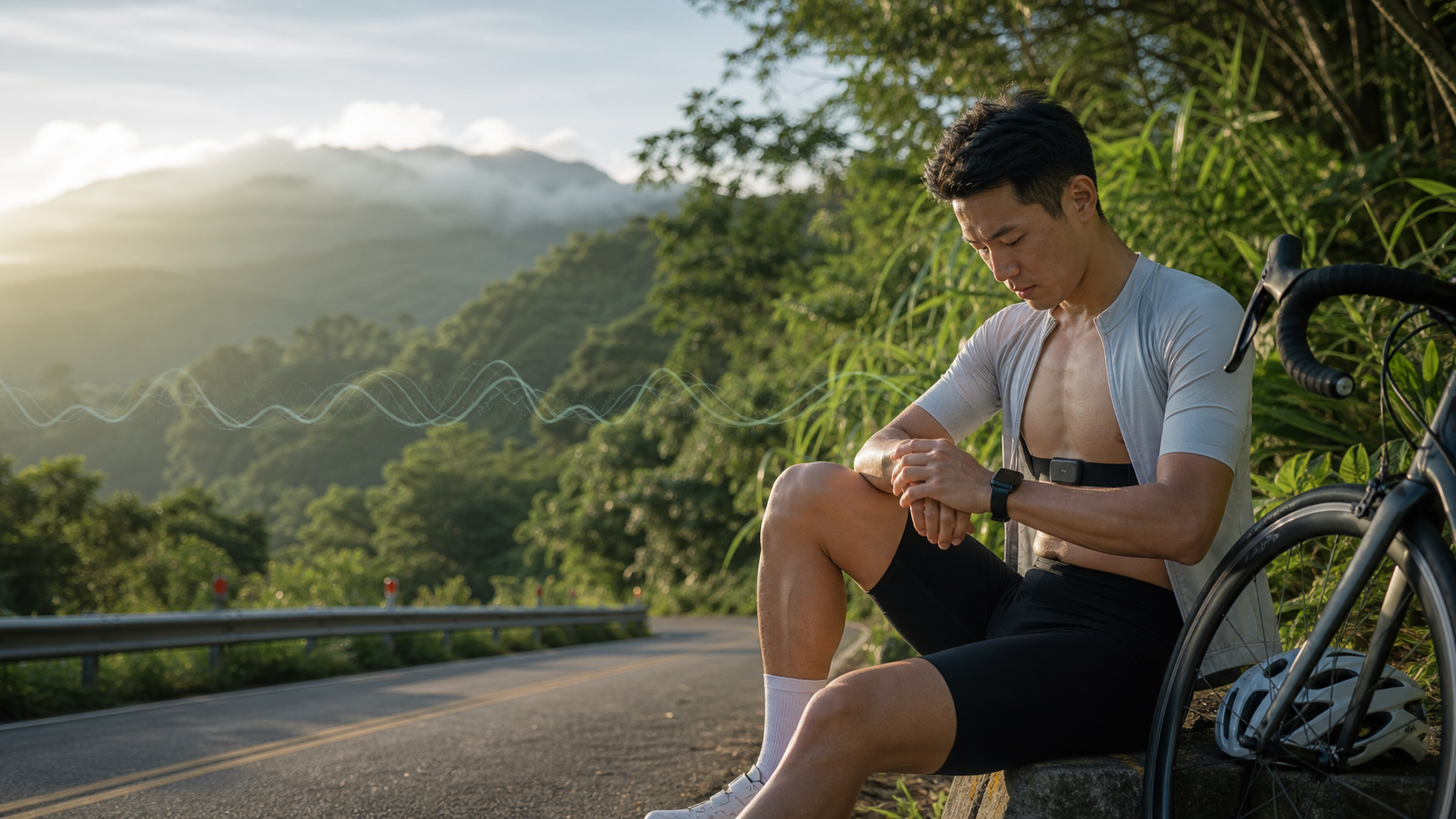
First, a Real Situation I Encountered
I once coached an engineer from Hsinchu Science Park—let’s call him A-Ting. In his early forties, he’d ride Fengguizui and Beiyi with his cycling buddies every Saturday, and did three indoor trainer sessions during the week. One winter, his form suddenly dropped off—at the same power zones, his heart rate spiked but his legs felt weak, and he caught a bad cold a week before a race. He came to me and asked, “Coach, I’m clearly training, so why am I getting worse?”
I asked him to pull up the HRV data he’d been measuring every morning on his phone. When we laid it out, the answer was almost written on his face: his HRV (heart rate variability) had been trending downward for ten days before the cold, dropping more than one standard deviation below his personal baseline, and it hadn’t recovered for several consecutive days. His body had been sending signals all along—he just hadn’t learned to read that window.
In this article, I want to explain HRV properly. It’s not some mystical number cooked up by wearable-device marketing; it’s a window that lets you glimpse the state of your autonomic nervous system. But it’s also easily over-interpreted and held hostage by single-day readings. I’ll walk you through the physiology, the measurement methods, then lay out the real research evidence on “can HRV actually guide training,” and finally give you a practical approach that works under Taiwan’s humid-hot climate, eating-out culture, and NHI healthcare conditions.
Let me state the conclusion up front: HRV is an excellent long-term trend tool and a terrible single-day referee. Remember that, and you won’t go astray.
Why Amateur Riders Need HRV Even More
You might be thinking: isn’t HRV something only pro athletes and national-team members use? I’m just a working professional who rides Fengguizui on weekends—do I really need it?
My answer is: amateur riders actually need it more than pros. The reason is practical. Pro athletes have coaches, physios, nutritionists, and team medical staff monitoring their recovery around the clock—sleep, diet, and training load are all managed. But for amateurs like us? We get chewed out by our bosses during the day, sit in traffic on the commute, take care of the kids at night, eat heavy-salt restaurant food, and still want to squeeze in more riding on weekends—our life stress is far more likely to break the body down than training stress, yet we have almost no objective tool helping us hit the brakes.
HRV fills exactly that gap. It takes your body’s total state—work stress plus sleep debt plus training fatigue plus dietary imbalance—and condenses it into a single number you can check every morning. For those of us without team resources, this cheap braking system is worth far more than its price tag.
1. Physiological Basics: What HRV Is Actually Measuring
The Heart Is Not a Metronome
Many people assume a healthy heart should beat as steadily as a metronome—but the opposite is true. A healthy, adaptable heart shows continuous, subtle variation in the intervals between each beat (medically known as R-R intervals or N-N intervals). The degree of variation in these beat-to-beat time differences is heart rate variability.
Where does the variation come from? The star player is the autonomic nervous system, which has two branches:
- Sympathetic nervous system: the accelerator. Responsible for fight-or-flight, speeding up, mobilizing energy—making the heart beat faster and more regularly.
- Parasympathetic nervous system (mainly the vagus nerve): the brake. Responsible for rest, digestion, and repair—slowing the heart and increasing variability.
These two branches are constantly in a tug-of-war. When you’re relaxed and recovering well, vagal (parasympathetic) activity is high, and it continuously fine-tunes the heartbeat with your breathing rhythm—slightly faster on inhalation, slightly slower on exhalation (this is called respiratory sinus arrhythmia, and it’s a good thing). The richer this fine-tuning, the greater the beat-to-beat variability, and the higher your HRV.
So here’s a key concept: at rest, high HRV generally reflects good vagal (parasympathetic) activity and a body that’s in a state capable of recovery and adaptation; low HRV often reflects elevated sympathetic tone and a body busy dealing with some kind of stress—whether that’s training load, infection, sleep deprivation, alcohol, dehydration, psychological stress, or even just binge-watching a show late the night before.
The Most Common Metric: RMSSD
There are countless HRV numbers out there, but the one most commonly used in sports science and by wearable devices—and the one that best reflects parasympathetic activity—is RMSSD (root mean square of successive differences between consecutive heartbeats). The literature indicates that RMSSD captures parasympathetic activity well—that is, the branch of the autonomic nervous system responsible for rest, recovery, and stress regulation. Because raw RMSSD values have a skewed distribution, in practice the natural logarithm is often taken to produce lnRMSSD, making the numbers more suitable for trend comparison. This is the logic behind apps like HRV4Training and Elite HRV.
The scores you see in different apps (some 0–100, some in milliseconds) are mostly converted and normalized from RMSSD or lnRMSSD. The point isn’t whether your score is higher or lower than someone else’s—it’s how your own numbers change relative to your personal baseline. Cross-person comparisons are almost meaningless—age, genetics, fitness level, and measurement methods vary too much.
Is High HRV Always Good?
Here’s a common misconception to watch out for. High HRV is usually a good thing, but it’s not “the higher the better” or “the higher the safer.” Two situations deserve attention:
- Abnormally high HRV: In cases of extreme fatigue or parasympathetic overtraining, HRV may rise instead of fall, or fluctuate wildly. So a sudden spike upward can also be a warning sign.
- Stable high: If your HRV sits steadily in your own high range with little fluctuation, that’s a genuinely good state of fitness and recovery.
What really matters is the trend and the magnitude of fluctuation, not the absolute value on any single day. That’s why I keep emphasizing it’s a “window,” not a “referee.”
A Checklist of Factors Affecting HRV
Many people’s first reaction when HRV suddenly drops is “did I overtrain?” In reality, many factors affect HRV, and training is just one of them. I’ve organized the common factors into a table so you can play detective and review everything before interpreting your numbers:
| Factor | Typical Effect on HRV | Local Context Example |
|---|---|---|
| High-intensity / high-volume training | Short-term decrease, recovers afterward | Two consecutive days of hard riding at Wuling or Beiyi on the weekend |
| Insufficient or poor-quality sleep | Noticeable decrease | Poor sleep in humid plum-rain season, shift work |
| Alcohol | Clear decrease that night and the next day | Business dinners, celebration parties |
| Dehydration and heat stress | Decrease | Long midday summer rides without enough fluids |
| Psychological / work stress | Decrease | Crunch time on projects, report deadlines |
| Early-stage infection / inflammation | Often decreases early | Pre-cold symptoms, after vaccination |
| High-salt diet | Possible decrease | Restaurant bento boxes, fried chicken, hot pot |
| Caffeine (consumed before measurement) | Interferes with readings | Had an Americano before measuring |
| Good recovery / tapering | Increase | Taper week before a race, full sleep on rest days |
Once you understand this table, you’ll see: low HRV doesn’t equal too much training—it reflects the “total stress” your body is under. Training, life, diet, and emotions all count. That’s also why it’s so valuable—it’s an integrated dashboard of your body, not just a training load meter.
2. Measurement Methods: How to Measure So It Means Something
The most frustrating thing about HRV is that it’s extremely sensitive to measurement conditions. For the same person, different timing, posture, or breathing can produce wildly different numbers. To make the data useful, the first step is standardizing your measurement.
The Golden Rule: Morning, Same Context, Every Day
In the sports science literature, the most common approach for resting HRV is: measure in the morning right after waking, lying flat (supine), for a short recording of about 5 minutes, using lnRMSSD as the most useful resting HRV metric. The reason is that when you first wake up, external interference is minimal (no coffee yet, no work messages bombarding you), so it best reflects the true state of your parasympathetic nervous system.
Here’s a standardized protocol table:
| Item | Recommended Approach | Why |
|---|---|---|
| Timing | Right after waking, before getting out of bed | Eliminates caffeine, food, and stress interference |
| Posture | Fixed supine (or fixed seated), consistent every day | Posture changes significantly affect values |
| Duration | 1–5 minutes of stable recording | Too short adds noise; 5 minutes is the common research standard |
| Breathing | Natural breathing, no deliberate deep breaths | Deliberate slow deep breathing artificially inflates HRV |
| Bladder | Don’t rush to move for bathroom needs | Reduces postural changes and sympathetic stimulation |
| Frequency | Measure daily, at least 4 consecutive weeks to establish baseline | Single days are meaningless; trends are what matter |
“Consistency” matters more than “accuracy.” Which device or posture you use isn’t that critical—what matters is measuring the same way every day, so the numbers can be compared with each other. Measure lying down today and standing tomorrow, and your data is ruined.
Supine vs. Standing: An Advanced Option
Some advanced users measure in both “supine” and “standing” postures. Research shows that morning supine RMSSD and standing RMSSD have only a weak linear relationship, and standing measurements correlate more noticeably with psychological stress indicators than supine ones; other studies have found that overtrained athletes show a clearly blunted HRV response in the standing (upright) posture. In other words, supine measures pure parasympathetic recovery, while standing adds in the autonomic nervous system’s “switching ability” and stress response.
For the vast majority of amateur riders, mastering one morning supine posture consistently for 4–8 weeks is more than enough. Dual-posture is an advanced option once you’re comfortable—no need to complicate things from the start.
An Often-Overlooked Point: Morning vs. Nocturnal Measurement
With smartwatches now widespread, many people’s HRV is actually measured “automatically during overnight sleep” rather than actively in the morning. Each approach has pros and cons:
- Active morning measurement (5 minutes supine): Highly controllable context, the most solid research foundation, but requires the discipline to spend a few minutes every morning.
- Automatic nocturnal measurement during sleep: Zero effort, no risk of forgetting, large data volume, but affected by sleep stages, body movement, and measurement window selection, with large algorithm differences between devices.
One study compared morning and nocturnal heart rate and HRV responses in recreational runners during an intensified training period; both methods reflected training-load-induced changes and each has reference value. In practice, my advice is simple: the method you’ll actually use every day is the best one for you. Don’t chase “maximum scientific rigor” and pick a method you’ll abandon after three days. Consistency is always the biggest variable in HRV monitoring.
How to Choose a Device
| Measurement Method | Accuracy | Convenience | Suitable For |
|---|---|---|---|
| Chest strap heart rate monitor (e.g., Polar H10) + App | Highest, close to ECG | Requires wearing it; active morning measurement | Those serious about trend analysis |
| Phone camera fingertip measurement (HRV App) | Moderate, high individual variation | Extremely convenient, no equipment needed | Beginners on a budget |
| Smartwatch / band nocturnal measurement | Moderate-to-good, depends on model | Automatic during sleep, zero effort | Those who want long-term tracking without hassle |
Nocturnal watch measurement (e.g., measuring HRV throughout overnight sleep) has become increasingly popular in recent years—the advantage is that you don’t have to do anything, and noise resistance is decent. Research is also comparing morning versus nocturnal measurement, and both have value. My recommendation: choose a method you’ll use every day without finding it a hassle—the device you can stick with long-term is the best device. A high-end chest strap you use for three weeks loses to a band you wear to sleep every night.
3. Laying Out the Evidence: Does HRV-Guided Training Actually Work?
This is the section most people misunderstand, and the one where I need to be most honest. Many claims in the market make HRV sound like a magic tool—but what does the research say?
What “HRV-Guided Training” Means
The concept is simple: instead of rigidly following a fixed plan, you check your HRV every day to decide how to train that day.
- HRV in the normal range or elevated → body is recovering well → proceed with the planned intensity session (intervals, threshold work)
- HRV clearly below personal baseline → body is still dealing with stress → switch to easy aerobic work or rest
Sounds reasonable—so what does the evidence say?
What the Research Says: Good, but Depends on What You Want
Multiple systematic reviews with meta-analyses have compared “HRV-guided training” with “traditional fixed training plans.” The conclusions can be broken down into a few key points:
- For parasympathetic-related HRV metrics: HRV-guided training does better at maintaining and enhancing vagal-related HRV, and is less likely to produce negative responses (i.e., less likely to break people down).
- For submaximal physiological parameters: HRV-guided training shows a significant moderate positive effect.
- For VO2max and endurance performance: Compared to fixed plans, HRV-guided training shows a consistent but small and statistically non-significant advantage. In other words, it may not make your maximal aerobic capacity or endurance performance improve noticeably more than traditional plans.
Let me put that into plain language:
The greatest value of HRV-guided training isn’t making you stronger or faster—it’s helping you avoid injury, overtraining, and burning yourself out while you pursue progress.
It’s a risk management tool, a braking system, not a turbocharger. For amateur riders—who already carry work, family, sleep debt, eating out, and commute stress—this “preventing overtraining” value is actually more precious than it is for pros. Because the cost of us breaking down (taking leave, seeing a doctor, wasted race entry fees, unhappy family members) is all very high.
A Decision Table: How to Train Each Morning
Let’s turn the logic above into a table you can consult directly every morning:
| Morning HRV Relative to Baseline | Body State Interpretation | Training Recommendation for the Day |
|---|---|---|
| Clearly elevated or normal-high | Good recovery, adaptation on track | Follow the plan; high-intensity intervals / threshold work OK |
| Within normal fluctuation range | Everything as usual | Execute the original plan |
| Slightly below baseline (single day) | Possible minor fatigue or poor sleep | Follow the plan, but reduce intensity by a conservative 10–15% |
| Clearly low (2–3 consecutive days) | Accumulated fatigue / stress / possible pre-illness sign | Switch to easy aerobic or complete rest; observe |
| Abnormally spiked or wildly fluctuating | Overtired or abnormal body signal | Reduce load and rest; watch for cold / inflammation |
Pay attention to the word “consecutive.” A single low day is fine—everyone has a bad night’s sleep now and then. What truly warrants alertness is multiple consecutive days below baseline that don’t recover—like A-Ting at the start, whose HRV was already trending down ten days before his cold.
Walking Through a Week with A-Ting
Looking at a table can still feel abstract, so let me lay out a week from A-Ting’s later experience (data is illustrative; the point is the interpretation logic) so you can see how to “read the window.” Suppose his personal baseline range for the lnRMSSD relative score is between 58 and 72:
| Day | Relative Score | Context | My Interpretation and Advice |
|---|---|---|---|
| Mon | 65 | Just rode Beiyi on the weekend, normal rest | Within range; easy aerobic as planned |
| Tue | 68 | Slept well | Good recovery; proceed with threshold intervals as scheduled |
| Wed | 62 | Worked late until 11 PM the night before | Slightly down but still in range; follow plan, reduce intensity 10% |
| Thu | 54 | Drank two beers at a social event | Dropped out of range, but single day with a clear cause; switch to easy ride |
| Fri | 51 | Poor sleep, slight throat tickle | Second consecutive low day; switch to complete rest, hydrate and sleep more |
| Sat | 49 | Throat tickle worsening | Third consecutive day down; judged as pre-cold sign; cancel long ride, see a doctor and observe |
| Sun | 55 | After rest and early sleep | Starting to recover; still no hard riding, continue observing |
The key point: when Thursday dropped out of range as a single day, I wasn’t too concerned, because the cause was clear (alcohol); but Thursday, Friday, and Saturday trending down for three consecutive days with throat symptoms—that’s the real warning sign. This time, because A-Ting backed off early, saw a doctor promptly, and slept well, he only had a mild cold for two or three days before returning, unlike last time when it derailed his entire winter of training. That’s the practical payoff of learning to read this window.
4. Common Mistakes and Corrections
In all my years coaching, I’ve seen too many people misuse a good tool. Here are the pitfalls you’ll likely encounter—consider this your preventive shot.
Mistake 1: Being Held Hostage by Single-Day Numbers
The most common disaster. HRV drops one day, and you’re too anxious to train—or you sleep even worse from worry, making HRV drop further the next day. A vicious cycle.
Correction: Always look at the 7-day rolling average or trend line, not single points. Most good HRV apps will draw your baseline range for you (typically your personal mean plus/minus one standard deviation). As long as the number falls within that band, treat it as “normal” and don’t stress daily.
Mistake 2: Measurement Conditions Change Every Day
Today you measure lying down, tomorrow you’re rushed and measure sitting up, the day after you have coffee first. Your data is a mess, and then you blame HRV for being inaccurate.
Correction: Lock in a fixed SOP (wake up, lie flat, breathe naturally, measure for 2 minutes), as routine as brushing your teeth. When conditions are consistent, the numbers become comparable.
Mistake 3: Deliberate Deep Breathing to Inflate the Numbers
Some people deliberately breathe slowly and deeply while measuring, and their HRV instantly looks great. But that’s self-deception—you’re measuring “HRV under deliberate breath control,” not “true resting state.”
Correction: Just breathe naturally. Don’t manipulate it to make the numbers look good. You want the truth, not reassurance.
Mistake 4: Ignoring Taiwan’s Climate and Lifestyle Variables
This one is especially local. Taiwan’s summers are humid and hot. A long ride in the heat (like pushing hard up Beiyi at midday in summer) causes dehydration and heat stress that will clearly lower HRV that night and the next day; heavy-salt restaurant food, drinking at social events, shift work, and poor sleep in the muggy plum-rain season all show up in the numbers.
Correction: Treat a low HRV as a detective case to investigate, not something to blame solely on training. Ask yourself: did I ride in the sun yesterday without enough fluids? Did I eat something very salty and drink alcohol? Did the air conditioner break and ruin my sleep? Often, rehydrating, catching up on sleep, and skipping one salty meal will rescue your HRV more than skipping one training day.
Mistake 5: Treating HRV as a Medical Diagnosis
This one is the most serious. Chronically abnormal low HRV, or HRV accompanied by palpitations, chest tightness, shortness of breath, or unexplained irregular heartbeats—this is not something you handle by interpreting an app.
Correction: Seeing a cardiologist in Taiwan is very convenient, and under NHI coverage, the threshold for an ECG, 24-hour Holter monitor, or echocardiogram is low. If HRV remains abnormal and is accompanied by uncomfortable symptoms, see a cardiologist and let the doctor decide. Wearable HRV is a health-trend reference, not a diagnostic tool for arrhythmias or heart disease—don’t conflate the two. If you have chronic conditions like hypertension, diabetes, or heart disease, any approach to adjusting exercise based on HRV must first be discussed with your primary physician for individualized assessment.
5. Actionable Advice for Readers at Different Levels
HRV is used very differently depending on where you are in your journey. Find your level.
Beginners (Just Starting, Still Building the Habit)
- Don’t rush to interpret—accumulate a baseline first: Get a device you’re willing to use daily (a sleep-tracking band is the least painful), measure consistently for at least 4 weeks, and don’t adjust anything—just observe.
- Fix one measurement method at a time: Morning supine or nocturnal sleep—pick one and don’t switch back and forth.
- Record subjective feelings alongside it: Each day, jot down sleep quality, leg soreness, and mood. You’ll find HRV often lines up with these subjective feelings, and that’s when you’ll truly “trust” the number.
- The goal at this stage is “knowing yourself,” not using it to dictate workouts.
Intermediate (Have a Training Plan, Want to Optimize with HRV)
- Put the decision table to use: Refer to the “how to train each morning” table above and let HRV help you decide whether high-intensity days proceed as scheduled.
- Focus on the “foolproofing when you should rest” aspect: HRV’s greatest value is stopping you from pushing hard on days you shouldn’t. If it’s below baseline for 2–3 consecutive days, switch to easy aerobic work—don’t tough it out.
- Build your personal event reference library: After drinking, after staying up late, after a long hot ride, after a race—note how HRV changes each time. You’ll gradually learn to read your own window.
- Combine with periodization: During a taper week in a larger training cycle, you’ll typically see HRV rise—that’s a sign of supercompensation and can serve as one reference for peaking.
Advanced / Competition-Oriented
- Try dual-posture measurement (supine + standing) to observe autonomic switching ability, especially during high-intensity periods to monitor for overtraining signs.
- Cross-validate with multiple metrics: HRV is just one piece of the recovery puzzle. Look at resting heart rate, training load (TSS/CTL), subjective fatigue scales, and sleep data together—don’t let a single metric dominate decisions.
- Understand the evidence ceiling: As noted earlier, research shows HRV-guided training has limited additional benefit for VO2max and endurance performance. Don’t expect it to turn you into a superhuman. Position it as insurance that reduces the risk of crashing, and your mindset will be much healthier.
6. Practical FAQ: The Questions Students Ask Me Most
Q1: Do I have to measure every day? What happens if I miss a few days?
A: During the baseline-building phase, measure as close to daily as possible. After that, missing a day or two occasionally is fine, but missing too often breaks the continuity of the trend. Make it a morning habit, roughly the same cost as weighing yourself.
Q2: Different apps give different scores—which one is accurate?
A: Don’t compare across apps, and don’t compare with others. Use the same app and the same measurement method, and just watch your own changes. The absolute value of the score doesn’t matter; the relative trend does.
Q3: Do coffee and alcohol affect it?
A: Yes, and noticeably. Alcohol especially suppresses HRV that night and the next day (which is why some people use HRV as objective feedback for cutting back on drinking). For caffeine, I recommend having it only after your measurement to avoid interference.
Q4: What happens to HRV when I’m sick?
A: In the early stages of infection or inflammation, HRV often drops first, sometimes before you even feel symptoms. So consecutive unexplained HRV declines are worth paying attention to for signs of an impending cold—this is exactly the case with A-Ting at the start.
Q5: Does the menstrual cycle affect HRV?
A: Yes. Hormonal changes across the menstrual cycle cause regular fluctuations in HRV at different phases, typically with lower HRV during the luteal phase. Female users should factor the cycle into their interpretation and not mistake natural cycle-related fluctuations for overtraining.
Q6: Does low HRV mean I absolutely can’t train?
A: No. A single low day—you can still train, just dial the intensity back a bit. What truly warrants switching to rest or easy sessions is “multiple consecutive days low that don’t recover.” Don’t let one day’s number hold your training hostage.
Q7: I’m older and my HRV is naturally lower—am I doomed?
A: HRV does naturally decline with age; that’s a normal physiological phenomenon, no need to be anxious. The point is always “your own trend,” not comparing absolute values with younger people. At forty, taking care of your forty-year-old baseline and keeping your trend stable is a good state. And regular aerobic exercise is one of the few lifestyle habits repeatedly observed to help maintain autonomic function—the fact that you ride is already helping you.
Q8: Can HRV be used to track weight loss or metabolic health?
A: HRV correlates with overall stress, recovery, and sleep, so long-term trends can indirectly reflect whether your lifestyle is improving. But it’s not a body-fat scale or a glucose meter—don’t treat it as a diagnostic tool for metabolic disease. If you have metabolic syndrome, diabetes, or similar conditions, you still need to measure blood glucose, blood pressure, and lipids as prescribed and follow up with your doctor. HRV is at most a supplementary lifestyle feedback tool.
7. Fitting HRV into Your Training Week: An Actionable Wrap-Up
After all this theory, here’s a final workflow for “making it part of daily life.” Just follow it:
- Weeks 1–4: Observe only, no action. Choose your device and measurement method, measure daily, and jot down sleep and subjective fatigue along the way. The goal is to let the app draw your personal baseline range.
- From week 5: Start using the decision table. Each morning, see where your number falls in the range, consult the “how to train each morning” table, and decide the day’s intensity.
- Build your event library. After drinking, staying up late, long hot rides, races, vaccinations—record how each special event affects HRV, and you’ll understand yourself better over time.
- Review the trend line quarterly. See whether your overall baseline is moving up (improving fitness and recovery capacity) or down (possible accumulated life stress needing adjustment), and fine-tune training volume and daily routines accordingly.
- When something’s abnormal, seek verification—don’t scare yourself, and don’t tough it out. If numbers are consecutively abnormal with physical discomfort, book a doctor’s appointment; if numbers are normal but you subjectively feel exhausted, trust your body and rest when needed.
Remember, HRV is a tool that helps you make decisions, not a boss that makes decisions for you. The final call always rests in the dialogue between you and your body.
Conclusion: Treat It as a Window, Not an Oracle
Back to A-Ting at the start. I taught him to look at trends, not single points, and to correlate variables like long hot rides, social drinking, and shift-work late nights with his HRV. Six months later, he told me his biggest takeaway wasn’t getting faster—it was that he could finally “understand” what his body was saying. He could rest when he should and push when he should, and he went through the entire winter without a major cold interrupting his training.
That’s the real value of HRV. It’s a window that lets you glimpse the autonomic state you can’t otherwise feel. But in the end, it’s just a window—not a crystal ball, and not a doctor. Don’t be held hostage by single-day numbers, don’t use it as a diagnosis, and don’t expect it to make you a superhuman. Treat it as an honest friend that reports your body’s recovery status every morning. Use it consistently, and you’ll come to understand this body of yours better and better.
Learn to read this window, and you’ll master one of the most precious skills in amateur training: doing the right training at the right time, without breaking yourself down.
One last note for those just starting: Don’t chase perfection; chase consistency. You don’t need the most expensive chest strap, you don’t need dual-posture measurement every day, and you don’t need to calculate every number down to the millisecond. You just need to pick one method you’re willing to use daily, accumulate a few weeks of data, and start learning to read your own trends. Three months from now, you’ll be glad you started. This window has always been there—the only difference is whether you take the time to learn to see through it.
This article is educational content and cannot replace individual diagnosis and treatment advice from a physician, physical therapist, or nutritionist. If you have chronic conditions such as heart disease, hypertension, or diabetes, or experience symptoms such as palpitations, chest tightness, shortness of breath, or irregular heartbeats, seek medical attention promptly and engage in individualized exercise planning under a doctor’s guidance.
References
- Heart Rate Variability-Guided Training for Enhancing Cardiac-Vagal Modulation, Aerobic Fitness, and Endurance Performance: A Methodological Systematic Review with Meta-Analysis — https://pmc.ncbi.nlm.nih.gov/articles/PMC8507742/
- HRV-Based Training for Improving VO2max in Endurance Athletes. A Systematic Review with Meta-Analysis — https://pmc.ncbi.nlm.nih.gov/articles/PMC7663087/
- Monitoring and adapting endurance training on the basis of heart rate variability monitored by wearable technologies: A systematic review with meta-analysis — https://www.jsams.org/article/S1440-2440(21)00108-0/fulltext
- The Advantage of Supine and Standing Heart Rate Variability Analysis to Assess Training Status and Performance in a Walking Ultramarathon — https://www.ncbi.nlm.nih.gov/pmc/articles/PMC7394006/
- Morning versus Nocturnal Heart Rate and Heart Rate Variability Responses to Intensified Training in Recreational Runners — https://link.springer.com/article/10.1186/s40798-024-00779-5
Related Reading
- Heart Rate Variability (HRV) Monitoring: Applications of Autonomic Balance Index in Training Monitoring
- Heart Rate Variability (HRV) and Training Recovery: Using Data to Avoid Overtraining
- Applications of Heart Rate Variability (HRV) in Cycling Training Monitoring
- Applications of Heart Rate Variability (HRV) in Cycling Training: Using Morning HRV to Guide Daily Training Intensity
西進武嶺 免費訓練分析服務 Intervals | 練不夠還是練過頭?你哪一種類型選手?AI模型告訴你! | 備戰神器 | 公路車 訓練 | CT Yeh
4 年前
#公路車 #Vo2Max #最大攝氧量 測驗 體驗 | 心肺測試
6 年前
單車AI教練!全新 ChatGPT4o 幫你分析訓練成果!排武嶺課表,分析騎車姿勢! 太神了! / 公路車 / CT Yeh / feat. 緯緯
2 年前
2026 車錶排行榜!誰是最多車友正在使用?練家子最愛哪款?🏆 (2萬名車友數據) / 公路車 / CT Yeh
5 個月前
風櫃嘴! 現實與虛擬騎乘 會有誤差嗎? 背著iPad邊騎一趟風櫃嘴實際測試一次 | 公路車 | CT Yeh
3 年前
西進武嶺 自製新版AI配速表產生器 x 賽前攻略 抱佛腳! 沒有功率計也可以產生配速表嗎?有什麼其他眉角賽前要注意的呢? | 西進武嶺 / 東進武嶺 KOM 攻略 | 公路車 | CT Yeh
4 年前
Rouvy 元宇宙運動世界! 用VR 騎遍全台灣單車路線 武嶺 中社路 風櫃嘴
5 年前
一個測試有沒有認真練車的方法😂 #公路車
10 個月前