The Science of Muscle Damage and Delayed-Onset Muscle Soreness (DOMS): A Complete Breakdown of Mechanisms, Training Effects, and Recovery Methods
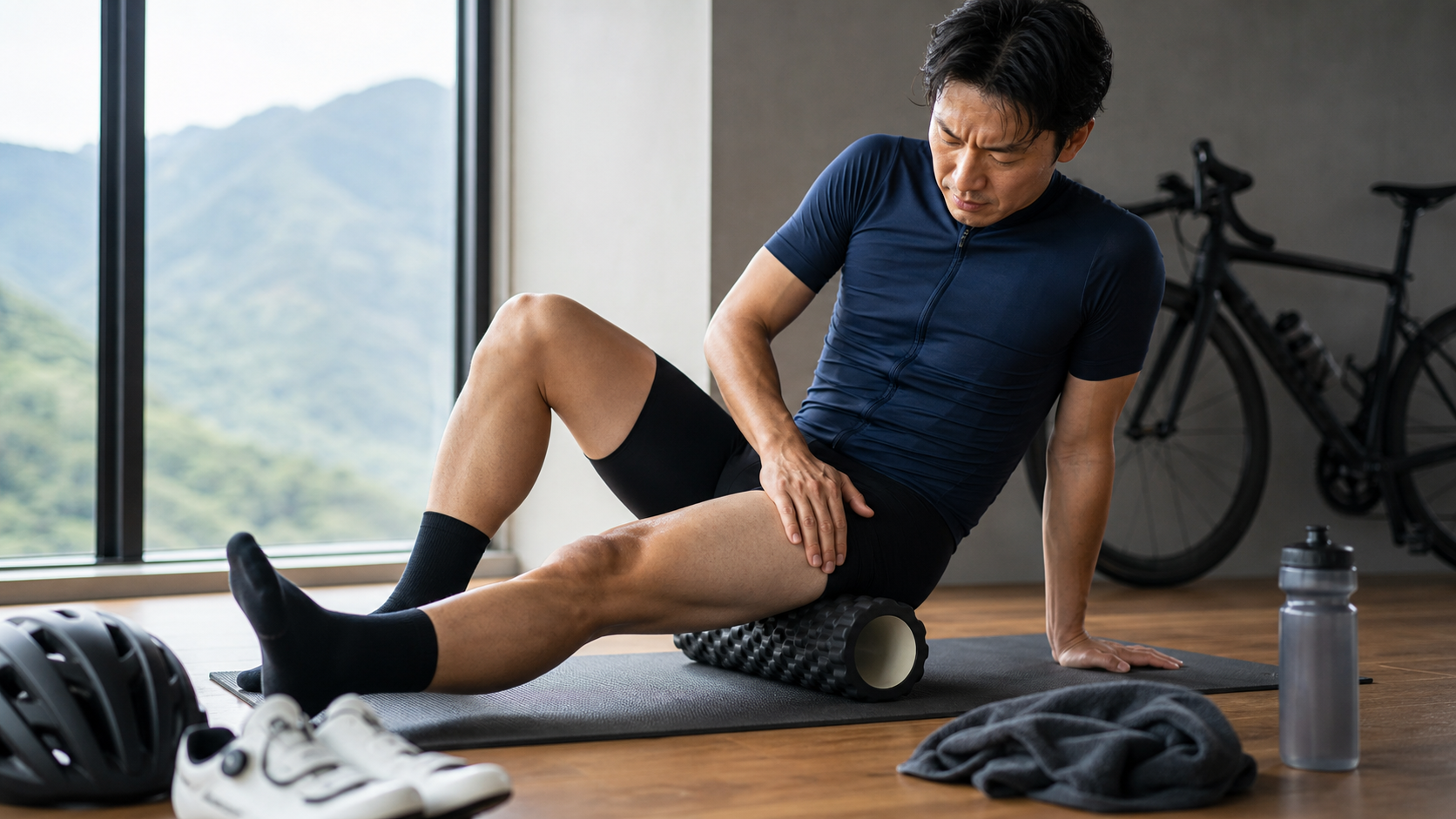
First, a Scenario I Encounter All the Time
Every year in March and April, when classic routes like Wuling, Yangmingshan, and Beiyi open up, my messages get flooded with the same type of question. Last week, a student in his early forties, A-Hao, sent me a voice message that sounded pretty distressed: “Coach, I rode up and down Fengguizui on Sunday. I was fine yesterday, but this morning when I woke up, my front thighs were so sore that I almost fell to my knees getting out of bed. I had to go down the stairs backwards. Did I pull a muscle? Should I see a doctor?”
I reassured him first: this is almost certainly not a strain, but Delayed Onset Muscle Soreness, abbreviated as DOMS. It has several very typical characteristics: no pain during the exercise itself, and it feels fine for a few hours afterward. But it slowly creeps in around 24 hours later, peaks in pain the next day (around 48 hours post-exercise), and then gradually subsides on its own within 5 to 7 days.
In fifteen years of coaching athletes and general fitness enthusiasts, I’ve found DOMS to be one of the most misunderstood topics. Some people are terrified of it, treating it like an injury; others worship it, believing “no soreness means no gain.” I want to break down both extremes in this article. We’ll cover how DOMS actually develops (first, debunking that decades-old lactic acid myth), whether it’s actually related to training progress, and finally, whether the massage guns, foam rollers, and ice baths you spend money on hold up to the evidence.
This will be a bit long, but I promise that by the end, your understanding of “soreness” will be completely different.
1. What Exactly Is DOMS? First, Let’s Debunk the Lactic Acid Myth
It’s Not Lactic Acid—How Many Times Do We Have to Say This?
If your gym buddy still says “soreness is from lactic acid buildup,” please show him this section.
Lactic acid (more precisely, lactate) is indeed produced in large amounts during high-intensity exercise, but it’s cleared remarkably quickly. Once exercise ends, blood lactate levels typically return to near-resting levels within an hour. Think about it: DOMS peaks 48 hours after exercise, when the lactic acid has long been metabolized. How could something that disappears in an hour cause pain that peaks two days later?
There’s an even more direct counterargument: concentric contractions (muscle shortening while producing force, e.g., pedaling a bike, standing up from a squat) also produce plenty of lactate, yet they rarely cause significant DOMS. In contrast, eccentric contractions (muscle being lengthened while producing force, e.g., downhill running, lowering into a squat, the lowering phase of a lift) don’t produce much extra lactate but are the biggest culprit behind DOMS. This comparison effectively crosses lactic acid off the suspect list.
This also explains why A-Hao suffered so much riding Fengguizui. Climbing is primarily concentric, but during long descents, the quadriceps constantly use eccentric contractions to brake and control your body from pitching forward. This eccentric load is the perfect breeding ground for DOMS. Runners feel this even more—a trail race with lots of downhill or a descent on Yangmingshan often leads to worse leg soreness the next day than a purely uphill effort.
So What Actually Causes It?
The current understanding that holds up best in sports science is that DOMS originates from micro-damage to muscle fibers caused by eccentric contractions, which then triggers a cascade of inflammatory and neural sensitization responses.
Literature reviews compiled on Wikipedia mention that at least six hypotheses have been proposed to explain the mechanisms of DOMS: lactic acid, muscle spasm, connective tissue damage, muscle damage, inflammatory response, and enzyme leakage. Looking at it now, no single hypothesis can fully explain it; it’s more like a multi-mechanism chain of “micro-damage → inflammation → neural sensitization.”
Let me break down the general timeline in plain language:
| Time Point | What’s Happening in the Body | Your Subjective Feeling |
|---|---|---|
| During Exercise | Eccentric contractions cause mechanical micro-damage at the sarcomere level, Z-line disruption | Usually no pain, might even feel great |
| 0–6 Hours Post-Exercise | Cell membrane permeability changes, calcium homeostasis disrupted, enzymes (like CK) begin leaking | Most people don’t feel anything yet |
| 12–24 Hours Post-Exercise | Inflammatory cells arrive, local swelling, inflammatory mediators accumulate | Tightness, stiffness, dull ache begins |
| 24–72 Hours Post-Exercise | Inflammatory response and neural sensitization peak, pain receptors sensitized | Peak pain—hurts to press, stretch, or climb stairs |
| 3–7 Days Post-Exercise | Repair and remodeling, sensitization gradually subsides | Soreness slowly fades, returns to normal |
Worth noting is that recent research has focused on neural sensitization. Some literature explores the role of neurotrophic factors in DOMS, proposing that after eccentric contractions, pathways like the B2 bradykinin receptor–nerve growth factor (NGF) pathway and the COX-2–glial cell line-derived neurotrophic factor (GDNF) pathway make local mechanical pain sensitivity higher. Simply put, the reason it hurts so much when you touch it or move is largely because “your pain perception has become more sensitive,” not just because the muscle itself is that badly damaged. This is why DOMS pain can feel alarming to the touch, but the actual degree of muscle damage is usually far less severe than you’d think.
2. Does DOMS Actually Have Anything to Do with Training Progress?
This is the second most common question students ask: “Coach, if I’m not sore after this workout, did I waste my time?”
The “Repeated Bout Effect”—Your Body Catches On Quickly
Here’s a crucial concept for you: the Repeated Bout Effect.
It means that for the same eccentric-load movement, the first time you do it, you’ll be very sore. But after repeating it once or twice, the soreness and muscle damage markers from the same movement drop significantly, and this protective effect can last for several weeks.
This has two key implications for training planning:
- Whether you’re sore mainly reflects “how unfamiliar this stimulus is to you,” not “how effective your training was.” A well-trained mountain biker who descends every day has long adapted his quads to eccentric loads. Even after a very hard ride, he won’t be very sore. Can you say he didn’t get a workout? Of course not.
- Beginners or people restarting training after a sedentary period will be especially sore the first few times—that’s normal. As long as you progress gradually, your body will quickly build protection, and the same workout won’t be as painful afterward.
So I often tell students like A-Hao: Don’t use soreness as a scoreboard for training effectiveness. Whether strength is improving, endurance is increasing, or power output is going up—those objective metrics are what matter. Judging your training by “how sore you are” is as unreliable as judging fat loss by “how much you sweat.”
So Is DOMS a Good Thing or a Bad Thing?
It’s neutral, leaning toward “a necessary evil.”
The micro-damage from eccentric loading is indeed one of the signals that initiates muscle adaptation and remodeling, so you don’t need to treat DOMS as an enemy. But—you absolutely don’t need to deliberately make yourself extremely sore just to chase DOMS. Muscle hypertrophy and strength gains come from the long-term accumulation of “sufficient training volume, progressive overload, and adequate recovery,” not from “one workout that leaves you wrecked.”
In fact, pushing yourself into extreme DOMS is often counterproductive: being too sore prevents you from training properly for the next several days, which disrupts training continuity—the loss outweighs the gain. I’ve seen too many people do a massive “revenge workout” on the weekend, then be immobile all week. Over a month, their total training volume ends up lower than someone who trains steadily.
3. Relief Methods Rundown: Which Ones Actually Work?
Alright, this is the practical part everyone wants to see. I’ll categorize the various “recovery gadgets” on the market into three groups based on current evidence strength. First, an important caveat: currently, no method can “completely eliminate” DOMS. Most methods can do is “slightly reduce symptoms, make you more comfortable, or speed up partial functional recovery”—not make the soreness disappear.
Foam Rolling and Massage: The Group with Relatively Solid Evidence
This is what I recommend most often, and it offers great value for money. Systematic reviews and meta-analyses indicate that foam rolling has a moderate effect on relieving post-exercise muscle soreness, though the overall evidence in this area is still somewhat weak, so don’t expect it to be a miracle cure.
There’s also an interesting study comparing foam rolling to percussive massage (massage guns): both can accelerate the recovery of muscle properties disrupted by DOMS (such as muscle tone and stiffness), but compared to simple rest, neither was significantly better at “reducing pain.” Notably, foam rolling performed better than percussive massage in reducing the duration of elevated muscle tone and stiffness.
My practical conclusion: The greatest value of foam rolling and massage may lie in improving stiffness and tightness, making movement feel smoother, and providing psychological comfort—not in actually suppressing much pain. This effect is quite helpful for maintaining training continuity, so I still recommend it.
There’s also an often-overlooked use: meta-analyses indicate that foam rolling as a “warm-up” may be more valuable than as a “recovery tool,” improving flexibility and even sprint performance. So next time before a ride or run, don’t rush to roll only afterward—rolling beforehand is a better deal.
Active Recovery and Light Activity: Cheap and Effective
This is what I consider the best value-for-money method, and it’s completely free.
When DOMS is at its worst, many people instinctively want to rest completely and not move. But in practice, light active recovery—such as an easy spin, brisk walk, or relaxed swim, at an intensity where you can still hold a conversation—can temporarily relieve soreness, promote circulation, and make you feel better. Note: it’s “temporary relief.” Some soreness may return after you stop, but at least you’ll feel better than if you’d stayed immobile.
For cyclists, scheduling an easy flat ride the next day (heart rate in the low aerobic zone, no chasing pace) is a great way to digest heavy legs. Runners can use the “active recovery” concept by swapping the next day’s workout for a walk or very slow jog.
Ice, Heat, Compression, Stretching: Use Judiciously, Don’t Over-Expect
The evidence for this group is more mixed. I’ve organized the key points into a table for easy reference:
| Method | Current Evidence Direction | Practical Advice |
|---|---|---|
| Ice / Cold Water Immersion | May reduce soreness short-term, but long-term may blunt some training adaptations | Useful during race season when you need quick recovery to compete again; don’t over-ice during daily strength-building phases |
| Heat / Warm Water | Can improve comfort and relax tightness, but limited effect on underlying recovery | Great for relaxation or a warm bath before bed, but don’t expect it to eliminate damage |
| Compression (Compression Garments, Sleeves) | Some studies show it may slightly reduce soreness and swelling sensation | Fine for long travel or post-race wear; results vary by individual |
| Static Stretching | Evidence shows limited help for “preventing or treating DOMS” | Don’t treat stretching as a painkiller; still do flexibility work, but don’t expect it to cure soreness |
| Painkillers / Anti-inflammatories (NSAIDs) | May provide temporary pain relief, but long-term use may interfere with muscle repair adaptations | Not recommended for routine use; consult a doctor if needed, don’t self-medicate long-term |
I want to specifically highlight a point about cold water immersion (ice baths). During dense race schedules when you need to compete again within 48 hours, it can indeed help you “feel” recovered faster. But if you’re in a training phase focused on building strength and muscle mass, jumping into an ice bath immediately after exercise may blunt the positive adaptations triggered by inflammatory signals. So I tell my students: clarify whether your current goal is “quick pain relief to compete again” or “long-term gains”—the strategies differ.
Nutrition and Sleep: The Two Most Underrated Pillars
After all this talk about gadgets, the most basic things are often the most overlooked.
- Protein: Repair needs raw materials. General recommendations are about 1.4 to 2.0 grams of protein per kilogram of body weight per day (adjusted based on training volume and goals). For a 70 kg cyclist, that’s roughly 100 to 140 grams. For people who eat out often in Taiwan, it’s not hard to hit this—a chicken breast, an egg, a glass of unsweetened soy milk, and a serving of tuna add up quickly. The key is distributing it evenly across three meals, not cramming it all into dinner.
- Total Calories and Carbohydrates: Repair is an energy-consuming process. Long-term caloric deficit will slow recovery. On high-training-volume days, don’t over-restrict your diet.
- Hydration: Taiwan’s summers are hot and humid. After heavy sweating, replenishing fluids and electrolytes is crucial. Dehydration impairs recovery and increases cramping risk (cramps and DOMS are two different things—don’t confuse them).
- Sleep: This is the most powerful, most free, and most side-effect-free recovery method—bar none. Chronic sleep deprivation can’t be compensated for by any massage gun.
4. Common Mistakes and Corrections
After coaching for so many years, here are the most common pitfalls I’ve compiled. Check if any apply to you:
Mistake 1: Treating DOMS as a Training Effectiveness Indicator
Correction: As discussed, whether you’re sore reflects the novelty of the stimulus, not its effectiveness. Use objective metrics (power, pace, reps, weight) to assess progress, not soreness.
Mistake 2: Training the Same Muscle Group Hard While Still Significantly Sore
Correction: During significant DOMS, maximal strength and power output of the affected muscles are reduced. Forcing a hard workout not only yields poor performance but also increases injury risk. What you can do is light active recovery, or train other muscle groups or energy systems.
Mistake 3: Confusing DOMS with a Real Injury
This one is extremely important—it determines whether you need to see a doctor. Here’s a quick table to help you differentiate:
| Feature | More Like DOMS (Usually Nothing to Worry About) | More Like an Injury (See a Doctor) |
|---|---|---|
| Onset Time | Develops gradually 12–24 hours after exercise | Sudden sharp pain during exercise, hearing a “pop” |
| Pain Area | Large area, symmetrical, whole-muscle soreness | A specific point that’s especially painful, can pinpoint the location |
| Pain Nature | Aching, tight, stiff; slightly relieved by movement | Sharp, stabbing pain; specific movements trigger intense pain |
| Appearance | Usually no obvious bruising or deformity | Noticeable swelling, bruising, deformity, or indentation |
| Course | Resolves on its own within 5–7 days | Doesn’t improve, or gets progressively worse |
| Function | Can still move, just sore | Completely unable to generate force or bear weight |
If you have any item from the right column—especially sharp pain during exercise, obvious swelling or bruising, or pain preventing weight-bearing—don’t try to tough it out with a foam roller. Go see an orthopedist or a rehabilitation specialist. Taiwan’s National Health Insurance makes it easy to see a doctor; don’t let convenience turn a small issue into a big problem. DOMS resolves on its own; injuries don’t.
Mistake 4: Weekend Revenge Workouts
Correction: Sitting all week and then doing one massive ride or run on the weekend is the standard recipe for severe DOMS and sports injuries. Instead, spread your volume across several shorter sessions during the week. Once your body builds the protection from the repeated bout effect, weekend long rides won’t be as painful.
Mistake 5: Believing in a Single Miracle Tool
Correction: No massage gun or compression garment can replace “a progressive training plan + enough sleep + adequate nutrition.” Gadgets are a bonus, not the main event.
5. Actionable Advice for Readers at Different Levels
Now that the concepts are covered, here are actionable plans you can follow.
If You’re a Beginner / Restarting After a Sedentary Period
- Accept that the first few sessions will be sore—this is a normal process, not a sign that exercise isn’t for you.
- Start with low eccentric load and gradual progression, e.g., ride on flat roads first, run on flat ground first. Don’t hit downhills or heavy eccentric lifting right away.
- If you’re very sore the day after your first session, do light activity (walking, easy riding). Don’t stay completely immobile, and don’t force a hard workout.
- Let your body build the repeated bout effect—usually after two or three times, the same workout won’t make you as sore.
If You’re a Consistent Intermediate Enthusiast
- Learn to distinguish DOMS from injury (use the table above).
- Plan your training with progressive eccentric loading—when adding downhill or heavy eccentric work, don’t increase too much at once.
- The day after heavy eccentric work (e.g., just ran a route with downhills), schedule an active recovery day rather than an intensity day.
- Use foam rolling for both pre-workout warm-up and post-workout relaxation; treat sleep and protein as non-negotiables.
If You’re an Advanced Athlete / Racing with Goals
- During pre-race training cycles, deliberately include eccentric adaptation so your body builds protection against the race course’s eccentric demands (e.g., if your target race has long descents, train descents).
- During dense race periods, you can strategically use cold water immersion and compression to accelerate subjective recovery; but during off-season strength-building phases, don’t over-rely on ice baths, to avoid blunting adaptations.
- Build your own recovery data habits: subjective soreness ratings, morning heart rate, sleep quality. Long-term tracking is more reliable than single-session feelings.
A Simple “Three-Day Post-Race Recovery Reference Table”
Using a cyclist who just finished a long ride with lots of downhill as an example:
| Time | Recommended Actions | Things to Avoid |
|---|---|---|
| Immediately After Race | Replenish fluids and electrolytes, eat enough protein and carbs, take a warm bath to relax, sleep early | Staying up late celebrating, drinking alcohol without eating a proper meal |
| Next Day (Day 1, Usually Most Sore) | Light active recovery (easy flat ride or 20–40 min walk), foam rolling, continue sleeping and eating well | High-intensity training of the same muscle group, revenge riding another session |
| Day 2 | If soreness has decreased, do low-intensity aerobic work; if still very sore, continue active recovery | Heavy eccentric lifting, sprint intervals |
| Day 3 | Most people feel significant relief; gradually return to normal training | Trying to make up all missed training volume at once |
6. FAQ: Questions Students Ask Most Often
Q: If I’m not sore at all, does that mean the session was ineffective?
A: No. Whether you’re sore depends on the novelty of the stimulus. Experienced athletes aren’t sore from familiar movements, yet still get training effects. Look at objective metrics, not soreness.
Q: Can I still exercise when I’m sore?
A: Light active recovery is fine and often helpful. But high-intensity training of the same muscle group should be avoided until soreness has significantly subsided.
Q: Should I buy a massage gun?
A: If you want one, go ahead. It can help relax tightness, improve comfort, and speed up recovery of some muscle properties. But don’t expect it to eliminate much pain. It’s a bonus tool, not a necessity.
Q: Is it okay to take painkillers to suppress soreness?
A: Routine use is not recommended. Anti-inflammatory painkillers may interfere with muscle repair adaptations. Long-term or heavy use does more harm than good. If you’re really uncomfortable, consult a doctor or pharmacist—don’t self-medicate long-term.
Q: Does stretching help during DOMS?
A: The evidence for “treating DOMS” is very limited. Don’t treat stretching as a painkiller. But you should still do flexibility work for its own sake—just don’t expect it to prevent soreness.
Q: Is being extra sore after training in Taiwan’s summer heat related to the weather?
A: Heat mainly affects dehydration and thermoregulation, making you “feel” more fatigued—that’s a separate mechanism from the eccentric damage of DOMS. However, dehydration does slow recovery, so hydration is even more critical in summer.
Conclusion: Make Peace with Soreness, Don’t Let It Hold You Hostage
Back to A-Hao, who thought he was injured. I did a video call with him—no swelling or bruising on his thighs, the pain was a symmetrical whole-muscle ache, and he could still walk. Classic DOMS. I told him to do an easy 40-minute flat ride the next day, eat enough protein, and sleep early. On the third day, he messaged me: “Coach, much better now. I wish I hadn’t panicked so much.”
This is what I want to convey most: DOMS is neither an enemy nor a badge of honor. It’s just your body telling you, “This stimulus is a bit unfamiliar to me.” You don’t need to chase it, and you don’t need to fear it. What truly determines whether you improve are the unglamorous but long-term effective fundamentals—a progressive training plan, enough sleep, adequate nutrition, and knowing when to rest and when to push.
Put those flashy recovery gadgets in their proper place: a bonus, not the main event. Learn to distinguish soreness from injury, and don’t skip seeing a doctor when you should. That way, you can ride longer, run farther, and train smarter on Taiwan’s beautiful mountain roads.
May every bout of heavy legs be just a normal part of the scenery on your road to progress.
This article is educational content and does not replace individual diagnosis or treatment advice from a physician, physical therapist, or nutritionist. If pain is accompanied by significant swelling, bruising, inability to bear weight, or progressive worsening, seek medical evaluation promptly. Individuals with chronic conditions (such as cardiovascular or metabolic diseases) should consult a professional for individualized assessment before starting or modifying an exercise program.
Appendix 1: A Deeper Look at the Cellular Level—What the Body Does After Micro-Damage
Earlier I covered the mechanisms with a timeline. Let’s zoom in a bit more here, because understanding “what the body is busy doing” is why you’ll understand that “recovery” takes time and can’t be rushed.
Eccentric contractions are particularly damaging because, during the process of a muscle producing force while being lengthened, the load is unevenly distributed across a few sarcomeres. These “unlucky” sarcomeres get overstretched, causing localized disruption of the Z-lines (the structures connecting sarcomeres)—what we call mechanical micro-damage. This isn’t a bad thing; it’s simply the necessary path for the body to adapt to intense stimuli.
The body then initiates a cascade of repair:
- Calcium Homeostasis Disrupted: Cell membrane permeability changes at the damaged sites, calcium enters places it shouldn’t, triggering a series of downstream reactions.
- Enzyme Leakage: Enzymes like creatine kinase (CK), normally inside muscle cells, leak into the bloodstream. This is why researchers use blood CK levels as an indirect marker of “muscle damage severity.” A caveat: the correlation between how high your CK is and how much pain you feel isn’t as strong as you’d think. Some people have very high CK but little pain, and vice versa. This is why you can’t rely on any single number.
- Inflammatory Cells Arrive: The immune system sends macrophages and other cells to clean up damaged tissue and initiate rebuilding. This inflammatory response is the “construction crew” for repair, not the enemy. Many people hear “inflammation” and want to suppress it, but moderate inflammation is actually a signal for adaptation and getting stronger.
- Neural Sensitization: As mentioned earlier with neurotrophic factor pathways, pain receptors become more sensitive than usual, so touching or moving the area hurts more than the actual damage would suggest.
Understanding this chain explains why “using anti-inflammatories or aggressive icing to suppress inflammation to the minimum” isn’t necessarily a good idea—you might suppress the adaptation signals along with it. Your body isn’t broken and in need of firefighting; it’s under construction and needs time.
Appendix 2: A Complete Case Study—From Heavy Legs to Adaptation
I want to use another student, Xiao-Min, as an example to tie all the concepts together and show you how the “repeated bout effect” works in the real world.
Xiao-Min is a 35-year-old office worker and mother who spent years sedentary at a desk. Last year, she decided to start cycling to relieve stress. Here’s her actual situation over the first four weeks (data is her self-reported subjective soreness score: 0 = no soreness, 10 = too painful to walk down stairs):
| Week | Workout Content | Next-Day Soreness Score | My Intervention |
|---|---|---|---|
| Week 1 | 15 km flat riverside ride, including a short gentle slope | 7, sore even when walking | Had her walk 30 minutes the next day, eat enough protein, sleep early; no intensity work |
| Week 2 | Same route again | 4, significantly reduced | This is the repeated bout effect! The same stimulus is no longer as damaging |
| Week 3 | 20 km riverside + a short climb | 5 | Added a new stimulus (climbing); slight increase is normal |
| Week 4 | Challenged a short mountain road with downhill | 8 (downhill eccentric!) | Downhill eccentric is a completely new stimulus; soreness returning is normal. Scheduled recovery days |
Once you understand this table, you’ve grasped the essence: whenever you introduce a new, more unfamiliar stimulus (especially downhill with higher eccentric load), DOMS comes back; once the body adapts, the same stimulus no longer causes as much soreness. Xiao-Min’s heavy legs in week four weren’t a regression—they were proof she’d successfully taken on a new challenge. Three months later, she rides that mountain road with almost no soreness. That’s progress.
The only thing I emphasized to her: Don’t doubt yourself because of one particularly sore session, and don’t feel like you slacked off because of one non-sore session. Focus on “has the distance, elevation gain, and average power I can ride in a month improved?”—that’s the real report card.
Appendix 3: Practical Protein Strategies for Taiwan’s Eating-Out Culture
Protein is the raw material for recovery, but “1.4 to 2.0 grams per kilogram” is too abstract for many students. Here’s a down-to-earth reference for people who eat out in Taiwan, showing roughly how much protein common foods provide (values are approximate ranges; actual amounts vary by portion and cut):
| Common Taiwanese Eating-Out Food | Approximate Protein Content |
|---|---|
| Chicken breast bento main dish (about palm-sized) | About 25–30 g |
| One egg | About 6–7 g |
| One glass of unsweetened soy milk (450 ml) | About 12–15 g |
| One tuna rice ball | About 6–9 g |
| A serving of braised tofu (small plate) | About 10–15 g |
| Two pieces of salmon nigiri | About 8–10 g |
| A serving of steamed fish from a buffet | About 20–25 g |
Using Xiao-Min (about 58 kg) as an example, her training-day target is roughly 90 to 100 grams. Two eggs plus a glass of unsweetened soy milk for breakfast (about 25 g), a chicken breast bento for lunch (about 28 g), steamed fish plus a serving of tofu for dinner (about 35 g), plus miscellaneous sources—hitting the target daily isn’t hard. The key is even distribution across three meals. Don’t have just a bubble tea for breakfast and then gorge on a huge piece of meat at dinner—research shows that spreading protein intake throughout the day is more beneficial for muscle repair than concentrating it in one meal.
A note on a uniquely Taiwanese situation: late-night snacks like bubble tea and Taiwanese fried chicken are high in calories and sugar/fat but low in protein. Using them to “replenish” after training means you’re not getting the raw materials, but you are overshooting calories. Enjoy them occasionally if you want, but don’t treat them as recovery meals.
Appendix 4: A More Nuanced Framework for “Should I Train While Sore?”
The answer to “can I train while sore” isn’t a simple yes or no—it depends on the degree of soreness, what you’re training, and which muscles. Here’s a more practical decision framework:
- Mild Soreness (1–3): Normal training is usually fine, and light activity may even help relieve it. Train with confidence.
- Moderate Soreness (4–6): Avoid high-intensity, heavy-load workouts for the same muscle group. You can train other muscle groups, do low-intensity aerobic work, or technical drills.
- Severe Soreness (7+): Focus on active recovery. Don’t touch high-intensity work for the same muscle group. Forcing it not only yields poor performance but also invites injury through compensatory movement patterns.
- If at any point you experience “sharp pain, localized severe pain, or joint catching/locking”: This is no longer a simple DOMS signal. Stop, and seek medical attention if necessary.
The analogy I often use: DOMS is like a “construction ahead, please detour” sign your body puts up. You can take a different road (train something else) or slow down (active recovery), but you shouldn’t barge through the construction site (hammering the same muscle group).
Appendix 5: Debunking Myths Circulating in Taiwanese Cycling/Running Circles
After leading groups for so long, I’ve noticed some claims spread widely but don’t hold up. Let me clarify them for you:
- “Soaking in a hot spring/sauna when sore will flush out the lactic acid”: As discussed, soreness has nothing to do with lactic acid. It’s already metabolized; there’s nothing to “flush out.” Hot springs can genuinely help you relax and feel good, but don’t use the wrong reasoning.
- “Stretching until it hurts will make you recover faster”: Forcefully stretching a sore muscle to the point of pain may actually worsen discomfort, and the evidence for treating DOMS is limited. Flexibility should be trained, but not this way.
- “The sorer you are, the more fat you’re burning”: Completely unrelated. DOMS is eccentric micro-damage; it has nothing to do with fat metabolism.
- “Beginners must train to soreness for it to count”: Incorrect. Progressive, consistent accumulation of training volume is what works. Deliberately making yourself extremely sore only increases the risk of injury and training interruptions.
References
- Delayed onset muscle soreness — Wikipedia: https://en.wikipedia.org/wiki/Delayed_onset_muscle_soreness
- Delayed onset muscle soreness: Involvement of neurotrophic factors, The Journal of Physiological Sciences: https://link.springer.com/article/10.1007/s12576-015-0397-0
- Preventive effect of foam rolling on muscle soreness after exercise: A systematic review and meta-analysis, ScienceDirect: https://www.sciencedirect.com/science/article/abs/pii/S1360859224004339
- Foam Rolling or Percussive Massage for Muscle Recovery: Insights into Delayed-Onset Muscle Soreness (DOMS), PMC: https://pmc.ncbi.nlm.nih.gov/articles/PMC12286022/
- A Meta-Analysis of the Effects of Foam Rolling on Performance and Recovery, PMC: https://www.ncbi.nlm.nih.gov/pmc/articles/PMC6465761/
Related Reading
- The Real Causes of Muscle Soreness (DOMS) and How to Manage It
- Muscle Damage and Repair After Road Running: The Science of DOMS Explained
- Managing Muscle Soreness After Running: Causes of DOMS and Ways to Speed Up Recovery
- The Neuroscience of Muscle Soreness (DOMS): Mechanisms and Management of Delayed-Onset Muscle Soreness
西進武嶺 免費訓練分析服務 Intervals | 練不夠還是練過頭?你哪一種類型選手?AI模型告訴你! | 備戰神器 | 公路車 訓練 | CT Yeh
4 年前
大禹嶺 到 武嶺牌樓 全程前後實況錄影 | 北進武嶺 | 東進武嶺 | KOM | 訓練台 | 坡度分析 | Taiwan KOM Last 10 km HARD | 公路車
6 年前
Never Stop 西進武嶺 前後雙機 完整全程錄影 訓練台 實境
8 年前
FTL 與 SYB 車隊專訪 西進武嶺 實用攻略分享! 2小時 如何練?!你不知道的眉角!新手準備武嶺必看 EP1 | 實力派女車友 | 精華版 | 公路車 | CTYeh
4 年前
一日北高/長距離團騎 常見問題補充篇 / 組團或跟團的眉角 / 壯車友容易被瘦車友慢性拉爆 / 原來屁股痛可能是這個原因...? / 風場配速法 / 公路車 / CT Yeh
2 年前
2019 夏季KOM 5小 完賽心得 準備攻略 東進武嶺 夏季登山王之路 Taiwan KOM Challenge
7 年前
一日北高常見問題大集合 | 攻略 | 路線 | 訓練 | 補給 | 自行車 單車 | 一日雙城 | 雙塔 | TWB北高360 | 屁股痛
6 年前
#KOM 夏季登山王之路 比賽實況 #東進武嶺
7 年前