Heat Shock Proteins and Exercise Adaptation: Understanding Heat Training at the Cellular Level, Making Summer Your Ally
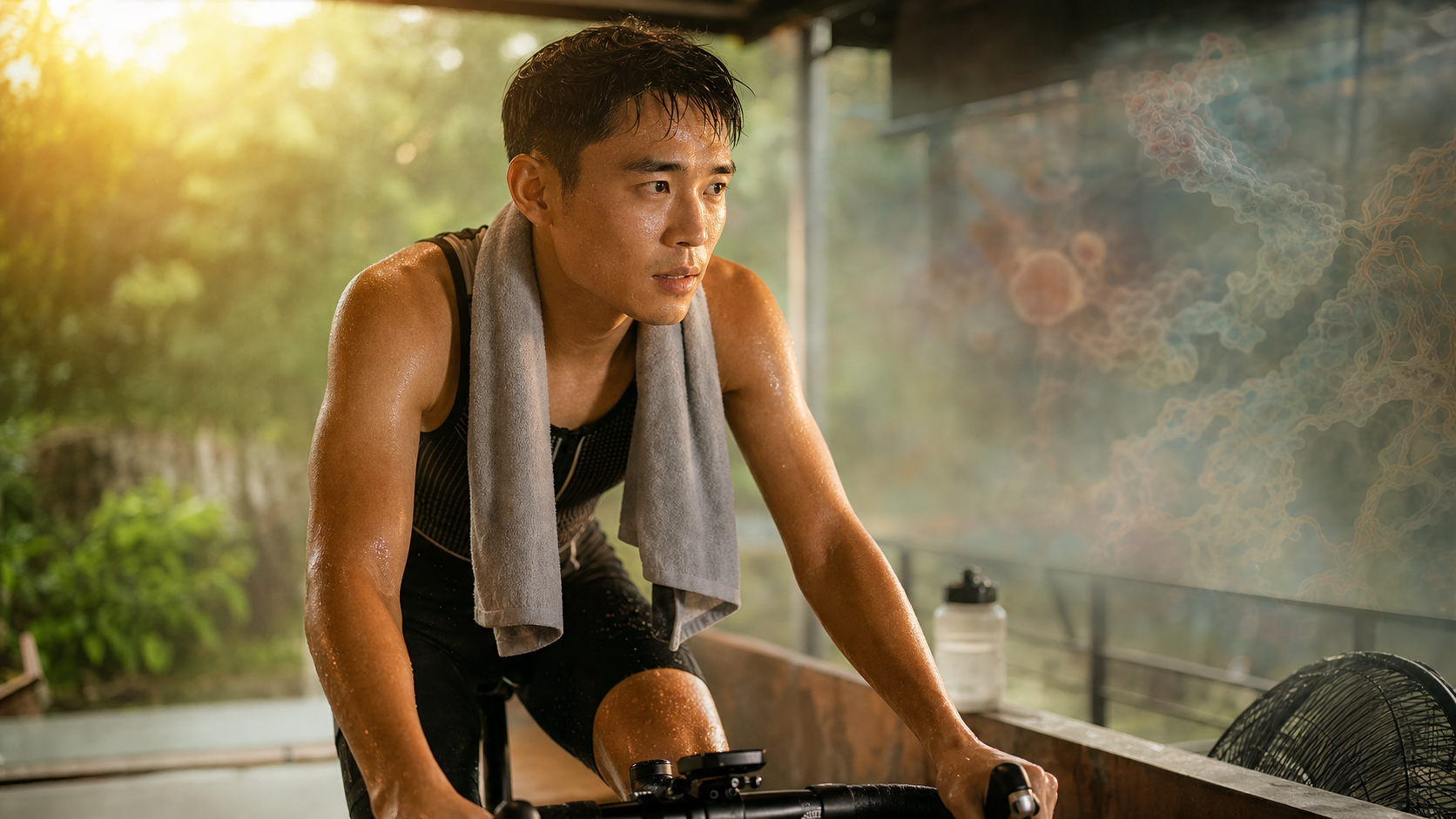
Opening: The Athlete Who “Fell Apart Every Summer”
I once coached an amateur triathlete—let’s call him A-Kai. In winter, his numbers looked great: a stable functional threshold power (FTP), long-distance pacing that never dropped, looking ready to set a personal record. But every year after May, once Taiwan’s humid heat arrived, he became a different person—same wattage, but his heart rate would be ten-plus beats higher, and within two hours of riding he’d feel dizzy, nauseous, and have to call it quits with dead legs. He came to me and asked: “Coach, is my fitness declining?”
I told him: It’s not a fitness problem—it’s that your body “hasn’t learned how to work in the heat yet.”
That sounds cryptic, but behind it lies solid physiological and molecular mechanisms. In this article, I want to walk you through a player you’d normally never notice—Heat Shock Proteins (HSP). They’re a group of “cellular-level security guards and repair workers” in your body, and one of the molecular foundations that make heat acclimation possible. Once you understand them, you’ll see why Taiwan’s humid, hot island climate can actually be “trained” into an endurance advantage, rather than something you resign yourself to losing speed to every summer.
This article follows a complete path: first the concepts and scientific basis, then heat acclimation methods you can actually follow (including concrete workouts and a dosage table), then the most common mistakes I’ve seen over the years and how to fix them, and finally actionable advice for different levels—from beginners just starting out to advanced athletes preparing for overseas races.
1. Concepts and Scientific Basis: What Exactly Is HSP?
1. A Group of Repair Workers Awakened by “Stress”
Heat shock proteins were first discovered when scientists observed that cells, after being subjected to heat stress, would mass-produce a specific set of proteins. Later, they learned that this group of proteins doesn’t only appear under “heat”—any condition that stresses cells—hypoxia, oxidative stress, acidosis, energy depletion, intense exercise—can induce them. So despite the name “heat” shock proteins, they’re actually a broad cellular stress response system.
Their core job is to act as “molecular chaperones” within the cell. Think of them as the cell’s quality control and repair department:
- Helping newly synthesized proteins fold correctly: Proteins need the correct three-dimensional structure to function, and HSPs help “fold them right.”
- Repairing or tagging damaged proteins: When heat or exercise denatures or breaks apart proteins, HSPs try to pull them back on track; those that can’t be fixed get sent for recycling.
- Protecting cells and preventing programmed cell death: Under intense stress, HSPs stabilize cells and buy time for survival.
In exercise science, the most discussed family is the HSP70 family, especially its inducible form (often written as HSP72 / HSPA1A). It maintains a certain baseline level in cells normally, but when hit with the dual stress of heat and exercise, its concentration rises markedly. Another frequently mentioned partner is HSP90.
2. Heat Acclimation: A Whole-Body Remodeling Where the Body “Learns to Work in the Heat”
Heat acclimation refers to the series of physiological adaptations that occur after repeated exposure to heat stress, allowing you to exercise in hot environments “more efficiently, more steadily, and with greater endurance.” According to exercise physiology literature, the hallmark adaptations of heat acclimation include:
- Plasma volume expansion: This is one of the earliest and most critical adaptations. With “more” blood, the pump has more fluid available, stroke volume increases, and resting and exercise heart rates drop.
- Lower core body temperature: Studies have observed that after heat acclimation, resting core temperature drops by about 0.19°C, and end-exercise core temperature drops by about 0.43°C (Journal of Applied Physiology related review). The numbers look small, but in endurance sports, every tiny reduction in core temperature noticeably extends how long you can hold on.
- Earlier sweating onset, greater sweat volume, and “diluter” sweat: The body starts sweating to dissipate heat sooner, and less sodium is lost in sweat, meaning you retain electrolytes better.
- Reduced cardiovascular strain: At the same intensity, heart rate is lower and perceived effort is easier.
Most of these adaptations are largely complete within the first week. The literature indicates that about 75–80% of physiological adaptations appear within the first 4–7 days of heat acclimation, and the heart rate reduction is nearly complete by around day 7 (Quantitative review of heat acclimation protocols). This is good news for busy Taiwanese office-worker cyclists: you don’t need a month—within two weeks you can capture most of the benefits.
3. What Role Does HSP Play in All This?
If plasma volume, sweating, and heart rate are the “visible results,” then HSP is the molecular backbone hiding inside cells, helping these adaptations accumulate steadily.
Research has observed a fascinating phenomenon: after heat and exercise adaptation, baseline intracellular HSP72 levels rise, while the HSP72 response that was once strongly induced by every exercise session becomes more subdued—in other words, the body shifts from “mobilizing a huge response every time” to “keeping stock on hand at all times” (Human HSP72 and heat acclimation study, PMC). This rise in intracellular HSP72 is thought to be linked to the establishment of “thermotolerance.” In plain terms: your cells are “pre-armed,” so the next time they encounter heat stress, they’re less likely to be damaged.
There’s also a 15-day consecutive heat-exercise adaptation study that tracked HSP70 changes across the acclimation period (15-day heat-exercise adaptation and HSP70, PMC). These studies give us more confidence in the pathway of “repeated heat stress → HSP upregulation → cellular protection and adaptation.”
It’s also worth adding a concept here: heat, hypoxia, and endurance training trigger adaptation largely because they make cells “feel a bit of a threat,” which activates repair and strengthening responses. HSP is a prime example of this “take a controllable dose of stress first, then become stronger” logic—which is why heat training, like high-intensity training, requires a “stress-recovery” rhythm rather than relentless loading. If you apply more stress than recovery can handle, you don’t get adaptation—you get overtraining or even injury. The same principle applies to heat training.
I want to emphasize: the scientific community is still clarifying whether HSP is the “cause” of adaptation or a “correlate,” and findings vary between studies. So when I coach athletes, I treat HSP as a framework for understanding mechanisms, not a target you should try to “spike the numbers” on daily. We can’t—and don’t need to—measure our own HSP at home. What you should actually track are the tangible metrics: heart rate, perceived effort, and body weight changes.
2. Practical Methods: How to Do Heat Acclimation in Taiwan’s Summer
Concepts done—now let’s get to what you can implement. The principle of heat acclimation is actually simple: repeatedly raise core body temperature moderately and sustain it for a period of time. A common protocol outline in the literature is—each exposure about 60–90 minutes, ambient temperature around 38–40°C, performed consecutively or nearly consecutively for about 1–2 weeks (Quantitative review of heat acclimation protocols).
There are several routes to achieving “elevated core body temperature,” each suited to different people:
Comparison of Key Methods
| Method | How It Works | Advantages | Cautions | Best For |
|---|---|---|---|---|
| Active Heat Training (constant work rate) | Ride at moderate intensity in a hot environment or on a trainer until core temperature rises and is maintained for about 60–90 minutes | Trains both cardiovascular fitness and heat adaptation simultaneously; efficient | Poor intensity control can lead to excessive fatigue | Riders with a training base |
| Isothermic Heat Training | Raise temperature first, then switch to low intensity to maintain body temperature in the target range | Sufficient heat stimulus with less leg fatigue | Requires core temperature monitoring or experience to gauge feel | Advanced athletes, pre-competition period |
| Post-Exercise Hot Bath | Soak in ~40°C hot water for about 30–40 minutes after regular training | Low equipment barrier; adds no extra leg training volume | Dehydration still occurs during the bath; hydration needed | Office workers, people with fragmented schedules |
| Passive Heat Exposure (sauna/hot bath) | Use a steam room or hot bath after exercise | Most convenient; friendly for injured athletes | Heat stimulus is milder; requires longer duration | Beginners, those recovering from injury |
Research also shows that post-exercise hot water immersion can induce meaningful heat adaptation, and these adaptations can be retained for at least two weeks after stopping (Post-exercise hot water immersion heat adaptation retention study, Frontiers). For Taiwanese riders who don’t have a climate-controlled trainer and live in apartments, this is a very practical path—just take a hot bath after training, and that’s low-cost heat adaptation.
A Practical 10-Day Heat Adaptation Sample Schedule
Below is a framework I would give to athletes who “already train regularly and want to build heat adaptation before a major summer event (e.g., certain summer hill climbs or races in hot regions abroad).” Intensity is based on perceived exertion (RPE, 1–10) and heart rate, to avoid people diving in and overdoing it.
| Day | Content | Target Time | Intensity/RPE | Notes |
|---|---|---|---|---|
| Day 1 | Easy ride in heat | 45–60 min | RPE 3–4 | Let the body “get to know” the heat; no performance goals |
| Day 2 | Steady ride in heat | 60 min | RPE 4–5 | Observe heart rate drift |
| Day 3 | Steady ride in heat | 60–75 min | RPE 4–5 | Start recording pre/post body weight |
| Day 4 | Active recovery or post-exercise hot bath | 30–40 min bath | Low | Give the body a breather while maintaining heat stimulus |
| Day 5 | Tempo ride in heat | 75 min | RPE 5–6 | Heart rate should start being lower than Day 1 |
| Day 6 | Steady ride in heat | 75–90 min | RPE 5 | Hydration and electrolyte intake must be thorough |
| Day 7 | Full rest or walk | — | Very low | Prioritize sleep and hydration |
| Day 8 | Intervals in heat | 60 min (including several moderate-intensity efforts) | RPE 6–7 | Simulate race climbing sections |
| Day 9 | Steady ride in heat | 75 min | RPE 5 | Check whether perceived effort is clearly easier |
| Day 10 | Tempo ride in heat | 60 min | RPE 5–6 | Wrap up; prepare for pre-race taper |
This schedule deliberately puts “time” ahead of “intensity.” The key to heat adaptation is the cumulative dose of heat exposure, not riding yourself to the point of vomiting. The biggest mistake many people make in the first week is setting intensity too high, which results in erratic heart rate and poor sleep the next day—and the adaptation fails.
How to Arrange a Hot Environment Locally in Taiwan
Taiwan’s summer itself is a natural hot environment—that’s our inherent advantage, but there are also traps:
- Make good use of early morning and evening vs. deliberately braving the heat: Heat adaptation requires heat stimulus, but you don’t need to gamble your life on the asphalt at noon. I usually recommend scheduling heat adaptation sessions between 9–11 AM or around 4 PM—there’s heat stimulus, but it’s not the most brutal window.
- The trainer is a hidden gem: Put the trainer in a less ventilated room, turn off the fan, and you can create a stable hot environment indoors. You can also precisely control intensity and time, which is far safer than battling traffic lights and gravel trucks on the road.
- Common venues: Riverside bike paths (Dajia, Xindian River, Houfeng, etc.) are hot, but water and shade are unevenly distributed, so bring enough water and electrolytes for longer hot rides. Mountain routes (such as Yangmingshan, Fengguizui, Beiyi) often have afternoon thunderstorms—hot and humid—so safety must come first.
- Align fueling with the eating-out culture: Taiwanese people often eat out right after exercise, which is actually very convenient for post-heat-training hydration and sodium replenishment—a bowl of noodle soup, the broth from braised dishes, plus a braised egg can restore a good amount of salt and protein. The key is don’t just drink plain water. If you sweat heavily for a long time and only replenish with pure water, you risk hyponatremia.
III. Hydration, Electrolytes, and the Concept of “Dose”
The most overlooked but most dangerous aspect of heat training is water and electrolyte management. Here’s a practical reference framework—all values are given as ranges, so adjust based on your personal sweat rate.
Hydration and Electrolyte Reference Table
| Timing | Recommended Approach | Reference Range | Reminder |
|---|---|---|---|
| 2 hours before exercise | Drink water in portions so urine is light yellow | About 300–500 ml | Don’t chug it all at once, or you’ll constantly need the bathroom |
| During exercise (per hour) | Drink electrolyte-containing beverages in small, frequent amounts | About 500–800 ml, sodium about 300–700 mg | Heavy sweaters should take the upper limit |
| After exercise | Replenish based on body weight difference | About 1.2–1.5 L per 1 kg lost | Pair with sodium-containing foods |
How to estimate your sweat rate: Weigh yourself before and after exercise (empty bladder, minimal clothing). The weight difference (kg) plus the water you drank during exercise (L) roughly equals your sweat volume for that period. In Taiwan’s summer, losing 1–2 kg of sweat per hour on longer rides is not uncommon. Knowing whether you’re a “heavy sweater” or a “light sweater” is essential for getting your fueling strategy right.
Be cautious if body weight drops more than 2%: For a 70 kg person, losing more than about 1.4 kg means dehydration is starting to affect performance and safety—time to actively slow down and increase fluid intake.
In terms of calories, long hot rides burn several hundred kcal per hour (depending on body weight and intensity, typically in the 500–800 kcal/hour range). In high heat, gastrointestinal absorption worsens, so carbohydrate intake should be small and frequent, in easily digestible forms—don’t try to stuff in a bunch of solid food at once.
IV. Common Mistakes and Corrections
Over the years of coaching athletes, I’ve seen the same pitfalls too many times. Here they are, so you can avoid the detours.
Mistake 1: Treating “being overheated” as proof of effectiveness
Many people think heat adaptation means pushing yourself to the brink of heatstroke for it to count. That’s completely wrong. Heat adaptation requires “moderate and repeated” heat stress, not a single extreme bout. A single episode of overheating doesn’t produce better adaptation and significantly raises the risk of heat injury.
Correction: Swap the “satisfaction” of a single day for the “consistency” of the entire cycle. Better to do moderate heat stimulus every day for ten days than to wreck yourself in one day and then be afraid to move for three.
Mistake 2: Ramping intensity too fast and blowing up in the first week
As the schedule above emphasizes, the body is already under extra load in the early stages of heat adaptation. Stacking high-intensity intervals on top of that is a double whammy, and it easily leads to abnormally elevated heart rate, poor sleep, and decreased appetite.
Correction: For the first 3–4 days, focus on “time” and “steady intensity,” keeping RPE at 4–5. Once your heart rate starts to drop and perceived effort becomes easier, then gradually add intensity.
Mistake 3: Only Replacing Water, Not Sodium
Taiwan’s climate is hot and humid, and you sweat a lot, and that sweat is salty. If you only drink plain water for a long time, your blood sodium will be diluted. In mild cases, you’ll feel weak; in severe cases, you can develop exercise-associated hyponatremia (nausea, headache, confusion), which has occurred in marathons and long-distance cycling events.
Fix: For prolonged efforts (over 60–90 minutes) or when sweating heavily, you must replenish with a sodium-containing sports drink or pair it with salty food. Don’t buy into the myth that “the more you drink, the safer you are.”
Mistake 4: Neglecting Recovery and Sleep
Heat training is a stressor. If recovery is poor, adaptations won’t develop. I’ve seen people with packed heat-training schedules who stay up late every night and get less than six hours of sleep—they just end up more and more exhausted.
Fix: During the heat-acclimation period, treat sleep as a formal training session. If any one of the three pillars—sleep, hydration, and nutrition—collapses, the entire benefit of heat acclimation is diminished.
Mistake 5: Ignoring Your Body’s Warning Signs and Pushing Through
This is the most dangerous one. Heat illness is a continuum, from heat cramps and heat exhaustion all the way to heat stroke. Continuing to push through when warning signs appear can be fatal.
Warning signs that require you to stop immediately, cool down, and seek medical attention if necessary include: dizziness, nausea or vomiting, abnormal skin (excessively sweaty or, conversely, a sudden stop in sweating with hot skin), confusion, lack of coordination, and an abnormally fast or irregular heartbeat. In Taiwan, medical care is convenient and accessible through the NHI system. If you truly feel unwell, please don’t say “I’ll finish first, then deal with it”—cool down immediately (move to shade, pour water over yourself, fan yourself, apply ice to large blood vessels like the neck, armpits, and groin) and seek medical attention as soon as possible. This is not the time to be tough.
V. Case Studies: How Three Riders with Different Situations Navigated Heat Acclimation
Principles alone are too abstract. I’ll use three case studies adapted from real situations to show you how the same principles apply to different people. The following scenarios are for instructional purposes; the values are drawn from common general ranges and are not clinical measurements of any specific individual.
Case A: Xiao-Mei, a Commuter and Weekend Rider
Xiao-Mei rides a U-Bike for her daily commute and joins group rides along the riverside on weekends—about three to four times a week, one to two hours per session. She doesn’t own a trainer and doesn’t want to invest a lot of extra time. My plan for her was simple: “hide” heat acclimation within her existing routine. She kept her weekend group rides as usual, but after finishing, she took a hot bath at about 40°C for 30 minutes at home. For her weekday commutes, she deliberately chose the slightly warmer early-evening hours, riding steadily without rushing or pushing hard—just a stable ride home. Two weeks later, she reported: previously, after a riverside ride, she was completely drained and couldn’t sleep well at night; now, after the same route, she “still has energy to cook dinner.” She did no intense training at all—she relied purely on the accumulation of low-threshold heat stimuli like post-exercise hot-water immersion.
Case B: A-Kai, a Triathlete Heading to a Hot Race
A-Kai is the person from the introduction. His goal was clear—travel abroad in summer to a hot, humid place to race a 113 half-distance triathlon. I set him up with the full protocol: starting about three weeks before the race, he followed the 10-day plan from this article for the first ten days—mostly steady heat rides early on, then adding tempo and simulated-climbing intervals later. After every session, he weighed himself and recorded his sweat rate to pin down his personal hydration and sodium needs. He’s a heavy sweater, losing nearly two kilograms of sweat per hour, so I set his sodium intake during exercise on the higher end (about 600–700 mg per hour). After completing heat acclimation, he did a three-to-four-day taper before the race. On race day, while others were struggling just to walk in the heat, he held his pace—that’s the value of doing heat acclimation in Taiwan before the race, rather than scrambling to adapt on-site.
Case C: Mr. Chen, a Senior Rider with a History of Hypertension
Mr. Chen is in his early sixties, has hypertension, and manages it with regular medication. He loves cycling, but his family gets nervous every summer. I handled his situation very conservatively: first, I asked him to see his doctor and confirm with his primary physician the safe range of exercise and precautions for hot environments before starting. His “heat acclimation” was almost entirely passive and very low intensity—easy rides in the slightly warm early morning, followed by a warm (not hot) shower. No high-intensity intervals at all, with continuous monitoring of heart rate and perceived exertion. The goal wasn’t to make him more heat-tolerant; it was to let his body gradually get used to summer under safe conditions. For seniors with chronic conditions, individualization and medical oversight always take priority over any training plan.
These three people used the same molecular and physiological principles, but the dosage, methods, and risk management were completely different. That’s the core message I want to convey: Heat acclimation is not a one-size-fits-all training plan; it’s a set of principles that must be adjusted to the individual.
VI. Debunking Common Myths
| Myth | Fact |
|---|---|
| “Drinking lots of water prevents heat stroke” | Hydration is important, but drinking only plain water for long periods can cause hyponatremia; hydration must be paired with electrolytes, and cooling, shade, and heat dissipation are equally critical |
| “The hotter you train, the better the results” | Excessive heat only raises the risk of injury; adaptation benefits don’t increase proportionally—moderate and repeated exposure is the key |
| “One sauna session is enough to become heat-acclimated” | A single heat exposure has limited benefit; hallmark adaptations require repeated accumulation over multiple days |
| “Heat acclimation lasts forever” | Once heat stimuli stop, the benefits gradually fade and need a maintenance dose to persist |
| “It’s completely useless in winter” | Heat acclimation is mostly built before race season; even in winter, indoor trainers can create heat stimuli to pave the way for spring and summer |
| “Supplements can replace heat acclimation” | No supplement can replace the physiological remodeling from repeated heat exposure; supplements are at best an adjunct and should be used only after consulting a professional |
VII. FAQ
Q1: I don’t race at all—I just want to ride more comfortably in summer. Do I need heat acclimation?
Yes, and it’s actually a better deal for you. The core benefits of heat acclimation—a steadier heart rate, a more comfortable feel, and less susceptibility to heat discomfort—are directly tangible for the “comfort and safety” of a purely recreational rider. You don’t need an aggressive plan; simply riding steadily during warmer hours and taking a hot bath after rides will get you a lot of the benefit.
Q2: Will heat acclimation make my winter performance worse?
Heat acclimation primarily affects heat-tolerance-related physiological adaptations (plasma volume, sweating, thermoregulation) and doesn’t sacrifice your aerobic base or strength. The adaptation benefits will gradually fade once heat stimuli stop, but your existing training gains won’t be negated.
Q3: Will using air conditioning or a fan “ruin” my heat acclimation?
Using air conditioning in daily life is completely fine—it’s necessary for cooling and recovery. Heat acclimation requires sufficient heat stimulus during “training sessions,” not living in heat 24/7. When it’s time to recover, cool down as needed and sleep as needed.
Q4: Can I rely solely on saunas or hot baths without exercising to become heat-acclimated?
Passive heat exposure can indeed induce some adaptations and is a great entry point for beginners or those recovering from injury. But if you want full adaptations for athletic performance, combining heat exposure with exercise is generally more effective. The practical approach is to combine both.
Q5: How often do I need to “top up” heat stimuli to avoid losing the adaptation?
Individual variation is large, but generally, if you completely stop heat exposure after acclimation, the benefits will gradually fade over one to several weeks. For those who want to maintain it, scheduling one to two heat stimuli per week (e.g., a post-exercise hot bath) as a maintenance dose is a common and feasible approach.
Q6: What symptoms should make me abandon today’s plan and see a doctor immediately?
Dizziness or nausea, confusion, lack of coordination, abnormally hot skin or a sudden stop in sweating, and a fast or irregular heartbeat—these are all warning signs of heat illness. Stop immediately, move to a cool area, cool down, and seek medical attention as soon as possible. Medical care is convenient in Taiwan—don’t gamble with your body.
VIII. Actionable Advice for Readers of Different Levels
Beginners / Those Just Starting Regular Exercise
What you should do now is not to create an aggressive heat-acclimation plan, but to first build basic exercise habits and sensitivity to your body’s signals.
- Start with the gentlest form of passive heat exposure, like post-exercise hot baths, to accumulate heat stimuli without adding exercise load.
- Learn to measure your body weight before and after exercise and observe your urine color to build fundamental hydration skills.
- In Taiwan’s summer, avoid midday and choose early morning or early evening.
- If you experience any dizziness or nausea, stop immediately. You have nothing to prove.
Intermediate / Those with Regular Training Who Want to Maintain Performance in Summer
- You can follow the 10-day plan above, scheduling it within a relatively complete two-week block.
- Treat “time over intensity” as your guiding principle, focusing on steady rides in the early phase.
- Seriously estimate your sweat rate and build a personalized hydration and sodium plan.
- After acclimation is complete, the effects will gradually fade. If you want to maintain them through the summer, keep 1–2 heat stimuli per week (including post-exercise hot baths) as a “maintenance dose.”
Advanced / Race Preparation: Possibly Traveling to Hot Climates for Races
- It is recommended to complete a full heat acclimation cycle approximately 2 weeks before your target race, so that the hallmark adaptations (plasma volume, core temperature, heart rate) are in place before the event, followed by a taper.
- If conditions allow, use an isothermic approach, which can provide sufficient heat stimulus while reducing leg fatigue and protecting key training quality.
- If traveling to a place with a significantly different climate for a race, building heat acclimation in Taiwan before departure is far more reliable than scrambling to adapt upon arrival.
- Individuals with cardiovascular, metabolic, or other chronic conditions (e.g., hypertension, diabetes, heart disease) must discuss with your physician first before introducing high-intensity heat training. Heat stress alters cardiovascular and fluid balance, and these populations require individualized assessment—never simply copy a general training plan.
Nine: Integrate the HSP Framework into Your Training Mindset
Back to A-Kai from the beginning. That season, I didn’t change his winter training volume; I just helped him schedule a two-week heat acclimation period in early summer: steady hot rides in the first phase, a bit of tempo added in the second phase, hot baths after training, and meticulous hydration and sodium replenishment. Two weeks later, on the same route and at the same wattage, his heart rate dropped by nearly ten beats, and his perceived effort went from “barely hanging on” to “able to talk.” He asked me skeptically, “That’s all it takes?” I said yes—your body simply learned to work in the heat.
From a molecular perspective, what happened over those two weeks was a quiet cellular remodeling: repeated heat and exercise stress raised the cellular stockpile of heat shock proteins, paired with plasma volume expansion, earlier sweating onset, and lower core temperature—the entire system was recalibrated to a more heat-tolerant operating point. You won’t “feel HSP” during any single workout, but it acts like infrastructure, silently supporting your stable performance on hot days.
For those of us living in Taiwan, facing humid, sweltering summers every year, this is actually an encouraging conclusion: heat doesn’t have to be the enemy. With the right methods, adequate recovery, and a firm safety baseline, you can absolutely turn this island’s mugginess into an endurance dividend others don’t have.
Finally, here’s the most practical takeaway: heat acclimation requires no expensive equipment and no esoteric knowledge—it requires “consistency, patience, and respect for your body’s signals.” Starting today, nail your hydration and sodium intake, protect your recovery sleep, and accumulate training regularly during hotter periods. Your body will, at the cellular level, gradually recalibrate summer into a teammate you can fight alongside.
When summer comes next time, don’t resign yourself to slowing down. First ask yourself: have I taught my body to work in the heat?
This article is educational content and cannot replace individual diagnosis and treatment advice from a physician, physical therapist, or nutritionist. If you have cardiovascular, metabolic, or other chronic conditions, or experience any discomfort during heat training, stop immediately and seek medical attention as soon as possible.
References
- Heat shock proteins and exercise adaptations (Journal of Applied Physiology review): https://journals.physiology.org/doi/full/10.1152/japplphysiol.00811.2015
- Heat and exercise acclimation increases intracellular levels of Hsp72 (PMC): https://pmc.ncbi.nlm.nih.gov/articles/PMC3024066/
- The effect of 15 consecutive days of heat–exercise acclimation on heat shock protein 70 (PMC): https://pmc.ncbi.nlm.nih.gov/articles/PMC2673895/
- Influence of Exercise Heat Acclimation Protocol Characteristics on Adaptation Kinetics (PMC): https://www.ncbi.nlm.nih.gov/pmc/articles/PMC12122934/
- Post-exercise Hot Water Immersion Elicits Heat Acclimation Adaptations Retained for at Least Two Weeks (Frontiers in Physiology): https://www.frontiersin.org/journals/physiology/articles/10.3389/fphys.2019.01080/full
Related Reading
- The Pleiotropic Role of Heat Shock Proteins (HSP) in Exercise Adaptation: Mechanisms of Cellular Protection
- Mitochondrial Adaptations to Training in High Heat: Mechanisms of Heat Shock Protein (HSP) Induction
- The Impact of Heat Acclimation Training on Endurance Performance: The Scientific Basis for Summer Training
- The Science of Heat Acclimation: Teaching Your Body to Dissipate Heat in Two Weeks
水金九不厭五分 10度寒流冷到不願停!feat. 卡卡 / 公路車 / CT Yeh
6 個月前
CT暗黑廚房) 車友必備 宇宙無敵鮮蚵湯 幫助訓練恢復 天然食補 好市多 超肥鮮蚵 破PR
7 年前
3D 列印車褲墊 / 舒適改善? / 無痕 x 分區壓縮 / ATK & Decider系列 / JE22黑科技 / #公路車 #CTYEH
11 個月前
西進武嶺 免費訓練分析服務 Intervals | 練不夠還是練過頭?你哪一種類型選手?AI模型告訴你! | 備戰神器 | 公路車 訓練 | CT Yeh
4 年前
大武山20%魔王陡坡【JJSC南台灣遊騎Day2】!屁股真的要裂開了...凡士林抹滿也沒用?神秘金教堂還有超便宜夜市
3 個月前
大武山後門26%歡樂陡坡!JJSC南台灣單車行Day2 / 被颱風追著跑 / 公路車 / CT Yeh
2 年前
秘境雪場 日本 八甲田 冰樹探險與滑雪體驗 ft. Q老師 & 運動生活
7 年前
西進武嶺 自製新版AI配速表產生器 x 賽前攻略 抱佛腳! 沒有功率計也可以產生配速表嗎?有什麼其他眉角賽前要注意的呢? | 西進武嶺 / 東進武嶺 KOM 攻略 | 公路車 | CT Yeh
4 年前