Respiratory Physiology in Exercise: Ventilation, Respiratory Muscles and Performance—The Overlooked Second Engine
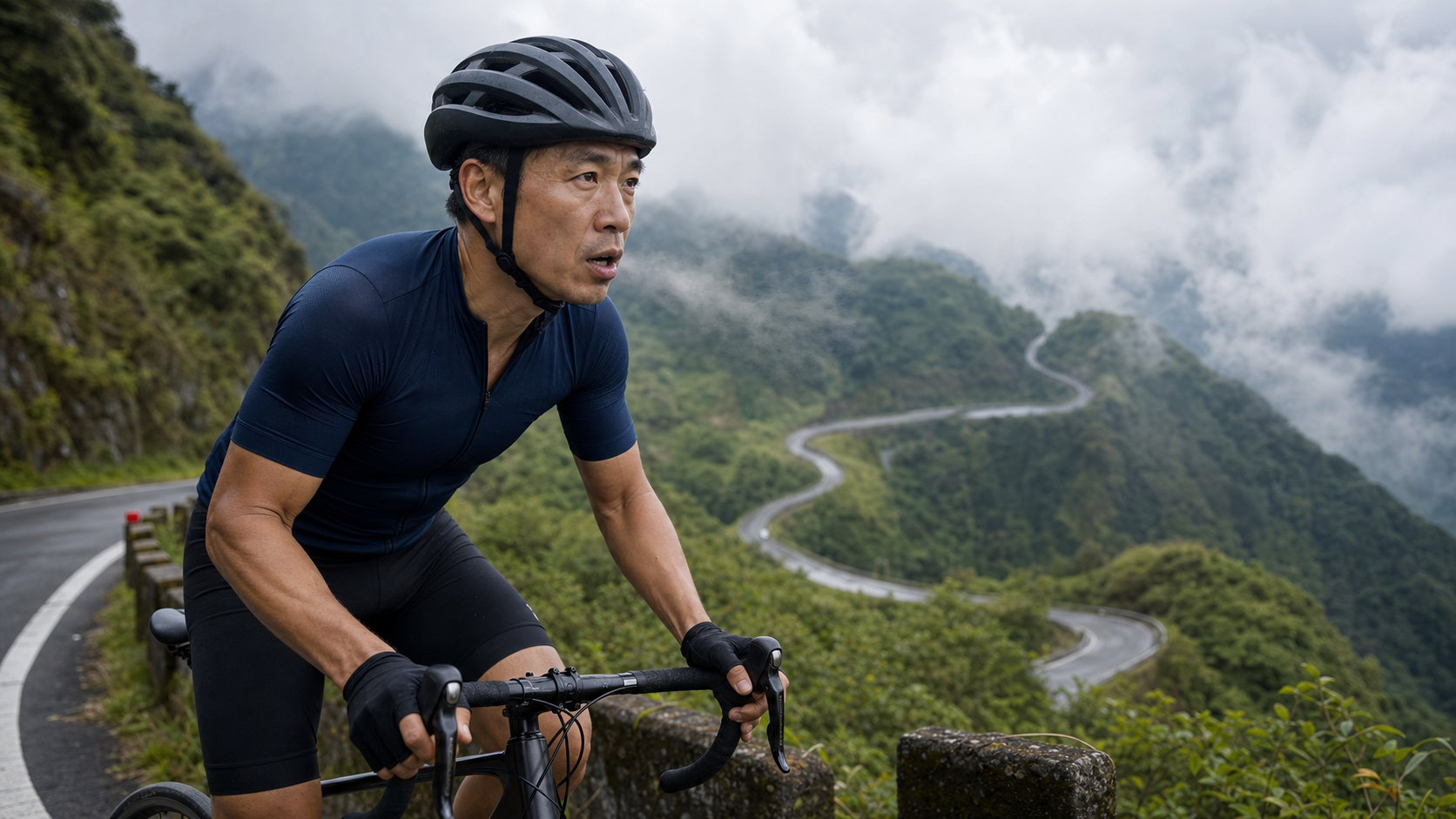
Opening: The Student Gasping for Air at Fengguizui
A few years ago, I coached a fascinating student—let’s call him A-De. In his early 40s, a tech-industry engineer, he rode Fengguizui every weekend. His power numbers were actually decent: an FTP around 3.8 W/kg, which puts him in the upper tier among amateurs. But he had a wall he could never break through: whenever the gradient exceeded 8% and his heart rate hit 170 bpm or above, he’d enter a state of “no matter how much I inhale, it’s never enough,” and he’d be forced to dismount and walk his bike.
At first, he thought his cardiovascular fitness was lacking. He went to the hospital for an ECG and a cardiopulmonary exercise test—all results came back normal. The doctor just told him, “You simply haven’t trained enough.” But watching him ride, I realized the real problem wasn’t in his legs, nor his heart—the problem was in his breathing. Climbing steep grades, his entire upper body was tense, shoulders shrugged up to his ears, chest rising and falling rapidly and shallowly, every breath like desperately grasping for oxygen that wouldn’t come.
This is the most common issue I’ve encountered in 15 years of coaching, yet the one few people take seriously: the respiratory system is actually the “second engine” of athletic performance. We spend countless hours training legs, training cardio, calculating power-to-weight ratios—yet almost no one seriously trains the muscles that actually move air in and out. In this long-form article, I want to lay it all out clearly—from the physiological fundamentals, the mechanisms of respiratory muscle fatigue, the actual evidence for respiratory muscle training, all the way to practical methods you can start today.
Concept One: Ventilation Isn’t as Simple as “How Much Oxygen You Inhale”
Many people think that huffing and puffing during exercise means “not enough oxygen.” That’s only half right. In most healthy individuals, the primary signal driving you to breathe faster and harder is changes in carbon dioxide (CO₂) and blood pH—not oxygen deficiency itself.
As your pedaling intensity rises, muscle metabolism produces large amounts of CO₂ and hydrogen ions, making the blood more acidic. To expel the CO₂ and bring pH back to normal, your body commands you to “breathe faster and deeper.” This is why, near the lactate threshold, you distinctly feel ventilation suddenly become labored—this turning point is called the ventilatory threshold in exercise physiology.
A Few Numbers You Should Feel
Here’s a rough reference range for you (everyone varies; these are ranges, not precise values):
| Metric | Resting | Moderate-Intensity Riding | Maximal Intensity |
|---|---|---|---|
| Minute ventilation | ~6–8 L | ~40–70 L | Up to 120–180 L or more |
| Breathing frequency | ~12–16 breaths/min | ~25–35 breaths/min | Up to 45–60 breaths/min |
| Tidal volume (volume per breath) | ~0.5 L | ~1.5–2.5 L | Near vital capacity limit |
Note the maximal-intensity column: ventilation can surge from 6–8 L at rest to over 150 L—a 20-fold increase or more. This isn’t free—moving that much air itself consumes significant energy and blood flow, which is exactly the core of what we’ll discuss next.
The “Oxygen Cost” of Breathing
At low to moderate intensity, the respiratory muscles consume only about 3–5% of total body oxygen consumption—almost negligible. But when you approach maximal intensity and ventilation surges past 120–150 L, breathing itself can consume 10–15% of total body oxygen consumption, and in extreme cases even more.
In other words, at the very moment you most need oxygen delivered to your legs, your respiratory muscles are competing with your legs for the same pie. This “blood flow stealing” mechanism is the key to understanding why respiratory muscle training works.
Concept Two: Respiratory Muscles Fatigue—and Drag Your Legs Down with Them
Who Are the Respiratory Muscles?
Let’s meet the protagonists first. The most important muscle for inhalation is the diaphragm—a dome-shaped muscle located between the chest and abdominal cavities, contributing about 70% of the work of breathing at rest. Supporting it are the external intercostal muscles, plus the accessory inspiratory muscles (scalenes, sternocleidomastoid, and other neck muscles) that are heavily recruited only at high intensity. Exhalation is mostly passive at rest, but during intense exercise, the abdominal muscles and internal intercostals actively participate in pushing air out.
These are genuine skeletal muscles, just like your quadriceps—they get worked, they fatigue, and they can be trained.
The Key Mechanism: Respiratory Muscle Metaboreflex
This is the most important section of the entire article—please read it slowly.
During prolonged high-intensity exercise, the diaphragm and respiratory muscles work continuously under heavy load, and metabolic waste products (hydrogen ions, inorganic phosphate, etc.) accumulate within the muscles. These waste products stimulate specialized nerve endings inside the respiratory muscles (group III and IV sensory afferent fibers), which send a “I’m tired, I’m ischemic” signal back to the central nervous system.
The central nervous system’s response is direct and ruthless: it commands, via the sympathetic nervous system, vasoconstriction of the blood vessels in the limb muscles, “redistributing” blood flow away from your legs and back to the respiratory muscles. The body’s logic is: “Breathing can’t stop—if it stops, you die. Legs being tired is fine.”
The result—your leg blood flow gets cut, oxygen delivery drops, lactate accumulates faster, and you exhaust sooner. This is why some people, despite having no issue with leg muscle strength, experience a “pace collapse that makes you question everything” in the latter stages of a long climb. This phenomenon has solid experimental evidence in the exercise physiology literature. Researchers have found that “unloading” the respiratory muscles—via breathing low-density gas mixtures or mechanical ventilatory support—can delay diaphragm fatigue and extend time to exhaustion (see references at the end).
Back to A-De’s example. When he climbed steep grades, shrugging his shoulders and breathing rapidly and shallowly, he was essentially asking a bunch of inefficient neck accessory muscles to do the diaphragm’s job. These small muscles accumulate metabolic waste faster and trigger the metaboreflex sooner, so his leg blood flow was prematurely deprived—he thought his legs were failing, but actually his respiratory muscles collapsed first, dragging his legs down with them.
Understanding the Metaboreflex with a Real-Life Analogy
If that all sounds too academic, here’s an analogy I often use with students: imagine your home’s water tank has a fixed supply, and the living room (your legs) and kitchen (your respiratory muscles) both have taps running simultaneously. Normally, there’s enough water for both. But when the kitchen (respiratory muscles) is about to run dry and sounds an alarm, your smart home system automatically throttles the living room’s water valve to prioritize the kitchen. Because the body has determined that “breathing can’t stop—it’s life-or-death.” So the living room’s water flow diminishes—your leg blood flow gets cut, and the slowdown follows.
The key point of this analogy: the problem often isn’t the water (total blood flow) being insufficient—it’s that the distribution gets hijacked. So rather than endlessly training your legs to fight the slowdown, it’s better to first keep the kitchen (respiratory muscles) from sounding the alarm so easily. That’s precisely the entry point for respiratory muscle training.
Why “Feeling Effortful” Is Also Tied to Breathing
In exercise physiology, there’s a concept called rating of perceived exertion (RPE)—how hard you subjectively feel the effort is. Interestingly, the sense of breathing effort is a major contributor to RPE. When respiratory muscles fatigue and the metaboreflex is triggered, the “tired” signal your brain receives gets amplified, making you want to quit earlier—even if your legs still have reserve. This is also why, after improving their breathing, many people report not “stronger legs,” but “at the same intensity, I don’t feel like giving up as much.” Breathing, in a sense, also manages your psychological ceiling.
Concept Three: Breathing Patterns Affect Performance More Than You Think
Beyond respiratory muscle training, there’s another “free” but severely underestimated variable: how you breathe.
Chest Breathing vs. Abdominal (Diaphragmatic) Breathing
Under stress or high intensity, many people unconsciously switch to chest breathing—inhaling by lifting the shoulders and chest. This type of breathing is shallow and rapid, relying primarily on inefficient accessory muscles, and it causes upper-body tension and wasted energy.
In contrast, abdominal breathing (diaphragmatic breathing) allows the diaphragm to descend and the abdomen to expand, achieving a larger tidal volume with fewer breaths—meaning each breath is more “valuable.”
The table below gives you a quick comparison:
| Aspect | Chest (Shallow, Rapid) Breathing | Abdominal (Diaphragmatic) Breathing |
|---|---|---|
| Primary muscles | Neck/shoulder accessory muscles, upper chest | Diaphragm, lower ribs |
| Efficiency per breath | Low (high dead-space ratio) | High |
| Upper-body tension | High, prone to shoulder shrugging | Low, relaxed neck and shoulders |
| Metaboreflex trigger | Earlier | Later |
| Suitable situations | (Almost no advantage) | Most endurance sports |
“Dead space” refers to the space in the trachea and bronchi that does not participate in gas exchange. With shallow, rapid breathing, a high proportion of each breath remains trapped in dead space without reaching the alveoli—essentially wasted effort. Deep, slow breathing improves the proportion of effective ventilation.
Coupling Breathing with Pedaling Rhythm
A more advanced concept is locomotor-respiratory coupling. Some well-trained cyclists unconsciously establish a stable ratio between their breathing rhythm and cadence (e.g., one complete breathing cycle every few pedal strokes). This coupling makes breathing smoother and the core more stable. You don’t need to count deliberately, but during steady cruising, you can “feel” that smooth rhythm.
Practical Approach: How to Actually Train Your Breathing Muscles (IMT)
Now that we’ve covered the mechanisms, let’s address what everyone cares about most: Does Inspiratory Muscle Training (IMT) really work? And how should you do it?
What the Evidence Says
Let’s start with the conclusion, then discuss the limitations. Multiple systematic reviews and meta-analyses show that IMT does improve maximal inspiratory pressure (MIP, reflecting inspiratory muscle strength) and respiratory muscle endurance, and it brings improvements in endurance performance markers such as constant-load tests and time trials (the magnitude varies by test protocol; see references at the end). Interestingly, subgroup analyses show that disciplines like cycling, endurance running, and rowing benefit more clearly, while results for swimmers and divers are more inconsistent—a reminder that effects vary by sport and population; it’s not a panacea.
Some studies also indicate that IMT can attenuate the aforementioned respiratory muscle metaboreflex, meaning the “respiratory muscles stealing blood flow from the legs” effect becomes less severe—this aligns with the mechanisms, connecting evidence and theory.
My coaching stance is: IMT won’t instantly skyrocket your FTP, but it’s a high-value, very low-risk supplement, especially suited for athletes like Ade who “fall apart breathing-first.” It’s more like raising your ceiling a bit, not installing a new engine.
Equipment and Basic Dosage
The most common approach uses a handheld inspiratory resistance training device (brands like PowerBreathe are available at pharmacies or sports stores, typically priced from a few hundred to one or two thousand NT$). The principle is creating inspiratory resistance, making your inspiratory muscles contract against resistance like lifting weights.
A widely used and relatively safe introductory protocol in the literature is roughly as follows (treat this as a general guideline; adjust according to product instructions and your own condition):
| Parameter | Recommended Range | Notes |
|---|---|---|
| Resistance intensity | ~50–60% of maximal inspiratory pressure | Most devices have adjustable levels |
| Reps per set | 30 inhalations per set | Inhale forcefully and fully |
| Sets per day | 1 set morning and evening (2 total) | Spreading them out reduces dizziness |
| Frequency | Daily for 4–6 weeks | Can reduce to maintenance afterward |
| Breathing pattern | Quick, forceful inhale; relaxed exhale | Emphasis on the inhalation phase |
Important reminder: You may feel slightly dizzy or want to cough when starting—this is a normal adaptation, but please do it while seated, not standing or walking, to avoid falling from dizziness. If you experience chest pain, significant breathlessness, or palpitations, stop immediately and seek medical evaluation.
Three Exercises You Can Do Without Equipment
Before buying equipment, you can actually build a foundation with zero cost. Here are three beginner exercises I often give my athletes:
- Supine abdominal breathing: Lie flat, place one hand on your chest and one on your belly. As you inhale, only the hand on your belly should rise; the hand on your chest should stay as still as possible. Do this for 5 minutes daily to make “breathing with the diaphragm” instinctive.
- Resisted exhalation (pursed-lip breathing): Inhale for 2 seconds, then purse your lips as if blowing out a candle and exhale slowly for 4–6 seconds. This trains exhalation control and extends ventilation time, which helps settle your breathing after high-intensity efforts.
- Box breathing: Inhale for 4 seconds, hold for 4 seconds, exhale for 4 seconds, hold for 4 seconds. This technique leans toward regulating the autonomic nervous system and is useful for pre-race nerves or cool-down relaxation.
A 6-Week Breathing Enhancement Plan You Can Follow
Combining the elements above, here’s a 6-week plan suitable for general to intermediate athletes. It doesn’t require disrupting your existing cycling or running schedule—it’s “bolted on.”
| Week | IMT Device Training | Bodyweight Breathing Exercises | Focus During Exercise |
|---|---|---|---|
| Weeks 1–2 | 30 reps morning and evening daily, low resistance | Supine abdominal breathing 5 min/day | Deliberately use abdominal breathing during easy rides/jogs |
| Weeks 3–4 | Increase resistance by 1 level, maintain 2 sets daily | Add pursed-lip breathing 3 min/day | Practice “deep and steady” breathing on gentle climbs |
| Weeks 5–6 | Increase resistance by another level (aim for a challenging 30 reps) | Box breathing 5 min (for pre-race use) | During intervals, observe breathing changes before speed drops |
After 6 weeks, most people feel that “high-intensity breathlessness” becomes more manageable—not that you stop huffing, but that the huffing becomes more orderly and breaks down more slowly. Afterward, you can reduce IMT to 2–3 times per week for maintenance.
Two Athlete Case Studies: Different Starting Points, Different Approaches
To show you how this method plays out in real situations, let me share two anonymized case studies (scenarios are reconstructed for teaching purposes; data are general descriptions).
Case 1: Xiao Ling, an office worker aiming for her first long-distance climb
Xiao Ling, 35, has about a year of training experience. Her goal is to complete a challenge of roughly 60 km with over 1,000 meters of climbing. Her fitness is actually adequate, but on sustained climbs she tends to “lose her breathing first, then panic entirely.” Instead of increasing her training volume, we spent the first two weeks purely on abdominal breathing to break her “shoulder-shrugging when tired” habit. We only introduced the IMT device in week three, starting at low resistance. The key was having her set “maintaining breathing order” as the primary goal during every climb, with speed secondary. On event day, she never put a foot down, and her biggest takeaway afterward was: “Once my breathing stayed orderly, my mind stayed calm.”
Case 2: A-Kai, an intermediate cyclist stuck in a plateau
A-Kai, 42, has been cycling for five years. His power numbers look good, but he always fades in the latter part of long climbs. He was initially resistant to breathing training, thinking, “How can something so esoteric actually help?” I asked him to do a simple test: hold a steady power on the trainer while focusing solely on fully exhaling and breathing deeply from the diaphragm. He surprised himself—at the same power, his heart rate was a few bpm lower than usual, and his perceived exertion dropped. That “immediate feedback” made him willing to take IMT seriously. Two months later, his late-climb fading had clearly improved. His reflection was spot on: “Turns out I’d been riding with half an engine all along.”
The point of these two cases is: The effects of breathing training often appear first in “feel” and “stability,” then gradually show up in the data. Don’t just stare at the power meter—listen to your breath, too.
Common Mistakes and Corrections
Over the years of coaching students, I’ve compiled the most common breathing mistakes. You can check how many of these apply to you.
Mistake 1: Shrugging shoulders and shallow, rapid breathing during high intensity
Symptoms: When tired, your shoulders creep up, neck veins bulge, and every breath is shallow and hurried.
Problem: This shifts the work to inefficient neck accessory muscles, accelerating the metabolic reflex and causing you to lose speed faster.
Correction: Deliberately “send the breath down into your belly and let your shoulders drop.” Before climbing, take a deep breath, relax your shoulders and neck, then settle into your rhythm.
Mistake 2: Only inhaling, not exhaling, or not exhaling fully
Symptoms: Desperately trying to inhale more air, but forgetting to fully expel the stale air first.
Problem: With residual air left in the lungs, the amount of fresh air you can take in actually decreases—the more you try to inhale, the more insufficient it feels.
Correction: Focus on actively and completely exhaling, especially during intense exercise. Once you’ve emptied your lungs, the next inhale will naturally be full.
Mistake 3: Turning IMT into a breath-holding contest
Symptoms: Believing that more resistance and longer breath-holds equal better results, training until dizzy and lightheaded.
Problem: Overexertion brings no extra benefit and may cause injury from falls due to dizziness.
Correction: Follow the prescribed dosage (approximately 50–60% intensity, 30 reps per set), and progress gradually.
Mistake 4: Neglecting core strength and posture
Symptoms: Slouching or hunching while cycling or running, with a loose core.
Problem: The diaphragm and core muscles share the same intra-abdominal pressure system. Once posture collapses, breathing space gets compressed.
Correction: Maintain stable core tension so the diaphragm has enough room to descend. This is also why core training indirectly helps breathing.
Mistake 5: Equating “breathlessness” with “danger” and over-panicking
This one needs careful handling. For healthy people, breathlessness during exercise is a normal physiological response—no need to panic. However, if your breathlessness is accompanied by chest pain, chest tightness, dizziness, cold sweats, highly irregular heartbeat, or occurs at unusually light intensity, it’s not simply a respiratory muscle issue. Please seek medical attention promptly, especially if you have a history of chronic conditions such as hypertension, heart disease, asthma, or diabetes. In Taiwan, medical access is convenient and NHI coverage is readily available—don’t tough it out on your own or self-diagnose online. Get checked when needed.
Taiwan-Specific Considerations: Climate, Eating Out, and Training Venues
Theory is theory, but we ride and run in Taiwan, so some local conditions must be factored in.
Humid heat adds to the respiratory load
Taiwan summers routinely hit 32–35°C with humidity above 80%. High heat and humidity force the body to increase ventilation for cooling, and heart rate runs higher too—meaning at the same intensity, the respiratory system carries an extra burden. When training in summer, the same climb will feel harder. That’s not entirely a decline in fitness; part of it is an environmental tax. In summer, schedule intensity sessions for early morning or evening, and stay properly hydrated (when sweating heavily, replenish approximately 500–1000 ml of electrolyte-containing fluid per hour, adjusted to your individual sweat rate).
Air quality and allergies
In certain seasons and regions of Taiwan, PM2.5 levels run high. Combined with the prevalence of allergic rhinitis, nasal congestion forces mouth breathing, increasing irritation of the airways from dry or polluted air. On poor air quality days, switch to an indoor trainer, wear an appropriate mask, or avoid busy main roads. For those with severe allergies, addressing the nasal issues often improves breathing quality during exercise—this is worth an evaluation by an ENT specialist.
The link between eating out, breathing, and body weight
Many people don’t realize this: every extra kilogram you carry up a climb raises the load on both your breathing and cardiovascular system. Eating out in Taiwan commonly means high oil and high sodium. Excessive sodium intake can also affect fluid retention and blood pressure. No matter how well you train your breathing, if weight management and diet spiral out of control, climbing performance won’t improve. A balanced diet with controlled refined carbohydrates and fried foods is the foundation for all of this.
Common training venues
Fengguizui, Yangmingshan, Beiyi, Zhongshe Road, and riverside bike paths across the island are all excellent venues for practicing breathing rhythm. Flat riverside paths suit practicing “deep and steady” cruising breaths; sections with gradient are ideal for observing whether your breathing falls apart early as intensity rises. Next time you climb, try shifting your attention from “my legs are sore” to “how am I breathing right now”—you’ll discover something new.
A simple “self-check” method that requires no equipment
Want to know if your breathing pattern has issues? Here’s a very simple self-test: find a moderate-intensity climb you know well and can complete steadily. When you reach the latter part and start feeling the effort, quickly scan three things—
- Are my shoulders creeping up? If so, you’re relying on accessory muscles to push through.
- Am I breathing shallowly and rapidly through my mouth, or am I sending the breath down into my belly? If only your chest is moving, you’ve switched to an inefficient mode.
- Am I actually exhaling fully? Many people, when tired, only focus on inhaling and forget to exhale.
If you hit two or more of the three, you’re someone whose breathing is worth training. The good news is that all three issues can be improved with the methods above—and without spending a fortune.
How to use Taiwan’s medical resources
Taiwan’s NHI and medical accessibility rank among the most convenient in the world. If you repeatedly experience “abnormal breathlessness” during exercise, don’t guess on your own. Cardiopulmonary exercise testing (CPET) is available at many medical centers and sports medicine clinics, providing an objective assessment of your cardiopulmonary function, ventilatory threshold, and any underlying issues. If allergic rhinitis is troubling you, an ENT specialist can address nasal airway patency; if you suspect exercise-induced asthma, a pulmonologist or allergist/immunologist can evaluate further. Leave professional matters to the professionals, so you can confidently invest your energy in training.
Actionable Advice for Readers at Different Levels
Everyone starts from a different point, so I’ve split the advice into three tiers. Find the one that fits you.
If you’re a complete beginner / just starting to exercise
- Don’t rush to buy equipment. Spend two weeks making “supine diaphragmatic breathing” instinctive. Simply learning to breathe with your diaphragm will noticeably improve how exercise feels.
- During exercise, remind yourself to “relax your shoulders and send the breath down into your belly.”
- If you have any chronic conditions, have a physician evaluate you once before starting regular exercise, and only push hard once you know your safe range.
If you’re a consistent intermediate enthusiast
- You can introduce a handheld IMT device and follow the 6-week program above.
- Make “observing your breathing” a routine check in every session: during intervals, notice whether your breathing falls apart before your pace drops.
- Add basic core training to give your diaphragm more breathing room.
If you’re an advanced athlete chasing performance
- IMT can serve as a long-term maintenance item (2–3 times per week), with a ramp-up 6–8 weeks before key races.
- Study the coupling between breathing and pedaling/cadence to find the most fluid rhythm ratio for your cruising pace.
- Don’t forget: respiratory muscle training is “supplementary,” not “the main course.” It helps you express your existing cardiovascular and muscular capacity more fully, but it cannot replace a solid aerobic foundation and periodized training.
Quick FAQ
Q: Will training my respiratory muscles increase my VO₂max?
A: Current evidence more strongly supports improvements in “respiratory muscle strength and endurance” itself, as well as some endurance performance, while the direct impact on VO₂max, that ceiling metric, is limited. It’s more accurate to think of it as an “unlock tool” for performance rather than an “engine upgrade.”
Q: How long until I feel a difference?
A: Most study training periods fall within 4–6 weeks. Subjectively, many people start feeling “more able to hold on” during high-intensity efforts around weeks 3–4.
Q: I have asthma / high blood pressure / heart disease. Can I do IMT?
A: Don’t start on your own. These groups aren’t absolutely prohibited from doing it, but it must go through physician evaluation and individualized adjustment—forceful inhalation has specific considerations for certain cardiovascular conditions. Leave this to your primary care physician’s judgment.
Q: Does it also apply to running and swimming?
A: The principles are the same, but research shows the degree of benefit varies by discipline (more pronounced in cycling and rowing, less consistent in swimming). Because breathing rhythm in swimming is constrained by stroke mechanics, training methods need to be more sport-specific.
Q: How should I use breathing during warm-up?
A: In the final minutes of warm-up, you can do a few sets of deep, slow diaphragmatic breathing—this both awakens the diaphragm and uses box breathing to stabilize pre-race nervous-system arousal. During cool-down, use slow exhalation (pursed-lip breathing) to help the body shift from sympathetic dominance back to parasympathetic, speeding up recovery.
Q: If I train my respiratory muscles, do I still need to build my aerobic base?
A: Absolutely. Respiratory muscle training is supplementary, not a replacement. It lets your existing cardiovascular and muscular capacity express itself more fully, but a solid aerobic base, periodized training, strength work, and weight management remain the main course. Get the order wrong, and results will be very limited.
Q: What’s the best time of day to do IMT?
A: There’s no hard rule—the key is consistency and regularity. Many people do one session morning and evening: the morning one doubles as a body wake-up, the evening one as part of cool-down. Avoid doing it right after a big meal or when very fatigued, to prevent dizziness or discomfort.
A Quick-Reference Cheat Sheet
If this article is too long, remembering just this table is enough:
| Your Situation | Priority Action |
|---|---|
| Shoulders hike up, shallow rapid breathing when tired | Practice supine diaphragmatic breathing; break the chest-breathing habit |
| Significant slowdown in the latter part of high-intensity efforts | Check whether breathing collapses first; introduce IMT |
| Prone to pre-race anxiety and erratic breathing | Use box breathing before races to stabilize the autonomic nervous system |
| Want to squeeze out more performance | Research breathing–pedaling/cadence coupling |
| Have a chronic condition or abnormal breathlessness | Get medical evaluation first, then talk training |
Conclusion: Wiring Up the Second Engine
Back to Ade’s story. We didn’t overhaul his power training plan—we only did three things: changed his breathing pattern from shallow shoulder-hiking to deep, stable diaphragmatic breathing, added 6 weeks of IMT, and threw in some basic core work. About two months later, he hit that steep climb on Fengguizui again and for the first time didn’t have to unclip and walk. He told me: “My legs were just as sore, but I no longer had that ‘about to suffocate’ panic. I could push through and ride to the top.”
That’s the real value of breathing training—it’s not magic, it won’t conjure an extra 30 watts out of nowhere, but it helps you restore the performance that breathing was dragging down. We put so much effort into training our legs and cardiovascular system, yet often forget the muscles that move air for us every single second. They’ve been there all along, just rarely given proper attention.
I often tell my athletes: the ceiling of your training is often not where you think it is. Some people are limited by leg strength, some by cardiovascular capacity, some by willpower—but a large group is actually limited by that “breath that won’t come back.” Finding your true bottleneck matters far more than blindly increasing training volume. And breathing is precisely the area the most people have issues with, yet the fewest actually examine.
One final reminder: all of this is premised on “you being healthy and able to exercise safely.” If you have any history of cardiovascular or chronic disease, or experience unusual symptoms during exercise, have medical professionals clear you first, then come back and train this second engine. Safety is always the foundation of all training.
Starting today, the next time you ride or run, spare a little attention for your breathing. Learn to use your diaphragm, learn to fully exhale, and maintain breathing order as intensity rises. This “second engine” is worth the time to wire it up.
This article is educational content and cannot replace individual diagnosis and treatment advice from a physician, physical therapist, or nutritionist. If you have cardiovascular, metabolic, or other chronic conditions, or experience abnormal symptoms during exercise, seek medical attention promptly and undergo individualized assessment.
References
- Effect of respiratory muscle training on exercise performance in healthy individuals: a systematic review and meta-analysis (PubMed): https://pubmed.ncbi.nlm.nih.gov/22765281/
- Effects of Respiratory Muscle Training on Performance (Journal of Strength & Conditioning Research): https://journals.lww.com/nsca-jscr/fulltext/2013/06000/effects_of_respiratory_muscle_training_on.25.aspx
- Exercise-induced respiratory muscle fatigue: implications for performance (Journal of Applied Physiology): https://journals.physiology.org/doi/full/10.1152/japplphysiol.01157.2007
- Insights into the role of the respiratory muscle metaboreflex (PMC): https://pmc.ncbi.nlm.nih.gov/articles/PMC2277009/
- Inspiratory muscle training attenuates the human respiratory muscle metaboreflex (PMC): https://pmc.ncbi.nlm.nih.gov/articles/PMC2277000/
- The respiratory muscles during exercise (PMC / European Respiratory Society): https://pmc.ncbi.nlm.nih.gov/articles/PMC4933622/
Related Reading
- Respiratory Function and Training for Athletes: A Complete Guide to Breathing Pattern Assessment, Diaphragm Training, and Practical Application
- Breathing Efficiency Training for Cyclists: Nasal Breathing, Rhythmic Breathing, and Diaphragmatic Breathing
- Breathing Strategies for Cycling: The Connection Between Rhythmic Breathing and Core Stability
- Climbing Breathing Techniques: Synchronizing Diaphragmatic Breathing Rhythm with Pedaling
#公路車 #Vo2Max #最大攝氧量 測驗 體驗 | 心肺測試
6 年前
西進武嶺 免費訓練分析服務 Intervals | 練不夠還是練過頭?你哪一種類型選手?AI模型告訴你! | 備戰神器 | 公路車 訓練 | CT Yeh
4 年前
風櫃嘴 衝刺慢動作回放!
8 年前
福隆鐵人團練隨拍
8 年前
戰略) Zwift Race 如何咬在第一集團 如何評估自己要開多少推力 (請開1.5倍速看)
7 年前
西進武嶺 自製新版AI配速表產生器 x 賽前攻略 抱佛腳! 沒有功率計也可以產生配速表嗎?有什麼其他眉角賽前要注意的呢? | 西進武嶺 / 東進武嶺 KOM 攻略 | 公路車 | CT Yeh
4 年前
多機位拍片神器 DJI Action 2 拍出速度張力感 | 類空拍機視角 4陣列麥克風超強降風噪 實測! | 公路車 | CT Yeh
3 年前
風櫃嘴時間 預測西進武嶺時間?13000名車友統計數據分析告訴你 !
5 年前