The Revival of Isometric Training: From Tendon Repair to Pain Management, the Underrated Science of Static Contractions
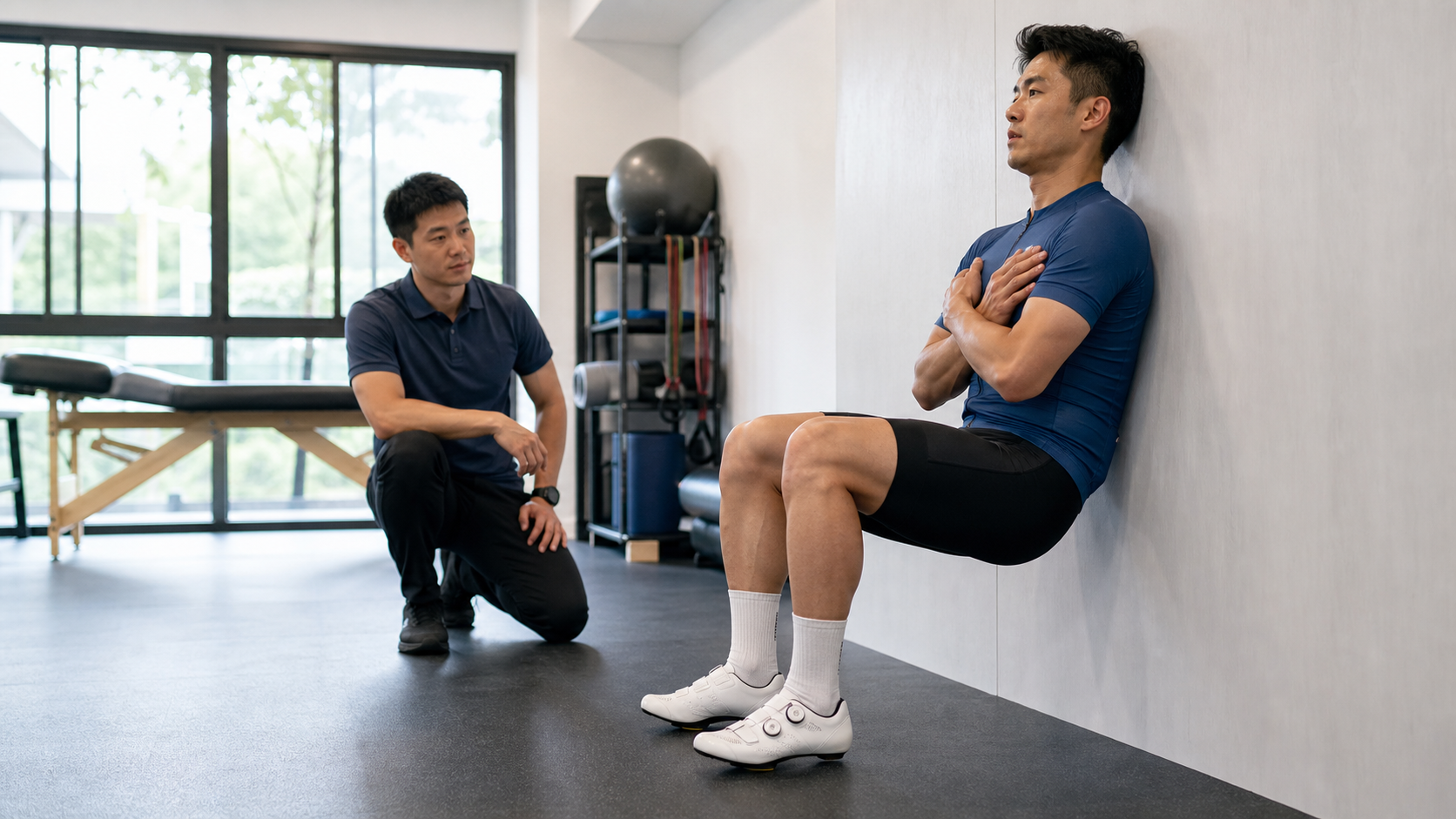
Opening: The Knee That Was Afraid to Squat
A few years ago, I worked with a long-distance cyclist in his early thirties named A-Hong. He rode over 200 kilometers a week, and the front of his knee (that spot just below the patella) had been hurting for nearly six months. He’d heard every theory out there: some told him to rest completely, others told him to do heavy squats to “build the strength back up.” The result was that one approach left him weaker with each passing day, and the other left him in more pain with every rep. The first thing he said to me was: “Coach, am I just going to have to give up?”
I didn’t have him rest, and I didn’t have him do anything that hurt. I had him lean against a wall and do something that looked like “nothing was moving”—a wall squat. Hold it, stay there, breathe slowly. At the end of the first week, he texted me: “Weird—after doing that static move, my knee actually hurts less, and the effect seemed to last almost an hour.”
That wasn’t a miracle. It was isometric contraction doing two things for him: first, a short-term pain-relieving effect, and second, maintaining strength without aggravating the injured tissue. In recent years, this training method—once dismissed by the fitness world as “too boring, too outdated”—has been quietly making a comeback in sports medicine and tendon rehabilitation. That’s what I want to talk to you about properly today.
1. First, Let’s Get This Straight: What Exactly Is an Isometric Contraction?
Muscle contractions can be roughly divided into three types. Understanding the differences is the starting point for appreciating the value of isometric training.
| Contraction Type | Muscle Length Change | Joint Movement | Everyday Example |
|---|---|---|---|
| Concentric | Shortens | Movement, against gravity | Standing up from a squat, curling a dumbbell upward |
| Eccentric | Lengthens | Movement, controlling against gravity | Sitting down into a squat, walking downstairs |
| Isometric | Unchanged | Joint angle stays fixed | Holding a wall squat, plank, holding a heavy object suspended mid-air |
The key phrase is “length unchanged, joint stationary.” You’re exerting force, muscle tension is high, but visually you’re motionless. That’s its defining feature, and it’s exactly why it’s so valuable in rehabilitation: you can generate significant force without repeatedly moving a painful joint through a painful range of motion.
For many injured people, “moving hurts” is the biggest obstacle. Both concentric and eccentric movements require the joint to travel through a range, and injured tissue often protests at a specific angle or under a specific load. Isometric contraction sidesteps this problem—you pick a pain-free (or least painful) angle, hold there and push, and you still train strength.
2. Neurological Benefits: It’s Not Just About the Muscle
Many people assume training is simply about “making muscles bigger and stronger,” but a large part of strength performance actually comes from the nervous system—whether your brain and spinal cord can effectively “recruit” muscle fibers and get them to fire in sync. Isometric training is particularly interesting at this level.
High Tension, High Recruitment
Because isometric contractions don’t require moving a load or controlling acceleration, you can put your full attention on the single task of “pushing hard.” During a maximal voluntary isometric contraction (MVIC), the nervous system is called upon to achieve near-maximal motor unit recruitment. Over time, this kind of high-intensity neural drive training helps improve strength performance and rate of force development.
For endurance athletes like cyclists and runners, this point is often overlooked: you don’t necessarily need huge muscles, but you do need your nervous system to be able to “call up” the right muscle groups when it’s time to push. Isometric training is a relatively safe, controllable way to train this. A practical scenario: in the final kilometers of a long climb, or in the late stages of a marathon when your legs are going weak, your ability to keep producing power steadily depends largely on neuromuscular tolerance and recruitment capacity—not just muscle size. That’s exactly where isometric training’s “high tension, low injury risk” profile comes into play.
Angle Specificity—A Limitation Worth Noting
Here I need to be honest about one limitation: strength gains from isometric training show a considerable degree of angle specificity. In other words, if you train at 90 degrees of knee flexion, the main strength gains occur near that angle; the farther you get from it, the weaker the transfer tends to be. This is a general principle that has been repeatedly observed in physiology.
So in practice, if your goal is strength across a full range, isometric training at a single angle won’t be enough. You’ll typically train at multiple angles separately, or use it as one component of a complete training plan—not the whole plan.
3. Tendon-Level Benefits and Pain Management: This Is the Main Event
If the neurological benefits are the “bonus,” then the application to tendinopathy and pain management is the real reason isometric training has surged back into the spotlight in recent years.
A Widely Cited Study: The Immediate Pain-Relieving Effect of Isometric Contractions
In a 2015 study, sports medicine researcher Rio and colleagues observed volleyball players with patellar tendinopathy (commonly known as “jumper’s knee”). They found that after a set of isometric contractions, the players’ tendon pain dropped immediately, and this pain-relieving effect lasted approximately 45 minutes; at the same time, their maximal voluntary isometric contraction (MVIC) strength increased. In comparison, isotonic contractions produced a smaller pain-relieving effect that did not persist to the 45-minute mark.
The researchers observed that this reduction in pain was accompanied by a decrease in cortical inhibition, providing a neurological clue as to “why it relieves pain”—the hypothesis being that sustained isometric contraction activates the body’s descending inhibition pain modulation system. This study has since been widely cited and directly influenced clinical approaches to managing athletes who are mid-season and don’t want to stop competing.
In plainer terms: when you sustain a hard, effortful hold for a period of time, the body activates a “built-in pain-relief system.” This brief, exercise-induced pain reduction has a name in exercise physiology: “exercise-induced hypoalgesia”—it’s not unique to isometric training, but because isometric contractions can maintain high tension steadily for extended periods, they’re particularly well-suited to triggering it. This also explains why many clients report “after doing that hold, it actually hurts less”—that’s not a placebo effect; it’s a phenomenon with a neurophysiological basis.
One thing to note: this pain relief is temporary (observed to last around 45 minutes in the study). It helps you “get through this session, this workout,” but it doesn’t mean the tendon is healed. Treat it as a bridge for pain management, not as proof of recovery—otherwise you’ll misjudge your progress.
Practical takeaway: For athletes who are mid-season, in pain, and unwilling to stop, isometric contractions offer a very practical option—they can reduce pain in a short time, allowing you to maintain a certain level of training and competition without worsening the tissue. That’s exactly what happened with A-Hong.
However, I must add an honest caveat: subsequent systematic reviews have indicated that the evidence that isometric training is “definitely superior to other exercise therapies” is not consistent, and individual responses vary widely. Some people respond very well (like A-Hong); others don’t get as clear a pain-relieving effect. So in clinical practice, I treat it as “a low-cost tool worth trying first,” not a guaranteed miracle cure.
Why Tendons Respond So Well to This
Tendons are the connective tissue that links muscle to bone. They heal slowly, have relatively poor blood flow, and are highly sensitive to load fluctuations—“too much at once, too little at other times.” The advantages of isometric contractions are:
- Controllable load: You can precisely choose an angle and intensity that doesn’t provoke (or minimally provokes) pain.
- No need to pass through painful ranges: You avoid repeatedly stretching injured tissue into painful positions.
- Provides appropriate tensile stimulus: Tendons need load stimulus to repair and adapt; doing nothing at all actually makes them more fragile. Isometric contractions give them “just the right amount” of stimulus.
This is also why “complete rest” is often the wrong answer. A-Hong’s initial “weaker with every day of rest” was precisely because his tendon lost its adaptive capacity in the absence of load.
Tendon Stiffness and Long-Term Adaptation
Beyond immediate pain relief, long-term, regular isometric loading offers a deeper value for tendons: increasing tendon stiffness and the capacity for elastic energy storage. You can think of a tendon like a spring—a spring that is too loose and floppy cannot effectively transmit muscle force during pedaling, landing, or pushing off, and is also prone to micro-damage under repeated loading.
Progressive, sustained isometric loading (especially longer-duration, moderate-to-high intensity holds) prompts the tendon tissue to gradually adapt, becoming more “elastic yet firm.” For endurance athletes, this means better force transmission efficiency; for those rehabilitating from injury, this is the crucial process of guiding the tendon from “fearing load” back to “tolerating load.” This process cannot be rushed—it occurs on a scale of weeks and months, which is why I always tell my clients: “Pain relief can be quick, but repair takes time.”
A Reference Table for Angle Selection
Many people get stuck on “which angle should I hold at?” Here is a reference table using the knee joint as an example (the logic applies to other joints: find a pain-free angle with manageable load):
| Knee Joint Angle | Quadriceps Tension | Suitable For | Notes |
|---|---|---|---|
| Shallow squat (approx. 30 degrees) | Lower | Those with higher pain sensitivity, beginners | Low load, easy to start, build confidence first |
| Mid squat (approx. 60 degrees) | Moderate | The sweet spot for pain relief in most tendons | Many find this angle most comfortable yet effective |
| Deep squat (approx. 90 degrees) | Higher | Those with stable pain levels, looking to progress | High tension, must confirm it doesn’t provoke pain |
The principle is always the same: First seek no pain, then seek sensation, and finally seek intensity.
Part 2 of 3, Case Two: A Runner’s Achilles Tendon
Let me share another example from a different body part to clarify the logic behind isometric training.
My client, Xiao-Hui, was a marathon enthusiast in her early forties. After increasing her training volume, she began experiencing tightness at the back of her right heel (the Achilles tendon) and significant pain when stepping on the ground in the morning. This is a classic early presentation of Achilles tendinopathy. She also went down the old, familiar path: first, she stopped running entirely—the pain didn’t improve, and she lost fitness; then she looked things up online and aggressively did calf raises, which only made the pain worse.
My first phase for her wasn’t calf raises, but isometric calf raise holds—standing on both feet on flat ground, rising onto her toes to a pain-free height, and holding for about 30 to 45 seconds, for 4 to 5 sets. The angle and height were guided by the principle of “no pain during the hold, no worsening the next day.”
Two weeks later, her morning stiffness had significantly improved, and she resumed short-distance, low-intensity running. The key point here isn’t that “isometrics are magical,” but that they allowed her to provide appropriate stimulus to the tissue during the most sensitive phase of her tendon, without pushing it into a painful range. Once her pain stabilized, we gradually reintroduced eccentric calf raises, progressing from double-leg to single-leg, and from flat ground to a raised step.
The common script in these two cases: Complete rest → getting weaker with more rest; adding load recklessly → more pain with more training; switching to isometrics → pain relief and maintenance → gradual return to full-range training once pain stabilizes. This script applies to most common lower-limb tendinopathies.
4. An Unexpected Bonus: Isometric Training and Blood Pressure
In recent years, isometric training has also gained attention in a seemingly unrelated field—blood pressure management. This is particularly relevant for middle-aged and older athletes in Taiwan, who often also have hypertension.
A recent systematic review and meta-analysis focusing on the general population indicated that isometric training can significantly lower blood pressure: systolic blood pressure by approximately 6.72 mmHg and diastolic blood pressure by approximately 2.72 mmHg. Among various exercise modalities, the wall squat was the most effective for lowering systolic blood pressure, associated with a reduction of approximately 10 mmHg in some analyses. Common effective parameters include: about 3 sessions per week, lasting several weeks to 8 weeks or more, with more pronounced effects observed in men and individuals with hypertension.
| Training Parameter | Common Effective Range (study observations, not a personalized prescription) |
|---|---|
| Frequency | About 3 times per week |
| Contraction duration per set | About 2 minutes per set (adjust based on individual condition) |
| Sets per session | About 4 sets, with 1-4 minutes rest between sets |
| Total program length | More noticeable effects after 8 weeks or more |
| Intensity indicator | Moderate intensity, can be controlled using Rating of Perceived Exertion (RPE) |
Important Reminder: If you have hypertension, a history of heart disease, or other cardiovascular conditions, isometric contractions temporarily raise blood pressure and cardiac load. Be sure to consult your physician before starting, and avoid breath-holding (Valsalva maneuver). The numbers above are average observations from research populations, not a prescription for you personally. With Taiwan’s easily accessible National Health Insurance, a consultation with a cardiologist or family medicine physician is far more worthwhile than taking risks on your own.
5. Practical Methods: How to Train? (With Specific Programs)
After all this science, here’s something you can use directly. Below are three program templates I commonly use. Please note: These are general training frameworks. If you are in the acute phase of an injury or have a medical condition, please seek medical evaluation first.
Scenario A: Tendon Pain Management (e.g., Patellar Tendon, Anterior Knee Pain)
The goal is “pain relief + maintaining strength.” The classic approach is similar to the Rio study framework:
| Item | Recommended Approach |
|---|---|
| Exercise | Wall sit, or hold on a seated leg extension machine at a pain-free angle |
| Angle Selection | Choose a knee angle with the lowest pain (many find around 60 degrees comfortable) |
| Hold Duration | About 30-45 seconds |
| Sets | 4-5 sets, with 1-2 minutes rest between sets |
| Intensity | Muscles working noticeably hard but without provoking sharp pain (approximately moderate-to-high intensity) |
| Frequency | Daily to every other day; can be used pre-competition during the season for pain relief |
Interpretation Principle: During and after the exercise, pain should be stable or decreased. If pain significantly increases after the session, or is worse the next day, the angle or intensity is wrong—scale it down.
Scenario B: Strength Maintenance for Endurance Athletes (Cycling/Running)
Suitable for those with high training volume, minor joint issues, who don’t want to stop training completely:
| Exercise | Target Area | Recommended Hold Time | Sets |
|---|---|---|---|
| Wall Sit | Quadriceps, Glutes | 30-60 seconds | 3-4 |
| Split Squat Isometric Hold | Single-leg Quadriceps, Glutes | 20-40 seconds per side | 3 |
| Plank (Front + Side) | Core, Trunk | 30-45 seconds | 3 |
| Calf Raise Hold | Calves | 30-45 seconds | 3 |
Incorporate 2-3 times per week, scheduled on non-high-intensity days for cycling/running, to avoid compromising recovery from your main sport.
Scenario C: General Health & Blood Pressure Friendly (Low Barrier, Home-Friendly)
This is the most accessible version, requiring no equipment, and is well-suited for Taiwanese apartments and offices:
- Wall Squat: Sit against a wall until your thighs are roughly parallel to the floor (or at an angle you can hold steadily), hold for about 2 minutes, rest 1-2 minutes, repeat for 4 sets.
- About 3 times per week, maintaining normal breathing throughout, absolutely no breath-holding.
- Use the “talk test” to gauge intensity: if you can just barely speak a short sentence while holding, but it’s not easy, that’s roughly moderate intensity.
An 8-Week Progressive Schedule (Using Tendon Rehab Return as an Example)
Many people have the movements, but don’t know how to “push forward.” Isometric training also requires progressive overload, but its progression dimensions are hold time, sets, intensity, and angle, rather than adding weight. Here’s a conservative, easy-to-follow framework:
| Week | Primary Goal | Hold Time | Sets | Frequency | Progression Criteria |
|---|---|---|---|---|---|
| Weeks 1-2 | Build confidence, confirm no pain | 20-30 sec | 3-4 | Every other day | No pain during and the day after |
| Weeks 3-4 | Increase time, slightly raise intensity | 30-45 sec | 4 | Every other day | Pain stable below 3/10 |
| Weeks 5-6 | Add load or change angle | 40-45 sec | 4-5 | Can be daily | Stable hold, no compensation |
| Weeks 7-8 | Transition to eccentric and full range | Maintain isometrics + add eccentrics | Depends on movement | Depends on recovery | Ready to return to sport-specific training |
Core Principle: Each time you push forward, change only one variable (choose one: time, sets, intensity, or angle), and use “no pain during, no worsening the next day” as the green light for progression. This principle is simple, but ninety percent of people mess it up by “adding too much at once.”
Isometric Applications Across Different Sports
Isometric training isn’t just for the knee. Here are corresponding ideas for several common sports:
| Sport / Common Area | Common Issue | Isometric Exercise to Try |
|---|---|---|
| Cycling / Front of knee | Patellar tendon discomfort | Wall sit, seated leg extension held at a pain-free angle |
| Running / Achilles tendon | Tightness and pain in the heel cord | Isometric calf raise hold (progress from double leg to single leg) |
| Running / Patella, glutes | Knee pain, glute weakness | Wall sit, single-leg stance hip stability hold |
| Tennis, Badminton / Elbow | Tennis elbow, tendon discomfort | Isometric grip hold, isometric wrist extensor hold |
| General population / Blood pressure | Want to gently lower blood pressure | Wall sit (3 times per week, 2 minutes per set) |
This table is a “thought comparison,” not a guaranteed prescription. Actual movements and angles must be adjusted based on your pain response, and if necessary, be evaluated by a physical therapist.
Isometric vs. Eccentric: It’s Not an Either/Or
Many people ask me: “For rehab, should I do isometrics or eccentrics?” My answer is usually—it’s about sequencing, not choosing one over the other.
| Aspect | Isometric Contraction | Eccentric Contraction |
|---|---|---|
| Immediate pain relief | More noticeable (especially in acute phase) | Relatively weaker |
| When to use | Pain-sensitive, in-season, early rehab | After pain stabilizes, during tendon remodeling phase |
| Range of motion requirement | Low (can be done at a single angle) | High (needs to move through range) |
| Primary value | Pain relief, maintain strength, build confidence | Promote long-term tendon remodeling and adaptation |
The typical path is: Use isometrics first in the acute, pain-averse phase for pain relief and maintenance → Once pain stabilizes, gradually introduce eccentrics and full range → Finally, return to sport-specific explosive and reactive movements. Isometrics are the lowest-threshold first step, not the finish line.
Part 5-2: Taiwan-Specific Context: Climate, Venues, and Medical Care
Training doesn’t happen in a vacuum, especially in Taiwan, where several local factors are worth highlighting.
Hot and humid climate: In Taiwan, summer feels like 30+ degrees Celsius with high humidity. Isometric training has a very practical advantage—it can almost entirely be done indoors, in an air-conditioned room, or even at the office. Wall sits, planks, and calf raise holds require no moving space, no sun exposure, and no fear of heatstroke. For those who can’t easily train outdoors in the peak of summer, or who tend to slack off when it’s hot, this is a great tool for maintaining training consistency. However, even indoors, you’ll still sweat and your heart rate will rise during holds, so remember to hydrate and don’t push through in a stuffy, unventilated space.
Very low facility barrier: Living spaces in Taiwan’s urban areas are generally small, and many people don’t have a large space for training. Isometric exercises have minimal facility requirements—a wall and a small patch of floor are enough. This removes the “I don’t have space, so I can’t train” excuse. Parks, riverside paths, and community gyms are all fine, but the wall in your living room is actually the best starting point.
Eating out and overall health: The potential benefits of isometric training (especially wall sits) for blood pressure management are particularly relevant for Taiwan’s population, where eating out is common and sodium intake tends to be high. But to be honest: exercise is one part of overall lifestyle. If your diet is chronically high in sodium, you’re sleep-deprived, and stressed, wall sits alone won’t turn your blood pressure around. Treat it as one piece of the health puzzle, combined with dietary adjustments (reducing processed foods and overly salty soups) and a regular routine, and the effects will compound.
Medical environment: Taiwan’s National Health Insurance makes seeing a doctor easy, and physical therapy clinics are increasingly common—this is a huge advantage. I constantly remind my students: Don’t treat online information (including this article) as a diagnosis. There are many causes of knee pain and Achilles pain; isometric training is suitable for specific types of tendinopathy. If your pain is accompanied by swelling, catching, weakness, or is getting progressively worse, go directly to an orthopedist, rehabilitation specialist, or sports medicine doctor. One professional assessment is worth three months of self-experimentation. In practice, a common and unfortunate situation I see is students waiting until the pain is so bad they can’t run or ride before seeking help, which often prolongs recovery. Early intervention when pain first appears, combined with isometric training to maintain activity, can usually stop a small problem from becoming a big one. This is why I always emphasize—don’t treat “resting until it doesn’t hurt” as the only strategy. Appropriate, correct loading often helps you get back to the field better than stopping completely.
Six, Common Mistakes and Corrections
Having coached students for years, these are the most common ways isometric training gets messed up. Let’s go through them one by one.
Mistake 1: Holding your breath (Valsalva maneuver)
This is the most dangerous one. Many people automatically hold their breath when exerting force, causing a spike in intrathoracic pressure and a sudden rise in blood pressure. This is especially dangerous for those with cardiovascular conditions.
Correction: From day one, practice “exhale continuously and breathe normally during exertion.” Count your breathing rhythm mentally during the hold.
Mistake 2: Pushing through a painful angle
Some people think “no pain, no gain” and grit their teeth through the most painful angle. This usually just aggravates the tendon.
Correction: The logic of isometric pain relief is to choose a pain-free or least painful angle. On a 0-10 scale, pain should ideally be kept below 3, and it shouldn’t worsen afterward.
Mistake 3: Making isometrics the only training
Due to angle specificity, doing only single-angle isometrics long-term will limit full-range strength and function.
Correction: Treat it as a “phase-specific tool” or “part of a complete program.” Once pain stabilizes, gradually add eccentric, concentric, and full-range movements.
Mistake 4: Randomly guessing hold time and intensity
Some people let go after 5 seconds; others push until they’re shaking and lose control.
Correction: Choose the time based on your goal (pain relief type: ~30-45 seconds; blood pressure type: ~2 minutes). Intensity should be “clearly effortful but controlled.” Better to be stable than to push to the point of losing control.
Mistake 5: Expecting immediate healing
Pain relief can be quick, but true tendon repair is measured in weeks and months.
Correction: Separate immediate pain relief from long-term repair. Pain relief lets you keep moving; repair relies on long-term, progressive load management and patience.
Seven, Actionable Advice for Readers at Different Levels
If you’re a complete beginner / a general person wanting to manage blood pressure
Just start with the wall sit from Scenario C. 3 times a week, 4 sets each time, about 2 minutes per set, breathing normally. Find a wall in your home; no equipment needed. If you have a history of high blood pressure or heart disease, see a doctor first before starting. Taiwan’s summers are hot and humid, so do it indoors and remember to hydrate.
If you’re an endurance athlete with a minor injury
First, clarify “where does it hurt, and what movement triggers it.” If it’s typical anterior tendon pain, try Scenario A: choose a pain-free angle, hold for 30-45 seconds, 4-5 sets, and observe the pain response during and the day after. If there’s no improvement within two weeks, or if it’s getting worse, seek medical attention (physical therapist or sports medicine doctor); don’t just wait it out. Physical therapy clinics are increasingly common in Taiwan, and early intervention usually saves time and money.
If You Are an Advanced Athlete / Coach
Incorporate isometric training into your periodized framework: use it as a pre-competition pain-relief and neural activation tool during the season; in the off-season, use it as a multi-angle strength foundation and the first stop on the road back from injury. Remember to address angle specificity—cover the joint ranges your sport demands with multiple angles, and transition to eccentric and full-range training as soon as pain stabilizes.
VIII. Quick Q&A (FAQ)
Q: Won’t isometric training fail to build muscle?
A: It’s true that it isn’t the most efficient method for muscle growth, but it can effectively maintain and increase strength (especially near the training angle), and it’s particularly valuable when injured or unable to perform full-range movements. For those with high muscle-gain goals, full-range concentric/eccentric training is still recommended as the primary approach.
Q: Will the blood-pressure-lowering effect of wall sits disappear once I stop training?
A: Like most exercise-related blood pressure benefits, the effects generally require consistent training to maintain. It’s a habit, not a one-time treatment.
Q: Is it normal for my hands and legs to shake while holding a position?
A: Slight trembling near your limit is a normal neuromuscular phenomenon. But if the shaking is severe enough to break your form or becomes uncontrollable, it means the intensity is too high or the duration too long—time to shorten it.
Q: Can I do it every day?
A: Low-intensity blood-pressure-focused wall sits can be performed regularly by most people; high-intensity strength-focused isometrics, however, should be scheduled with recovery just like other resistance training. If in doubt, start with every other day.
Q: Can isometric training completely replace physical therapy?
A: No. It’s a tool, not the whole picture. Complete management of tendinopathy requires load management, progressive exercise, and sometimes professional assessment of posture and training volume. It helps with pain relief and maintenance, but it cannot replace individualized diagnosis and treatment.
Q: How long should I hold? I’ve heard some say 45 seconds, others say 2 minutes.
A: It depends on your goal. For tendon pain relief, the common approach is multiple sets of tens of seconds each (about 30–45 seconds); for blood pressure management, wall sits in studies typically use about 2 minutes per set. The logic behind each is different—don’t mix the numbers. The common principle is: stable, controllable, no breath-holding, and no worsening of pain.
Q: Will isometric training make muscles stiff and lose elasticity?
A: This is a common misconception. Proper isometric training won’t make you “stiff and inflexible”—it affects the tendon’s ability to transmit force and strength performance, not flexibility. Flexibility is a separate matter; continue your usual mobility and stretching as needed. As long as you maintain full-range mobility practice after training, there’s no need to worry.
Q: Are wall sits suitable for elderly people or seniors with knee degeneration?
A: Many seniors can start with very shallow wall sits (small angle, short duration), which helps with lower-limb strength and daily function. However, for those with osteoarthritis, osteoporosis, or cardiovascular disease, individual differences are significant—it is strongly recommended to have a rehabilitation physician or physical therapist assess first, letting a professional determine the angle, intensity, and suitability. Don’t push through on your own.
Conclusion: Rediscovering the Power of “Stillness”
Back to A-Hong. Three months later, he had not only regained his training volume but also finished a long-distance event he had originally thought he’d have to give up. Isometric training didn’t “cure” his tendon—what truly healed him was patience, progressive loading, and a mindset that no longer avoided movement. Isometric contraction was simply the crucial starting point: it let him, at his most painful and frustrated moment, believe again that his knees could still produce force.
The revival of isometric training isn’t because it’s some new invention, but because we’ve finally come to better understand its value—maintaining strength without creating pain, efficiently driving muscles at the neural level, providing immediate pain-relief dividends during the season, and even proving surprisingly useful for blood pressure management. It’s quiet, plain, and unflashy, yet it’s often the tool that truly brings people back to the playing field.
Next time you or your athlete are afraid to move because of pain, perhaps the answer isn’t “rest,” but leaning against a wall, quietly, forcefully—staying there. Sometimes, the most powerful movement is precisely the one that looks like nothing is moving at all. May we all, at the right moment and in the right way, know how to stay there well.
This article is educational content and does not replace individualized diagnosis and treatment advice from physicians, physical therapists, or nutritionists. If you have hypertension, heart disease, or other chronic conditions, please consult a professional before starting any exercise program.
References
- Frontiers in Public Health (Systematic review and meta-analysis of isometric training on blood pressure regulation): https://www.frontiersin.org/journals/public-health/articles/10.3389/fpubh.2026.1774541/full
- BMJ Group (Report on static isometric exercise such as wall sits for lowering blood pressure): https://bmjgroup.com/static-isometric-exercise-such-as-wall-sits-best-for-lowering-blood-pressure/
- Rio et al. (2015) Study on analgesia and cortical inhibition of isometric contractions in patellar tendinopathy (University of Canberra Research Portal): https://researchprofiles.canberra.edu.au/en/publications/isometric-exercise-induces-analgesia-and-reduces-inhibition-in-pa/
- PMC: Systematic review and meta-analysis of isometric exercise in tendinopathy management: https://pmc.ncbi.nlm.nih.gov/articles/PMC7406028/
Related Reading
- The Unique Adaptations of Eccentric Training: From Mechanics and Tendons to DOMS Management, a Coach’s Field Notes
- How Isometric Contraction Training Enhances Tendon Stiffness and Rate of Force Development: The Hidden Engine for Endurance Athletes
- The Complete Squat Guide: A Coach’s Practical Handbook from Mechanics and Common Errors to Progressive Programming
- Therapeutic Benefits of Isometric Contraction Training for Tendinopathy: A Clinical Randomized Controlled Trial
一日北高/長距離團騎 常見問題補充篇 / 組團或跟團的眉角 / 壯車友容易被瘦車友慢性拉爆 / 原來屁股痛可能是這個原因...? / 風場配速法 / 公路車 / CT Yeh
2 年前
西進武嶺 免費訓練分析服務 Intervals | 練不夠還是練過頭?你哪一種類型選手?AI模型告訴你! | 備戰神器 | 公路車 訓練 | CT Yeh
4 年前
CT暗黑廚房) 車友必備 宇宙無敵鮮蚵湯 幫助訓練恢復 天然食補 好市多 超肥鮮蚵 破PR
7 年前
實景訓練台) 彰化經典百K 高強度喵團 90分鐘 跟著一起練功 2019 Indoor workout Changhua Classic 100 Taiwan
7 年前
Never Stop 西進武嶺 前後雙機 完整全程錄影 訓練台 實境
8 年前
CT趣訪 西進武嶺 2小時組 EP2 全村的希望 蔣緯緯! 訓練菜單&技巧公開 |公路車 |CT Yeh
4 年前
靠單車減肥35公斤 心得分享與整理
7 年前
台北闊瀨陡坡 騎旅 / 日本單車雜誌編輯車友臨時加入!/ 髮香才是最強的 / feat. 北迴歸線小隊 / 公路車 CT Yeh
6 個月前