Focus and Flow in Sport: The "Zero-Resistance State" Between Pedal Strokes — A Coach Breaks Down the Neuroscience and Entry Conditions
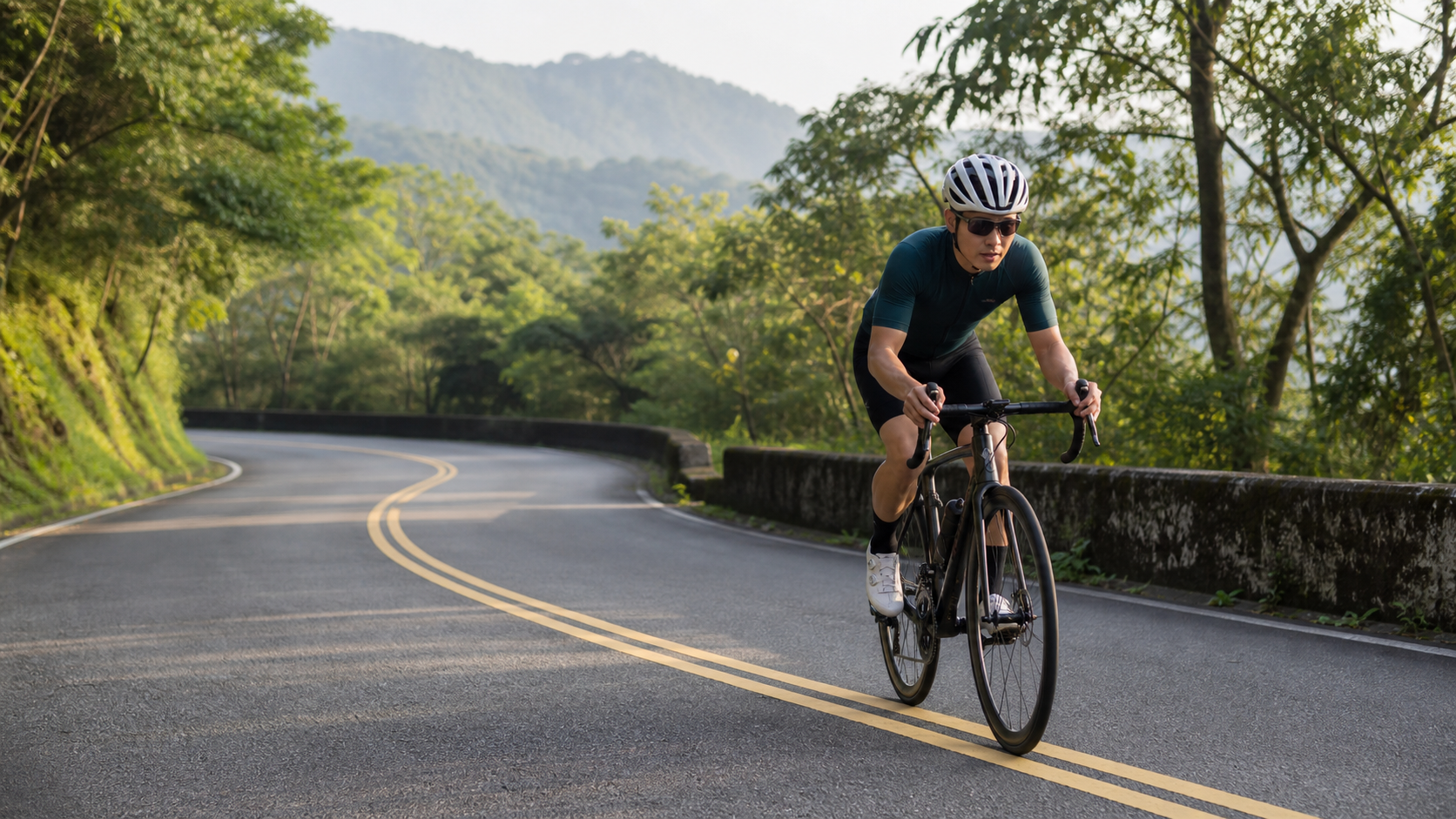
Opening: That Day on Fengguizui, He Forgot He Was Climbing
In my fifteenth year of coaching, I’ve seen every kind of “blown-up” face, and also the rare few that were “lit up.”
The lit-up face I remember most belongs to a 42-year-old tech engineer; let’s call him A-Kai. A-Kai first came to me because every time he climbed Fengguizui, he felt his “mind was too noisy”—the whole way up he’d be thinking about work projects, whether to grab a coffee later, whether he was riding too slowly, why his thighs were so sore. His power numbers weren’t bad, but he described it himself as “arguing with myself the whole way.”
Then one session, I deliberately simplified his goal to just one thing: keep cadence steady between 88 and 92 rpm, and ignore everything else. Halfway up the mountain, he suddenly went quiet. Afterward, he said something to me I still remember: “Coach, for those ten-odd minutes, I kind of disappeared. My legs were turning on their own, I was just looking at the scenery, and I only remembered the soreness later.”
That is flow.
Many people think flow is something reserved for elite athletes, for geniuses, a mystical experience you can only hope to stumble upon. But as a coach who has read a lot of sports physiology and sports psychology literature and has worked with athletes at all levels, I can tell you very responsibly: flow has a neuroscientific basis, it has conditions for entry, and—it can be trained.
In this article, I’ll break flow down for you from three angles: what happens in your brain (the neuroscience), how you get in (the conditions and methods), and what it actually has to do with your performance (the honest version, no hype). Along the way, I’ll include practical session plans, common mistakes, and specific advice for readers at different levels.
1. Conceptual Foundations: What Exactly Is Flow?
1-1 Starting with Csikszentmihalyi
The concept of “flow” was first proposed by psychologist Mihaly Csikszentmihalyi to describe the optimal experience state in which a person is fully absorbed in one activity, losing themselves, and feeling effortless. The people he observed included painters, chess players, surgeons, and rock climbers—people who, at the peak of their focus, often describe an experience of “movements happening on their own, time disappearing, and self-awareness stepping aside.”
Athletes are no strangers to this state; you may have heard a more colloquial term for it: “in the zone.” A basketball player with a hot hand who makes every shot; a runner who suddenly feels “light” in the latter half of a race; a cyclist on a familiar climb whose pedals seem to turn by themselves. These are everyday versions of flow.
1-2 The Nine Characteristics of Flow
The research literature typically breaks flow into several “preconditions” and several “experiential characteristics that occur afterward.” Let me organize this for you in coach’s language in the table below—you can use this table as a self-check list. Think back to the last time you were “in the zone” and see how many items you matched.
| Category | Characteristic | Plain-Language Translation (Cycling/Sport Version) |
|---|---|---|
| Precondition | Challenge–skill balance | It’s a bit hard, but I can do it |
| Precondition | Clear goals | I know exactly what this segment is for |
| Precondition | Immediate feedback | I know right away how I’m doing (power, cadence, breathing) |
| Experiential | Focus on the present | Attention is entirely on this task, no distraction |
| Experiential | Action–awareness merging | Legs turn on their own, no need to “think” |
| Experiential | Sense of control | I feel everything is within my control |
| Experiential | Loss of self-consciousness | Forget caring about what others think of me |
| Experiential | Distorted sense of time | An hour feels like ten minutes (or ten minutes feels like a long time) |
| Experiential | Autotelic nature | The activity itself is enjoyable, not for any other reason |
Here’s a key coaching reminder: the first three are things you can actively design; the last six are results that happen naturally. Many people get the order wrong, desperately trying to “make themselves lose self-awareness” or “make themselves enjoy it,” and the harder they try, the less they get in. The correct approach is—prepare the first three conditions, and the rest will come on their own. This is the most important sentence in this entire article; it’s worth underlining.
2. Neuroscience: What Happens in Your Brain During Flow?
This section is a bit denser, but I’ll keep it in plain language. Understanding the mechanism means you’ll know which “knob” you’re adjusting, rather than guessing blindly.
2-1 The “Temporary Shutdown” of the Prefrontal Cortex — Transient Hypofrontality
The most frequently cited hypothesis explaining flow is the Transient Hypofrontality Hypothesis, proposed by neuroscientist Arne Dietrich in 2004.
It sounds like a mouthful, but the concept is actually intuitive. Your prefrontal cortex, especially the dorsolateral prefrontal cortex, is responsible for: self-criticism, planning, sense of time, awareness of self, and the internal chatter in your head (“Am I riding too slow?” “Will people laugh at me?”). This is the region A-Kai called his “noisy” brain.
This hypothesis suggests that when you enter flow, some functions of the prefrontal cortex temporarily “downshift.” The brain doesn’t have spare processing power for self-criticism, sensing time, or being aware of “me”—so you experience the disappearance of self, time distortion, and effortlessness. Control is handed over to regions like the basal ganglia, which handle “movements already trained to automaticity.”
Here’s an analogy: normally, riding feels like “driving a manual transmission while staring at the dashboard and giving yourself a performance review the whole time.” Entering flow is like closing unnecessary background programs, leaving only the most streamlined autopilot. This also explains why flow almost exclusively occurs in movements you’re already highly skilled at—you can’t enter flow the first time you’re on a spin bike with messy technique, because the basal ganglia doesn’t yet have an automated program to take over.
2-2 A Supporting Observation: The Brain During Improvisation
There’s a frequently cited example: researchers used fMRI to observe jazz musicians’ brains during improvisation and found that when musicians entered that “freely flowing” improvisational state, activity in the dorsolateral prefrontal cortex decreased, while regions related to self-expression became more active. This echoes the “transient hypofrontality” hypothesis.
I want to honestly add: the neuroscience of flow is still developing. Results from different research methods (fMRI, EEG) aren’t entirely consistent, and the field is still building more rigorous experimental frameworks. So please treat “prefrontal downshift” as a highly explanatory but still-validating model, not a settled iron law. This is also my principle when writing on such topics—better to be conservative than to present a hypothesis as established fact.
2-3 The Neurochemical “Cocktail”
Beyond changes in brain region activity, flow is also often described as a combination state of neurotransmitters. Roles frequently mentioned in the literature include:
- Dopamine: related to focus, reward sensation, and pattern recognition; helps you lock onto goals.
- Norepinephrine: increases alertness and attention.
- Endorphins: reduce pain perception and bring pleasure.
- Serotonin: associated with that “satisfying afterglow” when flow ends.
I’d especially caution: these neurochemical explanations are often dramatized in popular science (all that “natural pleasure cocktail” talk), but the human brain isn’t that simple and linear. You don’t need to memorize the name of each substance. You only need to know one thing: flow is a paradoxical state of being “highly alert yet relaxed”—the body is active, but the noise in the mind is quiet. Your goal is to create the conditions for this “active but quiet” state.
3. Conditions for Entering Flow and Practical Methods
Okay, enough theory. As a coach, what I care about most is always: “So what do I actually do?”
Flow doesn’t come from wishing. It comes from designing the conditions correctly. Below, I’ll break down the actionable levers one by one.
3-1 The Core Lever: Challenge–Skill Balance
Among all conditions, the one most emphasized in research is the challenge–skill balance. The classic formulation is: when “the challenge is slightly above your current ability,” you’re most likely to enter flow.
Here, I want to give an honest supplement. Recent meta-analyses have actually found that the relationship between challenge–skill balance and flow is “moderate,” not a panacea; moreover, this relationship is moderated by other factors, such as: how much you care about the activity, your achievement motivation, and whether you’re a “success-seeking” or “failure-avoidant” person. Research indicates that people with a “hope for success” mindset are more likely to enter flow in tasks with challenge–skill balance; those with a high “fear of failure” tendency find it harder.
What does this mean practically? Two things:
- Set difficulty to “reachable on tiptoes”: too easy leads to boredom, too hard leads to anxiety, and neither gets you in. The sweet spot is “somewhat effortful, but I know I can do it.”
- Mindset matters more than difficulty: on the same steep climb, whether you treat it as an exam to “prove you won’t fail” or as a game of “let’s see if I can hold steady today” makes a world of difference in your odds of entering flow.
The table below is one I actually show my athletes—a “difficulty self-calibration” reference:
| Your Subjective Feeling | Challenge/Skill Relationship | State You’ll Enter | Coach’s Prescription |
|---|---|---|---|
| Bored, want to check my phone | Challenge << Skill | Zoning out, distracted | Increase difficulty (add gradient, distance, pacing target) |
| Somewhat effortful but holding steady | Challenge slightly > Skill | Flow sweet spot | Maintain, don’t change anything |
| Very tense, a bit panicked | Challenge > Skill by a notch | Anxiety, technique breaking down | Slightly reduce difficulty or break into smaller segments |
| About to blow up, just want it to end | Challenge >> Skill | Panic, collapse | Immediately reduce intensity, don’t push through |
3-2 Clear Goals and Immediate Feedback
Levers two and three are clear goals and immediate feedback.
Remember A-Kai’s story? I changed nothing except shrinking his goal from “a whole bunch of things” to “one thing: cadence 88–92 rpm.” That’s the power of a “clear goal.” The more singular and specific the goal, the less material the prefrontal cortex has to ruminate on.
And feedback is the fuel of flow. You need a signal that “tells you right away whether you’re doing well”:
- If you have a bike computer: power, cadence, and heart rate are the best real-time feedback.
- If you don’t: breathing rhythm, leg sensation, wind noise, and self-talk about breathing (“Can I still speak a full sentence?”) work just as well.
Here’s a particularly practical tip for Taiwan: many people watch too many data points at once while riding—power, heart rate, cadence, speed, gradient, remaining distance… six numbers at once, and the mind gets even noisier, making it harder to get in. My advice is to watch only one primary metric at a time, treating the rest as background.
3-3 Designing Your Environment and Attention
Flow hates being interrupted. In Taiwan’s riding environment, there are several practical details:
- Choose the right venue: urban routes with lots of traffic lights make flow nearly impossible (you’re constantly forced to stop and switch attention). To train flow, choose continuous, low-traffic, familiar routes—such as a familiar riverside bike path, a fixed climbing route, or an indoor trainer (minimizing distractions to the lowest level).
- Reduce notification distractions: phone notifications and group messages are flow killers. Turn on Do Not Disturb during training.
- Warm up properly: when your body is still cold and movements aren’t smooth yet, the basal ganglia’s automated programs can’t take over, making entry difficult. Give yourself 10 to 15 minutes to warm the body up and smooth out the movement.
3-4 An Often-Overlooked Lever: Breathing as an “Anchor” for Attention
In my coaching practice, I’ve found a tool that works well but few people train systematically: using the breath as an anchor for attention.
The logic is this: the prefrontal cortex gets noisy because, when idle, it starts chattering. If you give your attention a clear, rhythmic, present-moment “grip point,” it’s less likely to drift. And breathing is the most convenient, always-carryable anchor.
The specific exercise I give athletes is a simple “breath–cadence synchronization” drill:
- Choose a gentle climb or flat road, with intensity at RPE 5 to 6.
- Use a fixed breathing rhythm, such as “inhale for two beats, exhale for three,” making the exhale slightly longer than the inhale (this helps relax the parasympathetic nervous system).
- Link the breathing rhythm to the pedal rotation, feeling both like the same metronome.
- When you notice your mind wandering again (it will), don’t scold yourself—just gently “bring” your attention back to the breath.
This exercise itself is training the “muscle” of bringing attention back to the present. The more you practice, the easier it becomes to enter that state of “attention fully in the present, no stray thoughts.” This is actually the same core mechanism as mindfulness training—not “forcing yourself not to get distracted,” but “when distracted, gently return.” Distraction isn’t failure; “noticing the distraction and bringing yourself back” is the practice itself.
3-5 Why “External Focus” Flows More Easily Than “Internal Focus”
Here’s one more advanced but practical concept: the “direction” of attention.
Sports science has a solid finding: for well-learned movements, directing attention externally (to the effect the movement should produce, or to external environmental targets) generally produces smoother, more efficient performance than directing it internally (to your own muscles, your own bodily sensations).
Examples:
- Internal focus (more likely to jam up): “My quadriceps need to push hard” “Is my ankle angle correct?”
- External focus (more likely to flow): “Send the power into the road” “Stare at that sign ahead and pull it toward me.”
Why? Because when you “monitor” your own body, you’re essentially calling the prefrontal cortex back to take over a movement that was already automated—this is called “paralysis by analysis,” that predicament where “the more you think, the more your form falls apart.” External focus does the opposite; it lets the automated system take over with confidence.
So if you want to chase flow, practice directing your attention “outward” rather than “inward.” This is also why many riders find it easiest to enter the zone while looking at scenery, chasing the rider ahead, or feeling the wind.
3-6 A Sample “Flow-Friendly” Training Session
Below is a session I often give to intermediate athletes who want to experience flow, whether on a trainer or a familiar climb. The point isn’t explosive intensity, but creating stable, single-goal, continuous, uninterrupted blocks. Intensity is based on the Rating of Perceived Exertion (RPE, 1–10 scale); those with power/heart rate can map accordingly.
| Segment | Time | Intensity (RPE) | Single Focus Goal | Purpose |
|---|---|---|---|---|
| Warm-up | 15 min | 3–4 | Focus only on breathing and smooth cadence | Warm up the body, shut off mental noise |
| Entry Block A | 12 min | 5–6 | Cadence steady at 85–90 rpm | Establish rhythm, give the prefrontal cortex “one thing” |
| Recovery | 3 min | 3 | Don’t think about anything, relax | Prevent fatigue buildup from breaking focus |
| Entry Block B | 15 min | 6–7 | Maintain breathing that allows “short phrases, not conversation” | Slightly higher challenge, approaching the sweet spot |
| Recovery | 3 min | 3 | Relax | Same as above |
| Entry Block C | 12 min | 6 | Look only at the road ahead, feel the wind | Practice “external focus,” let self-awareness step aside |
| Cool-down | 10 min | 2–3 | Gradually ease down | Let the body and nervous system settle |
This session isn’t flashy, but its design logic is entirely for flow: single focus, continuous blocks, difficulty at the sweet spot, and recovery periods in between to prevent fatigue from kicking you out of the state. You won’t necessarily enter flow every time (flow can never be “guaranteed”), but you’ll significantly raise the odds.
4. The Relationship Between Flow and Performance: The Honest Version
I want to be especially careful in this section, because there’s too much talk out there framing flow as a “performance miracle drug,” and that’s not honest.
4-1 Subjective vs. Objective
There’s a very interesting and important distinction in the research:
- When performance is measured with subjective indicators (e.g., athletes’ own sense of “how well did I perform”), the positive correlation with flow is usually clear.
- But when measured with objective indicators (e.g., finish time, placing, actual power output), the relationship between flow and performance is much less clear.
In other words: entering flow will almost certainly make you “feel” like you performed better and enjoyed the process more; but it doesn’t guarantee prettier numbers on your bike computer or a better placing.
This isn’t meant to pour cold water on you; it’s to help you set expectations in the right place. The most certain benefit of flow is experiential quality—you’ll enjoy the sport more, suffer less, and find it easier to stick with it (which is enormously valuable for long-term health and training consistency). As for whether it can directly give you a PB (personal best), the evidence says “possibly, but don’t take it for granted.”
4-2 My Own Observations
After all these years of coaching, my practical observations align with the research: flow’s biggest dividend is actually in “training sustainability.” People like A-Kai, who originally found riding “painful, noisy, and wanted to quit,” undergo a complete shift in attitude toward exercise once they taste flow a few times—from “I should exercise” to “I want to go ride.” This motivational shift, over the long term, has a far greater impact on health than pushing 10 more watts in a single session.
So this is how I position flow for my athletes: it’s not a tool for “chasing results”; it’s an engine for “making you fall in love with the activity, and then doing it for the long haul.” Results are a byproduct of long-term persistence.
5. Common Mistakes and Corrections
This section compiles the mistakes I see most often, and the ones that most easily keep people “out.” Check how many you’ve hit.
Mistake 1: Trying Too Hard to “Enter” Flow
This is the most common and most paradoxical mistake. The essence of flow is “the prefrontal cortex steps aside,” and the very thought “I must enter flow” is precisely the prefrontal cortex at its most active—you’re simultaneously pressing the gas and the brake.
Correction: Don’t chase flow; chase the “conditions.” Shrink your goal to a single one, set difficulty at the sweet spot, turn off distractions—then let go, whether or not you get in. Paradoxically, the less you cling, the more likely it comes.
Mistake 2: Setting Difficulty Wrong
Beginners often set difficulty too high (forcing intensities beyond their ability, resulting in constant anxiety); experienced riders often set it too low (cruising in too-easy zones, resulting in boredom and zoning out). Neither gets you in.
Correction: Use the “difficulty self-calibration table” in 3-1 to regularly check where you currently fall, and actively fine-tune.
Mistake 3: Watching Too Many Data Points, Too Chaotically
Correction: Watch only one primary metric at a time; treat the rest as background. Keep your bike computer display as clean as possible.
Mistake 4: Choosing the Wrong Venue and Timing
Trying to force flow in a city full of traffic lights, or before your body is warmed up, is almost guaranteed to fail.
Correction: Schedule “flow-chasing” training on familiar continuous routes or an indoor trainer, and always warm up thoroughly first.
Mistake 5: Treating Flow as a KPI to Hit Every Time
Flow is a “probabilistic event,” not a “mandatory goal.” Treating it as a KPI to check off every session only creates pressure, making it even harder to get in.
Correction: Treat flow as “a gift you occasionally receive after preparing the conditions.” What you can do is raise the odds, not guarantee occurrence.
The table below condenses the five mistakes and corrections onto one page for easy saving:
| Common Mistake | Why It Keeps You Out | Corrective Action |
|---|---|---|
| Trying too hard to enter | The prefrontal cortex becomes even more active | Only prepare the conditions, then let go |
| Difficulty too high/low | Anxiety or boredom | Use the calibration table to fine-tune to the sweet spot |
| Watching too many data points | Attention gets fragmented | Watch only one primary metric at a time |
| Wrong venue/timing | Constantly interrupted, body not warmed up | Choose continuous routes, warm up for 15 minutes first |
| Treating it as a mandatory KPI | Creates pressure | Treat it as “raising odds” rather than “guaranteeing” |
6. Actionable Advice for Readers at Different Levels
Flow doesn’t discriminate by level, but “how to train it” depends on where you are.
6-1 Commuters / Beginners
Your primary task is not to chase flow, but first to drill basic movements to automaticity—because, as mentioned earlier, flow requires the basal ganglia to have a well-practiced program to take over. When your movements are still raw, you won’t enter flow, and that’s normal. Don’t get discouraged.
Specific steps:
- Find a safe, familiar, low-traffic route (a riverside bike path is ideal) and ride it regularly.
- Give yourself just one ultra-simple focus goal each time, such as “for these 10 minutes, I’ll only feel the rhythm of my breathing.”
- The goal is first to build consistency and enjoyment; flow will quietly appear on its own as you become more skilled.
6-2 Intermediate / Regular Trainers
You already have a foundation of movement automaticity, so you can start deliberately designing flow conditions.
Specific steps:
- Adopt the “flow-friendly session” from Section 3-4, scheduling it 1 to 2 times per week.
- Practice the “single focus” technique: lock onto only one thing per block.
- Start keeping records: which times did you “get in”? What were the difficulty, venue, mood, and warm-up status? Find your personal flow recipe.
6-3 Advanced / Competitive Athletes
Your challenge usually isn’t “getting in,” but “not being kicked out by self-awareness and anxiety in high-pressure competition.”
Specific steps:
- Build a pre-performance routine: fixed warm-up, fixed breathing, a fixed self-cue phrase. The function of a routine is to help turn down the prefrontal cortex’s noise and direct attention to the present.
- Practice “external focus”: direct attention to “the effect the movement should produce” or “the external environment” (road, opponents, wind), rather than “my body, my feelings, my placing.” Both research and practice show external focus is more conducive to automated movement and fluid performance.
- Do the work on “fear of failure”: if you find yourself so tense at races that you can’t get in, what often needs addressing isn’t technique, but your relationship with “failure.” If this seriously affects you, seeking help from a sports psychology professional is a worthwhile investment.
Here’s a comparison of action priorities for the three levels:
| Level | Primary Task | Weekly Suggestion | Common Sticking Point |
|---|---|---|---|
| Commuter/Beginner | Movement automaticity + building enjoyment | Ride regularly 2–3 times, one simple focus each time | Movements too raw, can’t get in yet (normal) |
| Intermediate | Deliberately design flow conditions | Flow-friendly session 1–2 times + keep records | Goals too scattered, difficulty not calibrated |
| Advanced/Athlete | Not getting kicked out under pressure | Pre-race routine + external focus practice | Fear of failure, excessive self-awareness |
7. Frequently Asked Questions (FAQ)
Q: Can I enter flow “anytime”?
A: No, and pursuing “anytime” is itself a trap. Flow is a probabilistic event; what you can do is prepare the conditions and raise the odds. Think of it as “when the conditions are right, the gift comes more often,” not “flip a switch.”
Q: Does listening to music help you enter flow?
A: It varies by person. For some, music with a steady rhythm helps lock in focus and drown out stray thoughts; for others, music is an additional distraction. Try it yourself and record which works for you. Safety caveat: when riding outdoors where you need to be aware of traffic, don’t turn the volume up so high that you can’t hear ambient sounds.
Q: Does caffeine help?
A: Moderate caffeine can indeed increase alertness and focus, which may indirectly help you enter that “active but quiet” state. Caffeine is very accessible in Taiwan (one cup at a convenience store), but dosage and individual tolerance vary greatly; too much can cause heart palpitations, anxiety, and make it harder to get in. Go by your own body’s response, and don’t chase high doses.
Q: In Taiwan’s summer, hot and humid—can I still get in?
A: High heat and humidity are themselves massive physiological stressors; the body is busy cooling itself and heart rate spikes, making it genuinely harder to enter that relaxed, fluid state. To chase flow in Taiwan’s summer, I recommend avoiding the midday heat (ride early morning or evening), staying well-hydrated, or moving to an air-conditioned indoor trainer. Rather than pushing through the scorching heat, create the right conditions.
Q: Is flow the same as “fighting above your weight class, pushing beyond your ability”?
A: No, and these are often confused. Pushing far beyond your ability usually brings anxiety, broken form, and even injury risk—that’s “struggle,” not “flow.” Flow’s sweet spot is “slightly above ability, but holdable.” If you find yourself getting increasingly tense during a session, breathing falling apart, and form deteriorating, that’s not approaching flow—that’s approaching blowing up. The right move is to reduce intensity, not push through.
Q: I’m older, or just returning from injury—can I still train flow?
A: Of course you can, and flow’s qualities of “enjoying the process and reducing pain sensation” are especially friendly to people who need long-term rehabilitation or to maintain an exercise habit. The key is to calibrate difficulty to your ability “now,” not your ability “before.” After injury, please progress gradually and determine intensity under the assessment of a physician or physical therapist; don’t rush to add volume just because you’re chasing that fluid feeling.
Q: Can flow be “stored” or “replicated”?
A: It can’t be directly replicated, but you can build your own “flow recipe record.” Each time you enter the state, reflect and note the conditions: venue, difficulty, warm-up status, mood, time, whether you listened to music. After accumulating several entries, you’ll see your own patterns—for example, “I get in most easily in the evening, on my familiar riverside route, after a full 15-minute warm-up, watching only cadence.” This personalized recipe is more accurate than any general rule.
8. Conclusion: Fall in Love First, Then Talk About Results
Back to A-Kai.
He later became the most consistent and most enjoyment-driven rider in our team. He never became some kind of elite racer, but he volunteered to ride every weekend, his health check numbers improved year after year, and he became much more cheerful. Once he told me: “Coach, I get it now. I used to fight with my own brain the whole time; now I’ve learned to let it go quiet.”
That’s what I most want to convey through this article: flow isn’t a stunt to show off; it’s an ability that makes your relationship with sport better.
It has a neuroscientific basis (the temporary retreat of the prefrontal cortex, the paradoxical state of being active but quiet); it has designable entry conditions (challenge–skill balance, clear goals, immediate feedback, the right venue and mindset); and its relationship with performance is—it will almost certainly make you enjoy it more, not necessarily make you faster, but in the long run it will definitely make you more consistent.
Next time you’re out on the road, stop arguing with yourself the whole way. Shrink your goal to one thing, turn off the distractions, set the difficulty to a height you can reach on tiptoes—and then let go, and ride. Leave the rest to your basal ganglia.
May you soon meet that “disappeared” version of yourself between the pedal strokes.
This article is educational content and does not replace individual diagnosis and treatment advice from a physician, physical therapist, or nutritionist. If you have cardiovascular disease, metabolic disease, or other health concerns, please consult a qualified medical professional before starting or adjusting your training, and rely on individualized assessment.
References
- A Review on the Role of the Neuroscience of Flow States in the Modern World (PMC): https://pmc.ncbi.nlm.nih.gov/articles/PMC7551835/
- A framework for neurophysiological experiments on flow states (PMC): https://www.ncbi.nlm.nih.gov/pmc/articles/PMC11332228/
- A systematic review and meta-analysis of the relationship between flow states and performance (Taylor & Francis): https://www.tandfonline.com/doi/full/10.1080/1750984X.2021.1929402
- The challenge–skill balance and antecedents of flow: A meta-analytic investigation: https://www.academia.edu/8921152/The_challenge_skill_balance_and_antecedents_of_flow_A_meta_analytic_investigation
- Dispositional Flow and Performance in Brazilian Triathletes (PMC): https://www.ncbi.nlm.nih.gov/pmc/articles/PMC6763559/
Related Reading
西進武嶺 免費訓練分析服務 Intervals | 練不夠還是練過頭?你哪一種類型選手?AI模型告訴你! | 備戰神器 | 公路車 訓練 | CT Yeh
4 年前
西進武嶺 自製新版AI配速表產生器 x 賽前攻略 抱佛腳! 沒有功率計也可以產生配速表嗎?有什麼其他眉角賽前要注意的呢? | 西進武嶺 / 東進武嶺 KOM 攻略 | 公路車 | CT Yeh
4 年前
大禹嶺 到 武嶺牌樓 全程前後實況錄影 | 北進武嶺 | 東進武嶺 | KOM | 訓練台 | 坡度分析 | Taiwan KOM Last 10 km HARD | 公路車
6 年前
單車AI教練!全新 ChatGPT4o 幫你分析訓練成果!排武嶺課表,分析騎車姿勢! 太神了! / 公路車 / CT Yeh / feat. 緯緯
2 年前
CT 喇低賽) 武嶺牽車 才是王道 西進牽車四小時內秘訣 攝手位置 如何判斷 防抽筋小秘訣
7 年前
2026 輪霸西濱200K 挑戰VLOG / 第一集團 / 首次參加..經驗不足、膀胱不足 /死守6H內 / AI戰鬥力顯示系統 / 公路車 / CT Yeh
4 個月前
風櫃嘴時間 預測西進武嶺時間?13000名車友統計數據分析告訴你 !
5 年前
備戰 戀戀197 賽前關門點分析 西濱團練 #公路車 4K高畫質
6 年前