The Science of Cool-Down and Stretching: Does It Really Work? A Coach Helps You See Through the Overhyped Rituals
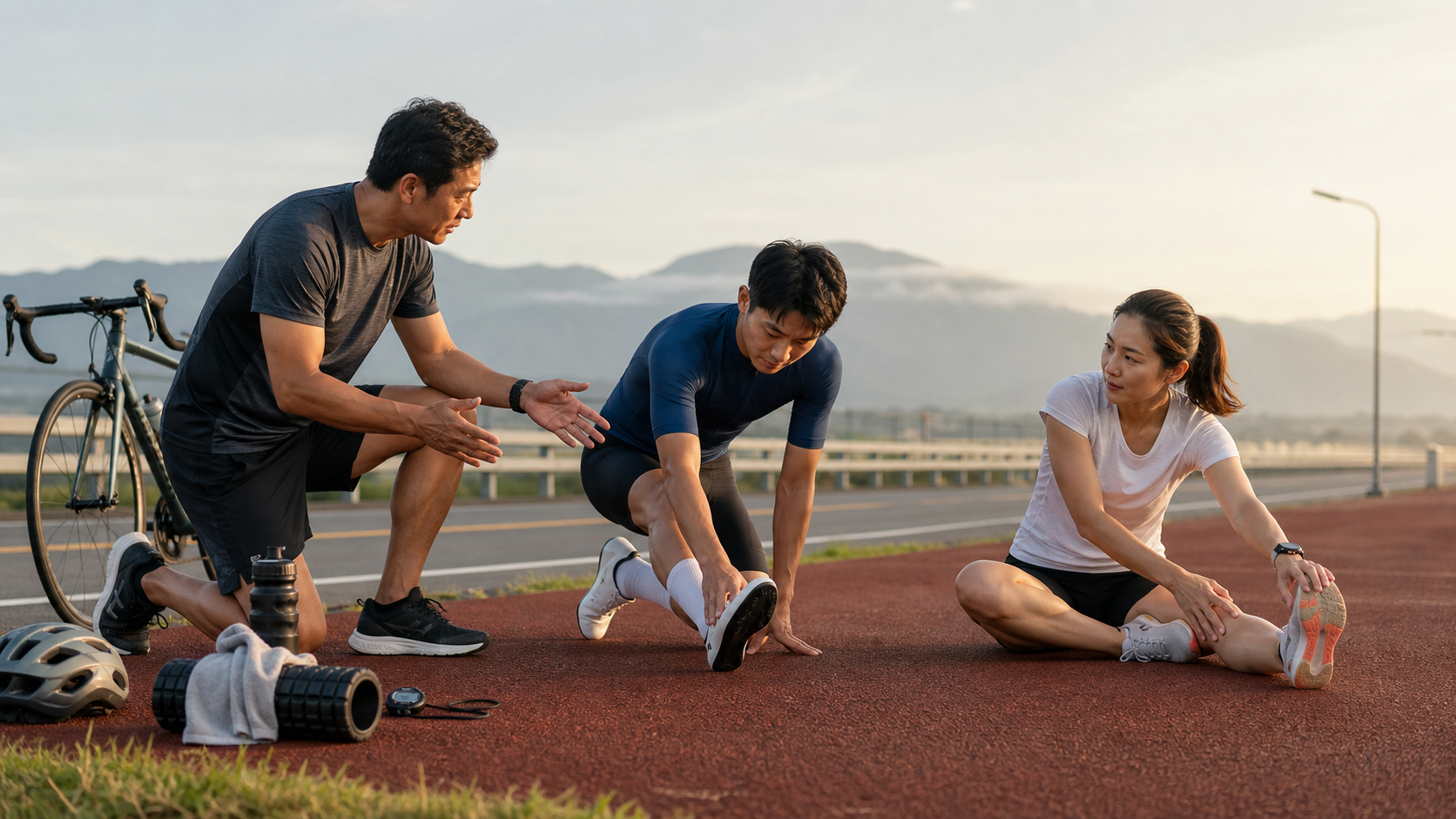
Opening: The Student Who Never Cooled Down, and the One Who Stretched Religiously Yet Kept Getting Injured
I’ve been coaching athletes and recreational exercisers for 15 years, and two students’ stories have stayed with me.
The first is A-Zhe, a 40-year-old tech engineer who rides Yangmingshan and Fengguizui every weekend. His principle is simple: after riding, he loads the bike straight onto the rack and heads home to shower. “Coach, I never cool down, and I’m doing just fine,” he said half-jokingly.
The second is Yi-Jun, a road runner in her early 30s preparing for the Taipei Marathon. She’s very disciplined—after every run, she spends 20 minutes doing static stretches, with form so precise she could pass for a yoga instructor. Yet that season, she kept suffering from recurring hamstring strains and iliotibial (IT) band issues.
Their confusion is actually two sides of the same question: Do cool-downs and stretching actually work? Are they essential protective rituals, or just wishful habits we cling to?
In this article, I want to talk to you honestly about this. Because in this field, there’s no shortage of claims like “lactic acid needs to be flushed out with a cool-down” or “stretching prevents injury.” They sound reasonable, but once you look at the existing research, you’ll find things aren’t that simple. I’ll try to stick to what the evidence supports, and where the evidence is thin, I’ll honestly say “we’re not sure yet”—that’s more valuable than giving you false reassurance.
Let me be clear about my stance upfront: I’m not telling you to “skip cool-downs and stretching.” Quite the opposite—I myself spin easy for a few minutes after every long climb. What I want to do is help you see the “true picture” of this practice—where it helps, where it’s overhyped, and where your time is best spent. Because when you have wrong expectations about something, you’re not just wasting time; you’re neglecting the real issues that need addressing (training load, sleep, strength). Over these 15 years, I’ve seen too many people chase a perfect 100 in cool-downs and stretching while only putting in 30 where it truly determines outcomes.
1. Conclusion First, Then the Why
I know many people don’t have the patience to read the whole thing, so let me lay my position—built on 15 years of literature review and coaching experience—on the table:
- Cool-downs aren’t magic; their “lactic acid clearing” and “soreness relief” effects are greatly overestimated. But they still offer some mild, genuine benefits worth 5 to 10 minutes of your time.
- Static stretching cannot effectively reduce overall sports injury risk—the research evidence on this is quite consistent. Stretching has its value, but “injury prevention” isn’t its main selling point.
- Flexibility training works, but it’s an independent capacity that needs long-term accumulation—not an insurance policy you can buy with a quick stretch after exercise.
- Most importantly: Cool-downs and stretching are “icing on the cake,” not “charity in times of need.” What truly determines whether you get injured or recover well is training load management, sleep, nutrition, and long-term progression.
Let me break this down for you, point by point.
2. Conceptual Foundations: Half of What You Think About Cool-Downs Is a Myth
Myth 1: “Cool-downs are for flushing out lactic acid”
This is probably the most stubborn urban legend in the gym. The truth is: lactate itself isn’t the culprit behind next-day soreness, and lactate typically returns to near-baseline levels within 30 to 60 minutes after you stop exercising—whether or not you do an easy spin or jog to cool down.
More critically, many people equate “lactic acid buildup” with next-day soreness, and that’s wrong. That tight, painful feeling the next day is formally called Delayed Onset Muscle Soreness (DOMS). Its main cause is microstructural damage from eccentric contractions (e.g., downhill running, downhill braking, the lowering phase of weight training) and the subsequent inflammatory response—it has almost nothing to do with lactate. So the claim “cool down to flush lactate and avoid sore legs” falls apart on both counts.
Myth 2: “Cool-downs significantly reduce soreness and speed up recovery”
This is the expectation I most want to help people recalibrate. A narrative review of cool-downs, summarizing a large body of research, found that active cool-downs generally show no significant benefit for reducing muscle soreness, improving muscle damage markers, neuromuscular contractile properties, tendon stiffness, joint range of motion, hormone concentrations, or psychological recovery. In other words, you think the cool-down is “speeding up blood return,” but objectively measured, the effect is very limited (Van Hooren & Peake, Sports Medicine, 2018).
One noteworthy detail: in professional and highly trained athletes, active cool-downs “might” slightly reduce the impact of DOMS; but in recreational exercisers, this benefit is barely visible. This actually matches my observations—elite athletes train at such high volumes and their bodies are more sensitive to subtle differences that the small marginal benefit of a cool-down is worth it for them.
So what’s left for the cool-down? Don’t worry—it still has value, and I’ll cover that in Section 3. First, let me finish the stretching thread.
3. Stretching and Flexibility: Distinguishing “A Quick Stretch Now” from “Long-Term Development”
Before discussing stretching, we must distinguish three concepts that are often conflated—much of the debate is really people talking past each other:
| Concept | Plain Explanation | Time Scale |
|---|---|---|
| Static stretching | Lengthening a muscle and holding it at end range for a period (e.g., holding a hamstring stretch for 30 seconds) | Immediate, single session |
| Dynamic stretching | Moving with control through a joint’s range of motion (e.g., walking lunges, leg swings, torso rotations) | Usually part of warm-up |
| Flexibility/Mobility | The range of motion your joints “naturally” have; a physical capacity developed through long-term training | Accumulated over weeks to months |
Can Static Stretching Prevent Injury? The Evidence Says: Largely No
This is the claim I’m most confident making in this article. Multiple systematic reviews examining hundreds of studies have reached a fairly consistent conclusion: including static stretching in a warm-up does not reduce overall sports injury rates. One systematic review screened 364 studies down to 7 eligible ones, and all the randomized controlled trials found static stretching ineffective at reducing exercise-related injuries (Small et al., Research in Sports Medicine, 2008).
But I want to be honest and add nuance, so you don’t think stretching is completely useless:
- Some studies have observed that stretching may offer some protective effect for specific injuries like musculotendinous and ligament injuries, even if it has no significant effect on “overall injury risk.”
- In other words, the evidence isn’t “stretching does nothing”—it’s “it can’t prevent overall injuries, but it may help in certain specific situations.” This kind of nuance is exactly the way of thinking I want you to take away—don’t see things in black and white.
So back to Yi-Jun from the opening. She was doing static stretches after every run to “prevent injury,” but her recurring strains were never something stretching could solve. When we shifted focus to her weekly mileage jumping nearly 40% within two weeks, and insufficient glute and core strength, her problems truly improved after adjusting training progression and adding strength work. This case reinforced my conviction: putting the big label of “injury prevention” on stretching often makes people overlook the real root of the problem.
Static Stretching Before Exercise Can Even Hold You Back
Another practical point: if you do prolonged static stretching (over 60 seconds per muscle group) before activities requiring explosive power, sprinting, or maximal strength, it can temporarily cause a small decrease in strength and power output. For cycling sprints, track and field, and explosive sports, that’s not what you want. So warm-ups should focus on dynamic stretching; save static stretching for the cool-down or a dedicated flexibility session.
What About Flexibility Training? That’s Genuinely Useful
Note that “static stretching doesn’t prevent injury” doesn’t equal “flexibility doesn’t matter.” If you already have insufficient mobility—for example, limited ankle dorsiflexion affecting squats, or tight hips affecting your pedal stroke or running form—then regular, long-term stretching and mobility training can indeed increase your range of motion and improve movement quality. This is a capacity built over weeks to months, a completely different thing from “a 30-second stretch after exercise to feel better.”
4. Practical Methods: So How Should You Cool Down and Stretch? (With a Concrete Plan)
After all this talk about “limited effects,” you might ask: should I still do it? My answer is—yes, but do it for the right reasons, in the right way, and keep reasonable expectations about its effects.
The Genuinely Reliable Benefits of a Cool-Down
Even if the lactic-acid-clearing and soreness-reducing effects are overestimated, a cool-down still has several relatively sound reasons to keep:
- Letting heart rate and breathing decline smoothly: Stopping abruptly after high intensity (especially standing still right after a steep climb or sprint) can cause blood to pool in the lower limbs, drop venous return, and a few people may feel dizzy or even experience orthostatic hypotension. Spending a few minutes spinning easy or walking to let your body “downshift” is a sensible safety buffer.
- Psychological closure and transition: Switching from a high-arousal exercise state back to daily life—this mental transition is a real benefit for many people and helps build the ritual of regular exercise.
- A low-intensity window for technique or relaxation: Smoothing out your pedal stroke while spinning easy, or regulating your breathing during a post-run walk, are nice bonus uses.
The key is: position the cool-down as a “safety and psychological buffer,” not “recovery magic”—then your expectations are right.
A Practical Cool-Down Protocol (Cycling vs. Running)
Here’s a template I often give my athletes. Intensity should be “easy enough to hold a normal conversation”:
| Phase | Cycling | Running | Time | Purpose |
|---|---|---|---|---|
| Reduce intensity | Shift to easier gear, maintain cadence, drop power very low (e.g., 30–40% of max effort) | Transition from running to jogging to brisk walking | 5 min | Smooth decline in heart rate and breathing |
| Full relaxation | Easy coasting on flat ground or gentle pedaling in place | Walking, regulating breath | 2–3 min | Return to near-resting state |
| Optional flexibility | Gentle static stretches for quads, hip flexors, calves | Gentle static stretches for hamstrings, calves, glutes | 5 min | Maintain/improve mobility (long-term) |
| Start refueling | Begin hydration, carbs, and protein | Same as left | Ongoing | Support subsequent recovery |
How to Dose Static Stretching
If you decide to do flexibility stretching, here’s a practical dosing reference (ranges, not false precision):
| Item | General Recommended Range | Notes |
|---|---|---|
| Hold duration per stretch | About 15 to 60 seconds | Stretch to “tight, mild discomfort”—no need to chase pain |
| Repetitions per muscle group | 2 to 4 times | Accumulating across sets is safer than one hard yank |
| Weekly frequency | At least 2 to 3 times or more | Improving mobility requires long-term consistency |
| Intensity sensation | Mild tightness, no pain | Stop immediately on sharp pain or numbness |
Key reminder: If your goal is “immediate relaxation and maintaining mobility,” static stretching after exercise is reasonable; but if your goal is “preventing injury,” invest your time and energy where it works better—progressive training, strength work, sleep, and nutrition.
5. What Matters More Than Cool-Downs and Stretching: Recovery Priorities
I often tell my athletes: “Instead of agonizing over whether your cool-down is 5 or 15 minutes, just get better sleep first.” If we mapped out recovery resource allocation, cool-downs and stretching rank pretty low:
| Priority | Recovery Lever | Impact | Explanation |
|---|---|---|---|
| Highest | Progressive training load | Extremely large | Don’t spike weekly volume (a common conservative guideline is ~10% or so); this is the core of injury prevention |
| Highest | Sleep | Extremely large | Recovery and adaptation happen mainly during sleep; most adults need about 7 to 9 hours |
| High | Nutrition and hydration | Large | Post-exercise carbs + protein, replenish lost fluids and electrolytes |
| Medium | Active recovery days, easy exercise | Medium | Easy ride/walk the next day promotes circulation and mental relaxation |
| Low to Medium | Cool-downs, stretching, foam rolling | Small to Medium | Feels good, psychologically beneficial, but objective recovery benefits are limited |
This table isn’t telling you to skip cool-downs; it’s telling you to know your priorities. I’ve seen too many people do cool-downs and stretching to perfection while chronically sleeping under 6 hours and tripling their training volume—then blaming “not cooling down enough.” That’s the wrong direction.
Practical Reminders for the Taiwan Context
- Hot, humid summers: Taiwan’s summer heat and humidity slow the drop in core temperature and heart rate after exercise. A slow cool-down (letting your body dissipate heat gradually) actually has more meaning in summer; also be sure to replenish fluids and electrolytes.
- Nutrition for those who eat out: No need to splurge on expensive supplements after exercise—convenience stores have you covered: tea eggs or soy milk (protein), onigiri or bananas (carbs), and unsweetened or electrolyte drinks for hydration. That’s a very practical Taiwanese recovery meal.
- Common venues: After riding along riverside bike paths or running at school tracks, just find a short flat stretch or grassy area for your cool-down and stretching—no special equipment needed.
- Healthcare access: Taiwan’s National Health Insurance makes seeing a doctor easy. If you have sharp, persistent pain that affects daily life, don’t tough it out with “more stretching.” Getting evaluated early is far more efficient than guessing on your own. Rehabilitation, orthopedics, or sports medicine clinics are all reasonable first stops; physical therapists can identify the root movement and strength issues—far more effective than self-treating with a bunch of stretching videos you found online.
- Commute and time pressure: Many people in Taiwan only squeeze in exercise after work, and by the time a riverside ride or run is done, it’s often late and you’re rushing home. Instead of stressing over “not cooling down,” focus on “a relaxing bath at home, a proper meal, and getting to bed early”—these have a far bigger impact on how you feel the next day than five extra minutes of stretching by the river.
6. Common Mistakes and Corrections
Over the years, I’ve seen every variation of “cool-down and stretching myth in practice.” Here are the most common ones:
Mistake 1: Putting static stretching in the warm-up as an injury-prevention talisman
Fix: Warm up with dynamic stretching and progressive acceleration (e.g., leg swings, walking lunges, accelerating from slow to fast); move static stretching to after exercise or a separate session.
Mistake 2: Chasing “the more painful, the more effective”
Fix: Stretch to “tight, mild discomfort” and stop there. Sharp pain or numbness is your body’s warning signal, not a badge of progress. Bouncing stretches are more likely to cause injury—avoid them.
Mistake 3: Blaming poor recovery and recurring injuries on “not cooling down enough”
Fix: First check whether training volume spiked, whether sleep is sufficient, and whether there are strength weaknesses. These are the decisive factors; the cool-down is just a minor supporting player.
Mistake 4: Coming to a complete stop immediately after riding/running
Fix: Especially after high intensity or steep climbs, don’t stand still or sit down right away. Keep moving at low intensity for a few minutes to let circulation smooth out and reduce the risk of dizziness and orthostatic hypotension.
Mistake 5: Stretching through pain or injury
Fix: Forcing stretches during an acute strain or inflammation can make tissue worse. If you have a clear injury, get a professional evaluation first—don’t play your own physiotherapist.
Mistake 6: Expecting too much from cool-downs and feeling guilty when you skip them
Fix: Missing a cool-down won’t ruin your training. It’s a bonus, not a passing grade. Relax.
7. Actionable Advice for Different Reader Levels
For Beginners / General Health Exercisers
- Spend 5 to 8 minutes after each session gradually reducing intensity to let heart rate and breathing settle—treat it as a safety buffer.
- If you want to improve mobility, treat static stretching as an “independent 2–3 times per week habit,” not something you must do after every workout.
- Don’t stress about whether you cooled down. Prioritize sleep, hydration, and avoiding training volume spikes—the payoff is far greater than agonizing over a cool-down.
For Advanced Enthusiasts / Those with Race Goals (e.g., Yi-Jun)
- After high-intensity or high-volume sessions, the marginal benefit of an active cool-down is more worthwhile; you can maintain 8 to 12 minutes.
- Do regular flexibility training for areas where your mobility is limited (e.g., hips, ankles) to improve movement quality.
- Put your energy into progressive training and strength work—that’s the main driver of injury prevention and performance.
- Use dynamic stretching in your pre-race warm-up; avoid prolonged static stretching before racing, as it can affect explosive performance.
For Those with Chronic Conditions or Special Situations (Hypertension, Heart Disease, Diabetes, etc.)
- Strongly recommend discussing your exercise plan and intensity limits with your physician first. The following are general reminders, not individualized prescriptions.
- After high intensity, pay even more attention to a gradual cool-down to avoid sudden swings in blood pressure and heart rate; those with cardiovascular history especially should not stop abruptly.
- Those with peripheral neuropathy (e.g., some diabetics) may have altered pain perception during stretching and exercise—keep movements gentle and progressive.
- If you experience chest tightness, unusual breathlessness, dizziness, or cold sweats, stop immediately and seek medical attention. These situations require individualized care and medical evaluation—never self-diagnose.
7b. Going Deeper: Why Cool-Downs “Feel Useful” but “Don’t Measure Up”
Many students, upon hearing “cool-down effects are overestimated,” push back: “But I really do feel better after a cool-down—how can it be useless?” That’s a great question, and the answer lies in the gap between “subjective feeling” and “objective recovery markers.”
Blood Flow, Heart Rate, and That “Good Feeling”
During exercise, your muscle pump relies on repeated contractions to return venous blood to the heart. When you stop completely after high intensity, that pump shuts off instantly, blood tends to pool in the lower limbs, venous return drops, and your heart has to compensate to maintain blood pressure—that’s why some people feel dizzy or even see black spots when standing still after crossing a finish line. Spinning or walking easy for a few minutes keeps the muscle pump working gently, allowing blood pressure and heart rate to “downshift” smoothly. That physiological smoothness genuinely translates into a subjective “feeling better.”
But note: “Feeling better and less dizzy right now” and “muscle damage recovers faster by tomorrow” are two different things. The former is something a cool-down can help with; the evidence for the latter is very weak. Research tends to measure the latter (creatine kinase and other damage markers, maximal strength recovery, range of motion), which is why you get the discrepancy of “you feel it works, but the instruments say it’s about the same.” That’s not your imagination—the benefit you feel genuinely lies mainly in “immediate physiological and psychological smoothness.”
The True Causes and Timeline of DOMS
If you map out the timeline of delayed onset muscle soreness, you’ll see more clearly why a cool-down can’t save you from sore legs:
| Time Point | What’s Happening in the Body | Can a Cool-Down Help? |
|---|---|---|
| During exercise | Eccentric contractions cause microstructural damage to muscle fibers | The damage has already occurred; a cool-down can’t reverse it |
| Hours after exercise | Inflammatory response kicks in, local swelling | Largely irrelevant |
| 24 to 72 hours | Soreness peaks (this is the “iron legs” feeling) | Limited help |
| Days later | Tissue repairs, “repeated bout effect” makes you more resilient | This comes from training adaptation, not a cool-down |
The key takeaway from this table: what actually makes you less sore next time is the repeated bout effect—your body’s adaptation to the same intensity stimulus. That’s built through “regular, progressive repetition of that activity,” not bought with any single cool-down or stretch.
An Extended Case: The Mountain Biker Who Always Got Sore Legs on Downhills
Let me share another case. A-Kai is a mountain biker who loves descending. After every long downhill, his quads would be so sore the next day that climbing stairs was painful. He once thought it was because he “didn’t cool down properly,” so he doubled down on stretching his quads after rides—and still hurt just as much the next day.
I told him: your quads are doing eccentric braking the whole way down a long descent—that’s the contraction pattern most likely to trigger DOMS. This isn’t something a cool-down can fix. What we changed was: in the weeks before the season, we scheduled progressive downhill and eccentric loading so his quads got “vaccinated” first, building the repeated bout effect. A few weeks later, the same intensity of long descent produced noticeably less soreness the next day. What actually works is preparing your body in advance, progressively—not frantically stretching afterward to compensate.
8. FAQ: Questions My Students Ask Most
Q: Will I definitely get sore legs if I don’t cool down?
A: Not necessarily. Sore legs (DOMS) are mainly caused by micro-damage from eccentric contractions, which has little to do with whether you cool down. A more effective way to reduce soreness is “progressive training, letting your body gradually adapt to the intensity”—not relying on a cool-down to fix it.
Q: Are foam rollers useful?
A: Foam rolling and massage do help some people feel better and more relaxed in the moment—that subjective improvement is real. But claiming it significantly accelerates objective recovery? The evidence isn’t that strong. Use it as a comfortable relaxation tool—fine. Just don’t treat it as a miracle cure.
Q: So should I spend time stretching or not?
A: If your mobility is insufficient and your movements feel restricted, regular flexibility training is worth the investment. If you’re just trying to “prevent injury,” then spending that same time on sleep, progressive training, and strength work gives you far better value.
Q: Is icing or cold-water immersion after exercise useful?
A: Cold-water immersion and cryotherapy have some effect on reducing the subjective feeling of DOMS. But during training phases where you need long-term strength and hypertrophy adaptations, excessive icing may actually interfere with adaptation signals. Occasional use for recreational recovery is fine; for long-term use, be cautious and ideally get an individual assessment.
Q: With so many recovery methods on the market, which ones actually work?
A: Based on signals from existing systematic reviews and meta-analyses, here’s my rough ranking of evidence strength for common methods (remember: individual variation is huge, and most affect subjective soreness rather than objective damage markers):
| Recovery Method | Evidence for “Subjective Soreness” | My Practical Advice |
|---|---|---|
| Massage | Relatively stronger signal; considered one of the more helpful methods for DOMS and fatigue | Feels good, worth it, but no need to be expensive |
| Cold-water immersion / cryotherapy | Some effect on subjective soreness | Occasional use during race season; be cautious during long-term strength training phases |
| Compression garments, contrast water therapy | Small to moderate signal | Icing on the cake, not essential |
| Active cool-down | Limited effect on objective recovery markers | Use as a safety and psychological buffer |
| Post-exercise static stretching | Existing data insufficient to support “accelerated recovery” claims | Do it for mobility, not for recovery |
| Foam rolling | Subjective relaxation feels good; objective evidence weaker | Use as a comfortable relaxation tool |
The soul of this table is one sentence: Almost all “recovery miracle tools” affect your “feelings,” not the deep rate of muscle repair. Feelings matter too, but don’t confuse them with “objective recovery”—and definitely don’t spend big money on exaggerated claims.
Q: I have very little time and can only choose between a cool-down and stretching. How do I decide?
A: If you just finished a high-intensity, explosive, or heavy downhill/braking session and feel dizzy, prioritize 3 to 5 minutes of “intensity-reducing cool-down” for safety. If you have a long-term mobility limitation, schedule stretching as “a dedicated 2–3 times per week session” rather than squeezing it in every time. Neither is a daily pass/fail requirement.
Q: Can stretching actually make me “more flexible”?
A: Yes, but it requires consistency and time. Flexibility is a trained capacity, not something you get from one or two stretches. The key is sustained effort over weeks to months, several times per week, stretching to mild tightness without pain. An occasional stretch for peace of mind does very little for long-term mobility.
Q: Do children and older adults need cool-downs and stretching after exercise?
A: The principles are similar, but individual circumstances matter more. For older adults with cardiovascular or joint issues, a gradual cool-down after high intensity (avoiding abrupt stops) is actually more important, and movements should be gentler. Don’t chase large ranges of motion in stretching; safety and consistency matter more than intensity. For these populations, I always recommend consulting a physician or physical therapist first—a tailored plan is safer than applying general rules.
Q: Why do professional athletes take cool-downs and stretching so seriously?
A: Because at their level, any tiny marginal benefit is worth pursuing—and research does show active cool-downs are “more likely” to help highly trained individuals. But for the general exercising population, that marginal benefit is too small, far less valuable than investing time in sleep and training structure. Don’t assume that because elite athletes do it, it’s a required course for you.
9. Conclusion: Put Your Effort Where It Actually Matters
Let’s return to the two students from the opening.
A-Zhe “never cools down and is fine”—that’s not surprising, because a cool-down was never the deciding factor in whether he gets injured. But I still recommend he spend a few minutes spinning easy after long climbs like Yangmingshan—not to “flush lactic acid,” but to let heart rate and blood pressure settle smoothly and give his body a safe finish.
Yi-Jun “stretched religiously yet kept getting injured”—also not surprising, because static stretching was never an effective injury-prevention tool. When we shifted focus back to progressive training load and strength, her problems were truly resolved.
This is the core message I most want to convey: Cool-downs and stretching aren’t useless—they’ve just been placed in the wrong position and given expectations they can’t carry. They’re gentle bonus items—letting your body downshift gradually, your mind wrap up properly, and maintaining mobility long-term. But what truly keeps you injury-free, recovering well, and getting stronger over time are those less glamorous but decisive fundamentals: smart training progression, adequate sleep, solid nutrition, and regular strength work.
Put your effort where the leverage is. That’s the one sentence I most want to give every serious athlete after 15 years of coaching.
Let me end with something I often tell my students from the heart: In exercise, the scariest thing isn’t “not doing enough”—it’s “putting your energy in the wrong place without realizing it.” Cool-downs and stretching—those “feel-good, ritualistic, reassuring” actions—make it especially easy to believe you’re already taking great care of your body, while overlooking the “unnoticeable but decisive” homework of sleep, progression, and strength. Next time you hesitate over “should I do five more minutes of cool-down today,” first ask yourself: did I sleep enough last night? Is this week’s training volume increasing too fast? Face those answers honestly, and you’ll be closer to health and progress than any perfect cool-down could get you. Wishing you joyful riding, long-lasting running, and smart training.
This article is educational content and does not replace individualized diagnosis or treatment advice from physicians, physical therapists, or nutritionists. If you have a chronic condition, are recovering from injury, or experience unusual symptoms during exercise, please seek professional individualized evaluation.
References
- Van Hooren B, Peake JM. Do We Need a Cool-Down After Exercise? A Narrative Review of the Psychophysiological Effects and the Effects on Performance, Injuries and the Long-Term Adaptive Response. Sports Medicine. https://link.springer.com/article/10.1007/s40279-018-0916-2
- Small K, et al. A Systematic Review into the Efficacy of Static Stretching as Part of a Warm-Up for the Prevention of Exercise-Related Injury. Research in Sports Medicine. https://pubmed.ncbi.nlm.nih.gov/18785063/
- An Evidence-Based Approach for Choosing Post-exercise Recovery Techniques to Reduce Markers of Muscle Damage, Soreness, Fatigue, and Inflammation: A Systematic Review With Meta-Analysis. Frontiers in Physiology. https://www.ncbi.nlm.nih.gov/pmc/articles/PMC5932411/
- The Effectiveness of Post-exercise Stretching in Short-Term and Delayed Recovery of Strength, Range of Motion and Delayed Onset Muscle Soreness: A Systematic Review and Meta-Analysis of Randomized Controlled Trials. Frontiers in Physiology. https://www.ncbi.nlm.nih.gov/pmc/articles/PMC8133317/
Related Reading
- Flexibility and Injury: Does Stretching Really Prevent Injury? A Coach’s 15 Years of Evidence and Practice with Athletes
- The Complete Guide to Post-Ride Static Stretching: The Golden Cool-Down Protocol for Faster Recovery
- The Complete Guide to Sports Massage and Soft Tissue Therapy: How to Balance Benefits, Timing, Professional Care, and Self-Care
- The Scientific Examination of Massage and Foam Rolling: Mechanisms, Effect Sizes, and the Overlooked Placebo Component
一日北高/長距離團騎 常見問題補充篇 / 組團或跟團的眉角 / 壯車友容易被瘦車友慢性拉爆 / 原來屁股痛可能是這個原因...? / 風場配速法 / 公路車 / CT Yeh
2 年前
Never Stop 西進武嶺 前後雙機 完整全程錄影 訓練台 實境
8 年前
一個測試有沒有認真練車的方法😂 #公路車
10 個月前
靠單車減肥35公斤 心得分享與整理
7 年前
Insta 360 One 超級防手震技術實測
7 年前
CT 喇低賽) 武嶺牽車 才是王道 西進牽車四小時內秘訣 攝手位置 如何判斷 防抽筋小秘訣
7 年前
台北闊瀨陡坡 騎旅 / 日本單車雜誌編輯車友臨時加入!/ 髮香才是最強的 / feat. 北迴歸線小隊 / 公路車 CT Yeh
6 個月前
碟煞公路車 銑面器 !? 原來銑完差這麼多! 降低蹭碟機率! | TIME 公路車 保養小記錄 | CT Yeh
3 年前