Cold Therapy and Ice Baths: The Double-Edged Sword of Inflammation Suppression—Trade-offs and Timing Between Recovery and Adaptation
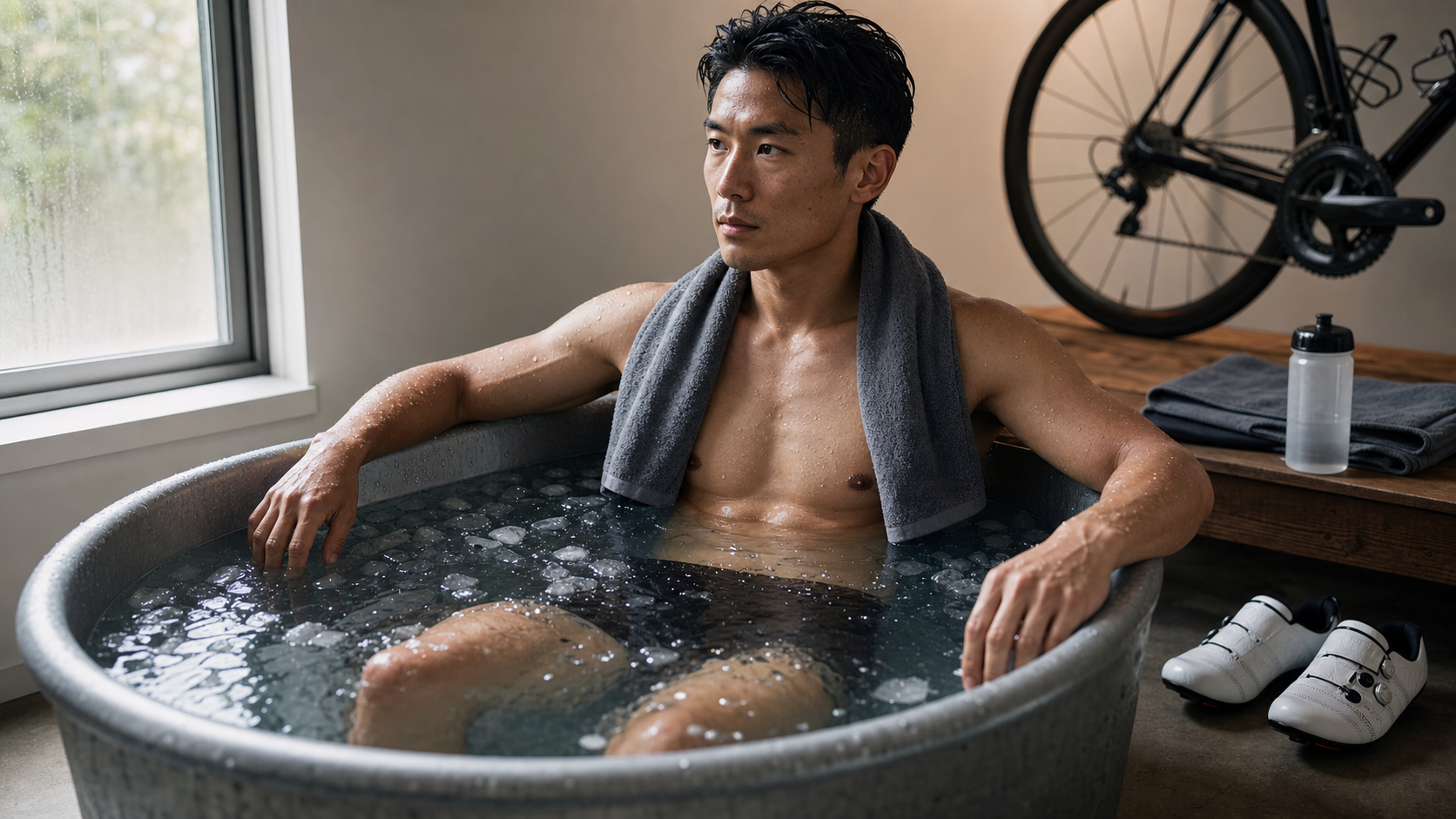
First, a Story That Changed How I Do Things
A few years ago, I coached an amateur mountain biker working in Taipei—let’s call him A-Kai. His biggest goal every year was a few classic climbing races, and he trained hard, often finishing around 7 or 8 PM on weekdays, then forcing himself onto the trainer for another hour at home. Around that time, he got hooked on ice baths—his gym had just installed a cold plunge tub set to about 10°C. He never skipped it after training, soaking for over ten minutes each time, until his lips turned pale. He’d proudly tell me, “Coach, my legs feel super light the next day, zero soreness.”
Sounds great, right? The problem was, throughout that entire winter training block, his VO₂max improvements and the weight progression on his strength program were both far slower than I’d expected. Same program, same nutrition, sleep was solid too—the numbers just stalled. Eventually, I had him drop the post-training ice baths and keep them only for race weeks. Two months later, his power curve finally started climbing again.
That experience forced me to go back to the literature and rethink one thing clearly: An ice bath is not a recovery miracle where “the more often, the better”—it’s a double-edged sword. On one hand, it helps suppress inflammation, quickly eases soreness, and gets you ready to perform again tomorrow. On the other, it can suppress the very “adaptation” you’re working so hard to earn. In this article, I want to lay out clearly—drawing on years of coaching athletes plus the evidence in the literature—when you should soak, when you absolutely shouldn’t, what water temperature and duration to use, and how different types of athletes should approach it.
Let me start with the takeaway so you can focus on what matters: If your current goal is “perform again tomorrow” (race season, dense race schedule), ice baths are your friend; if your goal is “get stronger through this training session” (muscle gain, aerobic development, base-building phase), an immediate post-training ice bath is likely working against you.
Quick note: This article will include various physiological and training numbers. I’ll give ranges rather than false precision. Body size, body fat, and cold tolerance vary enormously between individuals, so treat these numbers as “starting points,” not “iron rules.”
What Cold Therapy Actually Does in the Body
Vasoconstriction: The Core Mechanism for Pain Relief and Swelling Reduction
When you immerse your body in cold water, the most immediate response is vasoconstriction of the skin and superficial tissues. Blood flow decreases, tissue temperature drops, and this brings several immediate effects:
- Reduces the release and spread of inflammatory mediators: Exercise-induced micro-damage to muscles triggers a local inflammatory response; cold water puts the brakes on this response.
- Slows nerve conduction velocity: Pain signals travel slower and feel duller, so you perceive “less soreness.”
- Reduces swelling: Vasoconstriction plus hydrostatic pressure (the pressure of being submerged in water) pushes interstitial fluid back, providing decent swelling reduction.
This is also why delayed-onset muscle soreness (DOMS) tends to be milder after ice baths. A well-known 2012 Cochrane systematic review found that cold-water immersion significantly reduced DOMS at 24, 48, and even 96 hours post-exercise compared to passive rest alone. That’s relatively solid evidence.
Beyond subjective soreness, common immediate benefits of ice baths include: better perceived recovery, lighter legs, and a psychological sense of “resetting.” This feeling isn’t entirely illusory—cold stimulation affects the autonomic nervous system, promotes alertness, and reduces pre-sleep restlessness, indirectly helping you fall asleep. For athletes who are wound up and too stimulated to sleep after a long race, this “brake after the body’s accelerator” is genuinely valuable. So please note: I never deny that ice baths have benefits; what I’m warning about is that these benefits have their “timing,” and using them in the wrong context turns them into a cost.
But “Suppressing Inflammation” Is Exactly the Problem
Here’s a key concept many people haven’t fully grasped: Post-exercise inflammation isn’t entirely a bad thing.
After you finish a demanding set of heavy strength training or high-intensity intervals, a cascade of “repair-and-upgrade” signals kicks off in the muscle. The inflammatory response, satellite cell activation, anabolic signaling pathways (like the mTOR system) switching on, and transcription factors related to ribosome biogenesis being activated—these are the body saying: “That stimulus was too much; I need to rebuild this muscle stronger so it can handle it next time.”
This entire “inflammation → repair → get stronger” process is the essence of training adaptation. And cold-water immersion precisely suppresses the front end of this process.
A series of recent studies has made this increasingly clear: an immediate post-training ice bath blunts muscle protein synthesis signaling, suppresses satellite cell activity, and dulls the transcriptional response related to ribosome biogenesis. Over the long term, this shows up as a reduced magnitude of muscle fiber hypertrophy. One study using a 12-week full-body resistance training protocol found that the group doing regular post-training ice baths gained significantly less thigh muscle mass than the group that only did a cool-down afterward.
An Interesting Fork in the Road: Strength Isn’t Necessarily Held Back
But there’s a twist in the story that’s worth explaining clearly to athletes: Ice baths primarily suppress “muscle growth,” but their effect on “strength gains” is less consistent.
Some studies have found that even when muscle fiber hypertrophy is blunted in the ice bath group, gains in maximal strength don’t necessarily suffer to the same degree. The reason may be that a large portion of strength gains comes from neural adaptations (recruitment efficiency, neural drive), not solely from muscle cross-sectional area. So if you’re the type who wants strength without specifically chasing bigger muscles, the cost of ice baths is relatively lower—but if your goal is explicitly muscle growth, you need to be very careful.
Why “Fast Recovery” and “Getting Stronger” Conflict
I often use an analogy to help athletes understand this: Training is like cracking a wall; the body patches the crack with better materials, and once patched, the wall is thicker than before. Cold-water immersion is like, the moment the crack appears, rushing to “freeze and seal it” with ice water. It stops the pain, sure, but you’ve also chased away the repair crew.
Looking more closely, here’s roughly the sequence of events in muscle after training:
- Mechanical and metabolic stimulus: Muscle fibers experience tension, metabolic waste accumulates—this is the “signal source.”
- Acute inflammation and signal amplification: Immune cells arrive, cytokines rise, satellite cells are awakened, ready to engage in repair.
- Anabolic pathway activation: “Building” signals like mTOR switch on, and ribosomes begin preparing for large-scale protein production.
- Repair and supercompensation: Over the following hours to days, the muscle repairs and upgrades simultaneously—this is “adaptation.”
Cold-water immersion interferes mainly at steps 2 to 3. It dulls inflammation, weakens anabolic signaling, and suppresses satellite cell activity—you freeze away both the “pain” and the “repair-and-upgrade” together, because they’re products of the same assembly line. This is the root cause of why “fast recovery” and “getting stronger” conflict, and why I keep emphasizing timing.
Worth adding: most of these mechanisms come from resistance training studies, where the evidence is relatively clear. As for whether ice baths after long-duration aerobic or endurance training similarly interfere with mitochondrial and capillary adaptations, the current evidence is more mixed and lacks a consistent conclusion. So when I discuss aerobic training below, I’ll keep a more cautious tone and leave room for nuance.
The table below is a “one-page summary” I commonly use with athletes:
| Aspect | Effect of immediate post-training ice bath | Who it matters to |
|---|---|---|
| DOMS (soreness) | Significantly reduced | Dense race schedules, competing again the next day |
| Swelling | Reduced | Acute soft-tissue discomfort, post-race |
| Perceived recovery | Improved, lighter legs | Psychological state and sleep quality |
| Muscle fiber hypertrophy | May be blunted | Muscle-building phases, those seeking to add muscle |
| Maximal strength | Less consistent effect | Strength-based disciplines |
| Aerobic/mitochondrial adaptation | Mixed evidence, possible long-term interference | Base phase, those building their aerobic engine |
Cold Therapy Methodology: Getting Water Temperature, Time, and Timing Right
After covering the concepts, let’s talk about practical application. Cold therapy isn’t just “ice baths”—common forms include:
- Whole-body cold water immersion (CWI): The most common, with the most evidence, and the focus of this article.
- Cold showers / localized cold packs: Lower intensity, suitable for daily light recovery or localized soft tissue treatment.
- Whole-body cryotherapy (the kind of cryo-chamber at minus a hundred-plus degrees): Available at some sports recovery centers in Taiwan, but its mechanism isn’t identical to cold water immersion, and the evidence is more mixed. This article won’t go into depth on it.
Dosage: Temperature × Time
Based on the current body of evidence, cold water immersion for recovery generally falls within this range: water temperature around 10 to 15°C, immersion for about 10 to 15 minutes, completed within two hours after training. A network meta-analysis indicates that moderate duration (about 10 to 15 minutes) combined with moderate water temperature (about 11 to 15°C) works better for reducing DOMS and lowering markers of muscle damage; while colder water (about 5 to 10°C) may be more noticeable for recovering explosive power and jumping performance.
Here’s a dosage reference table (treat it as a starting point, not a prescription):
| Goal / Scenario | Recommended Water Temp | Recommended Duration | Timing |
|---|---|---|---|
| General recovery, reducing DOMS | 11–15°C | 10–15 min | Within 2 hours post-training |
| Racing again tomorrow, regaining leg power | 10–12°C | 10–15 min | 30 min–2 hours post-race |
| Recovering explosive power, jumping performance | 5–10°C | Shorter, 5–10 min | Post-race or between events |
| Want to preserve training adaptations | 11–15°C | Shorter, less frequent | Delay 4–6 hours post-training or do it the next day |
Timing Matters More Than Temperature
If you remember only one thing from this article, I hope it’s this: “When you soak” matters more than “how cold you soak” in determining whether you’ll regret it.
Two timing details:
-
Don’t jump in immediately while your core temperature is still very high. Going straight into ice water right after high-intensity work, while you’re still sweating and your heart rate is above 150 bpm, is a huge shock to the system, and some research suggests the benefits are actually diminished. The usual advice is to cool down, let your body settle for about 15 to 30 minutes, then soak.
-
If you want to preserve training adaptations, push the ice bath later. Since anabolic signaling is most active in the few hours after training, delaying the ice bath to 4 to 6 hours post-training—or even the next morning—lets you get some recovery benefits while stepping less on the “blunting adaptations” landmine. This is an approach many coaches have adjusted to in recent years.
A Decision-Making Table for “Should I Soak or Not?”
Many athletes ask me: “Coach, I understand the principles you explain, but should I soak today or not?” Eventually, I made a simple decision table listing the key questions so everyone can walk through it themselves:
| Your Situation | Main Consideration | Recommendation |
|---|---|---|
| Another race / key training session tomorrow | Performance first | Soak after cooling down post-race, moderate dose |
| This week is a muscle-building / base-building week | Adaptations first | Don’t soak; rely on active recovery + nutrition + sleep |
| Today is an easy day, no particular stimulus | Not necessary | Usually no need to soak |
| Multi-day event, competing every day | Recovery outweighs adaptations | Can soak after each day’s race |
| Just finished the hardest heavy lifting / intervals | This is exactly the golden adaptation window | If you want to preserve adaptations, don’t soak within 4 hours |
| Just feel like soaking for the enjoyment | Non-training reason | Soak if you want, but don’t tell yourself “this counts as extra training” |
| Feeling unwell / fever / active infection | Safety first | Don’t soak at all; rest and see a doctor |
The spirit of this table is simple: First ask, “Is my reason for soaking to recover performance, or am I stealing adaptations?” The answer usually reveals itself.
Practical Details for the Taiwan Context
There are a few local nuances to cold therapy in Taiwan:
- Summer tap water isn’t cold enough. In Taiwan’s summer, tap water is often in the twenties (Celsius). To reach 10 to 15°C, you’ll definitely need to add ice or use a chilled water tank. Buying bagged ice, or using a Styrofoam box with lots of ice, is a common DIY approach.
- In winter, be careful not to overdo it. In northern Taiwan’s damp, cold winters, it already feels cold. If you don’t dry off and warm up immediately after getting out, you can easily catch a chill. Always have a dry towel and warm clothes ready, and let your body rewarm naturally.
- Facilities: Some swimming pools, gyms, and sports recovery centers already have cold plunge tanks or ice bath tubs. The simplest home version is a bathtub with cold water and ice; if budget allows, there are also foldable ice bath tubs on the market.
- Don’t soak alone to the point of hypothermia. Especially with low temperatures and longer durations—if you experience uncontrollable shivering, confusion, or numbness in your extremities, get out immediately. People with a history of cardiovascular disease, high blood pressure, or heart conditions should be especially conservative. This point will be emphasized again later.
Safety Red Lines: Be Extra Careful in These Situations
Cold water immersion may look simple, but it’s actually a significant stimulus to the cardiovascular system. When the body contacts cold water, it triggers the so-called “cold shock response”—an immediate gasp, with heart rate and blood pressure spiking. For healthy people, it’s mostly just uncomfortable, but for certain groups, the risk is not to be underestimated. When working with athletes, I draw clear red lines for the following situations:
| Group / Condition | Why Caution Is Needed | Recommended Approach |
|---|---|---|
| High blood pressure, heart disease, arrhythmia | Cold stimulus spikes blood pressure and heart rate, increasing strain | Consult a physician first, get individualized assessment, don’t try it on your own |
| Diabetes (especially peripheral neuropathy) | Reduced sensitivity to cold and numbness, making frostbite harder to notice | Decide only after physician evaluation; be conservative with both time and temperature |
| Raynaud’s phenomenon | Excessive vasoconstriction in extremities when cold, turning white/purple | Cold therapy generally not recommended |
| Pregnancy | Altered physiological load, limited data | Ask an obstetrician first |
| Cold, fever, active infection | Body is fighting; cold stimulus adds unnecessary strain | Pause cold therapy; rest and see a doctor |
| Alone, late at night, after drinking | No one to help if something goes wrong, impaired judgment | Avoid; at minimum, have someone nearby |
The purpose of this table isn’t to scare you, but to remind you: Cold therapy benefits are “icing on the cake”—not worth risking your health for. Taiwan has convenient healthcare and accessible NHI coverage, so if you have any chronic condition or feel unwell, asking a doctor is always worth it. If you experience chest tightness, palpitations, dizziness, or shortness of breath the moment cold water hits, get out immediately and seek medical attention if needed. Don’t push through it.
The Six Most Common Mistakes I See (and How to Fix Them)
After coaching athletes for so many years, the mistakes in cold therapy almost always fall into the categories below. You can use them to check your own practices.
Mistake 1: Daily Post-Training Ice Baths During Muscle-Building Phases
This is the classic mistake—and exactly what A-Kai did that year. You work hard in the gym to stimulate your muscles, then immediately suppress the anabolic signal with ice water—it’s like stepping on the gas and the brake at the same time.
Fix: During muscle-building and strength foundation phases, don’t ice bath immediately after training. If you’re really sore, use “active recovery”—easy riding, walking, stretching, massage, eating plenty of protein and carbs, and getting good sleep. If you want an ice bath, save it for the next day or a non-key training day.
Mistake 2: Treating the Ice Bath as a “Must-Do Daily” Ritual
Many people, once they get results, turn it into a religious ritual and feel off if they skip it. But using recovery methods too aggressively leaves the body with fewer adaptation signals.
Fix: Treat the ice bath as a “tool,” not a “habit.” Ask yourself: Am I soaking today because I need to perform tomorrow, or just because it feels good? If it’s just for the feeling, skip it.
Mistake 3: Randomly Guessing Temperature and Time, Chasing Extremes
Some people think colder equals more effective and push it to nearly freezing, soaking until they’re almost hypothermic. This is both dangerous and not necessarily more beneficial.
Fix: For most recovery purposes, 11 to 15°C for 10 to 15 minutes is sufficient. Only if you’re specifically trying to regain explosive power should you consider colder temperatures with shorter durations. Don’t get injured for the sake of being “hardcore.”
Mistake 4: Chugging Ice Water and Rushing to Eat Ice Cream After Training
This isn’t an ice bath, but the logic is similar. Some people think “icing the whole body” equals recovery, so they chug ice-cold drinks and eat lots of ice after training. This is very common in Taiwan’s summer.
Fix: The priority after training is replenishing fluids, carbs, and protein. The temperature of the drink isn’t the key variable—don’t get the priorities backwards. The focus should always be on “eating back” and “sleeping it off.”
Mistake 5: Forcing Ice Baths While Ignoring Personal Health Conditions
People with cardiovascular disease, Raynaud’s phenomenon (fingers and toes turning white or purple when exposed to cold), or those currently sick with a cold or fever face considerable risk from forcing ice baths.
Fix: If you have a chronic condition, consult a physician first. If you’re feeling unwell, have a fever, or are fighting an infection, pause cold therapy.
Mistake 6: Using Ice Baths to Mask Underlying Problems
If you’re so sore every day that you need an ice bath just to get through it, the real problem is often training volume too aggressive, insufficient sleep, or nutrition not keeping up. The ice bath becomes a painkiller, masking the warning signs of overtraining.
Fix: First, check whether your training plan is reasonable, whether you’re sleeping enough, and whether you’re eating right. The foundation of recovery is sleep and nutrition; cold therapy is just the finishing touch.
What to Do Based on Your Level and Goals
Below, I’ve split the recommendations into three types of readers so you can easily find where you fit.
For Beginners and Recreational Athletes
If you’ve just started exercising regularly and your focus is health and enjoyment:
- You most likely don’t need ice baths at all. In the beginner phase, your body’s adaptation needs are straightforward. Sleeping well, eating well, and progressing gradually are the best recovery.
- Only if you’re truly sore, uncomfortable, and it’s affecting your next day’s life, use a mild version occasionally (12 to 15°C, around 10 minutes).
- Don’t treat ice baths as a license to “train more.” It won’t make an excessive training plan safe.
For Serious Advanced Athletes / Amateur Racers
This is the group that most needs “periodization thinking”—and it’s also A-Kai’s demographic:
- Base phase / muscle-building phase / aerobic foundation phase: Avoid ice baths after training as much as possible, letting adaptation happen properly. For recovery, rely on active recovery + nutrition + sleep.
- Race season peak / back-to-back races: This is when “performing again tomorrow” outweighs “getting stronger this time,” so ice baths earn their keep. Wait a bit after racing, then soak to bring back leg power.
- Want both: Delay the ice bath to 4 to 6 hours after training or the next day, using a moderate dose.
A periodization usage reference table:
| Training Phase | Primary Goal | Ice Bath Recommendation |
|---|---|---|
| Base / Muscle-building Phase | Pursuing adaptation, getting stronger | Avoid soaking right after training; delay or skip |
| Intensity Accumulation Phase | Adaptation first, some recovery support | Use sparingly; skip on key days |
| Pre-race Taper Phase | Staying fresh, maintaining form | Use moderately as needed |
| Race Season Peak | Performing again the next day | Use actively, right after racing |
| Post-season Transition | Repair, relaxation | Based on subjective need, not mandatory |
For Competitive Athletes Preparing for Races
- You most likely already have a coach or sports science team. Cold therapy should be integrated into the overall periodization plan, not done on a whim by the athlete.
- The principle remains the same: in training blocks focused on adaptation, cold therapy takes a back seat; in race blocks focused on performance, cold therapy steps up.
- If you plan to use ice baths as a recovery method before a major race, make sure you’ve practiced it in training first. Don’t try it for the first time on race day, in case the sensation or reaction is unexpected.
Second Case Study: Xiao-Ru, an Office Worker Wanting to Build Muscle in Summer
After covering A-Kai’s “endurance-type” case, let me share a very different scenario, because it’s actually more common in Taiwan. Xiao-Ru is an office worker in her early thirties with a clear goal—she wants to build muscle definition and a tighter physique before summer, lifting weights three to four times a week. Taipei’s summers are humid and hot, so after training she’s drenched in sweat. The first thing she does when she gets home is take a long cold shower, and she even bought ice cubes to toss into her bathtub, thinking “cooling off and recovery, two birds with one stone.”
Her confusion when she came to see me was: “I’m training seriously and eating enough protein (in the range of about 1.6 to 2.0 grams per kilogram of body weight), so why is my muscle gain so slow?”
As soon as I asked about her routine, I found the problem. She was conflating “cooling off” with “recovery,” and the timing was the most damaging—soaking herself in ice water within half an hour after lifting weights was essentially suppressing the muscle-building signal at its most active window. Her goal was hypertrophy, which makes her exactly the group that pays the highest price for cold-water immersion.
The adjustments I gave her were simple and very practical for Taiwan’s summer reality:
- If you want to cool off after training, use “cool” not “ice”: Just shower with room-temperature or slightly cool water. Avoid prolonged, low-temperature full-body ice baths. You can achieve the cooling-off goal with gentler methods just as well.
- If you really want an ice bath, move it to non-lifting days or a time slot far from training, like before bed—don’t place it in the golden post-training window.
- Put your recovery effort back into the fundamentals: sleep, distributing protein across every meal, and taking in carbs after training. These contribute far more to muscle gain than ice baths.
Two or three months later, her physique progress was clearly back on track. She told me something I really liked: “So I’ve been using a cooling-off method to quietly cancel out my own training.”—I’d like to dedicate that line to everyone in Taiwan who loves ice-cold showers in summer while trying to build muscle.
Putting the two cases side by side is essentially the summary of this article:
| Case | Goal | Original Approach | Problem | Adjustment |
|---|---|---|---|---|
| A-Kai (Endurance type) | Get stronger in winter training | Ice bath after every session | Suppressed aerobic and strength adaptation | No soaking in winter; soak during race season |
| Xiao-Ru (Muscle-building type) | Build muscle in summer | Ice water to cool off after training | Suppressed the golden muscle-building window | Switch to cool water for cooling off; keep ice baths away from post-training time |
Frequently Asked Questions (FAQ)
Q: Which is better: ice baths, heat packs, or contrast water therapy (hot/cold alternation)?
A: They serve different purposes. Ice baths lean toward “suppressing inflammation, relieving soreness, and reducing swelling”; heat and contrast therapy lean toward “promoting circulation and relaxation.” If you’re chasing next-day performance, ice baths are more targeted; if you simply want to relax and boost blood flow, contrast therapy or heat packs are also options. Neither is absolutely better—it depends on what you want.
Q: Can I take an ice bath after aerobic training (like long-distance cycling or running)?
A: The logic is the same as for strength training. If that long ride is meant to build your aerobic engine and stimulate mitochondrial and capillary adaptations, the evidence for post-ride ice bath interference is more mixed than in the strength domain, but to be conservative, don’t rush into ice baths during the base phase. If it’s a stage race where you ride every day, recovery takes priority, and ice baths are justified.
Q: Will an ice bath make a cold better or worse?
A: Do not use cold therapy when you’re sick, feverish, or infected—let your body focus on fighting the infection. Ice baths are not a means of boosting immunity; don’t misuse them.
Q: I feel great and energized after soaking—is that just psychological?
A: Part of it is a genuine physiological response (cold stimulation affects the sympathetic nervous system and makes you feel alert), and part of it is psychological and ritualistic. This “feeling good” is valuable, but don’t equate “feeling good” directly with “good for long-term progress”—that’s exactly the double-edged sword this article keeps emphasizing.
Q: How many times a week is a reasonable amount to soak?
A: There’s no standard answer; it depends on your training phase and goals. The principle is “only soak when you have a clear reason.” During adaptation-focused periods, you might not soak at all for a whole week; during a dense race schedule, you might soak daily. Rather than asking about frequency, ask about timing.
Q: I’m injured and my ankle is swollen—can I ice it? Is that the same as an ice bath?
A: These are two different things. Local icing for acute soft-tissue injuries aims to control swelling and relieve pain; it falls under injury management, which differs from the purpose of “whole-body ice baths for post-training recovery.” The approach to acute sprains and strains has also evolved in recent years (shifting from the old “ice and immobilize everything” toward moderate movement and progressive loading). If the injury is significant, swelling and pain persist, or you can’t move normally, see a doctor or physical therapist for evaluation—don’t play doctor yourself. In Taiwan, medical access is convenient and National Health Insurance coverage is readily available; get it checked when needed.
Q: I don’t have a cold water tub—can I substitute with a cold shower?
A: A cold shower is much weaker than full-body immersion (no hydrostatic pressure, and contact is incomplete), so recovery benefits are diminished, but it’s fine as a daily light relaxation. If your goal is serious post-race recovery, full-body immersion is more effective; if you just want to cool down and relax, a cold shower is enough.
Q: Can ice baths help with fat loss or boosting metabolism?
A: The claim that “cold stimulation activates brown fat and boosts metabolism” is often exaggerated in popular discourse. Even if such effects exist, their contribution to fat loss for the average person is very limited—far outweighed by diet control and regular exercise. Don’t treat ice baths as a fat-loss shortcut; that’s not their strength.
Q: Can I scroll on my phone or take calls while soaking in an ice bath?
A: Please don’t. Low temperature plus wet hands plus electronic devices—safety risks aside, the key point is that you need to focus on sensing your body’s signals: whether you’re shivering uncontrollably, or your hands and feet are going numb. Staying alert and aware during cold therapy matters more than binge-watching a show.
Distilling the Whole Article into One Decision-Making Principle
If I had to give my athletes one sentence from this article, it would be this:
Ask yourself: in this session, do I want to “perform again tomorrow,” or do I want to “get stronger through it”? In the former case, the ice bath is a teammate; in the latter, the ice bath may be a pickpocket.
Cold therapy has no absolute right or wrong—only “right timing” and “wrong timing.” It can indeed suppress inflammation, quickly relieve soreness, reduce swelling, and get you back on the field the next day—these are invaluable during dense race schedules. But the very same “inflammation-suppressing” ability becomes a double-edged sword that steals your gains when you’re relying on training to drive adaptation.
A-Kai eventually learned this lesson. During winter base training, he put the ice bath away and let his body adapt; when the race season brought back-to-back weekends, he brought the ice bath back to help his legs recover after racing. That year, he rode to his personal best. The tool was still the same tool—the only difference was that he finally knew when to use it.
I hope this article helps you too—holding this double-edged sword in the right hand, and striking in the right place.
This article is educational content and does not replace individual diagnosis and treatment advice from a physician, physical therapist, or nutritionist. If you have cardiovascular disease, hypertension, heart disease, Raynaud’s phenomenon, or other chronic conditions, please consult a doctor and undergo individualized assessment before cold therapy; seek immediate medical attention if severe discomfort occurs.
References
- Cold water immersion attenuates anabolic signaling and skeletal muscle fiber hypertrophy, but not strength gain, following whole-body resistance training (Journal of Applied Physiology): https://journals.physiology.org/doi/full/10.1152/japplphysiol.00127.2019
- Post-exercise cold water immersion attenuates acute anabolic signalling and long-term adaptations in muscle to strength training (PMC): https://pmc.ncbi.nlm.nih.gov/articles/PMC4594298/
- Post-exercise Cold Water Immersion Effects on Physiological Adaptations to Resistance Training: A Narrative Review (Frontiers in Sports and Active Living): https://www.frontiersin.org/journals/sports-and-active-living/articles/10.3389/fspor.2021.660291/full
- Throwing cold water on muscle growth: A systematic review with meta-analysis of post-exercise CWI on resistance training-induced hypertrophy (PMC): https://pmc.ncbi.nlm.nih.gov/articles/PMC11235606/
- Impact of different doses of cold water immersion on recovery from acute exercise-induced muscle damage: a network meta-analysis (Frontiers in Physiology): https://www.frontiersin.org/journals/physiology/articles/10.3389/fphys.2025.1525726/full
- Cold Water Immersion: Friend or Froze? (American College of Sports Medicine): https://acsm.org/cold-water-immersion-friend-froze/
Related Reading
- The Double-Edged Sword of Cold Water Immersion: Faster Recovery but Potentially Suppressed Training Adaptations
- Cold Baths and Recovery: When Post-Race Ice Baths Are Appropriate and the Risks of Overuse
- Latest Research on Cold Water Immersion (Ice Baths): When It Works and When It Can Be Harmful
- [Nutrition & Recovery] A Guide to Post-Exercise Cold Therapy (Ice Baths) for Endurance Athletes: The Dual Effects of Cold Water Immersion on Acute Inflammation and Long-Term Hypertrophic Adaptations, and Recovery Scheduling: The Key to Breaking Three Hours and Pushing Beyond Limits](/articles/11396)
碟煞公路車 銑面器 !? 原來銑完差這麼多! 降低蹭碟機率! | TIME 公路車 保養小記錄 | CT Yeh
3 年前
滑雪新手們慘摔學習全紀錄(請開字幕),滑雪好好玩 | Snowboard + Ski | 岩原 スキー場 | 滑雪APP使用 | GoPro Max
6 年前
CT暗黑廚房) 車友必備 宇宙無敵鮮蚵湯 幫助訓練恢復 天然食補 好市多 超肥鮮蚵 破PR
7 年前
4K 東眼山 x 水蜜桃冰沙 百人單車約騎! 操完再吃冰 多爽快
7 年前
西進武嶺 免費訓練分析服務 Intervals | 練不夠還是練過頭?你哪一種類型選手?AI模型告訴你! | 備戰神器 | 公路車 訓練 | CT Yeh
4 年前
水金九不厭五分 10度寒流冷到不願停!feat. 卡卡 / 公路車 / CT Yeh
6 個月前
單車 一日北高 ( 雙城 ) 肥宅雙人瘋狂行 紀錄片 REACTO
10 年前
騎單車去大屯山賞雪! 助航台滑冰 全記錄 | 台北R友大集合 | 下雪打雪仗囉 | 4K超高畫質
5 年前