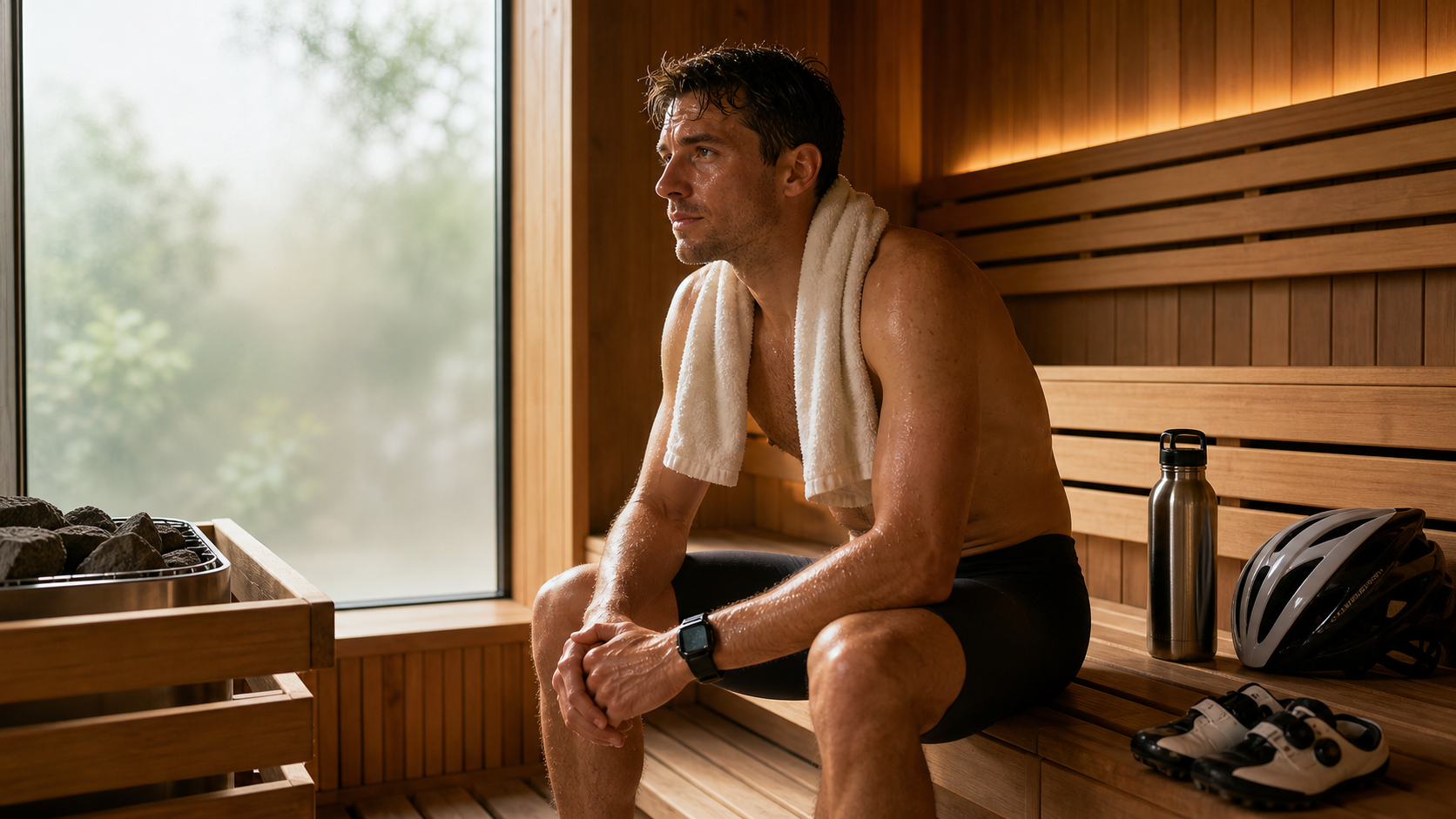
Starting from a Sauna Session That Made My Heart Rate “Feel It”
A few years ago, one of my athletes—let’s call him A-Kai—came to me before the race season with a puzzled look and asked: “Coach, my training plan hasn’t changed, but last week I hit the gym sauna twice, and the next day my heart rate on the bike seemed steadier, and I wasn’t as breathless at the same power.” He wasn’t the only athlete who asked me this. In Taiwan’s humid summer, many people instinctively avoid the sauna like it’s “a hotter form of torture,” but in the world of exercise science, passive heat exposure has in recent years been repositioned from “just feels good after a wash” to a training stimulus capable of inducing real physiological adaptations.
In my 15th year of coaching athletes, I’ve seen too many people narrow “training” down to “ride longer, train harder.” But the ceiling of endurance performance is largely constrained by the cardiovascular and thermoregulatory systems—how much oxygen your blood can deliver, how efficient your body is at dissipating heat, and how much power you lose in high temperatures. Sauna and heat therapy happen to be tools that directly stress exactly these axes. In this article, I want to explain “heat adaptation” in the tone of a coach working with athletes: its scientific basis, how to actually do it, the common pitfalls Taiwanese people tend to fall into, and how you can start today depending on your level.
Let me give you the takeaway first, so you know what to expect: The sauna is not magic, and it won’t replace the specific training of cycling or running; but it’s a “supporting tool” with surprisingly high cost-effectiveness, especially useful for certain groups. And its benefits aren’t limited to summer races—even winter and flat-course races can benefit.
Why does it work in winter too? This is a key point many overlook. Although Taiwan’s winter isn’t as muggy as summer, it’s actually the perfect time to build and maintain a foundation of heat adaptation—you don’t have to cram right before the summer race season. And the cardiovascular efficiency that comes from plasma volume expansion is inherently unrelated to ambient temperature—you’ll benefit from it just as much in a cool flat race. So please don’t use “it’s not hot right now” as an excuse to skip this. I often tell my athletes: heat adaptation is an asset you can partially “bank,” not a seasonal product that’s only valuable in summer.
Conceptual Foundation: Why Heat Can “Train” the Endurance System
What Heat Exposure Does to the Body
When you sit in a sauna at 70 to 90 degrees, or soak in hot water, your core temperature gradually rises. To dissipate heat, your body kicks off a cascade of responses:
- Skin vasodilation: Heat is shuttled from the core to the skin surface, so the heart has to pump more blood, and heart rate rises.
- Profuse sweating: Carries heat away, but simultaneously loses water and electrolytes.
- Increased cardiovascular load: Without moving at all, heart rate can climb to 100 to 130 bpm, essentially a low-intensity “cardiovascular workout.”
The key insight here is: your body can’t really tell whether the heat is “produced by exercise” or “imposed from the outside.” Rising core temperature, the cardiovascular system being forced to work overtime, heavy sweating—these signals heavily overlap with what happens when you ride for an hour under the blazing sun. So the body activates similar adaptation mechanisms. That’s the fundamental reason passive heat exposure is “unexpectedly useful.”
Two Main Adaptation Pathways
I usually break this down into two parts for athletes, because it’s easier to understand.
Pathway one: heat acclimation itself.
Regular heat exposure makes your body better at dissipating heat and more heat-tolerant. Specific manifestations include: core temperature rises more slowly at the same intensity, sweating starts earlier, sweat becomes “thinner” (less electrolyte loss), and heart rate is lower at the same load. For people racing in Taiwan’s summer—whether it’s the June Westbound Wuling climb, a summer triathlon, or a long ride on a muggy afternoon—this pathway directly determines whether you’ll “blow up from the heat.”
Pathway two: plasma volume expansion.
This is the key I believe also helps in “flat, cool environments.” Regular heat exposure stimulates the body to retain more water and plasma proteins, increasing total blood volume (especially the plasma fraction). According to research on endurance athletes and heat adaptation, heat acclimation can cause plasma volume expansion of roughly 10% to 25% (Frontiers in Physiology, 2019; ScienceDirect Heat Acclimatization Overview).
What’s the benefit of more plasma? Imagine your circulatory system as a set of pipes: with more water, the volume of blood pushed out per heartbeat (stroke volume) increases, so at the same cardiac output, heart rate can be lower and the heart works more efficiently. That’s also why A-Kai felt “less breathless at the same power”—he was most likely experiencing the early effects of plasma volume expansion.
I have to be honest here: plasma volume expansion appears within the first 3 to 5 days of heat exposure—it comes quickly; but it also goes quickly, gradually declining within days to a couple of weeks after the stimulus stops. The more durable and more valuable increases in red blood cell volume and hemoglobin mass require weeks or more of sustained stimulation. This determines how you should schedule your “dose” and “timing,” which the table below will detail.
Long-Term Evidence for Cardiovascular Health
Beyond athletic performance, there’s also observational evidence for sauna use and cardiovascular health. A long-term cohort study in Finland of middle-aged men (the Kuopio Ischemic Heart Disease study, with a median follow-up of about 20 years) found that: those who used the sauna 2 to 3 times per week had about a 22% lower risk of fatal cardiovascular disease compared to those who used it once per week; and the group using it 4 to 7 times per week showed a markedly greater risk reduction than the 2 to 3 times group. Regarding session duration, longer sessions of 15 to 20 minutes at around 79 degrees showed the strongest association (PubMed, 2015 cohort;BMC Medicine, 2018).
I must add a professional caveat: these are observational studies—they can only show “an association,” not prove that “the sauna directly causes” better cardiovascular health. People who regularly use saunas may already have different lifestyles, socioeconomic status, or exercise habits. But when you put this together with the mechanistic evidence from exercise physiology, the direction is consistent and plausible: regular, moderate heat exposure is a beneficial stimulus for the cardiovascular system.
Going Deeper: What “Parts” Does Heat Adaptation Actually Change
If you like to think of your body as a tunable machine, let me list the key “parts” that heat adaptation modifies. This isn’t for memorization, but so you know what your body is actually upgrading when you spend time in the sauna:
- Increased stroke volume: Plasma volume expands, cardiac preload increases, and more blood is pumped per beat. This is the direct source of “doing more work at the same heart rate.”
- Lower resting and exercise heart rate: Because stroke volume has increased, fewer heartbeats are needed to achieve the same cardiac output, making the heart work more efficiently.
- Earlier and smarter sweating response: After heat adaptation, you start sweating sooner, sweat distribution becomes more even, and sodium is reabsorbed more effectively—your body learns to dissipate heat while losing fewer electrolytes.
- More efficient skin blood flow regulation: The mechanism for delivering heat to the skin surface for dissipation becomes smoother, slowing the rise in core temperature.
- Reduced subjective heat perception and perceived fatigue: This is hard to quantify, but athletes commonly report “the same muggy day feels less miserable,” which is crucial for psychological endurance in long events.
I often tell my athletes this analogy: specific training is about “increasing engine displacement,” while heat adaptation is more like “upgrading the radiator and cooling system.” No matter how big the engine is, if the cooling can’t keep up, you’ll still overheat and slow down in the second half of a summer race in Taiwan. The two are complementary, not either/or.
Two Highly Relatable Case Scenarios
To make this concrete, let me share two common athlete profiles (scenarios adapted for teaching purposes; data are illustrative ranges, not precise measurements).
Case A: A flat-road TT enthusiast who hates the heat.
Xiao Lin focuses on flat time trials, trains in cool conditions, and initially didn’t believe heat training had anything to do with him. What I asked him to do wasn’t “for heat tolerance,” but “for plasma volume”: one week straight, 20 minutes of sauna after training. On days five and six, he reported that at the same target power, his heart rate was a few bpm lower and his perceived exertion dropped. This is the classic early response to plasma volume expansion—it can even benefit performance in cool conditions, because cardiovascular efficiency is universal.
Case B: An endurance athlete who “cooks” in summer triathlons.
A-Kai (the one from the intro) didn’t have an engine problem; his issue was that every race, he’d blow up on the muggy sections in the second half—pace collapsing, heart rate spiking, and stomach issues flaring up. His prescription focused on “heat tolerance”: regular, progressive heat exposure in the two weeks before the race, letting his sweating and cooling systems finish their upgrade before race day. That year, he held his pace on the hottest sections instead of being sunk by the heat like before.
These two cases map neatly onto the two pathways discussed earlier: Xiao Lin benefited from the cardiovascular efficiency of plasma volume; A-Kai benefited from the heat tolerance of heat adaptation. Which category you fall into determines how you should schedule your dose and timing.
Practical Methods: Dose, Protocol, and Schedule
Now that the concepts are covered, let’s address the most common question: “So how exactly should I sauna, for how long, and how often?” I’ve organized this into several tables you can follow and adjust directly.
Basic Heat Exposure Dose Reference
The following are my starting reference ranges when working with athletes—these are ranges, adjust based on individual tolerance and health status, not precise prescriptions:
| Goal | Duration per Session | Temperature Range | Frequency per Week | Recommended Timing |
|---|---|---|---|---|
| General cardiovascular maintenance | 10–20 min | 70–85°C | 2–4 times | Any time, avoid fasting or after alcohol |
| Pre-race heat adaptation (summer races) | 20–30 min | 75–90°C | 4–6 times | Intense block 10–14 days before race |
| Plasma volume expansion (flat-race support) | 15–25 min | 70–85°C | 4–5 times | Best within 30 minutes after training |
| Recovery and relaxation | 8–15 min | 60–75°C | As needed | After high-intensity sessions |
“Post-Exercise Heat Exposure” Is More Effective Than “Standalone Heat Exposure”
This is the practical tip I want to emphasize most: scheduling the sauna right after your training session generally works better than randomly going on your own time. The reason is that training has already elevated your core temperature and cardiovascular system, so the subsequent heat exposure effectively “extends and amplifies” the heat stimulus, concentrating the signal for heat adaptation and plasma volume expansion. In practice, a moderate-to-low intensity ride or run, followed by rest, some fluid intake, and then 15–25 minutes in the sauna within 30 minutes, is a combination I frequently prescribe for athletes with clear summer race goals.
A Sample “Two-Week Pre-Race Heat Adaptation” Plan
Assuming the goal is a summer endurance race in Taiwan with expected high heat and humidity, here’s a sample framework I’d give athletes with “a consistent training base and no cardiovascular disease” (individualization is critical; this is just a skeleton):
| Day | Training Content | Heat Exposure Plan | Notes |
|---|---|---|---|
| Days 1–3 | Normal schedule | 15 min sauna after training | Let the body adapt first; keep duration conservative |
| Days 4–7 | Normal schedule | 20–25 min after training | Plasma volume expansion is usually already underway |
| Days 8–11 | Slightly reduced training load | 5 times/week, 25 min each | Enter the intensive heat adaptation phase |
| Days 12–13 | Taper | Shorten to 15 min, reduce frequency | Avoid accumulating excessive fatigue |
| 1 day before race | Complete rest | Skip or very short 5–8 min | Preserve hydration and electrolyte status |
Note the “wrap-up” in the final two days: the benefits of heat adaptation don’t require a hard session the day before the race to be maintained. In fact, excessive heat exposure will leave you starting the race dehydrated and fatigued—not worth it.
Hydration and Electrolyte Strategy
Heat exposure always causes sweating, and while Taiwanese people often eat out and typically have a fairly high sodium intake, the dehydration risk from post-exercise heat exposure should still not be underestimated. My practical principles:
- Before the session: Confirm you’re not significantly dehydrated (light yellow urine is a good sign), and consider drinking 200–300 mL of water beforehand.
- During the session: Bring a water bottle in and drink when thirsty; don’t tough it out.
- After the session: Rehydrate based on sweat loss. If you sweated heavily, pair it with a sodium-containing sports drink or supplement electrolytes moderately with a meal. In Taiwan, noodle soups and miso soup from restaurants already contain a fair amount of sodium, so normal eating usually replenishes most electrolytes—no need to overdo salt tablets.
- Use body weight as a guide: Advanced users can weigh themselves before and after. Each kilogram lost roughly represents about 1 liter of fluid loss, serving as a rough reference for rehydration.
Comparing Heat Exposure Methods: Sauna, Steam Room, Hot Water Immersion
Common passive heat exposure options in Taiwan aren’t limited to dry saunas; there are also steam rooms and hot water baths. Their sensations and operational priorities differ, so I’ve put together a table for easy comparison:
| Method | Environmental Characteristics | Ease of Heat Dissipation | Subjective Sensation | Practical Notes |
|---|---|---|---|---|
| Dry sauna | High temp, low humidity (70–90°C) | Sweat evaporates; dissipation relatively smooth | Dry heat; can sit longer | Most commonly studied; highly flexible duration |
| Wet steam room | Moderate-high temp, high humidity | Sweat evaporates poorly; more muggy | Oppressive; feels heavier | Shorten duration; watch for dizziness and hydration |
| Hot water immersion | Full-body soak (approx. 39–41°C) | Almost no evaporative cooling | Core temperature rises quickly | High heating efficiency but requires more caution to avoid overheating |
None is “best”—the key is whether you can execute it consistently without overdoing it. Taiwan’s high humidity makes steam rooms feel especially heavy. For beginners, I usually recommend starting with a dry sauna at shorter durations to learn your body’s responses before considering other methods.
Fitting Heat Exposure into an Amateur Weekly Training Plan
A common pain point for many athletes is: “I only train a few days a week, where am I supposed to fit in heat exposure?” Here’s a common framework for an amateur’s weekly schedule (assuming a clear summer race goal and no chronic health conditions):
| Day | Main Training | Heat Exposure | Focus |
|---|---|---|---|
| Monday | Rest | Not scheduled | Complete recovery |
| Tuesday | Moderate-low intensity aerobic | 20 minutes post-training | Ideal for stacking heat stimulus |
| Wednesday | High-intensity intervals | Not scheduled or very short | Avoid conflicting with high intensity |
| Thursday | Easy recovery ride/run | 15–20 minutes post-training | Recovery plus heat stimulus |
| Friday | Rest | Optional 15 minutes standalone | To make up frequency |
| Saturday | Long endurance | 20–25 minutes post-training | Most effective after the weekend long session |
| Sunday | Rest or easy activity | Not scheduled | Preserve recovery |
You’ll notice I deliberately avoid scheduling heat exposure on high-intensity interval days and concentrate it after aerobic sessions and long rides. This is the operational principle of “stacking without overloading.”
Common Mistakes and Corrections
Having coached athletes for years, the mistakes I see in heat therapy are actually quite concentrated. Let me lay them all out clearly here.
Mistake 1: Treating “Hotter and Longer” as More Effective
Many people hear it works and immediately want to sit at 100 degrees for 40 minutes. Wrong. The dose-response of heat exposure isn’t linear upward; excessive core temperature rise and dehydration can override the adaptation benefits and disrupt the quality of that day’s and the next day’s training. My principle is: Better to be consistent in frequency and moderate in each session than to occasionally go all-out. Start with 10 to 15 minutes at 70 to 80 degrees, and gradually increase once your body adapts.
Mistake 2: Ignoring the Knock-On Effect of Dehydration on Next-Day Training
Heat exposure feels great in the moment, but if you don’t keep up with hydration, you’ll show up the next day with low blood volume and an elevated heart rate, then mistakenly think it’s “overtraining.” The fix is simple: treat heat exposure as a session with physiological load—log it and hydrate accordingly—not as a free relaxation activity.
Mistake 3: Doing It on an Empty Stomach, After Drinking, or with Severe Sleep Deprivation
This is a safety issue, not an efficiency one. Heat exposure on an empty stomach easily causes dizziness and low blood sugar; after alcohol, blood vessels are already dilated, and adding heat exposure makes hypotension and fainting more likely; with severe sleep deprivation, cardiovascular regulation is impaired. In Taiwan, many people habitually hit the sauna after drinking at social gatherings to “sober up,” but this is actually a high-risk combination and should be strictly avoided.
Mistake 4: Self-Administering Extra Heat Exposure with Cardiovascular Disease
I’ll state this in the most conservative terms possible. Anyone with hypertension, heart disease, diabetes, pregnancy, or any history of cardiovascular disease must discuss this with their physician before using the sauna as a regular training tool. Heat exposure significantly alters heart rate and blood pressure, and for certain conditions, it may pose a risk rather than a benefit. Taiwan’s National Health Insurance makes seeing a doctor convenient, so the barrier to doing this is very low—don’t skip this step.
Common Mistakes and Corrections Reference Table
| Common Mistake | Why It’s a Problem | Corrective Action |
|---|---|---|
| A single session exceeding 30–40 minutes | Excessive core temperature rise and dehydration, diminishing returns | Keep each session to 15–25 minutes |
| Only doing intense sessions 1–2 days before a race | Heat adaptation requires 10–14 days of accumulation | Schedule consistently starting 2 weeks prior |
| Not replenishing fluids and electrolytes afterward | Carrying dehydration into next-day training | Hydrate based on sweat loss, replenish sodium with meals |
| Entering on an empty stomach or after drinking | Risk of fainting, hypoglycemia, hypotension | Go 1–2 hours after a meal, in a sober state |
| Self-managing with chronic conditions | Cardiovascular load may exceed safe limits | Get a medical evaluation first, individualize the plan |
Actionable Advice for Readers at Different Levels
There’s no one-size-fits-all protocol. I’ll give recommendations based on three categories of where you currently stand.
If You’re a “Sedentary Person Just Starting to Exercise”
Your focus isn’t on squeezing out performance, but on safely enjoying the cardiovascular maintenance and relaxation benefits.
- Start with 2 sessions per week, 10 minutes each, at 60 to 75 degrees, and gauge your body’s response.
- Before entering, confirm you haven’t been drinking or fasting, and bring water in with you.
- If you feel dizzy standing up after your session, sit down for a bit before leaving—don’t rush.
- If you have any chronic conditions or are on medication, ask your doctor before starting.
- Don’t compare how long you can sit with the seasoned regulars next to you; it’s meaningless.
If You’re a “Regularly Training Amateur Athlete”
You’re the one who can reap the most benefit from the “training aid” bonus.
- Attach the sauna right after moderate-low intensity sessions, 3 to 4 times per week, 15 to 25 minutes each.
- When you have a clear summer race goal, enter an intensive heat adaptation phase 10 to 14 days before the event.
- Track your morning heart rate and training heart rate changes to observe whether heat adaptation lowers your heart rate at the same power output.
- On high-intensity interval or heavy training days, keep heat exposure duration conservative—don’t stack too much.
- During taper weeks, shorten heat exposure accordingly to let your body enter the race clean.
If You’re an “Advanced Competitor Chasing Marginal Gains”
You should treat heat exposure as a quantifiable, periodizable variable.
- Use pre- and post-session body weight to estimate sweat loss and precisely calculate your hydration and sodium replenishment strategy.
- Distinguish your goals: Summer races prioritize “heat adaptation,” while cool flat races prioritize “plasma volume expansion”—the doses and timing differ between the two.
- Plasma volume benefits fade quickly; if your target is a flat race, schedule intensive heat exposure around one week before the event—don’t stop too early.
- Work with your coach or sports science support team to incorporate heat exposure into overall training load monitoring, avoiding conflicts with high-intensity sessions.
- If considering more advanced practices like hot water immersion or combining sauna with hypoxia, make sure it’s done under professional supervision.
How to Know If Heat Adaptation Is “Working”: Tracking and Monitoring
The worst thing in training is “doing something without knowing if it’s effective.” Heat adaptation actually has several simple, cost-free observational indicators I frequently use with my athletes:
- Heart rate at the same power/pace: This is the most direct one. If your heart rate at the same cycling power or running pace is a few bpm lower than before heat adaptation, it typically indicates improved cardiovascular efficiency (plasma volume expansion is often a major contributor).
- Rating of Perceived Exertion (RPE): Feeling easier at the same intensity is a highly valuable signal—don’t underestimate subjective perception.
- Sweating response: After heat adaptation, you’ll start sweating earlier and sweat more profusely. That sounds like a downside, but it actually means your cooling system responds faster.
- Endurance in hot, humid conditions: The real test comes at the race or during a long, muggy session. Holding on through sections where you’d previously blow up is a hard metric.
- Morning resting heart rate and sleep quality: If heat exposure is overdone, your morning heart rate may rise and sleep quality may drop—these are warning signs of “exceeding the dose” and you should pull back.
I recommend at least logging your same-intensity heart rate for “the week before heat adaptation” and “after implementation” as a comparison. You don’t need expensive equipment—a watch with heart rate function or a chest strap is sufficient. Only when you can quantify it can you decide whether to push harder or back off.
Safety Red Lines: Which Signals Mean You Should Stop Immediately
Heat exposure is generally safe, but there are clear red lines. If any of the following occur in the sauna, leave immediately, cool down, hydrate, and seek medical attention if necessary:
- Significant dizziness, blacking out, or feeling like you’re about to faint
- Nausea, vomiting, or severe headache
- Heart palpitations, chest tightness, chest pain, or irregular heartbeat
- Skin stops sweating yet feels abnormally hot (a potentially dangerous sign of heat illness)
- Confusion or slurred speech
Medical care is easily accessible in Taiwan. If you repeatedly experience the above symptoms after heat exposure, don’t tough it out or guess—make an appointment and let a physician evaluate you. Safety always takes priority over any training benefit.
Practical reminders for the Taiwanese context
Finally, a few local points to make this truly actionable.
- Facility access: Many chain gyms, sports centers, and hot spring clubs in Taiwan offer dry or wet saunas, and the barrier to entry is low. Finding a place you’ll visit regularly matters more than chasing “top-tier equipment.”
- Summer itself is natural heat adaptation: Outdoor cycling and running in Taiwan’s summer are already intense heat stimuli. If you’re already training under the sun every day, keep the additional sauna dose more conservative to avoid excessive heat load.
- Humid heat vs. dry heat: Taiwan has high humidity, so the sensation and heat-dissipation efficiency of a wet steam room differ from a dry sauna. In a humid environment, your body struggles more to cool down through evaporation—it feels stuffier, so you need shorter sessions and more attention to hydration.
- Easy healthcare access is an advantage: Taiwan’s National Health Insurance makes it very easy to “get a basic cardiovascular assessment before starting.” Especially if you’re older or have a family history of cardiovascular disease, take advantage of this.
- Don’t treat the sauna as a weight-loss tool: The weight you lose right after a session is almost all water, not fat—it comes back once you rehydrate. Its value lies in cardiovascular and heat adaptation, not in the number on the scale.
- Communicating with older relatives who have metabolic conditions: Many Taiwanese elders love hot springs and saunas. If an older family member has hypertension, diabetes, or a heart condition, kindly remind them not to stay too long, not to go in after drinking alcohol, and encourage them to first talk with their regular doctor. This is more practical than outright prohibition.
Quick FAQ
Q: Can the sauna replace aerobic training?
A: No. It’s a supplementary tool that can impose similar cardiovascular and core-temperature stimuli, but it cannot replace the muscular and metabolic adaptations from dedicated cycling, running, or swimming training.
Q: Is a hot bath as effective as a sauna?
A: The mechanism is similar (both passively raise core temperature), and hot-water immersion has also been used to induce heat adaptation in some studies. Choose whichever is convenient and that you can do consistently.
Q: How long until I feel a difference?
A: The “less breathless at the same power” effect from plasma volume expansion can often be felt within the first 3 to 5 days of regular sessions; full heat adaptation takes roughly 10 to 14 days.
Q: How long before the benefits fade after stopping?
A: Plasma-volume-related benefits fade relatively quickly, gradually declining within a few days to a week or two after stopping. So consistency matters more than occasional intense sessions.
Q: Can I use the sauna if I have high blood pressure?
A: Discuss it with your doctor first—don’t decide on your own. The cautious wording is because everyone’s condition really is different.
Q: Can I take a cold shower or cold plunge right after the sauna?
A: Alternating hot and cold is a habit many people enjoy and it feels great. But note: if your goal is “heat adaptation and plasma volume,” cooling down immediately may shorten the heat stimulus and reduce the benefit. If your goal is recovery and relaxation, hot-cold contrast is fine; if your goal is heat training, let the heat stimulus run its full course before cooling down. Those with cardiovascular disease should be especially cautious with drastic hot-cold switching—ask your doctor first.
Q: Will doing it twice a day double the effect?
A: No, it won’t scale linearly, and the risk of dehydration and fatigue goes up. Instead of two intense sessions in one day, maintain a consistent weekly frequency. Adaptation comes from “regular, repeated stimuli,” not from piling on volume in a single day.
Q: Is it okay for women, during menstruation, or during pregnancy?
A: Generally healthy women have no special restrictions with regular exercise and moderate heat exposure, but heat exposure during pregnancy requires extra caution—be sure to consult your obstetrician first. During menstruation, if you’re prone to dizziness or fatigue, keep both duration and temperature more conservative.
Q: Can I use the sauna while taking cold medicine, blood pressure medication, or diuretics?
A: Certain medications affect thermoregulation, blood pressure, or fluid balance (for example, diuretics increase dehydration risk). If you’re on medication—especially cardiovascular drugs—ask your doctor or pharmacist before starting regular heat exposure.
Q: Can someone with no exercise habits at all improve cardiovascular health through the sauna alone?
A: Regular moderate heat exposure does show observed positive associations with cardiovascular health, but it cannot replace the fundamentals of regular exercise, diet, and sleep. Treat it as a “bonus” to a healthy lifestyle rather than the sole method—that’s the realistic expectation. Those with chronic conditions should still get a medical evaluation before starting.
Conclusion: Put “heat” into your training toolbox
Back to A-Kai from the opening. Eventually, I helped him systematically schedule the sauna after his workouts, control the dose and hydration, and at that summer’s triathlon, he didn’t fall apart on the most humid stretch like in previous years. He held his pace and told me afterward: “So heat can be trained.”
That’s exactly what I want to convey: Progress in endurance performance doesn’t always have to come from more mileage and harder intervals. Cardiovascular efficiency, thermoregulation, and blood volume—these “invisible engines”—deserve to be trained in smart ways too. The sauna and passive heat exposure are exactly such a tool: surprisingly high value for the effort, yet long underestimated.
But remember three words: moderation, consistency, individualization. Hotter isn’t better, longer isn’t stronger, and not everyone is suited to unconditional escalation. Respect it as a session with physiological load—mind your hydration, mind your safety, and see a doctor first if you have chronic conditions—and you can safely turn “heat” into a great tool in your training box.
Next time you step into the sauna, don’t just zone out—you’re actually giving your cardiovascular system a gentle yet effective workout.
This article is educational content and cannot replace individual diagnosis and treatment advice from a physician, physical therapist, or nutritionist. Those with hypertension, heart disease, diabetes, or other conditions must discuss with a doctor and undergo individualized assessment before starting any heat exposure program.
References
- Frontiers in Physiology (2019): Hematological adaptations to prolonged heat acclimation in endurance athletes
- ScienceDirect: Overview of heat acclimatization (plasma volume expansion 10–25%)
- PubMed (2015): Sauna bathing and risk of fatal cardiovascular and all-cause mortality (Kuopio Ischemic Heart Disease Study)
- BMC Medicine (2018): Prospective cohort study on sauna bathing and reduced cardiovascular mortality
Related Reading
- Sauna and Heat Therapy Recovery: Principles, Integration with Training Schedules, and Precautions for Cardiovascular Risk Groups
- The Science of Heat Adaptation: Teaching Your Body to Dissipate Heat in Two Weeks
- Complete Heat Adaptation Manual: Why It Works, How Long to Train, How to Execute Safely, and How Many Days Before It Fades
- Heat Adaptation Training: Performance Enhancement Strategies for Taiwan’s Hot Summer Environment
JJSC南台灣單車走春三日行 DAY 1 / 強度 x 美食 x 節慶體驗 / 公路車 CT Yeh
5 個月前
CT暗黑廚房) 車友必備 宇宙無敵鮮蚵湯 幫助訓練恢復 天然食補 好市多 超肥鮮蚵 破PR
7 年前
秘境雪場 日本 八甲田 冰樹探險與滑雪體驗 ft. Q老師 & 運動生活
7 年前
單車 一日北高 ( 雙城 ) 肥宅雙人瘋狂行 紀錄片 REACTO
10 年前
水金九不厭五分 10度寒流冷到不願停!feat. 卡卡 / 公路車 / CT Yeh
6 個月前
#公路車 #Fitting 靠人工智慧APP 幫你調整單車
6 年前
彰化經典百K 多視角衝刺實錄 | 范老師高鐵 NEKO's Fun Eva | 公路車
5 年前
[防寒衣體驗] 鐵人魂 三鐵 防寒衣試穿會 於松運 深水游泳池 鯨魚池
8 年前