The Science of Compression Recovery Gear: Are Compression Pants and Intermittent Pneumatic Compression Devices Worth the Investment?
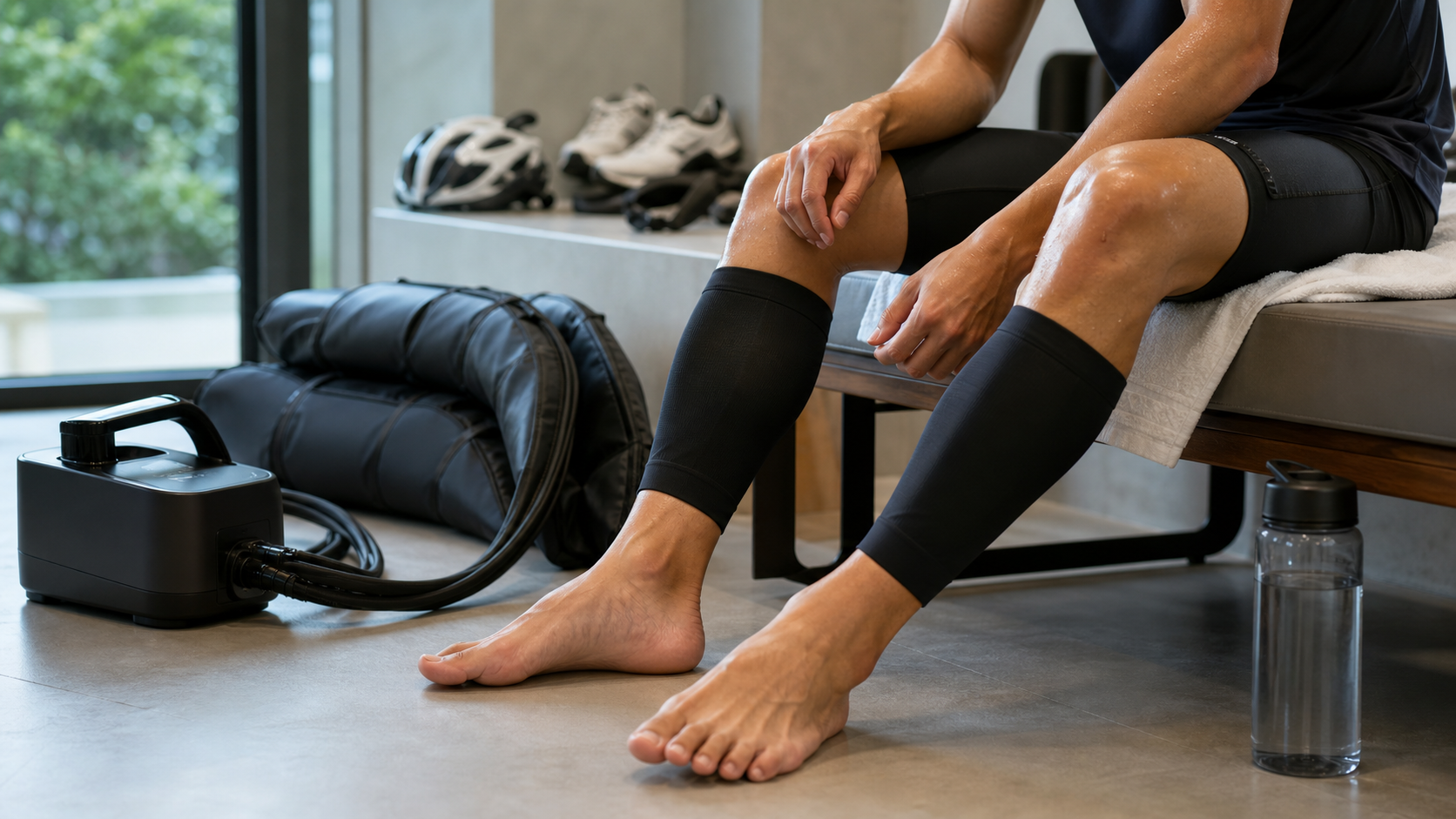
Starting with a Compression Therapy Machine That Cost Over Ten Thousand
A few years ago, one of my amateur triathlete trainees, A-Kai, excitedly messaged me after finishing a 113km half-Ironman: “Coach, I bought a compression therapy machine, over NT$18,000. All the influencers are promoting it, saying it can flush out lactic acid faster and prevent sore legs the next day.” I replied, “Hold off on unboxing it. Let’s talk about what problem you’re actually trying to solve.”
In recent years, across Taiwan’s running groups, triathlon communities, and gyms, compression recovery gear has almost become a status symbol for being a “serious athlete.” From a few-hundred-dollar compression calf sleeve, to compression tights costing two to three thousand, to intermittent pneumatic compression (IPC) machines that easily run into the tens of thousands, the marketing pitches are invariably about “accelerating lactic acid metabolism,” “flushing metabolic waste,” and “recovering faster than everyone else.” But as a coach who has read fifteen years of literature and trained athletes at all levels, I must honestly tell you: these tools do have effects, but the magnitude of those effects, and whether they’re worth the price, is very different from what the ads claim.
What I want to do in this article isn’t to tell you to buy or not to buy, but to lay out the concept of “levels of evidence” clearly. When you understand whether a tool’s effect size is “large” or “small,” and whether the evidence is “strong” or “weak,” you’ll be equipped to judge: is this money worth it for someone at your level, with your training volume?
Conceptual Foundation: What Does Compression Actually Do?
Let’s first debunk the most common myth: Compression gear does not “flush lactic acid.”
This is the most indefensible claim in the marketing playbook. Lactic acid (more precisely, lactate) is mostly metabolized back by the body within 30 to 60 minutes after you stop high-intensity exercise, converted into reusable energy. It doesn’t need any external help. The “heavy legs” soreness the day after exercise isn’t caused by lactic acid buildup either; it’s delayed onset muscle soreness (DOMS), primarily caused by micro-damage to muscle fibers and the resulting inflammatory response from eccentric contractions. So any gear claiming to “help flush lactic acid” fails at the very first sentence.
It’s worth noting that the origin of compression therapy is actually clinical medicine, not the sports field. Intermittent pneumatic compression was first used post-operatively to prevent deep vein thrombosis, treat lymphedema, and manage patients with chronic venous insufficiency—populations whose circulatory systems have clear, defined problems, so external compression provides substantial benefit. The sports recovery field later “borrowed” this technology, but healthy athletes’ circulatory systems don’t have those pathological issues. Therefore, directly applying the clear clinical efficacy to healthy athletes and expecting the same magnitude of results is itself an over-extension. Understanding this context helps you see why “clinically effective” doesn’t equal “equally effective for you as a healthy runner.”
So what does compression actually do? There are two main reasonable physiological mechanisms:
1. Improving Venous Return and Lymphatic Drainage
Applying graduated compression—pressure that decreases from the distal to proximal end of a limb—can theoretically help venous blood and lymph fluid return toward the heart, reducing post-exercise edema and fluid retention in the extremities. Intermittent pneumatic compression machines take this concept further with segmented air bladders that inflate sequentially from the ankle toward the thigh, squeezing and releasing, like squeezing toothpaste from the bottom of the tube upward.
2. Reducing Mechanical Muscle Vibration and Micro-Swelling
When wearing compression tights during exercise or recovery, the snug fabric limits excessive muscle oscillation, theoretically reducing additional mechanical micro-damage. Simultaneously, external pressure suppresses post-inflammatory tissue swelling, reducing pressure on pain receptors, which is why it “subjectively feels” less sore.
Notice I’ve used a lot of “theoretically” and “subjectively.” That’s exactly the point—a plausible mechanism doesn’t mean a large effect.
3. Pain Modulation and Psychological Soothing Effects
There’s another mechanism that’s often overlooked but actually quite important: external pressure itself stimulates mechanoreceptors in the skin and subcutaneous tissue, activating a neural mechanism similar to the “pain gate control” theory, which dampens the soreness signals reaching the brain. This explains why many people “feel immediate relief” the moment they put on compression tights or turn on an IPC machine—it’s not entirely that recovery has actually accelerated; part of it is that perception has been modulated. This isn’t a bad thing; subjective comfort has value for an athlete’s psychological resilience and consistency. But we must honestly distinguish: “feeling less sore” and “muscle damage actually repairing faster” are two different things, and the evidence for the latter is much weaker.
A Common Over-Extrapolation
Much marketing directly extrapolates “compression improves venous return” into “therefore it accelerates metabolic waste clearance and speeds up repair.” But there’s a huge logical leap in between. Improving venous return is real, but your venous system doesn’t have a serious congestion problem to begin with (unless you have venous disease). A normally functioning circulatory system won’t significantly speed up repair just because you add a bit of external pressure. It’s like adding more traffic controllers to an already clear road—traffic won’t move much faster. Understanding this, you won’t be led around by terms like “deep detox” or “accelerated metabolism.”
Levels of Evidence: What Does Science Actually Say?
This is the most important section of the entire article, so please read it carefully. I’ll discuss the two types of gear separately.
Compression Tights / Sleeves (Wearable)
There are now enough accumulated randomized controlled trials, and systematic reviews and meta-analyses are available for reference. Overall, for post-exercise recovery, compression garments have a “small to moderate” effect:
- A meta-analysis on post-exercise strength and power recovery found that compression garments had a moderate effect on delayed onset muscle soreness (DOMS) (Hedges’ g ≈ 0.40), and moderate effects on strength recovery (g ≈ 0.46), power recovery (g ≈ 0.49), and creatine kinase (CK, a muscle damage marker).
- Another, more recent meta-analysis yielded more conservative numbers, with effect sizes for strength and power recovery around g 0.21 to 0.23, classified as “small.”
- An interesting detail: when the rest interval fell between 1 and 24 hours post-exercise, compression garments showed the most pronounced effect on “attenuating strength loss”; and the effect was more pronounced in trained individuals than in untrained ones.
In plain language: compression tights aren’t a placebo. They do help with “subjective soreness” and “rate of strength recovery,” but the magnitude is modest, not transformative. You won’t go from being unable to get out of bed to bouncing with energy just by wearing compression tights.
Intermittent Pneumatic Compression (IPC)
This is that NT$18,000 machine. Its evidence is relatively weaker and more divergent:
- A systematic review and meta-analysis on lower-limb IPC for sports recovery found that IPC’s effect on muscle function was “trivial to small,” on pain and soreness was “trivial to moderate,” and on muscle damage markers (like CK) was highly inconsistent.
- The overall effect size for soreness and pain was approximately −0.45 (95% CI −0.65 to −0.25), a small effect.
- A key timing issue: IPC may make you “feel immediately more comfortable” during the treatment itself, but at the standard 24-hour post-exercise measurement point, it did not significantly reduce muscle pain.
- Most studies used a protocol of approximately 80 mmHg pressure, 20 to 30 minutes per session, which is currently the more accepted operating range. Overall, the evidence is rated as a Grade B recommendation (consistent RCT support, but limited effect).
So my advice to A-Kai was: If you’re buying it because “the massage feels great, it’s relaxing, and it gives me a psychological recovery ritual,” then great—it does that. But if you think it will significantly change your recovery curve and allow you to handle more training load, you need to lower your expectations.
How to Understand “Effect Size”?
Many people see numbers like g≈0.4 and it means nothing to them. Let me translate. In sports science, effect size (Hedges’ g or Cohen’s d) can be roughly understood as: around 0.2 is “small,” around 0.5 is “moderate,” and 0.8 or above is “large.” So compression garments’ effect of about 0.4 on soreness is “not quite moderate”; IPC’s effect of about 0.45 on soreness, but only trivial-to-small on muscle function, means it can make you “subjectively” more comfortable, but the evidence doesn’t support it dramatically speeding up your recovery.
Even more critical is the concept of “level of evidence.” A single industry-sponsored study with only a dozen or so participants carries vastly different weight than a systematic review that integrates multiple randomized controlled trials and controls for placebo effects. When you see a product ad citing “research proves,” develop the reflex to ask three questions: Is it a randomized controlled trial? Does it have a placebo group? Is it a meta-analysis or a single small study? These three questions will filter out ninety percent of marketing noise.
Why Is the Placebo Group So Important?
Recovery is a subjective experience that’s particularly susceptible to psychological influence. If you spent NT$18,000 on a machine, the mere belief that “I am recovering” is enough to make you report less soreness—that’s the placebo effect. Good studies design a “sham compression” control group (e.g., a device with such low pressure it’s essentially ineffective) to subtract this psychological layer, leaving only the gear’s true physiological contribution. This is also why, after accounting for placebo, the effect sizes of these tools often shrink from “feels amazing” to “small to moderate.” Understanding this, you won’t be fooled by your own expectations.
The table below summarizes the evidence for both types of gear:
| Gear Type | Main Claims | Actual Evidence Level | Effect Size on Soreness | Effect Size on Strength Recovery | My Plain-Language Conclusion |
|---|---|---|---|---|---|
| Compression Tights / Sleeves | Accelerate recovery, reduce soreness | Moderate (multiple RCTs + meta-analyses) | Moderate (g≈0.40) | Small to moderate (g≈0.21–0.46) | Mildly effective; value depends on price |
| Intermittent Pneumatic Compression (IPC) | Flush metabolic waste, deep recovery | Weaker and divergent (Grade B recommendation) | Small (≈−0.45) | Trivial to small | Mainly for comfort; don’t expect big effects |
| “Lactic Acid Flushing” Claims | Accelerate lactic acid metabolism | No scientific basis | N/A | N/A | Pure marketing; ignore entirely |
Practical Application: If You’re Going to Use It, How to Use It Right?
Assuming you already have compression gear, or have decided to get some, let’s make sure you use it correctly. Dosage and timing matter more than “whether it works.”
When to Use Compression Tights
Compression tights can be used in three scenarios, each with different effects and precautions:
| Use Scenario | Recommended Pressure / Tightness | Recommended Duration | Suitable For | Precautions |
|---|---|---|---|---|
| During Exercise | Moderate fit, not tight enough to cause numbness | Entire training session/race | Long-distance runners, triathletes | Taiwan’s heat and humidity; watch for heat dissipation and chafing |
| Post-Exercise Recovery | Moderate compression | Several hours within 1–24 hours post-exercise | High training volume athletes | Avoid wearing overly tight tights all night while sleeping |
| Long-Distance Travel Compression | Moderate compression | During prolonged sitting/standing | Athletes traveling long distances | Promotes venous return, reduces edema |
In practice, my top recommendation is the “post-exercise recovery wear” category, because the evidence shows the 1 to 24-hour window works best. For example, after a 30km long run on Sunday morning, shower at home, put on compression tights, and wear them into the afternoon while doing light chores. This usage aligns with the evidence and isn’t too inconvenient.
Operating Recommendations for IPC Machines
If you have an IPC machine, here’s the protocol most accepted in the literature:
- Pressure: Set around 80 mmHg (most consumer models are adjustable; don’t crank it to maximum thinking more pain equals more effectiveness—that’s wrong).
- Duration per session: 20 to 30 minutes.
- Timing: After high-intensity or long-distance training, on race night, or on rest nights between consecutive race days.
- Frequency: No need to use it daily. Reserve it for days when you’ve really pushed hard, to avoid it becoming a meaningless ritual.
- Pair with light activity: After using IPC or removing compression tights, get up and walk around for a few minutes, do some light mobility stretching. This works better than just lying still, because active muscle contraction is itself the most effective “pump.”
One practical detail particularly relevant for people in Taiwan: those 20 to 30 minutes using IPC are perfect for doing genuinely effective recovery tasks—eating a proper meal with protein and carbs, replenishing fluids and electrolytes, logging your training for the day, or getting ready for bed early. Rather than elevating the machine into some “detoxifying” ritual, treat it as a gentle alarm reminding you “it’s time to take good care of your body.” The machine’s greatest value, in fact, is helping you build a consistent recovery routine, not the air pressure itself.
A Practical Weekly Example
Take an amateur runner preparing for a full marathon with a weekly volume of 50 to 60 km. Here’s how I’d arrange recovery gear:
| Day | Training Content | Recovery Gear Setup |
|---|---|---|
| Monday | Easy run 8 km | No special gear needed; normal sleep is sufficient |
| Tuesday | Interval session (hard) | Compression tights for 3–4 hours after session |
| Wednesday | Rest or cross-training | Optional: IPC for 20 minutes to relax |
| Thursday | Tempo run 10 km | Compression tights for a few hours after session |
| Friday | Easy run 6 km | No special gear needed |
| Saturday | Rest | Prioritize getting enough sleep |
| Sunday | Long run 25–30 km (hardest) | Compression tights + IPC for 25 minutes in the evening |
Note that the real stars of this table aren’t the gear—they’re sleep, training distribution, and rest days. Recovery gear is always a supporting player.
Compression vs. Cryotherapy vs. Cryo-Compression: Three Things Often Confused
Recently, “cryo-compression” devices (combining cryotherapy and compression) have hit the market, bundling ice therapy and compression into one package. Let’s clarify the concepts here, because the evidence and appropriate timing differ for each:
| Recovery Method | Primary Function | Best Timing | Things to Watch |
|---|---|---|---|
| Compression (tights/IPC) | Reduce edema, modulate soreness, slight recovery aid | After hard training, race nights | Mild effect; don’t exaggerate |
| Cryotherapy (ice packs/cold water immersion) | Reduce inflammation, numb pain | Acute post-race phase, sprains/strains | Long-term use after strength training may blunt hypertrophy adaptations |
| Cryo-Compression Combined | Both combined | Acute sports injury management | Don’t use daily after normal training |
An important coaching reminder: if you’re pursuing strength or muscle mass gains, immediately doing prolonged ice baths or cold water immersion after training may actually blunt your body’s adaptation signals. In this case, plain “compression” is more suitable than “cryo-compression,” because compression doesn’t suppress the post-inflammatory repair and rebuilding response the way cold temperatures do. Many people don’t know this detail, so they ice daily during a muscle-building phase, effectively putting the brakes on their own progress.
Pre-Purchase Checklist
If you’ve decided to spend the money, check this list before buying to avoid being taken advantage of:
- Is it graduated compression or uniform compression? Good recovery compression should have higher pressure distally and lower pressure proximally, creating a gradient.
- Is the pressure adjustable (for IPC)? Be wary of models with fixed pressure that can’t be lowered to around 80 mmHg.
- Does it fit properly? Compression effectiveness is highly dependent on fit. Too loose and it does nothing; too tight and it over-constricts. The belief that “it has to be really tight to work” is a wrong myth.
- Is the material breathable? Taiwan is hot and humid; non-breathable materials will be miserable during exercise.
- Do you have any contraindications? Those with venous thrombosis, peripheral arterial disease, or severe diabetic neuropathy should get a medical evaluation first.
- What does this money displace? If buying the machine means your sleep environment or diet quality suffers this month, you’ve got your priorities backwards.
Common Mistakes and Corrections
In all my years coaching, I’ve seen too many people use recovery gear the wrong way. Here are the most common mistakes, with corrections.
Mistake 1: Treating Gear as a License to Increase Training Load
Many people think, “I have a compression therapy machine, so I can train more.” This is the most dangerous misconception. The marginal benefit of recovery gear is “small to moderate,” but the extra training volume you add is very real accumulated fatigue. Correction: First plan your training volume and intensity within what your body can handle. Gear is just icing on the cake, not a get-out-of-jail-free card.
Mistake 2: More Pressure Equals More Effective
Whether it’s compression tights so tight they leave red marks, or cranking the IPC to maximum pressure thinking “the more it hurts, the more detoxifying it is,” both are wrong. Excessive compression can actually impede blood flow, compress nerves, and cause discomfort or even numbness. Correction: Compression tights should be “snug but not numb or painful”; IPC should be comfortable and tolerable, around 80 mmHg.
Mistake 3: Ignoring Taiwan’s Hot, Humid Environment
Taiwan’s summers routinely hit 32°C or higher with humidity above 80%. Wearing full compression gear during exercise impairs heat dissipation, raises core body temperature more easily, and can actually hurt performance and recovery. Correction: Be cautious with during-exercise compression in hot seasons. Prioritize breathable materials, or reserve compression for post-exercise recovery in an air-conditioned room.
Mistake 4: Sleeping All Night in Overly Tight Compression Tights
Some people sleep all night in very tight compression tights to “extend recovery time.” Prolonged, high-pressure compression during sleep, when blood circulation is already slower, isn’t ideal. Correction: If you want to sleep in them, choose a lower-pressure model; or concentrate compression use in the few waking hours before bed.
Mistake 5: Using Gear to Replace the Fundamentals
This is the most fundamental mistake. The four pillars of recovery are always: adequate sleep, sufficient and balanced nutrition, proper training load management, and fluid/electrolyte replenishment. If these four aren’t done well, no amount of expensive gear can compensate. In Taiwan, where many people eat out, protein intake is especially often insufficient—a 65kg person with high training volume might need 100 to 130 grams of protein per day, but many people only get half that. Correction: First get enough sleep and enough protein (a palm-sized portion of meat/eggs/legumes at each meal), then talk about gear.
A Contrast of Two Real-Life Scenarios
Let me make the principles above more concrete with a comparison of two of my trainees.
Scenario 1: Xiao-Mei, Who Bought the Machine but Got More and More Tired
Xiao-Mei is a working professional runner with a weekly volume of about 40 km. She believed “compression therapy accelerates recovery,” bought the machine, and her mindset subtly shifted—she started adding mileage to her easy runs and turned rest days into slow jogs, because “the machine helps me recover anyway.” Three weeks later she came to me complaining, “I’m using the recovery miracle device, so why do my legs feel heavier and heavier, and my pace is getting worse?” The problem was clear: she was using the gear as a license to train more, paying for a significantly increased fatigue debt with a modest recovery benefit. The math simply didn’t work. I had her bring back her rest days and cut her volume back to 40 km, keeping the machine to just two or three times a week. Two weeks later, her legs felt good again and her pace stabilized. The lesson from this case: gear changes “recovery,” but if you simultaneously change “load,” everything is for nothing.
Scenario 2: Lao-Wang, Who Mastered the Fundamentals and Let the Gear Add Value
Lao-Wang is a 50-year-old veteran cyclist who rides over 200 km per week and frequently competes in multi-day stage races. His sleep, nutrition, and training planning are all solidly managed. He uses compression tights as routine recovery after long rides, and only uses the IPC on the middle nights of multi-day races. He never exaggerates the gear’s effects; instead, he often says, “This stuff probably buys me back a tiny bit, but that tiny bit makes all the difference on day two of a stage race.” Lao-Wang is the perfect example of “when the fundamentals are solid, gear can deliver its marginal benefit.” The same machine became an excuse to overtrain in Xiao-Mei’s hands, but a bonus in Lao-Wang’s hands. The difference lies entirely in whether the user’s overall strategy is mature.
Actionable Advice for Readers at Different Levels
There’s no one-size-fits-all answer. Here’s my advice based on training level.
Beginners: Exercising 2–3 Times Per Week
Honestly, you don’t need to spend money on recovery gear at this stage. Your recovery bottleneck is almost certainly insufficient sleep, too little protein, or being too impatient with training—not a lack of a machine. Save that NT$18,000, eat well, sleep well, and you’ll progress far faster than buying gear. If you really want a bit of recovery ritual, a pair of compression calf sleeves for a few hundred dollars, worn during prolonged sitting or standing, is low-cost, harmless, and acceptable.
Intermediate: Training Consistently with Clear Race Goals
This is where compression tights start to have a role. The evidence shows trained individuals benefit more, and your training volume is large enough to justify fighting for a bit more recovery. My recommendation: invest in a good pair of compression tights and use them in the 1 to 24-hour window after hard sessions and long runs. An IPC machine is a luxury item to consider “if you have the budget, the space, and enjoy the relaxation feeling”—not a necessity.
Advanced: High Training Volume, Dense Race Schedules
For you, any marginal recovery gain can matter, because you’ve already optimized sleep, nutrition, and training planning. What’s left is fighting for that 5% in the details. Regular use of compression tights, and IPC for the nights between consecutive race days and after major races, is a reasonable investment. But remember, the reason you can benefit from this gear is precisely because your fundamentals are already solid—not the other way around.
Run a One-Month Self-Experiment to Determine If It Works for You
Rather than trusting ads, run a simple personal experiment. Recovery is highly individual; what works for others may not work for you. The method is simple: pick a period of stable training. Use the gear normally for two weeks, then don’t use it at all for two weeks (or vice versa). Every morning upon waking, record three metrics—subjective leg soreness (0–10 scale), resting heart rate (bpm), and your subjective willingness to train (do you feel like moving?). After two weeks, compare the averages of the two periods. If the gear period was noticeably more comfortable and your legs felt better, then it has value for you. If it’s about the same, then you know the money isn’t worth it for you and you can save it. This “N=1 self-experiment” mindset is more reliable than blindly trusting any advertisement, because it directly measures the response of “you” as an individual.
One trap to watch for: during this experiment, keep other variables (sleep, diet, training volume) as constant as possible, otherwise you can’t tell whether changes came from the gear or something else. This again echoes the article’s main theme—recovery is a system, and gear is just one small, testable component.
Those with Chronic Conditions or Special Circumstances Must Consult a Doctor First
If you have a history of deep vein thrombosis, peripheral arterial disease, diabetic peripheral neuropathy, heart failure, lower-limb sensory abnormalities, or unexplained edema, compression gear (especially high-pressure IPC) is not something you should use casually on your own. Compression can be risky in these situations. You must consult a physician or physical therapist first. Taiwan’s National Health Insurance makes seeing a doctor easy. If you have relevant conditions, spending one consultation fee for a professional assessment is far safer than buying a machine online and using it blindly.
Quick Q&A
Q: Can compression tights help me lose fat or shape my body?
A: No. Compression garments have no metabolic effect on adipose tissue. Looking more toned while wearing them is just a temporary visual effect.
Q: Is it better to wear them during or after exercise?
A: For recovery purposes, the evidence better supports wearing them 1 to 24 hours after exercise. Wearing them during exercise is mainly for reducing muscle oscillation and personal comfort preference; in Taiwan’s hot season, watch out for heat dissipation.
Q: Which is better, an IPC machine or professional sports massage?
A: Both have different mechanisms and neither has strong evidence; their main value leans toward subjective relaxation and recovery ritual. If budget is limited, I usually suggest spending the money on your sleep environment (e.g., blackout curtains, air conditioning, bedding) first, as the benefits are more certain.
Q: Can compression gear cause dependence?
A: Physiologically, no. But psychologically, you might develop a ritual dependence where you feel you “haven’t recovered properly” without it. Stay rational and remember it’s just a supporting player.
Q: Do cheap compression tights work?
A: Compression effectiveness depends on whether the pressure gradient is properly designed. Products that are too cheap and lack graduated compression design may just be ordinary tight leggings with diminished effects. When choosing, look for whether graduated compression is specified.
Q: Can a compression therapy machine replace cool-down and stretching?
A: No, they serve different purposes. Cool-down and mobility work are active practices for maintaining muscle length and joint function. Compression is passive circulation and sensory modulation. If you’re ranking priorities, active fundamentals like cool-downs, stretching, and dynamic warm-ups matter more than gear.
Q: How soon after exercise should I use compression recovery?
A: The evidence better supports the 1 to 24-hour post-exercise window. In practice, putting on compression tights soon after showering at home, or using the IPC once before bed that night, both fall within this reasonable window. No need to obsess over doing it immediately at the exact moment you finish.
Q: I don’t have high training volume—I just ride 30 km on weekends. Do I need it?
A: At your volume, adequate sleep and a proper recovery meal are sufficient. The marginal benefit of recovery gear is very low. If you really want something, compression calf sleeves are a low-cost, harmless entry option, but don’t invest in expensive machines.
Q: Does compression affect menstruation or pregnancy?
A: For generally healthy women, using compression tights after exercise is usually fine. But for pregnancy, or for those with circulatory conditions, individual differences are significant. Consult a doctor before use, especially for high-pressure IPC.
Conclusion: Spend Money Where It’s Proven to Work
Back to A-Kai’s story. In the end, he didn’t return the machine, but his mindset changed—he no longer expected it to “accelerate lactic acid flushing.” Instead, he treated it as a comfortable relaxation ritual on long-run days and race nights: 20 minutes, 80 mmHg, watching a show while using it. At the same time, he put more effort into what truly determines recovery: sleeping 7 to 8 hours every night, getting enough protein at every meal, and scheduling sufficient easy days between hard sessions. Six months later, his marathon time improved by nearly 8 minutes.
This is the core message I want to convey: The science of recovery gear isn’t about “does it work,” but “how much does it work, is it worth it, and what’s its place in your overall recovery strategy.” Compression tights and intermittent pneumatic compression are both real but mild tools. They are supporting players, not the leads. Get the fundamentals right, and this gear can truly deliver that 5% bonus. Neglect the fundamentals, and even the most expensive gear is just an expensive comfort.
Next time you see ad copy like “accelerates lactic acid flushing” or “deep detox recovery,” I hope you’ll smile knowingly, and then rationally ask yourself: is this worth it for “someone at my level, with my training volume”? Being able to ask that question already puts you ahead of most people in understanding the science of recovery.
Finally, I’d like to leave one thought for every serious athlete: On the path to improvement, the most expensive thing isn’t gear—it’s whether we’re willing to do the most basic, least glamorous, yet most effective things well. Sleeping enough, eating enough, training smart, and resting when you should—none of these require spending a lot of money, yet they are the foundation that no recovery gear can match. Compression tights and therapy machines can be that nice-looking piece of your recovery puzzle, but don’t let them occupy the attention you should be investing in the fundamentals. Give the lead role back to the lead, keep the supporting role in its place, and your athletic career will go far and last long. Wishing you smooth training, solid recovery, and the ability to ride and run farther on every route in Taiwan.
This article is educational content and does not replace individual diagnosis or treatment advice from a physician, physical therapist, or nutritionist. If you have chronic conditions or special health circumstances, please consult a professional before using any compression gear.
References
- Effects of lower-limb intermittent pneumatic compression on sports recovery: A systematic review and meta-analysis (PMC): https://www.ncbi.nlm.nih.gov/pmc/articles/PMC11475002/
- Effects of lower-limb intermittent pneumatic compression on sports recovery (PubMed): https://pubmed.ncbi.nlm.nih.gov/39416507/
- Effects of Compression Garments on Muscle Strength and Power Recovery Post-Exercise: A Systematic Review and Meta-Analysis (PMC): https://pmc.ncbi.nlm.nih.gov/articles/PMC11944185/
- Compression garments and recovery from exercise-induced muscle damage: a meta-analysis (PubMed): https://pubmed.ncbi.nlm.nih.gov/23757486/
Related Reading
- The Scientific Examination of Recovery Tools: Massage Guns, Ice Baths, Compression, and Foam Rollers—Which Actually Work?
- Do Compression Garments Really Work? A Comprehensive Sports Science Analysis of Compression Gear
- The Recovery Benefits of Compression Tights: An Evidence-Based Review
- The Benefits of Compression Gear on Post-Exercise Recovery: A Study of Hemodynamic Mechanisms
摔車後補裝備: 好市多新款單車安全帽& Specialized Romin 北高整路屁股都不痛的坐墊 | 一千元居然有MIPS | CT Yeh | 公路車
4 年前
入門車錶王者 iGPSPORT BSC100S 一千元的售價! 超大螢幕、連續兩趟北高的續航、藝術般的APP! Bryton Garmin 兩王地位撼動? | 公路車 | CT Yeh
3 年前
鉅齒紋輪組!? ControlTech MEG-T50 EVO 碳纖維幅條輪組/ 功率對比實驗 / 公路車 / CT Yeh
2 年前
洗單車神器 吹水機! 實際洗車用用看 暴力洗鍊條大法 | 公路車 | CT Yeh
4 年前
3D 列印車褲墊 / 舒適改善? / 無痕 x 分區壓縮 / ATK & Decider系列 / JE22黑科技 / #公路車 #CTYEH
11 個月前
全台首發神車錶! iGPSPORT iGS630 兩趟一日北高的續航! 超強導航、功率訓練、超人性APP! Garmin & Bryton 有對手了嗎? | 公路車 |CT Yeh
3 年前
多到選擇障礙... 換個單車把帶想一個小時 / BTP / 編織&軟木特有材質超吸睛! / 公路車 / CT Yeh
1 年前
CT暗黑廚房) 車友必備 宇宙無敵鮮蚵湯 幫助訓練恢復 天然食補 好市多 超肥鮮蚵 破PR
7 年前