EMS Electrical Stimulation Training: A Lazy Way to Build Muscle? A Coach Breaks Down the Science, Evidence, and Real-World Applications
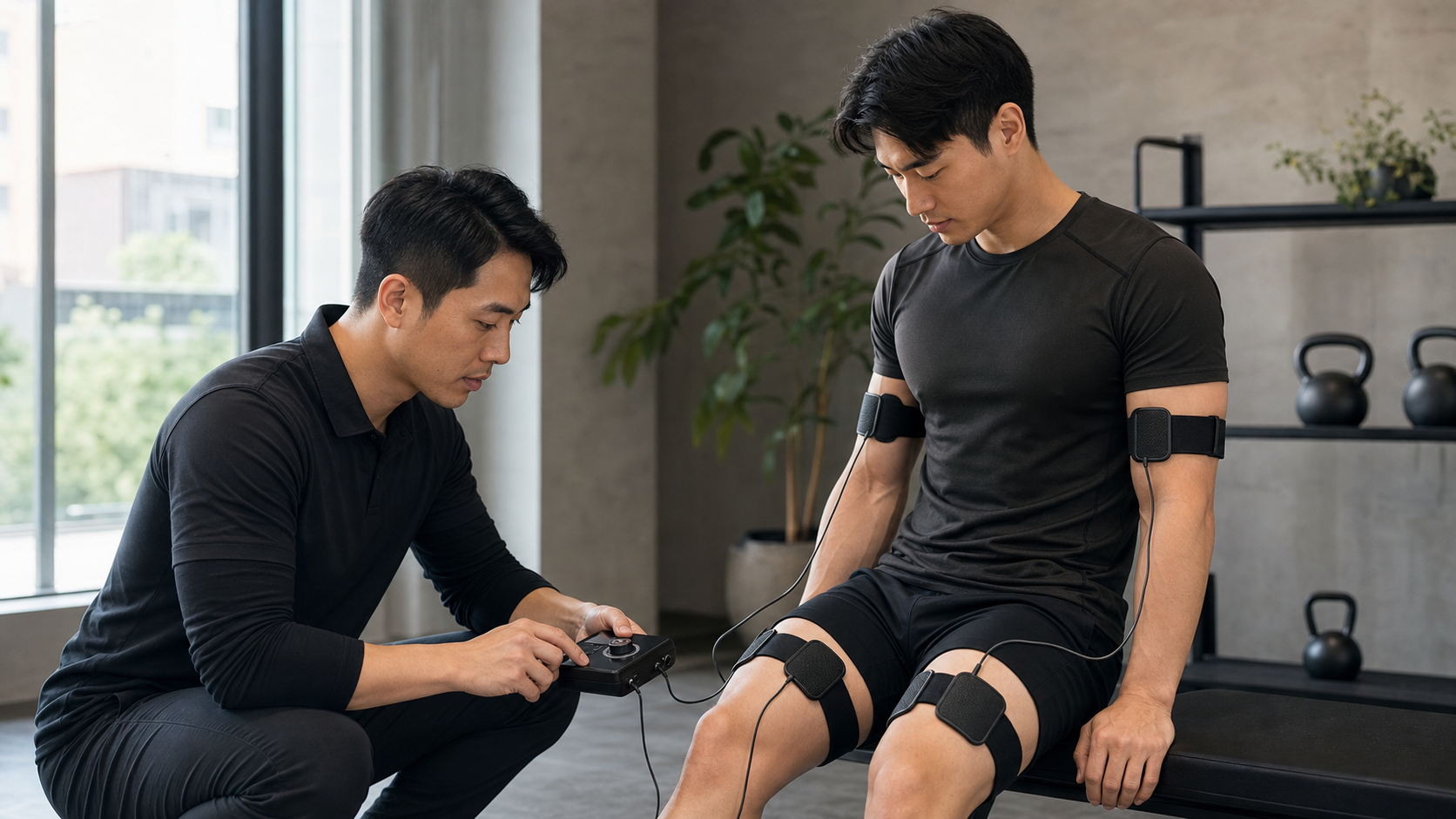
Opening: Can That Machine You “Use While Lying Down” Really Let You Cheat?
I still remember a few years ago, a student named A-Xian, who worked in the tech industry in Taipei’s Xinyi District, walked into my studio for the first time with a video saved on his phone. In the video, someone was wearing a tight suit covered in electrode pads, muscles twitching and jumping, with a voiceover saying, “20 minutes a week equals two hours at the gym.” He half-jokingly asked me, “Coach, can this EMS let me build muscle while lying down without getting so tired? I’m working overtime to the point of exhaustion; I really don’t have the energy for weight training.”
I understand that kind of fatigue. Office workers in Taiwan, especially in tech and service industries, have long working hours, long commutes, and eat out frequently. The time they can squeeze out for exercise is pitifully little. So whenever any training method promising “time-saving, effort-saving, effective while lying down” hits the market, a large crowd’s eyes light up. EMS (Electrical Muscle Stimulation) is one of the products that has been best at marketing this “lazy fantasy” in recent years.
But as a coach who has trained everyone from competitive athletes to grandparents in their sixties for over a decade, I have to say something first that might upset the marketers: EMS is not magic; it’s a tool with its uses, but its benefits are severely exaggerated. It can’t let you cheat your way to getting stronger, but in certain specific situations, it can indeed help. In this article, I want to show you, in the most honest way possible, what EMS actually does, what the scientific evidence says, where its limits are, and—if you really want to use it—how to do so without wasting your money.
Let me be clear about my stance: I’m not here to “oppose EMS.” Every tool has its appropriate scenarios; blindly praising or blindly condemning it is unprofessional. What I want to do is separate “marketing hype” from “actual evidence,” so you can judge for yourself whether this machine is worth incorporating into your training or recovery plan. In recent years, WB-EMS studios have been popping up all over Taiwan. A single trial class can cost over a thousand NT dollars, and package deals can run into tens of thousands. Every dollar you spend should be spent with clarity.
Conceptual Foundation: How Does Electricity Make Muscles “Move”?
Your Muscles Already Move via “Electricity”
Many people think muscle contraction relies on “willpower” or “strength,” but physiologically, the final step of muscle contraction is always an electrical signal. When your brain wants to move a muscle, it transmits an electrical potential (action potential) through motor neurons. This electrical signal reaches the neuromuscular junction, triggers the release of calcium ions, and the actin and myosin filaments within the muscle fibers slide, causing the muscle to shorten.
What EMS does is essentially bypass the brain, sending electrical current directly from the skin surface to stimulate the motor nerves (or the muscle itself), forcing it to contract. So strictly speaking, EMS produces a “passive, involuntary” muscle contraction—you don’t have to “think” about it, and the muscle still twitches. This is why it gives people that “lazy” feeling: you’re lying down, but your muscles are working.
Several Easily Confused Terms
The names of electrical therapy products on the market are quite messy. Let me clarify the most common ones for you:
| Abbreviation | Full Name | Primary Purpose | Contraction Intensity |
|---|---|---|---|
| EMS | Electrical Muscle Stimulation | Stimulate muscle contraction, train or maintain strength | Moderate to strong (visible muscle twitching) |
| NMES | Neuromuscular Electrical Stimulation | Medical/rehab use, stimulate neuromuscular recovery of function | Moderate to strong |
| WB-EMS | Whole-Body EMS | Wear electrode suit, stimulate multiple muscle groups simultaneously | Strong (common in commercial gyms) |
| TENS | Transcutaneous Electrical Nerve Stimulation | Primarily pain relief, stimulates sensory nerves | Weak (usually doesn’t cause visible contraction) |
This table is important. Many people confuse “electrotherapy patches for pain relief (TENS)” with “electrical stimulation for muscle building (EMS),” thinking that the little tingling device a rehab clinic sticks on your sore shoulder can build your chest muscles—no, those are different things, with different purposes and different current parameters. TENS targets sensory nerves for pain relief; EMS/NMES is specifically designed to induce stronger muscle contractions.
A Key Difference: The Recruitment Order Is “Reversed”
This is the most interesting physiological characteristic of EMS, and also the one most exploited by marketing.
When you voluntarily exert force, your body follows the “size principle”: it first recruits small, fatigue-resistant slow-twitch fibers (Type I), and only calls upon the large, powerful but easily fatigued fast-twitch fibers (Type II) when greater force is needed.
But EMS’s recruitment order is relatively chaotic, even tending to preferentially stimulate superficial and larger-diameter nerve fibers first. This is often marketed as “EMS can train the fast-twitch fibers you can’t normally train!” Sounds impressive, right? But in practice, this brings two problems: first, the unnatural recruitment order makes muscles fatigue faster and become sorer more easily (more on DOMS later); second, the current can only penetrate to a limited depth, so deep muscle groups (such as many core stabilizers and deep hip rotators) simply can’t be stimulated. So the statement “train muscles you normally can’t” is half true, half marketing spin.
Current Parameters Determine Everything: Frequency, Pulse Width, Intensity
I want to go one layer deeper, because this is the key to distinguishing “professional EMS” from “toy EMS.” The effect of electrical stimulation isn’t just about whether there’s “electricity” or not; it’s determined by several parameters working together:
| Parameter | Plain Explanation | General Range (for understanding, not a prescription) | Impact |
|---|---|---|---|
| Frequency (Hz) | How many electrical pulses per second | Low frequency ~20 to 50 Hz, high frequency ~50 to 120 Hz | Low frequency leans toward endurance/strengthening and recovery; high frequency leans toward power/muscle hypertrophy, but also causes faster fatigue |
| Pulse Width (microseconds) | How long each pulse lasts | ~200 to 400 microseconds | The wider the pulse width, the more muscle fibers recruited, the stronger the sensation |
| Intensity (milliamps) | The magnitude of the current | Varies by individual; the boundary is “visible contraction but tolerable” | Determines contraction strength and soreness level |
| Work/Rest Ratio | How many seconds of contraction, how many seconds of rest | E.g., 5 seconds contraction, 5 to 15 seconds rest | Too little rest can easily lead to over-fatigue |
The point of this table isn’t for you to memorize numbers, but to help you understand: Two things both called EMS—a cheap patch device from a night market and a professional system operated by a trained coach with finely adjustable parameters—are worlds apart. If the parameters are set incorrectly, the result is either ineffective or, worse, injury. This is why I keep emphasizing that “WB-EMS requires a professional on site”—it’s not as simple as just turning it up or down.
Why Can’t the Current “Penetrate Deeply”?
Let me add one more physiological concept: EMS current is delivered from electrodes on the skin surface and preferentially flows along paths of lower resistance, attenuating as depth increases. This means superficial muscles (such as the surface layer of the quadriceps or the biceps) are more easily and effectively stimulated, while deep stabilizer muscles are almost impossible to reach. This is one of the fundamental reasons EMS cannot replace “integrated movement training”—true athletic performance relies on coordinated force production between deep and superficial muscles and neural control of movement, which are things you can never learn by “lying down and getting zapped.” You can be zapped into having a twitching quadriceps, but you can’t be zapped into having the movement skill of “how to land when running or how to generate power when cycling.”
Scientific Evidence: Does EMS Actually Work?
This is the most important section of the entire article. I’ll try to only present conclusions that are actually verifiable in research and can give you sources, clearly defining the scope without exaggeration.
Evidence for “Strength”: Effective for Specific Populations, but Don’t Expect It to Replace Weight Training
The accumulated systematic reviews and meta-analyses generally point to several conclusions:
-
For sedentary individuals, older adults, and non-athletic populations, EMS (especially WB-EMS) can indeed bring significant increases in muscle mass and strength, and is considered “a viable alternative option to other training modalities.” This is meaningful for people who cannot perform traditional resistance training due to physical conditions, time constraints, or lack of motivation.
-
But here’s a crucial caveat: A meta-analysis of WB-EMS in non-athletic adults pointed out that while most studies could measure an increase in “strength numbers,” there was no corresponding improvement in “strength-related functional performance” (e.g., actual physical capabilities). In other words, getting stronger as measured by a machine doesn’t necessarily mean you’re actually stronger or more capable in daily life or on the sports field.
-
For athletes who already have a training base, the effects are less pronounced. A review of soccer players showed that local or whole-body EMS “might” improve certain performance indicators, but the study quality was mixed, most were not double-blind designs, and the strength of the evidence is limited. Low-frequency stimulation seems to lean more toward “strengthening,” while high-frequency leans more toward “increasing muscle mass,” but this is not yet a hard rule.
Let me summarize in plain coaching terms: If you were completely inactive before, EMS will make you progress; if you’re already doing regular weight training, EMS is at best a minor addition, and possibly makes no difference at all. This is entirely consistent with the common sense of training science—the more unfamiliar a training stimulus is, the greater the effect of any stimulus.
Evidence for “Recovery”: Better Than “Completely Lying Still,” but Not Better Than “Active Recovery”
I especially want to clarify this point, because too many people spend money on a “psychological comfort.”
Research on EMS/NMES for post-exercise recovery (especially delayed onset muscle soreness, DOMS) actually has fairly consistent “cold water” conclusions:
- NMES recovery effects are better than “passive recovery” (complete rest and immobility);
- But NMES is not better than “active recovery” (e.g., low-intensity jogging, easy spinning on a stationary bike)—the improvements in pain and fatigue are roughly the same.
What does this mean? If you already do active recovery after races or training (cool-down, easy 10-15 minute spin), then you don’t really need to spend extra money on EMS—the effects are similar. The truly valuable recovery scenario for EMS is very specific: when you can’t do active recovery. The researchers gave a vivid example—after a competition, the whole team immediately boards a tour bus for a several-hour ride home, with no space or conditions for active recovery. In that situation, wearing EMS to allow gentle passive muscle contraction and promote blood flow is genuinely useful.
Translating this to the Taiwanese context: If you finish a marathon or triathlon in Yilan or Hualien on the weekend and then have to drive three or four hours back to Taipei, stuck in the car—then EMS’s gentle recovery mode might help you avoid severe leg soreness the next day. But if you have time after the race to properly cool down, stretch, and walk around, there’s no need to be superstitious about this machine.
Evidence for “Medical and Rehabilitation”: This Is Where EMS/NMES Truly Shines
Ironically, EMS is most marketed as “lazy fitness,” but its most solid evidence actually lies in the medical rehabilitation field:
- When activity levels drop drastically due to injury, surgery, or prolonged bed rest, NMES can preserve or restore muscle mass and neuromuscular function, with effects even superior to some other rehabilitation methods;
- NMES has application value after stroke, anterior cruciate ligament (ACL) reconstruction, total knee replacement, muscle weakness caused by knee osteoarthritis, and muscle loss after intensive care.
This actually makes perfect sense: When a person “can’t perform voluntary contractions well or at all,” EMS, which can passively induce contractions, is most valuable. Once you’re a healthy person who can voluntarily exert force, move, and walk, the marginal benefit of EMS compared to “you going and training properly yourself” drops sharply.
Important reminder: All of the above rehabilitation applications must be conducted under the assessment and guidance of physicians and physical therapists. The electrical stimulation parameters and contraindication judgments for nerve damage, post-surgery, and chronic disease patients are far more complex than simply “turning it up or down” at the gym.
A Real-World Comparison: Two Students, Two Outcomes
Let me use two case studies to draw a clearer line between “effective” and “ineffective” (the scenarios are fictional, but they reflect the general patterns I see in my actual students; I won’t fabricate data, only describe the direction).
Case A: 65-year-old retired Auntie Lin, who barely exercises. Due to knee degeneration and being stuck at home for a long time during the pandemic, her thighs had visibly atrophied, she got tired easily when walking, and was afraid of going down stairs. Her rehab physician and physical therapist incorporated NMES into her treatment to stimulate her quadriceps, combined with progressive seated leg raises and simple resistance exercises. A few months later, her thighs were stronger and she dared to go down stairs again. In her case, EMS was valuable—because her starting point was “can’t even perform voluntary contractions well,” and passively induced contractions exactly filled that gap.
Case B: 30-year-old engineer Xiao-Jie, who lifts weights four times a week. He saw online ads and spent extra money on WB-EMS classes, thinking it would help his bench press progress faster. Three months later, his bench press weight had barely increased compared to “just following his original program,” but the soreness after each EMS session was affecting his performance in the next day’s regular workouts. In his case, EMS not only didn’t help, but the extra fatigue interfered with his main program. Later, I suggested he put that money and time into improving his sleep and protein intake, and he broke through his plateau.
These two contrasting cases echo the evidence conclusions above: The benefit of EMS is highly correlated with your “starting point.” The lower your starting point (the more sedentary, weaker, less able to contract voluntarily), the greater the benefit; the higher your starting point (already training regularly), the lower the benefit, or it even becomes a hindrance.
Practical Methods: If You Really Want to Use EMS, How Should You Use It?
Okay, after covering the evidence, I know some of you will still want to try it. Rather than letting businesses lead you around, let me lay out the “relatively reasonable usage.” All of the following is based on the premise that “you are a healthy adult with no contraindications.”
Common EMS Usage Scenarios and Positioning
| Usage Scenario | Reasonable Positioning of EMS | My Coaching Advice |
|---|---|---|
| No exercise habits at all, want to “start moving” | Introductory stimulation, build muscle awareness | Can be a transitional tool, but the goal is to transition to voluntary exercise as soon as possible |
| Already training regularly, want to break through | Supplementary, local reinforcement | Limited benefit; money is better spent on diet and sleep |
| Post-race/post-heavy training, unable to do active recovery | Passive recovery alternative | This is a relatively valuable use |
| Injury/post-surgery (medical) | Rehabilitation tool | Must be under the guidance of a physical therapist |
| Purely trying to lose fat | Almost useless | Evidence for EMS in “fat loss” is weak; don’t count on it |
I’m specifically highlighting the last row: EMS is almost useless for fat loss. The meta-analysis mentioned earlier clearly showed that WB-EMS is effective for muscle mass and strength, but has no significant effect on body fat mass. The core of fat loss is always a caloric deficit (the balance of eating and moving); no machine can make you lose weight just by zapping you.
A Sample “Reasonable EMS Supplementary Weekly Plan”
Assuming you’re an office worker like A-Xian with very little time and just starting out, and you really want to incorporate EMS, here’s how I would arrange it (note: EMS is the supporting role, not the lead):
| Day | Main Program (Voluntary Exercise) | EMS Role |
|---|---|---|
| Monday | Full-body resistance training 40 min | None |
| Tuesday | Brisk walking/light cycling during commute 30 min | None |
| Wednesday | Rest | Optional: EMS recovery mode 15 min |
| Thursday | Full-body resistance training 40 min | None |
| Friday | Rest or walk | None |
| Saturday | Long-distance cycling or road running | If unable to cool down after, EMS recovery 15 min |
| Sunday | Complete rest | None |
See the key point? What actually makes you stronger is the resistance training on Monday and Thursday and the cardio on the weekend. EMS is always that optional “add-on.” If you flip this entire plan upside down and think that a few EMS sessions a week can replace weight training, the return on your money and time will be very low.
Basic Safety Principles for Using EMS
- Progress intensity gradually: The first time you use it, you’ll definitely feel “why is it so sore and twitchy.” The fatigue from involuntary contractions is different from voluntary effort; don’t be a hero and crank it to maximum all at once.
- Stay hydrated and replenish electrolytes: Taiwan’s summers are hot and humid, and EMS sessions are often held in enclosed air-conditioned rooms. Combined with heavy sweating from intense contractions, dehydration is a risk. Hydrate before and after sessions.
- Coordinate breathing and slight movements during contractions: Good WB-EMS sessions will have you perform squats, lunges, and other movements in sync with the electrical contractions. This is far more meaningful than just lying there.
- Watch your skin condition: If there are wounds, inflammation, or infections on the skin under the electrode pads, do not use the device.
Common Mistakes and Corrections: Pitfalls I’ve Seen in Gyms and Studios
Mistake 1: Treating EMS as a “Replacement for Weight Training”
This is the biggest misconception. As mentioned earlier, evidence shows EMS is effective for sedentary individuals, but its transfer to “functional performance” is limited, and its benefit is low for those with a training base. Correction: Position EMS as a “supplementary tool” or “transitional bridge,” not your main program. Long-term improvements in strength, physique, and health still require progressive voluntary resistance training.
Mistake 2: Thinking “The More It Hurts, the Better It Works”
Soreness from involuntary contractions is not linearly related to training effect. Excessive current will only cause severe DOMS the next day, and there’s even a risk of rhabdomyolysis (detailed below). Correction: Use the principle of “visible muscle contraction but tolerable, able to coordinate with movement,” rather than chasing maximum pain.
Mistake 3: Ignoring the Risk of Rhabdomyolysis
This point must be addressed seriously. Because WB-EMS simultaneously and intensely stimulates a large number of muscle groups in an unnatural contraction pattern, there have been case reports of rhabdomyolysis in beginners or over-users—that is, massive muscle breakdown, with myoglobin entering the bloodstream, which can seriously damage the kidneys. Warning signs include: unusually severe and persistent muscle soreness and swelling after exercise, weakness, especially urine turning a dark brown color like cola or strong tea. Correction: When first trying WB-EMS, start with low intensity and short duration, ensure sufficient intervals between sessions (generally recommended no more than 1-2 whole-body WB-EMS sessions per week), and seek medical attention immediately if the above symptoms occur. In Taiwan, this situation warrants a trip to the emergency room or a nephrology/rehabilitation department. With NHI, medical access is convenient—never tough it out.
Mistake 4: Using It Despite Contraindications
EMS is not suitable for everyone. The following groups are contraindicated or high-risk, and must consult a physician before use:
- Those with a pacemaker or other implanted electronic devices
- Pregnant women
- People with epilepsy
- Those with severe cardiovascular disease (such as uncontrolled heart disease or hypertension)
- People with diabetes and peripheral neuropathy or skin sensation abnormalities
- Areas with malignant tumors, thrombosis, acute inflammation, or infection
I’m not trying to scare you; current passing through the body inherently carries risks. In Taiwan, seeing a doctor is convenient. Spending a registration fee to ask a physician first is far better than dealing with the consequences later.
Actionable Advice for Readers at Different Levels
Everyone’s starting point is different, so I’ll divide the advice into three types of people:
For “Completely Inactive with Very Little Time” (Like A-Xian Was)
You are the group most likely to “feel a benefit” from EMS, but I still have to be honest: EMS is suitable as your “start button,” not your “engine.” If a trial WB-EMS class can help you re-experience what it feels like to use your muscles and regain a bit of motivation to exercise, great, go try it. But please set your goal as: within three to six months, shift your primary exercise focus to voluntary resistance training and cardio. Taiwan has affordable gyms and community sports centers everywhere, and you can even start at home with bodyweight squats, push-ups, or resistance bands. In the long run, spending money on EMS is not as good as investing in “building the habit of moving on your own.”
Your first step: Instead of agonizing over whether to buy EMS, first achieve “regular exercise twice a week, 30 minutes each session” for one month. If you can do that, you’ll find you don’t even need that machine.
For “Already Exercising Regularly and Want to Advance”
To be frank, EMS has very low cost-effectiveness for you. Your bottleneck for progress is probably not “lacking a new stimulus,” but rather the progressiveness of your training program, your diet (is protein sufficient?), and your sleep and recovery.
Your first step: Take the budget you were going to spend on EMS and do one of these three things: hire a coach to review your form and program design, get your daily protein intake to approximately 1.6 to 2.2 grams per kilogram of body weight, or get your sleep up to 7 hours or more. These three things will benefit you far more than any electrical stimulation.
For “Injured, Post-Surgery, or with Chronic Illness”
This is the group where EMS/NMES has the strongest evidence-based value, but it’s also the group that should least use it on their own. After stroke, ACL or knee surgery, or muscle atrophy from prolonged bed rest, NMES can indeed help preserve muscle and accelerate functional recovery.
Your first step: Don’t buy a home device and stick it on yourself randomly. Go back to your rehabilitation physician and physical therapist. Taiwan’s rehabilitation medical resources are relatively comprehensive, and NHI covers related treatments. Let professionals set the correct current parameters based on your injury and determine contraindications—that’s the safe and effective path.
Frequently Asked Questions (FAQ)
Q1: Does a 20-minute WB-EMS session really equal two hours of weight training?
A: That’s marketing hype. A 20-minute high-intensity whole-body electrical stimulation session will indeed make you sore the next day and feel like you “worked out,” but “soreness” doesn’t equal “the long-term adaptations equivalent to two hours of weight training.” Long-term muscle and strength growth requires progressive overload, adequate recovery, and nutrition—none of which EMS can replace.
Q2: Can EMS spot-reduce belly fat or arm fat?
A: No. This involves two myths: first, the evidence for EMS in “fat loss” itself is weak; second, “spot reduction” physiologically almost doesn’t exist. Fat loss is systemic; it won’t target the area you zap.
Q3: Is a home EMS patch the same as gym WB-EMS?
A: The intensity and coverage are vastly different. Home mini-patches have weaker current and stimulate limited muscle groups, closer to the level of “massage/relaxation” or “light recovery”; commercial WB-EMS has strong current and works multiple muscle groups simultaneously, with higher effects and risks (such as rhabdomyolysis).
Q4: Will muscles “get used to” EMS and stop responding over time?
A: Any single stimulus used for a long time will lead to adaptation and diminishing returns, and EMS is no exception. This brings us back to the core conclusion: treat it as a supplement or a transition, not your only method.
Q5: What should I pay attention to when using EMS in Taiwan’s summer?
A: Taiwan’s summer is hot and humid. EMS sessions involve intense contractions and sweating, so the risk of dehydration is high. Be sure to hydrate and replenish electrolytes before, during, and after sessions. Don’t overlook air-conditioned rooms either; the heat generated by contractions and the ambient humidity can compound. If you feel dizzy, nauseous, or experience palpitations, stop immediately.
Q6: Is EMS helpful for cyclists or runners?
A: For endurance athletes, EMS has very low value as a “training replacement”—your engine (cardiopulmonary capacity, mitochondria, capillary density) must be built through actual miles of pedaling and running, which electricity cannot do. There are two relatively reasonable uses: one is during the post-injury transition period, such as when a knee injury prevents heavy cycling or running, using NMES under a therapist’s guidance to maintain the quadriceps and prevent rapid muscle loss; the other is passive recovery after a major race or high-mileage week when active recovery isn’t possible. Beyond that, spending your time cycling, running, and doing targeted strength training will yield far greater benefits than EMS.
Q7: If I’m very sore the day after an EMS session, does that mean it worked?
A: Soreness (DOMS) only indicates that the muscle received an unfamiliar stimulus; it doesn’t directly mean “you’ll get stronger in the long run.” EMS’s unnatural contractions are especially prone to causing soreness, so don’t use “soreness” as a marker of “progress.” The real markers of progress are: whether your strength, endurance, movement quality, or daily function have actually improved over time.
A Summary Table: What EMS “Can” and “Cannot” Do
Finally, let me condense the entire article into one table for easy reference:
| Aspect | What EMS Can Do | What EMS Cannot Do |
|---|---|---|
| Strength | Helps sedentary/older adults | Replace regular resistance training; low benefit for trained individuals |
| Recovery | Alternative when active recovery isn’t possible | Outperform normal active recovery |
| Fat loss | Almost ineffective | Spot reduction; replace caloric deficit |
| Rehabilitation | Preserve muscle after injury/surgery (requires professional guidance) | Replace medical assessment by randomly using it at home |
| Athletic performance | Maintain during post-injury transition | Build the cardiorespiratory engine and movement skills |
Conclusion: The Laziness You Can’t Cheat, and the Cleverness You Can
Back to A-Xian’s question: “Can EMS let me build muscle while lying down?”
The answer I gave him then is the same as the conclusion of this article: You can’t cheat the laziness out of getting stronger. Long-term muscle growth always requires progressive overload, adequate nutrition, and sleep. That’s a physiological law that no machine can bypass. EMS can’t cheat that laziness.
But EMS can indeed help you “cheat a little cleverness”—it can give you a reason to start when you’re completely inactive, help you recover passively when you can’t cool down after a race, and assist in rebuilding function when you can’t even contract voluntarily after injury or surgery. See clearly what it can and cannot do, and you won’t be led around by exaggerated marketing, nor will you completely dismiss a tool that is genuinely useful in the right context.
In the end, A-Xian didn’t buy the expensive EMS program. Instead, he used the most down-to-earth methods with me—resistance training twice a week, switching his commute to cycling, eating enough protein, and cutting out the late-night snacks after overtime. Six months later, not only had his physique visibly improved, but what he felt most was “I don’t get winded climbing the stairs at work, and I don’t get tired playing with the kids on weekends.” This kind of “functional strength gain” is precisely the thing hardest to achieve in those EMS studies that only measure “machine numbers.”
Tools are always just tools. What makes you stronger is always whether you’re willing to keep moving, consistently and intelligently.
This article is educational content and cannot replace individual diagnosis and treatment advice from physicians, physical therapists, or nutritionists. If you have cardiovascular disease, diabetes, epilepsy, a pacemaker, are pregnant, or have other chronic conditions, please consult a qualified medical professional before using any electrical stimulation product.
References
- Whole-Body Electromyostimulation (WB-EMS) on Body Composition and Muscle Strength in Non-athletic Adults (Systematic Review and Meta-Analysis, Frontiers in Physiology): https://www.frontiersin.org/journals/physiology/articles/10.3389/fphys.2021.640657/full
- Efficacy of Whole-Body Electromyostimulation (WB-EMS) on Body Composition and Muscle Strength in Non-athletic Adults (NCBI PMC version): https://www.ncbi.nlm.nih.gov/pmc/articles/PMC7952886/
- The Impact of Electromyostimulation on Strength, Recovery, and Performance in Soccer Athletes: A Systematic Review (MDPI Applied Sciences): https://www.mdpi.com/2076-3417/15/14/7950
- Neuromuscular electrical stimulation – Is it useful for training, recovery, and rehab? (Sports Injury Physio, includes evidence summary on recovery and DOMS): https://www.sports-injury-physio.com/post/neuromuscular-electrical-stimulation-is-it-useful-for-training-recovery-and-rehab
- Unlocking the potential of neuromuscular electrical stimulation (Frontiers in Sports and Active Living, NMES clinical and rehabilitation applications): https://www.frontiersin.org/journals/sports-and-active-living/articles/10.3389/fspor.2024.1507402/full
- Electrical muscle stimulation (Wikipedia, overview of terms and principles): https://en.wikipedia.org/wiki/Electrical_muscle_stimulation
Related Reading
- Application of Electrical Muscle Stimulation (EMS) in Cycling Training: Science or Gimmick?
- The Scientific Benefits of EMS as a Recovery Method: A Comparative Study with Active Recovery
- The Complete Guide to Sports Massage and Soft Tissue Therapy: How to Balance Benefits, Timing, Professional Care, and Self-Care
- The Science of Recovery: Adaptation Happens During Rest
一個測試有沒有認真練車的方法😂 #公路車
10 個月前
沉浸室內單車練功房開箱! 100吋大畫面,最便宜的花費? 居然還能K歌!? | 公路車 | CT Yeh
3 年前
西進武嶺 免費訓練分析服務 Intervals | 練不夠還是練過頭?你哪一種類型選手?AI模型告訴你! | 備戰神器 | 公路車 訓練 | CT Yeh
4 年前
2022台北國際自行車展 訓練台 試騎心得大全 差點腿軟走出! 元宇宙武嶺!| Garmin Tacx Oreka Xpedo Wahoo | 公路車 | CT Yeh
4 年前
Fitting訓練兩用功率車 ! Thinkrider ST900 完整實測!/ 坡度升降 / 鄰居測試/ smart bike/公路車/ CT Yeh
2 年前
元宇宙單車運動!智騎 X7 Pro 智能訓練台 ThinkRider 居家線上練功
5 年前
實景訓練台) 彰化經典百K 高強度喵團 90分鐘 跟著一起練功 2019 Indoor workout Changhua Classic 100 Taiwan
7 年前
CT趣訪 西進武嶺 2小時組 EP2 全村的希望 蔣緯緯! 訓練菜單&技巧公開 |公路車 |CT Yeh
4 年前