Sports and Jet Lag: The Complete Guide to Physiological Adjustment for Cross-Time-Zone Competitions
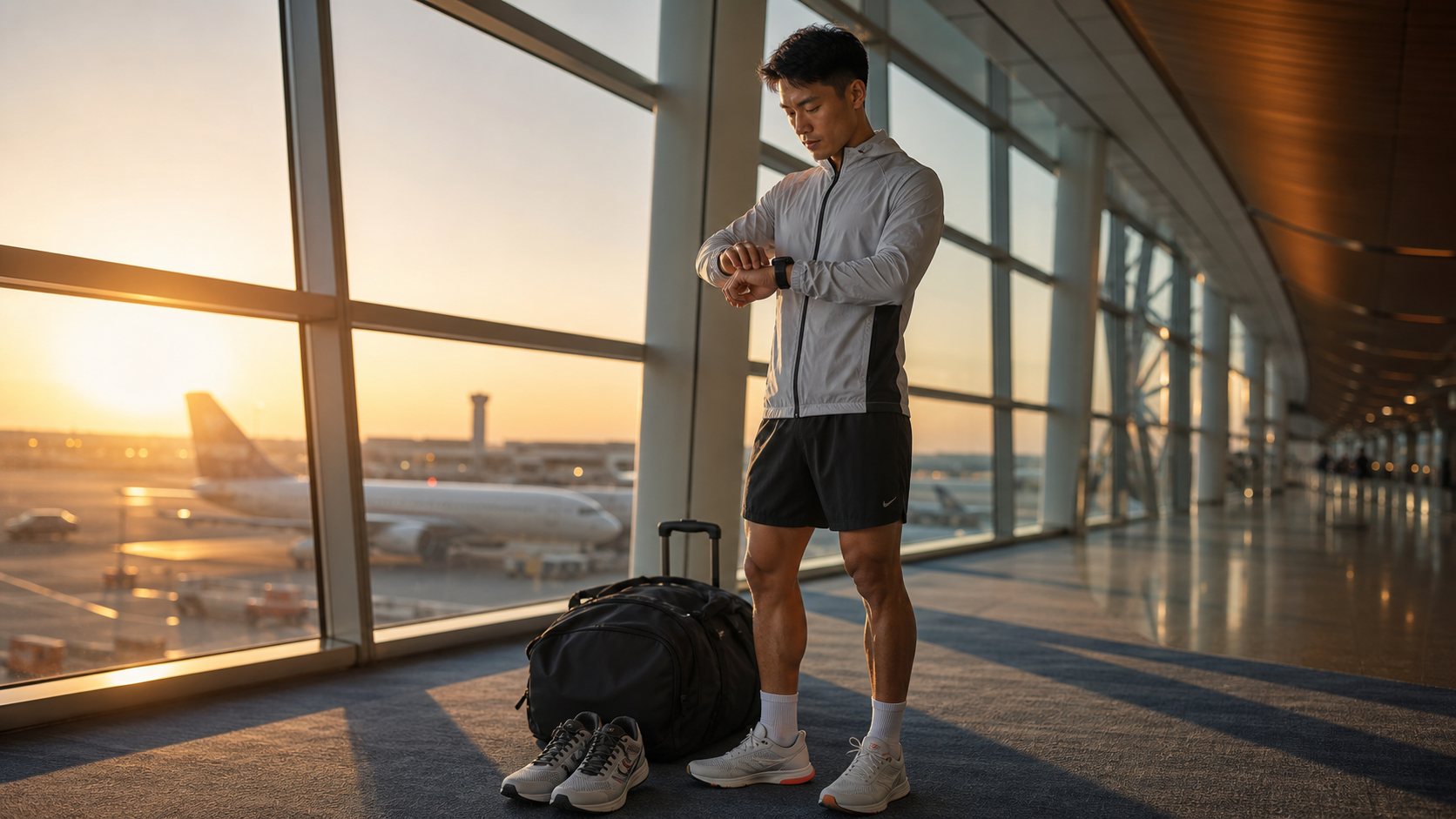
Opening: The Athlete Who “Slept at the Starting Line” at a Tokyo Race
I still remember, a few years ago, taking one of my athletes, Kobayashi, abroad for the Tokyo Marathon. She had prepared for a full six months—long runs, intervals, lactate threshold workouts—without skipping a single session. Her fitness was among the best I’d ever coached. But on race day, she completely “ran out of gas” at the 30-kilometer mark, her pace collapsing by nearly a minute. Afterward, she told me: “Coach, it wasn’t my legs that gave out—my brain felt like it was wrapped in fog, and I just couldn’t muster any drive.”
That experience made me truly treat “jet lag” as a component as critical as the training plan and nutrition in my coaching. Many people assume that racing across time zones just means “getting there a bit early to adapt,” but your biological clock has its own rhythm and rules. Pushing through, catching up on sleep haphazardly, or relying on caffeine overload often only makes things worse.
In this article, I want to distill fifteen years of experience coaching athletes through overseas races, combined with my ongoing reading of exercise physiology and chronobiology literature, into a cross-time-zone adjustment strategy that you can understand and actually use. Whether you’re heading to Japan or Europe for a cycling race, or flying to the U.S. for a marathon or a ball game, this guide will come in handy.
Let’s start with a core concept: Jet lag isn’t “fatigue”—it’s your body’s internal clock being out of sync with the external environment. Once you understand this, you’ll know why catching up on sleep doesn’t work, why flying east is especially brutal, and how to use light and melatonin—the two keys—to turn your clock to the right position.
Concepts and Scientific Foundations: You Have More Than One Clock in Your Body
What Exactly Is the Biological Clock
Inside our bodies, there’s a “master clock” located in the suprachiasmatic nucleus (SCN) of the brain’s hypothalamus. It acts like the conductor of an orchestra, governing a cascade of physiological rhythms—body temperature, hormone secretion, sleep-wake cycles, and more. This roughly 24-hour loop is called the circadian rhythm.
Interestingly, the human internal biological clock cycle is actually slightly longer than 24 hours (by a little over 24 hours). This small deviation is recalibrated daily by external “zeitgebers” (German for “time-givers”), of which light is the most powerful. This also explains a phenomenon many find confusing: why flying east is far more uncomfortable than flying west.
Why Flying East Is Especially Painful
Flying east (e.g., from Taiwan to the U.S. West Coast, or further east) means your day is “shortened”—your body must fall asleep and wake up earlier, which is called phase advance. Flying west (e.g., from Taiwan to Europe) means your day is “lengthened”—your body must delay its schedule, known as phase delay.
Because our natural cycle is already slightly longer than 24 hours, “lengthening the day and delaying the schedule” is relatively easy for the body; but “shortening the day and advancing the schedule” goes against instinct and is especially hard to adjust. Research literature consistently indicates that recovery after traveling east takes noticeably longer than after traveling west. This east-west asymmetry can even amount to a difference of several days when crossing multiple time zones.
This matters greatly for Taiwanese athletes:
- Taiwan to the Americas (eastward): The hardest to adjust; allow the most time.
- Taiwan to Europe, Africa (westward): Relatively easier.
- Taiwan to Japan, South Korea, Australia, Southeast Asia: Time differences are mostly within 1 to 3 hours, with less impact, but still not to be underestimated.
How Much Can the Biological Clock Shift Per Day
This is the most critical number in this entire article, so please remember it: Without any intervention, the human biological clock can only naturally adjust by about 0.5 to 1 hour per day.
In other words, if you cross 8 time zones, relying solely on your body to adapt slowly could take one to two weeks to fully reset. This is why “arriving two days early is enough” is completely inadequate for long-haul cross-time-zone races—two days will at best help you naturally adjust by one to two hours.
The good news is that when paired with properly timed light exposure and melatonin, the adjustment speed can be accelerated to several times the natural rate. This is the core of the practical strategies we’ll discuss next.
Jet Lag vs. Travel Fatigue: Two Different Things
Let me help clarify a common confusion here. The discomfort of racing across time zones actually comes from two independent sources:
- Jet lag: Caused by the biological clock being out of sync with local time; it requires resetting the clock to resolve.
- Travel fatigue: The tiredness from the long flight itself—prolonged sitting, dehydration, dry and low-oxygen cabin air, restricted movement, and aches from poor posture. This has nothing to do with the clock; drinking plenty of water, light activity after landing, and a good night’s sleep will ease it.
Many athletes conflate the two, thinking “I’ll feel better once I’ve slept enough.” But jet lag won’t automatically disappear no matter how much you sleep—it requires “turning the clock to the right position,” not “catching up on sleep hours.” Once you distinguish between the two, you won’t use the wrong approach.
Practical Methods: The Two Keys—Light and Melatonin
For adjusting the biological clock, I rely most heavily on two tools: light and melatonin. Timing them right is heaven; timing them wrong is hell—the same sunlight, when timed correctly, helps shift your clock, but when timed incorrectly, pushes it in the opposite direction.
Key One: Light Strategy
Light is the most powerful zeitgeber. The principle is simple, but you need to get the direction right:
- To phase advance (flying east, needing to wake earlier): Get bright light exposure in the morning, especially within the first hour after waking. Research shows that spending 15 to 30 minutes outdoors within the first hour after waking can roughly double the adaptation speed.
- To phase delay (flying west, needing to stay up later): Get light exposure in the evening to nighttime, and avoid bright light in the early morning.
A few key points about light:
- Higher intensity is more effective: Outdoor natural light is far stronger than indoor lighting; even an overcast outdoor setting is much brighter than indoors.
- Shorter wavelengths (bluer light) are more effective: This is also why the blue light from scrolling your phone before bed disrupts sleep.
- Longer duration yields greater effects: 15 minutes makes a difference; 30 minutes is even better.
Conversely, exposure to bright light during times when you shouldn’t be getting light will push the clock in the wrong direction. So for those flying east, actively seek morning sunlight in the first few days after arrival, but avoid bright light in the evening; for those flying west, do the opposite.
For Taiwanese athletes, there’s a ready-made advantage: our sunlight is generally abundant. Even back in Taiwan, you can use morning outdoor walks or cycling warm-ups as a “pre-light exposure” adjustment. Once at your destination, schedule your morning warm-up or easy run outdoors—two birds with one stone.
Key 2: Melatonin Strategy
Melatonin is a hormone secreted by the brain’s pineal gland after dark, serving as the body’s internal signal that “it’s dark, time to sleep.” Supplementing melatonin can help push the clock in the direction we want, but its timing matters more than its dosage.
Key principles:
- Take it from late afternoon to bedtime: Helps with phase advance (suitable for eastward travel).
- Take it in the early morning (a few hours after waking): Helps with phase delay (suitable for westward travel)—but this is a more advanced use, and it causes drowsiness, making it impractical for those who need to be active or race during the day. It’s rarely used in practice.
Regarding dosage, the literature has a crucial and counterintuitive point: lower doses are often better than higher ones. Common research doses range from 0.5 mg (physiological dose) to 3 mg (pharmacological dose), and most guidelines recommend 1 to 3 mg of the immediate-release form. Excessively high doses or extended-release versions may linger in the body too long, further disrupting the clock or causing next-day grogginess.
The table below summarizes common dosage and timing references. Please note this is general educational reference, not a personal prescription for you:
| Purpose | Timing | Common Dosage Range | Applicable Scenario |
|---|---|---|---|
| Phase advance (eastward) | Before the new, earlier local bedtime | 0.5–3 mg immediate-release | Taiwan to the Americas |
| Phase delay (westward, advanced) | Early morning, a few hours after waking | 0.5–3 mg immediate-release | Taiwan to Europe (less common, causes drowsiness) |
| Pure sleep aid, not for clock adjustment | 30–60 minutes before bed | 0.5–3 mg | Short-term insomnia after arrival |
Important reminder: In Taiwan, melatonin is classified as a pharmaceutical drug and requires a physician’s prescription; it is not an over-the-counter supplement freely available in supermarkets as it is in the US. If you plan to use it, be sure to consult a doctor first, especially if you have chronic conditions, are taking medication, or are pregnant or breastfeeding. Do not bring large quantities back from abroad for self-use.
Other Supporting Tools
Beyond the two main keys, a few supporting players can help:
- Caffeine: Can help maintain alertness during the day and combat drowsiness, but timing matters—generally, it’s recommended to avoid caffeine at least 6 hours before bedtime to avoid disrupting nighttime sleep. Caffeine’s half-life is about 5 hours, with individual variation in metabolism.
- Exercise timing: Moderate exercise itself has a mild clock-shifting effect and can combat travel fatigue. Scheduling outdoor training at the right time after arrival lets you reap the dual benefits of light exposure and exercise.
- Meal timing: Eating is also a zeitgeber. Try to eat according to local meal times to help your gut and metabolic clock catch up.
- Short naps: If you really can’t hold on after arrival, a nap is fine but keep it to 20–30 minutes to avoid entering deep sleep, which makes waking up harder—and don’t nap close to local nighttime.
Adjusting the Schedule: Start Before Departure
Many people think jet lag adjustment is “deal with it when you get there,” but my principle for athletes is—the clock should start turning before you leave. This is called “pre-adjustment,” and it can significantly shorten the adaptation period after arrival.
Here’s a concrete schedule demonstration. Assume a Taiwanese cyclist is flying to Europe for a race (westward, crossing about 6 to 7 time zones):
Scenario 1: Westward Flight (Taiwan→Europe, Phase Delay)
| Time Point | Sleep/Wake Adjustment | Light Exposure | Other |
|---|---|---|---|
| 3–4 days before departure | Delay bedtime and wake time by about 30–60 minutes each night | Get more light in the late afternoon, avoid bright light in the morning | Shift meal times later accordingly |
| During the flight | Decide whether to sleep based on destination schedule | Adjust eye mask use based on direction | Hydrate heavily, avoid excess alcohol and caffeine |
| Days 1–3 after arrival | Follow local schedule as much as possible | Get sunlight in the late afternoon, avoid overly bright light early morning | Schedule training in the local afternoon |
The advantage of flying west is that it “follows the body’s natural instinct,” and you can usually adapt well within 3 to 5 days.
Scenario 2: Eastward Flight (Taiwan→Americas, Phase Advance)
This is the hardest direction and requires earlier, more aggressive pre-adjustment:
| Time Point | Sleep/Wake Adjustment | Light Exposure | Melatonin (requires physician guidance) |
|---|---|---|---|
| 3–5 days before departure | Advance bedtime and wake time by about 30–60 minutes each night | Actively get sunlight in the early morning, avoid bright light in the evening | Consider 0.5–3 mg before the new, earlier bedtime |
| During the flight | Try to sleep during the destination’s nighttime hours | Manage light exposure according to destination time | Per medical advice |
| Days 1–5 after arrival | Sleep early and wake early, following local time | Get 15–30 minutes of outdoor morning light within one hour of waking | Per medical advice, before local bedtime |
Because flying east goes against the body’s instinct, when crossing 6 to 9 time zones, full adaptation may take 5 days to over a week. So for important races, I usually recommend arriving several extra days early when flying east.
A Practical Arrival-Time Principle
There’s a rough formula for estimating “how many days you need to adapt”: the number of time zones crossed—for eastward flights, roughly equal to the number of days; for westward flights, about two-thirds to half the number of time zones. For example, crossing 6 time zones eastward, plan for 5 to 6 days; westward, plan for 3 to 4 days. This is only an estimate; actual results vary by individual.
Common Mistakes and Corrections
Having coached athletes for so many years, I’ve seen all kinds of pitfalls. Here are the most common ones, along with corrections:
Mistake 1: “Catch Up on Sleep Immediately After Landing”
Many people are exhausted getting off the plane and crash for hours. If this sleep falls during “local daytime,” you’re going against the direction you’re trying to shift, pushing the clock further off, and making it even harder to sleep at night.
Correction: After arrival, try to hold out until local evening before sleeping. If you truly can’t, take a 20–30 minute nap—don’t sleep for hours on end.
Mistake 2: Getting Light Exposure Timing Backwards
Some athletes hear “sunlight helps adjust jet lag,” but then flying east, they desperately soak up the sunset in the evening, pushing the clock toward delay—exactly opposite to their goal.
Correction: First figure out whether you need to “advance” or “delay.” Flying east means get morning light, avoid evening light; flying west means get evening light, avoid morning light. Get the direction wrong, and the more effort you put in, the worse it gets.
Mistake 3: Treating Melatonin Like a Sleeping Pill and Overdosing
Melatonin is not a sleeping pill; it’s a “clock-shifting signal.” Some people take 10 mg at once, even extended-release versions, and end up groggy the next day with an even more disrupted clock. And in Taiwan, it’s a prescription drug—self-medicating in large amounts carries risks.
Correction: Low dose (0.5 to 3 mg), immediate-release, and correct timing. Always consult a physician first, especially if you have chronic conditions or are on medication.
Mistake 4: Relying on Alcohol to Sleep
Drinking on the plane or after arrival to help fall asleep. Alcohol may help you fall asleep faster, but it destroys sleep quality in the second half of the night and worsens dehydration, compounding travel fatigue.
Correction: During the flight and early after arrival, stick mainly to water and cut back on alcohol. Use other methods to relax.
Mistake 5: Thinking About Jet Lag Only on Race Day
The most regrettable case is the example of Lin from the opening of this article—all the training was done right, but jet lag wasn’t taken seriously, and it was a last-minute scramble upon arrival.
Correction: Build jet lag adjustment into your entire race preparation plan, starting pre-adjustment 3 to 5 days before departure. This is just as important as your training schedule.
Actionable Advice for Readers at Different Levels
General Sports Enthusiasts (Traveling for Marathons, Cycling Tours, Amateur Races)
If you just want to perform decently at an overseas event and have fun, three principles are enough:
- Switch to local time as quickly as possible: Eat and sleep according to local time.
- Use light wisely: Spend time outdoors during the day; remember—eastward flights, get morning light; westward flights, get evening light.
- Don’t push through exhaustion, and don’t oversleep: When tired, nap for 20–30 minutes, then hold out until local evening for proper sleep.
Melatonin is not essential for you; if you really want to use it, ask a doctor first. Most mild jet lag can be handled well with light exposure and sleep scheduling alone.
Serious Amateur Competitors (with Clear Performance Goals)
You need to be more systematic:
- Start pre-adjusting 3 to 5 days before departure: Shift your sleep schedule 30 to 60 minutes toward the target time zone each night.
- Calculate arrival time carefully: Allow more days when flying east. For a 6-time-zone eastward crossing, allow 5 to 6 days to adapt; for westward, allow 3 to 4 days.
- Align training with light exposure windows: Schedule outdoor training during periods when you can get the “right kind of light” at the right time.
- Consider low-dose melatonin: Only after evaluation and guidance from a physician.
- Avoid high-intensity training before the race: Your body is more vulnerable during the adaptation period—don’t schedule heavy workouts immediately upon arrival.
Elite and Professional Athletes (Performance Affects Livelihood)
At this level, jet lag management should be handled as professionally as equipment and nutrition:
- Work with a sports medicine team: Have physicians and exercise physiologists create individualized light exposure and melatonin protocols.
- Leverage technology: Many apps now calculate personalized light and melatonin schedules based on your itinerary, time zones, and chronotype.
- Monitor objective metrics: Such as morning heart rate, heart rate variability (HRV), and sleep tracking to assess adaptation progress.
- Arrive even earlier for major events: For long eastward trips, consider arriving a week or more in advance.
Local Tips for Taiwan
- Don’t overlook “reverse jet lag” upon returning home: Many people only manage the outbound trip, only to face another wave of jet lag back in Taiwan. If work or training follows, use light exposure and sleep scheduling to readjust gradually.
- Meal timing for those who eat out: Eating out is convenient in Taiwan. When pre-adjusting before a trip, shifting meal times to match the target time zone isn’t difficult—take advantage of this.
- Medical consultation and medication: Melatonin is a prescription drug in Taiwan. If you plan to use it before traveling abroad, book an appointment with a family medicine or travel medicine clinic early. Those with chronic conditions should plan ahead.
- Make the most of Taiwan’s abundant sunlight: For morning or evening outdoor training during the pre-adjustment period, Taiwan’s good weather is a natural resource—use it well.
In-Depth Case Studies: Full Breakdown of Three Common Scenarios
Principles alone are too abstract. Let me walk you through three scenarios I’ve actually coached (details anonymized) to show how the whole process works in practice. The case scenarios are for instructional demonstration only; all values are within general physiological ranges and do not constitute individual medical advice.
Case 1: Amateur Triathlete, Taiwan to US West Coast (Eastward, ~15/16 Time Zones)
This athlete, A-Zhe, was competing in a long-distance triathlon on the US West Coast. The nominal time difference from Taiwan to the US West Coast is about 15 to 16 hours, but since it exceeds 12 hours, in practice we treat it as “crossing about 8 to 9 effective time zones eastward” (because adjustment can be routed in the shorter direction). This is the hardest kind.
My approach was:
- Start pre-adjustment 5 days before departure: Advance bedtime and wake time by 30 to 45 minutes each day. First night, from the usual 23:00 to 22:15; second night, 21:30, and so on. At the same time, get 20 to 30 minutes of outdoor morning light immediately after waking each day.
- During the flight: Set your watch to US West Coast time right after boarding—mentally “move over” first. Decide whether to sleep on the plane based on local arrival time—his flight arrived in the local evening, so I had him take a light nap in the latter half of the flight, not a full sleep.
- After arrival: Hold off until about 22:00 local time before going to bed for the night. For 5 consecutive days, get outdoor morning light and a light jog as a warm-up. For melatonin, he had been evaluated by a family medicine physician before departure and was permitted to use a low-dose fast-release formulation before local bedtime.
- Race preparation: I scheduled his arrival 7 days before race day, giving his body enough time to complete most of the adaptation. The last 2 days before the race were only light activity and warm-ups, with no intensity.
He stayed mentally sharp throughout the race, and his pacing across swim, bike, and run was all within plan. His most memorable takeaway afterward: “So jet lag is something you can ‘start preparing for in advance.’”
Case 2: Cycling Enthusiast, Taiwan to Europe (Westward, ~6 to 7 Time Zones)
A-Hua was heading to Europe for a classic gran fondo cycling event. Westward travel is relatively easier to adjust to, but he made a typical mistake—the first time he went, he did zero pre-adjustment. He was exhausted by noon on arrival day, crashed for 4 hours, and then stayed awake all night. The next two days were completely day-night reversed.
The second time, I helped him replan:
- 3 days before departure: Push bedtime back 45 to 60 minutes each night. Following your body’s natural tendency to delay is actually not that painful.
- Arrival day: When the midday sleepiness hit, he was only allowed a 25-minute nap, then I sent him outside for a walk and evening light exposure. He held out until about 22:30 local time before sleeping.
- Take advantage of Europe’s long daylight: In summer, European evenings stay light late, which helps with phase delay. I asked him to spend more time outdoors in the evening.
The second time, he was mostly adapted within two days and was fully on form for the event. The key phrase for westward travel is: Don’t take random catch-up naps during the day—just follow your body’s natural delay.
Case 3: Recreational Runner, Taiwan to Japan (Eastward, 1 Time Zone)
Many people think flying to Japan involves no jet lag, but Japan is actually 1 hour ahead of Taiwan. The time difference itself has minimal impact—the real issues are usually travel fatigue plus pre-race excitement causing poor sleep.
This runner, Xiao-Mei, was a classic case: jet lag wasn’t the problem, but she was too excited the night before, and combined with an unfamiliar hotel pillow, she only slept 4 hours. My advice focused not on clock adjustment but on:
- Getting moderate daylight exposure and light activity during the day to stay alert.
- Not panicking about a poor night’s sleep before the race—in sports science, a single bad night’s sleep before a race has far less impact on performance than chronic sleep deprivation. Relaxing actually helps you fall asleep.
- Bringing your own familiar pillowcase, earplugs, and eye mask to reduce environmental disruption.
This case teaches us: Crossing time zones doesn’t always mean a jet lag problem. First determine whether you’re dealing with jet lag, travel fatigue, or sleep anxiety, then treat the right cause.
Time Difference Reference for Common Destinations from Taiwan
To help everyone estimate more easily, I’ve compiled a reference table for common overseas race destinations from Taiwan (UTC+8), including time differences and direction. Actual time differences are affected by daylight saving time—please confirm whether the destination observes DST before departure.
| Destination | Approximate Time Difference | Direction | Adjustment Difficulty | Recommended Arrival Lead Time |
|---|---|---|---|---|
| Japan, South Korea | +1 hour | Slightly eastward | Very low | 1 day |
| Eastern Australia | +2 hours | Eastward | Low | 1–2 days |
| Thailand, Vietnam | −1 hour | Slightly westward | Very low | 1 day |
| Middle East (Dubai, etc.) | −4 hours | Westward | Low to moderate | 2–3 days |
| Western Europe (France, Italy, etc.) | −6 to −7 hours | Westward | Moderate | 3–4 days |
| US West Coast | Effectively ~8–9 zones eastward | Eastward | High | 5–7 days |
| US East Coast | Effectively ~11–13 zones eastward | Eastward | Highest | 6–8 days |
Looking at this table, you’ll notice a pattern: Westward destinations (Europe, Middle East) are generally less difficult than eastward destinations (Americas) with a comparable number of time zones. This is the practical manifestation of the east-west asymmetry mentioned earlier.
More on Physiology: The Body Temperature Minimum and the “Turning Point for Adjustment Direction”
Here’s an advanced but practical concept that can help you more precisely determine which time window to get light exposure.
The body has a key physiological reference point: the core body temperature minimum (CBTmin), which typically falls about 2 to 3 hours before your usual wake-up time (for example, if you normally wake at 6:00 AM, your CBTmin is roughly between 3:00 and 4:00 AM). This point is the dividing line where the effects of light exposure reverse:
- Bright light exposure after CBTmin → tends to shift the clock earlier (suitable for eastward travel).
- Bright light exposure before CBTmin (i.e., late at night, before dawn) → tends to shift the clock later (suitable for westward travel).
This explains a practical detail: for eastward flights, “getting light as soon as dawn breaks” is usually correct (because that’s already past CBTmin); but if you’re exposed to bright light too early, in the middle of the night before dawn, it may actually push your clock later, backfiring. So I often remind athletes flying east: get morning light, but not “middle-of-the-night light”—wait for natural daylight after sunrise.
When crossing many time zones (more than 8 or 9), the position of CBTmin relative to local time becomes very difficult to estimate. This is why elite athletes on ultra-long-haul, multi-time-zone trips tend to rely on professional apps or sports medicine teams for precise calculations rather than guessing by feel.
The Interaction Between Nutrition, Training, and Jet Lag
Jet lag doesn’t just affect sleep and alertness—it also impacts your metabolism, digestion, and training response, and these points are often overlooked:
Your Gut Clock Needs Resetting Too
The digestive system has its own rhythm. Right after crossing time zones, your gut may still be on Taiwan time, causing no appetite at local meal times but hunger pangs in the middle of the night. Forcing down large amounts of pre-race carbs while your gut “isn’t awake yet” can easily lead to bloating and diarrhea.
What to do: After arrival, eat according to local meal times as soon as possible. Even if you don’t have much appetite, eat a little—use “eating” as a zeitgeber to help reset your gut. Your pre-race carbohydrate loading plan should also be calculated backward from local time.
Reduce Training Intensity During the Adjustment Period
Right after arrival, before your clock has adjusted, your coordination, reaction time, and maximal output may all be slightly reduced. Scheduling high-intensity sessions at this point won’t produce results and increases injury risk.
What to do: For the first 1 to 3 days after arrival, focus on easy movement, technical drills, outdoor jogs, or easy rides (which both aid adaptation and provide light exposure). Save quality sessions until your body has adjusted.
Hydration and Electrolytes
The dry cabin air on long flights causes dehydration, and dehydration itself amplifies fatigue, which can be mistaken for jet lag. After arrival, keep up with fluids and electrolytes. Taiwanese athletes accustomed to sports drinks or salt candies can bring familiar brands abroad.
Quick Q&A (FAQ)
Q: Do I need special adjustment for only 1 to 3 time zones (e.g., Japan, Australia)?
A: The impact is usually minor; most people adapt within a day or two. However, for important races, it’s still recommended to arrive a day or two early, follow local routines, and manage travel fatigue.
Q: Can sleeping pills replace melatonin?
A: They work differently. Sleeping pills make you “fall asleep,” while melatonin “adjusts the clock.” Any prescription medication must be under a physician’s guidance, and athletes must be mindful of anti-doping rules and side effects during competition.
Q: Should I sleep on the plane or not?
A: It depends on your destination time. If you arrive at local nighttime, sleeping on the plane helps; if you arrive during local daytime, don’t sleep too much on the plane. Use eye masks, earplugs, and light management to align with destination time.
Q: How many days does jet lag take to resolve?
A: Without intervention, the body naturally adjusts about 0.5 to 1 hour per day. With light exposure and melatonin, this can be accelerated several-fold. Eastward takes longer than westward, and the more time zones crossed, the longer it takes.
Q: Can caffeine cure jet lag?
A: Caffeine can help keep you alert during the day and combat drowsiness, but it cannot truly “reset the clock,” and it should be avoided within 6 hours of bedtime to prevent disrupting nighttime sleep.
Q: I’m a night owl / early bird—does my chronotype affect adjustment?
A: Yes. People naturally inclined to sleep late find westward phase delays relatively easier; those naturally inclined to wake early find eastward phase advances less difficult. Knowing your chronotype helps you anticipate which direction will be especially hard for you and plan extra buffer days in advance.
Q: How long until I’m back to normal after returning to Taiwan?
A: The return trip also involves jet lag, and recovery speed is similarly affected by direction and number of time zones. If you need to work or train the next day after returning, follow the same principles—outdoor morning light after waking, Taiwan-time routine, no random naps during the day—and adjust gradually. Don’t underestimate reverse jet lag.
Conclusion: Treat Jet Lag as a Trainable Skill
Back to Xiao Lin’s story at the beginning. The following year, she took on another overseas marathon. This time, we planned a week ahead—pre-adjusting her schedule before departure, taking her outside for morning light and easy jogs every day after arrival, and fully switching to local time. On race day, she ran a personal best and told me with a smile afterward: “Coach, my head was clear this time.”
The difference wasn’t fitness—it was that we turned “jet lag” from an unpredictable variable into a controllable part of the plan.
The physiology of cross-time-zone racing, in a nutshell, is: understand your body’s clock, use the two keys of light exposure and melatonin, and start turning your clock to the right position before you depart. When the direction is right, you can perform at your true level even abroad; when it’s wrong, even the best training gets clouded over.
Treat jet lag as a skill that can be trained and prepared for, not a matter of luck. Wishing you success at your next overseas race—body there, mind there, and form there.
This article is educational content and does not replace individual diagnosis or treatment advice from physicians, physical therapists, or nutritionists. Melatonin is a prescription medication in Taiwan. Before using any supplement or medication, please consult a qualified healthcare professional, especially if you have chronic conditions, are taking medication, or are pregnant or breastfeeding. Competitive athletes should also be aware of anti-doping regulations.
References
- Timeshifter — The Science of Jet Lag: https://www.timeshifter.com/jet-lag/the-science-of-jet-lag
- Timeshifter — Melatonin for Jet Lag: Type, Dose, Timing: https://www.timeshifter.com/jet-lag/melatonin-for-jet-lag-type-dose-timing
- Eastward Jet Lag is Associated with Impaired Performance and Game Outcome in the NBA (PMC): https://pmc.ncbi.nlm.nih.gov/articles/PMC9245584/
- Melatonin for the prevention and treatment of jet lag (PMC/NIH): https://pmc.ncbi.nlm.nih.gov/articles/PMC8958662/
- Interventions to Minimize Jet Lag After Westward and Eastward Flight (Frontiers in Physiology): https://www.frontiersin.org/journals/physiology/articles/10.3389/fphys.2019.00927/full
- Jet Lag Disorder — CDC Yellow Book: https://www.cdc.gov/yellow-book/hcp/travel-air-sea/jet-lag-disorder.html
Related Reading
- Managing Jet Lag for Races Across Time Zones: A Sleep Adjustment Guide for Competing Abroad
- Melatonin and Sleep Supplements for Athletes: A Complete Guide to Usage, Jet Lag Applications, and Safety
- Nutritional Adjustments During Travel and Jet Lag: Eating Rhythms and Gut Adaptation for Cross-Time-Zone Events
- Chronobiology and Athletic Performance: The Moment You Are Strongest in a Day
西進武嶺 免費訓練分析服務 Intervals | 練不夠還是練過頭?你哪一種類型選手?AI模型告訴你! | 備戰神器 | 公路車 訓練 | CT Yeh
4 年前
西進武嶺 自製新版AI配速表產生器 x 賽前攻略 抱佛腳! 沒有功率計也可以產生配速表嗎?有什麼其他眉角賽前要注意的呢? | 西進武嶺 / 東進武嶺 KOM 攻略 | 公路車 | CT Yeh
4 年前
FTL 與 SYB 車隊專訪 西進武嶺 實用攻略分享! 2小時 如何練?!你不知道的眉角!新手準備武嶺必看 EP1 | 實力派女車友 | 精華版 | 公路車 | CTYeh
4 年前
#公路車 #Fitting 靠人工智慧APP 幫你調整單車
6 年前
單車AI教練!全新 ChatGPT4o 幫你分析訓練成果!排武嶺課表,分析騎車姿勢! 太神了! / 公路車 / CT Yeh / feat. 緯緯
2 年前
一日北高前的高裝檢 | 北高 360 | 挑戰11小時的裝備 | 一日雙塔 | 補給
6 年前
單車 一日北高 ( 雙城 ) 肥宅雙人瘋狂行 紀錄片 REACTO
10 年前
2016 桐花飛舞 單車挑戰 精華片段
10 年前