First, a Scene I Witnessed Firsthand
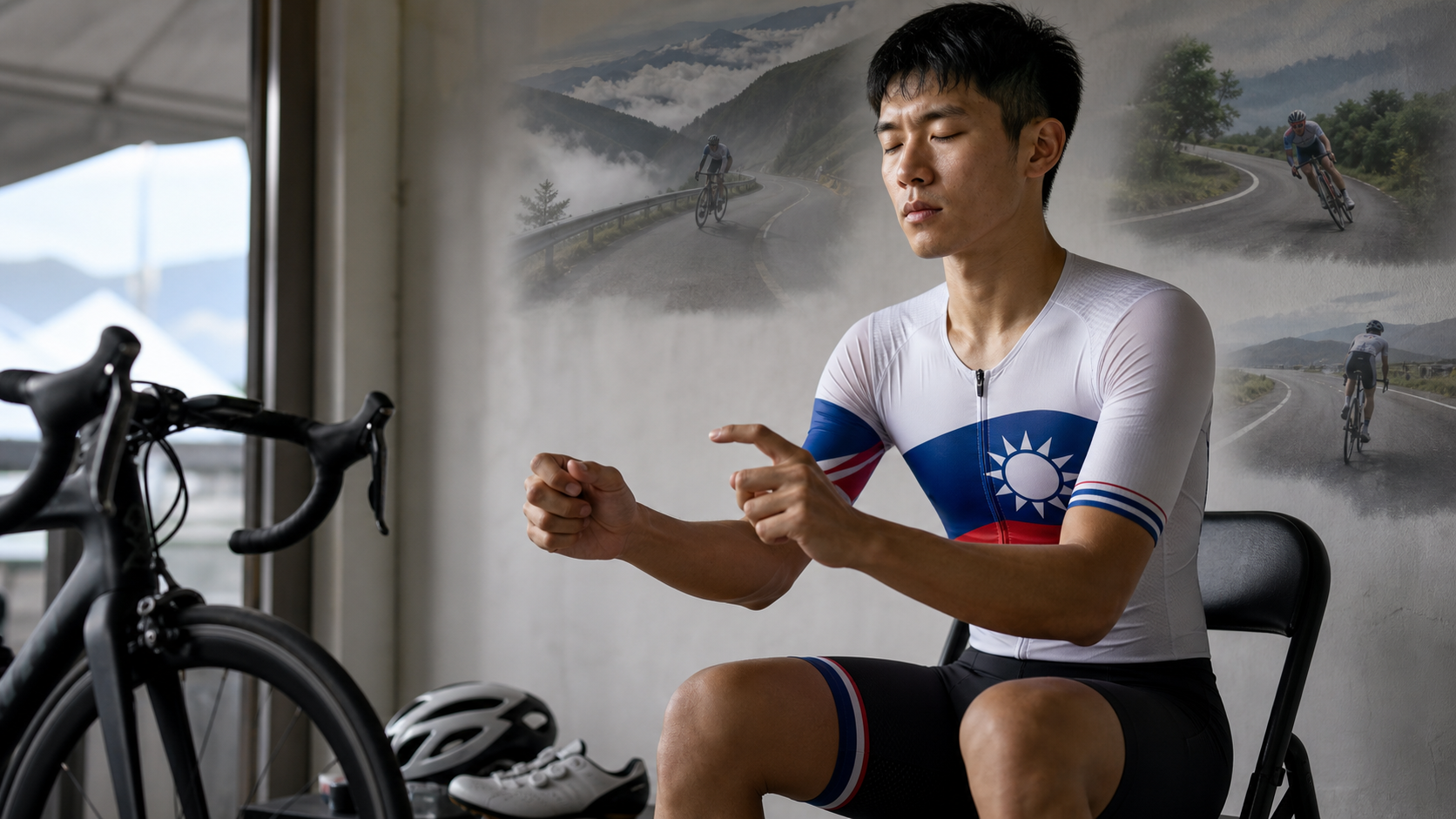
A few years ago, at the start of a domestic time trial, I watched a rider—let’s call him A-Kai—find a corner to sit in after checking in. He wasn’t scrolling his phone or chatting with anyone. Instead, he closed his eyes, held his hands as if gripping the handlebars, leaned slightly forward, and occasionally his right index finger would twitch—he was simulating gear shifts. For a full eight minutes, he “rode the entire course while sitting still.” When he opened his eyes, I asked him what he was doing. He said, “I rode the whole route in my head—every corner, what gear to use on each climb, where to stand and sprint. I ran through all of it once.”
A-Kai’s performance that day was remarkably steady. He wasn’t the strongest rider there, but he brought out 100% of what he had, without fumbling at any technical point. That experience got me seriously reading the literature on motor imagery. As a coach who has worked with athletes at all levels, as well as countless office workers who only find time to ride after work, my biggest question is simple: Is practicing in your mind just psychological comfort, or can it genuinely make you a better rider?
In this article, I want to organize what I’ve read over the past decade-plus and what I’ve actually applied with my athletes. I’ll cover the science, but more importantly, I’ll talk about “what you can do tonight.” Because no matter how elegant the theory, if you don’t know how to fit it into the training reality of Taiwan—hot, humid, you’re exhausted after work, and weekend venues are often crowded—it’s all useless.
What Is Motor Imagery? It’s Different from “Imagining”
Let’s clarify the terminology first. In everyday language, “imagining” is usually loose—you can imagine yourself standing on the podium, imagine holding a trophy; that’s a visual daydream. But in sports science, motor imagery refers to “rehearsing” a specific movement or skill in your mind without actually executing it, and it should reproduce the details of the movement, the physical sensations, and the force output as faithfully as possible.
There’s a key distinction here that often gets confused:
- Visual imagery: You “see” yourself performing the movement, like watching a video.
- Kinesthetic imagery: You “feel” yourself performing the movement—the tension in your quadriceps as you pedal, the vibration through the handlebars, your heart rate rising, your breathing getting heavier.
For athletic performance, kinesthetic imagery is often more powerful than purely visual imagery. Because it’s not just a picture; it also summons the “physical sensations,” bringing it closer to the imprint real movements leave on the nervous system. A-Kai’s finger twitching and forward lean that day were outward signs of kinesthetic imagery—he wasn’t “watching” himself ride; he was “riding in the moment.”
So Does It Actually Work? First, Look at What’s Happening at the Neural Level
This is the most hardcore—but also most convincing—section of the entire article. Over the past two-plus decades, brain imaging studies (fMRI, fNIRS, etc.) have repeatedly found one thing: When you imagine a movement, the brain regions activated significantly overlap with those activated when you actually perform that movement.
According to a synthesis of multiple brain imaging studies, motor imagery activates regions including the supplementary motor area (SMA), premotor cortex, primary motor cortex (M1), posterior parietal cortex, basal ganglia, and cerebellum—precisely the core network used for movement preparation and execution. In other words, “riding in your head” isn’t pure fantasy; part of your motor system is genuinely being awakened and put into a “ready to exert force” state. This concept is known in the literature as the functional equivalence hypothesis: imagery and real movements engage similar neural mechanisms.
However, as a coach who doesn’t want to mislead my athletes, I have to be complete here—this overlap is “partial,” not “complete.” Recent research also reminds us that imagery and actual execution are not 100% equivalent: some studies have found that during imagery, activation in certain brain regions can even be more effortful than during actual movement (because without real sensory feedback, the brain has to sustain the entire simulation on its own), and motor cortex activity during imagery is more like a “reorientation of neural dynamics” than a direct replica of execution.
This “partial overlap” conclusion has two very important practical implications:
- Imagery works because it genuinely trains the same neural circuits—so it can consolidate technique and strengthen movement automation.
- Imagery cannot replace actual riding—because without real muscular load, balance challenges, and sensory feedback, your “hardware”—cardiopulmonary fitness, strength, tendon resilience—will not get stronger from imagining. Imagery polishes the “software”; it doesn’t upgrade the “hardware.”
I often use this analogy with my athletes: actual riding builds the engine—muscles, heart, lungs. Imagery is like rewriting smoother firmware for the brain’s “engine control unit.” They have different roles, and you need both.
PETTLEP: Seven Elements to Make Mental Practice “Feel Real”
Once we know imagery works, the next question is: How do you imagine correctly?
This is where the most practical operational framework in sports psychology comes in—the PETTLEP model proposed by Holmes and Collins. The core idea is simple: the closer your imagery is to the real situation, the higher the “functional equivalence” in the brain, and the better the training effect. PETTLEP is an acronym for seven elements. I’ve organized them into the table below, with specific cycling applications.
| Element | English | Core Concept | Specific Cycling Application |
|---|---|---|---|
| Physical | Physical | Position your body as close to the real movement as possible | Sit on the trainer or at least adopt a riding posture, hands on the bars, lean forward; actually rise slightly when imagining a sprint |
| Environment | Environment | The imagined environment should match the actual race/training venue | If imaging Wuling, first look at photos or videos of that section, recall the corners and gradients; wearing a helmet can increase realism |
| Task | Task | Reproduce the real physical and eye movements, muscle tension, heart rate | While imagining, simultaneously “feel” the leg effort, heart rate rising, breathing getting heavier—not just watching a picture |
| Timing | Timing | Rehearse at real speed, not in slow motion | A climb expected to take 8 minutes should take close to 8 minutes in imagery, not fast-forwarded or slowed down |
| Learning | Learning | As your skill improves, update the imagery content | After technical improvements, update the movement version in your mind; don’t keep rehearsing old, incorrect movements |
| Emotion | Emotion | Bring in the real excitement and tension of the situation, but avoid negative emotions | Imagine the thrill of crossing the line, the focus of climbing, but don’t keep rehearsing the fear of “blowing up” or “crashing” |
| Perspective | Perspective | First-person is more effective for most tasks, but there are exceptions | Use first-person for technical movements (cornering, sprinting); use third-person when reviewing overall posture |
You don’t need to hit all seven elements every time, but at minimum, you should nail the three core ones: ‘Physical, Timing, Task.’ I’ve seen too many people close their eyes and randomly imagine with “fast-forward, slow motion, just watching pictures”—that’s far from real imagery training, and the results naturally suffer.
Why Is “Realistic Timing” So Important?
This is the most common mistake and also the easiest to fix. Many athletes unconsciously “fast-forward” the route in their heads—finishing a five-kilometer climb in thirty seconds. But both research and practice indicate that the duration of imagery should closely match the duration of the real movement. Because rhythm itself is part of motor memory: when to shift gears, when to adjust breathing, how many seconds a sprint should last—if these “time sensations” are compressed, you’re not training the actual skill.
I ask my athletes to use a stopwatch and actually time their imagery. First-timers often discover, “Hey, why is my mental version so much faster than reality?” That’s room for improvement. When you can rehearse a section at “real speed,” your imagery quality has taken a step up.
Practical Plan: A Four-Week Imagery Program You Can Follow
Enough theory—here’s something you can use directly. Below is a four-week imagery plan I designed for an intermediate rider preparing to challenge “One-Day Taipei to Kaohsiung.” He only needed an extra 10 to 15 minutes per day, on top of his regular riding training.
| Week | Duration per Session | Frequency | Imagery Content Focus | Key PETTLEP Elements |
|---|---|---|---|---|
| Week 1 | 5–8 min | 4x per week | Build basic visualization: first be able to clearly “see” yourself riding, the handlebars, the road | Physical, Environment |
| Week 2 | 8–10 min | 4–5x per week | Add kinesthetic feel: feel leg effort, breathing, heart rate; image a single technical point (e.g., cornering) | Task, Perspective |
| Week 3 | 10–12 min | 5x per week | Image a full race segment in real time; add fueling and gear-shift decisions | Timing, Learning |
| Week 4 | 12–15 min | 5–6x per week | Full-course scenario rehearsal, including start-line nerves, mid-ride fatigue, and the finish sprint; bring in emotion | Emotion, Full integration |
A few practical reminders:
- Do it when you’re awake and focused, not when you’re drowsy before bed—that easily becomes relaxation meditation rather than imagery training (of course, a relaxation version before bed has its value, but that’s a different matter).
- You can pair it with a trainer. Sit on the trainer, set your posture, even spin lightly for a few revolutions, then close your eyes and do imagery. This maximizes the “Physical” element of PETTLEP, and results are usually better.
- Image the “correct” movement. If you’re changing a technique (e.g., cornering visual guidance), image the “improved” version, not the old mistake—otherwise you’re just reinforcing a bad habit.
- Handle failure scenarios carefully. Moderately rehearsing “how to respond when something goes wrong” is useful (e.g., calmly dealing with a dropped chain), but don’t dwell on images of “crashing, blowing up, failing”—that feeds anxiety instead.
Imagery Isn’t Just for Technique: Three Often-Overlooked Uses
Many people think imagery is only for technical movements like cornering or sprinting, but its applications are much broader.
1. Maintaining Neural Connections When Injured or Unable to Ride
This is what I think is the most undervalued benefit of imagery. Given Taiwan’s road conditions, weather, and the fact that many people combine commuting with exercise, injuries or periods of not riding are inevitable—a broken collarbone, knee inflammation, or simply two weeks of continuous rain in the plum rain season. In these situations, imagery training can continuously “remind” the brain of those movement patterns without moving the injured part, slowing the degradation of technique and neural connections.
This has a solid foundation in rehabilitation contexts (imagery and real movements share some neural circuits, as mentioned earlier). But I want to be very clear: imagery is a supplement, not a treatment. Any rehabilitation plan for an injury must be arranged by your physician or physical therapist based on your individual situation. Don’t decide how to train on your own just from reading an article.
2. Pre-Race Emotional Regulation and Focus
Back to A-Kai at the beginning. What he was doing wasn’t just technical rehearsal; it was also a form of pre-race emotional and focus management. When you direct your attention to “how am I going to ride this road in a moment,” you don’t have spare mental capacity for wandering thoughts or nervousness. This is a very practical psychological benefit of imagery: channeling anxious energy into a concrete action plan.
3. Decision Rehearsal: Gear Shifts, Fueling, Pacing
When exactly should you shift to the easiest gear on a long climb? When should you eat or drink? If you have to make these decisions on the fly, it’s easy to get them wrong or miss the timing. Through imagery, you can “run through” these decision points in your mind many times. When you’re actually there, your body will have a sense of “I’ve done this before,” making your reactions faster and calmer.
Common Mistakes and Corrections
Having coached for so many years, I’ve found that people tend to fall into highly repetitive pitfalls. I’ve organized them into the comparison table below for self-checking.
| Common Mistake | Why It’s a Problem | How to Fix It |
|---|---|---|
| Only “watching pictures,” no physical sensation | Lacks kinesthetic feel, low functional equivalence, reduced effectiveness | Deliberately “feel” muscle effort, heart rate, breathing |
| Using fast-forward or slow motion | Destroys the real rhythm and time memory of the movement | Use a stopwatch and force yourself to use real speed |
| Constantly rehearsing incorrect movements | Reinforces bad habits | Image the “corrected” version |
| Dwelling on failure/crash images | Feeds anxiety, creates negative conditioning | Focus on successful execution; for failure scenarios, only practice “how to respond calmly” |
| Three-minute enthusiasm, giving up after two days | Imagery, like strength, requires accumulation | Schedule it into a fixed time slot, do it daily like brushing your teeth |
| Treating imagery as a substitute for actual riding | Cardiopulmonary fitness and strength hardware won’t improve from imagining | Imagery is a “multiplier” for actual riding, not a “replacement” |
| Forcing it in a noisy environment with a cluttered mind | Distraction leads to fragmented, low-quality imagery | Find a quiet corner, take a few deep breaths before starting |
I want to highlight one final big pitfall: misplaced expectations. Imagery isn’t magic. You won’t do two weeks of imagery and have your FTP jump from 200 watts to 250 watts—that comes from actual power training. What imagery is truly good at is helping you express your existing abilities more consistently and completely, and accelerating the learning and automation of technical movements. Once you understand its scope, you won’t be disappointed, and you also won’t underestimate it.
Actionable Advice for Readers at Different Levels
If You’re a Complete Beginner
Don’t overthink it. Your first goal is simply to “be able to clearly see and feel yourself riding in your mind.” Tonight, find a quiet place, sit down, close your eyes, and spend three minutes imagining the route you know best—maybe a riverside bike path near your home. Try not just to see it, but to feel the handlebars, the pedals, the wind. Afterward, you might feel “the image is so blurry”—that’s completely normal. Imagery ability itself is trainable. Do it three or four times a week, and after two or three weeks, you’ll notice the images getting clearer.
If You’re an Intermediate Rider Looking to Break Through
You’re ready to seriously use PETTLEP. Pick one point where you’re “technically stuck”—maybe you can’t let go on downhill corners, or your sprint rhythm is erratic—and do kinesthetic imagery on that specific point, paired with actual practice. Adapt the four-week plan above into a version that suits you. The key is alternating imagery with actual riding: do imagery to consolidate right after a ride while the memory is fresh, then verify with actual riding after imagery. This “dual-track” approach yields the fastest progress.
If You’re an Advanced/Competitive Athlete
Your focus should be on full pre-race scenario rehearsal and decision automation. Break the entire course into key segments, rehearse each one in real time, first-person, with emotion—including start-line nerves, mid-race fatigue, key attack points, and the finish sprint. Also incorporate fueling, gear-shift, and pacing decision points. The goal: when you’re actually there, there’s no scenario you haven’t “ridden” before.
For Readers with Chronic Conditions or Special Health Situations
If you have diabetes, hypertension, heart disease, or other chronic conditions, your exercise planning must first be discussed with your physician and individualized. Imagery training itself is a low-physiological-load activity (it barely engages your cardiopulmonary or muscular hardware), but when you connect it back to “actual riding,” factors like intensity, frequency, and climate (Taiwan’s summers are humid and hot, placing greater strain on the cardiovascular system) must be carefully arranged according to your physical condition. I’ll put this conservatively: any physical discomfort, chest tightness, or abnormal palpitations—stop immediately and seek medical attention. Don’t tough it out with willpower or imagination. Taiwan’s National Health Insurance makes seeing a doctor convenient; if you have any concerns, seeing a cardiologist or family medicine physician to clarify is absolutely worth it.
Two Real Case Studies: How Imagery Changed Them
Enough theory—let’s look at two living examples. The following scenarios are synthesized and adapted from my experiences with athletes I’ve coached. The numbers are conservative estimates, not precise claims. The point is to show you “how imagery is actually used.”
Case Study 1: Xiao-Mei, the Commuter Afraid of Downhills
Xiao-Mei is a software engineer in her thirties who loves riding the Yangmingshan area on weekends. Her problem is classic: she pushes hard on climbs, but the moment she hits a descent, she tenses up and brakes constantly, giving back all the advantage she worked so hard to gain. To make matters worse, she had a frightening downhill slip once, and ever since, just thinking about downhill corners makes her heart race and palms sweat.
This is a classic “technical + psychological” double blockage. Here’s what we did:
- First, break down the correct downhill cornering technique—outside pedal down, body weight low, eyes leading toward the corner exit, brakes fully released before the turn. She practiced these at slow speed on flat ground several times so her body had a memory of the correct version.
- Then use imagery to “rewrite” that frightening experience. I asked her to close her eyes and, in first-person, at real speed, repeatedly image “herself cornering calmly, correctly, and smoothly,” replacing the body’s tension with feelings of “stable, smooth, in control.” This step is the Emotion element of PETTLEP—not avoiding fear, but using a high volume of successful execution imagery to overwrite the negative conditioning.
- Alternate imagery with actual riding. Before each actual downhill practice, she did a two-minute imagery warm-up on the spot; after finishing the ride, she did another consolidation session at home.
After about six to eight weeks, Xiao-Mei reported: on the same descent, which used to take her six to seven minutes (because she was braking the whole way), she could now ride it smoothly in just over four minutes, and “it’s no longer about mustering courage—I actually know what I’m doing.” The point isn’t that she became braver; it’s that she automated the correct movement while weakening the neural connection to fear. Imagery’s role here was filling the gap that actual riding couldn’t—especially since you can’t endlessly “trial-and-error” on a real descent in a fear-inducing situation, but in your mind, you can safely rehearse it hundreds of times.
Case Study 2: A-De, the Intermediate Rider Whose Pacing Always Falls Apart on Climbs
A-De has a strong engine—FTP around 280 watts—but he has a bad habit: he starts every long climb too hot. He’d hit 320 watts in the early section, heart rate spiking to 175 bpm, then blow up halfway through and drop to 200 watts for the rest, making his overall time worse. This is a common problem among capable riders who lack pacing discipline.
We used imagery to address his “pacing decisions”:
- He rehearsed a familiar 40-minute climb in his mind at real time. No fast-forwarding—a solid 40 minutes of imagery (we broke it into segments; no need to do it all at once).
- We embedded specific internal cues and physical anchors into the imagery: at the start, “deliberately hold back, feel that the legs still have reserve, breathing still allows talking”; mid-climb, “maintain a steady rhythm, keep heart rate around 160 bpm”; only in the final five minutes, “feel like you can add a bit more, pour out what’s left.”
- We also imaged the “urge to surge at the start” itself—rehearsing the moment of “feeling the impulse to accelerate, but choosing to hold back.” This is crucial, because the real enemy is often not fitness, but that uncontrollable in-the-moment emotion.
After a few weeks, combined with actual power training, A-De’s climbing power curve became noticeably smoother. He no longer surged at the start, and his overall finish time actually improved. To be honest here: the improvement came mainly from his existing engine plus the establishment of pacing discipline. Imagery was the tool that helped him “run the pacing plan smoothly through his nervous system in advance” and keep his on-the-spot execution from going off track. Without that strong engine, imagery alone wouldn’t make him fast. This again echoes the point: imagery polishes the software, not the hardware.
Advanced Concepts: Pairing Imagery Vividness with “Self-Talk”
For intermediate-to-advanced athletes, I add two more tools to make imagery even more powerful.
Vividness and Controllability
Imagery quality can be broken down into two dimensions for self-checking:
| Dimension | Meaning | Poor Example | Good Example | How to Train |
|---|---|---|---|---|
| Vividness | How clear and real the image and physical sensations are | Blurry, black-and-white, no physical sensation | Colorful, with sound, muscle effort, and breathing sensation | Watch more actual venue footage; add multi-sensory details (wind, chain noise, sweat smell) |
| Controllability | Whether you can make the imagery go where you want it to | Images wander, keep jumping to crashes | Can stably rehearse the movement you intend | Start with short, simple movements; prioritize stability before length |
Many people think poor imagery is due to “no talent,” but usually it’s because these two dimensions haven’t been trained separately. If vividness is poor, feed in more sensory details; if controllability is poor, shorten the content and practice simpler things first.
Using “Self-Talk” as the Soundtrack to Imagery
Imagery is pictures and physical sensations; self-talk is what you say to yourself in your mind. Combining the two has a multiplicative effect. For example, when A-De imaged climbing, pairing it with instructional self-talk like “steady, still have reserve” locked in his pacing discipline far better than just picturing the scene.
Here are a few short phrases I commonly use and suggest athletes adapt for themselves:
- Holding pace on climbs: “Slow is smooth, smooth is fast” / “Save here, spend later”
- Relaxing on descents: “Look to the exit, relax, soften the body”
- When fatigued and wanting to quit: “One pedal at a time” / “Just make it past this corner”
The key is using your own language—short, positive, and pointing to specific actions. Negative phrases like “don’t be nervous” or “don’t crash” actually direct attention toward the very image you don’t want. Try to reframe them positively: “stay calm,” “corner smoothly.”
Practical Reminders for the Taiwan Context
Putting imagery into Taiwan’s training reality involves several very local considerations:
- When summer heat keeps you indoors, indoor imagery + trainer is an excellent combination. Turn on the AC, sit on the trainer, set your posture, and do imagery—you avoid afternoon thunderstorms and UV radiation while maintaining technical feel. Taiwan summers routinely exceed 35°C; recklessly training outdoors at noon for extended periods places significant strain on the cardiovascular system. This deserves special attention.
- Fueling rehearsal for those who eat out. Taiwan makes cycling fueling very convenient—convenience stores are everywhere—but precisely because of that, many people fuel without any structure. You can rehearse fueling decisions in your imagery: when to stop at a convenience store, what to buy (e.g., a banana is about 100 kcal, a sports drink for fluids and electrolytes), and how long to rest before getting back on the bike. Running through your fueling rhythm in your mind first means you’re less likely to forget to eat on a long ride, or eat too late and run out of energy.
- Familiar local routes are best for practice. Riverside bike paths, Fengguizui, Maokong, Yangjin Highway—routes you’ve ridden before have abundant memory material, so imagery vividness will be much higher. If you want to image a course you’ve never ridden, do your homework first—look at route maps, watch others’ videos, understand the gradient and corner distribution.
- Take advantage of Taiwan’s convenient healthcare. Seeing a doctor in Taiwan is convenient and affordable. For any persistent discomfort during exercise, don’t put it off, don’t self-diagnose online—just go see a doctor to clarify. No matter how powerful imagery is, it can’t replace medical judgment.
How Long Until Imagery Shows Results? On Patience and Tracking
This is the question athletes ask most often, and the one where I find it hardest to give a “precise number.” Honestly, imagery’s effectiveness varies greatly depending on the person, the technical difficulty, and the quality of your investment. Any claim that guarantees “results in two weeks” raises my eyebrows. But based on practical experience, I can give you a reasonable expectation framework.
| Timeframe | Changes You Might Observe | Reminder |
|---|---|---|
| Weeks 1–2 | Imagery goes from blurry to clearer; physical sensations start to emerge | This phase is mainly about training “imagery ability itself”; don’t rush to look at performance |
| Weeks 3–6 | The targeted technical point starts feeling “smoother” in actual riding; less panic on the spot | Alternate imagery with actual riding for results to transfer to performance |
| 6+ weeks | Technique becomes more automated, pacing decisions steadier, pre-race anxiety more controllable | Make imagery a long-term habit, sustained like brushing your teeth |
How do you track whether it’s working? Don’t rely on feelings alone. Here are three concrete indicators:
- Self-rated imagery vividness: After each session, rate the clarity of your image and physical sensations from 1 to 10, and watch whether the trend is upward.
- Actual riding technical metrics: Has the data for the targeted technical point improved? For example, time through a specific descent, or smoothness of climbing power (coefficient of variation if you have a power meter).
- Subjective sense of control: In the same situations, has your level of tension or panic decreased? This is subjective, but it has a major impact on performance.
Jot these down simply in your phone’s notes or training log. Review them once a month, and you’ll have a clearer picture of how much imagery is helping you and whether you need to adjust your approach.
What if you feel absolutely nothing after six to eight weeks? First check three things: One, does your imagery include kinesthetic sensation, or are you just “watching pictures”? Two, is the timing realistic, or are you secretly fast-forwarding? Three, have you connected imagery back to actual riding to verify it? Nine times out of ten, the problem lies in one of these three. Correct it, give it a few more weeks, and you’ll usually see a turnaround.
A Supplementary FAQ
Q: My images are blurry when I close my eyes. Does that mean I have no talent and imagery isn’t for me?
A: No. Imagery vividness is a trainable ability, just like strength, and it improves with practice. Blurriness at the start is normal. Keep practicing, and pair it with looking at actual venue photos and videos—the images will get clearer.
Q: Should imagery be done with eyes open or closed?
A: Most people find it easier to focus and block out distractions with eyes closed. But if you’re on a trainer and want to strengthen the “Physical” and “Environment” elements, keeping your eyes open and staring at an imagined road ahead also works. There’s no standard answer—go with whatever lets you concentrate.
Q: Is doing it many times a day better?
A: Imagery is about quality over quantity. Rather than forcing ten low-quality sessions in a day, do one or two high-quality sessions with kinesthetic sensation and real timing. Overdoing it causes fatigue and distraction, which undermines focus.
Q: Can imagery replace training on rainy days?
A: It can “partially” compensate for maintaining technique and neural connections, but it cannot replace the training stimulus for cardiopulmonary fitness and strength. Doing imagery on rainy days is great, but don’t think your aerobic fitness won’t decline—that still requires a trainer or other actual exercise to maintain.
Conclusion: Don’t Underestimate Those Few Minutes in Your Mind
Back to the image of A-Kai at the beginning. Those eight minutes looked like a person just sitting with his eyes closed, but science tells us his motor system was genuinely awakened, his technique was being consolidated, and his anxiety was being transformed into a concrete plan. Imagery training is neither mysticism nor a psychological placebo—it has a solid neural foundation. As long as you use the right method (remember those seven letters: Physical, Environment, Task, Timing, Learning, Emotion, Perspective), it’s a training tool that costs almost nothing and can be done anywhere, anytime.
But also remember its boundaries: it polishes the software, not the hardware. It helps you bring out what you already have to its fullest and accelerates learning new techniques, but your engine—cardiopulmonary fitness, strength, tendon resilience—still has to be built by actually riding. Treat imagery as a “multiplier” for your training, not a “replacement.” You’ll find that those few minutes in your mind can genuinely make you ride steadier and smarter on the road.
Tonight, why not start with three minutes. Close your eyes and ride your favorite road.
This article is educational content and cannot replace individualized diagnosis and treatment advice from a physician, physical therapist, or nutritionist. If you have chronic conditions, injuries, or any physical discomfort, please seek individualized evaluation from a qualified medical professional.
References
- Holmes & Collins, The PETTLEP Approach to Motor Imagery: A Functional Equivalence Model for Sport Psychologists — https://www.researchgate.net/publication/27398498_The_PETTLEP_Approach_to_Motor_Imagery_A_Functional_Equivalence_Model_for_Sport_Psychologists
- Twenty years of PETTLEP imagery: An update and new direction for simulation-based training (ScienceDirect) — https://www.sciencedirect.com/science/article/pii/S2667239122000260
- Neural correlates of motor imagery and execution in real-world dynamic behavior: evidence for similarities and differences (Frontiers/PMC) — https://pmc.ncbi.nlm.nih.gov/articles/PMC11224467/
- Greater neural overlap between motor imagery and working memory than with movement execution: A meta-analytic comparison (PMC) — https://pmc.ncbi.nlm.nih.gov/articles/PMC12797143/
Related Reading
- Imagery Training: How Top Cyclists Practice with Their Minds
- Motor Imagery Training: The Scientific Method of Rehearsing Perfect Performance in Your Mind
- Mental Imagery Training: Completing the Race in Your Mind
- Visualization and Mental Imagery Training: The Neuroscience of Pre-Running a Race in Your Mind
西進武嶺 免費訓練分析服務 Intervals | 練不夠還是練過頭?你哪一種類型選手?AI模型告訴你! | 備戰神器 | 公路車 訓練 | CT Yeh
4 年前
西進武嶺 自製新版AI配速表產生器 x 賽前攻略 抱佛腳! 沒有功率計也可以產生配速表嗎?有什麼其他眉角賽前要注意的呢? | 西進武嶺 / 東進武嶺 KOM 攻略 | 公路車 | CT Yeh
4 年前
FTL 與 SYB 車隊專訪 西進武嶺 實用攻略分享! 2小時 如何練?!你不知道的眉角!新手準備武嶺必看 EP1 | 實力派女車友 | 精華版 | 公路車 | CTYeh
4 年前
單車AI教練!全新 ChatGPT4o 幫你分析訓練成果!排武嶺課表,分析騎車姿勢! 太神了! / 公路車 / CT Yeh / feat. 緯緯
2 年前
一個測試有沒有認真練車的方法😂 #公路車
10 個月前
如果Pogačar騎西進武嶺可以多快?會破2嗎?各種情況深度推估探討 / 公路車 / CT Yeh
2 年前
Stages功率計 和 智騎 X7 Pro 訓練檯同時騎兩個 Rouvy 角色會一起進終點嗎?最後來點數據分析 | 公路車
5 年前
2022台北國際自行車展 訓練台 試騎心得大全 差點腿軟走出! 元宇宙武嶺!| Garmin Tacx Oreka Xpedo Wahoo | 公路車 | CT Yeh
4 年前