Opening: The Athlete Who Had to Do Left First, Then Right
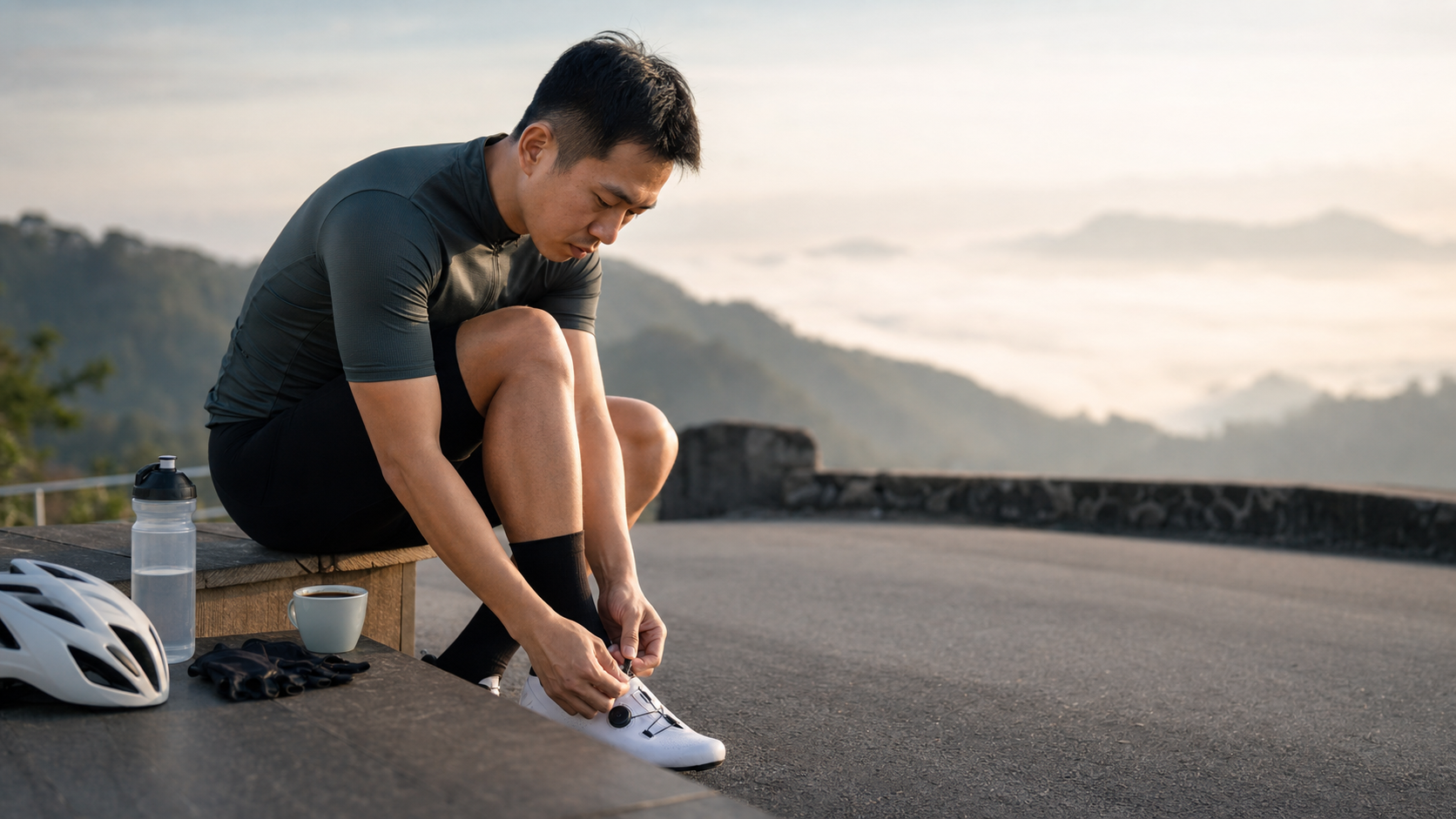
A few years ago, I coached an amateur cyclist preparing for the Wuling Summit Race—let’s call him A-Kai. A-Kai was an engineer, very rational in his speech, wanted data for everything. But before every race, he absolutely had to tie his left shoelace first, then his right. He needed to hear two distinct “clicks” from his cleats before he felt at ease, and then he’d drink half a bottle of a specific brand of sports drink—never a full bottle, always exactly half. One time, the aid station only had another brand left, and he looked like someone had pulled his batteries out. His power output for the first twenty kilometers of that race dropped nearly 15% from his usual numbers.
I asked him: “You know that half bottle is physiologically about the same as a full one, right?” He gave a wry smile: “I know. But I need that action.”
That’s what we’re talking about today. Was A-Kai’s routine a pre-performance routine that helped him get into the zone, or was it the opposite—a superstition that held him hostage? The line is very fine, but it determines whether your ritual is an asset or a liability. In fifteen years of coaching athletes, and through continuous reading of sports physiology, sports psychology, and sports medicine literature, I’ve become increasingly certain of one thing: the value of routines is real, but used the wrong way, they can turn from a stabilizer into an amplifier of anxiety.
In this article, I want to clarify three things: what ritual actually does scientifically, where the line with superstition lies, and how you can design a pre-race routine for yourself that is “functional, not fragile.”
1. What Ritual Actually Does: Three Scientifically Sound Functions
Let me state the conclusion first: Pre-performance routines are not mysticism—they have several quite solid psychological and physiological functions. But the mechanism at work is completely different from what most people think of as “bringing good luck.” What’s actually operating are these three things.
1. Reducing Anxiety, Shifting Attention from “Outcome” Back to “Process”
One of the biggest performance killers in sport is focusing on things you can’t control: how strong the opponent is, your placing, the weather, how other people are looking at you. These thoughts ramp up sympathetic nervous system activity, sending heart rate, breathing, and muscle tension all upward, making your movements stiff.
A fixed routine is, essentially, giving your brain a sequence of actions that is entirely within your control, predictable, and has a clear endpoint. When you complete it step by step, your brain receives a signal: “Things are orderly. I can handle this.” Research by Brooks and colleagues at Harvard Business School pointed out that people who performed a ritual before a task reported lower anxiety, had lower heart rates, and performed better in practice (HBS research page). To be especially honest here: some papers in this area were later re-examined, and there were even retraction controversies, so we should treat this as “a general principle pointing in the right direction,” not “an iron law precise to some percentage.”
2. Boosting Self-Efficacy—the Confidence of “I’m Ready”
Self-efficacy is the subjective assessment of “I believe I can do this.” It’s not empty talk—confidence directly affects the effort you’re willing to put in, your persistence in the face of setbacks, and the fluidity of your movements.
One frequently cited line of experimental evidence is the research by Damisch et al. (2010): in tasks like golf putting, memory, and manual dexterity, activating beliefs related to “luck” could actually improve performance, and the mediating variable was precisely the self-efficacy perceived by the participants (related summary). In other words, the ritual itself doesn’t make the ball roll into the hole, but it makes you believe more strongly that you can do it, so you putt more relaxed and more decisively—it’s that confidence that lifts performance.
3. Reducing the Neural Response to Failure, Helping You Return to Stability Faster
This one I find the most practical. An EEG study observed that people who had performed a ritual showed a lower error-related negativity—the brain’s neural response to mistakes—after making an error (PMC study). In plain language: ritual makes you less likely to spiral downward after a single mistake.
Anyone who has climbed Wuling knows that feeling: you blow up on some steep section, heart rate spikes beyond your zone, and for the next ten minutes you’re sunk in frustration, pacing completely thrown off. A stable routine (including an in-race “reset ritual,” which I’ll cover shortly) can shorten that collapse time and get you back to the present faster.
Below is a table laying out the differences between “functional routines” and “pure superstition” across these three mechanisms.
| Aspect | Functional Routine | Pure Superstition |
|---|---|---|
| Source of anxiety reduction | Relies on the controllable, completable action sequence itself | Relies on “believing supernatural forces will protect you” |
| If one step can’t be done | Has alternatives; can still compete | Anxiety spikes; performance collapses |
| Causal link to performance | Actions have physiological/psychological preparation meaning (warm-up, breathing, imagery) | No substantive link between action and performance (e.g., a certain pair of socks) |
| Effect on confidence | Built on “I genuinely prepared well” | Built on “luck is on my side” |
| Long-term trajectory | Gets steadier and more flexible with use | Gets more rigid with use; checklist grows longer |
2. The Line Between Superstition and Function: One Very Simple Criterion
Many athletes ask me: “Coach, is my habit superstition or a routine?” I usually just ask one question in return:
“If you couldn’t do this one step today, could you still race normally?”
- If the answer is “Yes, I’d just be a bit out of sorts”—then it leans toward a functional routine; it’s your asset.
- If the answer is “No, I’d feel completely off, and my performance would probably collapse”—then it has slid into superstition and is starting to hold you hostage.
A-Kai’s “half bottle of a specific drink” was the latter. It wasn’t that he needed the sugar and electrolytes from that half bottle (that’s physiological, and replaceable); he needed the psychological certainty that “the ritual wasn’t disrupted.” And once that certainty is tied to an external condition you can’t control (whether the aid station has that brand), you’ve outsourced your mental state to the environment. In a race full of variables, that’s very dangerous.
Three Practical Boundary-Check Questions
I give athletes these three questions for self-checking; if any answer is “yes,” it means an adjustment is needed:
- Does this step depend on external conditions? (specific items, specific people, specific weather, specific timing)—the more external conditions it depends on, the more fragile it is.
- Does this step have substantive physiological or psychological preparation meaning? (warm-up, activation, breathing regulation, mental imagery count; wearing a certain pair of “lucky socks” doesn’t)
- Is the checklist getting longer and increasingly non-negotiable?—a healthy routine converges to something lean and stable; an out-of-control superstition keeps spawning new rules.
The key to the line isn’t “whether you have a ritual”—it’s whether you’re the master, or it is. A good routine is a tool you can add to, cut from, and adapt flexibly when things go off-script; a bad superstition is a shackle you’re afraid to touch and panic over if it’s broken.
3. Practical Methods: How to Design a “Functional, Not Fragile” Pre-Race Routine
This is the most practical part of the article. I break the pre-race routine into four layers, from farthest to nearest: 24 hours before the race, 60–90 minutes before, 5 minutes before starting, and the in-race “reset ritual.” Each layer needs to be “functional,” and each needs a designed “Plan B” to avoid fragility.
3-1 The 24 Hours Before: Digesting Uncertainty in Advance
The purpose of this layer is to reduce the number of things you need to worry about on the spot. Many races in Taiwan start at dawn, and road conditions and weather can be highly variable (hot and humid in summer, large temperature swings between morning and evening in mountainous areas). Preparing everything you can the day before is, in itself, the biggest anxiety-reduction valve.
| Item | Recommended Approach | Why It’s Functional (Not Superstition) |
|---|---|---|
| Gear Check | Lay out all your gear the night before, take a photo, and check off each item | Eliminates the uncertainty of “did I forget something”—this is real, controllable preparation |
| Nutrition Planning | Estimate carbohydrate intake based on race duration (for endurance events, roughly 30–60 grams per hour is common; can go higher for longer efforts), and pre-portion everything | The physiological need is real; you don’t rely on whatever brand the aid stations happen to have |
| Course Preview | Study the elevation profile, note key steep climbs and aid station locations | Builds a mental map, reducing in-race unknowns |
| Sleep | Accept that “sleeping poorly the night before a race is normal”; the key is cumulative sleep over the week before | Breaking the over-expectation of “I must get a full eight hours tonight” actually helps you sleep better |
I want to add a note about that last row. Many people lie awake the night before a race, then spend the next day telling themselves, “I’m doomed, I didn’t get enough sleep.” That thought itself hurts performance more than the actual lack of sleep. Both research and practical experience support this view: the actual impact of one poor night of sleep on endurance performance is usually far smaller than you think; what really matters is your cumulative sleep over the week before the race. Adjusting your psychological expectation is the cheapest performance boost there is.
3-2 60–90 Minutes Before: Physiological Activation + Mental Anchoring
This layer has to address both the body and the brain simultaneously. Here’s the template I give my athletes (adjustable by sport):
| Time Point | Action | Function |
|---|---|---|
| T-90 min | Eat (easily digestible carbs primarily; avoid high-fat, high-fiber foods) | Top off glycogen, avoid GI distress |
| T-60 min | Change clothes, set gear in place, drink the first portion of fluids | Clear away logistics, enter a focused state |
| T-45 min | Begin progressive warm-up: low-intensity aerobic work + dynamic stretching | Raise core temperature, activate neuromuscular pathways |
| T-25 min | A few short accelerations or short climbs near race intensity | Give the heart, lungs, and muscles a “preview” of the intensity to come |
| T-10 min | Breathing regulation (e.g., slow the exhale, lengthen expiration) | Lower sympathetic nervous system activity, stabilize heart rate |
| T-5 min | Mental imagery rehearsal + one self-talk cue phrase | Anchor attention on “process” rather than “outcome” |
Every step here has a physiological or psychological basis; none of them are “lucky charm”-level superstition. This is what I mean by “functional.”
The breathing part is something I want to emphasize specifically. Taiwan’s summer races are hot and humid, and many people arrive at the start line with an already-elevated heart rate from the heat and nerves. Taking several rounds of slow breathing with a lengthened exhale (inhale for about 4 seconds, extend the exhale to 6 seconds or more) can help bring an overly high heart rate and breathing frequency down a notch. This isn’t about becoming lax—it’s about pulling yourself back from “so amped my hands are shaking” into the “focused and steady” zone.
Mental imagery rehearsal involves having athletes close their eyes for 60–90 seconds and, in the first person, “see” themselves smoothly climbing that key steep section, successfully completing a pass, and running through the finish arch. The emphasis is on rehearsing the process and the actions, not rehearsing the finishing place.
3-3 The Final 5 Minutes Before Start: A Minimal, Portable, Robust “Trigger Action”
This is something many top athletes have: a minimal closing action that you can do anywhere, anytime, and that depends on no external object. It might be three deep breaths, two slaps on the thigh, or a clenched fist with a key word (e.g., “steady,” “right now,” “one segment at a time”).
There are only three design principles:
- Short: It should take three to five seconds to complete, not consuming mental bandwidth at the start line.
- Portable: It requires no specific object or environment; you can do it anywhere.
- Meaningful: The action must have personal significance to you, not be done at random—research reminds us that for a ritual to work, it must be imbued with meaning; if people are told “this is just a random action,” the effect disappears (HBS Paper PDF).
That’s why I don’t tell athletes to copy someone else’s ritual. Your trigger action has to mean something to you for it to have power.
3-4 The In-Race “Reset Ritual”: A Lifeline When Things Fall Apart
As mentioned earlier, rituals can reduce the neural response after failure. This is most useful during the race itself. When you blow up on a climb, get dropped from the group, your pacing falls apart, and your mindset starts sinking, you need a mini reset ritual to pull yourself back into the present moment.
The version I teach athletes is the “three-step reset”:
- One long, deep exhale (physiologically dampens the sympathetic nervous system).
- One fixed self-talk phrase (e.g., “What’s done is done, focus on the next segment”).
- Narrow attention to one controllable metric (e.g., cadence, or the rhythm of your breathing over the next 500 meters).
These three steps take under ten seconds, yet they can significantly shorten the time spent in the “regret → collapse” spiral. It’s part of the routine system, just deployed mid-race.
4. Common Mistakes and Corrections
After years of coaching, I’ve found that athletes make the same few mistakes when it comes to ritual. Let me point them out one by one, along with the fixes.
Mistake 1: Turning Your Routine into a “Longer = More Reassuring” Checklist
Many people assume the more complete the ritual, the better, so the checklist keeps growing—until missing any single item sends them into a panic. At that point, you’ve slipped into the territory of superstition and compulsion.
Fix: Regularly “slim down” your routine. Ask yourself of each item: “If I dropped this, could I still start the race normally?” If yes, it’s optional—move it into the “nice to have, fine without” flexible zone, not the “must” zone. Keep the core “must” items to a small handful, and design everything else to be replaceable.
Mistake 2: Outsourcing Your Mental State to External Conditions
Like A-Kai’s “specific brand of half a bottle of drink,” or some people’s “I absolutely need those socks” or “I absolutely need to hear that one song.” Once the external condition isn’t met, you fall apart.
Fix: Move the anchor of your ritual from external objects to internal actions. The drink is a physiological need (replaceable by any equivalent fuel); shift your mental anchor to breathing, to a trigger action, to a self-talk phrase—these are things no one can take away from you.
Mistake 3: Confusing “Being Hyped Up” with “Being Ready”
Some people get themselves amped before a race—heart racing, talking loudly—and think that means they’re “in the zone.” That might work for explosive, short-duration events, but for endurance sports (mountain races, marathons, long-distance events), excessive hype will make you lose pacing control in the early stages and blow up prematurely.
Fix: The target state for endurance events is “focused and steady,” not “amped to the point of shaking.” Use breathing regulation and mental imagery to dial your arousal to just the right level—focused enough, but with your heart rate under control.
Mistake 4: Copying Pro Athletes’ Rituals Wholesale
You see a famous athlete with a cool pre-race routine and adopt the whole thing. The problem is that routine is meaningful to him, not to you—and meaning is exactly what makes a ritual work.
Fix: Steal the “principle,” not the “content.” Learn from his principle of “having a stable routine and a minimal trigger action,” but replace the content with a version that has personal significance to you.
Mistake Five: Anxious People Turn Rituals into Compulsions
This one needs to be handled carefully. Research reminds us that rituals are not uniform for everyone: for highly anxious people, rituals can actually become a source of pressure where “you must do it or else,” and can even be linked to burnout (source).
Fix: If you’re naturally prone to anxiety or overthinking, deliberately build in flexibility and backup options when designing your routine, and regularly check whether it has shifted from “helping me” to “controlling me.” If you notice that missing a ritual triggers noticeable, persistent anxiety or panic, that goes beyond normal performance adjustment—consider seeking help from a sport psychology professional or a psychiatrist. This isn’t something to be ashamed of; it’s taking care of yourself.
4.5 Arousal: Which Dial Is the Ritual Actually Adjusting?
After covering common mistakes, I want to add a deeper concept, because it explains “why the same ritual works for one person but not another.” In sport psychology, there’s a classic model called the “inverted U hypothesis”: the relationship between performance and arousal looks like an upside-down U—too low arousal (lethargic, numb) won’t work, too high arousal (overexcited, shaky hands, heart racing out of control) won’t work either, and there’s a “just right” sweet spot in the middle.
The key point: Different sports and different people have different sweet spot locations. Short, explosive efforts (e.g., track sprint, 100m) require higher arousal; long-duration endurance events (mountain races, full marathons) require lower, steadier arousal. The real job of a pre-competition routine is to push your current arousal level toward your sweet spot.
This brings out a key point many people haven’t thought through: Rituals aren’t only for “calming down”—they can also be used to “fire up.” Some people are naturally too tense when they step onto the field; their rituals should lean toward lowering arousal (slow breathing, relaxation, narrowing attention). Others are naturally too loose and can’t get going; their rituals should lean toward raising arousal (fast-paced music, slapping the body, shouting). If you use the wrong direction, the ritual will push you away from your sweet spot.
The table below helps you determine “which direction you should adjust” and the corresponding ritual tools.
| Your On-Site State | Typical Signs | Direction the Ritual Should Go | Suggested Tools |
|---|---|---|---|
| Over-aroused (most common) | Heart rate unreasonably fast, shaky hands, mind goes blank, talking more | Lower arousal, pull it down | Slow breathing with extended exhales, closed-eye imagery, narrowing attention to a single cue |
| Just right | Focused, body feels engaged but under control, can hear your own breathing | Maintain, don’t mess with it | One concise trigger action to lock in this state |
| Under-aroused | Can’t get going, body not awake, attention scattered | Raise arousal, bring it up | Fast-paced music, dynamic warm-up with added intensity, slapping the body, short self-talk shouts |
I once coached a female triathlete who was exactly the “under-aroused” type. She was always too relaxed before races and often started a beat slow in the early stages. The ritual we designed for her wasn’t calming—instead, we added fast-paced music plus three hard slaps on her thighs before the start. It sounds counterintuitive, but her sweet spot was on the higher side, and she needed to be “woken up.” This proves again: There is no one-size-fits-all ritual—only rituals that fit your current state.
This also explains A-Kai’s problem in retrospect. His “half bottle of drink” was perhaps originally meant to stabilize his emotions (lower arousal), but because it was anchored to an external condition, once that condition was disrupted, it actually caused his arousal to spike—anxiety rose, heart rate climbed, and he was pushed straight out of his sweet spot. That’s the biggest risk of externally dependent rituals: they help lower your arousal normally, but when something goes wrong, they backfire and send your arousal through the roof.
5. Actionable Advice for Readers at Different Levels
The sense of ritual—people at different stages need different things. I’ll break it down into three types of people with concrete approaches.
Beginners / Those Just Starting to Race
What you need most right now isn’t a fancy ritual—it’s getting the “controllable preparations” done right, and letting a routine naturally grow out of that.
- First, build a pre-race 24-hour checklist (gear, nutrition, course preview). This layer does the most to reduce your pre-race anxiety.
- Establish an ultra-simple trigger action: three deep breaths before the start, paired with a personal keyword. That’s it—no more.
- Don’t rush to imitate someone else’s long sequence of steps. Adding too many rules now will only make you more nervous.
- Remember: at this stage, finishing and enjoying the process matter far more than your placing.
Intermediate / Those with Established Training and Racing Habits
You may already have a routine—at this stage, the focus is checking whether it has quietly drifted toward superstition.
- Take your current pre-race routine and screen each item with “could I still race without it?”—trim the “must-have” items to a minimum.
- Convert all anchors that depend on external objects into internal actions (breathing, self-talk, trigger actions).
- Seriously practice the “three-step reset ritual” during competition—this is the most overlooked but highest-return piece for intermediate athletes.
- Start consciously doing imagery rehearsal, training your attention to focus on the process rather than the outcome.
Advanced / Those Targeting Race Results and Under Significant Pressure
You face greater pressure, so both the “anti-fragility” and “anti-excess” aspects of your rituals need to be more refined.
- Prepare a Plan B for every critical link (what if nutrition runs out, what if warm-up time gets compressed, what if the weather is scorching)—rehearse the “unexpected” in advance.
- If you lean toward high-anxiety traits, pay special attention to whether rituals have become compulsive; if needed, include sport psychology consultation as part of your regular support team.
- Treat your routine as an iterative system: after each season, review which elements truly helped you and which were just habits, and keep refining.
5.5 A Four-Week Plan to “Train” a Routine
Many people assume rituals are something you “just start doing when you feel like it.” That’s not the case. A routine that can truly hold you steady on race day is, like strength, built through training—it needs to be executed repeatedly in everyday practice before it becomes automatic and something your body remembers on high-pressure race day. If you only do it for the first time on race day itself, it’s unfamiliar, and that adds another layer of uncertainty.
My approach with athletes is this: treat your pre-race routine as a “skill” to be trained, and internalize it over four weeks during regular training. Below is the progressive table I commonly use; you can copy and adjust it directly.
| Week | This Week’s Task | Specific Approach | Acceptance Criteria |
|---|---|---|---|
| Week 1 | Inventory and declutter | Write down everything you actually do before a race right now, and filter each item one by one with “Can I still start without this?” | Separate into “essential” and “flexible” categories; essential items should not exceed 3–5 |
| Week 2 | Design a trigger action | From the flexible items, choose an action that is meaningful to you, and design a closing action that takes under 5 seconds and relies on no external objects | You can do this action with your eyes closed, anywhere, anytime |
| Week 3 | Test it in training | Before every higher-intensity session, run through your complete pre-race routine | Complete at least 3–4 full rehearsals; note which steps feel clunky |
| Week 4 | Add disruption drills | Deliberately break one element (leave something behind, shorten the warm-up), and practice responding with a Plan B | When an element is disrupted, you can stay emotionally steady and still complete the session |
The “disruption drill” in Week 4 is the soul of the entire plan, and it’s the step most people skip. I will deliberately tell an athlete before a session: “Today, that thing you’re used to isn’t available. We’re training anyway.” At first, many people feel uncomfortable or even a bit panicked, but after practicing this a few times, their tolerance for “the unexpected” rises dramatically. This is precisely the key training that transforms “fragile superstition” into an “anti-fragile routine.”
One case that stands out to me is a middle-aged athlete preparing for the Taipei Marathon. He was heavily dependent on “buying the exact same rice ball from the exact same convenience store” as his pre-race breakfast. One day, that store was out of stock, and his training run that day fell apart; he complained to me the entire way. Using the Week 4 method, we deliberately swapped his breakfast for three consecutive sessions (all equivalent, easily digestible carbs), forcing him to shift his psychological anchor from “that specific rice ball” to the principle of “just get easily digestible carbs in before the race.” On race day itself, his breakfast hit another snag, but he simply said to me, “Coach, I swapped it out. No big deal.” He finished that race within his target time. You see, what changed was never the rice ball—it was his psychological flexibility around “the unexpected.”
6. Frequently Asked Questions (FAQ)
Q: I don’t have any pre-race ritual. Am I at a disadvantage?
A: No. A routine is a tool, not an obligation. If you’re naturally steady at the start line and don’t get very nervous, you may not need a complex ritual. The greatest value of a ritual is in helping you stabilize when you do feel anxious or when pressure affects your performance. If you don’t have that need, there’s no need to force one.
Q: Is drinking coffee superstition or functional?
A: This needs to be split into two layers. The alertness boost and reduced perceived effort from caffeine in endurance performance have a physiological basis (a common intake range is several milligrams per kilogram of body weight, varying by individual, and you should pay attention to personal tolerance and gastrointestinal response)—that layer is functional. But if you treat “it has to be that shop, that cup, that temperature” as an unbreakable rule, then the extra part is superstition. Keep the physiological function; cut the external dependency.
Q: Does pre-race music actually help?
A: For many people, yes. It can help regulate arousal levels (energizing or calming) and shift attention away from nervousness. It leans functional—as long as you don’t turn it into a fragile dependency where “I can’t race without that specific song.” Treat it as an optional regulation tool, and it works well.
Q: When I get nervous, I need the bathroom or get diarrhea. Is this related to rituals?
A: Pre-race gastrointestinal reactions are very common in endurance athletes, and they’re mostly related to nervousness (sympathetic nervous system) combined with diet and fueling strategy. Breathing regulation, choosing easily digestible foods pre-race, and practicing your fueling schedule until it’s second nature usually help. But if symptoms are severe, persistent, or affect daily life, you should see a physician for evaluation—don’t just dismiss it as “just nerves.”
Q: I have a chronic condition (e.g., high blood pressure, diabetes, heart-related issues). Anything to watch for with pre-race rituals?
A: A ritual itself will not replace your disease management. If you have a chronic condition, the focus of pre-race preparation should instead be on confirming with your primary care physician the safe exercise intensity range, medication timing, and self-monitoring of blood sugar or blood pressure—those individualized medical arrangements. With Taiwan’s NHI system making medical visits convenient, scheduling one evaluation before the season and asking the right questions matters far more than any ritual. You can keep your psychological routine, but any decision related to your condition, medication, or warning symptoms should follow your physician’s individualized advice—don’t adjust things on your own based on how you feel.
Q: I’ve done the ritual a few times and don’t feel anything. Does that mean it’s not for me?
A: A routine takes time to internalize; feeling “nothing” in the first few sessions is completely normal. It’s more like strength training than taking a pill that works instantly. Follow the four-week plan above and practice it repeatedly in regular training to make it automatic—that “familiar, controllable” feeling on race day will then truly emerge. And if after genuinely practicing for a while you still feel nothing at all, that’s fine too—as mentioned earlier, a ritual is a tool, not an obligation. Keep only what works for you.
Conclusion: Let Ritual Be Your Tool, Not Your Master
Back to A-Kai. Later, I helped him rebuild that routine from scratch. We kept “two deep breaths while tying his shoes”—because that action was meaningful to him and entirely within his control; we swapped “half a bottle of a specific brand” for “any equivalent fuel + a self-talk phrase of ‘one segment at a time.’” Six months later, at another hill-climb race, the aid station again didn’t have his usual brand. But this time, he just smiled, grabbed something else, took a deep breath, and headed out. He set a personal best that day.
What changed wasn’t the half bottle of drink—it was that he stopped handing himself over to something that could be taken away.
That’s the most important lesson the science of ritual gives us: routines genuinely work. They reduce anxiety, boost confidence, and help you recover faster from mistakes—but all of these benefits rest on the premise that it is a tool you control. The moment you become controlled by it, it turns from a stabilizer into a source of anxiety.
So remember that simplest test: If this element isn’t available today, can you still start normally? Make every “yes” a little more frequent, and every “no” a little less. Your ritual will then always be on your side.
Next time you stand on the start line, when the familiar nervousness surges up, don’t rush to grab some external object. Take a deep breath, do that trigger action you’ve practiced countless times, and tell yourself: I’m ready. One segment at a time. That is the gentlest and most powerful part of the science of ritual.
This article is educational content and does not replace individualized diagnosis or treatment advice from a physician, physical therapist, or nutritionist. If you have persistent anxiety, panic, gastrointestinal, or other health symptoms, or if you have a chronic condition, please seek professional individualized evaluation and assistance.
References
- Brooks et al., Rituals improve performance by decreasing anxiety (Harvard Business School research page): https://www.hbs.edu/faculty/Pages/item.aspx?num=51401
- Full text PDF of the same research paper: https://www.hbs.edu/ris/Publication Files/Rituals OBHDP_5cbc5848-ef4d-4192-a320-68d30169763c.pdf
- Rituals decrease the neural response to performance failure (PMC): https://pmc.ncbi.nlm.nih.gov/articles/PMC5452956/
- The power of superstitions and rituals in sport (including a summary of Damisch et al.'s research, BelievePerform): https://members.believeperform.com/the-power-of-superstitions-and-rituals-in-sport/
Related Reading
- The Science of Pre-Race Rituals: 12 “Superstitions” and Psychological Mechanisms of Elite Athletes
- Swimming Pre-Race Routines: The Psychological Stabilizing Function of Pre-Race Rituals
- The Psychological Benefits of Pre-Race Ritual Behaviors: A Functional Analysis of Superstitious Behavior
- Sports Nutrition Myth-Busting Collection: Claims Circulating in Gyms and Cycling Groups That Fail Scientific Scrutiny
西進武嶺 自製新版AI配速表產生器 x 賽前攻略 抱佛腳! 沒有功率計也可以產生配速表嗎?有什麼其他眉角賽前要注意的呢? | 西進武嶺 / 東進武嶺 KOM 攻略 | 公路車 | CT Yeh
4 年前
西進武嶺 免費訓練分析服務 Intervals | 練不夠還是練過頭?你哪一種類型選手?AI模型告訴你! | 備戰神器 | 公路車 訓練 | CT Yeh
4 年前
CT 喇低賽) 武嶺牽車 才是王道 西進牽車四小時內秘訣 攝手位置 如何判斷 防抽筋小秘訣
7 年前
下次拍照前要查清楚啦🤣 #cycling
7 個月前
FTL 與 SYB 車隊專訪 西進武嶺 實用攻略分享! 2小時 如何練?!你不知道的眉角!新手準備武嶺必看 EP1 | 實力派女車友 | 精華版 | 公路車 | CTYeh
4 年前
Never Stop 西進武嶺 前後雙機 完整全程錄影 訓練台 實境
8 年前
#公路車 #西進武嶺 配速配瓦實驗 坡度分析 四小時內攻略 建大盃 NeverStop #西進武嶺攻略
6 年前
[教學] Premiere 影片 手震 修正 教學 防抖 單眼 影像 GoPro 穩定 Video Stabilization
8 年前