Proprioception and Motor Control: A Complete Coach's Guide from Balance Training to Post-Injury Rebuilding
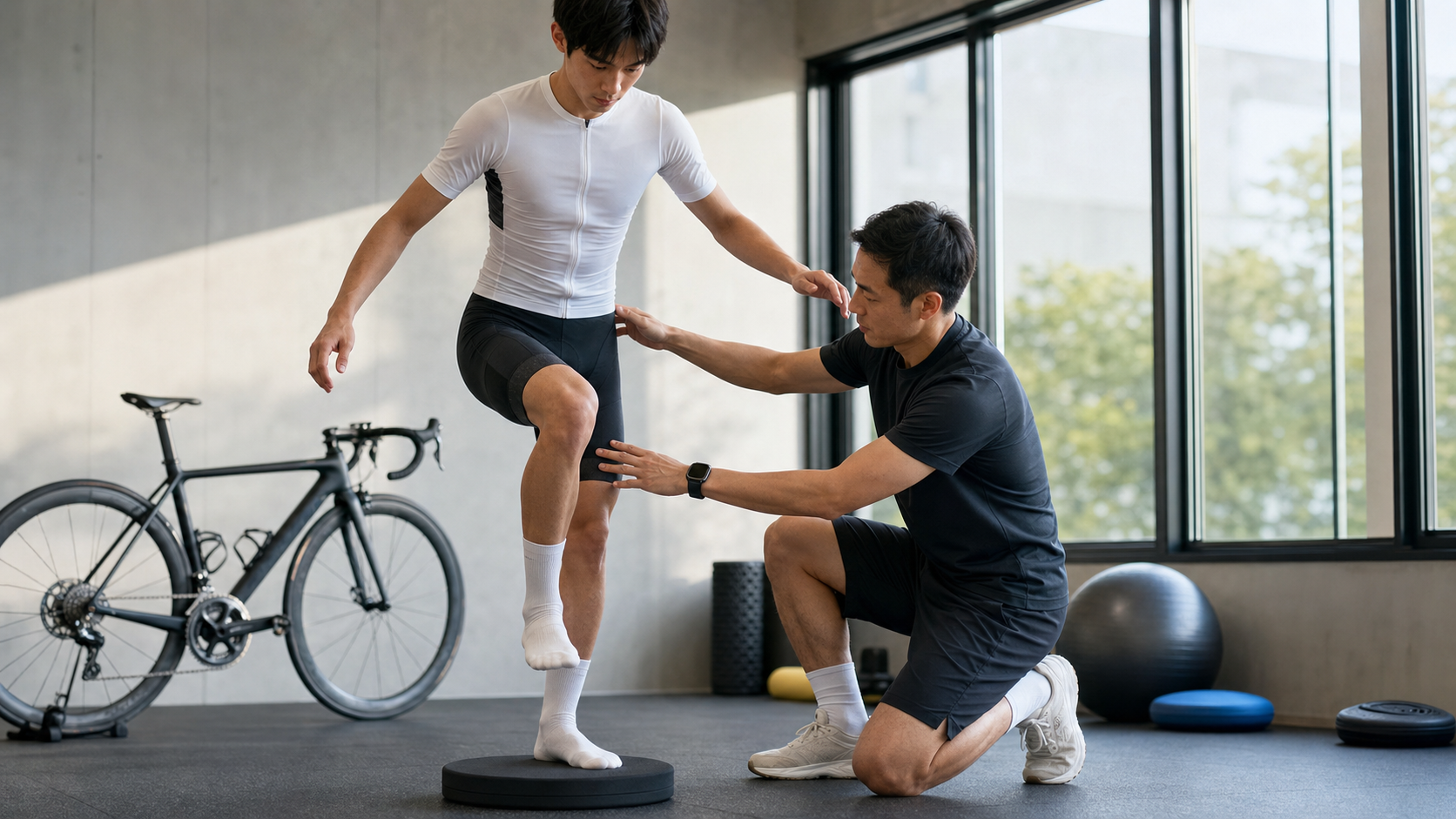
Opening: The Student Who Kept Crashing on the Same Corner
I once coached a road cyclist—let’s call him A-Zhe. His fitness was solid; his 5-minute power-to-weight ratio was around 4 W/kg, and he could hold his own on climbs. But every group ride, whenever we hit a series of downhill corners, he’d get especially tense. Twice, on the same left-hand bend on Yangjin Highway, he lost his center of gravity, scraping his elbow. He always thought it was a matter of “being timid” or “poor technique,” and kept trying to overcome it by simply riding more.
After riding with him a few times and having him do a few simple eyes-closed single-leg stance tests, I found the problem wasn’t courage, but proprioception. His body’s awareness of “how many degrees I’m leaning, where my weight is on which foot, how much my knee is bent” was fuzzy. So when entering a corner, his brain wasn’t getting clear feedback, forcing him to rely purely on vision. Once speed picked up and the corner got tight, the system crashed.
We didn’t increase his riding volume. Instead, we spent just over ten minutes a day on balance and proprioception training. Six weeks later, he reported back: “Coach, now when I corner, I know what the bike is doing.” After that, I became even more convinced—proprioception is the most underestimated piece of athletic performance and injury prevention, and the good news is, it can be trained.
In this article, I want to systematically lay out for you the concepts I’ve accumulated from fifteen years of coaching athletes and continuously reading sports physiology and sports medicine literature: what proprioception actually is, why it matters, how to train it, where the common mistakes lie, and where people at different levels should start.
Concepts and Scientific Basis: What Are Proprioception and Motor Control
You Have a Built-In Positioning System
Let’s start with a small experiment: close your eyes, raise your right hand to shoulder height, and hold it there. Without looking, you still roughly know where your hand is and how high it’s raised—that’s proprioception at work.
Proprioception is the body’s ability to perceive joint angles, limb position, muscle tension, and movement speed. Its information comes primarily from three types of receptors:
- Muscle spindles: Detect changes in muscle length and the speed of stretching; they are the most important source of position sense.
- Golgi tendon organs: Detect tendon tension—essentially “how much force this muscle is producing right now.”
- Mechanoreceptors in joints and skin: Detect end-range joint angles, pressure, and skin stretch.
This information travels up to the spinal cord and brain (with the cerebellum and somatosensory cortex playing starring roles). The brain integrates it and sends motor commands to fine-tune muscles. This entire loop of “sensory input → central integration → motor output” is the core of motor control.
Proprioception, along with two partners—the vestibular system in the inner ear (detecting head acceleration and direction) and vision—together form the body’s balance system. This is why an eyes-closed single-leg stance is much harder than an eyes-open one: once you cut off vision, you have to rely more on proprioception and the vestibular system, and weaknesses immediately show up.
Reflex Loops: Why “Reaction Speed” Matters More Than You Think
Many people assume injuries happen because of “insufficient strength,” but the actual scenario is often this: you hit a small pebble on a downhill on Yangjin Highway, the front wheel slips, and your ankle rolls inward in an instant—in these millisecond-level emergencies, you don’t have time to “consciously think” about how to save it. What’s actually saving you is the reflex loop at the spinal cord level.
Here’s a key concept: when a muscle spindle detects a sudden stretch, the signal goes to the spinal cord, which—without going through the brain—directly commands the muscle to contract and resist. That’s the stretch reflex. Whether you’ve done proprioception training directly affects the sensitivity and reaction time of this reflex loop. Trained individuals can recruit the stabilizing muscles around a joint faster and more precisely, defusing a “near-sprain” before it happens. This is also why balance training can actually reduce injury rates—it’s not mysticism; it’s fine-tuning your body’s most fundamental protective mechanism.
One more easily overlooked point: proprioception is linked to breathing and focus. When you’re tense, holding your breath, or distracted, your body’s perception of posture degrades. This is why A-Zhe handled the bike better on relaxed descents than when he was stiff—in coaching, I often remind athletes to “exhale and relax your shoulders” before a corner. That’s not just a mental cue; it genuinely helps open up the sensory channels in the nervous system.
Why It Matters for Cycling and Endurance Sports
Many people assume proprioception is only for gymnasts or ball-sport athletes, but endurance sports rely on it just as much:
- Pedaling efficiency and symmetry: Good proprioception gives you clearer awareness of whether your left and right legs are producing force evenly and whether your ankle is wobbling excessively at the bottom of the pedal stroke. Long-term left-right power asymmetry is a breeding ground for overuse injuries.
- Bike handling and cornering: As with A-Zhe’s case, weight shifting and lean-angle control depend heavily on real-time awareness of body position.
- Movement quality under fatigue: In the later stages of a long ride or run, muscle fatigue weakens proprioceptive signals, and movement patterns tend to break down. This is why many injuries happen in the second half of a session.
- Injury prevention: Whether the muscles around a joint can “react instantly” to stabilize a sudden misalignment (like an ankle rolling on landing) depends largely on proprioception and neuromuscular control.
This point has empirical support. A systematic review and meta-analysis of athletic populations found that proprioceptive (balance) training can significantly reduce the incidence of ankle sprains—the effect is substantial. It’s not a nice-to-have bonus; it’s a genuinely effective intervention for reducing injuries (see references at the end). In my own coaching experience, athletes who dutifully did balance training had noticeably fewer sprains and strains over a full season compared to those who only focused on power.
A Commonly Misunderstood Concept: Proprioception ≠ Flexibility
Let me clear up a common confusion. Many people attribute “poor balance” to “tight muscles” and then stretch endlessly, only to see no improvement in balance. Flexibility (range of motion) and proprioception (position sense and neuromuscular control) are two different things. A very flexible yoga practitioner with untrained proprioception can still struggle with an eyes-closed single-leg stance. Conversely, someone with tighter muscles can have excellent dynamic stability if their proprioception and neuromuscular control are good.
So think of it as an independent athletic ability, on par with strength, endurance, and flexibility. It requires dedicated methods to train and won’t automatically develop from “riding or running more” or “stretching more.” This is also why even highly experienced athletes with large training volumes can still have significant blind spots in proprioception.
Practical Methods: How to Structure Balance and Proprioception Training
This section is the main event. I break training into four difficulty stages, based on the principle: stability before challenge, eyes open before eyes closed, double-leg before single-leg, static before dynamic, flat ground before unstable surfaces.
The Four Progression Stages
| Stage | Core Goal | Representative Exercises | Criteria for Advancing |
|---|---|---|---|
| Stage 1: Foundational Stability | Build static single-leg balance | Eyes-open single-leg stance, eyes-closed double-leg stance | Can hold an eyes-open single-leg stance for 30 seconds without swaying or putting the foot down |
| Stage 2: Remove Vision | Force the body to rely on proprioception | Eyes-closed single-leg stance, eyes-closed weight shifting | Can hold an eyes-closed single-leg stance for 15–20 seconds |
| Stage 3: Unstable Surfaces | Increase sensory challenge | Single-leg stance on a balance pad/soft mat, Bosu ball stance | Can hold a single-leg stance on a soft mat for 20 seconds |
| Stage 4: Dynamic Integration | Add movement and perturbation | Single-leg stance catching a ball, single-leg deadlift, landing stabilization | Can fully stabilize within 1 second of landing on one leg with no excessive movement |
Many people rush to Stages 3 and 4 to play with the Bosu ball—this is a common mistake. If you can’t hold an eyes-closed single-leg stance for ten seconds, solidify Stages 1 and 2 first. Don’t rush.
A One-Week Beginner Plan for Home and the Gym
Below is a beginner plan I often give to general athletic populations or endurance athletes. It requires no expensive equipment—just a yoga mat, a wall, and a soft pad. Each session takes about 12–15 minutes, 3–4 times per week.
| Day | Main Content | Sets/Duration | Notes |
|---|---|---|---|
| Monday | Eyes-open single-leg stance + eyes-closed single-leg stance | 3 sets × 30 seconds per leg | Keep a hand near the wall as backup; grab it if you’re about to fall |
| Tuesday | Rest or normal ride/run | — | Let the nervous system recover |
| Wednesday | Single-leg stance on soft pad + single-leg front-back toe taps | 3 sets × 20 seconds per leg | Focus on “not swaying,” not “standing long” |
| Thursday | Rest | — | — |
| Friday | Single-leg deadlift (bodyweight or light load) + single-leg stance catching a ball | 3 sets × 8–10 reps per leg | Have a family member toss the ball, or throw against a wall |
| Saturday | Landing stabilization (small hop in place, land on one leg and hold) | 3 sets × 6 reps per leg | Keep knees aligned over toes; don’t let them cave inward |
| Sunday | Rest or long ride/run | — | Can add 5 minutes of balance work as a cool-down when fatigued |
Key reminder: The focus of proprioception training is quality, not quantity. Sloppily forcing yourself to stand for 60 seconds while wobbling all over is far worse than standing focused and stable for 20 seconds. Once you find an exercise easy, move to the next stage—don’t stay stuck in place.
Integrating Proprioception into Cycling Training
For cyclists, I add a few sport-specific practices:
- Single-leg pedaling: On the trainer, pedal with only one leg while the other rests off the pedal. Do 30–60 seconds per leg, feeling whether the pedal stroke is “round” and whether there’s any hesitation at the bottom. This dramatically improves your awareness of pedaling symmetry and ankle control.
- Low-speed balance drills: On a safe, open area, practice riding in a straight line at very low speed, or even track stands, forcing you to make real-time micro-adjustments to your center of gravity.
- Core stability + breathing: Proprioception isn’t just about the legs—torso position sense matters too. Planks, dead bugs, and bird dogs all train the trunk’s control over posture.
Difficulty Comparison of Common Equipment and Drills
The question students ask me most is: “Coach, what equipment do I actually need to buy?” My answer is usually—don’t buy anything yet. The table below ranks common drills from easy to hard. First, figure out which level you’re stuck at, then decide whether to spend money.
| Equipment/Drill | Difficulty | Primary Ability Challenged | Where to Get It in Taiwan |
|---|---|---|---|
| Eyes-open single-leg stance on hard floor | ★ | Foundational static balance | Anywhere at home |
| Eyes-closed single-leg stance on hard floor | ★★ | Removing vision, relying on proprioception | Anywhere at home |
| Single-leg stance on folded towel/pillow | ★★ | Mild unstable surface | Everyday items at home |
| Balance pad | ★★★ | Moderate unstable surface | Sporting goods stores, online |
| Bosu ball | ★★★★ | High instability, dynamic | Gyms, online |
| Balance board/wobble board | ★★★★ | Multi-directional instability | Gyms, online |
| Single-leg stance catching a ball/perturbation | ★★★★★ | Dynamic reaction, dual-task | Just find a partner—no equipment needed |
See the key point? The hardest drill—“single-leg stance while catching a ball”—is actually free. Equipment is a supplement; what truly determines intensity is whether you add “dynamic movement” and “unpredictable perturbation.” I often tell my athletes: instead of buying a Bosu ball to collect dust, have a family member toss you twenty balls a day. It’s more effective and more fun.
An Advanced Technique: Dual-Task Training
This is a tool I reserve for advanced athletes. In real sports, your brain is never focused solely on balance—you’re simultaneously watching the road, assessing conditions, and shouting to people around you. So I have athletes, while in a single-leg stance or on an unstable surface, simultaneously do something that requires mental effort: count backward from 100 by 3s (100, 97, 94…), answer questions, or catch a ball.
This kind of “balancing while distracted” training is closer to real-world situations than pure balance work, because it forces your proprioception and neuromuscular control to maintain stability while cognitive resources are occupied. For cyclists, this corresponds to the real-world ability to “corner while watching traffic and the pack.” One caution: this is an advanced drill. You must first build solid single-leg stability, and do it in a safe environment (with something to hold onto).
Post-Injury Rebuilding: Why Proprioception Is the Core of Rehab
This is a section I especially want to clarify, because too many people focus only on strength after an injury and neglect proprioception—only to get re-injured the moment they return to sport.
Injuries “Damage” Proprioception
When you sprain your ankle or injure your knee (e.g., an ACL tear), beyond the tissue damage itself, the proprioceptors inside the joint are also damaged or their signals degrade. This creates a vicious cycle: joint position sense becomes fuzzy → neuromuscular reactions slow down → you can’t stabilize in time during sudden events → you sprain again → proprioception gets worse. This is why “people who’ve sprained an ankle once are especially prone to repeated sprains.”
In the research, for populations with ACL injuries or reconstructions, adding proprioceptive and balance training is considered helpful for improving joint position sense, strength, and subjective knee function, and it’s a relatively safe rehab approach—there’s no evidence it increases joint laxity or decreases strength (see references at the end). It’s worth noting that high-quality studies in this area are still limited, so proprioception training is “an important and safe component,” but it’s part of a comprehensive rehab plan, not a standalone miracle cure.
Stage-Based Principles for Post-Injury Rebuilding (Conceptual Framework)
The following is a general progressive framework. Actual progress must be individualized by your physical therapist or sports medicine physician based on the injury and imaging assessment—never self-diagnose and follow this blindly.
| Rehab Stage | General Goal | Role of Proprioception Training |
|---|---|---|
| Acute phase | Reduce swelling, manage pain, protect tissue | Usually begins with pain-free range-of-motion and basic contractions |
| Recovery phase | Restore joint mobility and foundational strength | Begin eyes-open double-leg, then progress to single-leg static balance |
| Strengthening phase | Build strength and neuromuscular control | Add unstable surfaces, eyes-closed, single-leg dynamic movements |
| Return-to-sport phase | Restore sport-specific movements and confidence | Add perturbation, landing, cutting, and stability testing under fatigue |
The spirit of this framework is: proprioception training isn’t something you do only after the injury heals—it should be incorporated as early as possible (progressively) within safe limits. But the “safe limits” at each stage must be determined by a professional.
A Case Scenario: Returning to Sport After an Ankle Sprain
Here’s a common scenario (illustrative, with no exaggerated numbers). An athlete who loves trail running sprained his ankle rolling inward on a downhill in Yangmingshan. After the acute phase—rest, ice, and a medical check confirming no fracture or severe ligament tear—the physical therapist’s rehab plan explicitly included proprioception training:
- Week one, while still swollen: pain-free ankle range-of-motion and toe towel curls.
- Weeks two to three: progressed from eyes-open double-leg stance to eyes-open single-leg stance.
- Then added single-leg stance on a soft pad and eyes-closed single-leg stance.
- Before returning to sport: single-leg landing stabilization, toe taps in different directions, and walk-run transition tests.
The key was that he didn’t just “go back to trail running once it didn’t hurt.” He worked through proprioception rehab, confirmed he could stabilize on single-leg landings, and only then gradually returned to the trails. The purpose was to break the “repeated sprain vicious cycle” described earlier.
Practical Notes on Taiwan’s Medical and Rehab Environment
In Taiwan, the path to care for sports injuries is actually very convenient, but it’s also often misused. Here are a few practical observations:
- Acute-phase principles: After an acute sprain or strain, the general principle is to give the tissue a chance to repair—avoid continuing to irritate the injured area, ice moderately to reduce swelling, and elevate the limb. But these are general principles; actual management (whether to ice, how long, whether to immobilize) should follow medical advice, as injuries vary greatly.
- NHI outpatient care is convenient, but don’t rely only on passive treatment: Rehab clinic visits under the National Health Insurance are easy to access. Passive treatments like electrotherapy, heat packs, and ultrasound can help with pain and swelling, but they won’t restore your proprioception. You must actively request or separately arrange functional exercise therapy.
- Make good use of physical therapists: Whether through the NHI system or out-of-pocket sports physical therapy, a good physical therapist will design an individualized progressive program—something no internet article (including this one) can ever replace.
- If issues are recurrent or persistent, definitely see a doctor: If sprains keep happening, the joint feels like it “gives way” or “catches,” or swelling and pain don’t improve within a reasonable time, don’t keep waiting it out or relying on medicated patches. Go back to orthopedics or rehab for a full assessment (with imaging if necessary) to rule out ligament, cartilage, or other structural problems.
Taiwan’s climate is also worth mentioning: summers are hot and humid, with large indoor-outdoor temperature swings. Many people sit in air-conditioned rooms for hours and then suddenly exercise, generating force before their joints and muscles are “warmed up.” Add heavy sweating and slippery surfaces—these are prime times for proprioception and neuromuscular reactions to fail. Warming up thoroughly and avoiding high-intensity dynamic movements on slippery surfaces are basic but often overlooked forms of self-protection.
Common Mistakes and Corrections
After years of coaching, I’ve compiled the most common mistakes into the comparison table below. Use it for self-checks.
| Common Mistake | Why It’s Wrong | Correction |
|---|---|---|
| Only training strength, never balance | No matter how strong your muscles are, slow reactions still lead to injury | Schedule 2–3 proprioception sessions per week |
| Rushing to high-difficulty equipment like Bosu balls or balance boards | Without a solid foundation, you’re just wobbling—poor training quality and risk of falling | First pass the eyes-open and eyes-closed single-leg stance standards |
| Chasing long hold times (competing over who stands longest) | Holding for time leads to compensatory postures and declining quality | Prioritize quality; stop and reset if you start swaying |
| After injury, only resting, no rebuilding | Proprioception doesn’t fully recover on its own | After medical assessment, progressively incorporate balance training |
| Noticing form breakdown under fatigue but ignoring it | Injuries often happen in the fatigued later stages | Add stability work under fatigue to your cool-down |
| Scrolling on your phone or getting distracted during training | Proprioception training depends heavily on focus | Stay fully focused on bodily sensations; don’t get distracted |
I especially want to emphasize the first one: strength training and proprioception training are complementary, not either/or. Strength gives you “the ability to produce force”; proprioception and neuromuscular control give you “the ability to produce the right force, in the right direction, at the right time.” You need both. I’ve seen too many people squat heavy in the gym yet wobble like they’re drunk in an eyes-closed single-leg stance—that’s not a strength problem; it’s a control problem that needs the right approach to fix.
Another easily overlooked mistake: only training balance when you’re fresh. The highest injury risk in real competition is often in the fatigued later stages. If your balance training only ever happens when you’re mentally fresh, you’ll never train the ability to “stay stable under fatigue.” Advanced athletes can deliberately add a few sets of single-leg stability work after a long ride or interval session to simulate that most dangerous moment. This is especially important for people who regularly do long rides or trail runs, because your peak crash or sprain risk is almost always on that final stretch when energy is depleted and attention is fading.
Another common local situation in Taiwan: many people, after an injury, habitually “go to a traditional bone-setter for an adjustment and slap on a medicated patch,” or because NHI is convenient, they keep going to clinics for medication and passive electrotherapy/heat therapy without ever doing active functional rehab. Passive treatment can manage pain and swelling, but breaking the cycle of repeated injury absolutely requires active strength and proprioception rebuilding. If sprains or joint injuries keep recurring, or swelling and pain won’t resolve, be sure to return to orthopedics or rehab for a full assessment and ask a physical therapist for an individualized exercise prescription.
Action Recommendations for Readers at Different Levels
If You’re a Beginner / General Athletic Population
- Start with the simplest thing: eyes-open single-leg stance. You can practice it while brushing your teeth (keep a hand near the sink as backup).
- Goal: First get an eyes-open single-leg stance stable for 30 seconds, then challenge yourself with eyes closed.
- Frequency: 3 times per week, 10 minutes per session is enough to feel a difference.
- Mindset: Don’t compare yourself to others; compare yourself to last week’s you. Even holding your eyes-closed stance two seconds longer is real, tangible progress in your nervous system—worth acknowledging.
If You’re an Experienced Endurance Athlete (Cyclist/Runner)
- Integrate into your sport: single-leg pedaling on the trainer, low-speed balance work, and core stability as part of your routine.
- Add dynamic elements: single-leg deadlifts, landing stabilization, single-leg stance catching a ball.
- Train under fatigue: add 5 minutes of balance work to your cool-down after long rides or runs to simulate late-race fatigue control.
- Watch left-right differences: most people have a dominant side. Deliberately train the weaker side more to improve symmetry.
If You’re Recovering from Injury
- Step one is always a medical assessment: confirm the injury grade and any contraindicated movements.
- Follow your physical therapist’s prescription: the framework in this article is only to help you understand “why you’re doing this,” not to replace a prescription.
- Progress gradually, don’t skip levels: only move forward once you’ve met the advancement criteria for each stage.
- Pass functional tests before returning: for example, being able to stabilize on a single-leg landing and change direction without the knee giving way, before gradually returning to your sport.
For Older Adults or Those with Poor Balance
Proprioception naturally declines with age—this is one reason older adults are prone to falls. The good news is it can improve with training. Older adults must practice in a safe environment (with sturdy furniture or a wall nearby for support, non-slip flooring), starting with supported single-leg stances and progressing gradually. If there’s a history of osteoporosis, joint degeneration, or balance disorders, consult a physician and physical therapist first. For older populations, this type of training often matters beyond athletic performance—it’s directly tied to preventing fall-related fractures. And a hip fracture’s impact on an older person’s health is far more serious than a sprain. It’s worth the whole family taking it seriously and practicing together with your elders.
FAQ
Q: How long until proprioception training shows results?
A: Neural adaptations are usually faster than muscle hypertrophy. Most people feel improvements in balance and movement control within 4–6 weeks of regular practice, but solidifying those gains and translating them to sport-specific performance typically takes longer, sustained practice.
Q: Do I have to buy a balance board or Bosu ball?
A: Absolutely not. Single-leg stances, eyes-closed work, and a soft pad (or even a folded towel or pillow) provide plenty of challenge. Equipment is an advanced option, not a beginner necessity.
Q: Does proprioception training need to make me feel “sore” or “tired” to be effective?
A: No. It’s primarily training for the nervous and sensory systems, unlike strength training where you chase failure. You’re aiming for “stability and precision,” not “soreness and breathlessness.” Quality matters far more than volume.
Q: Doesn’t riding and running itself train proprioception?
A: Partially, but that’s within your familiar movement patterns. Additional balance training challenges different contexts (single-leg, eyes-closed, unstable surfaces), fills the blind spots that sport-specific movements miss, and better prepares your reaction ability for unexpected situations.
Q: After an injury, if it doesn’t hurt anymore, can I go straight back to sport?
A: No pain doesn’t equal restored function. Proprioception and neuromuscular control often lag behind pain resolution. It’s recommended to pass functional tests (like single-leg landing stability) first and return progressively under professional guidance to avoid re-injury.
Q: I’m older. Is it too late to train this?
A: It’s not too late—it’s even more necessary. Proprioception and balance do decline with age, but they respond well to training, and improvement is possible at any age. For middle-aged and older adults, this isn’t just about athletic performance; it’s about fall prevention and quality of life. Just make sure to train in a safe environment, progress gradually, and consult a physician first if you have chronic conditions or a history of balance disorders.
Q: What’s the best time of day to train?
A: There’s no absolute answer, but I usually recommend a time when you’re not too fatigued and can still focus, because proprioception training depends on concentration. Some people like it as “neural activation” before a main workout; others do it in the cool-down for fatigue-state stability. Both work. The only thing to avoid is forcing it when you’re exhausted and spaced out—quality will be poor and you risk falling.
Q: Is a big difference between left and right legs normal? How should I handle it?
A: Most people have a dominant side, so some left-right difference is normal. But if the gap is significant (e.g., one leg can hold an eyes-closed stance for 20 seconds while the other can’t manage 5), it’s worth attention. The approach is to train the weaker side with one to two extra sets so it gradually catches up. If one side is especially poor and accompanied by pain or instability, it could be an unaddressed old injury—recommend a medical evaluation.
A Self-Test You Can Stick on the Fridge
Finally, here’s a simple self-test. Do it once a month, record the results, and you’ll see progress. Have a wall nearby as backup, and do it barefoot on a hard floor:
| Test Item | Beginner Reference | Advanced Reference |
|---|---|---|
| Eyes-open single-leg stance | Can hold 30 seconds steadily | Easily exceeds 45 seconds |
| Eyes-closed single-leg stance | Can hold 10 seconds steadily | Holds 20+ seconds |
| Single-leg stance on soft pad | Can hold 15 seconds steadily | Holds 30 seconds |
| Single-leg landing hold | Can stop after landing without extra steps | Stable immediately on landing, no sway |
This table isn’t for comparing with others—it’s for comparing with your past self. Numbers trending upward mean your nervous system is genuinely improving. This kind of “visible feedback” is often the key to keeping athletes motivated to continue.
Conclusion: Train the Invisible Abilities
Back to A-Zhe from the opening. He didn’t just become more stable in corners—his pedaling in the later stages of long rides became more efficient and more symmetrical, because his body finally “understood” what it was doing.
Proprioception is that kind of ability—you can’t see it, and measuring it isn’t as intuitive as power or heart rate, but it silently determines your movement precision, your injury risk, and whether your body can save you in a critical moment. It requires no expensive equipment, no large time commitment—just a willingness to spend ten-plus minutes a day, focused, in conversation with your own body.
I often tell my athletes: Power and heart rate tell you “how strong the engine is,” but proprioception determines whether you can drive that engine safely and precisely to the finish line. A rider with a powerful engine but fuzzy chassis awareness, versus a rider with an average engine who knows their vehicle intimately—over the long run, who rides longer, gets injured less, and progresses more steadily? The answer is clear.
If you’ve read this far, my biggest request is—don’t just close the article. Right now, stand up, lift one foot, close your eyes, and feel how your body sways slightly and how it pulls itself back. That process is your nervous system at work. The more you talk to it, the sharper and more reliable it becomes. This is an investment with an extremely high return rate and nearly zero cost.
Whether you’re a cyclist wanting to ride more steadily, a runner wanting to run more smoothly, or someone recovering from injury, proprioception training deserves a place in your daily routine. Start with today’s single-leg stance.
This article is educational content and cannot replace individual diagnosis and treatment advice from a physician, physical therapist, or nutritionist. If you have joint injuries, recurrent sprains, balance disorders, osteoporosis, or other chronic conditions, please consult a qualified medical professional first and train according to an individualized assessment and prescription.
References
- Effects of proprioceptive training on the incidence of ankle sprain in athletes: systematic review and meta-analysis (PubMed): https://pubmed.ncbi.nlm.nih.gov/29996668/
- Proprioceptive Training for the Prevention of Ankle Sprains: An Evidence-Based Review (PMC): https://pmc.ncbi.nlm.nih.gov/articles/PMC5737043/
- Is there evidence that proprioception or balance training can prevent anterior cruciate ligament (ACL) injuries in athletes without previous ACL injury? (Oxford Academic / Physical Therapy): https://academic.oup.com/ptj/article/86/10/1436/2805299
- A Systematic Review of the Effect of Proprioceptive and Balance Exercises on People With an Injured or Reconstructed Anterior Cruciate Ligament (Taylor & Francis): https://www.tandfonline.com/doi/full/10.1080/15438620590956197
Related Reading
- Ankle Proprioception Training: The Key to Zero Sprains in Trail Running
- Balance and Fall Prevention for Athletes: A Practical Guide from Single-Leg Stance Assessment to Elderly Fall Prevention
- Basketball Single-Leg Stability and Proprioception: No More Rolling Ankles, No More Crooked Jump Shots
- Lateral Balance Control in Trail Running: Research on Measuring and Training Ankle Proprioception
#公路車 #Fitting 靠人工智慧APP 幫你調整單車
6 年前
西進武嶺 免費訓練分析服務 Intervals | 練不夠還是練過頭?你哪一種類型選手?AI模型告訴你! | 備戰神器 | 公路車 訓練 | CT Yeh
4 年前
CT 喇低賽) 單車 比賽總是沒照片? 攝影師的觀點大公開 姿勢就是力量! 請加速1.25倍收看
7 年前
Insta 360 One 超級防手震技術實測
7 年前
CT 喇低賽) 武嶺牽車 才是王道 西進牽車四小時內秘訣 攝手位置 如何判斷 防抽筋小秘訣
7 年前
單車AI教練!全新 ChatGPT4o 幫你分析訓練成果!排武嶺課表,分析騎車姿勢! 太神了! / 公路車 / CT Yeh / feat. 緯緯
2 年前
一個測試有沒有認真練車的方法😂 #公路車
10 個月前
西進武嶺 自製新版AI配速表產生器 x 賽前攻略 抱佛腳! 沒有功率計也可以產生配速表嗎?有什麼其他眉角賽前要注意的呢? | 西進武嶺 / 東進武嶺 KOM 攻略 | 公路車 | CT Yeh
4 年前