Sports Vision and Eye Training: Seeing Clearly, Catching Accurately, or Just Following Marketing Hype?
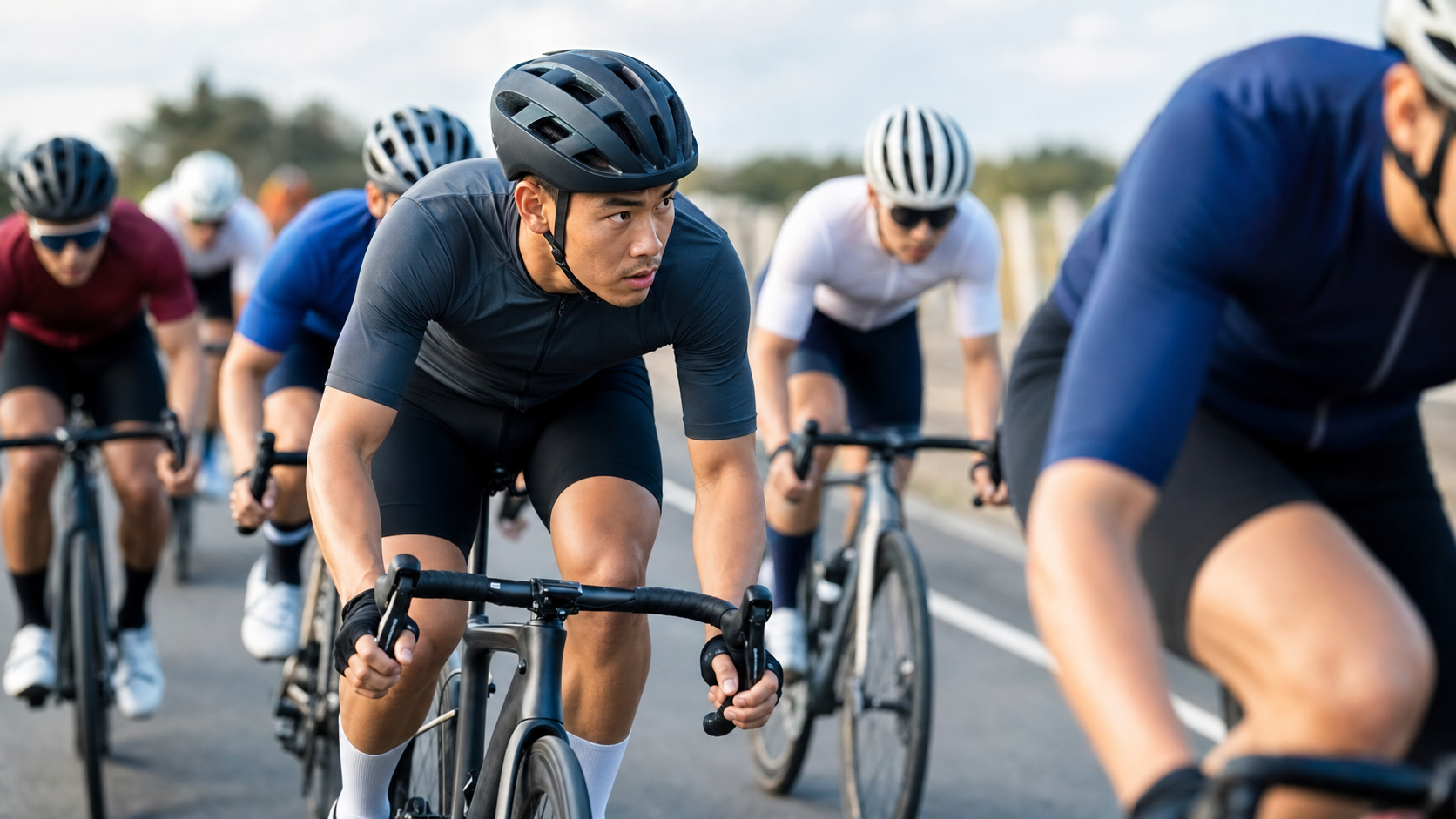
Starting with a Rider Who Always “Saw It Too Late”
A few years ago, I coached a very dedicated road cyclist—let’s call him Ah-Jie. His fitness numbers were impressive for an amateur: a Functional Threshold Power (FTP) of around 4.2 W/kg, a steady output of over 280 watts on long climbs, and a resting heart rate around 48 bpm. By all accounts, an engine like that should have placed well in a bunch sprint. But every time, in the chaos of the final 200 meters, he was a “half-beat slow”—not because his legs lacked power, but as he vividly described it: “Coach, it feels like I’m always a fraction of a second slower than everyone else in spotting where the gap is.”
That comment got me seriously researching a topic long overlooked in Taiwan’s sports community: sports vision. We spend countless hours training our cardio, strength, and technique, yet rarely ask a more fundamental question—before your legs react, what exactly are your eyes and brain seeing, how fast are they seeing it, and how accurately?
In this article, I want to honestly discuss three things: the role sports vision plays in performance, whether vision training actually has evidence behind it, and where its true practical limits lie. Because the biggest problem in this field isn’t that it doesn’t work—it’s that the effects are heavily inflated by commercial marketing, leading many people to waste money on training that never translates to real on-field performance.
Conceptual Foundation: The Eye Isn’t a Camera, It’s the Brain’s Outpost
The Misconception: “Good Visual Acuity” Equals “Good Sports Vision”
Let’s first debunk the most common myth. The “20/20 vision” you get measured at an eye clinic or optical shop refers to static visual acuity—staring at a fixed eye chart and seeing how small the letters are that you can identify. But almost nothing in sports is stationary: a ball flying toward you, an opponent cutting in, a pothole appearing 30 centimeters in front of your front wheel, gaps in the peloton opening and closing.
What comes into play here is a completely different ability: dynamic visual acuity (DVA)—the ability to see details clearly while an object is moving, or while you yourself are moving. Research has a fairly consistent finding: athletes generally have superior dynamic visual acuity compared to non-athletes, and this difference is only significant when subjects are allowed to freely track with their eyes. If subjects are forced to fixate on a single point without moving their eyes, the athletes’ advantage disappears.
This detail is crucial. It tells us that athletes see more clearly not primarily because their retinal image is better, but because they are better at using their eyes to “track” moving targets. In other words, the advantage lies in “eye movements” and “brain processing,” not “the lens itself.” This also explains why many top athletes with only 20/25 vision—or even those wearing contact lenses—still have exceptional on-field reading ability.
Sports Vision Is a Whole System, Not a Single Metric
I usually tell my athletes that sports vision isn’t one number; it’s an entire information chain from “seeing” to “acting.” I break it down into several components:
- Static visual acuity: The basic ability to see fixed details clearly (the scope of corrective lenses).
- Dynamic visual acuity (DVA): The ability to see details clearly while objects or you are moving.
- Eye pursuit and saccades: The ability to smoothly track a moving target and to rapidly shift focus between multiple targets.
- Peripheral vision: The ability to detect movement on the flanks of the peloton or an opponent cutting in using the corners of your eyes.
- Depth perception and vergence: Judging distance and coordinating both eyes to focus on near and far objects.
- Visuomotor reaction time: The time delay between “seeing” and “the body starting to move.”
- Perceptual-cognitive: The ability to anticipate, make decisions, and extract key cues from chaotic information.
Note the last two—they actually cross over into the realm of the “brain.” This is precisely what makes the entire field of sports vision research so fascinating and so easily misunderstood: much of what is called “eye training” isn’t training the eyes at all—it’s training the brain’s information processing.
An Information Chain: From Light Entering the Eye to the Legs Starting to Move
I like to use a “timeline” to help athletes build a holistic understanding. When an opponent suddenly surges ahead on your left, the actual sequence of events is roughly as follows:
- Optical imaging: The image lands on the retina (this part is almost untrainable; it falls under optics and refractive correction).
- Eye capture: Your eyes use pursuit or saccades to “grab” the target into central vision—this is the main battleground where athletes have an advantage.
- Brain processing: The visual cortex and higher-order cognitive areas compute “what is this, where is it, what happens next,” including anticipation.
- Decision-making: The brain decides “do I follow, and through which gap.”
- Action initiation: The signal reaches the muscles, and your legs start to apply power.
Throughout this entire chain, what can actually be significantly shortened through training are stages 2, 3, and 4—capture, processing, and decision-making. Stage 1 relies on correction, and stage 5 is a physiological transmission limit. This is why I keep emphasizing: rather than obsessing over “faster reactions” (compressing stage 5, where there’s very little room), focus on “earlier anticipation” (making stages 3 and 4 happen sooner)—the payoff is far greater.
Why “Seeing Earlier” Is Worth More Than “Seeing Faster”
Here’s an analogy: two riders might both have pure physiological reaction times around 200 milliseconds, with a difference of at most a few dozen milliseconds. But one rider, by reading the opponent’s hips and cadence, anticipates the surge about half a second before the opponent actually commits—that half-second (500 milliseconds) far exceeds anything reaction-time training could squeeze out. Anticipation is built through accumulated situational experience, not by staring at a screen and tapping light dots. Remember this sentence—it will save you a lot of wasted money.
Scientific Evidence: Distinguishing “Correlation” from “Effective Training”
When discussing evidence, I must first help you separate two questions that are often conflated:
- Do elite athletes have better visual/cognitive abilities? — The answer leans toward “yes.”
- Can targeted vision training actually improve on-field performance? — The answer is “limited, depends on how you train, and the transfer effect is often overestimated.”
Evidence 1: Elite Athletes Do Have Superior Visual-Cognitive Abilities
Research across multiple sports consistently shows that expert athletes have significantly better visual-perceptual and visual-cognitive abilities than lower-level athletes or the general population. This includes faster reactions, better anticipation and decision-making, and quicker extraction of key information from noise. Dynamic visual acuity also correlates with performance in various ball sports (volleyball, basketball, baseball/softball), as well as in motorsports and catching tasks.
But please remember: this is a “correlation,” not “causation.” We cannot directly infer “therefore, training vision will make you elite,” because it’s quite possible that years of high-intensity sport-specific training incidentally sharpened these visual-cognitive abilities, rather than the other way around.
Evidence 2: Vision Training “Can Improve” Certain Abilities, but Transfer to Competition Often Falls Short
This is the section I consider most important and most in need of clarity. The overall conclusion from systematic reviews is roughly as follows:
- Visual functions can indeed be improved through training, supported by the brain’s neuroplasticity—the brain reorganizes and adapts through practice and experience.
- Perceptual-cognitive training has a positive impact on anticipation and decision-making in elite athletes; vision training groups show improvements in reaction time, executive control, perceptual speed, and other cognitive performance measures.
- However—improvements in the lab transfer to real competition performance to a significantly lesser degree than the improvements measured within the lab. Training visual functions in non-sport-specific contexts helps “general cognitive performance,” but is less effective at enhancing “specific sports skills.”
- The effectiveness of specific methods varies; for example, some studies show that stroboscopic training does not significantly improve visual search ability in volleyball players.
In plain terms: maxing out a reaction test on an app doesn’t mean you’ll actually see more accurately or find gaps better in a bunch sprint. There’s a hurdle called “transfer” in between, and current evidence shows that the more general and detached from sport-specific context a vision training is, the worse the transfer.
Here, I want to add a concept that marketing often conveniently omits—“near transfer” and “far transfer.” You train A, and A itself improves—that’s near transfer, which almost always happens (it’s normal to improve at what you practice). You train A, and B (competition performance), which you actually care about, also improves—that’s far transfer, and it’s exactly what you’re spending money to buy. And it’s precisely the hardest to achieve and the most easily exaggerated. When an advertisement only shows you “improvement in the training task itself” but doesn’t show you “changes in competition performance,” you can almost be certain it’s selling you near transfer while making you think you’re buying far transfer. Learn this distinction, and you won’t be led around by pretty growth curves.
The table below is a simplified framework I use to communicate “strength of evidence” to my athletes (the strength is a directional judgment, not a precise quantification):
| Claim | Evidence Direction | My Practical Interpretation |
|---|---|---|
| Elite athletes have superior dynamic visual acuity/anticipation | Fairly consistent support | Worth noting, but may be a “result” not a “cause” |
| Visual/cognitive abilities can be improved through training | Supported | Trainable, but often training the brain, not the eyes |
| Training effects transfer to laboratory tests | Supported | Easy to see impressive numbers; don’t be fooled |
| Training effects transfer to real competition performance | Weaker, often overestimated | This is what you actually care about; be conservative |
| General “brain training apps” improve sport-specific performance | Weak evidence | Guard your wallet; don’t make it your main program |
Practical Methods: How to Train for Possible Transfer
Since general training transfers poorly, what’s the most cost-effective approach in practice? My core principle for athletes is just one sentence: The closer you get to your sport-specific context, the greater the chance of transfer. Below, I’ve organized this into two layers: “basic eye abilities” and “situational perceptual-cognitive.”
Layer 1: Basic Eye Abilities (Low-Cost, Do as Warm-Up)
These don’t require spending money on equipment and are suitable as a 5–10 minute visual warm-up before formal training. The point isn’t to “get really good” but to awaken the eye control system.
| Item | Method | Recommended Dosage | Purpose |
|---|---|---|---|
| Smooth pursuit | Hold a pen at arm’s length, move it slowly left/right/up/down; follow with your eyes, keep your head still | 30 seconds per direction × 2 | Awaken the pursuit system |
| Rapid saccades | Place two targets on the wall, left and right; rapidly shift your gaze back and forth between them | 30 seconds × 2 | Train saccade speed |
| Near-far focus shift | Place one target near (30 cm) and one far (6 meters); alternate focusing to see each clearly | 20 reps | Train accommodation and vergence |
| Peripheral awareness | Fix your gaze straight ahead; use peripheral vision to detect the number of times an assistant raises their hand on either side | 2 minutes | Train peripheral visual attention |
The evidence for this layer is relatively pragmatic: it helps the “eye movement” component where athletes already have an advantage. It should feel easy and pressure-free. Stop immediately if you experience dizziness, nausea, or visual fatigue—this means you’ve overdone it or have an underlying eye alignment issue, which we’ll discuss later regarding medical care.
Layer 2: Situational Perceptual-Cognitive (This Is the Key)
This is where I really invest my effort, because it has the highest potential for transfer. The core approach is: integrate visual reading directly into your sport-specific skill practice. Using road cycling and cycling scenarios as examples:
- Peloton gap reading: In a safe closed course or with trainer videos, have the rider maintain a target power output (e.g., 250 watts) while verbally calling out “the gap position the coach is pointing to now,” training “action + reading” simultaneously.
- Road scanning rhythm: On descents or technical sections, deliberately practice the habit of scanning “2–3 seconds ahead of your bike” rather than staring at the front wheel. This is both safety and reading.
- Peripheral opponent awareness: In group rides, practice reporting whether someone is coming up on your left or right using only peripheral vision, without turning your head.
- Anticipation cues: Watch opponents’ shoulder lines, hips, and cadence changes; practice predicting their surge before they move.
The common thread in these exercises is: carrying sport-specific physical load, in sport-specific scenarios, practicing sport-specific reading. This is exactly what research reminds us of—general, context-free training transfers poorly, so we do the opposite and put the training back into context.
An 8-Week Progressive Plan You Can Follow
Many people ask me “how long should I train and how do I progress.” I’ll give you a conservative 8-week framework that emphasizes “habit formation” rather than “training to exhaustion.” All visual elements are layered onto your existing schedule without adding extra riding time:
| Week | Focus | Situational Practice | Self-Check Indicator |
|---|---|---|---|
| 1–2 | Build the habit | Practice “look 2 seconds ahead” scanning on every descent | Can you consistently avoid staring at the front wheel? |
| 3–4 | Add peripheral vision | In group rides, use peripheral vision to report vehicles approaching from either side | Has the number of head turns decreased? |
| 5–6 | Add anticipation | Read opponents’ hip/shoulder/cadence cues | Can you call out the surge before the opponent commits? |
| 7–8 | Combined load | Simulate sprinting while reading gaps | Has your final positioning improved? |
Note the last column, “Self-Check Indicators”—they are all real-world behaviors, not any test scores. This is intentional: I want you to develop the habit of using on-field performance as the judge, starting from week one.
How to Fit It into a Week?
Here’s an example framework (assuming you ride 4–5 times per week). Vision training is always a supporting role and should never crowd out your main physical training schedule:
| Day | Main Workout | Visual Element (Additive, No Extra Volume) |
|---|---|---|
| Monday | Rest/Spin | 5-minute basic eye warm-up |
| Tuesday | Intervals | Near-far focus shift + saccades during warm-up |
| Wednesday | Aerobic endurance | Practice “look 2 seconds ahead” scanning on descents |
| Thursday | Rest | 2-minute peripheral awareness practice |
| Friday | Skills/Group ride | Peloton gap reading + peripheral awareness |
| Saturday | Long distance | Road scanning rhythm, anticipating opponent cues |
| Sunday | Recovery ride | None; let the nervous system rest |
Case Review: What Happened to Ah-Jie
Back to Ah-Jie from the beginning. I didn’t have him buy expensive stroboscopic glasses or subscribe to brain-training apps. What we did was very old-school but context-specific:
First, I sent him for a basic eye exam to rule out “not a training problem, but an eye problem.” It turned out he did have mild uncorrected astigmatism. After getting properly fitted sports glasses, his static clarity improved immediately—this step is skipped by many, yet it’s often the highest cost-performance move.
Second, we integrated “reading” directly into group rides. During simulated sprints before the finish, I would call out gaps in real time via his earpiece, requiring him to confirm positions using peripheral vision rather than turning his head. He was very uncomfortable at first, but after two or three weeks, he started positioning himself before the move happened.
Third, I deliberately shifted his focus away from “reacting faster” and toward “anticipating earlier.” Because the physiological limit of reaction time is hard to compress further, but anticipation can be significantly advanced through situational experience.
About two months later, his finishing positions improved noticeably. I must be honest: how much of this was due to visual reading, how much to better tactical positioning, and how much to simply increased confidence, I can’t precisely break down. But this is the true nature of sports vision training—it’s one piece of the overall performance puzzle, not a magic switch.
A Counterexample: Xiao-Min, Who Spent Big but Got No Transfer
I also want to share a “failed” case as a contrast, because it better illustrates the boundaries. Xiao-Min was a highly ambitious trail runner. Following a friend’s recommendation, she spent a considerable amount of money subscribing to a vision training app that claimed to improve “reaction and focus.” She diligently tapped light dots for 20 minutes a day. Three months later, she came to me frustrated: her scores on the app had indeed climbed steadily, but she felt no difference in her actual trail descents—choosing lines and dodging rocks.
This was entirely within expectations. What she was training was “tapping fixed-pattern light dots on a screen,” which is worlds apart from “on a rugged mountain trail, breathing hard, deciding which rock to step on next”—the bridge for transfer was never built. I later asked her to use that 20 minutes for actual technical descent practice, progressing through trails of increasing difficulty, and her reading ability improved noticeably within a few weeks.
These two cases together perfectly illustrate the core of this article: whether a method works depends on “how similar it is to your sport-specific context,” not on how expensive the equipment is or how impressive the scores look.
Common Mistakes and Corrections
Having coached so many athletes, I’ve seen almost all the pitfalls fall into a few categories. Check how many you’ve fallen into.
Mistake 1: Treating “Lab Numbers” as “On-Field Performance”
This is the most common. You improve 30% on some test and assume you’ll be 30% better on the field. As discussed earlier, the transfer effect takes a big hit. The correction: always use “real-world performance” as the ultimate indicator—finishing position, error rate on technical sections, how many times you get cut off in a group ride—not app scores.
Mistake 2: Spending Money on General “Brain/Vision Training” Products While Neglecting Sport-Specific Context
Many flashy products package “reaction time improvement” as “performance enhancement.” But evidence shows general training offers limited help for sport-specific skills. The correction: fully utilize the free situational practices first, then consider spending money, and before you spend, ask “does the context it trains resemble my sport?”
Mistake 3: Skipping the “Correct Basic Vision” Step
I’ve met many people who go off to do fancy vision training without even knowing they have uncorrected myopia or astigmatism. The correction: see an eye doctor/optometrist first and get what needs correcting corrected—this is usually more effective and cheaper than any training.
Mistake 4: Overworking Your Eyes
The visual system gets fatigued too. Prolonged high-intensity pursuit or stroboscopic practice can cause headaches, nausea, and eye alignment discomfort. The correction: err on the side of less dosage rather than more; treat it as a warm-up, not a main course. Stop and log any discomfort, and if it recurs, seek medical attention.
Mistake 5: Ignoring Sleep, Screen Use, and Overall Recovery
Visual-cognitive abilities are extremely sensitive to fatigue. After staying up late or staring at screens for long periods, your anticipation and scanning will definitely dull. This is especially important in Taiwan—many people spend long daytime hours on computers and phones, so their eyes are already tired before they even get on the bike. The correction: treat “eye recovery” as part of your training; reduce phone scrolling and get good sleep the day before a race.
Taiwan-Specific Context: Climate, Terrain, Eating Out, and Medical Care
No matter how good the principles are, they’re useless if they don’t fit into your life. Let’s discuss a few practical points unique to Taiwan.
Humidity, Heat, and Glare
Taiwan’s summers are humid and hot, with strong UV at noon. Squinting in bright light, sweat stinging your eyes, and fogged-up lenses all directly undermine your dynamic reading. Practical advice:
- A good pair of sports sunglasses (with prescription lenses if needed) is often the most underrated “vision training investment”—it protects your eyes and directly improves clarity.
- Choose models with anti-fog and breathable nose pads; Taiwan’s humidity will fog up cheap lenses quickly.
- Train in the early morning or evening—besides avoiding the heat, you also avoid the visual strain of harsh midday light.
Reading Priorities for Common Terrains
Taiwan’s popular riverside bike paths and mountain climbs (such as Yangmingshan, Beiyi, Wuling, and other long climbs) each present different visual challenges: riverside paths are crowded with mixed traffic and sudden surprises, making peripheral vision and scanning rhythm most important; mountain descents rely on depth perception and looking far ahead. Target the most relevant skill for the terrain you ride most. The table below summarizes the visual priorities for common Taiwan scenarios—check it against where you spend the most time:
| Scenario | Main Visual Challenge | Ability to Prioritize | Practical Reminder |
|---|---|---|---|
| Riverside bike path | Pedestrians, pets, oncoming traffic appearing suddenly | Peripheral vision, scanning rhythm | Slow down and yield; use peripheral vision for both sides |
| Long mountain descent | Corner line selection, road potholes | Depth perception, looking far ahead | Look through the corner; don’t stare at the front wheel |
| Peloton/group ride | Gaps opening and closing, opponent movements | Pursuit, anticipation, peripheral vision | Don’t turn your head; confirm with peripheral vision |
| Night/early morning riding | Insufficient light, reduced contrast | Contrast sensitivity | Good lights + reflectors, ride slower |
| Midday sun | Glare, sweat, fogged lenses | Maintaining clarity | Proper sunglasses + anti-fog |
The purpose of this table isn’t to make you train every item, but to help you focus your limited attention on the one or two items most relevant to your terrain—that’s the efficient approach.
Eye Nutrition for People Who Eat Out
I’ll speak very conservatively here. A balanced diet is beneficial for overall health, including vision. Dark green vegetables, eggs, dark berries, and fish rich in Omega-3 are generally considered eye-friendly foods under standard nutritional principles. In Taiwan, eating out often means insufficient vegetable intake, so make an effort to add more dark green vegetables from bento shops or buffet restaurants. But please note:
- I will not tell you to load up on lutein or any supplement as a means to “enhance sports vision”—treating supplements as performance enhancers has weak evidence and is outside my professional scope for prescribing.
- For any nutritional supplement needs, especially if you have chronic conditions or are on medication, please consult a physician or dietitian.
Health Insurance and Medical Care: When to See a Doctor
Seeing an eye doctor in Taiwan is convenient and affordable—that’s our advantage, so don’t waste it. If any of the following occur, prioritize seeing a doctor, not a coach or buying products:
- Blurred vision, double vision, visual field defects, floaters, or flashes of light.
- Recurrent headaches, nausea, or eye soreness after training or screen use.
- A sudden, noticeable decline in reading ability.
These could involve refractive issues, eye alignment/strabismus, dry eye, or even more serious retinal or neurological problems. A special reminder: individuals with diabetes, hypertension, or cardiovascular disease need regular professional eye monitoring (e.g., diabetic retinopathy). In such cases, everything must be individualized and follow medical advice; any training should come after medical evaluation, and I must be conservative in my language—I cannot and will not make any diagnosis or prescription for you here.
Actionable Advice for Readers at Different Levels
If You’re a Beginner
Do the two most basic, highest cost-performance things first: one, get an eye exam and correct your basic vision; two, get a proper pair of sports glasses. For training, just add 5 minutes of basic eye exercises to your warm-up. No equipment purchases needed. Put your energy into fitness and technique, which are what really determine your results.
If You’re an Intermediate
Start incorporating “situational perceptual-cognitive” training into your existing schedule: practice gap reading and peripheral awareness in group rides, practice looking far ahead on descents, and look for anticipation cues in opponents. Use real-world performance as your indicator, and review every 4–6 weeks: Have errors on technical sections decreased? Has your final positioning improved?
If You’re an Elite/Semi-Professional
You deserve more professional intervention, but you should also be the most skeptical. Consider working with a qualified sports vision professional (optometrist/sports vision coach) for assessment and highly sport-specific training. But allocate your budget to training that “resembles your competition context,” and remain wary of general brain-training apps. Remember—at your level, every percentage point of transfer must be earned through evidence, not marketing hype.
Investment Priorities for the Three Levels
| Level | First Priority | Second Priority | Be Skeptical Of |
|---|---|---|---|
| Beginner | Eye exam and correction | Sports glasses | Any paid training product |
| Intermediate | Situational reading practice | Basic eye warm-up | General brain-training apps |
| Elite | Sport-specific situational training | Professional assessment | Marketing that exaggerates transfer effects |
Quick FAQ
Q: Do people who wear glasses necessarily have worse sports vision?
A: Not necessarily. Research shows elite athletes’ dynamic visual acuity advantage comes primarily from eye pursuit and brain processing, not the “lens” itself. With proper refractive correction, people who wear glasses can have excellent sports reading ability.
Q: Do those stroboscopic glasses and stroboscopic training work?
A: Evidence is inconsistent; for example, some studies show stroboscopic training did not significantly improve visual search ability in volleyball players. It’s not completely useless, but don’t make it your main program, and don’t expect significant transfer to competition.
Q: Can reaction time be trained to be faster?
A: It can improve somewhat, but the physiological limit is finite. A more cost-effective direction is training “earlier anticipation,” using situational experience to read the opponent’s move before it happens.
Q: I don’t have money for equipment. Does that mean I can’t train?
A: Quite the opposite. The practices with the best transfer are almost all free—integrating reading into your sport-specific training context is far more practical than any expensive equipment.
Q: I’m older. Is my sports vision hopeless?
A: No. While some visual functions change with age, “anticipation built from accumulated situational experience” is actually a veteran’s strength—many experienced riders compensate for declining raw reaction speed by reading the race and positioning well. Get your correction done, use your experience, and age isn’t a death sentence.
Q: Is there a difference in sports vision between contact lenses and glasses?
A: Each has trade-offs. Contact lenses offer a wider field of view without frame obstruction and are less prone to fogging, but can be uncomfortable with dry eyes or wind; sports glasses are easy to put on and take off, block wind and dust, but can fog up easily in Taiwan’s humid climate. This is more about personal fit—try both before deciding, and let your optometrist assist.
Conclusion: Seeing Clearly Is About Deciding Early
What’s truly fascinating about sports vision isn’t “training your eyes to become eagle eyes,” but that it forces us to look at the very front end of performance—before your legs react, your brain has already made a decision based on what your eyes saw. Ah-Jie’s story taught me: what he lacked was never power, but those fractions of a second in reading and anticipation.
But I also want to leave you with an honest assessment. The science in this field gives us two statements: elite athletes do have superior visual-cognitive abilities, and visual functions are indeed trainable; but general, context-free training has transfer effects to real competition that are often overestimated. So my advice remains consistent—first, get the basics right (correction, glasses, sleep, eye recovery), then put the training into your sport-specific context, and always use real on-field performance as the judge. Don’t let polished marketing make promises for science that go beyond the evidence.
Take care of your eyes, train your reading within context, and leave abnormal signals to the doctor—do these three things, and you’re already ahead of most people who only focus on training their legs. And these three things are all quite humble: one eye exam, a good pair of glasses, a few weeks of integrating reading into group rides and descents, and a healthy skepticism toward exaggerated claims. It’s not sexy, and it won’t transform you overnight, but it’s a path backed by evidence that won’t waste your money. The next time you see marketing claiming “put them on and become an eagle eye,” I hope you’ll smile knowingly, and then get back to the training that actually matters.
This article is educational content and cannot replace individual diagnosis and treatment advice from a physician, physical therapist, or dietitian. If you have a medical condition or physical discomfort, seek medical attention promptly and undergo individualized assessment.
References
- Role of Sport Vision in Performance: Systematic Review (PMC): https://pmc.ncbi.nlm.nih.gov/articles/PMC11204951/
- Training vision in athletes to improve sports performance: a systematic review of the literature (Taylor & Francis): https://www.tandfonline.com/doi/full/10.1080/1750984X.2024.2437385
- Effects of Perceptual-Cognitive Training on Anticipation and Decision-Making Skills in Team Sports: A Systematic Review and Meta-Analysis (PMC): https://www.ncbi.nlm.nih.gov/pmc/articles/PMC11505547/
- Origins of Superior Dynamic Visual Acuity in Baseball Players (PLOS One): https://journals.plos.org/plosone/article?id=10.1371%2Fjournal.pone.0031530
- Athletes Demonstrate Superior Dynamic Visual Acuity (PubMed): https://pubmed.ncbi.nlm.nih.gov/34267082/
Related Reading
- Sports and Eye Health: A Complete Guide from Intraocular Pressure, Vision to Prolonged Screen Use
- The Benefits of Visualization Training on Motor Skill Learning Rate: A Neuroscience Validation Study
- The Science of Imagery Training: Can Practicing in Your Mind Really Make You Ride Faster?
- An Eye-Tracking Study on Visual Attention Allocation in Cycling Descent Technique
CT 喇低賽) 單車 比賽總是沒照片? 攝影師的觀點大公開 姿勢就是力量! 請加速1.25倍收看
7 年前
西進武嶺 免費訓練分析服務 Intervals | 練不夠還是練過頭?你哪一種類型選手?AI模型告訴你! | 備戰神器 | 公路車 訓練 | CT Yeh
4 年前
一個測試有沒有認真練車的方法😂 #公路車
10 個月前
雷達尾燈 雷不雷? 邁金L508 智慧雷達尾燈 情境考驗實測 | 同場加映 2千元等級的專業車錶 C406 Pro | 公路車 | CT Yeh
3 年前
崇越盃武嶺冠軍高手 賽前JJSC 群峰會精華!對應大數據分析,會有落差嗎?/ feat. JJSC中部公路車約騎 /公路車 / CT Yeh
2 年前
西進武嶺 自製新版AI配速表產生器 x 賽前攻略 抱佛腳! 沒有功率計也可以產生配速表嗎?有什麼其他眉角賽前要注意的呢? | 西進武嶺 / 東進武嶺 KOM 攻略 | 公路車 | CT Yeh
4 年前
FTL 與 SYB 車隊專訪 西進武嶺 實用攻略分享! 2小時 如何練?!你不知道的眉角!新手準備武嶺必看 EP1 | 實力派女車友 | 精華版 | 公路車 | CTYeh
4 年前
多機位拍片神器 DJI Action 2 拍出速度張力感 | 類空拍機視角 4陣列麥克風超強降風噪 實測! | 公路車 | CT Yeh
3 年前