The Science of Team Sports: Coordination, Communication, and Collective Efficacy — How a Group Can Ride Faster Than the Sum of Its Parts
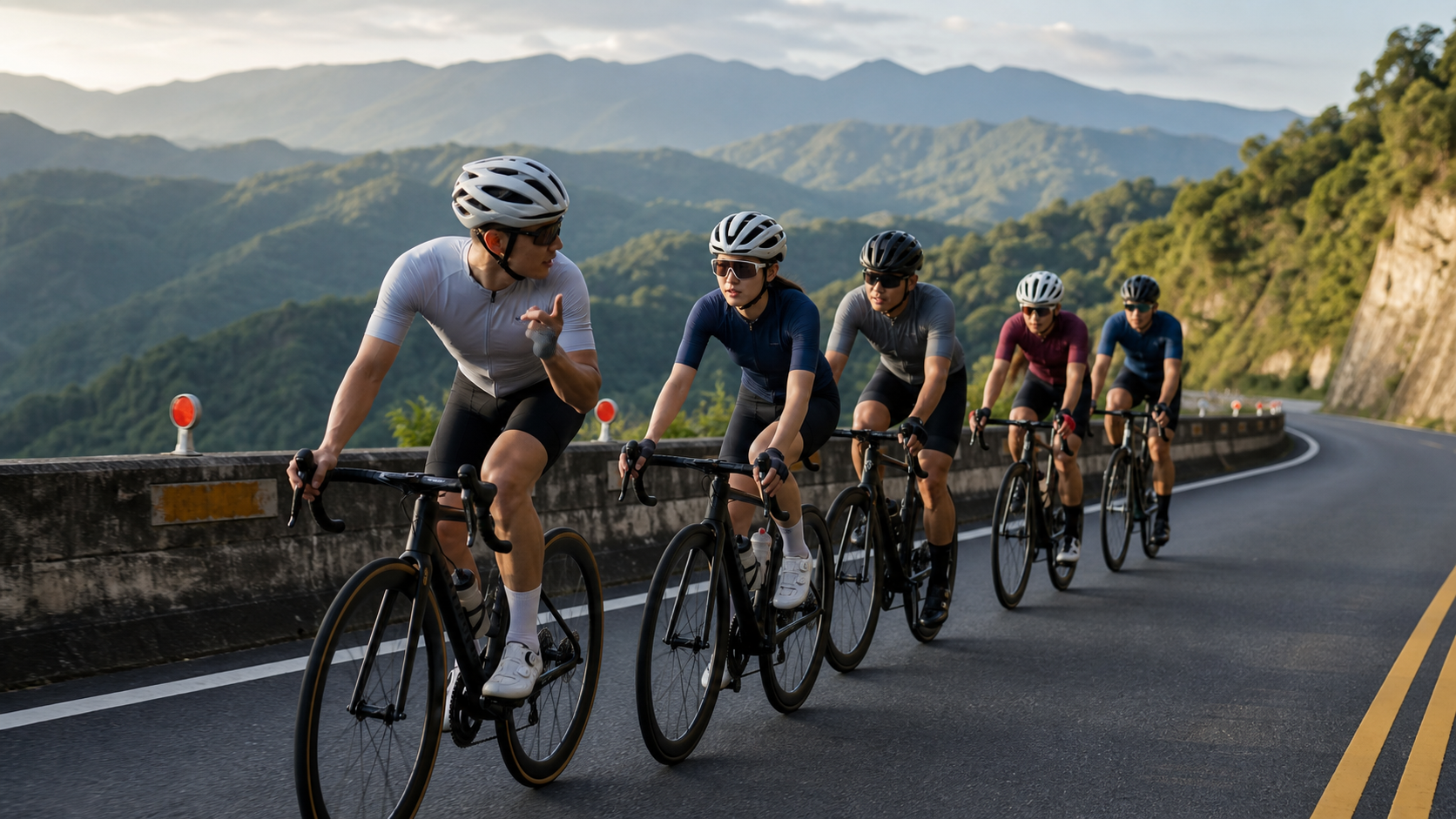
Opening: The Team That Was “Clearly Strong but Always Fell Apart”
I once led a community cycling team where every member was individually capable. One guy had an FTP close to 300 watts, one woman climbed as lightly as a feather, and two middle-aged riders had solid aerobic bases from finishing full marathons. By all accounts, this was a team that could roll over the Beihuang Highway and Fengguizui one after another. But when we actually rode together, it often turned into “a long, broken line within five kilometers of starting.” The riders in front would look back and not find the riders behind; the riders in the back would ride wondering what they were doing wrong. After training, everyone went their separate ways, and no one could even be bothered to type a word in the Facebook group.
In my first year leading them, the first thing I did wasn’t laying out a training plan—it was sitting down and asking one question: “Do you think this team can finish Wuling together?” The result was total silence. That silence told me something—these people’s individual abilities were fine; the problem was “the collective” itself. They didn’t trust each other, didn’t communicate, and had no shared rhythm. So no matter how strong the individuals were, they couldn’t stick together as a team.
In this article, I want to lay out clearly what I’ve accumulated over 15 years of leading cycling teams, triathlon teams, and even building teams for corporate clubs, cross-referenced with sports science research. Team sport—whether it’s road cycling in a peloton, relay racing, or any situation requiring multi-person coordination—has a science to its performance, and that science can be trained. We’ll cover three core elements: coordination, communication, and collective efficacy, and then give you a practical set of methods you can take back and use.
Let me start with a counterintuitive conclusion that research has repeatedly confirmed: a team’s overall performance often cannot be predicted by the sum of its individual members’ abilities. In collective efficacy research, there’s a frequently cited observation—a team’s shared belief in “what we can accomplish together” predicts actual team performance better than summing up each person’s individual self-efficacy. In other words, putting five people with an FTP of 250 watts together doesn’t automatically create a 1250-watt monster. They might, through smooth coordination and mutual trust, perform far beyond what their numbers suggest, or they might, through broken communication and mutual distrust, produce results worse than any one of them riding solo.
Concepts and Scientific Foundations: What Team Performance Is Actually Made Of
Three Core Variables: Coordination, Communication, Collective Efficacy
I like to explain team performance to trainees with a simple framework. Imagine it held up by three pillars:
-
Coordination: The alignment of multiple people’s movements, rhythms, and positions in time and space. Pacelines in group riding, baton exchanges in relays, handoffs in triathlon relays—all of these are coordination problems. With good coordination, energy loss is low, wind resistance is shared, and speed is higher; with poor coordination, you don’t save the energy you should, and you don’t fill the positions you should.
-
Communication: The quality and speed of information flowing between members. This includes verbal (shouting “car back” or “shifting now”) and non-verbal (hand signals, eye contact, body language cues). Research on team coordination repeatedly points out that trust, non-verbal communication, and shared emotional states are key to enabling coordination. Communication isn’t just talk—it’s the nervous system that strings individual actions into collective action.
-
Collective Efficacy: A group’s shared belief in “our collective ability to organize and execute the actions required to achieve our goals.” This concept originates from Bandura’s self-efficacy theory and is its extension to the group level. Teams with high collective efficacy, when facing headwinds, falling behind, or someone cramping, tend to think “let’s figure this out together”; teams with low collective efficacy start blaming each other and giving up individually at the first sign of trouble.
These three pillars feed each other. Good communication makes coordination smooth; smooth coordination and repeated shared success raise collective efficacy; high collective efficacy makes members more willing to invest in communication and cooperation—this forms what research calls the positive spiral (spiraling up). Conversely, broken communication, chaotic coordination, and repeated failure cause collective efficacy to collapse, and the team enters a downward spiral (spiraling down), eventually disbanding.
Cohesion and Its Relationship with Performance
Many people equate “cohesion” with “everyone gets along well,” which is a common misunderstanding. Sports psychology splits cohesion into two parts:
- Task Cohesion: The degree to which everyone is committed to “accomplishing this goal together.”
- Social Cohesion: The degree to which people like each other and want to spend time together.
The general trend in research is: task cohesion is usually more strongly associated with performance than social cohesion, and under high-pressure situations, task cohesion is particularly effective at enhancing performance and group motivation. This has a direct implication for coaches—you don’t need everyone on the team to become best friends, but you do need them to have a clear and shared commitment to “we are going to accomplish this together.” In my experience leading teams, I’ve seen teams with great camaraderie that trained terribly (they’d go out, chat over coffee, and log zero training volume), and teams that weren’t particularly chummy day-to-day but were perfectly aligned and precise once on the road. The latter wins.
Why “Coordination” Makes You Ride More Efficiently
Let me insert some physiology and physics here, because it shows that “team” isn’t just a psychological concept. On a road bike at speeds above roughly 30 to 40 km/h, air resistance becomes the dominant source of energy expenditure, accounting for a very high proportion. Drafting behind someone else, the rider in front blocks most of the wind for you, and the following rider’s power requirement can drop significantly—depending on formation, distance, and speed, the savings vary within a range, but “significantly easier” is an undisputed physical fact.
What does this mean? It means coordination itself is free fitness. In a smoothly rotating paceline, at the same speed, each rider’s average power output is lower than riding solo; the energy saved can be reserved for key climbs or the final sprint. So team training isn’t mystical—it has a real, physical dividend. But that dividend is only available when coordination is good enough, when everyone is willing and able to hug the wheel and change positions smoothly. When coordination breaks down, gaps grow and shrink, speed surges and drops, and the dividend instantly turns into mutual drag.
Practical Methods: A Complete Process for Forging a Team from Loose Sand
This section is the key part. I’ve organized what I actually do when leading teams into executable steps and tables.
Step 1: Build a Shared Mental Model (The Same Map in Everyone’s Head)
The scientific core of team coordination is the “shared mental model”—each member having a consistent understanding of “what we’re doing, how we’re doing it, and who’s responsible for what.” When mental models don’t align, you get disasters like “I thought you’d take the pull, I thought you’d lead.”
When I lead a new team, I always do a “five-minute briefing” before heading out, which consistently covers these items:
| Briefing Item | What Needs to Be Made Clear | Why It Matters |
|---|---|---|
| Today’s Goal | Is it an endurance ride, interval session, or easy recovery? Target pace/power zone | Prevents some wanting to push hard while others want to cruise, causing rhythm conflicts |
| Route and Terrain | Where are the steep climbs, dense traffic lights, and feed zones | Lets everyone anticipate and allocate energy in advance |
| Formation and Paceline Rules | How many per row, direction of rotation, whether to split up on climbs | The specific operating rules for coordination |
| Communication Signals | Fixed calls and hand signals for “car back,” “pothole,” “slowing” | Standardizes language, reduces misunderstandings |
| Dropped Rider Protocol | Whether to wait if someone falls off, and where to regroup | Decided in advance to avoid arguments and anxiety in the moment |
These five minutes often improve team performance more than riding an extra ten kilometers. Because they turn “assumptions” into “shared understanding.”
Step 2: Communication Framework—Building a Common Team Language
Communication can’t rely on improvisation; it relies on pre-agreed, fixed signals. Here’s the basic communication dictionary I use with cycling teams. You can copy it directly or adapt it to your team’s version:
| Situation | Verbal Signal | Hand/Body Signal | How It’s Passed |
|---|---|---|---|
| Vehicle approaching from behind | “Car back!” | Hand waved behind the body | Relayed from back to front, one rider at a time |
| Obstacle/pothole ahead | “Pothole!” “Rock!” | Point toward the obstacle | Relayed from front to back, one rider at a time |
| Slowing/stopping | “Slowing!” “Stopping!” | Palm pressed downward | From front to back |
| Rotating/relinquishing the lead | “Rotate!” | Elbow flicked outward | Called by the lead rider |
| Someone is struggling | “Hold up” “Ease off” | Hand raised | Called by the rider themselves or someone else |
There are three key principles: First, signals must be short—in headwinds, heavy breathing, and traffic noise, the shorter the signal, the more likely it gets through. Second, relay the signal—once one person calls it, everyone who hears it passes it on so the back of the group receives it too. Third, non-verbal signals are essential—often the wind is too loud for voices to carry, and hand signals are more reliable. This also echoes what research repeatedly emphasizes about “the importance of non-verbal communication for coordination.”
I also specifically train one thing: anticipatory communication. That means sending the signal before the action happens, not reacting at the moment it occurs. A good lead rider gives the signal one second before slowing, giving the riders behind time to react; a poor lead rider brakes first, leaving everyone behind scrambling. This habit is the dividing line between group safety and chaos, smoothness and disruption.
Step 3: Coordination Training Plan
Coordination, like fitness, needs to be trained. Here’s a progressive eight-week plan to help a team build paceline and communication chemistry. Assume the team can ride together 1–2 times per week, with individual training on other days.
| Week | Team Training Focus | Specific Content | What to Observe |
|---|---|---|---|
| Weeks 1–2 | Steady-speed wheel hugging | Single paceline the whole ride, speed held in a comfortable zone, practice maintaining a fixed gap | Whether the gap is stable, no surging or slowing |
| Weeks 3–4 | Smooth rotation | Practice the lead rider pulling off and the next rider coming through, rotating every 1–2 minutes | Whether speed drops during rotation, whether formation breaks down |
| Weeks 5–6 | Communication relay | Deliberately design signal passing (calling potholes, car back), check whether the back receives it | Signal transmission completion rate, reaction time |
| Week 7 | Small-group coordination | Split into small groups for paceline racing, practicing coordination at high intensity | Whether communication holds at high heart rates |
| Week 8 | Full integration test | Simulate a complete ride on a target route | Whether all elements from the previous seven weeks integrate |
The philosophy of this plan is: slow before fast, simple before complex, individual skills before integration. Just as you wouldn’t throw someone into a 1500-meter swim on their first day of lessons, coordination has to be built layer by layer. I’ve seen too many teams go hard from day one, only to have injuries or arguments break up the team before coordination is ever established.
Step 4: Deliberately Cultivating Collective Efficacy
Collective efficacy isn’t built by chanting slogans; it’s built on shared success experiences. Bandura’s theory tells us the strongest source of efficacy is “mastery experience”—actually having done it. That’s why I place great importance on “arranging winnable battles” when leading teams.
Here I want to share a very realistic case study (a typical reconstruction, but reflecting my actual approach to leading teams). I once led a four-person triathlon relay team with mixed abilities: one strong swimmer, one solid cyclist, and two average runners. They were anxious at first because one runner was particularly unconfident about their leg, often saying during practice, “I’m definitely going to hold everyone back.” That phrase is dangerous—it’s the seed of a downward spiral in collective efficacy.
The first thing I did wasn’t telling them to run more. Instead, I redesigned the team’s “definition of success.” I changed the first-stage goal from “finish under a certain time” to “zero errors on all four handoffs, with everyone completing their leg steadily within their own range.” This was a goal everyone could achieve together, without concentrating pressure on any single individual. At the first test, they achieved zero handoff errors, and that anxious runner showed, for the first time, an expression that said “we’re one unit.” Only after that success did the positive spiral kick in—they started adding extra training, and the team’s collective efficacy built up from there. The key takeaway from this case is: the first brick of collective efficacy should be deliberately designed as a success that the whole team achieves together, not one that targets any individual.
Concretely: set laddered goals. Don’t have a novice team challenge Wuling from the start—that will likely fail, and collective efficacy will collapse. First set a goal that’s within reach but still requires everyone to work together, such as “the whole team completes a 50 km flat paceline ride without anyone dropping off.” Once achieved, everyone has a shared memory of “we can do this,” and that memory is a brick of collective efficacy. Then build up: 80 km, a route with a climb, a half-day expedition… step by step, letting success experiences accumulate and the positive spiral turn.
| Source of Collective Efficacy | How a Coach Can Operate It |
|---|---|
| Mastery experience (strongest) | Design laddered goals that can be achieved together, accumulating “we did it” memories |
| Vicarious experience | Share success stories from similar teams, or have members demonstrate for each other |
| Verbal persuasion | Specific, genuine affirmation (“that rotation just now was beautiful”), not empty “go go go” |
| Emotional and physiological states | Manage team anxiety; reframe pre-race nerves as “we’re ready” excitement |
Advanced Concepts: The “Quantity” and “Quality” of Communication, and When to Shut Up
A trainee once asked me a great question: “Coach, is more communication always better? Should we be shouting and talking the whole way?” The answer is no. The science of communication isn’t “the more the better”—it’s the right information, at the right time, in the right way.
Over-communication is actually harmful. Imagine a group where everyone is constantly shouting and giving orders—the information interferes with itself, drowns out genuinely important safety signals (“car back” buried under casual chatter), and increases cognitive load. During high-intensity riding, people’s attentional resources are already stretched thin; excess communication becomes a burden.
I use a simple principle to teach trainees when to speak:
| Communication Type | Should There Be More? | Explanation |
|---|---|---|
| Safety signals (obstacles, vehicles, slowing) | Absolutely, and immediately | It’s about safety; better to over-call than miss one |
| Coordination commands (rotation, shifting, regrouping) | Precise and brief | Say what needs to be said, no rambling |
| Morale encouragement | Moderate, specific | One well-timed word at a key moment beats a constant stream of “keep going” |
| Casual chat | Depends on the situation | Fine on easy rides; shut up and focus during high-intensity sections |
This also connects to a theme that appears repeatedly in research: shared emotional states are important for coordination. Sometimes a team’s best communication isn’t verbal at all—it’s that unspoken understanding of “no need to say it, we all know it’s time to push.” This kind of chemistry comes from tacit understanding accumulated through long-term shared training, and it’s the highest form of communication—less is more.
How Leadership Style Affects Team Performance
Research on leadership and athletic performance has found that communication and team cohesion moderate the relationship between leadership style and performance. In plain terms: for a visionary, inspiring leader to actually translate into good results, good communication and cohesion must serve as the bridge in between. A charismatic captain alone, without communication channels and cohesion properly built, will have their leadership “spin its wheels.”
The implication for captains is clear: don’t just try to be the person pumping their fist and rallying the troops—be the person who builds the communication system and team cohesion. The former is the stage; the latter is the engine. I’ve seen many charismatic captains who couldn’t retain their team members, and the problem was almost always that they had inspiration but hadn’t cultivated the day-to-day communication mechanisms and shared goals.
Common Mistakes and Corrections
In all my years leading teams, I’ve seen the same mistakes repeat with high frequency. Here are the most common ones, and how to fix them.
Mistake 1: Thinking “Gathering Strong Riders” Equals a Strong Team
This is the most expensive mistake. As mentioned earlier, team performance cannot be predicted by the sum of individual abilities. I’ve seen a boss spend a lot of money assembling the company’s best cyclists into an “elite team,” only to have it fall apart because everyone was used to being the boss and no one was willing to play a supporting role. Coordination was a mess, and they got dropped by a team of average riders with great chemistry.
Fix: When forming a team, beyond ability, look at role complementarity and willingness to cooperate. A good team needs someone who can lead and take the wind, someone who excels at climbing and lifting morale, someone detail-oriented who looks after dropped riders. Role diversity matters more than stacking abilities.
Mistake 2: Training Only Fitness, Not Coordination and Communication
Many teams’ training is just “go out and ride until you’re exhausted,” never deliberately practicing rotation or signal passing. The result is that everyone has fitness, but everything falls apart the moment coordination is required.
Fix: Treat coordination and communication as independent training items on the schedule (see the eight-week plan above). Like intervals and long distance, they are skills that need dedicated practice.
Mistake 3: Treating Social Cohesion as the Only Goal
Some teams turn into purely social groups—dinners, drinks, all of it—but never actually train properly. Great camaraderie, terrible results.
Fix: Prioritize building task cohesion—a clear shared goal and commitment to achieving it. Social cohesion is a bonus, but it can’t replace task cohesion. Ideally you have both, but if you have to rank them, task comes first.
Mistake 4: Communicating Only “When Something Goes Wrong”
Many people only shout when they’re about to hit something. That’s reactive communication, and it’s too slow.
Fix: Train anticipatory communication—send the signal before the action. And build a “relay the message” culture so the back of the group receives information too.
Mistake 5: Letting Collective Efficacy Collapse After a Single Failure
If a team has one terrible ride (someone crashes, someone blows up, morale tanks) and no one addresses it, the downward spiral starts.
Fix: After a failure, do a team debrief, but focus on “how do we do better together next time,” not on finding a scapegoat. Reframe the failure as “a lesson we learned together” to protect collective efficacy.
How to “Measure” a Team: Turning Abstract Chemistry into Trackable Indicators
Many people think team dynamics are too vague to measure, so they don’t manage them. But if you don’t measure it, you can’t systematically improve it. When I lead teams, I use a few simple indicators that require no expensive equipment to track, turning abstract “chemistry” into visible numbers or observations.
| Indicator | How to Measure | What Progress Looks Like |
|---|---|---|
| Formation stability | Observe how many times the group stretches out or breaks apart during a ride | Fewer breaks, more consistent gaps |
| Signal transmission completion rate | After the front sends a signal, check whether the back received it (can ask afterward) | Goes from “often not passed on” to “almost always received” |
| Rotation smoothness | Whether speed drops noticeably during rotation, whether formation breaks down | Speed maintained during rotation, formation holds |
| Dropped rider handling | Whether the team’s reaction to someone falling off is panicked or orderly | From arguing/chaos to calmly following the pre-agreed protocol |
| Team self-rated efficacy | Before a ride, simply ask “how confident are we that we can finish this together” | Confidence is stable and accurately reflects ability |
I want to emphasize the last one, “team self-rated efficacy.” It’s essentially a simple measurement of collective efficacy. You can ask it at the start of the season and mid-season to see whether it’s trending up. If a team’s collective efficacy is steadily rising, it usually means your communication, coordination, and success experiences are all on the right track. Conversely, if it’s dropping, that’s an early warning sign—intervene quickly, don’t wait until the team falls apart to regret it.
Remember the important reminder from research: collective efficacy and performance influence each other bidirectionally and spiral. Good performance raises efficacy, and raised efficacy improves performance in turn. So if you can get the spiral turning upward early, it gets easier and easier; but if you let it turn downward, it gets harder and harder to rescue. Intervening early and accumulating small successes early is the most cost-effective investment in team building.
Local Context in Taiwan: Bringing the Science Down to Earth in Our Environment
Theory is theory, but Taiwan has its own realities. Let me add a few localization notes.
Weather and humidity: Taiwan’s summers are hot and humid. When a team rides out, dropping off is often not a fitness problem—it’s a heat exhaustion problem. If someone in the group turns pale, talks less, or moves sluggishly, that’s the body signaling for help. The team communication dictionary must include a “someone is struggling” signal so the rider themselves or someone nearby can call it out immediately, and the whole group slows down or stops to hydrate. For long summer rides in Taiwan, hydration and electrolyte frequency needs to be aggressive. The general principle is to replenish more actively in hot, sweaty conditions than in cool weather, and to pay attention to sodium intake (people who eat out usually get plenty of sodium day-to-day, but prolonged heavy sweating can still deplete it). For any team member with a history of cardiovascular disease, this must be individualized and discussed with a physician first.
Eating out and nutrition: Taiwan’s convenient food options are a double-edged sword for post-training recovery. Convenience is good, but many people just grab a random bento box and a sugary drink after training, shortchanging their protein intake. Teams can build a “eat together after training” culture, reminding each other to get quality protein (roughly a palm-sized portion of meat/fish/legumes) and carbohydrates. This serves both recovery science and social cohesion—two birds with one stone.
Common venues: Fengguizui and Yangjin Highway in the north, Wuling and Dakeng in the center, Qishan and Meinong in the south—these are popular group training routes. Most of them have significant climbing sections. How the team handles climbs is the moment it’s most likely to fall apart—because individual ability gaps are magnified on climbs, with the fast riders pulling away and the slow ones left behind. Agreeing in advance on a “ride your own pace on the climb, regroup at the summit” rule is more practical than trying to stay glued together, and it prevents the fast riders from getting frustrated and the slow riders from being crushed by pressure.
National health insurance and medical access: Taiwan’s convenient healthcare is a huge advantage. If someone on the team repeatedly shows abnormal symptoms—unusually severe breathlessness on climbs, chest tightness, palpitations, dizziness—don’t dismiss it with “they’re just not fit.” Encourage them to see a doctor to rule out cardiovascular issues. One important function of a team is being each other’s “health watchdogs.” Sudden cardiac death during exercise is rare, but it usually has warning signs, and a teammate’s timely reminder can genuinely save a life.
Actionable Advice for Readers at Different Levels
If You’re a Beginner Group “Just Getting Friends Together to Ride”
- Get the safety communication signals down first—this matters a hundred times more than chasing speed. At minimum, have “car back,” “pothole,” and “slowing” signals and be able to relay them.
- Set goals low and specific: make the first shared goal “the whole team completes an easy short ride without anyone dropping off,” then build from there. Accumulate success experiences; don’t start with a battle that makes everyone want to quit.
- Spend five minutes briefing before every ride: what we’re doing today, the route, and the regroup points.
If You’re an Advanced Group “Already Riding Together for a While”
- Start deliberately training coordination: schedule rotation practice and communication drills at high intensity. Take the eight-week plan and adapt it to your team.
- Build a team debrief culture: after every important ride, spend ten minutes talking about “what went well, what can be better next time,” without blaming anyone.
- Cultivate task cohesion: set a seasonal goal that requires months of collective effort (e.g., completing a specific event or classic route together).
If You’re a “Coach or Captain Leading a Team”
- Position yourself as the architect of collective efficacy: your core job isn’t how fast you ride yourself, but designing a ladder of experiences where “everyone can succeed together.”
- Manage team emotions: reframe pre-race anxiety as “we’re ready” excitement; after failures, protect morale and avoid the downward spiral.
- Cultivate role complementarity: give everyone a clear, needed role, not just the strongest riders. Being needed is the key to retaining people and maintaining commitment.
FAQ
Q: Our team gets along great, so why are our results still average?
A: Getting along is social cohesion. Results depend more on task cohesion and coordination skills. Check whether you have a clear shared goal and whether you’re actually training coordination, rather than turning every ride into a social gathering.
Q: There’s one rider who’s much stronger than everyone else, and the rest can’t keep up. What do we do?
A: Make the strong rider a “supporter” rather than a “dropper.” The strong rider can take the wind, wait on climbs, and lead at a controlled pace. Turn their strength into a team resource rather than a source of separation. At the same time, give the slower riders laddered goals so they also get success experiences.
Q: Someone always drops off on rides, and the atmosphere gets bad. How do we fix it?
A: Agree on the dropped rider protocol in advance (where to regroup, whether to wait), making it a system rather than an emotional argument in the moment. Also review whether the route and pace exceed the team’s current ability—usually, dropping off is the result of setting goals too aggressively.
Q: Will coordination training sacrifice individual fitness gains?
A: No, the two can run in parallel. Keep your individual training plan (intervals, long distance, strength), and add coordination training during team rides. The energy-saving dividend from coordination actually gives you more fitness to use at key moments.
Q: Is non-verbal communication really that important?
A: In environments with strong wind, traffic noise, and heavy breathing, voices often don’t carry, so hand signals and body cues are more reliable. Research also repeatedly points to non-verbal communication and shared emotional states as key to team coordination. Make hand signals a reflex, and your team will be safer and smoother.
Q: What if cliques or factions form within the team?
A: This is usually the result of social cohesion overriding task cohesion, combined with a lack of shared goals. Pull the focus back to “what are we collectively trying to achieve,” and design tasks that require cross-clique cooperation (e.g., mixed small-group paceline racing) to dissolve factions with a common goal. Also check whether resources or attention are unevenly distributed, making some people feel marginalized.
Q: I’m the weaker rider on the team and always feel like I’m holding everyone back. How should I adjust?
A: First, know this—a team needs far more roles than just “the fastest person.” You can be the one who relays safety signals most reliably, the one who looks after dropped riders, the stabilizer of team morale. Shift your focus from “who am I beating” to “what am I contributing to the team.” At the same time, talk to the captain about setting laddered progress goals for yourself, building your own efficacy through small successes one at a time. Voicing your anxiety and having the team catch it is itself a demonstration of collective efficacy.
Conclusion: Making “We” a Capability
Back to that team that fell apart at the start. I led them for one season, and what I did wasn’t complicated: trained communication signals, trained rotation, set laddered goals, briefed before every ride, debriefed after every ride. Six months later, they completed Wuling together—not the fastest, but not a single rider dropped off; the whole team made it to the summit together. In the group photo at the top that day, everyone’s expression was unrecognizable compared to that first moment of silence.
The science of team sport, at its core, is about how to turn a group of "I"s into a “we.” Coordination aligns your movements and shares the physical dividend of efficiency; communication lets information flow smoothly between members and becomes the collective’s nervous system; collective efficacy makes you choose “let’s figure it out together” in adversity rather than giving up individually. The positive spiral woven from these three can let a team perform far beyond the sum of its parts.
The best part is that all of this is trainable. It’s not innate, not luck—it’s method, deliberate practice, and the accumulation of shared success experiences, one after another. So if you have a group of people, or you’re thinking of gathering a group to exercise together, don’t rush to chase speed. Spend the time first building up “we”—that’s the secret to riding farther, faster, and happier than anyone could alone.
Before your next ride, try spending five minutes asking your team that question: “Can we do this together?” If the answer is still silence, that’s the starting point for growing together.
This article is educational content and does not replace individual diagnosis or treatment advice from a physician, physical therapist, or nutritionist. If you or a teammate have a history of cardiovascular disease, diabetes, hypertension, or other chronic conditions, or experience chest tightness, palpitations, unusual breathlessness, or dizziness during exercise, please seek medical attention and receive an individualized assessment before engaging in team training.
References
- Collective efficacy in soccer teams: a systematic review (cohesion, collective efficacy, and team performance) — https://pmc.ncbi.nlm.nih.gov/articles/PMC8236009/
- Collective Efficacy — an overview (ScienceDirect Topics, definition of collective efficacy and spiral concept) — https://www.sciencedirect.com/topics/psychology/collective-efficacy
- The cohesion–performance relationship in sport: a 10-year retrospective meta-analysis (meta-analysis of cohesion and performance) — https://link.springer.com/article/10.1007/s11332-014-0188-7
- Communication and Team Cohesion Moderate the Relationship Between Transformational Leadership and Athletic Performance (communication, cohesion, and performance) — https://journals.sagepub.com/doi/full/10.1177/21582440231195196
- Analyzing the impact of team-building interventions on team cohesion in sports teams: a meta-analysis (effectiveness of team-building interventions) — https://pmc.ncbi.nlm.nih.gov/articles/PMC10978621/
Related Reading
- The Benefits of Group Training: Why Riding with Stronger Riders Makes You Improve Faster
- Group Dynamics in Team Riding
- The Science of Cycling Efficiency: A Combined Analysis of Pedaling Technique, Aerodynamics, and Equipment
- The Psychological Benefits of Group Running: How Running Companions Improve Performance
CT Talk) 數據面窺看 武嶺大神們 平時的備戰 共通點 (娛樂性質XD)
7 年前
FTL 與 SYB 車隊專訪 西進武嶺 實用攻略分享! 2小時 如何練?!你不知道的眉角!新手準備武嶺必看 EP1 | 實力派女車友 | 精華版 | 公路車 | CTYeh
4 年前
昇陽SYB車隊 & Fuji 菁英選手們的趣味經驗分享,長知識了!市民車友必看~ 一路被拉爆後才給問 | 戀戀197 武嶺 凸台經驗分享 | 公路車 | CT Yeh
4 年前
西進武嶺 免費訓練分析服務 Intervals | 練不夠還是練過頭?你哪一種類型選手?AI模型告訴你! | 備戰神器 | 公路車 訓練 | CT Yeh
4 年前
崇越盃武嶺冠軍高手 賽前JJSC 群峰會精華!對應大數據分析,會有落差嗎?/ feat. JJSC中部公路車約騎 /公路車 / CT Yeh
2 年前
如果Pogačar騎西進武嶺可以多快?會破2嗎?各種情況深度推估探討 / 公路車 / CT Yeh
2 年前
2019 夏季KOM 5小 完賽心得 準備攻略 東進武嶺 夏季登山王之路 Taiwan KOM Challenge
7 年前
#公路車 #西進武嶺 配速配瓦實驗 坡度分析 四小時內攻略 建大盃 NeverStop #西進武嶺攻略
6 年前