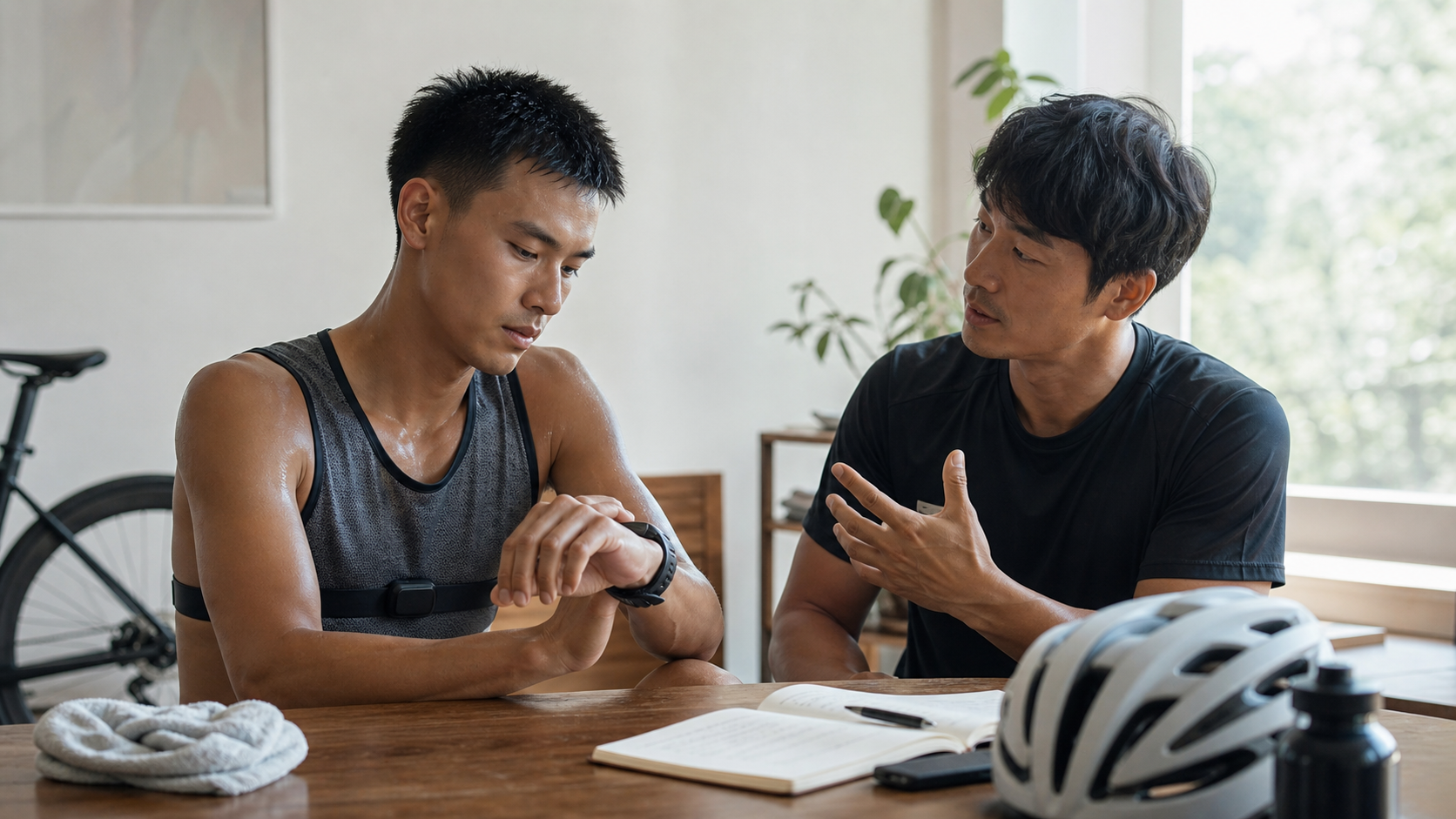
Let Me Start with a Scenario I Often Encounter
A few years ago, a trainee named Xiao Lin came to me for his first training plan and immediately hit me with a question: “Coach, last night my watch said I only got 18 minutes of deep sleep. Is something wrong with my body? Should I see a doctor?”
I looked at him—his complexion was rosy, he seemed energetic, and his training performance was improving. I asked him, “Do you feel tired after sleeping?” He said no. I asked again, “Then why do you think there’s a problem?” He paused: “Because the watch said so…”
That’s the core of what I want to discuss in this article. Over the past fifteen years, I’ve coached athletes at every level, as well as countless everyday people who squeeze in exercise after work. I’ve watched wearables go from luxury toys to an everyday accessory nearly everyone wears—on running routes, riverside bike paths, and in gyms, you see watches and bands glowing with green light everywhere. This is a good thing; data makes training more transparent. But at the same time, I’ve seen too many people held hostage by data, terrified by a number that may not even be accurate, or conversely, blindly trusting the watch’s calculation of “850 kcal burned” and eating an extra late-night snack.
So today, I want to talk to you clearly from a coach’s and sports-science perspective about one thing: On the watch you’re wearing, which data can you trust, to what degree, where can it go wrong, and most importantly—how to use it rationally, rather than being used by it.
This article isn’t telling you to throw your watch away—quite the opposite. Only by understanding the limits of a tool can you truly use it well.
1. Establish a Core Concept First: There’s No “Accurate or Not,” Only “How Accurate”
Many people ask me whether wearables are “accurate,” but the question itself is somewhat flawed. Every measurement tool has error—even precision instruments costing millions in laboratories have error. The real question is: How large is its error? And for my purposes, is that error acceptable?
Here’s a relatable example. Your bathroom scale might differ by a kilogram between morning and evening, but you wouldn’t call it “inaccurate” because you know it captures trends, and small day-to-day fluctuations don’t matter. The same logic applies to your watch.
In sports science, when we evaluate whether a measurement tool is “good enough,” we typically look at several metrics:
- Mean Absolute Error (MAE): How much the measured value differs from the actual value—the smaller, the better.
- Systematic Bias: Does it consistently read high or low?
- Consistency: Under the same conditions, how stable are the results?
There’s a key distinction I need to establish for you right away: “Accuracy” and “consistency” are two different things.
A device might be “not accurate” (always reads slightly high), but very “consistent” (always reads high by a fixed amount). For tracking personal trends, consistency is sometimes more important than absolute accuracy. If your watch always overestimates heart rate by 5 bpm, but it always does so consistently, then when you compare “was today easier or harder than yesterday,” it’s actually perfectly usable—because the error cancels out.
This concept will run through the entire article, so keep it in mind: Look at trends, don’t obsess over a single number.
2. Optical Heart Rate: The Most Misunderstood Green Light
What the Green Light Is Actually Doing
The green light on the back of your watch uses a technology called photoplethysmography (PPG). The principle isn’t hard to understand: blood absorbs specific wavelengths of light. Each time your heart beats and blood flows through the capillaries in your wrist, the amount of light reflected back to the sensor changes slightly. The watch detects this periodic change and converts it into a heart rate.
It sounds clever, and it genuinely is clever. But the problem is—it’s measuring “blood flow changes in the superficial capillaries of the wrist,” and there are several layers where things can go wrong in between. In comparison, a chest strap uses ECG signals, directly capturing the heart’s electrical activity—that’s the “source” of the heartbeat, so accuracy is naturally a notch higher.
How Accurate Is It? Look at the Actual Data
This isn’t just my opinion. According to a validation study comparing wrist-worn optical heart rate with chest strap ECG, the optical sensor showed a mean absolute error of around 3 bpm (approximately 2.5%) across various activities (walking, running, cycling, gym work, household activities, and sedentary states)—clinically acceptable for many applications (source).
But here’s a very important detail. Another 2025 validation study found that wearing position significantly affects accuracy: when the same sensor was worn on the “upper arm,” systematic bias was only about −0.05 bpm with an MAE of about 1.43 bpm; but when worn on the “non-dominant wrist,” bias jumped to about 2.56 bpm with an MAE of about 6.41 bpm (source).
In other words, the same sensor can have error more than four times greater on the wrist compared to the upper arm.
Why Wrist Optical Heart Rate Goes Wrong
Based on my practical observations with trainees, optical heart rate is most likely to “misbehave” in these situations:
| Situation | Why It Goes Wrong | Common Symptoms |
|---|---|---|
| High-intensity intervals | Arm movement creates motion artifacts; peripheral blood flow changes rapidly | Heart rate “freezes” or jumps erratically |
| Cold winter weather | Peripheral vasoconstriction reduces blood flow, weakening the signal | Readings drift or read low in the first few minutes |
| Strap too loose | Gap between sensor and skin lets in ambient light | Unstable readings, fluctuating high and low |
| Weight training, gripping movements | Wrist tendons move and compress the sensor | Unreasonably high heart rate readings |
| Heavy sweating | Sweat creates interference between sensor and skin | Delayed or drifting readings |
| “Cadence lock” phenomenon | Algorithm mistakes arm swing frequency for heart rate | Heart rate exactly matches your cadence |
I especially want to emphasize that last one—“cadence lock.” Many runners in Taiwan doing tempo runs along the riverside notice their watch heart rate stuck at 170–180 bpm without moving—that’s likely not your actual heart rate, but the watch mistaking your 180 steps-per-minute cadence for your heartbeat. This is a classic optical heart rate trap.
Coach’s Practical Advice
If you just want to know “roughly what intensity I’m training at today,” wrist optical heart rate is perfectly sufficient. But if you’re doing training that requires precise heart rate—like lactate threshold intervals or workouts with strict heart rate zone control—I’d strongly recommend investing in a chest strap or an upper-arm optical band.
One tip: wear the watch a bit higher up your arm, avoiding the wrist joint area where there’s more bone and less blood flow. Position it over the thicker muscle of the forearm, and adjust the strap to a tightness that “won’t slide but isn’t constricting.” Optical heart rate accuracy will noticeably improve.
3. GPS: The “Hard Evidence” You Think You Have Can Also Deceive You
“This Race Was Definitely Not 42 Kilometers!”
After every full marathon, someone always posts a watch screenshot on social media: “The official distance is 42.195, but my watch says 43.1—the race organizers must have measured the course wrong!”
I have to defend the organizers: Nine times out of ten, it’s your watch that over-counted.
GPS (more precisely GNSS, Global Navigation Satellite System) works by receiving signals from multiple satellites and using the time difference of signal arrival to triangulate your position. But the satellites are tens of thousands of kilometers away, and the signal travels through the atmosphere, gets reflected off buildings, and is blocked by tree canopies—by the time it reaches your wrist, it has a certain degree of distortion.
How Accurate Is It?
According to a validation study of distance measurement across eight sport watches, under different test environments, the mean absolute percentage error ranged from about 3.2% to 6.1%; in urban and forest environments, distance was significantly underestimated and accuracy was poorer (source). The study also found that error rates during running were generally higher than during walking and cycling—because running involves greater arm swing and routes often have more turns.
Convert that 3% to 6% into real numbers and you’ll understand: for a full marathon of 42.195 km, a 5% error means a difference of over 2 km. You think your watch is “hard evidence,” but it actually has a floating margin of plus or minus one to two kilometers.
The Main Cause of GPS Errors: The Multipath Effect
GPS’s biggest enemy is called the “multipath effect.” Satellite signals don’t just travel in a straight line to your watch—they can hit nearby buildings, cliff faces, or dense tree canopies and bounce in. When the watch receives these “detoured” signals, it mistakenly thinks you’ve traveled a longer distance.
This is especially noticeable in Taiwan. Think about these common scenarios:
- Urban running (Xinyi District, around Ximending): Tall buildings everywhere, signals bouncing all over the place, and your pace graph often shows you “running into a building and back out” like some kind of scribble.
- Mountain training (Yangmingshan, Beiyi, Wuling sections): Cliff faces block signals and dense vegetation makes them intermittent.
- Under bridges on riverside bike paths: The signal cuts out the moment you pass under a bridge or through a tunnel, and when you emerge, the watch connects the two points with a straight line, causing distance to jump.
Coach’s Practical Advice
| Purpose | Is GPS Good Enough? | Recommendation |
|---|---|---|
| Logging daily running distance | Good enough | Look at trends; don’t compare hard numbers with others’ watches |
| Tracking pace in broad terms | Mostly good enough | Pace charts in dense urban areas are for reference only |
| Precise pace training | Risky | Use lap counting on a 400m track, or pair with a footpod |
| Certified race results | Cannot be the standard | Rely on official chip timing and official distance |
If you want to do precise pace training, I usually recommend two paths: first, go to a standard 400-meter track and count laps directly (that’s the most accurate); second, add a footpod that clips to your shoelaces—it uses inertial measurement rather than relying on satellites, so it’s actually more stable in tunnels, forests, and built-up areas.
One more tip: before heading out, let your watch sit still in an open outdoor area for 30 seconds to 1 minute to “acquire a fix” before you start running. This can significantly reduce the “satellites not yet locked” scribbles at the beginning.
4. Sleep Tracking: The Number You Should Trust the Least
Back to Xiao Lin from the Beginning
Remember Xiao Lin from the opening, worried about “only 18 minutes of deep sleep”? Now I can tell you how I responded to him: “The sleep stages your watch measures are inherently ‘guesses,’ and they’re not as accurate as you think. Don’t get anxious over an estimate.”
This isn’t just reassurance—it’s backed by research.
How Your Watch “Guesses” Your Sleep
The true gold standard in sleep medicine is called polysomnography (PSG), which involves placing EEG electrodes on your head to directly read brain waves and determine sleep stages. That’s the gold standard for distinguishing light sleep, deep sleep, and REM.
Your watch—it doesn’t have brain wave electrodes. It relies on wrist motion sensors (accelerometers) combined with heart rate changes to “infer” which sleep stage you might be in. This is essentially a clever estimate, but an estimate nonetheless.
How Accurate Is It? Let’s Break It Down
Here we need to separate two things, because their accuracy levels differ greatly:
Thing one: Determining “whether you’re actually asleep” (sleep/wake detection).
Watches actually perform quite well here. According to recent validation studies, most devices achieve sensitivity above 95% in detecting “asleep” (source). So when your watch tells you “you slept 7 hours last night,” that total sleep time is generally relatively reliable.
Thing two: Determining “whether you’re in light sleep, deep sleep, or REM” (sleep staging).
This is where it’s… mediocre. The same body of research shows that consumer wearables achieve accuracy of roughly 60% to 85% compared to PSG when distinguishing between light sleep, deep sleep, and REM stages, with significant variation between brands and algorithm versions (source).
Let me summarize the key points in a table:
| Data Claimed by Watch | Reliability | Coach’s Recommendation |
|---|---|---|
| Total sleep time | Relatively high | Can reference; track long-term averages |
| Sleep/wake detection | Relatively high | Broad direction is trustworthy |
| Sleep onset time | Moderate | Lying still without moving may be misclassified as asleep |
| Deep sleep duration | Low | Don’t get anxious over a single number |
| REM duration | Low | Look at monthly average trends only |
| Sleep score (overall) | For reference only | Compare with yourself, not with others |
So Is Sleep Tracking Still Useful?
Yes, but you need to use it correctly. What you should look at isn’t “how many minutes of deep sleep last night,” but “has my total sleep duration and sleep regularity worsened over the past month.”
For example, if you see total sleep time drop from your usual 7 hours to 5.5 hours for a full week, that’s a real and meaningful warning sign worth adjusting your schedule and reducing training volume. But if deep sleep is just 20 minutes less on a single night, that’s most likely estimation error in the algorithm—not worth dwelling on, and definitely not worth losing sleep over (that would be truly counterproductive; anxiety itself harms sleep).
Here’s a local reminder: Taiwan’s National Health Insurance makes seeing a doctor very convenient. If you’ve had severe snoring, daytime sleepiness, waking up still exhausted, or even others saying you “stop breathing” during sleep for an extended period (several weeks or more), please don’t self-diagnose with your watch—go directly to a pulmonology, otolaryngology (ENT), or sleep center. Your watch’s blood oxygen and sleep data are at most clues that “you should get checked,” but they cannot replace a proper sleep study and a physician’s judgment.
5. Other Common Data: Calories, Blood Oxygen, Stress, Recovery Scores
Beyond heart rate, GPS, and sleep—the big three—today’s watches give you a whole pile of flashy data. Let me quickly grade their reliability for you:
Calorie Expenditure (kcal)
This is one of the numbers I believe you should trust the least. Watches calculate calories by plugging your heart rate, weight, age, and sex into formulas. Individual differences, metabolic variations, and exercise type can all cause significant deviation—especially for activities like weight training or yoga where heart rate doesn’t closely track actual energy expenditure, the error can be substantial.
Coach’s plain-language version: If your watch says you burned 850 kcal, treat it as some number between 600 and 1000. Whatever you do, don’t see “850 burned” and feel justified eating an extra fried chicken cutlet (incidentally, one fried chicken cutlet can be nearly 500 kcal—it can easily eat back your estimated exercise expenditure in one go). If you want to manage your weight, tracking long-term weight trends and dietary content is far more useful than staring at the watch’s calorie number.
Blood Oxygen (SpO₂)
Wrist-worn optical blood oxygen accuracy is considerably lower than medical-grade fingertip pulse oximeters, and it’s easily affected by strap tightness, skin tone, and movement. It’s suitable for spotting “trend abnormalities” (e.g., you’re usually at 96–98%, then suddenly it drops below 90% for several consecutive days), but a single reading cannot be used as a basis for medical judgment. If you have concerns related to respiratory or cardiovascular disease, defer to medical facility testing and physician judgment.
Stress Score / Recovery Score / HRV
These scores are mostly derived from metrics like heart rate variability (HRV). HRV itself is a scientifically grounded physiological metric, but by the time the watch packages it into a number like “stress 72,” it’s passed through a lot of algorithmic black boxes.
My advice remains the same: Look at trends, compare with yourself. If your “recovery score” has been low for several consecutive days and you also genuinely feel heavy legs, low energy, and lack of motivation—those two things corroborating each other is a meaningful signal that it’s time to reduce volume and rest. But if the score is low and your body feels great, trust your body. The watch is a tool to assist your judgment, not a master to replace it.
6. Common Mistakes and Corrections: What I Most Often Correct in My Trainees
In all my years coaching, I see the same mistakes repeated over and over. In this section, I’ve compiled the most common ones along with how to fix them.
Mistake One: Treating Watch Numbers as Medical Diagnoses
This is the most dangerous one. Watches are not medical devices (except for a few certified specific functions). Their heart rate, blood oxygen, and sleep data are all estimates. “My watch says my HRV is low, so I must be sick”—that kind of reasoning doesn’t hold up logically.
Correction: If watch data is persistently abnormal, treat it as a clue to “go see a doctor,” and then actually go see a doctor. Let professional examination and diagnosis confirm things, rather than scaring yourself or drawing your own conclusions.
Mistake Two: Obsessing Over a Single Number, Ignoring Trends
I’ve said this countless times already. Single numbers contain noise; trends carry meaning.
Correction: Develop the habit of looking at “7-day averages” and “monthly trends.” Most watch apps have trend charts—that’s where you should be spending your time.
Mistake Three: Comparing Your Data with Others’
“His watch says his max heart rate is 195, why is mine only 182?”—Different people have different physiological conditions to begin with, and different brands use different algorithms. Cross-person and cross-brand comparisons are almost meaningless.
Correction: Only compare with your past self. Your progress and your trends are what you should focus on.
Mistake Four: Being “Conditioned” by the Watch and Losing Body Awareness
This is the subtlest and deepest problem. I’ve seen trainees reach a point where they don’t know what pace to run without their watch, or don’t dare to push harder without checking their heart rate—completely losing their intuition about their bodies.
Correction: I deliberately arrange “bare runs” for trainees—running with no data at all, purely on feel (RPE, rating of perceived exertion). This recalibrates your body awareness. The best use of a watch is to help you “verify” what your body feels, not “replace” it. Elite athletes all have extremely strong body awareness; the watch is just an aid.
Mistake Five: Ignoring Wearing Details
Many accuracy problems actually stem from simply “wearing it wrong.” Strap too loose, positioned too close to the wrist bone, dirty sensor…
Correction: During exercise, wear the watch a bit higher toward the upper arm, tighten the strap so it doesn’t slide, and periodically wipe the back sensor clean with water. These small actions have an immediate effect on optical heart rate improvement.
7. Actionable Advice for Readers at Different Levels
Everyone uses their watch for different purposes, so here’s advice tailored to your level.
If You’re in the “Everyday Health / Weight Loss” Group
Your goal is building exercise habits and managing health.
- Focus on: Daily activity level trends, total sleep time trends, and long-term changes in resting heart rate.
- Don’t worry too much about: Absolute calorie numbers, sleep stage details.
- Mindset: The watch is a coach that “reminds you to move,” not a nutritionist that “precisely calculates calories.” Weight loss comes down to diet and long-term habits, not the watch’s calorie number.
- Local reminder: Eating out is common in Taiwan and sugary drinks are convenient. In weight management, dietary factors usually have a greater impact than the estimated exercise expenditure—don’t get the priorities backwards.
If You’re an “Advanced Runner / Cyclist”
You already have a training plan and want to use data to optimize training.
- Invest in a chest strap or upper-arm heart rate band: If you’re serious about heart rate zone training, this is the most worthwhile investment—the accuracy difference is substantial.
- Use a track or footpod for pace training: Don’t rely entirely on GPS pace.
- Establish your own baselines: Long-term recording of resting heart rate, and heart rate on the same route at the same pace—only changes have interpretive value.
- Use trends for deload decisions: Recovery scores and HRV trends combined with how you feel, as a reference for scheduling rest days.
If You’re in the “Have Chronic Conditions or Health Concerns” Group
I want to be especially careful with this section.
If you have cardiovascular disease, diabetes, hypertension, arrhythmia, or similar conditions, wearables can be a good tool to help you monitor your body, but they absolutely cannot replace medical monitoring and physician instructions.
- If your watch’s heart rate, blood oxygen, or heart rhythm alerts show abnormalities, use them as a clue to seek medical attention promptly, and let physicians determine things through proper examinations. Don’t interpret data yourself, and don’t adjust your own medication or exercise prescription.
- Before starting any new exercise program, especially with the conditions mentioned above, consult your primary care physician first so that exercise intensity and methods can be individualized.
- Taiwan has convenient healthcare with accessible National Health Insurance. Take advantage of this—get checked when you should. Don’t treat your watch as a substitute for medical care.
8. A Comprehensive Case Study: Putting It All Together
Let me use a comprehensive (scenario-based) case to tie all the concepts together—it’ll make things more tangible.
Imagine a cyclist named A-Zhe, early forties, office worker, rides Beiyi and Yangmingshan on weekends. He came to me very anxious, for these reasons:
- His watch said his heart rate spiked to 195 on a climb, and he was terrified, thinking he had a heart problem.
- His watch said his sleep score was only 62, with very little deep sleep.
- His watch said he burned 1500 kcal on every ride, yet his weight wasn’t dropping.
I walked him through each item one by one:
About the heart rate of 195: I asked him to switch to an upper-arm heart rate band and ride the same climb again. His actual heart rate was 178. That 195 was a “cadence lock” misreading by the wrist optical sensor under intense pedaling and handlebar vibration. The problem wasn’t his heart—it was how the sensor was worn. However, I also reminded him that since he’d been worried, getting a basic exercise ECG evaluation and having a physician confirm things was also a good idea—that’s called “using the watch as a clue to see a doctor,” which is the correct usage.
About the sleep score of 62: I asked him to ignore the score and instead look at total sleep time trends. It turned out that on nights before his days off, he’d get excited and only sleep 5 hours. The real problem was insufficient sleep duration, not that 62 score or the deep sleep estimate. After we adjusted his pre-ride schedule and brought total sleep back to 7 hours, his perceived recovery noticeably improved—note, “perceived” improvement, not “score” improvement.
About burning 1500 kcal but not losing weight: I asked him to log his diet for three days. It turned out that after every ride, he’d “reward himself” with a hearty meal plus a hand-shaken drink, easily eating back the estimated calories or even exceeding them. The watch’s calorie estimate gave him the illusion that “I burned a lot, so I can eat more.” We shifted the focus away from the watch’s calories and instead looked at dietary content and weight trends. Two months later, he naturally lost weight.
See, none of A-Zhe’s three anxieties were solved by “believing the watch numbers.” All of them were solved by “understanding the watch’s limits and returning to trends and body sensation.” That’s the essence of using wearables rationally.
9. Verify It Yourself: You Can Give Your Watch a “Checkup” Too
Many people don’t realize you can easily test your watch’s accuracy at home without sending it to a lab. I often have trainees do the following small experiments—hands-on verification is more convincing than me talking about it a hundred times.
Testing Heart Rate: Count It Yourself at Rest
The simplest method: sit quietly for five minutes, then press two fingers on your radial artery (or carotid artery), count your pulse for 30 seconds and multiply by 2, then compare with the watch’s current reading. At rest, the watch will usually be quite close to your manual count (within a few bpm). This proves that optical heart rate is actually quite accurate when you’re “still and motionless”—its problems mainly arise when you “start moving.”
If you have a chest strap, an even better approach is to wear both the chest strap and the watch simultaneously, do a set of intervals (e.g., fast run for one minute, jog for one minute, repeat several times), then overlay the two heart rate curves afterward. You’ll see with your own eyes how the wrist optical sensor “lags” or “locks” when intensity changes suddenly, while the chest strap tracks quickly and accurately. Once you’ve seen that, you’ll never forget which one to trust in which situation.
Testing GPS: The Track Lap Method
Find a standard 400-meter track. Run or walk 10 full laps in the innermost lane (lane one)—that’s exactly 4000 meters (4 km). After finishing, check what the watch displays.
| Watch Display | Error | Interpretation |
|---|---|---|
| 3.90–4.10 km | About ±2.5% | Good performance; fine for general use |
| 3.80–4.20 km | About ±5% | Normal range; look at pace charts for broad direction |
| Over 4.20 or under 3.80 | Over 5% | Check positioning mode; consider enabling multi-satellite systems |
By the way, many watches have settings to enable “multi-satellite system” or “dual-band GPS” modes. They use more battery, but they noticeably improve positioning stability in dense urban areas and mountains. If you often train in these environments, it’s worth turning on.
Testing Sleep: Cross-Reference with Your Own Subjective Feeling
You can’t self-test sleep stages at home (that requires an EEG), but you can do one thing: for two consecutive weeks, every morning when you wake up, first rate your sleep quality from 1 to 5 based on how you feel, write it down, then compare it with the watch’s sleep score. You’ll likely find that the two sometimes align in broad terms and sometimes completely disagree. The purpose of this exercise isn’t to prove the watch right or wrong—it’s to remind you that your own subjective feeling is also an important piece of data that shouldn’t be completely overridden by the watch’s score.
10. FAQ
This section compiles the questions trainees ask me most often, answered clearly in Q&A format.
Q1: Should I Buy a Chest Strap or Just Use the Wrist?
It depends on your purpose. If you just want to maintain an exercise habit and see approximate intensity, wrist optical heart rate is perfectly sufficient. If you’re serious about heart rate zone training and care about time distribution in each zone, then a chest strap or upper-arm band is a worthwhile investment. A middle-ground option is an upper-arm optical band—accuracy close to a chest strap, but more comfortable. It’s my top recommendation for advanced users.
Q2: My Watch’s Resting Heart Rate Is Getting Lower. Is That a Good Thing?
Usually, yes. Regular aerobic training increases the volume of blood pumped per heartbeat, and resting heart rate consequently drops—that’s a positive indicator of improving cardiorespiratory fitness. But the premise is that you feel good. If resting heart rate is abnormally low and accompanied by dizziness, weakness, or palpitations, that’s not a training effect—it’s time to seek medical evaluation. Again: the watch shows trends; if something seems off, see a doctor.
Q3: My Watch Shows an “Arrhythmia” Alert. Should I Panic?
Don’t panic, but don’t ignore it either. Some watches have atrial fibrillation (AFib) detection features. The meaning of such alerts is “we recommend you get checked by a physician”—it is not a diagnosis in itself. The correct approach is to save the alert record and bring it to a cardiologist, who will determine things with a proper ECG. Don’t lose sleep over an alert, but don’t completely dismiss it as “probably a false reading” either.
Q4: Can Data from Different Watch Brands Be Compared?
Almost never. Each brand’s sensors, algorithms, and data processing methods differ—especially for “processed” data like sleep stages, stress scores, and recovery scores, cross-brand comparison is meaningless. Even for the same metric like heart rate, different brands can perform very differently during intense exercise. After switching watches, treat the data as “starting fresh” and only compare with the same watch’s history.
Q5: My Watch Says I’m “Under-Recovered” Today. Do I Have to Rest?
Treat it as “one vote,” not “the sole judge.” A low recovery score, plus you genuinely feeling heavy legs, low energy, and no motivation for training—when these votes add up, it’s time to rest or reduce volume. But if only the watch says you’re under-recovered while your body feels great and you slept enough, you can train normally while paying extra attention to bodily feedback. The final judge is always your body; the watch is just one of many sources of information.
Q6: Does Outdoor Exercise in Taiwan’s Summer Make Data Less Accurate?
Some of it, yes. Taiwan’s summers are hot and humid with heavy sweating—sweat interferes with the optical heart rate sensor, and high temperatures affect peripheral blood flow readings. GPS is largely unaffected by temperature, and summer afternoon thunderstorms or thick cloud cover have limited impact on positioning—the main factors remain surrounding buildings and tree canopies. Practical summer advice: dry your wrist, wear the watch snugly, and choose cooler times like early morning or evening for exercise. Both data quality and training quality will improve.
11. Quick Self-Check Table
Finally, here’s a checklist you can reference anytime to help you judge “how seriously should I take this watch number”:
| Ask Yourself | If It Is | Then |
|---|---|---|
| Is this a single number or a trend? | A single number | Don’t panic; look at the trend |
| How does my body actually feel? | Feels great | Trust your body; treat data as reference only |
| Is this an absolute value or an estimate? | An estimate (calories, stages, stress scores) | Discount it |
| Has the data been persistently abnormal for weeks? | Yes | This is a clue to see a doctor—go |
| Am I comparing myself with others? | Yes | Stop; only compare with your past self |
| Is my wearing method correct? | Not sure | Check the fit first; many problems originate here |
Conclusion: Let Data Serve You—Don’t Let It Make You Anxious
As I wrap up, I want to return to the most fundamental point.
Wearables are a gift to sports enthusiasts of this era. They let us glimpse how our bodies work more cheaply and conveniently than ever before. I fully support you using them—in fact, I wear one every day myself.
But the value of a tool depends on whether the user understands its limits. A watch that helps you understand yourself better, motivates you to exercise more, and teaches you to rest when appropriate—that’s a good tool. Conversely, if it makes you lose sleep over a deep sleep estimate that’s only 60% accurate, makes you doubt race organizers over 800 meters of GPS over-counting, or lets you indulge your diet based on a calorie number—then it’s transformed from a tool into a shackle.
Remember the three principles I most want to leave you with:
- Look at trends; don’t obsess over single numbers.
- Trust your body’s sensations; let data “verify” rather than “replace” them.
- When data is persistently abnormal, treat it as a clue to see a doctor and defer to professional judgment—don’t self-diagnose.
That watch on your wrist—let it be your assistant, not your master. Wishing you smooth training and sound sleep—regardless of what score the watch gives you that night.
This article is educational content and cannot replace individual diagnosis and treatment advice from physicians, physical therapists, or nutritionists. If you have cardiovascular, metabolic, sleep-related conditions, or concerns, please consult professional medical personnel.
References
- Wrist-worn optical and chest strap heart rate comparison — BMC Sports Science, Medicine and Rehabilitation: https://link.springer.com/article/10.1186/s13102-018-0098-0
- Wrist-Worn and Arm-Worn Wearables for Monitoring Heart Rate: Device Validation Study — PMC: https://pmc.ncbi.nlm.nih.gov/articles/PMC11951816/
- Accuracy of Distance Recordings in Eight Positioning-Enabled Sport Watches: Instrument Validation Study — PMC: https://pmc.ncbi.nlm.nih.gov/articles/PMC7381051/
- Accuracy of Three Commercial Wearable Devices for Sleep Tracking in Healthy Adults — Sensors (MDPI): https://www.mdpi.com/1424-8220/24/20/6532
Related Reading
- The Science of Wearable Accuracy: Optical Heart Rate, GPS, and Power Error—A Coach’s Guide to Reading Your Data
- The Truth About Wearable Accuracy: How Much Can You Trust Heart Rate, Sleep, and Recovery Scores
- Validity of Wearable Devices in Training Monitoring: A Comparative Study of Commercial Products vs. Laboratory Equipment
- How Much Can You Trust Sleep Scores and Recovery Indexes: The Principles and Limitations of Wearables and AI Training Recommendations
Apple Watch 3 值得 買嗎!? 實測 單車車錶 遙控相機 Zwift 心律連線 Apple Pay 全聯買菜 GoPro 遙控
8 年前
西進武嶺 免費訓練分析服務 Intervals | 練不夠還是練過頭?你哪一種類型選手?AI模型告訴你! | 備戰神器 | 公路車 訓練 | CT Yeh
4 年前
全台首發神車錶! iGPSPORT iGS630 兩趟一日北高的續航! 超強導航、功率訓練、超人性APP! Garmin & Bryton 有對手了嗎? | 公路車 |CT Yeh
3 年前
2022 前十五大自行車錶 !? 兩萬名車友大數據統計 | 你的上榜了嗎? | 菁英車友都用哪些錶? | Bryton Garmin 誰能拔得頭籌?| 車錶推薦 | 公路車 CT Yeh
4 年前
2026 車錶排行榜!誰是最多車友正在使用?練家子最愛哪款?🏆 (2萬名車友數據) / 公路車 / CT Yeh
5 個月前
2025 自行車錶排行榜 兩萬車友大數據 / Garmin Bryton 排名會大洗牌嗎? / 全新的碼表前身分析 /公路車 / CT Yeh
1 年前
Bryton Rider S500 全面實測 有什麼缺點嗎?| CT Yeh | 公路車 車錶
4 年前
首發 Garmin Edge 850 車錶 深入開箱!? / 公路車 / CT Yeh
10 個月前