The Exercise Science of Caffeine: Mechanisms, Dosing, and Individual Differences—Why the Same Cup of Coffee Makes One Person Fly and Another Blow Up
Opening: The Same Energy Gel, Two Riders, Two Very Different Outcomes
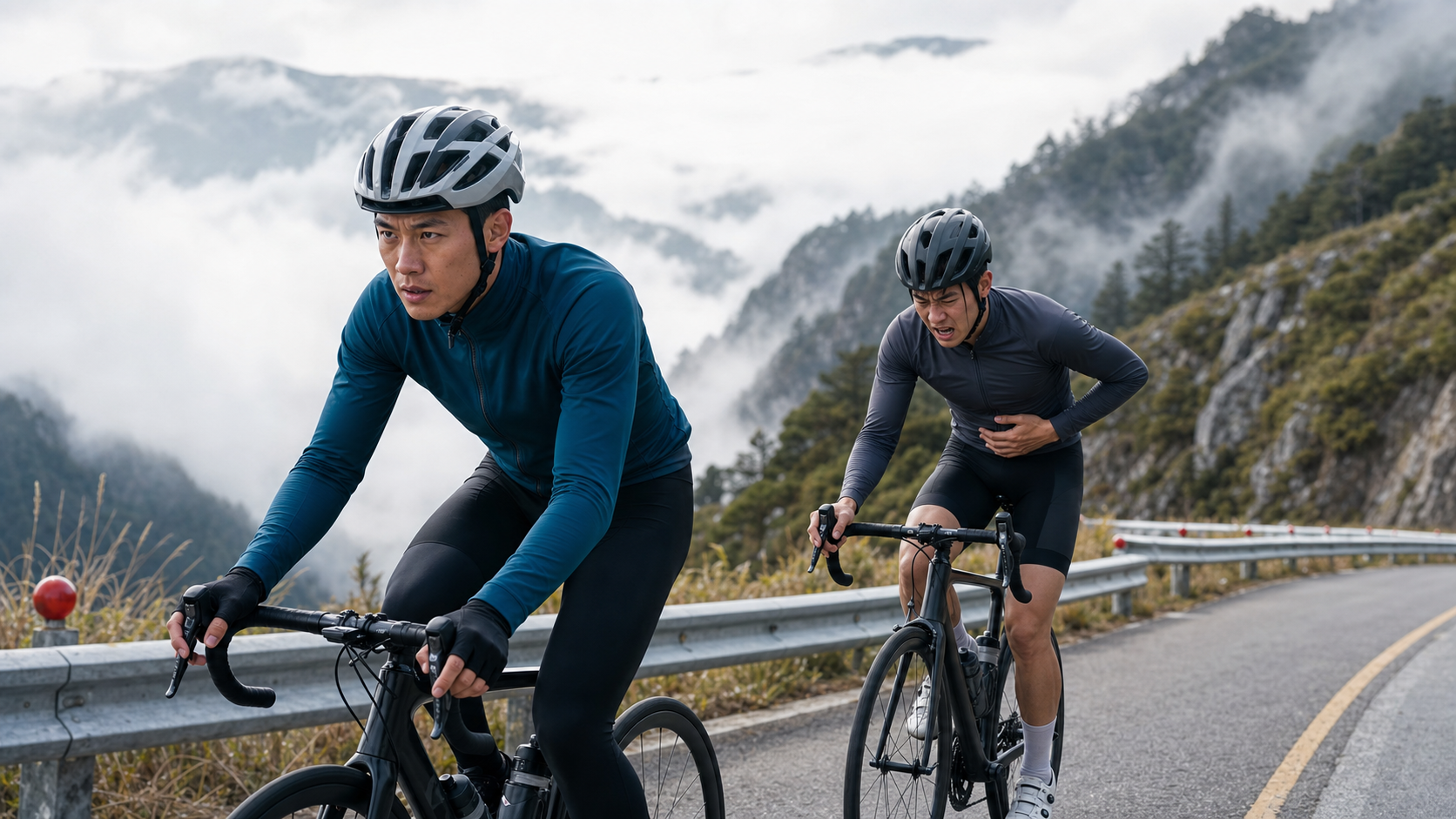
A few years ago at a Wuling practice race, I had two riders of similar ability with me—let’s call them A-Zhe and Little K. Their FTPs were within 10 watts of each other, and their weekly training volume was comparable. One hour before the start, as per my usual routine, I had each of them take a caffeinated energy gel, with the dose around 3 mg per kilogram of body weight.
By the time we hit the Cuifeng section, A-Zhe looked like he’d swapped in a new engine—clean pedaling, steady heart rate, and his perceived exertion was actually dropping. Little K? His heart rate was spiking more than ten bpm higher than usual, his stomach was churning, his hands were slightly shaky, and he told me, “Coach, something feels off today.” He faded badly in the later stages.
Same product, same dose, similar fitness—why did one fly and the other fall apart? That’s the topic I want to discuss with you: Caffeine is never as simple as “it works or it doesn’t.” It’s a science of mechanisms, dosing, and individual differences. In this article, I’ll lay out the observations I’ve accumulated over years of coaching, alongside the evidence from sports physiology and nutrition literature that actually holds up—so you can understand it clearly, and then you’ll know exactly how to handle that cup of coffee before the start.
Foundational Concepts: What Caffeine Actually Does in Your Body
Many people think caffeine “wakes you up” by forcing out adrenaline and jolting the body awake. That understanding isn’t wrong, but it misses the main character.
1. The “Fake Key” at Adenosine Receptors
Caffeine’s most central and best-evidenced mechanism is blocking adenosine receptors.
Adenosine is your body’s “fatigue signal molecule.” The longer you’ve been awake and the longer you exercise, the more adenosine accumulates in the brain. It binds to receptors on nerve cells, like someone constantly whispering in your ear, “You’re tired, slow down, rest.”
Caffeine’s molecular shape closely resembles adenosine, so it slips into those receptors first, but it locks in without activating them—like a fake key that fits the lock but won’t turn. The result: fatigue signals are intercepted, and the brain never receives the “time to be tired” message.
This produces several highly valuable effects for sport:
- Lower perceived exertion (RPE): At the same power output, you feel like you’re working less hard. This is one of caffeine’s most consistent and repeatedly verified effects on endurance performance.
- Enhanced alertness and focus: In the later stages of a long ride or run, your decision-making, line choice, and pacing discipline are less likely to fall apart.
- Increased pain tolerance: The burning in your muscles and the heaviness in your legs feel less unbearable.
2. The Overrated “Fat Burning” and Adrenaline
You’ve certainly heard that “caffeine helps burn fat and spares glycogen.” This claim was popular in the early days, but based on current evidence, it’s seriously overrated.
Caffeine does modestly raise blood adrenaline and slightly promote fat breakdown, but this effect contributes very little to actual performance, and it’s even less pronounced in trained individuals. What truly underpins caffeine’s performance benefits is the central nervous system effect described above—it makes you “feel less tired,” allowing you to sustain higher intensity for longer.
So I often tell my riders: Don’t treat caffeine as a fat-loss drug. It’s “noise-canceling headphones for fatigue,” not a “paper shredder for fat.”
3. Direct Effects on Muscle
Beyond the brain, caffeine also has some direct effects on muscle tissue itself, potentially improving the release and utilization efficiency of calcium ions within muscles, which theoretically supports the force and speed of muscle contraction. This might offer additional benefits in explosive, interval, and strength-based disciplines, but the mechanistic details in humans aren’t as well-established as the central effects, so I tend to take a conservative view.
4. Putting the Three Mechanisms Together
I like to use an analogy to help my riders remember these three layers. Imagine your body is a car grinding up a long climb:
- Adenosine blockade (central) is like temporarily turning off that flashing “engine overheating—pull over now” warning light on the dashboard—the engine’s actual condition hasn’t changed, but you’re no longer being forced to slow down by that light. This is the main event.
- The slight rise in adrenaline (peripheral) is like pressing the accelerator a bit deeper, but the effect is limited—don’t expect it to turn a three-cylinder into a six-cylinder.
- The muscle calcium effect (local) is like the gearbox shifting a bit more crisply, contractions becoming more efficient, but it’s a supporting role.
Understanding this hierarchy matters because it tells you: Caffeine doesn’t actually make you “stronger”; it lets you squeeze more out of the strength you already have. If your foundation isn’t built, turning off the warning light won’t give you an engine to push. That’s why I always put training ahead of supplements.
Which Sports Benefit Most from Caffeine?
For endurance disciplines like cycling and road running, caffeine is one of the legal supplements with the highest level of evidence and the most consistent effects. The International Society of Sports Nutrition (ISSN), in its caffeine position stand, reviewed dozens of studies and noted that at doses of 3–6 mg per kilogram of body weight, caffeine reliably improves endurance performance by approximately 2–4% (varying by individual).
Does 2–4% sound small? Let me translate that into something you can feel:
- In a 40-kilometer time trial that would normally take 65 minutes, 2–4% is roughly 1.3 to 2.6 minutes faster—in a race where every second counts, that’s the difference of several places.
- On a three-to-four-hour long climb like the west approach to Wuling, the line between “still hanging on” and “my legs are done” in the later stages often comes down to exactly this few-percent difference in perceived effort.
The table below summarizes caffeine’s effects across different exercise modalities, based on my synthesis of the literature and coaching experience:
| Exercise Modality | Caffeine Benefit | Primary Mechanism | Coach’s Notes |
|---|---|---|---|
| Endurance (road cycling, marathon, triathlon) | High, most consistent | Lowers RPE, delays central fatigue | Primary beneficiary group |
| High-intensity intervals (repeated climbs, track) | Moderate to high | Focus, pain tolerance, possible muscle contraction support | Watch heart rate and palpitations |
| Sprint/explosive (single effort) | Inconsistent, high individual variability | Mainly central alertness | Don’t expect reliable gains |
| Pure strength (single maximal effort) | Small to moderate, weaker evidence | Central drive, muscle calcium | Benefit less clear than in endurance |
The Most Critical Lesson: CYP1A2 Genotype and Individual Differences
Back to the story of A-Zhe and Little K. Their difference likely wasn’t fitness, wasn’t psychology—it was written in their genes.
Who Breaks Down Your Caffeine?
The caffeine you consume is primarily metabolized and broken down by an enzyme in the liver called CYP1A2. The activity level of this enzyme is largely determined by a single genetic variant (rs762551), which comes in three forms:
- AA type (fast metabolizers): High enzyme activity; caffeine is cleared quickly.
- AC type (intermediate metabolizers): Falls between the two.
- CC type (slow metabolizers): Low enzyme activity; caffeine lingers in the body longer, with an extended half-life.
How big is this difference? In the literature, one study on cycling time trials is particularly illustrative: in a 10 km time trial, caffeine (at 2 and 4 mg per kilogram) significantly improved performance only in AA-type subjects; for AA types at the 4 mg/kg dose, the improvement in performance was substantial. In contrast, CC-type (slow metabolizers) showed no improvement at higher doses—and even performed worse.
A systematic review and meta-analysis points in the same direction: fast metabolizers (AA) showed meaningful improvements, intermediate types (AC) showed small improvements, and CC-type slow metabolizers actually saw a slight decline in performance after caffeine supplementation.
Why Do Slow Metabolizers Actually Perform Worse?
This exactly explains Little K’s predicament. Slow metabolizers can’t clear caffeine, so blood concentrations stay high, and before the benefits (lowered RPE) fully manifest, side effects show up first: rapid heartbeat, anxiety, shaky hands, and gastrointestinal distress. These negative feelings themselves can drag down performance, especially in long-distance events where gut stability is crucial.
The table below helps you compare the practical characteristics of the three metabolizer types:
| CYP1A2 Type | Common Name | Caffeine Half-Life Tendency | Exercise Response Tendency | Practical Advice |
|---|---|---|---|---|
| AA | Fast metabolizer | Shorter | Most clear-cut benefits, high tolerance | Can use standard to higher doses, can take close to exercise |
| AC | Intermediate | Moderate | Small benefits | Start with low to moderate doses |
| CC | Slow metabolizer | Longer | Weak benefits, high side-effect risk | Use low doses or don’t rely on it, avoid afternoon/evening |
Key reminder: You don’t actually need to get genetic testing to use this knowledge. Your body has already told you the answer. If one cup of coffee gives you heart palpitations, keeps you up until midnight, or makes your hands shake, you’re likely a slow metabolizer—caffeine isn’t a guaranteed win for you, and you need to use it very conservatively, or even consider cutting back. Conversely, people who can sleep fine after coffee, feel energized, and have no discomfort can usually use it more confidently as a pre-race strategy.
(On a side note: there are plenty of products on the market claiming to test “caffeine metabolism genes,” but the interpretation of results is often oversimplified. Rather than spending money on that, it’s better to honestly track your own physical responses each time—that’s the most truthful personalized data.)
Practical Approach: How to Nail Dosage, Timing, and Delivery Form
Now that we’ve covered the mechanisms, let’s get to what most people want to know—exactly how much to take, when to take it, and in what form.
1. Dosage: Start Low and Work Your Way Up
Based on the collective evidence, the effective dose for endurance performance falls between 3–6 mg per kilogram of body weight. Some studies show that as low as 2 mg/kg can be effective, while high doses like 9 mg/kg offer no additional benefit but significantly increase side effects—high doses are a pure losing proposition.
My principle when coaching athletes is: better to start low and increase gradually than to go big right from the start. The practical dosage table below converts a few common body weights for easy reference:
| Body Weight | Low Dose 3 mg/kg | Moderate Dose 4.5 mg/kg | Upper Reference 6 mg/kg |
|---|---|---|---|
| 55 kg | ~165 mg | ~248 mg | ~330 mg |
| 65 kg | ~195 mg | ~293 mg | ~390 mg |
| 75 kg | ~225 mg | ~338 mg | ~450 mg |
| 85 kg | ~255 mg | ~383 mg | ~510 mg |
Here’s a real-world reference: a medium Americano from a Taiwanese convenience store typically contains around 150–200 mg of caffeine (varies quite a bit by store and beans); a caffeinated energy gel commonly contains 25–100 mg. So a 65 kg person aiming for 3 mg/kg (~195 mg) would need roughly one stronger-than-average Americano.
2. Timing: 60 Minutes Before Exercise Is the Classic
After oral ingestion, blood caffeine levels typically peak within 30 to 90 minutes, which is why the most common strategy in the literature and in practice is consuming it about 60 minutes before exercise.
For ultra-long events (e.g., 4+ hour rides, ultramarathons), consider split dosing: one dose before the start, then a small top-up during the second half before fatigue sets in (e.g., via a caffeinated energy gel or sports drink). Don’t slam it all at once—keep levels steady to cover the later stages when you need it most.
To give you a clearer picture, I’ve put together a typical caffeine timeline for a long-distance event in the table below (using an example of a rider who has confirmed good tolerance in training; adjust based on your own testing):
| Time Point | Recommended Action | Notes |
|---|---|---|
| Night before race | Sleep normally, avoid extra caffeine in the evening | Sleep is the foundation of recovery; don’t borrow from tomorrow |
| 60 min before race | Main dose (starting at ~3 mg/kg) | Get levels peaking shortly after the start |
| First half of race | Focus on hydration, electrolytes, carbs | Caffeine’s main act isn’t needed most yet |
| Before fatigue sets in during the second half | Add a small top-up as needed | Cover the phase where you’re most likely to slow down |
| Evening/night after race | Avoid more caffeine | Protect that night’s sleep and recovery |
The spirit of this table isn’t to follow it by rote, but to remind you: caffeine is a tool with a “time window”—aim it at the period when you most need to reduce perceived effort, which matters far more than loading up at the start.
3. Delivery Forms: Coffee, Pills, Gels, Gum
| Form | Dosage Precision | Absorption Speed | Coach’s Take |
|---|---|---|---|
| Brewed coffee | Low (high variability) | Moderate | Easy to get, convenient locally, but hard to dose precisely |
| Caffeine tablets | High | Moderate | Best way to control dosage before a race |
| Caffeinated energy gels | Medium-high | Medium-fast | Gets energy and caffeine in one go; great for long distances |
| Caffeine gum | High | Fast (absorbed through oral mucosa) | Quick onset; good for an immediate boost on the spot |
Local tip: Taiwanese people love hand-shaken drinks and convenience store coffee, but their caffeine content labeling is often vague. If you want to treat caffeine as a serious race strategy, I’d recommend using clearly dosed tablets or well-labeled energy gels rather than gambling on a latte of unknown strength.
4. Caffeine Reference for Common Drinks and Foods
Many athletes ask me, “So how much am I actually getting from what I normally drink?” I’ve put together a practical reference table. Note: these are rough ranges, and actual amounts can vary widely—the same Americano from the same hand-shaken shop can differ with a different barista or batch of beans. So this table is just to give you a “sense of magnitude,” not a precise calculation basis:
| Common Source | Approximate Caffeine Range | Notes |
|---|---|---|
| Convenience store medium Americano | ~150–200 mg | Varies greatly by store and cup size |
| Hand-shaken shop medium latte/Americano | ~100–200 mg | Labeling is often unclear |
| Espresso (single shot) | ~60–80 mg | Relatively concentrated |
| Common Taiwanese black/green tea (large cup) | ~30–70 mg | Depends on tea type and steeping |
| Commercial energy drink (one can) | ~80–160 mg | Often also contains sugar and other ingredients |
| Caffeinated energy gel (one serving) | ~25–100 mg | Labeling is usually clearer |
| Caffeine tablet (one pill) | Commonly 100 mg or 200 mg | Easiest to control dosage |
I often remind athletes: your “everyday” caffeine intake determines how much marginal effect that pre-race dose will have. Someone who slams four Americanos a day won’t feel much from one more before a race—their body is already used to it. That’s also the “tolerance” issue we’ll address next.
Two Real-Life Scenarios: Putting Knowledge Back Into People
Tables are easy to forget, so I’ll use two case studies (with altered scenarios and realistic data) to tie all the concepts above together.
Case 1: The Office Worker Cyclist Using Caffeine as a Pick-Me-Up
A-Hong, 42, is a tech industry engineer who rides on weekends. When he came to me, his question was: “Coach, I’ve heard caffeine is useful for cycling, but I already need three or four cups of coffee a day just to get through work. When I have another cup before a weekend ride, I don’t feel anything?”
This is a classic case of tolerance. His daily intake was already very high, dulling his body’s response to caffeine, and the marginal benefit of that pre-ride cup was essentially zero. Here’s the adjustment I gave him:
- Scale back daily intake: Reduce workday coffee from three or four cups to one or two, and concentrate them in the morning to avoid affecting sleep.
- Deliberately cut back a bit more the day before an important ride, allowing his body to become sensitive to caffeine again.
- Use one energy gel with a clear dosage 60 minutes before departure, replacing that “can’t feel it” cup of coffee.
After a few weeks of adjustment, he reported that the latter part of his weekend long rides finally felt like he “could push the pedals again,” and his weekday sleep quality even improved. The key point of this case isn’t to add more, but to first lower the daily baseline noise—only then can caffeine have a signal.
Case 2: The Serious Runner with Slow Metabolism Who Overdid the Dose
Yi-Jun, 35, is a runner targeting a sub-4-hour marathon with a very driven personality. She read a bunch of information about “elite athletes using 6 mg/kg” and forced a high dose at a half marathon. The result: her heart rate was abnormally high in the first 5 km, she felt nauseous, and she was forced to walk mid-race.
When I talked to her, the key signal emerged immediately: she gets insomnia, shaky hands, and heart palpitations from just one cup of coffee—this is practically a billboard for a slow-metabolizer profile. By forcing “someone else’s high dose,” she was amplifying her own weakness. The adjustment direction:
- Acknowledge and accept her slow metabolism; her sweet spot is naturally lower, so don’t compare doses with others.
- Drastically reduce the dose, starting from a very low 2 mg/kg, and observe during training whether RPE drops and whether there’s any discomfort.
- Move the timing earlier, to avoid having peak concentration coincide with the race segment where gastrointestinal stability matters most.
- Refocus on pacing discipline and hydration, rather than hoping caffeine will save the day.
Later, with a lower dose and proper rehearsal, she ran a personal best. Her story shows: sports science principles should be used, but they must pass through the filter of “you.” Someone else’s optimal dose might be your landmine.
Caffeine vs. Other Common Supplements
Athletes often ask, “Do I need other supplements?” Let me quickly compare a few things that are often discussed together, using the same yardstick (strength of evidence, practical utility for endurance), so you can get your bearings:
| Supplement | Evidence for Endurance | Individual Variability | Coach’s Positioning |
|---|---|---|---|
| Caffeine | Strong, most consistent | Large (influenced by genotype) | High value-for-money first choice, but needs personalization |
| Proper carbohydrate intake | Strong (long-duration events) | Moderate (different GI tolerance) | The foundation for long distances, prioritized over any fancy supplement |
| Electrolytes/Sodium | Situational (heavy sweating in heat) | Large (different sweat rates) | Very practical in Taiwan’s hot, humid environment; needs personalization |
| Nitrates (e.g., beetroot) | Moderate | Moderate | Can try if interested, but don’t place it ahead of caffeine and fueling |
My prioritization principle is simple: get training, sleep, daily nutrition, and race-day carbohydrate and fluid intake right first—the returns from these far outweigh any “magic pill.” Caffeine is a worthwhile, but still personalizable, bonus on top of that solid foundation—not something to patch holes in the foundation with.
FAQ
Q: Will consuming caffeinated products dehydrate me during a long ride?
A: For most people at typical intake levels, caffeine’s diuretic effect is quite mild, especially once the body is somewhat accustomed to it. It usually won’t cause dehydration issues under normal hydration practices. What really matters is overall sweating and fluid intake in Taiwan’s hot, humid weather—that’s the main event. Those with a history of GI or fluid sensitivity should just be a bit more conservative.
Q: I don’t drink coffee at all—will the effect be more noticeable for me?
A: Theoretically, people who consume little regularly have a larger “signal space,” so the relative effect of a pre-race dose may be more pronounced. However, your individual metabolic type (fast/slow) is still the more fundamental factor. Instead of agonizing over it, test your own response during training.
Q: Which is better for exercise: black coffee or caffeine pills?
A: Mechanistically, what matters is “caffeine itself” and “the dose you ingest.” The advantage of pills is precise dosing and easy replication; the advantage of coffee is convenience and local availability. For a serious race strategy, I prefer a form with a clear dose; for daily training, coffee is perfectly fine.
Q: Will taking caffeine on an empty stomach before morning training hurt my stomach?
A: It varies by person. Some people experience GI discomfort with caffeine on an empty stomach, especially during high-intensity exercise when things can churn more easily. If you’re that type, pair it with a little food, or switch to a gentler form and a lower dose. Same old advice: test it in training, don’t gamble on race day.
Q: Will caffeine affect my sleep and recovery, making it counterproductive?
A: This is a very real concern. Sleep is the foundation of recovery. If you gain a bit of performance in the moment but sacrifice that night’s sleep, it’s a net loss long-term. For evening or late-night training, keep the caffeine strategy restrained. Slow metabolizers especially need to pull the last intake time earlier.
Common Mistakes and Fixes
The failures I’ve seen over the years almost all fall into the following categories. See which one fits you.
Mistake 1: Trying It for the First Time on Race Day
This is the most fatal and most common mistake. Never having used a certain dose or a certain brand of gel in training, then using it for the first time at an important event, is treating the race as a laboratory. If you’re a slow metabolizer, or that formula upsets your stomach, the whole race is ruined.
Fix: All fueling strategies must be rehearsed in training. Use several long workouts at intensities close to race pace to test the dose, timing, and carrier until you’re confident. “Nothing new on race day” is an iron rule of endurance sports.
Mistake 2: Mistaking Heart Palpitations for “It’s Working”
Many people think a racing heart, shaky hands, and jitteriness mean “this is what being fueled feels like.” Wrong. Those are mostly side effects of overdose or poor metabolism, not signals of improved performance. The real feeling of effectiveness is actually quiet—the same intensity feels easier, you’re more focused, and you don’t fall apart in the latter stages.
Fix: Use “reduced perceived exertion” rather than “spiked heart rate” as the indicator of effectiveness. If every use comes with noticeable discomfort, lower the dose, or accept that you may simply be someone who doesn’t tolerate large amounts.
Mistake 3: Relying on It Daily, Then Building Tolerance
Consuming large amounts of caffeine every day leads to tolerance, shrinking the marginal benefit on race day. And withdrawal brings headaches and low energy.
Fix: Some people reduce their daily caffeine intake in the days before an important event to let the body “re-sensitize,” but this requires careful handling of withdrawal discomfort and must also be tested during training first. Moderate daily use, with higher doses reserved for key moments, is the more practical approach. The framework I often give in practice is: keep your “daily maintenance dose” at a low level, so you neither suffer severe withdrawal headaches nor lose the signal space for that pre-race dose—this middle path works best for most people. Whether to do the aggressive “full withdrawal then reload” version before a race depends on the individual; those who find withdrawal too miserable shouldn’t force it.
Mistake 4: Still Chugging It Before Bed
Caffeine’s half-life is measured in hours, and it’s longer for slow metabolizers. Taking caffeine after an evening or late-night workout can easily cost you that night’s sleep—and sleep is the foundation of recovery, so it’s a case of penny-wise, pound-foolish.
Fix: For training later in the afternoon and beyond, be more conservative with caffeine strategy, prioritizing sleep first. Slow metabolizers especially should pull the “last caffeine” time earlier.
Mistake 5: Ignoring GI and Dehydration Context
Taiwan’s summers are muggy and hot, and long rides are already a major test for the gut and hydration. Caffeine has mild diuretic and GI-stimulating effects for some people, and when stacked on top of heavy sweating in high heat, it can worsen discomfort.
Fix: On hot long rides, plan caffeine, hydration, and electrolytes together—don’t look at caffeine in isolation. Those with a history of GI sensitivity should be even more conservative with dosing.
Actionable Advice for Readers at Different Levels
If You’re a Beginner Athlete
- Don’t rush to use it as a weapon. Getting the fundamentals right—base training, sleep, and daily nutrition—will yield far greater benefits than any supplement.
- Start with a very low dose to learn about your body. For example, a small cup of coffee, and record how you feel during exercise, your heart rate, and your sleep.
- Watch for warning signs of side effects: heart palpitations, shaky hands, insomnia, gastrointestinal discomfort—these tell you “you might be a slow metabolizer, don’t increase the dose.”
- No need to deliberately use it for everyday training; save it for the days you really want to push hard.
If You’re an Advanced Athlete with a Training Base
- Systematically test your dosage during training: start at 3 mg per kilogram of body weight, and observe whether your RPE drops and whether you’re more stable in the latter part of the session.
- Lock in the timing: primarily 60 minutes before competition; for longer distances, plan split doses later in the event.
- Use precise delivery methods (tablets, clearly labeled capsules)—don’t rely on drinks with uncertain concentrations.
- Build your own personal database: record which dose, which timing, and under what weather conditions you felt and performed a certain way. This is worth more than any generic advice.
If You’re a Competition-Focused Athlete
- Treat caffeine as part of a well-rehearsed pre-race routine, not a spur-of-the-moment idea.
- In simulation races or key long rides, rehearse the dosage, timing, delivery method, and weather conditions all together.
- Know your metabolic tendencies: if you repeatedly experience heart palpitations or insomnia, rationally accept that your sweet spot may be on the lower end.
- For hot-weather races, plan caffeine together with your hydration, electrolyte, and gastrointestinal strategies.
Special Note: Health Conditions and Seeking Medical Care
I need to be very direct here. Caffeine is not something that is safe for everyone.
- If you have arrhythmia, high blood pressure, heart disease, anxiety disorders, thyroid issues, or are taking medications that interact with caffeine, please discuss it with your doctor first before using caffeine as a sports supplement. Taiwan’s National Health Insurance makes seeing a doctor convenient—don’t skip this step.
- During pregnancy and breastfeeding, there are additional recommended upper limits for caffeine intake, which go beyond the scope of sports performance and should follow professional medical advice.
- If you experience chest tightness, chest pain, noticeably irregular heartbeat, or dizziness during or after exercise, don’t push through it, don’t try to self-diagnose whether it’s the caffeine—seek medical attention promptly.
These situations involve individualized medical judgment that a general article cannot decide for you. Caffeine is a relatively safe, well-evidenced sports supplement for healthy populations, but “relatively safe” does not mean “definitely safe for you.”
I especially want to say something to two types of Taiwanese cyclists. The first group is friends who started serious exercise only in middle age and have a family history of metabolic syndrome or are already on medication: you often want quick results, and seeing “improves performance by 2–4%” makes you want to try it. But caffeine’s effects on heart rate and blood pressure need more careful evaluation in your case—be sure to talk to your doctor before starting, and don’t play doctor yourself. The second group is younger athletes who rely on energy drinks to push through training: those drinks often mix caffeine with large amounts of sugar and other ingredients, making it easy to unintentionally exceed your intake. Read the ingredients and total amounts carefully before drinking, and don’t mistake “feeling it” for “it’s working.”
One more very practical reminder: Taiwan has convenient healthcare and accessible National Health Insurance—this is actually your advantage, not a burden. Rather than scrolling through forums to self-diagnose “is this palpitation caused by caffeine,” make an appointment and get a basic check-up when you have concerns, and leave the uncertainty to the professionals. You exercise to make your body better, not to trade your health for a temporary number.
Conclusion: Treat Caffeine as a Tool, Not a Belief
Back to that Wuling practice race at the start. Afterwards, Xiao K and I adjusted his strategy: we significantly reduced his pre-race caffeine dose, avoided using it after evening training, and refocused on his pacing discipline and hydration. A few weeks later on the same stretch, he no longer had palpitations or faded, and he held on steadily. As for A-Zhe, we confidently maintained his usual dose and timing, letting those “noise-canceling headphones for fatigue” save him precious effort on the key climbs.
The same cup of coffee makes some people fly and others blow up—the answer has never been in the coffee, but in the person. Caffeine is a well-understood, well-evidenced tool, but it’s not a miracle cure, and it certainly shouldn’t be a belief. Understanding how it works, knowing your own metabolism and reactions, testing it honestly in training, and then using it at the right dose and the right time only when you truly need it—that’s what sports science should look like.
Next time you pick up that cup of coffee before heading out, I hope what crosses your mind isn’t “does it work,” but “for me, how much, when, is just right.” Hand the answer back to your own body—that’s the most reliable coach you’ll ever have.
This article is educational content and cannot replace individual diagnosis and treatment advice from a physician, physical therapist, or nutritionist. If you have cardiovascular, endocrine, or other chronic conditions, or are taking medication, please consult a qualified medical professional before adjusting your caffeine use.
References
- International Society of Sports Nutrition position stand: caffeine and exercise performance(PMC): https://pmc.ncbi.nlm.nih.gov/articles/PMC7777221/
- Influence of the CYP1A2 genotype on the exercise performance of physically active individuals under caffeine supplementation: a systematic review(ScienceDirect): https://www.sciencedirect.com/science/article/abs/pii/S0271531725001319
- Impact of CYP1A2 Genotypes on the Ergogenic Effects and Subjective Mood States of Caffeine Ingestion(PMC): https://www.ncbi.nlm.nih.gov/pmc/articles/PMC11356906/
Related Reading
- Caffeine and Exercise Performance: Mechanisms, Individual Differences, and Side Effects to Watch For
- Caffeine Supplementation Guide: How to Get Dose, Timing, and Sources Right? A Coach Helps You Drink It Right
- The Complete Caffeine Supplementation Guide: Dosage, Timing, and Genetic Differences—A Coach Helps You Use Caffeine Correctly
- Caffeine and Exercise Performance: A Legal Aid for Boosting Endurance and Strength Output
西進武嶺 自製新版AI配速表產生器 x 賽前攻略 抱佛腳! 沒有功率計也可以產生配速表嗎?有什麼其他眉角賽前要注意的呢? | 西進武嶺 / 東進武嶺 KOM 攻略 | 公路車 | CT Yeh
4 年前
西進武嶺 8000名單車友數據分析 PART1 | 從新手到高手數量/瓦數/推力比/FTP推力比/功率計使用率 大解析 | 公路車 | CTYeh
5 年前
2021 96聯賽 桃園市長盃 4K多視角實況 當天選手瓦數/推力比/均速/時間 即時數據分析 | 公路車 | CT Yeh
5 年前
戰略) Zwift Race 如何咬在第一集團 如何評估自己要開多少推力 (請開1.5倍速看)
7 年前
西進武嶺 免費訓練分析服務 Intervals | 練不夠還是練過頭?你哪一種類型選手?AI模型告訴你! | 備戰神器 | 公路車 訓練 | CT Yeh
4 年前
Never Stop 西進武嶺 前後雙機 完整全程錄影 訓練台 實境
8 年前
靠單車減肥35公斤 心得分享與整理
7 年前
一日北高/長距離團騎 常見問題補充篇 / 組團或跟團的眉角 / 壯車友容易被瘦車友慢性拉爆 / 原來屁股痛可能是這個原因...? / 風場配速法 / 公路車 / CT Yeh
2 年前