The Science of Exercise and Electrolyte Balance: The Roles of Sodium, Potassium, Magnesium, and Calcium, Their Loss, and Individualized Supplementation Strategies
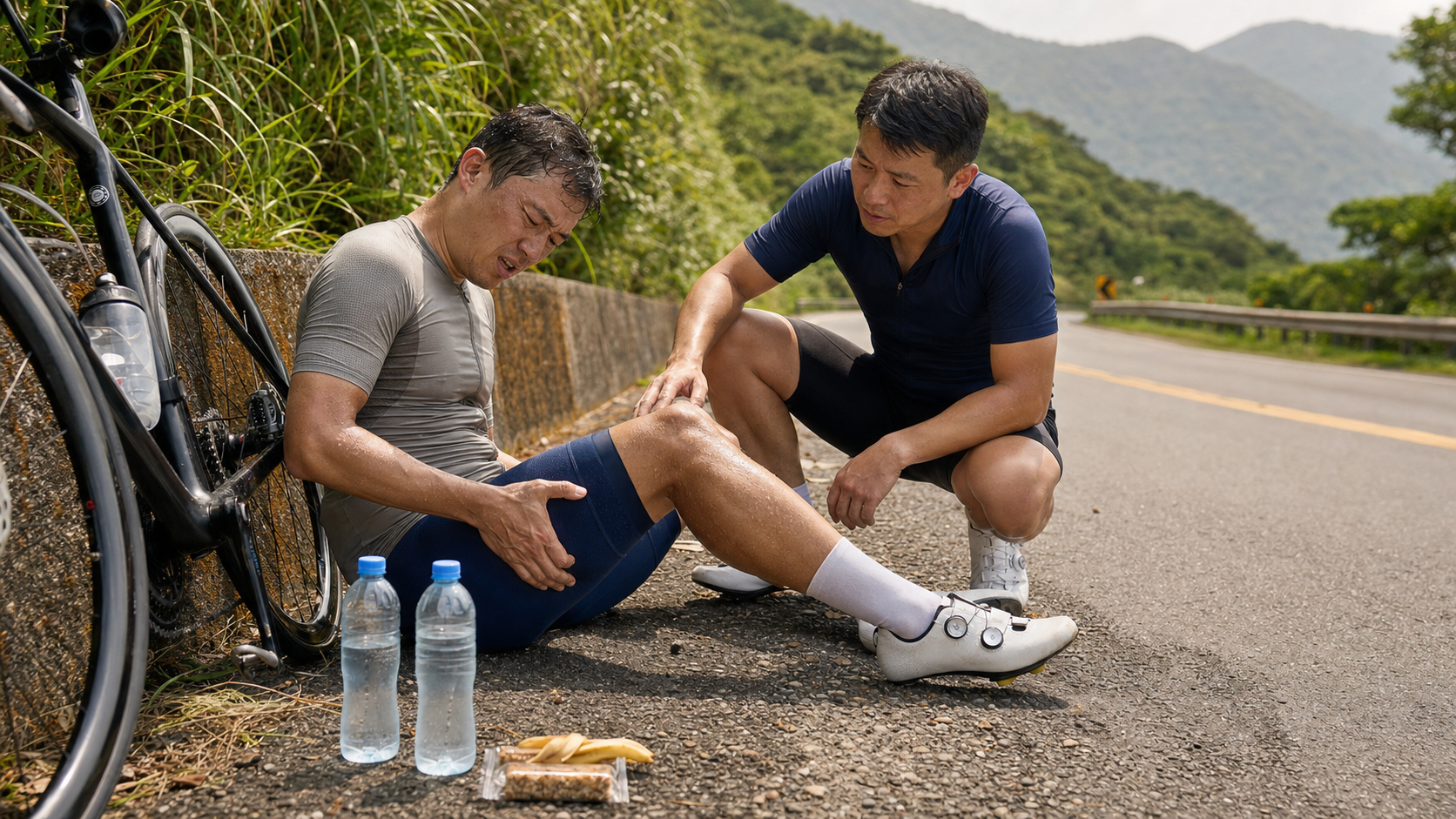
Starting with a Cramp-Induced Fall on Yangmingshan
I will never forget that Sunday morning. A middle-aged trainee who had been training with me for about six months—let’s call him A-Hong—was excitedly taking on a roughly 60-kilometer climbing route around Yangmingshan that day. The weather was typical Taipei in July: by just past 7 a.m., the temperature was already approaching 30 degrees Celsius, with humidity near 90 percent. A-Hong’s usual training form was pretty good, but that day, on the final climb up Fengguizui, his entire inner thigh muscle suddenly locked up like a towel being wrung out with force. He toppled off his pedals and crashed, lying on the roadside asphalt in agony, howling in pain.
Many people’s first reaction would be: “That’s just a salt deficiency—pop one salt tablet and you’re good.” But it’s not that simple. When I later carefully questioned him about the details of that ride, I found the real problem was a whole chain of events: that morning he’d only had a black coffee before heading out, no breakfast; his bottle contained plain water; and the night before, to feel “light and fresh,” he’d deliberately skipped the miso soup at dinner. String those details together, and that’s the real script behind that cramp.
I’ve been in sports science and coaching for about fifteen years, working with pro cyclists, triathletes, and also a large number of everyday athletes like A-Hong who want to push themselves on weekends. Electrolyte balance is one of the most misunderstood and most accident-prone aspects of my training plans. It doesn’t have flashy numbers to show off like FTP or pace, but when it goes wrong, the consequences range from a ruined ride with cramps to a trip to the emergency room. In this article, I want to lay out clearly what I’ve learned over these years—at the roadside, at aid stations, and next to clinic doors.
Bottom line first: Electrolyte balance isn’t as simple as “just add more salt.” It’s the result of a dynamic tug-of-war among four minerals—sodium, potassium, magnesium, and calcium—plus water, inside your body. And the key word is “individualization”—the supplementation strategy that works for your friend may be completely ineffective, or even harmful, when applied to you.
Foundational Concepts: What Electrolytes Actually Do in Your Body
Electrolytes are mineral ions dissolved in body fluids that carry an electrical charge. They aren’t there to “provide energy” (that’s carbohydrates’ job); rather, they maintain the most basic operating environment of your body. You can think of them as the “electrical system” and “water-level regulator” of the cellular world.
The four we care most about during exercise are: sodium (Na⁺), potassium (K⁺), magnesium (Mg²⁺), and calcium (Ca²⁺). Each has its own role, and they also constrain one another.
Sodium: The Commander-in-Chief of Water
Sodium is the primary cation in extracellular fluid and the key determinant of “where water goes in your body.” The normal range for blood sodium concentration is roughly 135 to 145 millimoles per liter (mmol/L). Sodium maintains plasma osmotic pressure, drives the electrical signals of nerves, and is the chemical switch behind the sensation of thirst.
In the exercise context, sodium is the electrolyte lost in the greatest amount and the protagonist of our supplementation strategies. When we discuss sweat loss shortly, you’ll see just how staggering the individual variation in sodium can be.
Potassium: The Pacemaker for Muscles and Heartbeat
Potassium mainly resides inside cells. Sodium is outside the cell, potassium is inside, and the two form an electrical potential difference across the cell membrane. This “sodium-potassium pump” mechanism is the physical foundation of every muscle contraction and every heartbeat. Abnormal potassium levels (too high or too low) directly affect heart rhythm—which is why people with poor kidney function must strictly control their potassium.
For the average athlete, the amount of potassium lost through sweat isn’t actually that large, and in most cases a balanced diet (vegetables, fruit, sweet potatoes, bananas, legumes) is enough to cover it. What truly warrants caution is specific disease or medication populations, which I’ll flag later.
Magnesium: The Underappreciated Behind-the-Scenes Contributor
Magnesium participates in more than 300 enzymatic reactions in the body, including energy metabolism (almost all ATP function requires magnesium), muscle relaxation, and nerve transmission. Many people think of sodium first when cramps hit, but magnesium’s role in “whether muscles can relax properly” is often overlooked. The average magnesium intake among Taiwan’s typical eat-out crowd is actually on the low side, because magnesium mainly comes from whole grains, dark green vegetables, nuts, and legumes—precisely the items most likely to be sacrificed in a takeout bento box.
Calcium: Not Just About Bones
Everyone knows calcium is linked to bones, but during exercise, calcium ions are actually the trigger switch for muscle contraction. For a muscle fiber to contract, calcium ions must be released from the sarcoplasmic reticulum; to relax, the calcium must be pumped back in. This mechanism works in tandem with magnesium’s relaxing effect. Blood calcium regulation is extremely tight (controlled by hormones like parathyroid hormone and vitamin D), so acute calcium deficiency causing problems during exercise is relatively rare. However, long-term inadequate calcium and vitamin D intake is a very real risk to bone density for endurance athletes.
The Relationship Among the Four: A Team, Not Four Lone Wolves
Here’s the analogy I often use with my athletes: these four electrolytes are like a cycling team, not four riders going solo. Sodium sets the water level, potassium and sodium face off across the membrane to generate electricity, calcium presses the contraction switch, and magnesium is in charge of calling “relax, recover.” When any one falls out of balance, it drags the others down with it. So “aggressively loading up on just one” is often not a good strategy—balance is what matters.
When the Team Falls Out of Balance: How the Chain Reaction Unfolds
To give you a clearer picture, let me use A-Hong’s cramp episode as an example and break down the chain reaction of the four falling out of balance. That day, with low sodium stores and plain water in his bottle, he was sweating heavily. The sodium in his blood got diluted, and osmotic pressure started going haywire. Once osmotic pressure was disrupted, the distribution of water inside and outside cells also fell into disorder, changing the ionic environment around his muscle cells. At that point, his thigh muscles happened to be pushed to extreme fatigue by the climb—the mechanism responsible for “relaxing and reabsorbing calcium” (in which magnesium plays a role) couldn’t keep up with the rhythm of contraction, the contraction-relaxation cycle jammed, and the entire muscle locked up.
See—no single electrolyte is the lone culprit here. It was the whole chain reaction—“sodium diluted, water distribution disrupted, muscles over-fatigued, relaxation mechanism unable to keep up”—that caused it together. This is also why I keep emphasizing balance: you can’t just stare at one metric, because they’re a team that pulls on each other. Whenever one member falls behind, the whole line suffers. Once you understand this, you won’t fall into the trap of “cramp = deficient in one thing, so load up on that one thing.”
During Exercise, How Much Do You Actually Lose?
This is the part of the article I most want to make clear, because there are far too many assumptions and myths out there.
Sodium in Sweat: Individual Variation Is Staggering
I’ve looked at the current sports science literature, and the individual variation in sweat sodium concentration is truly enormous. One study of marathon runners showed an average sweat sodium concentration of around 43 mmol/L, but individual values ranged from as low as about 7 to over 95 mmol/L. In other words, for the same liter of sweat, one person might lose only a tiny bit of sodium while another loses more than ten times that amount.
This is also why “everyone takes the same salt tablets” simply doesn’t make sense. Some people are naturally “salty sweaters”—after exercise, a white layer of salt crystals forms on their skin, hat brims, and jerseys. These people typically have higher sweat sodium concentrations and need a more aggressive supplementation strategy. You can observe whether your clothes leave obvious white stains after drying post-workout—that’s the simplest at-home clue. I once coached a trainee with particularly noticeable salty sweat; after every ride, his black jersey looked like it had been dusted with flour, and his supplementation strategy had to be far more aggressive than his teammates’. On the same group ride, one salt tablet was enough for others, but he might need two or three plus a sodium-containing drink to stay stable. That’s the most direct on-the-ground proof of individualization—the same route, the same weather, and each person’s correct answer can be completely different. That’s why I never give my athletes a one-size-fits-all salt tablet number; instead, I first help them get to know their own bodies.
| Electrolyte | Primary Distribution | Degree of Loss During Exercise | Primary Physiological Role |
|---|---|---|---|
| Sodium (Na⁺) | Extracellular fluid | Greatest (large loss through sweat) | Water regulation, osmotic pressure, nerve transmission |
| Potassium (K⁺) | Intracellular | Moderate (lower content in sweat) | Heart rhythm, muscle contraction, cellular electrical potential |
| Magnesium (Mg²⁺) | Intracellular/bone | Small but easily deficient long-term | Energy metabolism, muscle relaxation, enzymatic reactions |
| Calcium (Ca²⁺) | Primarily bone | Small | Muscle contraction trigger, bone, blood clotting |
Factors Affecting Your Fluid Loss
The same person will lose fluids differently under different conditions. It mainly comes down to a few variables:
- Sweat rate: The higher the intensity, the longer the duration, and the more you sweat, the more you lose. In Taiwan’s summer, long-distance cycling and full marathons are high-loss scenarios.
- Climate: Taiwan’s high heat and humidity are key factors. When humidity is high, sweat doesn’t evaporate easily, so the body can only cool itself by “sweating more,” resulting in greater fluid loss.
- Heat acclimatization: An interesting scientific point—after the body adapts to a hot environment, the sodium concentration in sweat actually decreases (studies show structured heat acclimatization can lower it by about 15 to 25 millimoles per liter). In other words, someone who just stepped out of an air-conditioned room and usually trains in a climate-controlled gym will, when sweating heavily outdoors, lose sweat with a higher sodium concentration than someone who trains outdoors year-round. This explains why many people are especially prone to problems on “the first hot day of the season.”
- Individual physiology and diet: People who regularly eat a salty diet tend to have bodies that excrete excess sodium.
Is Cramping Really an Electrolyte Deficiency? Debunking the Biggest Myth
This is the question I’ve been asked a hundred times. Honestly, the scientific cause of exercise-associated muscle cramps is still not fully settled. There are two main schools of thought:
- The dehydration and electrolyte loss theory: It posits that heavy sweating leads to an imbalance of electrolytes like sodium, altering the environment around the muscles and triggering spasms.
- The neuromuscular fatigue theory: It suggests cramps are more about excessive muscle fatigue and a disruption in the neural reflexes controlling contraction and relaxation—more related to “this muscle doing far more work today than it’s used to.”
My practical observation is: both are often at play simultaneously. Take Ah-Hong’s case—he had neglected both electrolytes and fluids (dehydration + plain water + no salty food), and he also pushed his legs to the limit on a climb intensity he didn’t normally ride. It was a perfect storm. So if you only supplement salt but ignore training load and pacing, cramps will still find you. Conversely, if you only build fitness but chug plain water on a hot day, that’s just as dangerous.
Coach’s Note: If your cramps always happen at a “specific intensity or distance you haven’t trained for,” then the training aspect (progressive overload) might be a bigger issue than electrolytes; if you’re a “salty sweater” and only cramp during prolonged exercise in the heat, then the electrolyte side deserves serious attention. Being honest with yourself about which category you fall into is more important than randomly buying supplements.
Something Scarier Than Dehydration: Drinking Too Much Water
At this point, I must seriously address one thing, because it claims lives every year at marathons and triathlons around the world—exercise-associated hyponatremia (EAH).
This condition refers to an acute drop in blood sodium concentration to below 135 millimoles per liter during prolonged exercise or within 24 hours after finishing. Its most counterintuitive aspect is: the main cause isn’t a lack of salt, but drinking too much water. When you consume more fluid than your body can excrete, your blood gets diluted, sodium concentration is washed out, and cells start to swell by absorbing water. The most dangerous part is brain cell swelling, which can lead to confusion, seizures, coma, and even death.
Here’s a key concept, drawing from international consensus and the Wilderness Medical Society guidelines: what ultimately determines your final blood sodium level is primarily “how much water you drink,” not “how much sodium you take in.” While consuming sodium during exercise can slightly slow the drop in blood sodium, if you’re chugging water, sodium supplementation alone won’t prevent hyponatremia.
So the current mainstream recommendation is “drink to thirst”—trust your body’s thirst mechanism, and don’t force yourself to keep drinking when you’re not thirsty just to “prevent dehydration.” At the same time, during long, hot events, keep salty options (salt tablets, salty crackers, sodium-containing sports drinks) readily available, especially for those not yet heat-acclimatized.
Early symptoms include: headache, nausea, feeling like vomiting, confusion, lack of coordination, and weight that doesn’t drop or even rises (because water is being retained). If a runner weighs more after exercise than before and has these symptoms, be highly alert—this is a medical emergency requiring immediate attention, not telling them to drink more water.
Practical Approach: How to Build Your Own Fueling Strategy
Alright, with the science and risks covered, let’s get to something actionable. When I work with athletes, I use a progressive method, from simple to complex, to help everyone find their own fueling rhythm.
Step 1: Estimate Your Sweat Rate
This is the most valuable, cheapest “at-home personalized test”—all you need is a scale. Here’s how:
- Empty your bladder before exercise and weigh yourself nude (in kilograms).
- Exercise for one hour at close to your target intensity, and record how much water you drink (in milliliters).
- After exercise, dry off the sweat and weigh yourself nude again.
- Calculate: Sweat volume (ml) ≈ (pre-exercise weight − post-exercise weight) × 1000 + fluid consumed.
Example: Ah-Hong weighed 72 kg before exercise and 71.2 kg after, drinking 500 ml of water during the session. Sweat volume ≈ (72 − 71.2) × 1000 + 500 = 1300 ml/hour. This number tells us how much fluid he needs to roughly replace per hour in similar weather (though this doesn’t mean you need to replace 100% of losses—replacing about 70% to 80% is usually sufficient, with the body handling the rest).
Step 2: Determine If You’re a “Salty Sweater”
- Do you see noticeable white salt stains on your clothes or hat after exercise?
- Does sweat sting your eyes particularly sharply or taste especially salty?
- Do you often cramp late in prolonged, hot exercise sessions?
The more “yes” answers you have, the more likely you need to be proactive with sodium. If you want precision, lab-based sweat sodium testing services exist, but for most people, the observational method is enough.
Step 3: Reference the Fueling Chart
The table below is a “starting point reference” I give my athletes, not a hard rule. Please note the units and adjust based on your own sweat rate and physiology. This is an educational reference for generally healthy adults, not a medical prescription.
| Exercise Duration / Scenario | Fluids | Sodium Supplementation | Notes |
|---|---|---|---|
| < 60 minutes, cool weather | Drink to thirst, plain water is fine | Usually no extra needed | Don’t overthink it |
| 60–90 minutes, moderate | About 400–800 ml per hour | Depending on sweat rate, a sodium-containing sports drink is fine | Can start earlier at high intensity |
| > 90 minutes or hot/humid | Adjust based on sweat rate and thirst | Start at about 300–700 mg sodium per hour; higher for salty sweaters | Long rides and full marathons in Taiwan’s summer fall into this category |
| Ultra-endurance (> 4 hours) | Take fluids in portions, avoid gulping large amounts at once | Be more aggressive, combine with sodium from food | Beware of hyponatremia; drinking to thirst is safer |
The “Timeline” of Fueling Matters More Than the “Total Amount”
I’ve noticed many athletes only care about “how much should I take in per session” while overlooking “when to take it.” The same amount, spread evenly throughout the session, versus chugging it all at once when you’re desperately thirsty, makes a world of difference in both effectiveness and gastrointestinal comfort. Here’s the pacing principle I give my athletes:
- From the night before to 2 hours before exercise: Build your “baseline hydration.” Eat normally, have some soup, and don’t deliberately dehydrate yourself to feel lighter. About 2 hours before, you can drink roughly 300 to 500 ml of water, giving your body time to excrete the excess and reach a state of “not dehydrated, but not overhydrated.”
- 15 minutes before exercise: Just take a few small sips. Don’t chug right before starting—that will only leave you needing the bathroom or feeling bloated the whole way.
- During exercise: Small amounts, frequently, is the golden rule. Instead of downing 500 ml every 40 minutes, take small sips of 100 to 150 ml every 15 to 20 minutes, adjusting based on thirst cues. Sodium intake should also be spread out for steady gastrointestinal absorption.
- After exercise: Replace what you’ve lost and give your body time to rebalance. Pairing sodium- and carbohydrate-containing foods and drinks will aid recovery. In Taiwan, the salty soups and congee commonly eaten after races are actually excellent natural recovery meals.
This timeline concept often matters more than agonizing over “should I take 400 or 600 mg of sodium” when it comes to how comfortable you feel and whether you run into trouble that day. Even distribution, following your body’s cues, is the core principle.
Step 4: Make Good Use of “Food” as a Natural Electrolyte Source
I always remind my athletes that fueling isn’t just about salt tablets and sports drinks. Natural foods are an excellent source of electrolytes and are also better absorbed:
- Sodium: Miso soup, salty soups, salty rice balls, and salty crackers in your pre-ride meal. In Taiwan, salty congee and salty soy milk are hidden gems for sodium intake.
- Potassium: Bananas, sweet potatoes, legumes, and spinach. The sweet potatoes and bananas readily available at Taiwan’s convenience stores are super convenient.
- Magnesium: Nuts, whole grains, dark leafy greens, and dark chocolate. People who eat out frequently especially need to be deliberate about getting enough.
- Calcium: Dairy products, dried small fish, tofu, and dark leafy greens.
A large part of Ahong’s problem that time was that he skipped dinner’s miso soup and breakfast “to keep things light.” He essentially went into a high-sweat workout in a hot environment with low sodium reserves. After we corrected this, I had him eat normally before races and always have his soup. For long rides, he carried a sodium-containing sports drink and sweet potatoes. He didn’t cramp once for the rest of that summer.
A Quick Table: Converting Common Foods into Electrolytes
Many athletes ask me: “Coach, I don’t want to swallow a bunch of supplements. Can I just get it from food?” Of course you can, and I actually recommend it. The table below converts foods readily available in Taiwan into approximate electrolyte contributions, to give you a better idea (values are rough ranges; actual amounts vary by item and portion size):
| Common Food (one serving) | Primary Electrolyte | Approximate Amount Range | Availability in Taiwan |
|---|---|---|---|
| A bowl of miso soup | Sodium | Several hundred mg sodium | Available at convenience stores and breakfast shops |
| A salty rice ball | Sodium, Carbs | Several hundred mg sodium | Extremely convenient at convenience stores |
| A banana | Potassium | Several hundred mg potassium | Convenience stores, fruit stands |
| A medium sweet potato | Potassium, Carbs | Several hundred mg potassium | Freshly baked at convenience stores |
| A handful of mixed nuts | Magnesium | Tens to over a hundred mg magnesium | Supermarkets, convenience stores |
| A serving of dark leafy greens | Magnesium, Potassium, Calcium | Combined contribution | Buffet restaurants, add-on to bento boxes |
| A cup of unsweetened soy milk | Magnesium, small amount of Calcium | Combined contribution | Breakfast shops, convenience stores |
My main point is: if you incorporate these foods into your regular meals, your electrolyte “baseline level” stays stable; fueling during exercise is just fine-tuning on top of that solid foundation, not a last-minute scramble to fill an empty reservoir all at once. No matter how frantically you try to refill an empty reservoir, it’s too late—that’s the most genuine lesson I’ve learned in over a decade of coaching.
The Second Case Study: The Triathlete Who “Over-Fueled”
After talking about Ahong’s “deficiency,” I want to share a case in the opposite direction, so you can see the other end of the balance. A female athlete, Xiaomin, was preparing for a 113 half-ironman. She was very diligent in her homework, but she took the online advice of “supplement more sodium, drink more water” at face value. During practice races, she swallowed several salt tablets every hour and constantly chugged water. As a result, in the latter part of a five-hour simulation race, she started getting headaches, feeling nauseous, and her movements became clumsy. At one point she felt like her “head was foggy.” After the race, she weighed herself and was actually nearly a kilogram heavier than before she started.
This is a classic warning sign of overhydration. Fortunately, it was just a training session and people were around. I immediately had her stop drinking water, sit down and rest, eat something salty, and we monitored her closely. If her symptoms had continued to worsen, the correct action would have been to seek immediate medical attention, because severe hyponatremia requires professional medical treatment—it’s not something you can resolve on the roadside by yourself. Xiaomin’s lesson reminds us: being diligent doesn’t mean consuming more. She later switched to “drink only when thirsty, fuel based on sweat rate rather than fear,” and her symptoms never returned. In fact, her performance improved.
Looking at these two cases together is particularly interesting: Ahong cramped from “under-fueling,” while Xiaomin showed signs of hyponatremia from “over-fueling.” The fine line in between is exactly the “balance” this entire article is about.
Common Mistakes and How to Fix Them
These are the mistakes I see most often in practice, and they’re also the easiest to correct. Check how many you might be guilty of.
Mistake 1: Only Drinking Plain Water Until You’re Full
This is the most dangerous one. During prolonged exercise, consuming only plain water is like diluting your blood sodium while you hydrate, pushing yourself toward the risk of hyponatremia. Fix: For exercise lasting over 90 minutes or in hot environments, a sodium-containing sports drink or pairing with salty foods is safer than plain water.
Mistake 2: Treating “Drink More Water” as a Cure-All
Many people are conditioned by the “drink more water” health slogan and force themselves to drink even when they’re not thirsty during exercise. Fix: Learn to trust your thirst signals. Drink when thirsty—this doesn’t mean you should dehydrate yourself; it means you shouldn’t overhydrate.
Mistake 3: Treating Salt Tablets Like Candy
The other extreme. Some people hear that sodium supplementation is good and pop salt tablets by the handful, resulting in gastrointestinal discomfort, nausea, or even worsening conditions for older folks who already have high blood pressure. Fix: Sodium intake should match your sweat rate; more isn’t always better. People with cardiovascular or kidney issues should be especially conservative and consult a doctor first.
Mistake 4: Ignoring Magnesium and Long-Term Diet
Focusing only on fueling during exercise while eating out long-term for regular meals, with few vegetables, fruits, or whole grains. Fix: Electrolyte balance is about both “long-term diet” and “fueling during exercise.” When your daily magnesium and potassium stores are sufficient, you have the foundation to draw from during exercise.
Mistake 5: Going All Out on the First Day of a Season Change
Without heat acclimatization, your body loses more sodium through sweat. Many people train fine through the winter, but then on the first hot day of Taiwan’s late spring/early summer, they head out for a long ride and something goes wrong. Fix: Gradually increase outdoor training in hot conditions during season transitions, giving your body 1 to 2 weeks to acclimatize. Don’t go full intensity on day one.
Actionable Advice for Readers of Different Levels
An electrolyte strategy isn’t one-size-fits-all. It can be divided into three levels based on your training volume and goals.
For Beginners / Weekend Warriors
You don’t need to overthink this. Key points:
- For general exercise under an hour, plain water plus a balanced diet is sufficient. Don’t let marketing scare you into buying unnecessary supplements.
- If you’re heading out for over an hour of exercise in Taiwan’s summer, bring a bottle of sodium-containing sports drink, and eat a normal meal with some soup beforehand.
- Remember to “drink when thirsty”—don’t force yourself to chug water.
- Observe whether you’re a “salty sweater.” If so, actively supplement sodium during long, hot exercise.
For Intermediate Athletes / First-Time Ironman or Marathon Challengers
You need to start individualizing:
- Do a sweat rate test during one training session to know roughly how much you sweat per hour.
- Establish your own fueling schedule and “rehearse” it during training. Don’t try a new fuel product for the first time on race day.
- During long-distance training, practice both fluid and sodium intake so your gut gets used to it.
- Be deliberate about supplementing magnesium and potassium in your daily diet (nuts, sweet potatoes, dark leafy greens).
For Advanced Endurance Athletes
Your goal is to minimize variables:
- Consider getting a laboratory sweat sodium test for more precise personal data.
- Do heat acclimatization training in advance, tailored to the climate of your target race.
- Write your fueling strategy into a clear “per-hour plan” and validate it through simulation races.
- Pay close attention to the risk of hyponatremia in ultra-distance events; err on the side of conservative hydration.
A Few Practical Reminders Specific to Taiwan
Here are a few final points I think are especially important to keep in mind living in Taiwan:
- High heat and humidity are our everyday enemies: In Taiwan’s summer, sweat evaporates inefficiently, so you lose more fluids at the same intensity than in dry, hot regions. Fueling needs to be a bit more aggressive than what foreign training plans suggest.
- The hidden gap for people who eat out is magnesium and potassium: Bento boxes typically lack vegetables and whole grains. Deliberately adding a serving of dark leafy greens, a banana, or a sweet potato to your daily routine pays off long-term.
- Easy access to salty foods is our advantage: Convenience store salty rice balls, miso soup, sweet potatoes, and bananas are a very convenient natural electrolyte fueling station. Make good use of it.
- Medical care is accessible—don’t tough it out: Taiwan’s National Health Insurance makes seeing a doctor easy. If you experience severe headache, nausea, confusion, or weight gain instead of loss after exercise—symptoms that could indicate hyponatremia—don’t try to self-diagnose. Seek medical attention immediately; this is an emergency. If you have high blood pressure, heart disease, diabetes, kidney disease, or are taking medications that affect fluid and electrolyte balance (such as diuretics), you must discuss any sodium or potassium supplementation strategy with your doctor or nutritionist first, because “standard advice” may not be safe for you.
Frequently Asked Questions (FAQ)
These are the questions I get asked to death after class and at aid stations. Here they are, all organized for you.
Q1: Sports drinks, salt tablets, or electrolyte powder—which should you choose?
There’s no standard answer; it depends on the situation. Sodium-containing sports drinks are convenient, replenishing fluids, sodium, and a bit of carbohydrates all at once, making them suitable for most workouts lasting 1 to 3 hours. Salt tablets/electrolyte capsules are ideal when you already have another source of hydration and only want to precisely add sodium on its own (e.g., for ultra-long distances, flexibly adjusting alongside plain water). Electrolyte powder packets fall somewhere in between, allowing you to adjust the concentration yourself. My advice: first understand your sweat rate and whether you’re a “salty sweater,” then choose your tool—rather than letting product marketing dictate your approach.
Q2: Is coconut water effective for replenishing electrolytes?
Coconut water is a decent natural beverage, relatively high in potassium, and tastes good. However, its sodium content is low, and sodium is exactly what you lose the most during exercise. So coconut water is great as a daily drink or for hydration during short workouts, but in hot, prolonged, heavy-sweating situations, relying on coconut water alone for sodium isn’t enough—you’ll still need other sodium sources.
Q3: How should you handle a cramp on the spot?
Stop first—don’t push through and keep moving. Do passive stretching—for example, if your calf cramps, pull your toes toward you and gently lengthen the cramped muscle; this usually relieves the acute spasm. Replenish with a sodium-containing drink and water, and let your body cool down. Once the spasm has fully resolved and the muscle no longer twitches at the slightest touch, then consider whether to continue. If cramps recur repeatedly, or are accompanied by dizziness, nausea, or altered consciousness, stop exercising and seek help.
Q4: Do I need to pay for a sweat sodium test?
For most weekend athletes, no—observational methods (salt stains, salty sweat, cramping history) combined with a self-measured sweat rate are sufficient. It’s truly worth the investment when: you have a specific endurance race goal (first Ironman, marathon or beyond), or you repeatedly run into issues despite seemingly adequate fueling—that’s when precise personal data adds real value.
Q5: Do I not need to worry about electrolytes when exercising in winter?
Loss is indeed less than in summer, but it’s not zero. You still sweat when cycling or running in winter; you just don’t notice it as much, making it easier to neglect hydration. The key point in winter is: “Don’t skip replenishment just because you don’t feel hot.” The general principles still apply; your needs are simply lower.
Q6: Do caffeine and alcohol affect electrolytes and hydration?
Moderate caffeine has limited impact on overall fluid balance for most people, and a cup of coffee before exercise is usually fine. Alcohol is different—it has a diuretic effect, and drinking heavily the night before a race can affect your hydration status the next day. I generally recommend moderation the night before important events.
Key Takeaways on One Page
If you only want to remember a few things, remember these:
| Topic | One-Line Key Point |
|---|---|
| Four electrolytes | Sodium manages fluid levels, potassium manages power and heart rhythm, calcium hits the contraction button, magnesium manages relaxation and metabolism |
| Biggest loss | Sodium, and individual variation is huge—don’t copy someone else’s amount |
| Hydration principle | Drink when thirsty; overhydration is more dangerous than dehydration |
| Cramps | Electrolytes plus neuromuscular fatigue often act together; don’t just blame salt deficiency |
| Individualization | Measure your sweat rate and determine if you’re a salty sweater before talking about how much to take |
| Taiwan context | Be more aggressive in high heat and humidity; make good use of convenience store salty snacks, sweet potatoes, and bananas |
| Seek medical care | Suspected hyponatremia (headache, nausea, weight not dropping but rising) is an emergency—seek medical attention immediately |
Conclusion: Balance, Not Overloading
Back to A-Hong. Not only did he stop cramping in summer, but the following year he completed his first 100 km challenge. He told me something I really like: “It turns out it’s not about taking more; it’s about taking just the right amount.”
That’s the essence of electrolyte science. Sodium, potassium, magnesium, and calcium aren’t four supplements you can blindly chug; they’re a dynamic system that needs balance. It’s tied to your training volume, your weather, your physiology, and your diet all at once. Rather than chasing some influencer’s “miracle fuel,” spend time getting to know your own body—your sweat rate, whether you’re a salty sweater, and whether your daily diet is balanced enough.
These seemingly unremarkable homework items are the real foundation that lets you ride and run safely and enjoyably through Taiwan’s hot, humid summers. Next time you head out, don’t rush to stuff your fuel bag full. Ask yourself three questions first: About how much will I sweat today? Am I a salty sweater? Is my baseline hydration topped up? Think through these three, and you’re already ahead of most people. Wishing you every training session—fueled just right, and riding and running safely and smoothly.
This article is educational content and cannot replace individual diagnosis and treatment advice from a physician, physical therapist, or nutritionist.
References
- Exercise-Associated Hyponatremia: 2017 Update — https://pmc.ncbi.nlm.nih.gov/articles/PMC5334560/
- Exercise-Associated Hyponatremia: Updated Guidelines from the Wilderness Medical Society — https://www.aafp.org/pubs/afp/issues/2021/0215/p252.html
- Interindividual variability in sweat electrolyte concentration in marathoners — https://www.ncbi.nlm.nih.gov/pmc/articles/PMC4966593/
Related Reading
- The Truth About Cramps: Latest Research Overturns Electrolyte Theory
- IRONMAN Salt and Electrolyte Strategy: Cramps, Hyponatremia, and Taiwan’s High Heat
- The Complete Guide to Hydration Strategy: Build a Personalized Hydration Plan with a Sweat Rate Test
- 70.3 Salt and Cramp Prevention: How to Arrange Electrolytes
水金九不厭五分 10度寒流冷到不願停!feat. 卡卡 / 公路車 / CT Yeh
6 個月前
CT暗黑廚房) 車友必備 宇宙無敵鮮蚵湯 幫助訓練恢復 天然食補 好市多 超肥鮮蚵 破PR
7 年前
Never Stop 西進武嶺 前後雙機 完整全程錄影 訓練台 實境
8 年前
雨戰! 西進武嶺員工旅遊 加料 各路段大數據分析 | 同事端出5公斤的公路車來挑戰!? EP1
4 年前
單車 一日北高 ( 雙城 ) 肥宅雙人瘋狂行 紀錄片 REACTO
10 年前
CT 喇低賽) 武嶺牽車 才是王道 西進牽車四小時內秘訣 攝手位置 如何判斷 防抽筋小秘訣
7 年前
西進武嶺 免費訓練分析服務 Intervals | 練不夠還是練過頭?你哪一種類型選手?AI模型告訴你! | 備戰神器 | 公路車 訓練 | CT Yeh
4 年前
大武山20%魔王陡坡【JJSC南台灣遊騎Day2】!屁股真的要裂開了...凡士林抹滿也沒用?神秘金教堂還有超便宜夜市
3 個月前