Hydration Assessment in Practice: Three Key Signals—Urine, Body Weight, and Thirst—to Help You Read Your Body's Water Ledger
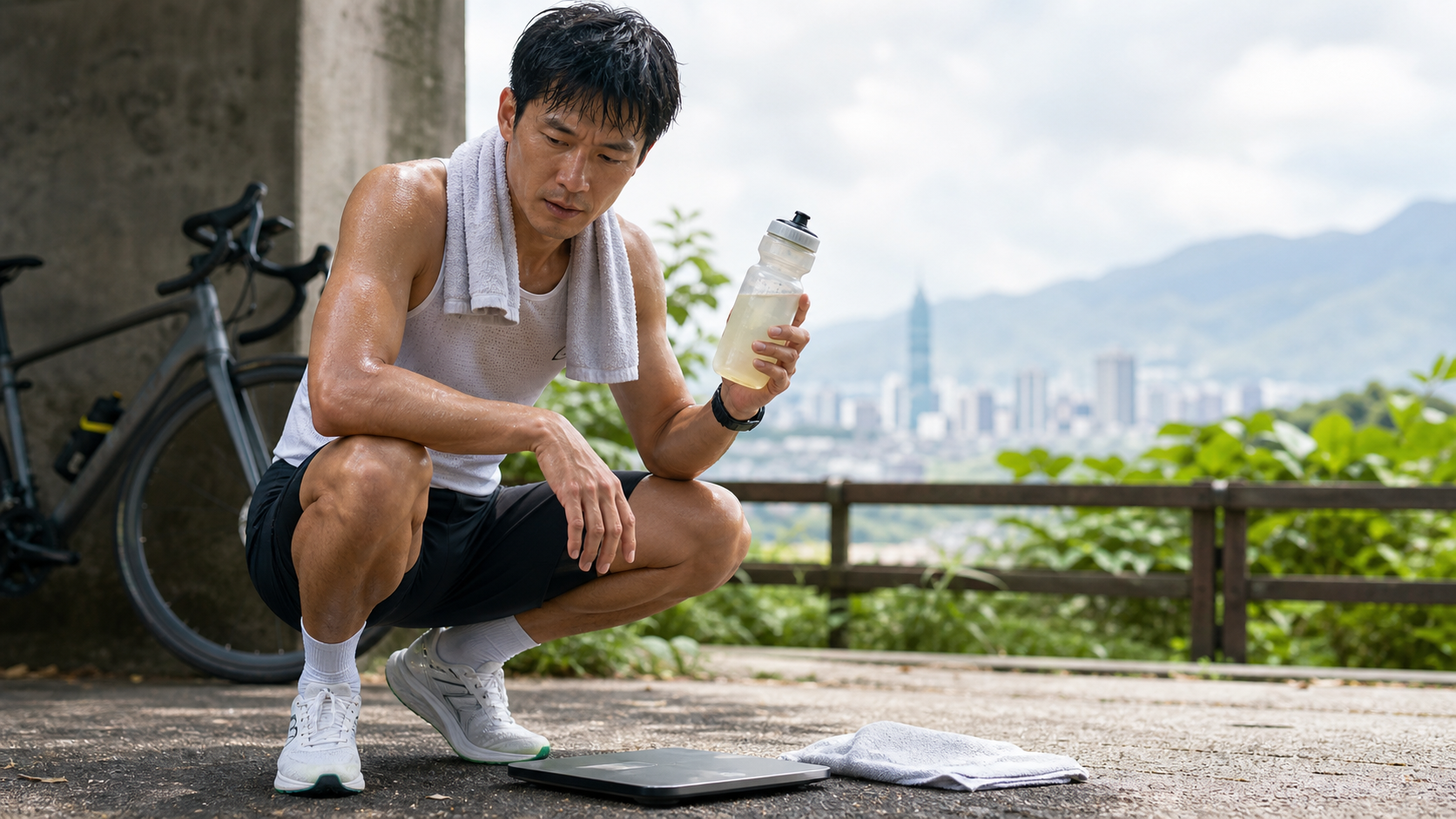
Opening: Two Athletes Behind a Sports Drink
I’ve been coaching endurance sports for over fifteen years, and many of my beliefs have been forged through real-life cases. Let me start with two contrasting examples so you can feel the two extremes of “hydration.”
The first, let’s call him A-Hong. He’s a salesperson in his early forties who joins group rides on weekends over Yangjin P-Style Mountain and Fengguizui, covering roughly sixty to seventy kilometers. One July, on the climb toward Qingtiangang, he cramped up and felt dizzy. When he pulled over, his face was pale and his heart rate had spiked to nearly 150 bpm. He later told me, almost indignantly: “Coach, I was hydrating diligently the whole way—how could this still happen?”
The second, let’s call her Xiao-Min. She’s a full-marathon runner preparing for the Taipei Marathon. She’s terrified of dehydration. Having heard that “by the time you feel thirsty, it’s already too late,” she forced herself to chug a big mouthful of water every fifteen minutes during every long run, even when she wasn’t thirsty. After a 30-kilometer training session, her weight had gone up instead of down, her fingers were swollen, and she felt nauseous and groggy afterward.
What do these two cases have in common? Both were “diligently hydrating,” and both ended up in trouble. A-Hong was losing too much and replacing it incorrectly, while Xiao-Min was a textbook case of overdrinking. This is exactly the core point I want to discuss with you today: Hydration status is not a linear “the more you drink, the better” relationship—it’s about staying within a just-right zone. And to hit that zone, you need to learn to read the signals your body gives you.
This article won’t get into anything esoteric. I’ll break down the three most practical assessment tools you can use starting today—urine, body weight, and thirst—and explain the risks of both underhydration and overhydration.
Why Hydration Matters So Much: First, Let’s Solidify the Science
The Body Is a Strictly Managed Water Bladder
The human body is roughly 60% water. This water isn’t static; it participates in temperature regulation (sweating to dissipate heat), nutrient transport, joint lubrication, and—most critically—maintaining stable blood volume and electrolyte concentration.
During exercise, your muscles generate massive amounts of heat, and your body relies on sweating to carry it away. Sweat isn’t just water; it also contains electrolytes like sodium, chloride, and potassium. When you sweat heavily and replace fluids incorrectly, the concentration and volume of this “water bladder” become imbalanced, manifesting as cramps, dizziness, abnormal heart rate, declining performance, and in severe cases, life-threatening conditions.
Here’s a concept many people get wrong: What the body truly cares about isn’t the “absolute amount of water,” but the “ratio of water to sodium (i.e., blood osmolality).” Remember this sentence, because it’s the key to understanding why overdrinking causes problems.
I often use a relatable analogy: imagine your blood is a pot of miso soup. Dehydration is like the soup boiling down—the miso becomes saltier and more concentrated (osmolality rises). Overdrinking plain water is like constantly adding plain water—the miso gets diluted until it’s almost tasteless (hyponatremia). What the body wants is that “just-right” pot of soup—balanced in saltiness. Looking only at “how much water was added” isn’t enough; what matters is the final concentration of that soup. This is also why simply comparing “how many liters I drank today” has limited meaning—what always matters is the state the body ultimately maintains.
Sweat Loss Isn’t Just Water
Many people think sweating is just losing water, but sweat is actually a fluid containing electrolytes. Sodium concentration in sweat varies greatly from person to person. Some are “salty sweaters”—after exercise, white salt crystals form on their clothes and caps, their skin tastes salty when licked, and sweat stings when it runs into their eyes. These people lose relatively more sodium. Others have “lighter” sweat. I’ve organized the approximate composition of sweat and its effects into the table below so you understand why “replacing only water without sodium” causes problems:
| Sweat Component | Relative Amount | Effect of Loss |
|---|---|---|
| Water | Largest | Decreased blood volume, elevated heart rate, poorer heat dissipation |
| Sodium, Chloride | Primary electrolytes | Heavy loss plus plain-water-only intake can trigger hyponatremia and cramps |
| Potassium | Small amount | Related to muscle contraction and heart rhythm |
| Magnesium, Calcium | Trace amounts | Related to neuromuscular function |
The key point is: When you sweat heavily (especially if you’re a salty sweater) and only chug plain water, you’re simultaneously losing sodium and further diluting what’s left—a double blow. That’s the underlying mechanism behind A-Hong’s cramps. Figuring out whether you’re a salty sweater is simple—check whether dark-colored athletic wear leaves obvious white salt stains after drying, or whether your skin forms a white frost. If so, your sodium replacement needs are more aggressive than others’.
Dehydration and Overhydration: Two Ends of a Balance
I often draw a balance scale for my athletes:
- The scale tips left (dehydration/hypohydration): Water loss exceeds intake, blood becomes more concentrated, blood volume drops, the heart has to pump harder, heat dissipation worsens, body temperature rises, and performance declines in a straight line. It’s generally accepted that when body weight drops beyond roughly 2%, endurance performance starts to suffer, and going further carries risks of heatstroke and heat exhaustion.
- The scale tips right (overhydration/hyponatremia): This is Xiao-Min’s situation. Water intake (especially plain water) far exceeds losses, “diluting” the sodium in the blood. According to consensus in sports science, the primary cause of exercise-associated hyponatremia (EAH) is consuming hypotonic fluids in excess of what the body needs to replace, compounded by non-osmotic stimulation of antidiuretic hormone (AVP) during exercise, which prevents the body from excreting the excess water. Mild cases bring nausea, headache, and swelling; severe cases can lead to cerebral edema, confusion, and seizures—it can be fatal.
The international sports medicine community (such as the ACSM’s position stand) has consistently emphasized: Both underhydration and overhydration impair performance and increase health risks, and athletes must be alert to both ends. This is also why I dislike giving athletes a rigid rule like “drink X hundred milliliters per hour”—because sweat rates vary enormously from person to person.
Taiwan’s Humid Heat Makes the Balance Even Harder
Taiwan’s climate amplifies this issue. In summer, temperatures routinely hit the mid-30s with 70–80% humidity. Sweat can’t evaporate, so you sweat even more to cool down, raising dehydration risk. But at the same time, if you’re held hostage by the “drink more water” mindset and chug plain water without replacing sodium, hyponatremia risk rises in tandem. A hot, humid environment pushes the risks at both ends outward simultaneously, which is why we need a reliable self-assessment method.
Let me give a scenario Taiwanese people will instantly recognize: riding on a riverside bike path or running on a track at noon in July or August. That stifling, unventilated feeling—sweat simply can’t evaporate; it just drips off drop by drop. This “ineffective sweating” means your heat dissipation efficiency is poor, so the body has to sweat even more to cope, and dehydration sets in much faster than in a dry, cool environment. On the same route, at the same pace, your sweat rate in winter versus summer can differ by more than double. That’s why I keep stressing: Don’t directly apply the fluid amounts you measured in winter to summer. Taiwan’s seasonal and perceived-temperature differences are enough to completely transform the same person’s fluid needs.
Practical Assessment: Urine, Body Weight, and Thirst—Three Key Tools
Okay, the concepts are covered. Now let’s get to the hands-on part you’re most eager for. These three tools require no purchased equipment—you can use them at home, in the office, or before a race.
Tool 1: Urine Color — The Most Intuitive Daily Indicator
Urine color is the first habit I ask athletes to develop. The principle is simple: when the body is well-hydrated, the kidneys excrete more water, diluting the urine and making it lighter in color; when dehydrated, the kidneys conserve water, concentrating the urine and making it darker.
In sports science, urine specific gravity and urine osmolality are used to precisely quantify hydration status. Generally, a urine specific gravity of approximately 1.010–1.020 and urine osmolality of approximately 500–700 mmol/kg is considered the “euhydration” range. As a surrogate for these objective markers, research consistently finds that urine color has a moderate to high correlation with urine specific gravity and osmolality (correlation coefficients typically ranging from 0.4 to 0.9), with good sensitivity for detecting dehydration.
That said, color interpretation has its limitations, and there are several “false signals” to watch out for. I’ve summarized the common scenarios in the table below:
| Urine Color | Approximate Hydration Status | Coach’s Interpretation & Reminder |
|---|---|---|
| Clear/Colorless | Possibly overhydrated | If it stays this way all day, be careful about drinking too much and diluting sodium |
| Pale Yellow (like diluted lemonade) | Ideal | This is the color we want—maintain it |
| Medium Yellow | Slightly low, can hydrate | Generally fine for daily life; consider topping up before exercise |
| Dark Yellow/Amber | Clearly insufficient | Time to seriously hydrate; be cautious if this appears before exercise |
| Deep Tea/Brown | Severely insufficient or other issues | If it doesn’t improve after hydrating, or if accompanied by muscle soreness, seek medical attention promptly |
A few “false signals” you must know:
- Vitamin B complex can turn urine a vivid fluorescent yellow. This doesn’t mean you’re dehydrated—it’s the color of riboflavin (B2). Many people in Taiwan take a multivitamin in the morning and panic at the yellow, but it’s a misunderstanding.
- Beets and dragon fruit eaten in large amounts can make urine appear reddish—don’t be alarmed.
- First morning urine is usually the most concentrated and darkest because you haven’t drunk anything all night. This is normal and doesn’t mean you’re severely dehydrated.
- Older individuals experience changes in kidney concentrating ability, so the correlation between urine color and actual hydration status decreases—interpret with more caution.
So my advice to athletes is: Look at the “full-day” trend, and preferably check the non-morning voids. Drawing conclusions from a single void is prone to error.
Tool 2: Body Weight Changes — The Most Accurate Estimate of Fluid Loss
If urine is qualitative, body weight is quantitative—and it’s the most practical, cheapest way to assess “how much fluid was lost during a session.” The principle: short-term (within hours) body weight changes are almost entirely due to fluid shifts, not fat or muscle changes.
Basic method (daily baseline): Over several consecutive days, weigh yourself in the morning after using the bathroom, before breakfast, wearing the same minimal clothing. Take the average as your “baseline weight.” Then weigh yourself each morning; if one day you’re clearly 1–2 kg below baseline, it’s likely you didn’t replenish fluids from the previous day.
Advanced method (estimating sweat rate): This is one I love, especially for athletes doing long rides or long-distance runs. Here’s how:
- Empty your bladder before exercise, weigh yourself nude (or in fixed minimal clothing), and record it.
- Record how much water you drank during the session (in milliliters).
- After exercise, towel off sweat, remove wet clothing, and weigh yourself nude again.
- Calculate: Sweat loss (liters) ≈ (pre-exercise weight − post-exercise weight) + fluid consumed. Divide by exercise duration to get your hourly sweat rate.
Let me walk you through a hypothetical example:
| Item | Value |
|---|---|
| Pre-exercise weight | 70.0 kg |
| Post-exercise weight | 68.5 kg |
| Fluid consumed during exercise | 500 ml (0.5 kg) |
| Exercise duration | 2 hours |
| Weight loss | 1.5 kg |
| Estimated total sweat | 1.5 + 0.5 = 2.0 kg (approx. 2 liters) |
| Hourly sweat rate | Approx. 1.0 liter/hour |
Once you know you sweat one liter per hour, next time under the same intensity and weather, you’ll know roughly how much to prepare and what your hourly intake target should be—rather than guessing and chugging blindly. This turns “hydration” from guesswork into manageable numbers.
Here’s a summary table for interpretation:
| Post-exercise Weight Change | Interpretation | Recommended Action |
|---|---|---|
| Loss > 2% | Significant dehydration, insufficient intake | Increase fluid intake during exercise next time; replenish about 1.2–1.5 liters per kg lost afterward |
| Loss 0–2% | Ideal range | Maintain current strategy |
| Nearly unchanged | Intake was just right | Good, but still watch for any bloating |
| Gain instead of loss | Warning sign—possible overhydration | Review whether you chugged too much plain water; check for bloating or nausea; reduce intake next time and ensure sodium intake |
Weight “gain” is a major red flag. In Xiao Min’s case, her weight actually increased after running—that’s evidence her body was retaining too much water, a high-risk sign of hyponatremia. If your weight goes up after exercise, you can be almost certain you overhydrated.
Tool 3: Thirst — The Underrated and Misunderstood Built-in Sensor
The saying “if you’re thirsty, it’s already too late” is widespread, but it’s been overinterpreted. In recent years, the mainstream consensus in sports medicine for typical exercise scenarios (not extreme ultramarathons) has shifted back to “drink to thirst (ad libitum)”—drinking when thirsty and replenishing based on the body’s actual needs, rather than forcing fluids on a rigid schedule. The International Hyponatremia Consensus Conference also states that the safest individual strategy for preventing exercise-associated hyponatremia is to drink according to thirst before, during, and after exercise.
Why? Because thirst is a highly sensitive regulatory mechanism honed by evolution. Your hypothalamus monitors blood osmolality; when blood becomes more concentrated (dehydrated), it triggers thirst to make you drink. Once you’ve had enough, thirst subsides. This system is sufficient for most people and most exercise contexts. Xiao Min’s problem was precisely that she overrode her thirst signals—drinking forcefully when not thirsty—and that’s what drove her into hyponatremia.
So when does “thirst means it’s too late” actually apply? Mainly in prolonged, high-intensity, hot endurance events, where the sensitivity of thirst may lag behind the rate of fluid loss. In those cases, you can use the sweat rate calculated earlier as a supplement. But for everyday exercise—a one- or two-hour ride or run—trusting your thirst is usually safer than rigid rules.
The Triad: Combining All Three Signals
Any single tool has blind spots, but together they’re highly reliable. Some research has proposed combining body weight, urine color, and thirst into a single assessment tool (conceptually like a three-circle Venn diagram), finding that this combination accurately assesses hydration status against objective urine and blood markers, whether in the morning or across free-living conditions throughout the day. This echoes what I’ve taught athletes for over a decade:
- All three signals point to dehydration (dark urine, weight loss, thirst): It’s almost certain you need to hydrate.
- All three are normal (pale yellow urine, stable weight, not particularly thirsty): Rest assured, hydration is good.
- Conflicting signals (e.g., thirsty but weight is up): Stop and think—this usually means overhydration or another issue; don’t keep chugging.
I’ve turned this “triad” logic into a reference table so you can quickly match your situation before a race or after training:
| Urine Color | Weight Change | Thirst | Combined Interpretation | Recommendation |
|---|---|---|---|---|
| Dark yellow | Loss > 2% | Clearly thirsty | Clear dehydration | Aggressively hydrate + sodium |
| Pale yellow | Loss 0–2% | Slightly/not thirsty | Ideal hydration | Maintain strategy |
| Clear | Nearly unchanged or gain | Not thirsty | Leaning toward overhydration | Reduce intake, stop chugging |
| Pale yellow | Gain + bloating | Not thirsty but nauseous | High risk of hyponatremia | Stop drinking, seek medical evaluation |
| Dark yellow | Gain | Thirsty | Conflicting signals, needs observation | Don’t rush to chug; hydrate slowly, monitor bloating |
The key takeaway from this table is the last two rows—those “conflicting signal” scenarios. When you’re fatigued, judgment declines, and relying on a single sensation (like thirst alone) and chugging excessively can easily lead to trouble. Look at all three signals together so you don’t get led astray by a single false signal.
A Deeper Look at Risk: Deficiency and Excess—What Exactly Should We Fear?
Many students ask at this point: “Coach, bottom line—dehydration or overhydration, which is more dangerous?” My answer is: Both can be fatal, but their symptoms and treatment directions are completely opposite. Getting the direction wrong makes things far worse.
The Risk Spectrum of Insufficient Fluid (Dehydration)
Dehydration doesn’t happen “all at once”—it’s gradual. Let me walk you through its progression so you know at which stage to hit the brakes:
- Mild (roughly 1–2% body weight loss): You start feeling thirsty, urine output decreases and darkens, focus drops slightly, and heart rate runs higher at the same pace. Rehydration at this stage brings things back to normal.
- Moderate (roughly 3–5%): Noticeable fatigue, dizziness, reduced efficiency, possible cramping, and feeling very short of breath. Athletic performance is now clearly compromised.
- Severe (over 5–6%): Risk of heatstroke and heat exhaustion; possible nausea, confusion, cessation of sweating, and hot skin. This is a medical emergency—cool down immediately and seek hospital care.
In Taiwan’s summer, prolonged outdoor exercise combined with moderate-to-severe dehydration and heat injury is a real risk. Key indicator: if someone who has been sweating suddenly “stops sweating,” becomes confused, and has hot skin, that’s a danger signal. Don’t hesitate—cool them down immediately and call an ambulance.
The Risk Spectrum of Overhydration (Hyponatremia)
Hyponatremia is often overlooked because it “looks like” the behavior of a diligent student who’s trying hard to hydrate. Its progression is:
- Mild: Bloating sensation, weight gain, slight nausea, head fullness. It’s easily mistaken for “not drinking enough yet,” leading to continued drinking, which worsens the condition.
- Moderate: Worsening headache, vomiting, confusion, unsteady gait.
- Severe: Cerebral edema, seizures, coma. This is equally a life-threatening emergency.
The scariest part of hyponatremia is its “false intuition”—when you feel unwell, the instinct is to “drink more water,” but for someone with hyponatremia, drinking more plain water is pouring fuel on the fire. That’s why I rank “post-exercise nausea + bloating + weight gain” as the highest-level red flag. Research indicates that women, lighter-weight individuals, and those taking non-steroidal anti-inflammatory drugs (NSAIDs) during exercise are at higher risk for hyponatremia. Readers in these categories should pay special attention.
One sentence to help you remember the direction: dehydrated people look dry with concentrated urine; hyponatremic people look swollen and puffy with weight gain. Get the direction wrong, and the rescue goes wrong too.
Common Mistakes and Corrections: Landmines I’ve Seen in My Students
In years of coaching, the same mistakes keep recurring. Let me list the most common ones, along with correction strategies.
Mistake 1: Treating “Drink More Water” as an Absolute Virtue
This is the most widespread misconception in Taiwan. Health campaigns have long preached “drink more water,” so everyone assumes the more water, the better. But as discussed above, for athletes, drinking too much dilutes blood sodium and can genuinely cause harm. Correction: plain water isn’t better in unlimited amounts—especially during prolonged exercise, pair it with electrolytes, and use “thirst + no weight gain” as your brake.
Mistake 2: “Carbo-loading” on Water Before a Race (Excessive Pre-Hydration)
Some students get nervous before a race and chug water from the night before to the start line, thinking “store it up in advance.” The result: constant trips to the bathroom before the start, and they may have already diluted their blood sodium. Correction: pre-race hydration should be moderate and early, not a last-minute binge. A general principle is to sip in divided amounts over the hours before the race until urine is pale yellow—no need to drink until it’s clear and colorless.
Mistake 3: Replacing Fluid Only, Not Sodium
This was exactly Ah-Hong’s problem. He drank diligently, but it was plain water. Sodium lost through sweat was never replenished, leading to cramps and dizziness—ultimately a failure of “effective hydration” because the body couldn’t retain water without sodium. Correction: for exercise lasting over roughly an hour, or with heavy sweating, use electrolyte-containing sports drinks or supplements—don’t just drink plain water.
Mistake 4: Making a Major Judgment Based on a Single Urine Sample
Seeing dark yellow morning urine and chugging water, or seeing fluorescent yellow after taking B-vitamins and assuming something is wrong. Correction: look at trends, avoid the interference of morning urine and vitamins, and interpret alongside body weight and thirst.
Mistake 5: Ignoring “Swelling” as a Critical Warning Sign
Rings feeling tighter on fingers, deeper sock marks, facial puffiness—when these appear after prolonged exercise, they’re often signs of fluid retention and hyponatremia. Correction: if unexplained swelling occurs during or after exercise along with nausea, headache, or confusion, stop drinking water and seek medical attention promptly. This cannot be solved by drinking more water—it will only get worse.
A Third Case: A Commuter Who “Thought He Barely Drank”
Besides Ah-Hong and Xiao-Min, let me add another often-overlooked type. My student Ah-Kai is an office worker who commutes by bike about ten kilometers daily. He figured, “I’m not an athlete, why should I care about hydration.” But he’d long suffered from low afternoon energy and frequent headaches, which he chalked up to work fatigue.
I gave him the simplest homework: for one week, note his urine color and morning body weight every day. The results showed he barely drank all morning (too busy, too lazy to use the restroom), his urine was often dark yellow, and only in the afternoon did he chug sugary drinks. This kind of chronic, low-grade daily dehydration won’t knock you down, but it quietly steals your energy, focus, and athletic performance—and most people never notice.
My adjustment for him was simple: put a fixed-capacity water bottle on his desk, set a goal of finishing one bottle each in the morning and afternoon, and keep urine color in the pale-yellow range. Two weeks later, he reported that his afternoon headaches and grogginess had clearly improved. The takeaway from this case: hydration isn’t just for athletes—everyday performance is affected by it too. And the assessment tools are exactly the same—urine, body weight, and thirst—anyone can use them.
Actionable Advice for Readers at Different Levels
Everyone starts from a different point, so I’ve divided the advice into three tiers. Find where you fit.
General Exercise Population (commuting, weekend rides or runs under one hour)
- Daily: Build the habit of checking urine color, aiming to keep it pale yellow. Eat three regular meals (Taiwan’s eating-out culture generally means sodium isn’t lacking), and sip water throughout the day rather than chugging it all at once.
- During exercise: For sessions under one hour, drink according to thirst; plain water is usually sufficient. On hot days, bring a bottle and drink when thirsty.
- What not to do: Force-drink when not thirsty, or binge-drink before a race.
Advanced Endurance Enthusiasts (long-distance cycling, half to full marathons, triathlon)
- Pre-race: Use the advanced body-weight method to measure your sweat rate and build your own fueling plan.
- During exercise: Beyond one hour, replenish electrolytes, adjusting by sweat rate and thirst. The principle is to keep body weight loss within 2% without letting weight increase.
- Post-exercise: Estimate losses from the pre- vs. post-exercise weight difference. For each kilogram lost, replenish in divided portions of roughly 1.2–1.5 liters (containing sodium) over several hours—don’t chug it all at once.
- Gear tip: For long climbs in Taiwan’s summer like Fengguizui or Wuling, bring two bottles (one water, one electrolyte), and plan refill points at convenience stores at the base of the mountain.
Those with Chronic Conditions or Special Circumstances (hypertension, heart disease, diabetes, kidney disease)
I’ll be conservative and clear in this section. If you have hypertension, heart disease, diabetes, or kidney-related conditions, or are taking medications such as diuretics or non-steroidal anti-inflammatory drugs (NSAIDs), your fluid and electrolyte regulation may differ from the general population, and your risk of hyponatremia or fluid retention may also differ.
- Be sure to discuss with your physician or dietitian before starting any new exercise and hydration plan, and get an individualized assessment.
- The body-weight method and urine-color interpretation provided here are general guidelines and are not suitable for direct application to those with conditions requiring strict fluid or electrolyte control.
- Taiwan’s National Health Insurance makes medical access convenient. If you repeatedly experience dizziness, swelling, palpitations, or altered consciousness after exercise, don’t guess on your own—make an appointment and have a physician evaluate you.
Quick Self-Check Table (Save This for Reference)
Use the table below before and after exercise:
| Check Item | Green Light (Good) | Yellow Light (Caution) | Red Light (Immediate Action) |
|---|---|---|---|
| Urine Color | Pale yellow | Dark yellow / dark morning urine | Deep tea color that doesn’t improve |
| Post-exercise weight change | Loss of 0–2% | Loss of >2% | No loss—actually gain + swelling |
| Thirst sensation | Moderate, relieved after drinking | Clearly thirsty | Not thirsty but nauseated from being force-fed fluids |
| Body sensation | Good energy | Slightly fatigued | Headache / nausea / confusion |
Green light: maintain current practice. Yellow light: adjust fluid or sodium intake according to the direction indicated. Red light—especially the combination of “weight gain + swelling + altered consciousness”—stop drinking water and seek medical attention immediately.
Frequently Asked Questions (FAQ)
Q1: How many liters of water should I drink per day?
There is no one-size-fits-all answer. Instead of fixating on a single number, self-calibrate by keeping your urine a light yellow color and drinking according to thirst. On days when you sweat a lot, you naturally need to drink more; on days when you sit in an air-conditioned office, you need less.
Q2: How do I choose between sports drinks and plain water?
For exercise lasting under an hour, plain water is usually sufficient. For sessions longer than an hour, with heavy sweating, or in hot and humid weather, it’s recommended to pair with an electrolyte-containing sports drink to replenish the sodium lost through sweat. If you’re concerned about sugar, you can dilute the sports drink with water.
Q3: Will coffee or tea dehydrate me?
The diuretic effect of moderate caffeine is not as strong as people think. Drinking coffee or tea in moderate amounts daily does not significantly cause dehydration. However, it’s not advisable to rely on large amounts of caffeine to stay alert before a race without also hydrating.
Q4: I’m always very thirsty after exercise. Is that a hydration problem?
Feeling thirsty after exercise is normal; just rehydrate in portions according to your thirst. What you need to watch for is the contradictory combination of “thirst + weight gain + swelling,” which is a warning sign.
Q5: Is it a problem if my morning urine is very yellow?
Usually not. That’s a normal concentration from not drinking water all night. It’s more accurate to look at the trend of your urine color during the day, excluding the first morning void.
Q6: Can I weigh myself during exercise to monitor hydration?
For very long activities (e.g., rides or ultramarathons lasting over three or four hours), weighing yourself at aid stations mid-event is a valuable real-time check. If you find your weight has increased compared to the start, it means you’re over-drinking and should back off. But for typical one- or two-hour sessions, there’s no need to weigh mid-workout; weighing once before and once after is sufficient.
Q7: Do I need electrolyte tablets or salt candies?
If you’re a salty sweater, or you’re doing high-intensity, high-sweat exercise for over an hour, additional sodium (electrolyte tablets, sodium-containing sports drinks, or even some salty snacks) is reasonable. But for short-duration exercise, and given that Taiwanese diets already tend to be high in sodium, most people don’t need to deliberately supplement large amounts of sodium in daily life. If you have kidney disease or hypertension and are on a sodium-restricted diet, be sure to consult your doctor before supplementing sodium.
Q8: Do I not need to worry about hydration in cold weather?
No. In winter, your thirst sensation is less pronounced, you still sweat even when bundled up, and you lose moisture through breathing. You can still get dehydrated on long winter rides, just with less awareness. In cold weather, you need to be more proactive and take small, regular sips.
Q9: I only do an hour of weight training at the gym. Do I need to be this meticulous?
In an air-conditioned indoor environment, an hour of weight training typically doesn’t cause that much sweat. Drinking according to thirst and keeping your urine light yellow is more than enough. There’s no need to force down large amounts of water or aggressively supplement electrolytes. This comprehensive approach is mainly for long-duration, high-sweat endurance sports.
Q10: Do the same guidelines apply to children and the elderly?
The principles are the same, but these groups require extra caution. Older adults have a blunted thirst sensation, and the correlation between urine color and actual hydration status is lower. Children have different thermoregulation capabilities. If these two groups are exercising for long periods in hot environments, caregivers should proactively monitor and encourage fluid intake rather than waiting for them to say they’re thirsty.
Conclusion: Learn to Read Your Body’s Hydration Ledger
Back to A-Hong and Xiao-Min from the beginning. I later helped A-Hong establish the concept of sweat rate. He started carrying electrolytes on long rides and drinking according to thirst, and he never cramped up and collapsed before Qingtiangang again. Xiao-Min learned to trust her thirst, watch her weight instead of the clock, and her swelling and nausea disappeared. She also finished her full marathon successfully.
Their transformation didn’t involve any high-tech methods—it came down to the three things covered in this article: check your urine, weigh yourself, and listen to your thirst. The essence of hydration isn’t “the more you drink, the better,” but rather staying in the optimal range—too little leads to dehydration, too much leads to hyponatremia, and both ends are dangerous.
You don’t need expensive equipment. If you’re willing to spend some time observing the signals your body gives you, within a few weeks you’ll gradually figure out how to keep your own “hydration ledger.” This is a fundamental skill every serious athlete should have.
One final reminder: your body will speak, but you need to be willing to listen honestly. When the red flags appear—especially that combination of “weight gain, swelling, and altered consciousness”—don’t push through. Medical care is easily accessible in Taiwan; leave it to the professionals.
This article is for educational purposes and cannot replace individual diagnosis and treatment advice from a physician, physical therapist, or nutritionist.
References
- The weight, urine colour and thirst Venn diagram is an accurate tool for hydration assessment (British Journal of Nutrition / PMC): https://www.ncbi.nlm.nih.gov/pmc/articles/PMC10918520/
- The Validity of Urine Color as a Hydration Biomarker (Systematic Review, PubMed): https://pubmed.ncbi.nlm.nih.gov/32330109/
- Validation of urine colour Lab* for assessing hydration amongst athletes (Frontiers in Nutrition / PMC): https://pmc.ncbi.nlm.nih.gov/articles/PMC9399725/
- Exercise-Associated Hyponatremia: 2017 Update (PMC): https://www.ncbi.nlm.nih.gov/pmc/articles/PMC5334560/
- ACSM Position Stand: Exercise and Fluid Replacement (ResearchGate): https://www.researchgate.net/publication/232208129_ACSM_Position_Stand_Exercise_and_Fluid_Replacement
Related Reading
- Fluid Balance During Exercise: How Much Dehydration Does It Take to Hurt Your Performance?
- Athletes’ Drinking Habits: How Much Water Should You Really Drink a Day? A Complete Practical Guide from Daily Needs to Training Days
- Hydration Management for Runners: Calculating Hourly Fluid Loss and Replenishment Strategies
- The Physiological Basis of Fluids and Electrolytes: Osmotic Pressure, Thirst Mechanisms, and Why “Drink More Water” Isn’t Always Right
西進武嶺 免費訓練分析服務 Intervals | 練不夠還是練過頭?你哪一種類型選手?AI模型告訴你! | 備戰神器 | 公路車 訓練 | CT Yeh
4 年前
#公路車 #Vo2Max #最大攝氧量 測驗 體驗 | 心肺測試
6 年前
16/02/16 - 夜訪中社路 緩慢進步中
10 年前
單車 一日北高 ( 雙城 ) 肥宅雙人瘋狂行 紀錄片 REACTO
10 年前
水金九不厭五分 10度寒流冷到不願停!feat. 卡卡 / 公路車 / CT Yeh
6 個月前
CT暗黑廚房) 車友必備 宇宙無敵鮮蚵湯 幫助訓練恢復 天然食補 好市多 超肥鮮蚵 破PR
7 年前
雨戰! 西進武嶺員工旅遊 加料 各路段大數據分析 | 同事端出5公斤的公路車來挑戰!? EP1
4 年前
單車 重低音 藍芽喇叭 音質實測 SoundBot SB525 Real Sound Test
8 年前