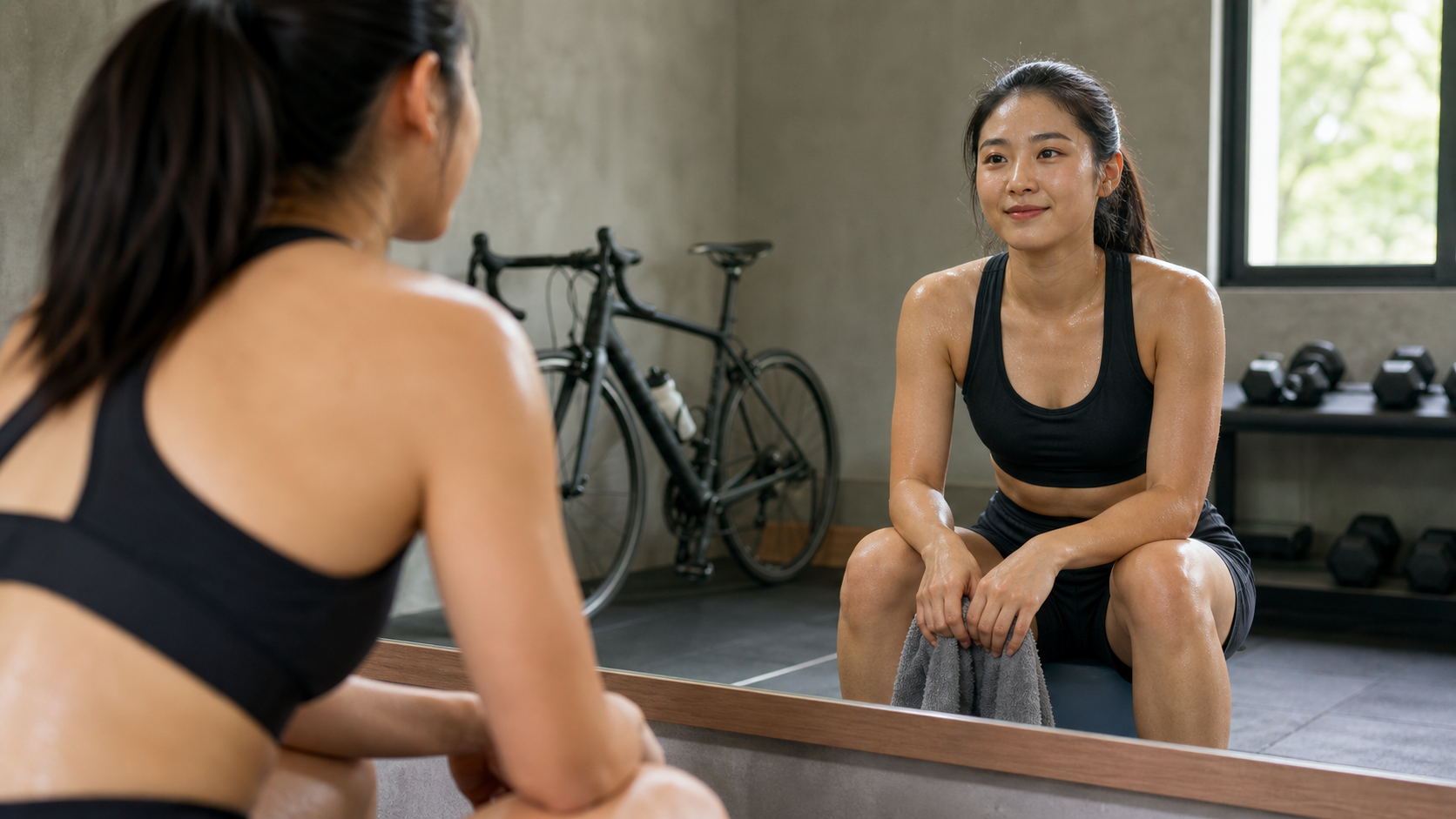
It Starts with a Client’s Mirror
I once coached a female client—let’s call her Xiao-Ting. When she first came to me, her fitness level wasn’t actually bad; she rode her bike three or four times a week and also went to the gym. But her opening line wasn’t “I want to ride faster”—it was “Coach, are my thighs too big?”
At that moment, I already knew what was going on. Because in my fifteen years of coaching athletes at all levels and everyday fitness enthusiasts, I’ve heard that same sentence far too many times. For some, it’s “my belly still won’t go away”; for others, it’s “my arms lack definition”; and for some, their physique is already impressively lean—the kind others envy—yet they still feel like they’re “not quite there.”
Exercise is supposed to make people like their bodies more. So why do some people become more anxious the more they train, and more dissatisfied the more they look in the mirror?
This is precisely what makes “body image” such a fascinating and tricky subject. Exercise’s impact on body image is double-edged: it can be the rope that pulls you out of self-loathing, or the chain that binds you even tighter. The difference often lies not in how hard or how often you train, but in why you train—and how you view the body that’s sweating.
In this article, I want to talk to you about this properly, grounded in exercise science and my practical experience coaching clients. Whether you’re a beginner just starting to exercise and hoping to lose weight, or a seasoned athlete chasing performance, I believe you’ll find something useful here. This won’t be an article about “how to get slim”—it’s an article about “how to get along with your body through exercise.” The latter is what will stay with you for a lifetime.
What Is Body Image? It’s Not Just “Fat or Thin”
Body image sounds abstract, so I usually break it down into four dimensions when explaining it to clients—it makes it easier to see where you fit:
- Perceptual dimension: How accurate the “picture” of your body is in your mind. Some people measure objectively within normal ranges, yet their mental self-image is a heavily distorted, magnified version.
- Cognitive dimension: The thoughts and beliefs you hold about your body, such as “abs are the only definition of good-looking” or “thick thighs are bad.”
- Emotional dimension: Whether looking at or thinking about your body brings up ease or shame, anxiety.
- Behavioral dimension: The actions you take because of your body image—like weighing yourself obsessively, only ever taking photos from one angle, avoiding tight cycling jerseys, or even doing extra training as “compensation.”
Here’s the key point: Body image is “your relationship with your body,” not the body-fat percentage number itself. I’ve seen people at 12% body fat who hate their bodies, and I’ve seen older folks with softer physiques happily riding around the lake every day, enjoying the wind on their faces. The former has a negative body image; the latter has a positive one—and it has almost nothing to do with the numbers.
“Positive Body Image” Is Not Narcissism
Many people assume that “feeling good about your body” means being narcissistic or complacent. But what sports psychology calls positive body image is fundamentally about body appreciation: appreciating what your body can do for you, respecting its needs, and treating it with kindness rather than criticism. It has nothing to do with whether you have a six-pack, and everything to do with whether you can eat well, rest well, and enjoy movement.
The Bright Side of Exercise: It Really Can Improve Body Image
Let’s start with the good news. Research broadly supports this: regular exercise is associated with higher positive body image. The sense of accomplishment and control that exercise brings translates into more positive feelings about and experiences with your body. There are several practical mechanisms behind this, which I see in my clients time and again:
- A sense of competence replaces appearance anxiety. When someone first rides up a climb they couldn’t manage before, or first jogs continuously for thirty minutes without stopping, that feeling of “my body did it” gradually drowns out the thought of “my thighs are too big.” The body shifts from being an “object to be scrutinized” to a “partner in collaboration.”
- Emotional regulation. The mood improvement during and after exercise (what some call the post-exercise relaxation and euphoria) makes people less likely to fall into negative rumination about their bodies.
- Community belonging. In Taiwan’s cycling clubs, running groups, and community exercise classes, many people experience for the first time that “what matters here is whether you finish together, not what your body looks like.” This experience of being accepted has tremendous power to repair body image. I’ve coached many clients who were initially too afraid of “being judged by their body” to join group rides—but once they actually rode with a group, they discovered that people talk about routes, weather, and who conquered Wuling again. Nobody cares whose legs are thick or thin. That relief of “I don’t have to become good-looking first to deserve a place in this community” is often the turning point in their body image.
- Shifting attention. During exercise, your attention is pulled toward your breathing, cadence, road conditions, and scenery—temporarily away from that inner voice constantly scrutinizing your appearance. For many people who live with body anxiety long-term, this respite of “finally not having to constantly rate my body” is healing in itself. This is also why riding or running outdoors can sometimes loosen appearance anxiety more effectively than gym workouts in front of mirrors—because you’re looking at the road ahead, not at yourself in the mirror.
I often tell clients like Xiao-Ting: “We’re not here to transform your body into something else. We’re here to help you rediscover what it can do.”
Why Is “Sense of Competence” So Powerful?
Let me elaborate on the first point, because it’s the engine of the entire positive cycle. Much of people’s dissatisfaction with their bodies stems from a sense of loss of control—feeling that the body won’t obey, can’t reach the ideal, and no matter how hard you try, it’s never enough. What’s most precious about exercise is that it constantly gives you concrete, cumulative, hard-earned progress: the climb you couldn’t make last week, you held this week; last month you were exhausted after 20 km, this month you can easily ride 40 km.
These improvements aren’t evaluations handed to you by others—they’re things your body has genuinely accomplished. When someone accumulates enough of these experiences, their relationship with their body shifts from “adversarial” to “trusting.” I’ve seen countless clients, through one “I did something I couldn’t do before” after another, gradually stop caring so much about some body part in the mirror. This isn’t something you can achieve through preaching—it’s the body convincing the brain through action.
The Dark Side of Exercise: The Same Activity Can Also Make You More Anxious
But here’s the crucial turning point—and the thing I most want to remind you of in this article.
Exercise does not automatically improve body image. The “motive” behind exercise is the fork in the road that determines whether it’s bright or dark.
Research has found a fascinating phenomenon: when a person’s primary motive for exercise is “for appearance,” the positive association between exercise frequency and positive body image is weakened; moreover, people with appearance as their primary motive are more likely to spiral into body dissatisfaction and anxiety. In other words, two people training five times a week—one training to “enjoy riding and get stronger,” the other training to “eliminate thigh fat and chase a specific physique”—can end up with completely opposite long-term psychological outcomes. (See references at the end of this article.)
Why is that? I explain it to clients with a simple analogy: making appearance your sole motive is like anchoring your boat to a buoy that keeps drifting. Today you lose a kilogram and think “not enough”; you hit your target weight and start nitpicking your muscle definition; you get the definition and start comparing yourself to someone better. Because the “ideal” appearance is always a moving target fed to you by society, media, and comparison—the moment you catch up, the target moves again. This structural “can never catch it” is itself a breeding ground for anxiety.
In contrast, function-oriented goals have an endpoint and can be satisfied: either you can ride a certain route continuously or you can’t—it’s clear-cut. When you achieve it, that sense of accomplishment is real and complete; it can’t be stolen by “not good enough.” This is the deeper reason these two motives lead to such divergent long-term psychological outcomes.
This matches exactly what I observe in the field. People with appearance as their sole motive often share several traits:
- No matter how much they train, it never feels like enough, because the “ideal body” is a moving target they can never catch.
- If they don’t lose weight or hit some appearance goal in a given week, they completely negate all their efforts.
- They treat exercise as “atonement”—eating more means they must train extra to burn it off; exercise becomes punishment rather than enjoyment.
When Passion Becomes Compulsion: Warning Signs of Exercise Dependence
Moving further down the spectrum, you encounter what clinicians call exercise dependence, sometimes referred to as compulsive exercise. It is considered a behavioral addiction, sharing features with substance addiction: needing to train more and more to get the same satisfaction (tolerance), feeling restless and anxious when not training (withdrawal), loss of control, and an inability to stop even when injured or when the body is showing red flags. It also frequently co-occurs with traits like body dysmorphic disorder (an excessive preoccupation with appearance) and perfectionism. (See references at the end)
I’ve put together a table to help you distinguish between “commitment” and “loss of control.” This is not a diagnostic tool, but a reminder for self-awareness:
| Aspect | Healthy Commitment | Warning Signs of Loss of Control |
|---|---|---|
| Motivation | For health, enjoyment, improvement, social connection | Primarily for appearance, weight numbers, atonement |
| Flexibility | Can rest without guilt when needed | Missing one day of training causes intense guilt, anxiety |
| Attitude toward pain/injury | Stops, seeks medical help, and adjusts when injured | Pushes through pain, fears that stopping will “break the streak” |
| Life balance | Exercise integrates into life, doesn’t crowd out work or relationships | Skips meals with friends, work, and sleep to train |
| Relationship with food | Eats normally according to needs | “Calculates” whether and how much to eat based on training volume |
| Self-evaluation | Performance is just one part of life | The quality of the day is determined by exercise and physique |
If you checked several items in the right-hand column, this doesn’t mean you “have a problem,” but it does mean your relationship with exercise and your body is worth pausing to examine. In Taiwan, medical access is convenient; under the National Health Insurance, psychiatric, psychological, and nutritional consultation services are all available. If this is accompanied by disordered eating, low mood, or significant functional impairment, please seek professional help. This is not a matter of willpower.
The Core Solution: Shifting Focus from “Appearance” to “Function”
Having discussed the dual impact, here comes the most practical part. If motivation is the fork in the road, how do we steer it in a healthy direction?
Research and my practical experience point to the same answer: shift your attention from “what your body looks like” to “what your body can do.” A function-focused mindset fosters more positive feelings toward your body and healthier behaviors, and can even buffer the negative impact of “ideal body” imagery in the media. (See references at the end)
I call this the “function-oriented exercise mindset.” How does it actually play out? The comparison table below is what I give my clients, helping you translate every thought that tends to slide toward appearance anxiety into a function-oriented version:
| Situation | Appearance-Oriented (Anxiety-Prone) | Function-Oriented (Healthier) |
|---|---|---|
| Setting goals | “Lose 5 kg and get visible abs in three months” | “Be able to ride a 40 km route continuously in three months” |
| Viewing data | Only looking at weight and body fat | Looking at power, pace, heart rate recovery, how far you can ride |
| After a workout | “Did I get thinner today?” | “What did my body accomplish today, and how does it feel?” |
| Facing the mirror | Checking what’s not good enough | “These legs carried me up that climb today” |
| Hitting a plateau | “Am I just not disciplined enough?” | “Should I adjust my training or rest more?” |
A Real Case: What Happened to Xiao-Ting
Back to Xiao-Ting. I didn’t give her a “slim thighs” workout plan, because that would only reinforce her view of her thighs as the enemy. What I did was change the goal: I helped her prepare for a 50 km countryside ride she had always been too afraid to sign up for.
During training, our conversations were all about “I lasted longer on the climb this week,” “I’m starting to dare to let go on the descents,” and “I can ride for two hours straight without my legs giving out.” I even asked her not to weigh herself for those three months. On event day, she finished the ride. She cried at the finish line—not because she was thinner, but because “these legs I’ve always resented can actually carry me this far.”
Her thigh circumference barely changed. But her relationship with her body did. That’s the power of a function-oriented mindset.
Not Just a Women’s Issue: Body Image Struggles in Men
When it comes to body image, many people instinctively think of women and of “wanting to be thin.” But I need to tell the other half of the story, because the male clients who have come to me over the years have just as many body image struggles—just in a different direction.
Another case. Ah-Tai, an office worker in his early thirties, trained hard with weights and cycling. His struggle wasn’t “too fat,” but “not muscular enough”—looking in the mirror, he always felt his chest wasn’t thick enough, his arms weren’t big enough, his physique was “too skinny.” He’d feel anxious about “getting in a protein meal,” couldn’t sit still if he missed an upper-body day, and even pushed through a shoulder injury to keep training.
In clinical terms, this corresponds to a concept called muscle dysmorphia, sometimes colloquially referred to as “weakness phobia” or “reverse anorexia”: not feeling too fat, but feeling not lean or muscular enough, with muscle mass never being sufficient. It is equally a body image disturbance and can also be accompanied by compulsive exercise and a tendency toward supplement overuse.
What I want to say is this: body image anxiety knows no gender boundaries. Women are often held captive by “thinness,” and men by “muscularity,” but the underlying mechanism is the same—pinning your self-worth on a body standard defined by external forces that can never be fully achieved. The solution is the same too: shift the focus from “do I look good enough” back to “what can my body do, and how does it feel.”
Ah-Tai’s eventual turnaround came when I changed his training goals from “measurements” to “performance”—how much he could lift, how long he could sustain power on climbs, and how to return safely after injury. When he started training to become “stronger and more durable,” rather than to “fill out that outline in the mirror he could never stop criticizing,” that restlessness slowly began to ease.
Body Image Looks Different at Different Life Stages
Body image isn’t fixed for life; it changes with age and life stage. I’ve summarized the key points for a few common stages to help you reflect on your own situation or that of a family member:
| Life Stage | Common Body Image Challenges | How Exercise Can Help |
|---|---|---|
| Adolescence | Extreme sensitivity to appearance, easily influenced by peers and social media | Use team sports and a sense of achievement from abilities to build self-worth based on “what the body can do” |
| Postpartum Women | Anxiety about body changes, eager to “get the body back” | Progress gradually; rebuild core strength and fitness first, don’t rush to chase appearance |
| Middle-Aged Office Workers | Sedentary lifestyle, metabolic changes, comparing to “younger self” | Replace comparisons with past appearance using health and functional indicators |
| Older Adults | Fear of “being old and useless” | Cycling and walking maintain independent mobility; the focus is on “continuing to do what you love” |
Taiwan has abundant local resources to support these stages: riverside bike paths and lake-loop routes are suitable for riders of all ages; community and sports centers offer age- and level-appropriate classes. For older adults especially, I recommend linking exercise to “maintaining mobility”—being able to ride your bike to the market or walk a stretch with your grandkids. These functional goals support a lasting positive body image far better than any appearance-based goal.
Practical Tools for You: Three Actionable Tables
Concepts alone aren’t enough, so I’ve prepared three concrete tools for you to take home and use.
1. A Beginner’s Weekly Plan Focused on Function (Using Cycling as an Example)
This plan deliberately sets no weight or appearance goals, only capability goals. It’s suitable for people who want to start exercising regularly without falling into body-image anxiety. Intensity is expressed using “rate of perceived exertion” combined with heart rate zone concepts, avoiding false precision—everyone’s maximum heart rate is different, so treat the numbers as a range reference.
| Day | Content | Intensity Feel | Time | Functional Goal |
|---|---|---|---|---|
| Monday | Rest or walk | Very easy | — | Let the body recover |
| Tuesday | Easy ride on flat roads | Can still chat easily | 40 minutes | Build aerobic base |
| Wednesday | Rest or stretch | Very easy | 20 minutes | Mobility, relaxation |
| Thursday | Ride on rolling terrain | Slightly breathless, can speak short sentences | 45 minutes | Adapt to climbing |
| Friday | Rest | — | — | Avoid accumulating fatigue |
| Saturday | Longer, slower ride | Easy to moderate | 60–80 minutes | Extend endurance |
| Sunday | Easy ride or other exercise | Easy | 30–40 minutes | Enjoyment, recovery |
Note that in the “Functional Goal” column of this plan, not a single cell says “burn X kcal” or “tone this area.” That’s intentional. Taiwan’s summers are hot and humid, so it’s recommended to schedule longer rides in the early morning or evening, avoiding midday heat and UV exposure; stay well-hydrated, and when sweating heavily, consider electrolyte-containing drinks.
2. Self-Checklist for Healthy Exercise Motivation
Every so often, honestly ask yourself these questions. This isn’t a test; it’s to help you recalibrate your direction:
| Check Question | A Healthy Direction Answer |
|---|---|
| Why do I want to exercise today? | Because I want to move, to relax, to get stronger—not “because I ate too much yesterday” |
| If my body is very tired today, do I allow myself to rest? | Yes, and I don’t feel guilty about it |
| If no one could see the results, would I still want to exercise? | Yes, because the process itself has value |
| How do I view progress? | By capability, feeling, and health—not just by looking in the mirror |
| Does exercise crowd out my sleep, work, or relationships? | No, exercise adds to my life rather than subtracting from it |
3. Common Emotional Traps and Coach Responses
| The Voice in Your Head | How I Would Respond |
|---|---|
| “I’ve trained this long and still don’t look good” | Looking good is someone else’s standard; your body has gotten stronger and healthier during this time—that’s what you can actually control |
| “I ate a lot today, so I have to run it off tonight” | Exercise is not punishment. Food is not a sin. Unlink the two |
| “Taking a rest day makes me feel useless” | Rest is part of training; muscles get stronger while you rest |
| “Everyone else has a better body than me” | You’re comparing their highlight reel to your everyday life—that’s neither fair nor realistic |
Common Mistakes and Corrections
Over the years, I’ve seen too many people with good intentions go in the wrong direction. Here are the most common ones—see if any apply to you:
Mistake 1: Using Exercise to “Offset” Food
“I’m having a big meal today, so I’ll run ten kilometers first.” This kind of compensatory exercise looks disciplined, but it’s really turning exercise into punishment and food into guilt. Over time, you’ll enjoy exercise less and less, and view every meal with increasing anxiety.
Correction: Treat eating and exercise as two separate, good things you do to care for your body. You exercise because you want to move; you eat because your body needs energy. With how convenient eating out is in Taiwan, instead of obsessing over whether you “can” eat something, put your energy into “eating balanced enough and getting enough protein.”
Mistake 2: Making the Scale Your Only Judge
Weighing yourself daily and panicking whenever the number goes up. But body weight is affected by water, salt, the menstrual cycle, and what you ate the day before. Short-term fluctuations of one to two kilograms are normal and have nothing to do with the value of your effort.
Correction: If weighing yourself affects your mood, reduce the frequency, or stop entirely for a while. Switch to functional indicators: how far can you ride this month, how long can you sustain a climb, do you get winded climbing stairs, are you sleeping well.
Mistake 3: Using Social Media Bodies as Your Baseline
Body photos on social media are the result of chosen angles, lighting, and editing—some are even the product of specific genetics or professions. Using them as your daily standard is comparing someone else’s highlights to your real life. Research also points to an association between social media use and exercise addiction and body image disturbance.
Correction: Review who you follow. Accounts that make you hate your body after viewing them—it’s okay to unfollow. Engage more with content that emphasizes “what the body can do”—for example, documenting the process of completing an event.
Mistake 4: Pushing Through Pain and Wearing Injury as a Badge
“No pain, no gain” is a dangerous myth. Treating the disregard of pain as willpower is one of the classic signs of exercise dependence.
Correction: Distinguish between “normal post-workout soreness” and “pain that feels wrong.” Persistent, sharp, one-sided pain, or pain that affects daily movements—rest when you should, and see a doctor when you should. Sports medicine and rehabilitation resources are accessible in Taiwan; don’t let fear of “losing progress” drag things into a chronic injury.
Mistake 5: Betting Everything on “Quick Fixes”
Many people start exercising driven by an urgent appearance goal—“there’s a wedding in three months, I need to lose weight” or “summer’s coming, I need to fit into a swimsuit.” The biggest problem with these short-term, appearance-oriented goals is: once that date passes, the motivation is gone, the exercise stops, and you fall into a vicious cycle of “regain weight—self-blame—desperately diet again.” And every cycle damages your relationship with your body.
Correction: Treat exercise as a lifelong habit, not a one-off project. Set your goal as “I want to become a person who exercises regularly and is healthy and energetic,” not “I want to look a certain way by a certain date.” Slow, but lasting; steady, and you’ll go far. This is also why I emphasize function so much—function and health are goals that can stay with you into old age; a specific appearance is not.
Actionable Advice for Readers at Different Levels
If You’re a Beginner Who Wants to Lose a Little Weight
- I completely understand that “wanting to look better” is a natural motivation—don’t feel guilty about it. But please put it in a secondary position, and set your primary goal as a capability-based one: for example, “be able to brisk-walk or easy-ride continuously for thirty minutes.”
- For the first four to eight weeks, put the scale away. Measure progress by “is this week a little easier than last week?”
- Find a community. Taiwan’s community exercise classes, or cycling groups on lakeside or riverside bike paths, have low barriers to entry and a good atmosphere—the feeling of being accepted will carry you through.
- Allow yourself to rest and to eat. This isn’t laziness; it’s sustainability.
- Pick an exercise you “enjoy doing,” not the one “rumored to burn the most fat.” If you like cycling, cycle; if you like swimming, swim. The exercise you can enjoy is the exercise you can sustain; and only what you can sustain brings all the downstream benefits. Taiwan’s climate is changeable—hot and humid summers with frequent afternoon thunderstorms—so it’s also wise to have an indoor backup plan (spinning, gym, stair climbing) so the weather doesn’t become an excuse to skip training.
If You’re an Advanced Athlete Who Already Trains Regularly
- Check whether your motivation has quietly drifted toward appearance. A simple test: if no one would ever see your body, would you still train this way?
- Diversify your goals. Beyond appearance, add performance goals (power, pace), experiential goals (completing a classic route), and health goals (heart rate recovery, sleep quality).
- Take recovery seriously. The most common mistake advanced athletes make is treating rest as the enemy. Schedule deload weeks, and don’t let the voice of “anxious if I don’t train” run the show.
- Pay attention to your mindset when sharing training on social media. Sharing the joy of completing a route is a good thing; but if you find yourself training and posting for “good numbers and photogenic physique,” your motivation may have quietly shifted. Ask yourself: does this still make me happy?
If You Already Feel Like You “Can’t Stop”
- If you checked many boxes on that loss-of-control signal list, or exercise is clearly crowding out your life, you’re pushing through pain, or you’re using exercise to “pay for” food—please treat this as a distress signal from your body and mind.
- This is not weak willpower. Medical care is convenient in Taiwan; psychiatry, psychology, and nutrition counseling under the National Health Insurance are all resources. Seeking professional help when combined with low mood or eating issues is brave, not weak.
- Start with one small thing: deliberately schedule one full rest day this week, and observe where that anxiety comes from. Awareness itself is the starting point of change.
Frequently Asked Questions from My Students
Over the years of coaching students, the same questions keep coming up. I’ve compiled the most common ones and answered them all at once.
Q1: But I really do want to look better. Is there anything wrong with pursuing appearance?
No, there isn’t. Wanting to look better is only human, and I never ask my students to pretend they don’t care about their appearance. The problem isn’t whether you have this motivation—it’s whether it’s your only or primary motivation. When appearance becomes the sole reason you exercise, you’ll give up or break down the moment you don’t see visible changes in the short term. Put it in a secondary position, let “enjoyment, getting stronger, and health” be the main engine, and improvements in appearance will often show up as a byproduct over time—and you’ll stick with it much longer.
Q2: How long does it take for exercise to improve body image?
This varies from person to person, and I won’t give you a falsely precise number of days. But based on my practical observations: improvements in how you “feel” often come before changes in “appearance.” Many students, before their physique visibly changes, already start feeling better about their bodies because they “can ride farther, don’t get winded climbing stairs, and sleep better.” This is exactly the advantage of a function-oriented approach—it lets you start liking your body without having to wait until you’ve slimmed down.
Q3: I feel guilty every time I rest. What should I do?
First, understand one thing: rest is not an interruption of training—rest is part of training. Your body repairs and gets stronger during rest. If rest causes you such intense anxiety that you can’t sit still, that itself is a signal worth paying attention to (refer back to the earlier red-flag checklist for loss of control). You can start by practicing rest days that are “deliberately scheduled and accepted in advance”—put them in your training plan and treat them as a task to complete.
Q4: Should I weigh myself or measure my body fat?
Tools themselves are neither right nor wrong—it depends on how you use them. If you can take the numbers in stride and treat them as reference, that’s fine. But if a number that doesn’t meet your expectations ruins your whole day and makes you want to add extra training or eat less, then this tool is currently doing more harm than good for you. I’d suggest putting it away and tracking your progress with functional indicators instead.
Q5: My child is starting to care about their body shape. How should I guide them?
Comment less on appearance (including others’ and your own), and affirm ability and effort more. Instead of saying “you’ll get fat if you do that,” say “you rode so steadily today—you’ve improved so much.” Helping children understand their body from a young age as “a partner that helps me do so many things,” rather than “an object to be scrutinized and graded,” is a gift that will serve them for life.
Conclusion: Turning Your Body from an Object of Scrutiny Back into Your Partner
Let’s return to the mirror from the very beginning.
The work of body image, at its core, is not about “remodeling your body into an ideal shape”—it’s about “changing the way you relate to your body.” Exercise is one of the most powerful tools on this journey—but it’s a tool, and the steering wheel is in your hands. Hold it right, and it leads you toward appreciation, capability, and ease; hold it wrong, and it can drag you into an endless loop of never feeling good enough.
The deepest insight I’ve gained over these fifteen years is this: those who exercise consistently and joyfully over the long term are almost never training because they hate a certain body part—they train because they love where their body can take them. May you also, through the sweat, gradually move from “this isn’t good enough, that needs fixing” to “thank you, body, for carrying me through another stretch of the road today.”
That is the best gift exercise can give to your body image. Next time you get on your bike or lace up your running shoes, take a deep breath first and tell yourself: today, I’m not moving to please anyone—I’m moving so that this body, which has carried me through everything, can live a little better.
This article is for educational purposes and does not replace individual diagnosis or treatment advice from physicians, physical therapists, or nutritionists. If you are struggling with disordered eating, emotional distress, or compulsive exercise, please seek professional help.
References
- Appearance-based exercise motivation moderates the relationship between exercise frequency and positive body image (PubMed): https://pubmed.ncbi.nlm.nih.gov/24529336/
- Predictive Model of the Relationship between Positive and Negative Affect, Self-Consciousness of Appearance, and Positive Body Image in Physical Exercise Practice (PMC): https://www.ncbi.nlm.nih.gov/pmc/articles/PMC10815446/
- Chapter 7: Body Image and Physical Activity – Essentials of Exercise Psychology: https://raider.pressbooks.pub/essentialsofexercisepsychology/chapter/chapter-7-body-image-and-physical-activity/
- Exercise Dependence – an overview (ScienceDirect): https://www.sciencedirect.com/topics/psychology/exercise-dependence
- When Exercise Becomes Too Much of a Good Thing (Columbia University Department of Psychiatry): https://www.columbiapsychiatry.org/news/when-exercise-becomes-too-much-good-thing
- Recent insights in the correlation between social media use, personality traits and exercise addiction (PMC): https://www.ncbi.nlm.nih.gov/pmc/articles/PMC11116774/
Related Reading
- How Exercise Reshapes Your View of Your Body: The Healthy Connection Between Exercise, Body Image, and Self-Esteem
- Body Image in Road Running: The Healthy Psychology of Weight Pressure and Running Performance
- Exercise and Appetite: Why You Sometimes Get Hungrier the More You Train, and Sometimes Don’t Feel Like Eating at All
- Body Image and Endurance Sports: Finding Balance Between Pursuing Performance and Self-Acceptance
CT 喇低賽) 單車 比賽總是沒照片? 攝影師的觀點大公開 姿勢就是力量! 請加速1.25倍收看
7 年前
靠單車減肥35公斤 心得分享與整理
7 年前
一日北高/長距離團騎 常見問題補充篇 / 組團或跟團的眉角 / 壯車友容易被瘦車友慢性拉爆 / 原來屁股痛可能是這個原因...? / 風場配速法 / 公路車 / CT Yeh
2 年前
一日北高常見問題大集合 | 攻略 | 路線 | 訓練 | 補給 | 自行車 單車 | 一日雙城 | 雙塔 | TWB北高360 | 屁股痛
6 年前
#公路車 #Fitting 靠人工智慧APP 幫你調整單車
6 年前
福隆鐵人團練隨拍
8 年前
西進武嶺 免費訓練分析服務 Intervals | 練不夠還是練過頭?你哪一種類型選手?AI模型告訴你! | 備戰神器 | 公路車 訓練 | CT Yeh
4 年前
#PUSHBIKE 原來這麼好玩! 小朋友 滑步車 初體驗 超可愛
6 年前