Oishi Highland (Prefectural Route 19) Guide: 6.7 km at 5.4% Average Grade, Hairpin Pacing, and a Complete Ride Guide for Silver Grass Season
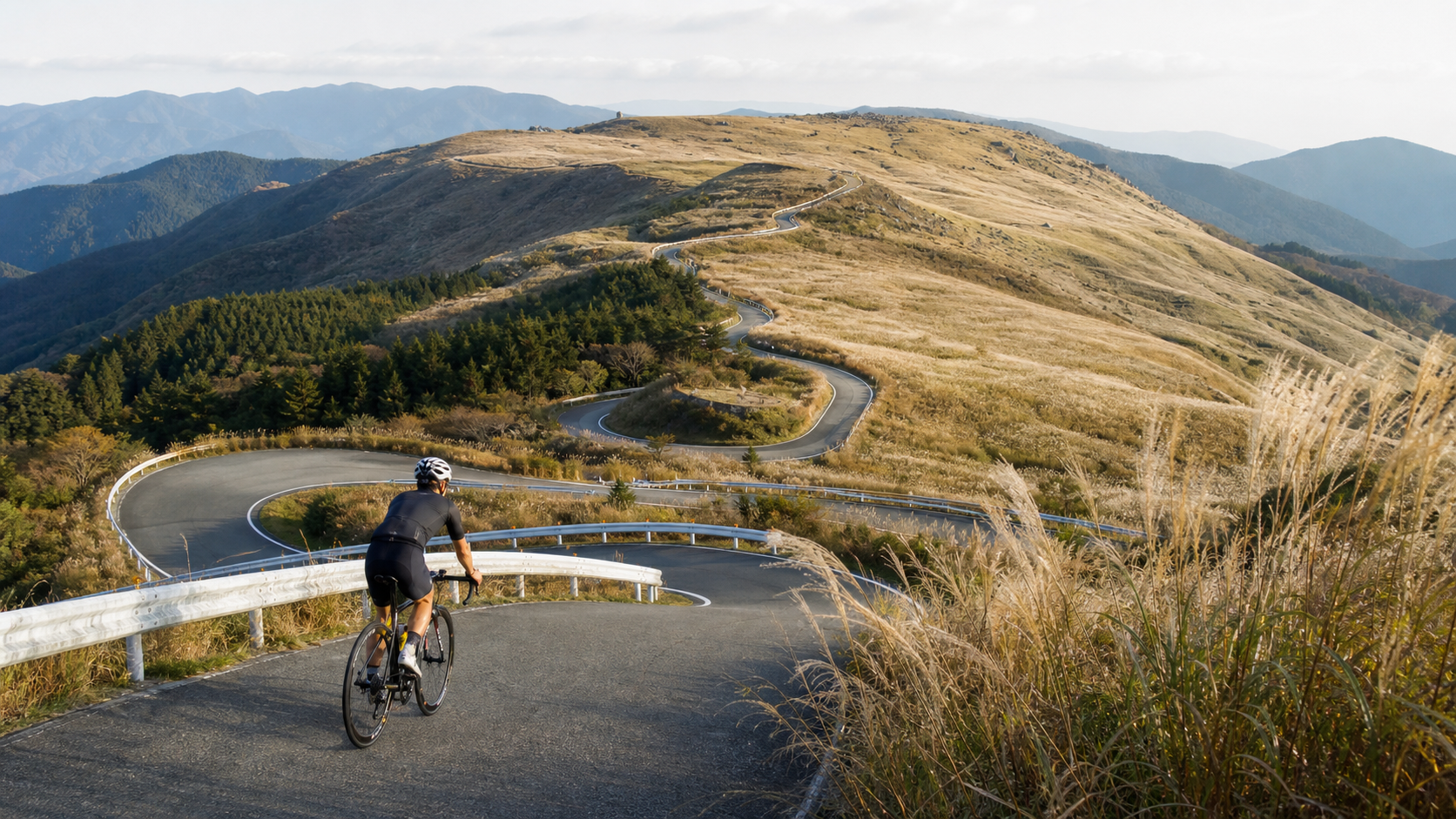
In Aridagawa Town, Wakayama, there is a climb nicknamed “Wakayama’s Alpe d’Huez (ラルプ・デュエズ)” by local cyclists—Prefectural Route 19 leading up to Oishi Highland. The name pays tribute to the legendary Tour de France climb Alpe d’Huez and its endless hairpin turns; its true identity is a 6.7 km (6,740 m) mid-distance climb with 361 m of total elevation gain and a 5.4% average grade, ending at an elevation of roughly 870 m at Oishi Highland, home to one of Kansai’s finest silver grass (ススキ) prairies.
To put it in Taiwanese terms, a 5.4% average grade over 6.7 km feels close to a “milder version of Fengguizui,” or a mid-level mountain road with very evenly distributed gradients—not enough to make your legs buckle, but certainly not a casual spin. Its appeal lies in: moderate difficulty + an unrealistically open silver grass vista at the summit, making it one of Wakayama’s most worthwhile climbs to tackle specifically.
This is a practical guide covering the numbers, segment breakdown, gearing, and refueling in detail.
1. Reading the Numbers: 5.4% Is “Friendly but Not Lenient”
| Item | Data | Interpretation |
|---|---|---|
| Distance | 6.7 km | Mid-distance climb |
| Total elevation gain | 361 m | Equivalent to climbing 118 floors continuously |
| Average grade | 5.4% | Moderate to approachable, suitable for advanced beginners |
| Estimated steepest section | ~9–10% | Steeper on the inside of some corners |
| Category | Category 3 | Moderate difficulty |
What 5.4% means: This is a grade that most regular cyclists can grind out seated. It’s friendly, but because it stretches 6.7 km, pacing is still required—especially since this road is known for consecutive hairpins, where the inside of corners sneakily gets steeper. It’s an ideal “gateway climb from flatland rider to mountain rider,” and also works for veterans as a relaxed tempo session.
Key concept: 5.4% won’t break you, but the nickname “Wakayama’s Alpe d’Huez” is a reminder—managing rhythm through the consecutive hairpins is the real challenge of this road.
2. Segment Breakdown: Splitting the 6.7 km into Three Parts
Segment 1 (0–2.2 km): Starting from the Base, Grade 4–6%
Turn off from the settlements along the Arida River onto Prefectural Route 19 to start the climb.
- Pacing: The opening grade is gentler, making it easiest to go out too fast. Deliberately hold an intensity where you can “speak a full sentence.”
- Cadence: Maintain 80–85 rpm to ease your body smoothly into rhythm.
- Note: This section still features satoyama pastoral scenery with relatively open road width, ideal for establishing rhythm.
Segment 2 (2.2–4.8 km): The Hairpin Core Zone, Grade 6–9%
Enter this road’s signature—consecutive hairpin turns. This is also the origin of the “Alpe d’Huez” nickname.
- Cornering strategy: The inside of hairpins is noticeably steeper. When safe and clear of oncoming traffic, take a wide outside arc to reduce the instantaneous grade and minimize pedaling interruptions; always prioritize sightlines at intersections and safety above all.
- Rhythm: The grade briefly eases at each hairpin exit—use that second or two to let your heart rate drop before the next push.
- Visual payoff: The advantage of hairpins is that you can periodically look back at the road you’ve just climbed spiraling below—a powerful psychological boost.
Segment 3 (4.8–6.7 km): Pre-Summit, Grade Settles Back to Gentle
Near the Oishi Highland parking area, the grade mostly eases off.
- Finishing: If you paced the earlier sections well, you can pick up the pace slightly here as conditions allow.
- Summit: Arriving at the Oishi Highland area, the silver grass prairie opening up before you is your reward. Watch out for people and vehicles when stopping.
3. Gearing and Equipment Recommendations
A 5.4% average grade puts little strain on gearing, but the short steep sections inside hairpins still warrant some margin.
| Rider Level | Chainring | Cassette | Notes |
|---|---|---|---|
| Advanced / Racing | 50/34 | 11-28 | Average grade easily manageable |
| General Enthusiast | 50/34 | 11-30 or 11-32 | Most recommended; protects cadence on hairpin steep sections |
| Beginner / Conservative | 50/34 | 11-34 | For those wanting an easy finish or learning to climb |
Equipment essentials:
- Wheels: For a mid-distance climb, lightweight or all-round rims both work well.
- Descent: The hairpin descent tests cornering and braking—be sure to check your brakes and control your speed going down.
- Camera: The silver grass vista at the summit is worth bringing a decent camera or steadying your phone.
4. Refueling and Hydration Strategy
- Water: Fill up fully at the base settlements; supply points on the mountain are limited. Oishi Highland has a parking area and recreational facilities, but don’t rely entirely on them.
- Energy: Take in a serving of carbs before starting, and refuel once more before the hairpin core zone before the summit.
- Summit: Oishi Highland has rest facilities like “Yama no Ie Oishi” (operating hours vary by season; check on-site), suitable for a rest and refuel after topping out.
5. Weather and Seasonal Considerations
- Silver grass season (early October to mid-November): This is Oishi Highland’s golden moment. The roughly 13-hectare silver grass prairie sways silver-white (October) and turns brilliant gold (November at dawn and dusk)—one of Kansai’s finest silver grass vistas. If you’re making a special trip to ride, this season is strongly recommended.
- Spring/Summer (April–September): Fresh greenery and summer highland scenery; relatively cool at elevation, ideal for a summer escape climb.
- Winter (December–February): Low temperatures on the highland, with possible slick or icy conditions—beginners should avoid.
- All seasons: At nearly 870 m elevation, the summit is windy and cold—bring a windbreaker.
6. Common Mistakes and DNF Risks
- Going out too fast at the start: The gentle grade deceives you; you only realize your legs are spent in the hairpin core zone.—Solution: Hold back for the first 2 km.
- Cutting the inside of hairpins: Taking the inside line for speed spikes the instantaneous grade and adds danger.—Solution: Take a wide outside arc when safe.
- Insufficient hydration: Assuming a mid-distance climb doesn’t need water, then fading from dehydration.—Solution: Fill up at the base.
- Only thinking about photos and forgetting to control speed on the descent: The summit vista lulls you into complacency; the hairpin descent is where the real risk lies.—Solution: Get down safely first, then savor the scenery.
7. Reference Target Times by Rider Level
The following are reference completion times for the roughly 6.7 km, 361 m climb on Prefectural Route 19 to Oishi Highland:
| Rider Level | Reference Time | Average Speed | Intensity Concept |
|---|---|---|---|
| Racing | 20–24 min | ~17–20 km/h | Near the upper edge of tempo |
| Advanced | 25–30 min | ~13–16 km/h | Steady rhythm |
| General Enthusiast | 31–40 min | ~10–13 km/h | Steady aerobic |
| Beginner Finish | 41–50 min | ~8–10 km/h | Goal is finishing and seeing the silver grass |
A word to challengers: Oishi Highland’s difficulty sits right at the sweet spot of “worth the effort, but not discouraging.” As you spiral up hairpin after hairpin and reach the top, with the entire silver grass prairie surging in the wind—you’ll understand that the name “Wakayama’s Alpe d’Huez” is no exaggeration.
Route data: 6.7 km distance, 361 m total elevation gain, 5.4% average grade (Strava segment), Aridagawa Town, Wakayama Prefecture, summit at Oishi Highland approximately 870 m elevation, a renowned Kansai silver grass scenic climb.
8. “The Alpe d’Huez of Wakayama”: The Weight of a Nickname
The road up Mount Oishi is nicknamed “The Alpe d’Huez of Wakayama (ラルプ・デュエズ),” and this nickname deserves to be taken seriously, because it precisely pinpoints the core challenge of this climb.
The real Alpe d’Huez is one of the most famous climbs in the Tour de France, renowned worldwide for its 21 numbered hairpin turns. Countless legendary Tour de France battles have unfolded on those spiraling switchbacks. Its defining feature isn’t simply steepness, but rather the “rhythmic challenge posed by consecutive hairpins”—the gradient inside each corner steepens while the outside is more gradual, and your choice of line through the turn directly impacts your pedaling rhythm and energy expenditure.
Mount Oishi borrows this nickname precisely because it is equally defined by consecutive hairpin turns. This means the key to conquering Mount Oishi is the same as conquering Alpe d’Huez: You must learn to manage your rhythm within the hairpins.
Key Techniques for Hairpin Turns
- Steep Inside, Gradual Outside: On Japanese mountain roads, the inside (apex) of a hairpin is often significantly steeper than the outside. When it’s safe and clear of oncoming traffic, taking a wider arc on the outside can noticeably reduce the instantaneous gradient and help maintain pedaling continuity.
- Utilize the Brief Flattening After the Apex: The exit of each hairpin usually features a short, temporary easing of the gradient. Use this second or two to let your heart rate settle, take a deep breath, and then tackle the next section of climbing. These are among the few spots on a consecutive-hairpin route where you can “actively recover.”
- Visual Motivation: The biggest psychological advantage of a hairpin route is that you can occasionally look back at the road you’ve just spiraled up. Seeing the road you’ve climbed winding round after round beneath you is a powerful boost to your willpower. Use this as your mental weapon.
9. Real-World Scenario Simulation: A Complete Ascent of Mount Oishi
Before Departure: Fill your bottles in the settlements along the Arida River, eat a banana, confirm your cassette has a 32T gear, and stuff a windbreaker into your back pocket (the summit is nearly 870 meters, where it’s windy and cold).
Segment 1 (0–2.2 km): Turn from the river valley settlements onto Prefectural Route 19, gradient 4–6%. This is the easiest section where you’ll be tempted to ride fast. Deliberately hold back to an intensity where you “can speak a full sentence,” maintaining 80–85 rpm.
Segment 2 (2.2–4.8 km): Enter the signature hairpin core zone, gradient 6–9%. Take the wide outside arc through corners, use the brief flattening after the apex to catch your breath, and look back at the spiraling road for motivation. This is the main event of the entire climb—manage your rhythm well here.
Segment 3 (4.8–6.7 km): The final stretch before the summit, where the gradient eases back. If you paced the earlier sections well, you can accelerate slightly here if conditions allow, finishing strong. Arriving at Mount Oishi, the expansive silver grass plains that suddenly open up before you are your reward.
After Reaching the Summit: Park your bike, put on your windbreaker, and take time to refuel and rest. Walk into the silver grass plains, climb up to the Hiage-iwa rock for a panoramic view, and fully enjoy one of Kansai’s finest silver grass vistas. After taking your photos and soaking in the view, focus on controlling your speed on the descent—the hairpin downhill is where this route truly demands your full attention.
10. Customized Advice for Different Rider Types
- For Climbing Beginners: Mount Oishi is an excellent first lesson in “graduating from flat roads to mountain climbs.” The 5.4% average gradient won’t intimidate you, and the consecutive hairpins allow you to fully learn cornering and rhythm management. Set your goal as “complete the whole climb without putting a foot down, and enjoy the silver grass along the way”—you’ll fall in love with climbing.
- For Riders Wanting to Practice Cornering: The consecutive hairpins on this route are a natural classroom for practicing “cornering lines while climbing.” Practice your line and rhythm on the way up, and cornering and braking control on the way down—one ride lets you train both core climbing techniques.
- For Photography Enthusiasts: The silver grass scenery at the summit of Mount Oishi is especially stunning in autumn. If photography is your goal, aim for the silver grass season from late October to mid-November, when the morning and evening light is most beautiful. Bring stable shooting equipment, but always park safely and never obstruct others while taking photos.
- For Group Rides: This route has moderate difficulty and spectacular scenery, making it ideal for group rides. Agree to meet at the summit, let everyone climb at their own pace, and enjoy the silver grass and take group photos together at the top—it makes for a wonderful group ride memory.
11. Adding Mount Oishi to Wakayama’s Climbing Map
Mount Oishi is not an isolated road; it’s a piece of the puzzle in Wakayama’s rich climbing landscape. Wakayama (Kishu) features terrain where mountains and sea intertwine. Besides Mount Oishi, there are long climbs leading to the World Heritage site of Mount Koya, as well as various coastal and mountain routes.
If you’re planning a cycling trip in Wakayama, you can make Mount Oishi one of the highlights—it has moderate difficulty and unique scenery (silver grass plains are rare among Japan’s climbing routes), making it a perfect “change of pace” day in a multi-day itinerary. It doesn’t demand the long endurance investment that Mount Koya does, yet it offers equally unforgettable summit views.
When planning, remember to consider the season: if you’re coming for the silver grass, be sure to target autumn; other seasons offer different charms, from fresh greenery to summer escapes to the desolate beauty of withered grass. Combined with Wakayama’s famous citrus fruits (Arita mandarins) and coastal seafood delicacies, a Kishu cycling trip can satisfy all your expectations for challenge, scenery, and taste.
12. The Science of Pacing on Hairpin Routes: Why “Steady” Is Fastest
Mount Oishi is known for its consecutive hairpins, making “pacing” its most critical challenge. The mistake many beginners make on hairpin routes is “mashing hard on the steep inside, easing off on the gradual outside”—which paradoxically makes them slower and more tired. Both physics and physiology tell us: maintaining a steady “metabolic intensity” as much as possible is the most time-efficient strategy.
When you suddenly spike your power output on the inside of a hairpin, you rapidly accumulate lactate and metabolic waste, heavily tapping into your anaerobic system. Even if you ease off on the subsequent gradual outside section, your body’s rate of clearing waste and recovering is far slower than the rate at which you produced it. The result is that one burst of effort costs you a long stretch of “paying off the debt” afterward.
The correct approach is to “anchor with your breathing”: establish a fixed breathing rhythm and maintain it consistently throughout the climb. Naturally slow down on the steep inside sections to preserve your breathing rhythm, and naturally speed up on the gradual outside sections—not the other way around. If you have a power meter, target a wattage you can sustain for the entire climb, keeping fluctuations within ±10%. Riding this way, you’ll find yourself both more comfortable and faster—this is precisely the wisdom Tour de France riders apply on the real Alpe d’Huez.
13. Descent Safety: The Hairpin Downhill Is the Real Test
The ascent of Mount Oishi is moderately difficult, but the hairpin “descent” is where the highest risk of the entire ride lies. After enjoying the silver grass at the summit, don’t rush into a fast descent—treat the downhill as a technical discipline requiring full focus.
Braking Essentials: The majority of braking force comes from the front brake (about 70%), but you must apply the rear brake in sequence to avoid flipping over from grabbing the front brake alone. All deceleration should be completed “before entering the corner”—avoid braking mid-corner as much as possible, keeping the bike stable and tracking. On long descents, don’t drag your brakes continuously; instead, use an “brake before the corner, release through the corner, accelerate out” pulsing technique to prevent overheating the rims or rotors.
Cornering Line: Look toward the corner exit, not your front wheel—the bike goes where you look. Use the “outside-inside-outside” line—enter wide, clip the apex, and exit back to the outside—maximizing your cornering radius to reduce the required lean angle and speed. Keep the outside pedal down and shift your weight onto it through the turn for increased stability and grip.
Specific Mountain Risks: Visibility is poor on hairpin descents, and there may be fallen leaves, gravel, or oncoming traffic hidden beyond the corner. Always leave a margin in your speed, and always assume there’s a hazard around any corner you can’t see through. Additionally, after working hard to reach the summit, you’ll be drenched in sweat—once you hit the high-speed descent, your body temperature will plummet rapidly. Be sure to put on your windbreaker at the summit—this is the single most important thing for a mountain descent.
14. Pre-Ride Preparation and Fitness Planning
To ride Mount Oishi beautifully, preparation before departure determines a large part of the outcome. Climbing requires a combination of three abilities: aerobic endurance (long Zone 2 rides as a foundation), threshold power (sweet spot intervals to boost sustainable output), and strength and fatigue resistance (low-cadence, big-gear climbing to build torque for steep sections). For a mid-distance hairpin route like Mount Oishi, a balance between aerobic endurance and threshold power is most critical.
Furthermore, climbing is a contest of “power-to-weight ratio (W/kg)”—at the same power output, a lighter rider climbs faster. Managing your body fat to a healthy range through sensible nutrition before the season is the most cost-effective climbing upgrade. But progress gradually—don’t crash-diet right before departure, as that will only leave you with no strength on the hairpins. Get your fitness, weight, equipment, and nutrition all properly prepared, and you’ll truly be able to enjoy the “Alpe d’Huez of Wakayama”—rather than being tortured by its hairpins.
15. Nutrition and Hydration Details
Although the 6.7 km climb of Mt. Oishi is not particularly long, the summit sits at nearly 870 meters with strong winds and low temperatures. Combined with the fact that it’s often paired with a longer cycling tour of Wakayama, nutrition and hydration should not be taken lightly.
Carbohydrates: Eat a carbohydrate-focused meal 2–3 hours before departure to ensure full glycogen stores. If the ride extends over a longer distance, consume 30–60 grams of carbohydrates per hour (energy gels, energy bars, or bananas all work). Before entering the core hairpin section, take in an easily absorbed carbohydrate so it takes effect during the most demanding part of the climb.
Water and Electrolytes: Generally, replenish 500–750 ml per hour, and more in hot, humid weather. Sweating heavily while only replacing water without electrolytes can easily lead to cramps. In summer or when sweating heavily, add electrolyte tablets to your water or drink sports drinks. The settlements at the foot of Mt. Oishi are the main resupply points; once you leave them, resupply options in the mountains are limited, so be sure to fill up at the bottom.
Summit Resupply: Mt. Oishi has rest facilities such as “Yama no Ie Oishi” (operating hours vary by season; please check on-site), which are ideal for resting, refueling, and warming up after reaching the summit. Paired with Kishu mandarins from the foothills, it’s a unique taste experience exclusive to this route.
16. Quick Answers to Common Questions
Q: Is Mt. Oishi suitable for a beginner tackling their first long climb? Very much so. The friendly 5.4% average gradient and the continuous hairpins allow you to fully learn cornering and pacing—it’s an ideal choice for your first long climb. Bring a 32T cassette and aim for “never putting a foot down.”
Q: Do I have to go in autumn? If you’re after the spectacular silver grass views, yes—late October to mid-November is the most beautiful. But other seasons each have their own charm—the fresh green of spring, the cool escape of summer, the vastness of winter. This road is worth climbing all year round.
Q: Is the descent scary? The continuous hairpin descent does require focus, but as long as you master the essentials—“brake well before the corner, release through the turn, look toward the exit, and follow an outside-inside-outside line”—and control your speed with margin throughout, you can descend safely. Remember to put on a windbreaker at the summit to prevent hypothermia.
Q: Between this road and Mt. Koya, which should I climb first? Both are in Wakayama, but they have different characters. Mt. Oishi offers moderate difficulty, emphasizing scenery and cornering technique; Mt. Koya is long and gradual, emphasizing endurance and a spiritual experience. If time is limited and you want a “high return on investment” day, Mt. Oishi is an excellent choice; if you want a deep experience of a World Heritage long haul, choose Mt. Koya. If you can climb both, it makes for a perfect Kishu climbing double-header.
17. Conclusion
To sum it all up, Mt. Oishi is a road like this: 6.7 km, 361 meters of elevation gain, 5.4% average gradient, marked by continuous hairpin turns, and nicknamed the “Alpe d’Huez of Wakayama.” It’s moderately difficult and beginner-friendly, yet hides one of Kansai’s finest silver grass vistas at the summit. The key to conquering it lies in managing your rhythm through the hairpins, conquering each corner at a steady pace, and saving your strength to properly enjoy that sea of grass at the top.
Bring ample gearing and supplies, hold back your early ambition, and spiral upward one hairpin at a time—when you reach the summit and the entire silver grass meadow surges in the wind, you’ll sincerely understand that the name “Alpe d’Huez of Wakayama” is no exaggeration, and the sweat of these 6.7 km buys you a golden landscape you’ll never forget. May you ride beautifully, summit successfully, and etch that sea of grass deep into your memory.
Appendix: Mt. Oishi Quick Checklist
Before departure, spend a minute going through this checklist—it can help you avoid most beginner mistakes:
| Check Item | Standard | Why It Matters |
|---|---|---|
| Largest rear cassette cog | ≥ 32T (34T to be conservative) | Maintains cadence on steep sections inside hairpins |
| Water | ≥ 750ml, more in hot, humid weather | Limited resupply points in the mountains |
| Energy supplies | At least 1–2 servings of easily absorbed carbs | Refuel before the core section to avoid slowing down |
| Windbreaker | Carry with you | Summit near 870 m has strong winds and low temperatures |
| Brake condition | Confirm brake pads and cables | The hairpin descent is the biggest risk |
| Camera / Phone | Bring them, fully charged | The silver grass vista at the summit is worth recording |
| Season | For silver grass season, target late October to mid-November | The golden moment of the golden grass sea |
| Weather | Check before departure, avoid icy or wet conditions | Plateau winter road conditions are poor |
Make this checklist a ritual before heading up Mt. Oishi. Once your preparation is complete, the rest is up to your legs, your camera, and a heart willing to slow down and appreciate the scenery. Mt. Oishi will not disappoint a rider who is well-prepared, knows how to pace, and ascends with a camera and respect. May you ride beautifully, summit safely, and spend an unforgettable evening in that golden sea of grass.
One final detail that’s often overlooked: the cool-down and recovery after the descent. Just after completing a climb, your muscles have accumulated a large amount of metabolic waste. If you sit still immediately after finishing, soreness often doubles down on you the next day. I recommend returning to flat ground and spinning gently for ten minutes at the easiest gear and very low intensity, allowing your heart rate and blood flow to settle down smoothly. After getting home, replenish carbohydrates and protein, do some moderate stretching, and get plenty of sleep—do your recovery well, and you’ll be able to greet the next climb more healthily. Loving the mountains is a lifelong pursuit; treat your body well, and it will carry you farther and longer on every climb.
Related Reading
- Riding Toward the Singing Golden Sea of Grass: Mt. Oishi, the Alpe d’Huez of Wakayama
- Alpe d’Huez, France: A Cyclist’s Pilgrimage Guide to the Tour de France’s Legendary 21 Turns
- Route Tactics: A Comprehensive Practical Guide to Power and Pacing Management for the Hairpin Climbing Mechanics of the Tour de France’s Legendary Mountain—Alpe d’Huez in the Alps
- The Complete Guide to Alishan Highway: The 53.57 km, 2,000+ Meter Climb—A Southern Taiwan Long-Haul Pilgrimage
台北闊瀨陡坡 騎旅 / 日本單車雜誌編輯車友臨時加入!/ 髮香才是最強的 / feat. 北迴歸線小隊 / 公路車 CT Yeh
6 個月前
大武山20%魔王陡坡【JJSC南台灣遊騎Day2】!屁股真的要裂開了...凡士林抹滿也沒用?神秘金教堂還有超便宜夜市
3 個月前
大武山後門26%歡樂陡坡!JJSC南台灣單車行Day2 / 被颱風追著跑 / 公路車 / CT Yeh
2 年前
萬年峽谷! 30% 超激陡坡 里佳部落DAY2 還是很硬! | 公路車 | CT Yeh
3 年前
一定要騎一次!阿里山最深處:里佳部落!單車旅行 | 2800m爬升 | 深度部落體驗:嗨翻晚會、螢火蟲、銀河 | feat. JJSC & 廢物伙伴 | 公路車 CT Yeh
9 個月前
單車 一日北高 ( 雙城 ) 肥宅雙人瘋狂行 紀錄片 REACTO
10 年前
水金九不厭五分 10度寒流冷到不願停!feat. 卡卡 / 公路車 / CT Yeh
6 個月前
單車 梅山36灣 坡度介紹 路段介紹 空拍 (相關遊記影片,請參考說明或我的頻道喔,歡迎訂閱)
6 年前