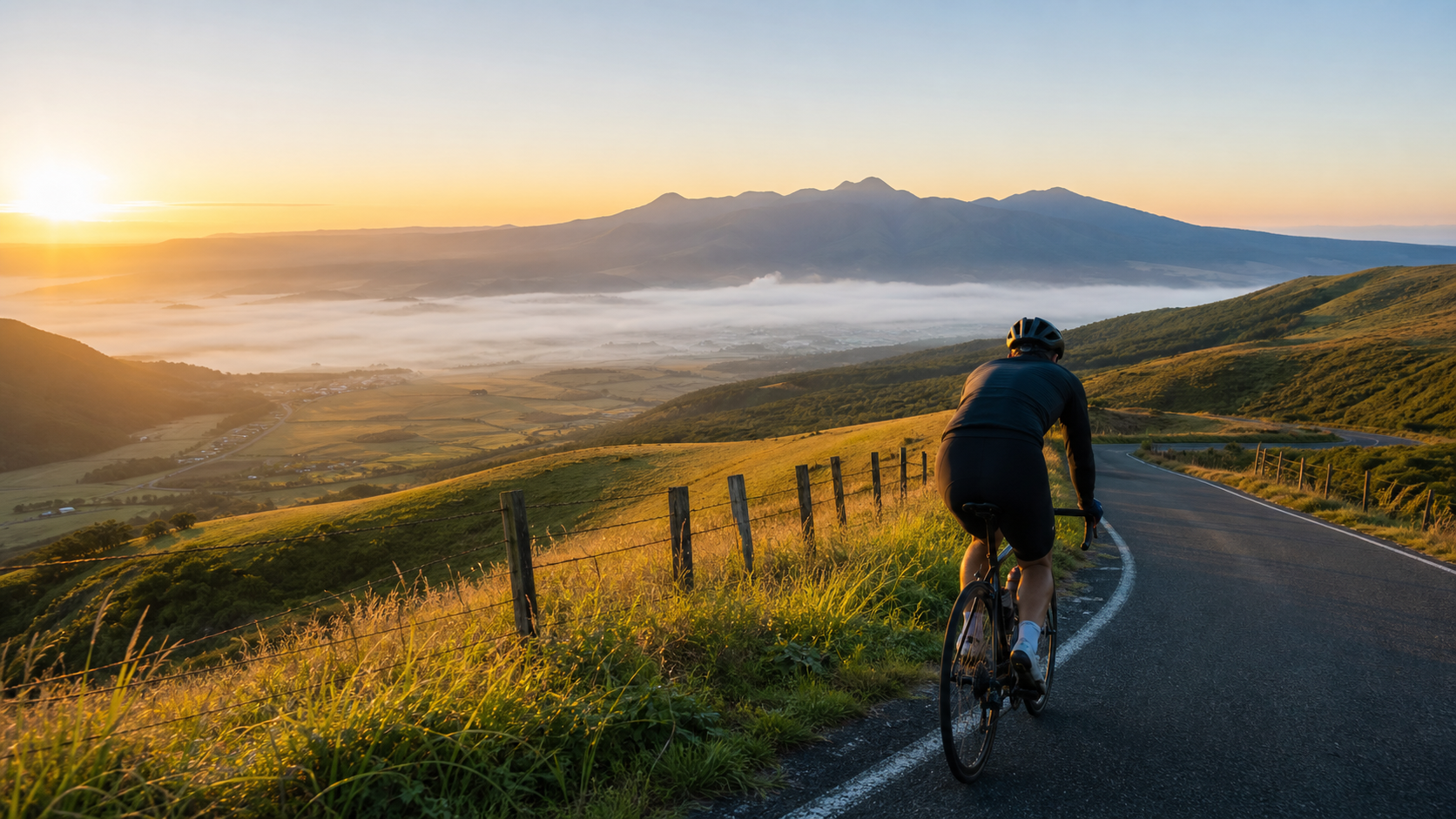
Chasing the Sunrise on the Caldera Ridge: The Spectacular Ride Along Aso Milk Road
Distance 11.6 km, elevation gain 724 m, average 6.2%. Along the ridge of Aso’s northern outer rim mountains, grasslands, pastures, the caldera, and the Aso Five Peaks resembling a reclining nirvana figure form one of Japan’s most expansive cycling canvases.
Some roads are meant to be “conquered,” but Aso Milk Road is meant to be “soaked in.”
A Road Named After Milk
“ミルクロード (Milk Road).” The first time you hear the name, you’d think it’s some kind of marketing gimmick—until you actually ride it and understand how straightforward and charming it is. This prefectural road stretches along the ridge of Aso’s northern outer rim mountains, with one pasture after another scattered on both sides. Dairy cows graze leisurely with their heads down in the grasslands, and the air genuinely carries the scent of fresh grass and milk. And so it came to be called Milk Road, stretching about 47 kilometers in total.
I took a section of it—about 11.6 kilometers with 724 meters of climbing. But in Aso, kilometers are never the point. The point is how vast a world you’ve been placed into.
The World’s Largest-Class Caldera
To understand Aso, you first need to understand one thing: the entire land you’re riding on is the interior and rim of a giant caldera.
A massive eruption tens of thousands of years ago collapsed the ground into this world-class caldera, with a diameter of over twenty kilometers. The Aso Five Peaks stand at the center, encircled by a ring of “outer rim mountains.” And Milk Road runs along the ridge of that ring.
In other words, when you ride along the ridge, one side opens onto the vast Aso Valley and the central Five Peaks within the caldera, while the other side rolls over the hills beyond the outer rim. This sense of geographic scale—“circling the edge of a giant volcano”—is something you can’t replicate anywhere else.
Climbing to the Ridge from the Gateway
I started at “Roadside Station Ozu”—locals call it “Aso’s gateway.” From the flatlands, I climbed steadily, keeping the outer rim’s ridge as my target. This section holds the main climbing, averaging 6.2%—not too brutal, but enough to warm up your body and settle your heart rate into a rhythm.
As I climbed, the view opened up bit by bit. When the forest ahead gave way to vast grasslands, when the sky’s share of the view grew larger and larger—you know the ridge is close. Veterans say, “When the view opens up, the summit is near.” In Aso, that saying becomes the gentlest of milestones.
Rolling Along the Ridge: Learning to Dance with the Terrain
Once you’re on the ridge, the route’s character changes. It’s no longer a steady climb, but a continuous series of gentle ups and downs, undulating like ocean waves.
This kind of terrain has its own way of riding. I learned to press steadily on the climbs and let go generously on the descents, using the momentum of each downhill to carry speed and recover my heart rate. If you sprint full-out at every little rise, you’ll be drained in no time. What Milk Road taught me is a wisdom of “dancing with the terrain”—saving energy so you can go farther and see longer.
Around you is endless green. The green of the grasslands and the blue of the sky contrast so sharply it feels almost unreal. Occasionally, a herd of cattle crosses your line of sight, unhurried, as if to say: what’s the rush?
Daikanbo: Gazing at the Reclining Nirvana Buddha
The most famous viewpoint on the ridge is Daikanbo.
Standing at Daikanbo, a 360-degree panorama unfolds before you: the world’s largest-class caldera, the Aso Five Peaks at the center, and the Kuju mountain range in the distance. But what takes your breath away most is the silhouette of the Aso Five Peaks—locals say it bears an uncanny resemblance to the reclining nirvana figure of Shakyamuni Buddha, a sleeping giant lying across the land. When you recognize that shape, a strange tranquility washes over you.
Many riders make a special trip up in the dark, all for the sake of welcoming the Goraikō (sunrise) at Daikanbo. When the first light crosses the sea of clouds and spills onto the caldera, the grasslands are gilded with a golden edge—a scene you’d remember for a lifetime. The ridge is bitterly cold in the early morning, but no one complains, because they know they’re standing somewhere truly extraordinary.
Wind, Fog, and the Deception of Distance
I should warn you: Aso’s beauty has a temper. With no shelter on the ridge, crosswinds and headwinds will genuinely eat away at your speed. In the early morning, seas of clouds and thick fog are common, and you need extra caution when visibility is low. The vastness of the grasslands also deceives your sense of distance, making you underestimate how much farther you have to go.
But these “temperaments” are precisely part of its charm. Milk Road isn’t a time-trial course for you to bury your head and sprint—it’s a landscape that invites you to look up, slow down, and take a deep breath.
What It Feels Like to Ride Inside a “Giant Caldera”
To truly understand Aso, you first need to reconstruct an ancient catastrophe in your mind.
Tens of thousands of years ago, a volcanic eruption of staggering scale occurred here. The ground collapsed, forming a caldera with a diameter of over twenty kilometers—one of the largest in the world. At the center, the remnants of the volcanic cluster rise as today’s “Aso Five Peaks.” Around it, a ring of “outer rim mountains” holds everything firmly in place.
And Milk Road runs along the ridge of that outer rim.
In other words, when I ride along the ridge, I’m actually circling the “edge” of a giant caldera. Looking inward on one side is the vast Aso Valley and the central Five Peaks within the caldera; looking outward on the other side are the rolling hills beyond the outer rim. This sense of scale is something no man-made landscape can replicate—you’re not just looking at scenery, you’re “inside” a geological wonder on a planetary scale. Once you understand that, the grasslands and mountains before you take on a different weight.
Why It’s Called “Milk Road”
The charming name “ミルクロード” comes from the pastures scattered along the way. The grasslands of Aso’s outer rim are natural grazing land, where dairy cows graze contentedly across the wide green fields. The dairy industry thrives here, and so this prefectural road running through it all was nicknamed “Milk Road.”
Riding on it, you’ll genuinely feel how fitting the name is. The air carries the scent of fresh grass and earth. Occasionally, a herd of cattle crosses your line of sight at a leisurely pace, and farm sheds dot the green waves in the distance. There’s no urban clamor here—only the sound of wind, the whir of your chain, and the occasional ding of cowbells. It’s a pastoral idyll that lets you fully unwind, forming a curious contrast with the tension of a “climbing challenge.”
Learning to “Dance with the Terrain”
The way you ride Milk Road is completely different from a typical climb, and that’s what makes it so fascinating.
It doesn’t climb steeply all the way to the top. Instead, once you reach the ridge, it turns into a continuous series of gentle ups and downs—undulating like waves. This kind of “rolling” terrain doesn’t test pure climbing power; it tests the “wisdom of pacing.”
I learned to press steadily on each climb and let go generously on each descent, using the momentum of the downhill to carry speed and let my heart rate recover before facing the next small rise. If you sprint full-out at every little hill, you’ll be drained in no time. Knowing how to “save energy with the terrain” is what lets you enjoy the scenery all the way through with ease. This rhythm of dancing with the terrain is a lesson Milk Road gave me—riding isn’t just about fighting; it can also be about going with the flow.
Daikanbo: Gazing at a Sleeping Giant Buddha
The most famous viewpoint on the ridge is Daikanbo.
Standing at Daikanbo, a 360-degree panorama unfolds before you: the world’s largest-class caldera, the Aso Five Peaks at the center, and the Kuju mountain range in the distance. But what takes your breath away most is the silhouette of the Aso Five Peaks—locals say it bears an uncanny resemblance to the reclining nirvana figure of Shakyamuni Buddha: a sleeping giant, peacefully lying across the land. When your eyes recognize that shape—the head, the chest, the gently raised abdomen—a strange tranquility washes over you.
This isn’t just scenery; it’s an almost religious experience. You suddenly feel how small you are, and how vast and embracing the world before you is. All your fatigue, under the gaze of this sleeping giant, becomes utterly insignificant.
Chasing the Goraikō
Many riders make a special trip up in the dark, all for the sake of welcoming the Goraikō—the sunrise—at Daikanbo.
I tried it once myself. At four or five in the morning, the ridge was bitingly cold, and the stars were still hanging in the sky. Wrapped in every layer of clothing I’d brought, I pedaled slowly up the ridge in the darkness, just to claim a good spot. When the eastern horizon began to pale and the sea of clouds churned below—then, the first beam of golden light crossed the clouds and spilled onto the caldera, instantly gilding the grasslands with a warm edge.
That image, I’ll never forget. The early-morning cold and the hardship of riding up in the dark all became worth it the moment that light appeared. Some scenery is only visible at a price, and the Goraikō is exactly that kind of scenery.
Its Beauty Has a Temper
I have to honestly warn you: Aso’s beauty is not tame.
There is no shelter on the ridgeline, and crosswinds and headwinds will genuinely eat away at your speed, sometimes making you question your life choices. In the early morning, there are often seas of clouds and thick fog, so you need to be extra careful when visibility is low. The vastness of the grasslands also deceives your sense of distance—landmarks you can clearly see turn out to be unimaginably far away when you ride toward them.
But these “temperaments” are precisely part of its charm. The Milk Road is not a time-trial course for you to bury your head and sprint for a personal best; it is a place that invites you to look up, slow down, take a deep breath, and feel the immensity of heaven and earth. It demands that you surrender to the rules of nature, and in that surrender, find a long-lost sense of freedom.
As I left the ridgeline, I kept looking back at that sleeping giant Buddha. The Aso Milk Road didn’t make me “conquer” anything—in fact, in the face of such a landscape, the word “conquer” seems almost laughable. What it did was place me inside a world so vast yet gentle, and whisper: ride slowly, look carefully. Perhaps that is what cycling is, at its very beginning and at its most beautiful.
Beyond the Numbers, a Sense of Scale
Back to the numbers: 11.6 kilometers, 724 meters of climbing, 6.2% average grade. These figures tell you how steep and how long the road is, but they say absolutely nothing about how “big” it is.
Because the awe of Aso has never been about the gradient—it’s about scale. When you ride along the ridgeline of Mount Uchinomaki, what unfolds before you is a caldera over twenty kilometers in diameter, grasslands stretching beyond the horizon, and mountain ranges stacked layer upon layer all the way to the sky. This sense of spatial vastness cannot be quantified by any number. You feel as small as an ant on the grassland, yet being in such a magnificent landscape fills you with an inexplicable sense of freedom and calm.
This is also why I always feel the Milk Road should not be ridden with a “guidebook” mentality. It is not a course for timing or competing—it is a landscape to be “soaked in.” What you should do is slow down, lift your head, take a deep breath, and let yourself fully merge into this scenery of astonishing scale. The numbers tell you how to finish the ride; Aso tells you why it’s worth riding.
The Heart of the Land of Fire
Kumamoto was historically known as the “Land of Fire,” and Aso is where that fiery heart resides.
Mount Aso is still an active volcano, with white smoke periodically rising from the crater of Mount Nakadake, reminding people of the vibrant life force of this land. This everyday coexistence with an active volcano has shaped Aso’s unique culture and landscape. The fertile volcanic ash soil nurtures rich pasture that feeds the cattle and sheep across the mountains; the volcanic activity beneath the ground gives rise to hot springs that sustain the lives of the locals.
When you ride the Milk Road, you are riding across land that is truly “alive.” The grasslands beneath your feet, the smoke in the distance, the scents in the air—all of them tell the story of a symbiotic relationship between this land and the volcano, one that is both dangerous and generous. Understanding this, the scenery before you is no longer merely “pretty”—it carries with it a sense of reverence for the power of nature.
The Aftertaste of a Bowl of Akaushi Don
After riding the Milk Road, Aso’s flavors are absolutely not to be missed.
Aso’s most famous offering is the “Aso Akaushi” (あか牛)—cattle raised grazing on the grasslands, with lean, intensely flavorful meat. A bowl of “Akaushi don” piled high with seared slices of red beef is the ultimate reward for countless riders after climbing the slopes. When you replenish the energy spent on the ridgeline with beef from that very same grassland, the perfect closed loop of “scenery, effort, and food” makes that meal extraordinarily satisfying. (Please confirm actual restaurants and their operating status on site.)
In addition, Aso’s milk, soft-serve ice cream, and dairy products are also renowned thanks to its excellent pastures—this is what truly makes the “Milk Road” live up to its name. Sitting by a lookout point, feeling the ridgeline breeze on your face, licking a rich soft-serve cone while gazing at the sleeping Nirvana Buddha in the distance—the satisfaction of that moment is simple yet utterly blissful.
For Those Who Seek Vastness
If you are tired of the city’s crowding, tired of the cold numbers on a timer, I sincerely recommend a trip to the Aso Milk Road.
It won’t push you to your limits with steep slopes, but it will expand your heart with its vastness. Here, you will relearn how to look up at the sky, slow your breathing, dance with the terrain, and surrender to nature. You will stand before Daikanbo and quietly gaze at a Nirvana Buddha that has slept for a thousand years; you will wait on the ridgeline at dawn for a beam of golden light to pierce through the sea of clouds; and after the climb, you will warm yourself with a bowl of Akaushi don from that same grassland.
Cycling, when it comes down to it, is not just about becoming faster or stronger. Sometimes, it is about carrying yourself to a world that is bigger, more beautiful, and quieter—and there, rediscovering a bit of passion for and ease with life. The Aso Milk Road is exactly such a road. It does not seek “conquest”; it simply invites you—ride slowly, look carefully, and breathe deeply.
The Complete Memory of That Day
On that morning in Aso, I had come to chase the first light of dawn.
At four in the morning, the alarm dragged me out of my warm bed. Outside, it was pitch black, with stars still densely scattered across the sky. I wrapped myself in every layer of clothing I had brought, assembled my bike in the cold, and set off toward Mount Uchinomaki. Riding in the dark is a strange experience—the world shrinks to the small circle illuminated by your headlight, leaving only your breath, your heartbeat, and the sound of the chain, along with that dazzlingly unreal starry sky above.
The climb from Genkoguchi up to the ridgeline felt especially long in the darkness at an average grade of 6.2%. I couldn’t see the scenery in the distance, so I could only focus on the road ahead and my own rhythm. Cold air filled my lungs while my legs burned from the climbing—that interplay of cold and heat kept me remarkably alert.
When I reached the ridgeline, the eastern horizon was just beginning to show a faint glimmer of light. I quickened my pedaling, hurrying toward Daikanbo to secure a good spot before sunrise. When I finally stopped my bike, the sight before me took my breath away—below, a surging sea of clouds, the entire caldera submerged in milky white mist; in the distance, a sky gradually tinting with gold and orange.
Then, that light came.
The first rays of sunlight crossed the edge of the sea of clouds, and golden light instantly spilled across the entire grassland. The sleeping Nirvana Buddha (the Aso Gogaku peaks) in the distance was gilded with a warm outline. The sea of clouds drifted slowly in the light, as if the earth itself were breathing. That scene was so beautiful it made my eyes sting with emotion. The morning cold, the hardship of riding in the dark, the hours of pedaling—all of it was worth it in the instant that light appeared.
I stayed at Daikanbo for a long time, watching the sun rise inch by inch, watching the sea of clouds slowly dissipate to reveal the full, magnificent view of the caldera. The other riders around me were also quiet; no one spoke, as if any sound would disturb that sacred moment.
A Final Note: On “Vastness”
On the way back, the sunlight was already warm and the grasslands gleamed green. As I enjoyed the rhythmic undulations of the ridgeline, I pondered the word “vastness.”
We often find ourselves trapped in very small worlds—a small office, a small screen, small worries. Over time, our hearts shrink and tighten along with them, and we easily obsess over trivial matters. Aso, with its world-class scale, forcefully stretched my heart wide open.
Standing at the edge of that caldera over twenty kilometers in diameter, gazing at grasslands that stretch beyond sight and mountain ranges stacked to the horizon, you suddenly realize that the worries you can’t let go of are actually laughably small. Heaven and earth are so vast—why fuss over life’s trifles? This feeling of having your heart “expanded” by nature is the most precious gift the Aso Milk Road has given me.
It reminds me that occasionally, we need to place ourselves in a larger world, to see true vastness, to feel our own smallness. Because only by witnessing what is truly great do you come to understand how small the everyday things you fuss over really are. And once your heart has been expanded, you return to daily life carrying a little more ease and magnanimity. This, perhaps, is why I will return, again and again, to that ridgeline where I chased the first light of dawn.
For Those Who Want to Come
- Season: Spring and summer bring the greenest grasslands and bluest skies; autumn offers swaying silver grass and the most comfortable riding temperatures; afternoon thunderstorms are common in the mountain area.
- Chasing the sunrise: Dress warmly against the early morning cold and bring proper lights.
- Pacing: Treat it as a long-distance ride—push on the climbs, ease off on the descents, and don’t exhaust yourself in the undulations.
- Side trips: Around Daikanbo there are famous shops and lookout facilities; the Aso Shrine and hot springs at the foot of the mountain are also well worth a visit (please confirm actual restaurants and their operating status on site).
As I left the ridgeline, I kept looking back at that sleeping giant Buddha. The Aso Milk Road didn’t make me “conquer” anything—what it did was place me inside a world so vast yet gentle, and whisper: ride slowly, look carefully.
Traveler Q&A: Practical Planning for This Ride
How much time should I set aside?
This section is about 11.6 km, but the essence of Aso lies in “circling the outer rim mountains.” I recommend setting aside a full day, linking Milk Road into a loop route so you can thoroughly cover Daikanbo, the grasslands, and the viewpoints along the way. If time permits, Mount Aso, Aso Shrine, and the surrounding hot springs are all worth an extra day.
How difficult is it? Who is it suitable for?
With an average grade of 6.2%, it’s moderately challenging, and since the ridgeline features rolling terrain, it’s quite friendly for beginners. The real challenge isn’t the gradient—it’s the wind on the ridgeline and the sense of vast distance. Just treat it as a long-distance ride and manage your pace accordingly.
What should I watch out for when chasing the first light of dawn?
Temperatures on the ridgeline are extremely low in the early morning, so be sure to dress warmly and bring proper lighting. Riding in the dark limits visibility, so proceed cautiously, ride slowly, and stay alert to road conditions.
Final Words
For me, the Aso Milk Road was a lesson in “vastness.” It doesn’t push you with steep slopes—it expands your heart through a world-class scale.
Standing at the edge of that caldera, over twenty kilometers in diameter, gazing at grasslands that stretch beyond sight, at the sleeping giant Buddha of a thousand years, at the first golden light piercing through the sea of clouds at dawn, you suddenly realize that the worries you can’t let go of are, in fact, laughably small. The world is so vast—why fuss over life’s trivialities?
If you’re tired of the cramped and crowded city, and long to let your heart breathe in a bigger world, then come to Aso. Come to this scenic road named after milk—ride slowly, look carefully, and breathe deeply. Let the grasslands and volcanoes of the Land of Fire stretch out a vast sky for your heart once more. This is what cycling looks like in its most original and beautiful form—something no timer can ever give you.
Related Reading
- Aso Milk Road Practical Guide: Segment Pacing and Gear Ratio Breakdown for 11.6 km with 723 m of Climbing
- 8,500 Riders in One Race: Mount Fuji Subaru Line, Asia’s Largest Climbing Pilgrimage
- Riding into Myth and Volcanic Land: A Ride Report from Ebino Kogen, a Highland Pilgrimage Through the Kirishima Mountain Range
- Riding the Line Between Heaven and Earth: The Scenery, Windmills, and Serene Moments of the Shikoku Karst Sky Road
嘉義大埔、阿婆灣挑戰賽,美到以為在日本!ft. 環騎5 Cool 西拉雅188 / 公路車 / CT Yeh
7 個月前
台北闊瀨陡坡 騎旅 / 日本單車雜誌編輯車友臨時加入!/ 髮香才是最強的 / feat. 北迴歸線小隊 / 公路車 CT Yeh
6 個月前
萬年峽谷! 30% 超激陡坡 里佳部落DAY2 還是很硬! | 公路車 | CT Yeh
3 年前
新竹羅平 x 天湖部落 大禹嶺級變態陡坡! 4K超高畫質 空拍 | 公路車
5 年前
一定要騎一次!阿里山最深處:里佳部落!單車旅行 | 2800m爬升 | 深度部落體驗:嗨翻晚會、螢火蟲、銀河 | feat. JJSC & 廢物伙伴 | 公路車 CT Yeh
9 個月前
2025 乘鞍 KOM 登山賽挑戰實錄 / 日本公路最高 ! 賽前探路篇 / 比富士山厲害,無敵絕景!/ 40週年 / 中文YT首發 / 公路車 / CT Yeh #乘鞍ヒルクライム
10 個月前
#北橫 + #北進武嶺 最硬的員工旅遊 EP1 | #公路車 #拉拉山 | 明池 | 武嶺 | 武陵農場 | 雲海 | Taiwan Cycling Route Wulin
6 年前
2025 乘鞍岳登山賽 比賽全紀錄篇 / 完整路線攻略介紹 / 日本版武嶺 公路最高點 / 高山空拍絕景 / 明年會開團! / 公路車 / CT Yeh
10 個月前