Zhongliao Erjian Mountain Guide: Complete Breakdown of Nantou's Rolling Tea Country 7.3% Hardcore Hidden Climb
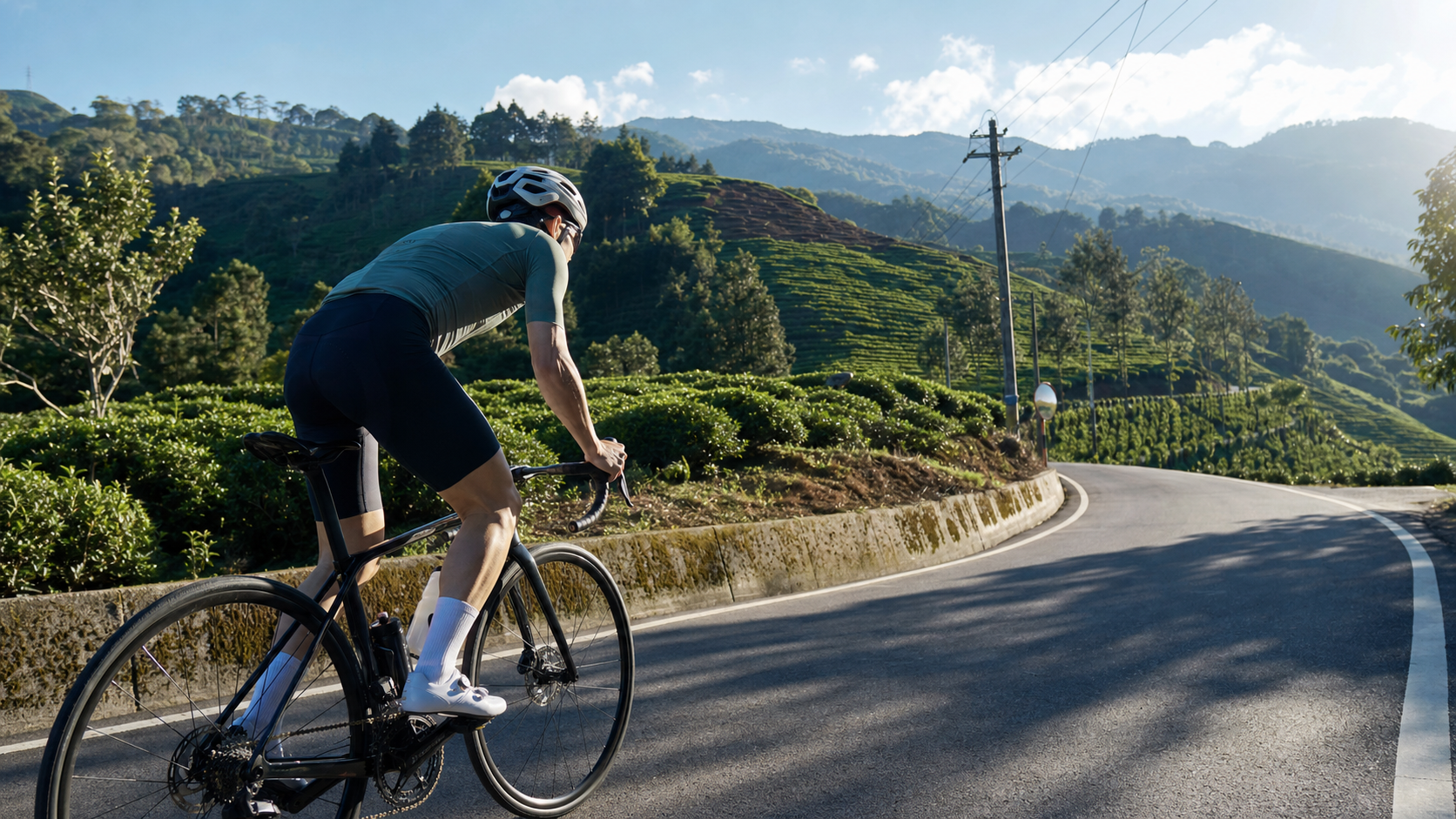
Zhongliao Erjian Mountain: The Complete Guide to Nantou’s Hidden Hardcore Climb in the Tea Hills
On Nantou’s climbing map, names like Wuling, Tou 89, and Fengguizui always dominate the spotlight, but seasoned riders who truly know how to pick routes are well aware that this industrial road leading to Erjian Mountain in Zhongliao Township, Nantou, is the hidden gem that perfectly combines “quiet” and “substance” in one. It’s not long—just 6,439.2 meters (about 6.44 km) in total—yet within that short distance it accumulates 497.6 meters of elevation gain, working out to an average gradient of 7.3%, and is classified by Strava as a proper Category 3 climb. That number may look tame on paper, but the actual riding experience is a completely different story.
This article isn’t about scenery and won’t wax poetic. We’ll break this road down to the bone with data—segment gradients, gear ratio selection, pacing strategy, nutrition planning, and DNF risk—covering every point clearly. Whether you’re a competitive rider chasing a PR or an advanced beginner tackling a mid-level climb for the first time, after reading this you’ll know exactly what pace to use against Erjian Mountain.
Route Overview and Real Data Analysis
Let’s lay out the cold, hard numbers first. The core parameters of the Erjian Mountain climb are as follows:
| Parameter | Value | Notes |
|---|---|---|
| Total Distance | 6,439.2 meters (6.44 km) | A short-to-medium climb, completable within a single high-intensity effort |
| Total Elevation Gain | 497.6 meters | Cumulative gain approaching 500 meters—a genuine hill climb |
| Average Gradient | 7.3% | Upper-mid intensity, with virtually no flat recovery sections throughout |
| Strava Category | Category 3 | Requires a certain level of climbing fitness and gear ratio setup |
| Location | Zhongliao Township, Nantou County | Near the 921 earthquake epicenter, in the tea-growing hill country |
The 7.3% average gradient is the soul of this road. Many people see “6.4 kilometers” and let their guard down, assuming it’s a warm-up-grade short climb—but note that a 7.3% average means there are almost no descents or flats to let you recover. In other words, these 6.44 kilometers demand “sustained” output; once your heart rate climbs, it’s very hard to bring it back down. Compared to those long climbs with a gentle start, steep middle, and flat platforms in between, Erjian Mountain’s “climbing from start to finish” profile actually places stricter demands on your pacing discipline.
Let’s use a simple physics conversion to understand what 7.3% means: for a rider weighing 70 kg, with bike and rider totaling about 80 kg, riding at 10 km/h on a 7.3% gradient, the power output needed just to overcome gravity already exceeds 160 watts. Add rolling resistance and drivetrain losses, and your actual pedaling power typically lands between 180 and 200 watts. If you want to push the speed up to 13 km/h, the power requirement jumps to nearly 250 watts. That’s why Erjian Mountain, despite being short, can wring you dry—it gives you no room to slack off.
Segment-by-Segment Strategy: Breaking 6.44 km into Five Sections
The key to performing well on a climb isn’t “pedal hard the whole way”—it’s dividing the route into psychologically and physiologically manageable chunks, each with its own strategy. Here’s the five-segment approach I recommend.
Segment 1 (0–1.3 km): Entry Warm-Up Zone—Resist the Urge to Sprint
The start of a climb is often a trap. With adrenaline up and fresh legs, many riders hammer out of the gate, only to blow up before 2 km. The entry section of Erjian Mountain sits at roughly 5% to 6.5% gradient—relatively “gentle” by the standards of the whole route. The correct approach here is to deliberately hold back, keeping your power at 80% to 85% of your FTP (Functional Threshold Power), giving your body time to transition smoothly from the anaerobic start into an aerobic climbing rhythm. Keep your cadence at 75 to 85 rpm, staying seated for the most part, with your hips pushed back and upper body relaxed—let the large muscle groups do the work rather than your calves.
Segment 2 (1.3–2.8 km): Gradient Ramp-Up Zone—Enter Race Pace
Past the warm-up section, the gradient gradually stacks up, with continuous stretches of 7% to 8.5%. This is the critical zone that determines your overall time. The goal is to hold power steady at 88% to 92% of FTP—the so-called “Sweet Spot” training range, an intensity that sustains long-duration output while still driving you forward effectively. Your cadence may naturally drop to around 70 rpm here; that’s normal. Don’t force yourself to maintain a high cadence by shifting into your easiest gear and spinning—that’s actually less efficient. Stay seated, and only briefly stand to shift the load on your muscle groups when the gradient momentarily spikes past 9%.
Segment 3 (2.8–4.2 km): Tea-Garden Buffer Zone—Seize the Recovery Window
The middle section of Erjian Mountain passes through an area where tea gardens and industrial roads interweave. The terrain here has slight undulations, with occasional “relatively flat” stretches where the gradient drops below 5%. This is the only opportunity on the entire route to actively lower your heart rate—don’t waste it. When you feel the gradient ease, resist the urge to accelerate and “burn through” it. Instead, deliberately shift down one or two gears, raise your cadence to 90 rpm, and give your legs a chance to flush out lactate. This kind of rhythm management—“save on the steep, recover on the flat”—is the biggest difference between climbing veterans and newcomers.
Segment 4 (4.2–5.5 km): The Devil’s Steep Zone—Where Gear Ratios Prove Their Worth
If Erjian Mountain has a “boss section,” this is it. After the tea-garden buffer zone, the gradient climbs again, with short, steep pitches approaching or exceeding 10%. This is where the energy you saved earlier becomes your capital. In this section, don’t hesitate—shift into your easiest gear, and keep your cadence from dropping below 60 rpm to avoid putting excessive strain on your knees or hitting sudden exhaustion from muscling through. Your heart rate may now be approaching your maximum—that’s normal. The priority is “keep moving forward,” not “accelerate.” Deliberately deepen your breathing rhythm, lengthen your exhales, and brace your core.
Segment 5 (5.5–6.44 km): Final Sprint Zone—Pour Out Everything You Have Left
In the final kilometer, when the viewing vista of Erjian Mountain gradually opens up before you, you know the finish isn’t far. If you’ve managed your energy well, this is the moment to dump all your reserves. Feel free to stand and sprint, pushing power above 100% of FTP, and will yourself through the final ascent. But a word of caution: if you’ve already blown up from poor pacing earlier, don’t push yourself to stand and sprint here—otherwise you risk your legs giving out and stalling within the last 200 meters before the finish.
Gearing and Equipment: A Light Gear Ratio Is Your Lifesaver
Facing an average gradient of 7.3% and steep sections that may exceed 10%, your gear ratio configuration directly determines whether you ride comfortably or painfully. Here are recommended setups for riders of different levels:
| Rider Level | Front Chainring (Crankset) | Rear Cassette | Notes |
|---|---|---|---|
| Advanced Beginner | 50/34 (Compact) | 11-34T | The 34T large cog provides maximum climbing forgiveness; highly recommended |
| Intermediate Rider | 50/34 | 11-32T | Balanced for both climbing and flat-road cruising |
| Competitive Rider | 52/36 (Semi-compact) | 11-30T or 11-32T | Requires high pedaling power, otherwise you risk stalling on steep sections |
For the vast majority of amateur riders, I strongly recommend having at least a 34T largest cog on your rear cassette. The reason is simple: in the lightest 34/34 gear ratio, for every full crank revolution, your rear wheel advances only about 2.1 meters. This allows you to maintain a cadence above 60 rpm even on gradients exceeding 10%, distributing your effort across many pedal strokes rather than muscling through with sheer leg force. Many riders blow up on climbs not because of insufficient fitness, but because their gearing is too heavy, forcing them into low-cadence, high-torque grinding that prematurely exhausts both knees and cardiovascular system.
Regarding equipment, this is a secluded industrial-road route where pavement quality is less consistent than provincial highways. You may encounter gravel, fallen leaves, moss, and potholes. Tires of 25C or wider—even 28C—are recommended, along with slightly reduced tire pressure (5 to 10 psi less than on flat roads) to increase grip and comfort, preventing slips on damp, shaded tea-garden sections. Additionally, since Zhongliao is a sparsely populated hidden gem, be sure to carry a complete tire repair kit, spare tube, and pump—there are no convenience stores here to bail you out.
Nutrition and Hydration: Don’t Underestimate a Short Climb
A 6.44 km climb might seem like one bottle of water is enough, but if you treat it as a serious high-intensity workout, nutrition planning still matters. In summer heat, sweat loss during the Erjian Mountain ascent can exceed 1 liter per hour. It’s recommended to consume about 500 ml of electrolyte sports drink 30 minutes before starting the climb, and carry at least one large bottle of water (750 ml or more) on the bike.
Since the route isn’t long, solid food isn’t necessary mid-ride, but consuming adequate carbohydrates (such as bananas, rice balls, or energy bars) 1 to 2 hours before departure is advised to ensure sufficient glycogen stores. Zhongliao Township is famous for locally grown citrus, longan, and bananas—if you visit during harvest season, farmers often set up stalls at the foot of the mountain selling seasonal fruit, making it ideal for topping up natural sugars. After reaching the Erjian Mountain viewpoint, remember to rehydrate and let your heart rate settle before descending.
Weather and Seasons: When to Go for Maximum Comfort
Zhongliao in Nantou has a central-hill climate, rideable year-round, but with distinct seasonal differences:
- Spring (March–May): Pleasant temperatures and lush green tea gardens make this the most recommended riding season. However, watch for occasional afternoon thunderstorms.
- Summer (June–August): Temperatures can exceed 33°C before noon; strongly recommend starting at dawn to avoid the midday sun. Parts of the Erjian Mountain route are shaded by trees, but sun protection and hydration are still essential.
- Autumn (September–November): Stable weather, lower humidity, and excellent visibility offer panoramic views of layered mountain ridges—the golden season for photos and chasing personal records.
- Winter (December–February): Cooler but with little rain, suitable for riders who dislike heat. Just be mindful of temperature swings between day and night, and dress warmly for the descent.
Special reminder: be extra cautious on wet roads after rain. Industrial roads are prone to moss and slippery fallen leaves after rainfall, especially on shaded tea-garden sections where grip drops significantly. Ride conservatively on both climbs and descents.
Common Mistakes and DNF Risks
Even on a short climb, people can “blow up” on Erjian Mountain. Here are the most common errors:
Mistake 1: Starting too fast. Pushing too hard on the first 1.3 km warm-up section causes early lactate buildup, leading to complete exhaustion on the fourth steep section. This is the most typical way amateur riders fail.
Mistake 2: Gearing too heavy. Having a 34T but refusing to use it, stubbornly sticking to mid-range gears to save face, results in cadence dropping to 40 rpm on steep sections, blowing up both knees and cardiovascular system.
Mistake 3: Underestimating hydration. Thinking “it’s only 6 km” and not bringing enough water leads to dehydration and cramping halfway up in summer heat.
Mistake 4: Not knowing the route. This hidden route has limited information; going in blind without preparation leaves you caught off guard by the 10%+ steep sections, causing a mental breakdown.
DNF (Did Not Finish) on this road is usually not due to absolute lack of fitness, but rather “pacing errors” combined with “insufficient mental preparation.” As long as you follow the five-stage pacing strategy described earlier and save your strength for the fourth steep section, the vast majority of riders at advanced level and above can summit successfully.
Reference Target Times for Different Rider Levels
Below are reference times for completing the 6.44 km Erjian Mountain climb by rider level, to help you set goals:
| Rider Level | Average Power-to-Weight Ratio (W/kg) | Estimated Finish Time | Average Speed |
|---|---|---|---|
| Advanced Beginner | 2.0 – 2.5 | Approximately 40–50 minutes | 8–10 km/h |
| Intermediate Rider | 2.5 – 3.2 | Approximately 30–38 minutes | 10–13 km/h |
| Experienced Rider | 3.2 – 4.0 | Approximately 24–29 minutes | 13–16 km/h |
| Competitive Elite | 4.0+ | Under 24 minutes | 16+ km/h |
These figures are for reference only; actual results will be affected by temperature, wind direction, road conditions, and physical state on the day. For your first attempt, don’t chase time—focus on “completing the five-stage pacing strategy in full” so your body can learn the rhythm of this road. Save the time trials for your second or third attempt.
Pre-Ride Checklist
Before departing, verify each item below to minimize risk:
- ☐ Bike check: Brake pads have sufficient thickness, shifting is smooth, chain is lubricated, tire pressure is correct, and quick-release skewers or thru-axles are tightened.
- ☐ Gear configuration: Confirm the largest cog on your rear cassette is 32T or 34T—it’s your lifeline on steep sections.
- ☐ Tire repair kit: Spare tube, tire levers, CO2 or pump, and patches—there’s no rescue in this remote area.
- ☐ Hydration: At least one large bottle of water plus electrolytes; add another bottle in summer.
- ☐ Sun protection and warmth: Sunscreen, arm sleeves, and a windbreaker for the descent.
- ☐ Navigation: Download a GPX track or offline map in advance; signal is poor in parts of Zhongliao.
- ☐ Emergency contact: Inform family or friends of your itinerary, ensure your phone is fully charged, and bring a power bank.
- ☐ Physical condition: Well-rested, eating normally, and free from colds or excessive fatigue.
Pedaling Technique Details: The Science of Seated vs. Standing
We’ve covered pacing and gear ratios; now let’s delve deeper into the “how” of pedaling, because at the same power output, differences in pedaling efficiency can save you several minutes on Erjian Mountain.
Seated climbing is the king of efficiency. On the 7% to 9% gradients most common on Erjian Mountain, seated pedaling lets you keep your weight steadily on the saddle, engaging the glutes, quadriceps, and hamstrings—these large muscle groups—for sustained output. Energy metabolism is primarily aerobic, which helps avoid rapid lactate accumulation. There are three key details when seated: First, sit slightly toward the rear of the saddle to optimize the force application angle of your quadriceps. Second, keep your upper body relaxed with elbows slightly bent; don’t death-grip the handlebars and waste energy in your upper body. Third, maintain moderate tension in your core (abdominals and lower back) to serve as a stable fulcrum for your lower-body pedaling.
Standing (out-of-saddle) pedaling is a tactical weapon, not the norm. Standing engages more muscle groups instantly and generates greater torque, making it suitable for three situations: first, when the gradient suddenly exceeds 10% and you need an instant burst; second, when your seated muscles are fatigued and you need to shift the load to a different muscle group for a “relay rest”; third, when you want to unleash everything for a final sprint. However, standing pedaling consumes significantly more oxygen than seated, and your heart rate will spike rapidly. If you stand for the entire climb, you’ll completely blow up midway. My advice: keep total standing time on Erjian Mountain under 15% of your total time, and use the seated position to stabilize your rhythm the rest of the way.
Another often-overlooked detail is “circular pedaling.” Many riders only push down hard (the push before bottom dead center), neglecting the other quadrants of the pedal stroke. The ideal pedaling motion should be like “scraping mud off the bottom of your shoe”—pulling back at bottom dead center, then smoothly lifting up, making the power delivery smoother and more continuous. This technique is especially important on steep climbs at low cadence, effectively reducing the power gaps caused by “dead spots” in the pedal stroke.
Managing Both Heart Rate and Power Meters
If you wear a heart rate strap and a power meter, Erjian Mountain is an excellent testing ground for your “pacing discipline.” Here are specific operational recommendations for managing both:
Use the power meter as your primary gauge. During climbs, power readings are more immediate than heart rate and better reflect your actual current output. After setting your FTP, display the power field as “3-second average power” (to avoid erratic jumps interfering with your judgment), and control your power within the corresponding FTP percentage ranges according to the five-stage strategy mentioned earlier.
Use heart rate as a secondary “safety valve.” Heart rate responds slower than power, but it’s the true signal of your body’s fatigue. If you notice that at the same power output, your heart rate keeps “drifting” upward (cardiac drift), it means you’re accumulating fatigue or dehydration, and you should moderately lower your target power, or you’ll inevitably blow up in the second half. Generally, during the Erjian Mountain climb, intermediate and advanced riders should have their heart rate between 85% and 92% of max heart rate, with brief touches above 95% only allowed in the final sprint.
If you don’t have a power meter, use the “talk test”—an old but reliable method: at the correct sweet-spot intensity, you should only be able to speak short phrases intermittently, unable to hold a full conversation, but not completely unable to make a sound. Once you can’t even utter a single word, it means the intensity is too high and you must slow down.
Descent Safety: Don’t Let Your Climbing Efforts Go to Waste on the Way Down
Although this is a climbing guide, the descent shouldn’t be taken lightly, especially since Erjian Mountain is an industrial road with varied conditions. The risk of death on descents is actually higher than on climbs. Here are several principles you must follow:
First, prioritize speed control. Industrial roads have many curves and blind spots, with potential oncoming traffic, farm vehicles, and even residents out for a walk or dogs. Be sure to keep your speed at a level where you can “stop at any time within your visible range.” Never treat the descent as a playground for setting speed records.
Second, brake with “intermittent taps” rather than “constant pulling.” On long descents, if you constantly hold the brakes, the rims or discs will overheat—the former can cause inner tube blowouts, and the latter will cause brake fade. The correct approach is to intermittently tap the brakes, giving the braking system room to cool.
Third, cornering center of gravity and vision. When cornering, the outside pedal should be at bottom dead center, the inside knee pointed toward the apex, and your vision should look toward the corner exit, not the road right in front of you. On wet or leaf-covered corners, slow down in advance and avoid braking mid-corner.
Fourth, stay warm. After nearly 500 meters of climbing, the temperature at the top can be several degrees lower than at the base, and the relative wind speed on the descent intensifies the feeling of cold. Be sure to put on a windbreaker at the summit before descending to avoid hypothermia impairing your bike handling.
Training Advice: How to Prepare for Erjian Mountain
If your current fitness level can’t easily handle Erjian Mountain, don’t rush into it. Here’s a progressive training direction:
Build an aerobic base. Schedule 1 to 2 longer rides per week at moderate-to-low intensity for 60 to 90 minutes to solidify your cardiovascular foundation—this is the bedrock of all climbing ability.
Sweet-spot interval training. This is the most efficient workout for improving climbing endurance: on a trainer or a gentle slope, ride at 88% to 94% of FTP for 8 to 12 minutes, rest for 3 to 5 minutes, and repeat for 3 to 4 sets. This intensity corresponds precisely to the output needed for the second section of Erjian Mountain; over time, you’ll find the climb feels “less breathless.”
Climbing-specific simulation. Find a slope with a gradient similar to Erjian Mountain (around 7%) and climb it 3 to 4 times, simulating the sustained climbing sensation of the real thing while familiarizing yourself with how your pedaling rhythm changes at different fatigue levels.
Weight management. Climbing is a battle against gravity, and power-to-weight ratio (W/kg) is the core metric determining climbing speed. Without sacrificing strength, moderately managing your weight allows you to climb faster at the same power. This is why professional climbers are all lean.
Quick Q&A on Common Questions
Q: Is Erjian Mountain suitable for a road bike or a mountain bike?
A: A road bike is perfectly fine—this is a paved industrial road, not a trail. The key is to have a light enough gear ratio (rear cassette 32T or larger); tire size of 25C to 28C is recommended. A gravel bike is also well-suited, offering a balance of handling varied road conditions and comfort.
Q: For a beginner tackling their first intermediate climb, is Erjian Mountain too hard?
A: For a complete beginner, the 7.3% average gradient is indeed challenging, but since the distance is only 6.44 kilometers, as long as the gearing is correct, pacing is conservative, and you’re not chasing a time, most advanced beginners with some foundation can complete it at a slower pace. It’s recommended to first gain experience on gentler slopes before taking on Erjian Mountain.
Q: How many times can you climb it in a day?
A: Because the distance is short and the descent is fast, fitter riders can treat Erjian Mountain as a “repeat training ground,” climbing it 2 to 3 times a day for climbing intervals. This is one of its major advantages as a training route—unlike Wuling, where you can only go up once a day.
Q: Do you need a mountain entry permit?
A: Erjian Mountain is on a general rural road and industrial road, not a restricted mountain area, so no entry permit is needed. However, it’s still recommended to respect local farmers and residents—slow down when passing tea gardens and farmland, don’t litter, and don’t disturb agricultural work.
Treat Every Climb as Data Accumulation
Finally, a piece of advice for serious riders: record your data from every Erjian Mountain ride. Segment times, average power, heart rate curves, and the day’s temperature and wind direction—archive it all. Once you’ve accumulated data from three to five rides, you’ll start to see your progress trajectory—the same finish time with a lower heart rate, or the same heart rate with higher power. These numbers don’t lie; they are the most honest testament to your training effectiveness. Erjian Mountain, a short but intense route, is the perfect vehicle for this “quantified self” training philosophy. It’s short enough for you to repeat and control variables; it’s steep enough to make every data point meaningful. This is why I recommend this hidden climbing gem in the Nantou hills to every rider who wants to seriously get stronger.
Conclusion: Treat the Hidden Gem as a Climbing Lesson
Zhongliao’s Erjian Mountain isn’t the kind of route that tops popular check-in lists, but precisely because of that, it retains a rare tranquility and challenge. A 7.3% average gradient, nearly 500 meters of elevation gain, and sections that may exceed 10%—these numbers form a solid climbing lesson. It teaches you not just fitness, but the wisdom of pacing—when to conserve and when to spend. Once you’ve mastered the five-stage rhythm of Erjian Mountain, you’ll find a new sense of composure when tackling longer, steeper mountains. That is the most precious value of this hidden route.
Related Reading
- Riding into Zhongliao Erjian Mountain: A Tea Village Reborn at the Epicenter of the 921 Earthquake, Searching for Taiwan’s Quietest Climb
- Maokong Zhinan Temple Practical Guide: 6.93 km, 388 m Elevation Gain, 5.6% Average Grade — A Complete Breakdown of Taipei’s Classic Intermediate Climb
- Dongshan Coffee Road Practical Guide: 16.41 km, 3.9% Average Grade — The Top Choice for Endurance Training
- Jinguashi Teapot Mountain Practical Guide: 3.15 km, 7.1% Average Grade — A Complete Breakdown of the Mining-Area Mountain Road
台北闊瀨陡坡 騎旅 / 日本單車雜誌編輯車友臨時加入!/ 髮香才是最強的 / feat. 北迴歸線小隊 / 公路車 CT Yeh
6 個月前
那瑪夏x茶山 阿里山系深山單車行 Day2 累積爬升6000M | 🥶超陡連續下坡 整路看隊友刷 | 爬升一座西進武嶺 | JJSC | 公路車 | CT Yeh
3 年前
一定要騎一次!阿里山最深處:里佳部落!單車旅行 | 2800m爬升 | 深度部落體驗:嗨翻晚會、螢火蟲、銀河 | feat. JJSC & 廢物伙伴 | 公路車 CT Yeh
9 個月前
大武山後門26%歡樂陡坡!JJSC南台灣單車行Day2 / 被颱風追著跑 / 公路車 / CT Yeh
2 年前
藤枝二集團 單車行 Day1 | 南部小武嶺 | 爬坡爬到罵罵叫 | JJSC | 公路車 | CT Yeh
3 年前
嘉義單車路線推薦:碧湖山茶園超陡坡挑戰!里佳部落-奮起湖-瑞峰 (附路線)
7 個月前
萬年峽谷! 30% 超激陡坡 里佳部落DAY2 還是很硬! | 公路車 | CT Yeh
3 年前
無耳茶壺山 半屏山 空拍震撼絕景 驚險O型縱走
8 年前