Coffee, Hot Springs, and the Memory of an Earthquake: A Deep Slow Journey Riding Guoxing's Demon King Slope
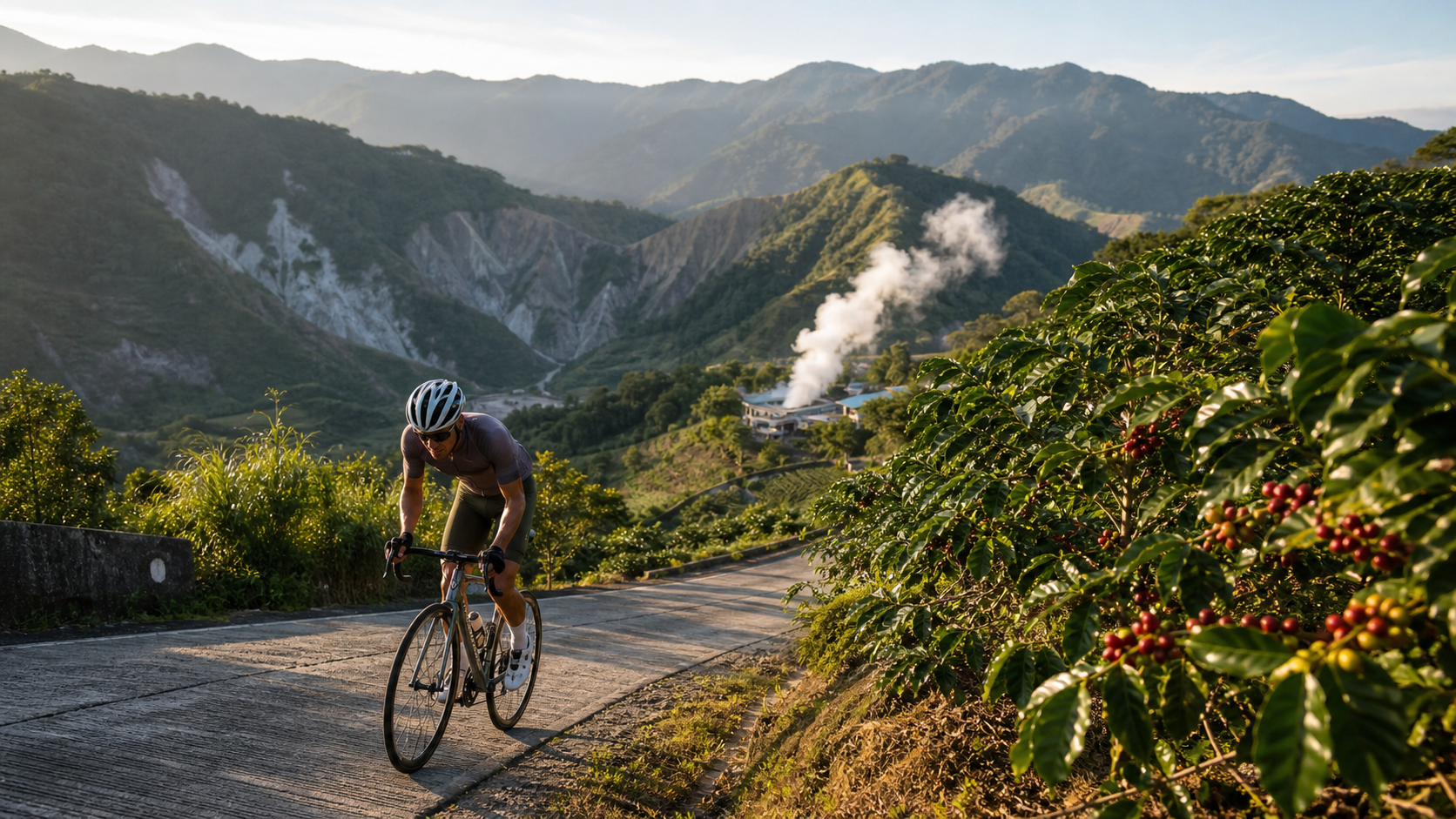
Coffee, Hot Springs, and the Memory of an Earthquake: A Deep Slow Ride Up Guoxing’s Demon Slope
People ask me why a brutally steep climb nicknamed the “Demon Slope” by fellow cyclists is worth riding all the way from another county. My answer: because Guoxing Township in Nantou, where it sits, is far more than just an 8.1% gradient.
This is an important homeland of Taiwanese coffee, the home of the “Beauty Spring” weak alkaline hot spring, and the place where the 921 Earthquake that changed Taiwan left its most profound landscape memories. When you ride your bike into the mountains of Guoxing, every pedal stroke you make is actually crossing a story about the land, about rebirth, and about how a good cup of coffee grew out of the scars. This article isn’t about power or gear ratios—I want to introduce you to the land beneath the nickname “Demon Slope,” a captivating place filled with the aroma of coffee, the breath of hot springs, and deep history.
The Homeland of Taiwanese Coffee
If you think Taiwan doesn’t produce coffee, then you’ve never been to Guoxing.
Guoxing Township in Nantou is one of the most important coffee-producing regions in Taiwan. Its latitude, elevation, sunlight, and well-drained hillside terrain nurture high-quality Arabica coffee beans. The name “Guoxing Coffee” is a well-known title in Taiwan’s specialty coffee circles. Heading into the mountains of Guoxing, you’ll find coffee plantations spreading across the slopes one after another, with bright red coffee cherries hanging from the branches, waiting to be harvested.
For cyclists, this is a very special experience. When you struggle up the Demon Slope, gasping and sweating, waiting for you at the bottom might be a cup of hand-brewed coffee made from locally grown beans, bursting with aroma. That sense of satisfaction from “earning a good cup of coffee with your sweat” is a reward unique to this road.
Guoxing’s coffee culture isn’t just about growing beans—it’s about drinking. The area is dotted with numerous coffee estates, many run by local coffee farmers who handle everything from planting, harvesting, roasting, to hand-brewing themselves. Sitting in an estate, gazing out at the mountains you just rode over, sipping a cup of coffee brewed by the estate owner’s own hands, and listening to them share the stories behind the plantation—that’s the most heartwarming part of cycling through Guoxing.
Many who ride the Demon Slope come not just to conquer that 8.1% gradient, but for that cup of thoughtfully hand-brewed coffee waiting at the bottom. Sweat and coffee aroma form the most captivating duet of a Guoxing cycling journey.
Landscape Memories Left by an Earthquake
To understand the land of Guoxing, you can’t avoid mentioning the 921 Earthquake of 1999.
At the border between Guoxing Township and neighboring Zhongliao Township stands a mountain called “Jiufen Ershan.” At about 1,173 meters above sea level, it’s one of Taiwan’s “Small Hundred Peaks,” but it became known to the world because of that earthquake. On September 21, 1999, this was one of the hardest-hit areas. The powerful quake triggered massive landslides, sending entire mountainsides sliding down, burying settlements below and forming a barrier lake at the collapse site.
Today, Jiufen Ershan has become an earthquake memorial site. When you stand there, looking at the enormous scar torn into the mountain by the quake, gazing at the barrier lake formed by the landslide, you’ll be deeply shaken by nature’s destructive power—and you’ll gain a deeper respect for the resilience and rebuilding of the people on this land.
This history gives cycling through Guoxing a different kind of weight. The mountains you ride through once collapsed in a matter of seconds; yet today, the slopes are replanted with coffee and fruit trees, smoke rises again from the settlements, and cups of hand-brewed coffee release their aroma atop the scars. This vitality of “from collapse to rebirth” is the most moving undertone of Guoxing’s land. When you’re suffering through the climb on the Demon Slope, take a moment to think about everything this land has endured—you’ll find that the hardship of this climb is actually trivial.
Beauty Spring: The Healing of Beigang River Hot Springs
After riding the grueling Demon Slope, your whole body aches—what could be more healing than soaking in a good hot spring?
The Guoxing area is home to the famous Beigang River Hot Spring District. The spring water here is a weakly alkaline sodium bicarbonate spring—clear, with a silky touch. Because it’s said to be especially good for the skin, it’s also called the “Beauty Spring.” Imagine: in the morning, you conquer the Demon Slope with all your might; at noon, you enjoy a hand-brewed coffee at a coffee estate; and in the evening, you soak in a warm Beauty Spring by the Beigang River, letting your tense, exhausted muscles fully relax in the hot water—a “climb, coffee, hot spring” trifecta like this is the ultimate enjoyment of a slow cycling trip in Nantou.
For cyclists, hot springs aren’t just a luxury—they’re genuine recovery. The warm water promotes blood circulation, helping flush out metabolic waste accumulated in muscles after climbing, easing soreness, and letting you ride in better shape the next day. This rhythm of “push to the limit, then heal to the limit” is precisely what makes deep cycling travel so captivating.
Hui-Sun Forest: A Hidden Gem of Coffee and Forest
If your itinerary has room to spare, I highly recommend adding “Hui-Sun Forest” to your Guoxing trip.
Hui-Sun Forest is an experimental forest of National Chung Hsing University, vast in scope and rich in forest types—a hidden mountain gem entered from Guoxing Township. Its most famous feature is its large-scale coffee plantation. In fact, Hui-Sun Forest has deep historical ties with Taiwanese coffee and is one of the important bases for coffee cultivation and research in Taiwan.
Inside Hui-Sun Forest, there’s the renowned “Coffee Academy,” where visitors can taste coffee hand-brewed from beans grown right in the forest. That “straight from the source” freshness and purity is something you can’t get in a city café. If time allows on your ride to Guoxing, a trip to Hui-Sun Forest—brewing a cup of coffee among towering trees and coffee aroma—will be one of the most healing moments of the entire journey. The trails here are gentle and the air is fresh, making it perfect for a completely relaxed stroll, deep breathing, and a conversation with nature after tackling the hardcore Demon Slope.
First Person: That Morning Facing the Demon
Let me take you, in first person, back through that morning when I faced the “Demon.”
Before the sky was fully light, I finished my final checks at the foot of the mountains in Guoxing. The air carried a faint, damp freshness typical of a mountain morning, and the distant coffee plantations were still shrouded in thin mist. I took a deep breath, confirmed my rear derailleur was on the easiest 34T, and swung onto the bike.
The early part of the climb wasn’t too brutal. I deliberately held back my pace, reminding myself, “Don’t rush, don’t rush.” The chain turned rhythmically, and my breathing gradually synced with my pedaling. On both sides were coffee plantations and fruit trees, morning mist drifting through the branches and leaves. The whole world was so quiet that all I could hear was my breathing and heartbeat.
Then, the Demon appeared. The gradient shot up suddenly, and I could clearly feel the pedals grow heavy and my speed plummet. I shifted to the easiest gear, but my cadence kept dropping anyway. Sweat began dripping relentlessly onto the top tube, the muscles in my thighs burned hot, and my breathing turned rapid and heavy. In that moment, I understood the weight of the nickname “Demon Slope” through the pain in every part of my body.
I stared at the road just a few meters ahead, afraid to look too far, worried that the endless steepness would shatter my will. One turn, then another, I ground the pedals through with sheer determination. I thought about the earthquake and rebuilding this land had endured, about the hand-brewed coffee waiting for me at the bottom, and little by little, I ground myself up to the top.
When the gradient finally eased, I stopped, collapsed over the handlebars, and gasped for air. Looking back, I saw the layered mountains of Guoxing, coffee plantations glowing green in the morning light. The sense of achievement at that moment was as intense as a freshly brewed cup of the darkest roast coffee. Bitterness ends, and then sweetness comes.
The Meaning of the Route: Between Bitter and Sweet
What makes coffee captivating is its layering of bitterness first, sweetness after; what makes riding the Demon Slope captivating is exactly the same.
The climb is bitter—gasping for breath, thighs burning, willpower wavering. But when you push through the steepest Demon section and reach the summit, the sweetness and satisfaction that follow are something those flat, easy routes can never give you. This experience of “bitter first, sweet after” resonates remarkably with the coffee culture of this land and its history of rebirth from the earthquake.
What the Guoxing Demon Slope teaches us, perhaps, is this: truly profound satisfaction often requires paying enough hardship first to earn it. Whether it’s a good cup of coffee, a hardcore climb, or a piece of land rebuilt from ruins, it’s all the same. Once you understand this layer, you’re no longer just riding a steep slope—you’re riding a life experience about “sweetness after bitterness.”
Suggested Side Trips: Turning a Guoxing Trip into an In-Depth Slow Journey
If you decide to make a special trip to Guoxing to ride Demon King Slope, I strongly suggest you don’t try to do it in a single day. Instead, plan a two-day, one-night in-depth slow journey to fully experience the beauty of this land.
First Day Morning: Conquer Demon King Slope. Take advantage of the cool morning air and give it your all against this “demon king.” Remember to equip a low gear ratio, pace yourself, and savor the moment of reaching the summit after all the hardship.
First Day Noon: Hand-Brewed Coffee at a Coffee Estate. After descending from the ride, find a local coffee estate and reward yourself with a cup of Guoxing coffee. Listen to the estate owner share stories about the coffee, and feel the coffee culture of this land.
First Day Afternoon: Explore Jiufen Ershan. Take some time to visit the Jiufen Ershan Earthquake Memorial Site, and see with your own eyes the massive scar on the mountain and the barrier lake left by nature. This will add a deeper understanding of the land to your journey.
First Day Evening: Soak in Beigang River Hot Springs. Head to the Beigang River hot spring area and soak in a pool of the weakly alkaline “Beauty Water,” letting your muscles, tense from the climb, fully relax and speed up recovery.
Second Day: A Leisurely Stroll Through Hui-Sun Forest Area. The next day, at a completely relaxed pace, take a walk through Hui-Sun Forest Area. Stroll among towering trees and vast coffee plantations, and hand-brew a cup of coffee straight from the source at the Coffee Academy, bringing this in-depth slow journey to a perfect close.
Seasonal Scenery
Guoxing in different seasons offers you different riding experiences. Here are a few “limited edition” scenes worth paying attention to.
The Vivid Red of the Coffee Harvest Season. Every time the coffee cherries ripen, the coffee plantations in the Guoxing mountains are covered with bright red coffee cherries (commonly known as coffee cherries), dotting the hillsides with a lively sea of red. This is the most iconic seasonal scene when cycling in Guoxing.
The Verdant Green of Spring Forests. In spring, the mountain forests of Guoxing are at their most lush, and the climate is also the most pleasant, making it the golden season for riding and side trips. Just be mindful of the occasional afternoon thunderstorms.
The Clarity of Crisp Autumn Air. In autumn, humidity drops and the air becomes clearer, offering the most distinct views of the Guoxing mountains in the distance. It’s also an ideal time to challenge Demon King Slope and pursue peak performance.
The Healing of Winter Hot Springs. As temperatures cool in winter, it becomes the most comfortable season for soaking in the Beigang River Beauty Water. After conquering Demon King Slope, soaking in a warm hot spring amidst the chill brings a healing feeling that is especially strong in winter.
The People and Encounters on the Road
Having cycled in Guoxing so many times, what I remember most vividly is often not the moment of reaching the summit, but the unexpected people and encounters along the way.
Once, I stopped to rest at a coffee estate at the foot of the mountain. The owner was a middle-aged man with sun-darkened skin and a hearty laugh. Seeing my disheveled cycling jersey, he didn’t hesitate to first bring me a glass of ice water, and only then slowly began to hand-brew a cup of coffee for me. While brewing, he talked about the story of this coffee plantation—after the earthquake, this place was in ruins, and it was he and his family who, one by one, replanted the coffee trees. He spoke in a calm, matter-of-fact tone, as if telling a perfectly ordinary story, but that resilience of living in symbiosis with the land and never giving up left a deep impression on me that I couldn’t shake for a long time. In that cup of coffee, I tasted the saltiness of sweat, the bitterness of coffee, and the sweetness of an entire land reborn.
Another time, I met an elderly woman working in a coffee plantation while climbing. I stopped to ask for directions. Not only did she kindly point the way, but she also pulled a few ripe coffee cherries from her bag and offered them to me to try, smiling and saying, “These are raw, you can eat them, they’re sweet.” At that moment, I suddenly felt that the most precious thing about cycling has never been the numbers on the bike computer, but these real and warm connections with the land and with people. In a rural area like Guoxing, the warmth of human kindness is as rich as a cup of dark-roasted coffee—bitter at first, then sweet, with a long, lingering aftertaste.
A large part of cycling’s charm lies precisely in this. You move at a speed closest to the land, slow enough to see the details of the coffee plantations, slow enough to meet, converse with, and be touched by the kindness of people on the road. This is something you can never experience while speeding by in a car. A route like Guoxing’s Demon King Slope, embedded in such a profound landscape, is precisely the place that best connects people with the land and with human warmth.
Why “Demon King Slope” Is Worth Returning To Again and Again
Many people who have conquered Demon King Slope once want to come back. This sounds a bit contradictory—if it’s so painful, why return again and again?
I think the answer lies in the layered richness of this land. Demon King Slope is not a road you can “see through in one visit.” The first time you come, your mind might be full of the agony of that 8.1% gradient, with no attention to spare for anything else; but once you’ve conquered it and no longer fear that steep section, you’ll have the leisure to appreciate the coffee plantations along the way, to feel the mountain forests in the morning mist, and to savor the history and culture of this land. Every time you come, what you see and feel is different.
Add to that the abundant side-trip resources around Guoxing—coffee estates, Beigang River Hot Springs, Jiufen Ershan, and Hui-Sun Forest Area—and this place becomes more than just a climbing spot where you “climb and leave.” It’s an in-depth travel destination worth visiting repeatedly, where you can discover new experiences each time. This is precisely the biggest difference between Guoxing’s Demon King Slope and many routes that “have only a slope, no story.” What it gives you is an entire land you can get to know slowly and fall in love with slowly.
A Cup of Coffee, A Slice of Life
As you ride on, you’ll gradually come to understand that the routes you choose to ride also reflect the attitude you choose toward life.
Some people prefer routes that are easy, scenic, and perfect for elegant check-ins; others favor routes like Demon King Slope, which are bitter first and sweet later, requiring sweat to earn satisfaction. There’s no right or wrong between these two choices, but what Demon King Slope represents is a life philosophy of “being willing to pay with hardship for profound satisfaction.” It’s like that cup of hand-brewed Guoxing coffee—you have to taste its intense bitterness first before you can appreciate how wonderful the ensuing sweetness is.
This coffee homeland, reborn from the earthquake, is itself the best embodiment of this philosophy. The landslides, the scars, the arduous reconstruction—that’s the bitterness; and today’s mountain air filled with coffee fragrance, the healing hot springs, and the laughter of visitors—that’s the sweetness. The land tells us in its own way: true sweetness is often brewed from the deepest bitterness. And when you ride your bike, measuring this land with your legs and earning the satisfaction of the summit with your sweat, you are, in fact, putting this principle into practice yourself. This, perhaps, is the life lesson that Demon King Slope, this story-filled steep road in Guoxing, most wants to teach every rider.
A Character Entirely Different from the Big Mountain Routes
If you were to compare Taiwan’s climbing routes to beverages, then Wuling might be like a flashy, crowd-favorite signature drink—its very name commands respect; Guoxing’s Demon King Slope, on the other hand, is more like a humble, unassuming estate hand-brew with a long, lingering aftertaste—it doesn’t show off, yet within its bitter-then-sweet finish lies the most genuine and moving depth.
Big mountain routes give you a sense of achievement marked by “milestones,” while Demon King Slope gives you the satisfaction of “connection to the land.” There’s no superiority or inferiority between the two; they simply satisfy our needs at different times. When you want a completion record you can show off and add to your resume, you head for those famous mountains; but when you want a journey that allows deep immersion, dialogue with the land, and healing for both body and mind, Guoxing’s Demon King Slope, along with its rich surrounding coffee, hot springs, and history, is the better choice.
I know many veteran cyclists with years of riding experience. In their youth, they chased all kinds of big mountains, but as they reached a certain age, they increasingly came to prefer routes like this—“with stories, with warmth, with side trips.” They say that when they were young, they rode to prove how strong they were; now they ride to live well and to truly feel this land. And Guoxing’s Demon King Slope is precisely such a road that allows you to “live well.” Its steepness is there to make you cherish the sweetness of that cup of coffee at the foot of the mountain; its difficulty is there to help you, between bitterness and sweetness, rediscover this beautiful land that is bitter first and sweet later.
For First-Timers
If this article has stirred something in you and you’ve decided to come ride the Demon King Slope in Guoxing, here are a few gentle reminders.
Don’t just focus on conquering—take time to savor. The Demon King Slope is certainly the centerpiece of this journey, but don’t let it be the only thing. Guoxing’s coffee, hot springs, forest reserves, and its profound history are equally worth your time to appreciate slowly. Slow down your itinerary, and you’ll walk away with far more than just “completing a steep climb.”
Respect this land and its history. The place you’re riding through has endured tremendous natural disasters and arduous reconstruction. When passing through villages and farmland, slow down, ride with reverence, and don’t litter. Every bit of kindness and respect you show is the best response to this land that has been reborn.
Be properly prepared. Although this article doesn’t cover technique, the Demon King Slope is a hardcore mountain climb with limited supplies and rescue access. Before setting off, be sure to check your bike, equip a compact gearing and tire repair tools, carry enough water, and let someone know your itinerary. Safety is always the prerequisite for enjoying all of this.
Bring a heart willing to slow down. Guoxing isn’t the kind of place you “check in for three hours and leave.” It asks you to slow down—to smell the aroma of coffee, to soak in the warmth of hot springs, to feel the weight of the land. When you’re willing to take it slow, this homeland of Taiwanese coffee will repay you with an unforgettable journey in its most profound and warmest way. Don’t rush your schedule, and don’t rush your times. Give yourself a full two days among these mountains, and you’ll find that the most beautiful scenery and the deepest emotions are often hidden in the moments you choose to pause—the aroma of a hand-brewed cup, the warmth of a hot spring, a casual greeting from a farmer. These seemingly trivial details, strung together, become a Guoxing cycling memory that is uniquely yours.
Conclusion: A Steep Slope with a Story
We tend to think a road’s worth lies in how steep it is, how long it is, or how fast we can set a time on it. But the Guoxing Demon King Slope taught me something else: a road’s true worth lies in how many stories it carries.
On the surface, this steep slope nicknamed “Demon King” by cyclists is a hardcore test of physical endurance and willpower. But when you widen your perspective, you’ll see it’s actually embedded in an incredibly rich landscape—the homeland of Taiwanese coffee, the beauty of hot springs, the earthquake memories of Jiufen Ershan, and the coffee sanctuary of Huisun Forest Reserve. These stories give every ascent a deeper meaning.
So, don’t treat the Guoxing Demon King Slope as just a statistic to conquer. Pack your compact gearing, and also pack a heart willing to listen to the land’s stories. Come for a two-day, one-night slow journey. Let sweat, coffee, hot springs, and history interweave on this land of sweetness after bitterness into a cycling memory that is rich, profound, and uniquely yours. After all, the best routes are never just the steepest ones, but the ones with the most stories and the ones that touch your heart the most. And the Guoxing Demon King Slope is exactly that—a steep slope with a story.
Related Reading
- Guoxing Demon King Slope Guide: A Complete Breakdown of the 8.1% Hardcore Climb in Taiwan’s Coffee Homeland
- Rolling Hills in the Aroma of Coffee: A Cyclist’s Private Memories of the Dongshan Coffee Road
- Climbs in the Aroma of Coffee: Gukeng Huashan Dahu Bottom, A Riding Memory Through the Birthplace of Taiwanese Coffee
- Cycling Coffee Culture: Bike-Friendly Cafés Worth Visiting Across Taiwan
大武山20%魔王陡坡【JJSC南台灣遊騎Day2】!屁股真的要裂開了...凡士林抹滿也沒用?神秘金教堂還有超便宜夜市
3 個月前
大武山後門26%歡樂陡坡!JJSC南台灣單車行Day2 / 被颱風追著跑 / 公路車 / CT Yeh
2 年前
台北闊瀨陡坡 騎旅 / 日本單車雜誌編輯車友臨時加入!/ 髮香才是最強的 / feat. 北迴歸線小隊 / 公路車 CT Yeh
6 個月前
一定要騎一次!阿里山最深處:里佳部落!單車旅行 | 2800m爬升 | 深度部落體驗:嗨翻晚會、螢火蟲、銀河 | feat. JJSC & 廢物伙伴 | 公路車 CT Yeh
9 個月前
那瑪夏x茶山 阿里山系深山單車行 Day2 累積爬升6000M | 🥶超陡連續下坡 整路看隊友刷 | 爬升一座西進武嶺 | JJSC | 公路車 | CT Yeh
3 年前
藤枝二集團 單車行 Day1 | 南部小武嶺 | 爬坡爬到罵罵叫 | JJSC | 公路車 | CT Yeh
3 年前
新竹羅平 x 天湖部落 大禹嶺級變態陡坡! 4K超高畫質 空拍 | 公路車
5 年前
爬坡ITT實境)台中 魔王 松鼠坡 首航 6:12 大肚山 大三元 科福路
8 年前