The Secret Steep Slope to the Sacred Tree: Route 投56, An Encounter with Ancient Giants in the Deep Shade of the Forest
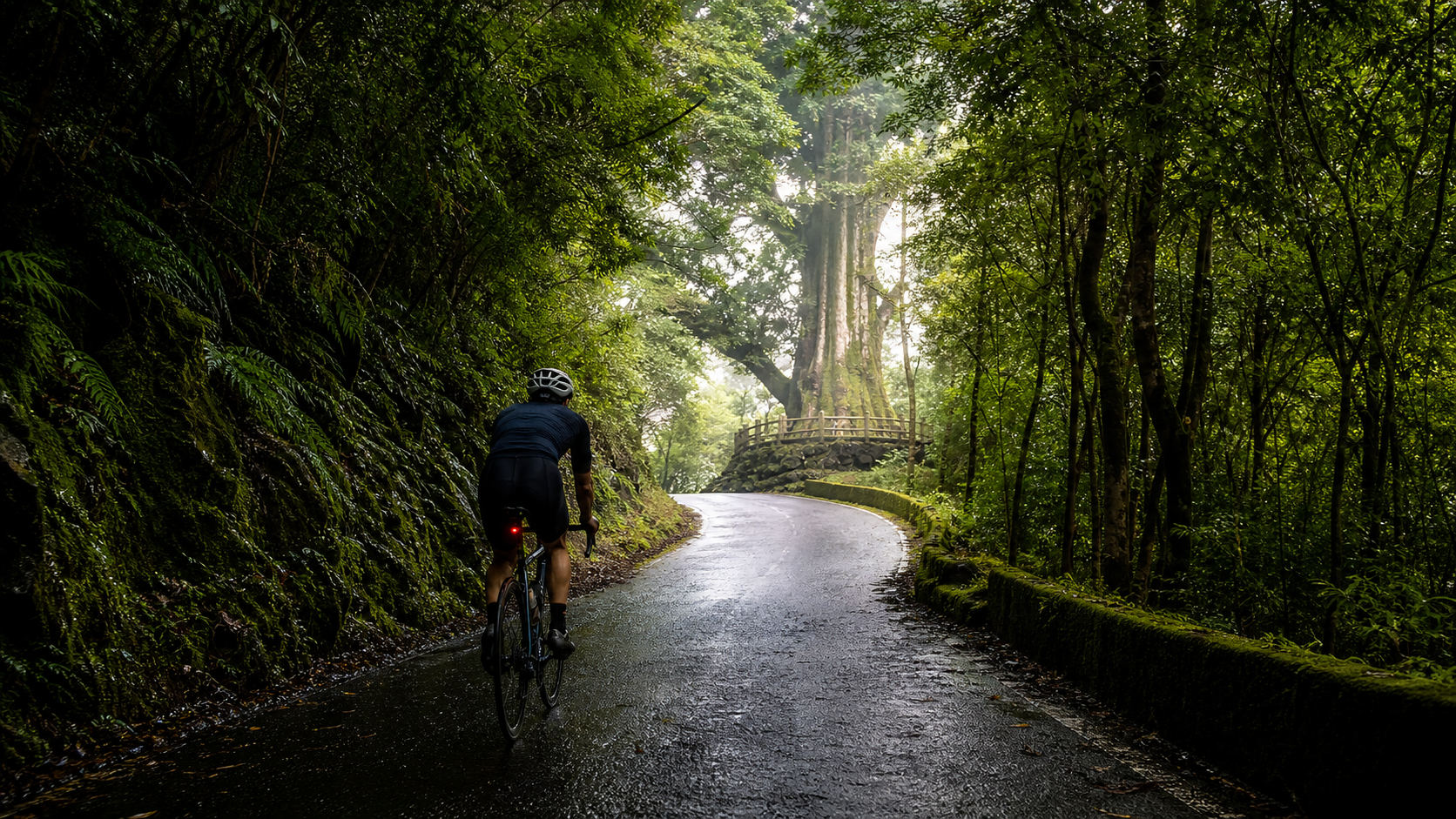
Some roads exist to take you somewhere; others exist to let you encounter something. Route 56 in Nantou belongs to the latter.
Deep in the mountains of Nantou, this steep road—just 6.9 kilometers long yet climbing 653 meters—winds quietly through the shade of the forest. It has no famous name, no steady stream of traffic, and most people have never even heard of it. But for those willing to leave the main roads and venture deep into the mountains, the end of this road holds an indescribable awe—an ancient sacred tree standing in silence, spanning vast stretches of time.
This article aims to set aside the calculations of gradient and gear ratios, and simply, through the senses of a cyclist, take you into this secret steep road to feel the forest shade, the mountain rain, the solitude, and the reverence brought by that giant tree.
1. Leaving the noise behind, diving into the folds of the mountains
Nantou is the heart of Taiwan, where mountain ranges stack upon one another. The areas of Zhushan, Lugu, and Xinyi have long been renowned for their sacred and giant trees—miracles of life that Taiwan red cypress and Taiwan hinoki can only achieve after countless years in the moist, temperate mountain air.
Route 56 is a small path that penetrates deep into these mountain folds.
When you turn off the main road onto this rural route, the world suddenly falls silent. The sound of traffic fades away, replaced by the rustling of wind through the treetops, the calls of unknown birds, and your own increasingly heavy breathing. The road climbs from the very start, and it climbs seriously—this is not a road that gives you gentle stretches to catch your breath. From the first kilometer, it shows its true colors as a secret steep road.
The first gift of a secret route is “silence.” When you’re used to the clamor of the city and the traffic of main roads, suddenly finding yourself on a mountain road where you’re almost the only one around—that silence awakens your senses anew. You hear sounds you normally can’t hear, and notice details you normally can’t see.
2. Deep in the forest shade: the flow of light, shadow, and scent
The most captivating aspect of Route 56 is its forest canopy.
As the elevation rises, the trees on both sides grow taller and denser, their branches and leaves weaving together overhead into a natural green tunnel. Sunlight filters through layer upon layer of leaves, casting dappled, dancing specks of light that drift across the asphalt. Riding through such forest shade, even as your legs burn from the steep climb, there’s a sense of calm in being gently wrapped by the mountain forest.
The scent of the air also shifts with the ascent. Near the bottom, there’s the fresh greenness of roadside vegetation along the industrial road; the higher you go, the more you can smell that moist, deep woody aroma that belongs only to primeval forests. If mountain rain has just passed, the entire road is shrouded in a thin layer of mist, and the scents of earth, moss, and bark mingle together. Take a deep breath, and it feels as though you’ve drawn the entire mountain’s breath into your lungs.
This stretch of riding is a dual journey of body and mind. The body fights against the pull of gravity on the steep slope, while the mind gradually settles amid the flowing light and shadow of the forest. You’ll find that the worries that clung to you before the climb slowly fade away as you focus on your breathing and pedaling, surrounded by nature.
3. Solitude is the defining tone of this road
Route 56 is a road “rarely traveled by people.”
Here, you’re likely to encounter very few people along the way. No fellow riders racing side by side, no spectators cheering you on, no convenient supply stops. Just you, your bike, and the asphalt stretching ever upward.
This solitude might be somewhat intimidating to some, but to those who appreciate it, it’s an invaluable gift.
Solitude on a secret steep road is not loneliness, but a rare opportunity to “be with yourself.” There’s no one to rely on, no one to compare yourself to—you can only honestly face your own fitness, your own willpower, your own pace. This kind of purity, in an era that is perpetually connected and perpetually noisy, has become almost a luxury.
When the ache in your legs accumulates to a certain point, your mind enters a peculiar stillness. You stop thinking about anything else, simply focusing on the rhythm of each breath, the weight of each pedal stroke, the change of each gradient. It’s a state close to meditation. In this solitude, you’ll hear the most honest voice within yourself.
4. The awe at the end: encountering the sacred tree
Then, after a certain bend, you arrive at the end. The sacred tree is right there.
How do you describe the feeling of seeing the sacred tree for the first time?
It’s a feeling of being awed by “time” itself. When you stand before a giant tree that may have lived for hundreds, even thousands of years, you suddenly become aware of your own smallness and brevity. It stood here long, long before you were born, and it will still be quietly watching over this mountain forest long, long after you’ve left this world. It has witnessed countless dawns and dusks, countless storms, countless cycles of seasons—and you are merely a fleeting passerby in its long life.
Taiwan’s sacred trees—red cypress and hinoki—are the island’s most precious ecological treasures. Their massive trunks are rings of time accumulated year after year; their tangled, sprawling root systems grip the earth tightly; their towering branches shelter the life of the entire forest. Standing before a sacred tree, you need no words. Simply look up in silence, breathe in silence, and you can feel that silent, immense life force that spans across time.
This is the ultimate reward Route 56 gives you. Not a beautiful performance record, not a check-in number on social media, but a real encounter with a thousand-year-old life.
5. Side trips and reflections on this journey
Although Route 56 itself is a focused climbing secret, the Nantou mountain area it sits in is itself a land worth exploring slowly.
| Aspect | Experience | Feeling |
|---|---|---|
| Forest-shaded riding | Green tunnel, dappled light | Gently wrapped by the mountain forest |
| Mountain rain scent | Woody and mossy aroma after rain | Deep and healing |
| Secret solitude | Focused time on a rarely traveled road | Being honest with yourself |
| Sacred tree encounter | The awe of a thousand-year giant | Reverence for time and life |
| Nantou mountain towns | Nearby Zhushan, Lugu, and more | Tea fragrance, mountain produce, hospitality |
A few small suggestions for those who want to explore:
- Slow down: This is not a road for rushing up, taking a photo, and leaving. It deserves you to linger a while longer in the forest shade and stand a few more minutes before the sacred tree.
- Carry reverence: The sacred tree is a fragile and precious ecological resource. Admire it, photograph it, but please do not touch, climb, or damage it. Let it continue to watch over the mountain forest in peace.
- Explore Nantou: The Nantou mountain area around Route 56 is rich in tea country, bamboo forests, and mountain town charm. If time allows, consider extending this ride into a more complete Nantou mountain journey.
6. Why is this secret steep road worth riding?
In a cycling world dominated by “speed” and “data,” Route 56 is a gentle rebellion.
It’s not long, but it’s steep; it’s not bustling, but it’s pure; it won’t give you the thrill of conquering a great mountain, but it will give you a quiet, profound emotion. It tells you that cycling isn’t just about results, about climbing numbers, about likes on social media—cycling can also be about entering a forest shade, breathing in the air after mountain rain, and rediscovering reverence for nature, for time, for life before a thousand-year-old sacred tree.
Sometimes, we ride too fast and chase too urgently, forgetting why we set out in the first place. Routes like Route 56, with their steepness and solitude, force you to slow down, to quiet down, to hear your own breathing again, and to see the beauty hidden deep within this island.
7. For those coming for the first time
If you’ve read this far and feel moved to come ride this secret steep road to the sacred tree yourself, here are a few heartfelt words for you.
This road will not be gentle with you. It climbs from the very start—steep gradients, few supplies, scarce human presence. You’ll be tired, you’ll be breathless, and there will be moments when you question why you’re putting yourself through this. But trust me, when you finally stand before the sacred tree, all that hardship will become infinitely worthwhile in an instant.
Prepare a heart willing to slow down, bring enough water and supplies, choose a day with stable weather, and then just go. Don’t rush, don’t rush to check in. Let the forest’s dappled light fall upon you, let the scent of mountain rain fill your lungs, and let the solitude of the secret place bring you back to the original, purest heart of cycling.
8. Why the sacred tree inspires awe: a lesson about time
We live in a “fast” era. Messages are sent in an instant, deliveries arrive at lightning speed, and videos are watched at double speed. We’re used to measuring the world in “seconds” and “minutes.” The sacred tree is the gentlest and most awe-inspiring reminder in this fast era—it exists in units of “hundreds of years” and “thousands of years.”
Taiwan’s red cypress and hinoki are among the oldest inhabitants of this island. They grow extremely slowly, perhaps thickening only slightly in a year; precisely because of this slowness, their wood is exceptionally dense and resilient, able to withstand storms, resist decay, and stand for a thousand years without falling. When you stand before a sacred tree, looking at a trunk that takes several people to encircle, you are actually gazing at time sealed within the rings—time so long it defies imagination.
A thousand-year-old sacred tree has witnessed more dawns and dusks than we will see in a thousand lifetimes. It stands there quietly, not competing, not rushing, not lagging, living out the most magnificent life in the most silent way. This existence itself is a form of power.
When we finish riding the 6.9-kilometer steep climb, gasping for breath, and stand before it, the pride from the climb transforms into humility in the face of its enormity and antiquity. We suddenly understand that no matter how glorious human achievements are, in the timescale of nature, they are but a fleeting instant. And it is precisely this realization of “how small we are” that paradoxically opens and softens the human spirit.
This is the lesson the sacred tree gives every visitor—a lesson about time, about humility, about how to live well.
9. Nantou: the homeland of Taiwan’s giant trees
Nantou, where Route 56 sits, is one of the regions in Taiwan richest in giant tree resources.
Located in the center of Taiwan, Nantou is surrounded by mountain ranges with enormous elevation differences, rising from low-altitude hills to the peaks of the Central Mountain Range. This topography, combined with a moist and temperate climate, nurtures Taiwan’s most precious cypress forests. The areas of Zhushan, Lugu, and Xinyi have long been important forestry and giant tree distribution zones, scattered with sacred trees and giant tree groves of various sizes.
These giant trees are not just spectacular scenery; they are the pillars of the entire forest ecosystem. A single sacred tree is itself a miniature ecosystem—its bark, branches, and roots shelter countless epiphytes, insects, birds, and small animals. It is the elder of the forest and the heart of the forest.
Precisely because they are so precious, these giant trees are also exceptionally fragile. Taiwan once went through an era of large-scale logging, and many precious primeval cypress forests disappeared during those years. Every sacred tree that survives and still stands among the mountains today is an invaluable natural heritage. The fact that we can ride our bikes and easily come before them today is itself a stroke of luck.
Therefore, when you visit the sacred tree at the end of Route 56, carry the deepest respect. Do not touch, do not climb, do not carve, do not leave any trash. Let this surviving giant continue to watch over the mountain forest in peace, so that the next generation, and the generation after that, can also witness its existence with their own eyes, just as you do today.
10. The secret place through the seasons: different faces of riding
A forest-shaded secret like Route 56 reveals completely different faces with each season.
- Spring: The mountain forest awakens from winter’s stillness. New leaves sprout, tender green spreads everywhere, and mountain cherries or wildflowers occasionally dot the woods. There’s a vibrant vitality in the air, and riding through it feels as though you’re infected by the awakening of the entire mountain.
- Summer: The dense forest canopy becomes especially precious in the height of summer. While the lowlands swelter, this steep road wrapped in greenery stays relatively cool. But summer is also the season of frequent afternoon thunderstorms—be sure to check the weather before setting out to avoid being caught in sudden heavy rain in the mountains.
- Autumn: This is the season with the most stable weather and the most comfortable riding on this route. Cool air and clear light make the agony of climbing more bearable. The light and shadow in the forest appear especially soft in autumn, making it one of the best seasons for riding.
- Winter: Mountain winters are cold and still. The depths of the forest carry a chill, human traces are even scarcer, and that lofty sense of secrecy becomes even more intense. But be sure to stay warm, especially the low temperatures on descents, and watch for potentially slippery roads.
Route 56 in each season is a different version of itself. Spring has vitality, summer has coolness, autumn has clarity, winter has solitude. And the one thing that never changes is the sacred tree waiting quietly for you at the end of the road.
11. A gentle reminder about “secret places”
The word “secret place” has been overused on social media in recent years. But what makes a true secret place precious is precisely that it remains “undisturbed.”
The beauty of a route like Route 56 comes largely from its “quietness” and “few people.” If one day it becomes flooded with crowds and traffic due to overexposure, the unique tranquility and purity of the secret place would vanish.
So, here is a gentle reminder to every rider who visits this route:
- Leave no trace: Take everything you brought in back out with you. Leave no trash, including food scraps and packaging.
- Respect the locals: This is an industrial road, and there may be local residents living and working along it. Slow down, be courteous, and be a welcome visitor.
- Share discreetly: Sharing your wonderful experience is fine, but perhaps you don’t need to publish every coordinate and every path in exhaustive detail. Leave some beauty with room for personal discovery.
To truly love a place is to know how to protect it, so that it can continue to exist in its best form for a long, long time.
12. Body and mind on the steep slope: an exploration of boundaries
Climbing a steep road like Route 56 is, in essence, an exploration of your own “boundaries.”
Cruising on flat roads, it’s hard to truly know your limits. It’s the steep slope—that sustained climb that makes your legs burn, your heart race, and your breath quicken—that pushes you to that boundary line you normally can’t see. And it’s precisely on that line that you encounter your most authentic self.
You’ll discover that your body is stronger than you thought. When you think you can’t go on, yet you still manage one more pedal stroke, one more bend, you push your boundary outward just a little. This realization of “so I can do it” is one of the most precious gifts the steep slope gives you. It doesn’t just apply to cycling—when you face seemingly insurmountable difficulties in life, you’ll remember this steep slope, remember the version of yourself who kept moving forward even when your legs felt like lead, and tell yourself: I can do it, just like that time.
A steep slope doesn’t just train your muscles; it trains an “attitude toward difficulty.” And that attitude quietly seeps into every corner of your life.
At the same time, a steep slope is a form of mental purification. When the intensity reaches a certain level, your brain is forced to “clear out”—there’s no spare bandwidth to worry about work, to agonize over relationships, to be anxious about the future. You can only focus on the present breath and pedal stroke. This forced “living in the moment” is precisely the mental state modern people lack most and need most. Many people spend a fortune on meditation classes, not realizing that a steep slope can give you the purest mindfulness experience.
13. Cycling is the best way to know Taiwan
A secret route like Route 56 reminds me that cycling might be the best way to know Taiwan.
Driving is too fast—you merely “pass by” the scenery, and the details fly past the window, disappearing before you can even see them clearly. Walking is too slow—the range you can cover is too limited. Cycling finds the perfect balance between the two—it’s slow enough to let you savor the forest’s dappled light, smell the mountain rain, hear the birdsong and the wind; and fast enough to let you penetrate deep into the folds of the mountains in a single day, reaching secret places that driving can’t reach and walking is too far to reach.
Getting to know Taiwan by bike, you’ll discover that this island is far richer than you imagined. Within a short riding distance, you can go from bustling towns into silent mountain forests; from sun-drenched lowlands up into mist-wrapped heights; from modern asphalt roads into sacred tree secrets bearing a thousand years of life. Much of Taiwan’s beauty is hidden in places that can only be reached with two feet and two wheels.
A route like Route 56 is a generous gift from Taiwan to riders willing to leave their comfort zones and pay with their sweat. It won’t appear in popular travel guides, won’t have throngs of tourists, but it will repay every person who comes to seek it with the purest forest shade, the deepest solitude, and the most awe-inspiring sacred tree.
14. After the descent: bringing that tranquility back into life
When you complete this ride and descend slowly through the forest shade back to the clamor of daily life, you’ll carry back something intangible yet precious.
You’ll carry back a sense of tranquility. The humility and openness you felt before the sacred tree will become an anchor you can look back to when facing life’s turmoil. When work suffocates you, when relationships frustrate you, close your eyes and recall that silently standing giant, recall the composure it has lived out over a thousand years—and perhaps your heart can settle just a little.
You’ll carry back a sense of strength. The version of yourself that wanted to give up on the steep slope but didn’t will become your confidence when facing other difficulties. You’ll know that you have the capacity to grit your teeth and endure hardship, just as you endured that steep slope.
You’ll also carry back a reverence for and longing for nature. Once you’ve personally experienced the healing of the mountain forest and the awe of the sacred tree, you’ll find yourself wanting to return to the mountains again and again, wanting to use your bike to seek out more of the island’s hidden secrets. This longing will give your life a healthy, fulfilling, and hopeful direction.
A true journey isn’t about where you arrive, but what you bring back. What Route 56 gives you is far more than a riding record—it’s a gift from deep within the mountains that can nourish your daily life.
Conclusion: Setting out anew before the sacred tree
Route 56 is a secret steep road in Nantou leading to a sacred tree. 6.9 kilometers of road, 653 meters of climbing—a considerable test for the legs. But what truly makes this road unforgettable has never been those numbers; it’s the light and shadow deep in the forest, the scent after mountain rain, the solitude of a rarely traveled path, and the giant tree standing in silence at the end, spanning a thousand years.
When you climb breathlessly to the end of the road and stand before the sacred tree, you’ll understand: the meaning of this journey is far more than “having climbed a steep road.” You’ve walked into the depths of the mountain, encountered the face of time, and in solitude and reverence, rediscovered yourself.
Then, as you turn your bike around and descend slowly through the forest shade you came up, you’ll carry with you an indescribable peace. The sacred tree still stands deep in the mountains, and you—you are no longer the person you were before the climb.
May you too have the chance, on some quiet day, to ride into this secret place, walk into the forest shade, encounter the sacred tree, and then—set out anew.
Related Reading
- Route 56 Sacred Tree Climbing Guide: 6.9 km with 653 m of Elevation Gain, Data Analysis of Nantou’s Secret Hardcore Climb
- Lugu Route 101 Guide: 4.3% Beginner-Friendly Training Route, Gateway to the Dalunshan Secret
- 36 Bends, 36 Conversations with Yourself: The Road Spectacle and Riding Philosophy of Meishan’s 36 Bends
- Encountering Butterflies and Tranquility on Lijia Forest Road: A Climb and Cultural Journey Through the Dabalijiu Mountains
台北闊瀨陡坡 騎旅 / 日本單車雜誌編輯車友臨時加入!/ 髮香才是最強的 / feat. 北迴歸線小隊 / 公路車 CT Yeh
6 個月前
一定要騎一次!阿里山最深處:里佳部落!單車旅行 | 2800m爬升 | 深度部落體驗:嗨翻晚會、螢火蟲、銀河 | feat. JJSC & 廢物伙伴 | 公路車 CT Yeh
10 個月前
觀霧 變好騎了! | 北高車友爆笑大會師 | 公路車 | 單車旅遊 Taiwan Cycling Route GuanWu
6 年前
藤枝二集團 單車行 Day1 | 南部小武嶺 | 爬坡爬到罵罵叫 | JJSC | 公路車 | CT Yeh
3 年前
新竹羅平 x 天湖部落 大禹嶺級變態陡坡! 4K超高畫質 空拍 | 公路車
5 年前
大武山20%魔王陡坡【JJSC南台灣遊騎Day2】!屁股真的要裂開了...凡士林抹滿也沒用?神秘金教堂還有超便宜夜市
3 個月前
嘉義大埔、阿婆灣挑戰賽,美到以為在日本!ft. 環騎5 Cool 西拉雅188 / 公路車 / CT Yeh
7 個月前
大武山後門26%歡樂陡坡!JJSC南台灣單車行Day2 / 被颱風追著跑 / 公路車 / CT Yeh
2 年前