Xitou to Sunlinksea: A Misty Journey Through Cedar Forests, Monster Village, and Songlongyan Waterfall
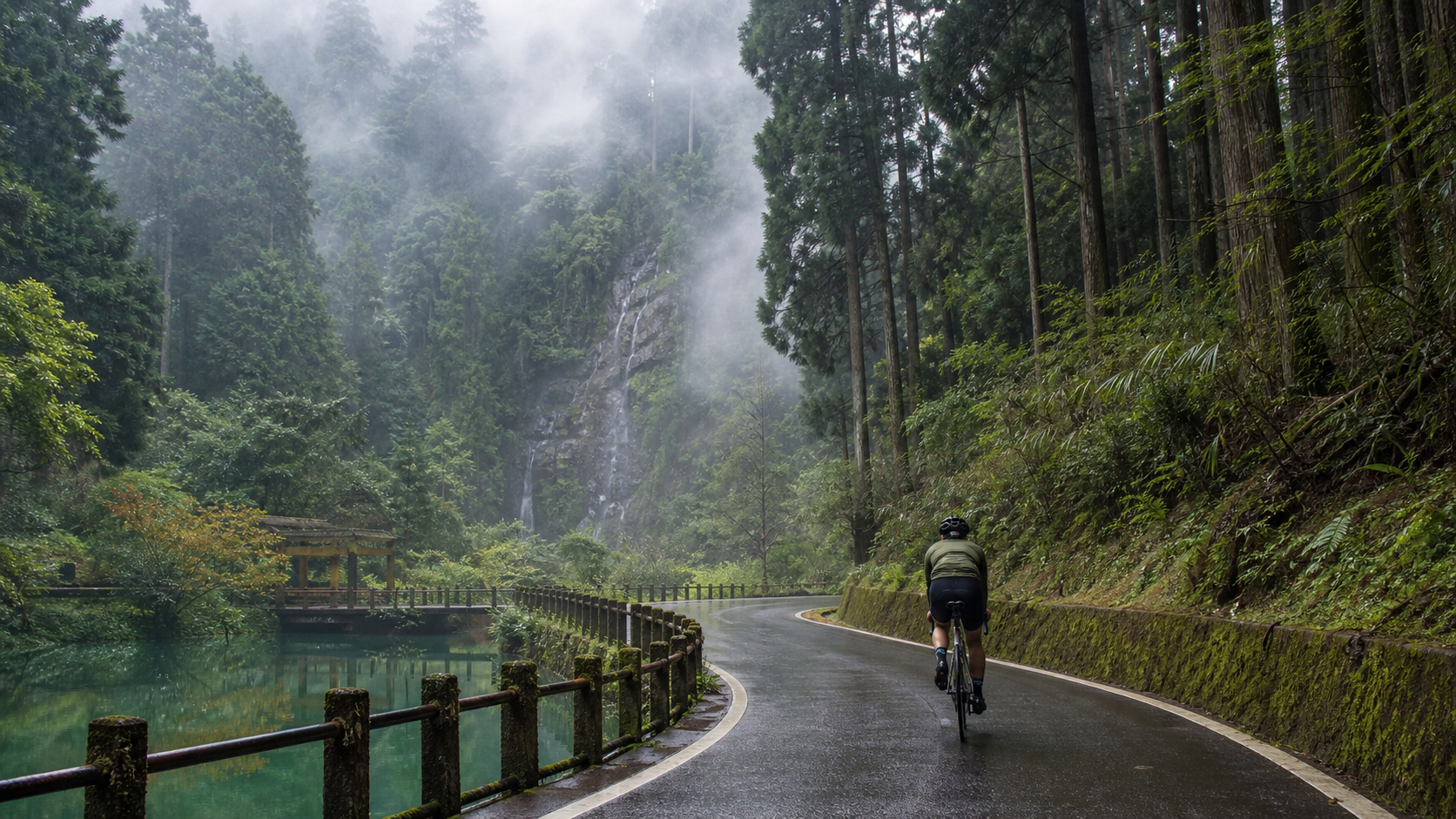
Riding from Xitou toward Shanlinxi, the elevation climbs from around 1,150 meters to over 1,600 meters. In just over 12 kilometers of road, it feels like passing through several distinct layers of forest. The higher you go, the cooler and quieter the air becomes—the fresh scent of Japanese cedar mingling with the aroma of bamboo leaves, washing away the heat you carried up from the lowlands. This is one of Taiwan’s rare high-mountain routes where “you ride through the clouds the entire way,” and for me, it’s the most healing climb I know.
This article isn’t about pacing. The climbing stats from Xitou to Shanlinxi—12.3 kilometers, 1,168 meters of elevation gain, 5.0% average grade—are in the guidebooks. What I want to introduce you to is the University Pond reflecting its arched bridge, the Monster Village with its black bear legend, the Songlongyan Waterfall cascading down the cliff face, and the story behind the place name “Liulongtou”—a tale of timber and aerial cable carts.
Xitou: A Forest That Breathes
The Xitou Nature Education Area sits in Fenghuang Valley, southwest of Lugu Township, and is managed by the Experimental Forest of National Taiwan University. It’s not an over-commercialized tourist spot, but a carefully tended Japanese cedar forest—step inside, and sunlight is filtered through layered canopies into dappled patches of light, the air thick with phytoncides.
Xitou’s most famous landmark is the University Pond. A bamboo arch bridge spans the water, its reflection shimmering on the surface. When mist rises, the entire pond seems wrapped in a sheer veil—for countless people, it’s the image of “Taiwan’s most beautiful corner of forest.” The pond is most enchanting in the early morning—the water perfectly still like a mirror, the cedar reflections undisturbed, mist drifting slowly across the surface, until a waterbird skims by and sends ripples across the scene. I once stood there for a long time, doing nothing at all, just watching the mist come and go. That kind of quiet is something money can’t buy in the city.
Another must-visit is the Sky Walk—an elevated canopy trail about 22.6 meters high and 220 meters long, letting you walk among the treetops and see the entire forest from a bird’s perspective. Walking along it, layered canopies spread beneath your feet, distant mountains cut through by clouds and mist before your eyes. In that moment, you suddenly understand how small you are in the face of the forest—and that smallness is strangely comforting. This is Xitou’s most generous gift: it lets you leave the ground for a while, and also leave behind the version of yourself that’s always in a hurry.
There’s also a ginkgo grove here, turning brilliant gold in late autumn—a seasonal spectacle photographers chase. As for the former Xitou sacred tree—that thousand-year-old red cypress—it sadly collapsed in September 2016, and now can only be remembered through photos and memories. It reminds us: everything in the forest has its life cycle, and all we can do is go see it while it’s still there.
I still remember the feeling of stepping into Xitou’s cedar forest for the first time. The summer heat that had followed me all the way up from Zhushan and Lugu seemed to switch off the moment I crossed into the park—the temperature dropped, the sounds deepened, even my breathing grew slower and fuller. The cedars are remnants of Japanese-era afforestation, standing in straight rows, their trunks covered in thin moss, sunlight piercing the canopy to cast shifting patches of light on the carpet of fallen needles. Walking among them, you instinctively soften your steps, as if afraid of waking something. This forest doesn’t clamor; it simply exists, catching every sweat-soaked climber with a nearly maternal gentleness.
I often think that Xitou’s most precious quality isn’t any single attraction, but the fact that “time moves more slowly here.” The city slices our days into a grid of appointments, while this forest does nothing at all—just reminds you: your breath can be longer, your pace can be slower, and you can look at a single tree for a very, very long time.
Monster Village: A Legend of Black Bear and Clouded Leopard
Tucked beside the Xitou park entrance lies a corner full of whimsy and story—Monster Village (Songlin Village). This is a Japanese-style commercial district that officially opened in 2011, with red lanterns, wooden shopfronts, and “monster” motifs everywhere, making it a favorite photo spot for visitors of all ages.
But the soul of Monster Village is actually a local legend. The story originates from “Songlin Sheng-yi,” a man from Lugu’s Dongding area—legend has it he once raised a black bear named “Kuma” and a clouded leopard named “Bado.” Thus “Beware of Kuma” became the village’s signature slogan, and that black bear became the spiritual symbol of the entire park.
I love this approach of “turning a local story into a world.” It’s not a fabricated commercial gimmick, but an imagination that grew out of Lugu’s mountains and Lugu’s people. When you ride past, it’s worth stopping to wander around, grab a novelty steamed bun, and soak in this valley’s humorous yet gentle character.
I especially love how Monster Village looks when the lights come on at dusk. As the valley’s twilight deepens, red lanterns light up one by one, the silhouettes of wooden shopfronts emerge in the glow, and when mist drifts through, the whole street truly feels like stepping into the edge of a fairy tale. Children chase after “Kuma” mascots, laughter echoing through the valley; adults stroll slowly beneath the lanterns, melted by this deliberately crafted yet unpretentious warmth. I always feel that a place willing to build an entire village for a legend is itself a kind of romance—it believes stories deserve to be treated well, believes imagination can take root in a real valley.
For riders, Monster Village also serves a practical purpose: it’s a rare “emotional refueling station” on this climb. When your legs are wrestling with the altitude and your mind starts asking “why am I putting myself through this,” rounding a corner to encounter red lanterns and the aroma of novelty steamed buns—that sudden burst of playfulness is often enough to recharge you completely, and you’ll pedal on with a smile.
Dongding Oolong: The Taste of These Hillsides
To understand Lugu, you have to talk about tea. This is the famed home of Dongding Oolong tea—“Dongding” is a place name in Lugu, and Dongding Oolong is renowned across Taiwan for its distinctive roasted aroma and sweet aftertaste. As you climb toward Shanlinxi, the higher the elevation, the crisper the tea’s character becomes; Shanlinxi high-mountain tea is equally celebrated.
Riding this stretch, you’ll pass tea gardens planted along the hillsides. In the early morning, thin mist drifts over the tea bushes, the silhouettes of tea pickers appearing and disappearing—that’s the most vivid scene of daily life on these slopes. When you’re tired, find a place to sit and have a cup of local tea, letting Dongding’s roasted fragrance or Shanlinxi’s high-altitude coolness revive your legs. This cup of tea is the gentlest refreshment this road has to offer.
Taiwanese tea has a remarkable ability—it can brew the character of an entire hillside into a single cup. Dongding Oolong’s roasted aroma is rich and steady, like the gentle slopes of Lugu that generations have cultivated; the higher you go toward Shanlinxi, with elevation rising, day-night temperature swings widening, and clouds swirling, tea bushes grow slowly in such conditions, yet their flavor becomes more refined and elegant—just like that stretch of road that grows quieter the higher you climb. As you sip, you realize you’re not just refueling; you’re reading this mountain through taste—every hint of sweetness in the aftertaste is a sentence this land has written to you.
And the people working in the tea gardens are the true soul of this landscape. Plucking, withering, rolling, roasting—every step carries generations of accumulated skill and patience. When you ride past row after row of tea bushes and see the bent backs of tea pickers in the distance, you suddenly understand: the “scenery” in your eyes is their “daily life.” This realization deepens your respect for this road—it’s not a stage built for tourism, but a place where real people live their lives, day in and day out.
Songlongyan Waterfall: Shanlinxi’s Premier Sight
At the Shanlinxi end of the climb, the one thing you absolutely can’t miss is the Songlongyan Waterfall. It drops over 38 meters, water thundering down from above, earning its title as “Shanlinxi’s premier sight.” Beside the waterfall is a natural sandstone cave called “Songlongyan,” where mist hangs thick and the chill is biting—the most refreshing spot on a scorching summer day.
Standing before the waterfall, hearing the roar of water and feeling the spray on your face, you suddenly realize—those 1,168 meters of climbing were all just to earn this moment of coolness and grandeur. The awe of a high-mountain waterfall belongs only to those willing to sweat their way up.
I particularly remember that summer afternoon standing beneath Songlongyan. The lowlands must have been baking under the sun, yet here I was wrapped in water mist, coolness seeping from my skin into my bones. The roar of the waterfall drowned out every stray thought—in that moment, there was no mileage, no heart rate, no leaderboard, only water, only coolness, only a nearly extravagant sense of being fully present. I suddenly understood why the ancients sought solitude in deep mountains—not to conquer, but to make themselves small before nature’s grandeur, and in doing so, find a strange peace. That water, plunging from 38 meters above, washed away not just the summer heat, but the exhaustion a whole city had piled up in my heart.
Liulongtou: A Place Name About Timber and Cableways
Near the highest point of this road, there’s a place called “Liulongtou,” also written as “Liulongtou” (流籠頭). Its origin holds a chapter of Taiwan’s forestry history—in the early years, people set up a cableway (流籠) here to transport timber harvested from the Shanlinxi area all the way to Xitou, about 13 kilometers away. “Liulongtou” was the starting point of that cableway.
When you climb to this highest point, gasping for breath, and learn the story behind the name, the scenery before you suddenly gains an extra layer of depth. The road you’re riding was once a lifeline for timber and laborers traveling back and forth; this quiet high mountain beneath your feet once echoed with the sounds of logging and cableway operations. Place names are letters the land writes to future generations—read them, and this ride gains the weight of a dialogue with history.
I love reading Taiwan’s high-mountain place names one by one—they are almost all traces of labor. Liulongtou, Mujiliao, jicai (log collection), cableways—behind these names is an entire generation of people who, with the most primitive tools and the strongest shoulders, hauled giant trees down from the deep mountains one by one. That was the most glorious and the most arduous era of Taiwan’s forestry. Today the cableways are dismantled, logging has ceased, and the forest has grown back into what it should be. Only the name “Liulongtou” remains, quietly keeping watch at the mountaintop, remembering the sweat shed by those nameless loggers.
Perhaps this is the most captivating thing about cycling. You think you’re just pushing the pedals upward, but in fact you’re rolling over layer after layer of time. The same road was once walked by tree cutters, timber haulers, and tea sellers; now it’s riders chasing gradients—and the mountain is always there, quietly watching people come and go, gathering every generation’s stories into its mist.
A Year of Mist: The Seasonal Charms of Xitou and Shanlinxi
The allure of this high-mountain route lies in how it changes all year round. In spring, azaleas and various flowers dot the forest; in summer, it’s one of Taiwan’s most popular summer retreats—when the lowlands hit 35 degrees, it stays cool and pleasant here; in autumn, the ginkgo trees turn gold, the sky is high and the air crisp, with the best visibility; in winter, it’s damp, cold, and quiet, with fog locking the forest in a unique, solitary beauty.
And no matter the season, the signature feature here is always the “mist and clouds.” In the afternoon, fog often rolls into the valleys, white moisture drifting through the Japanese cedar groves, making the entire road feel like it’s floating above the clouds. Riding through the fog, the world shrinks to just a few meters of road ahead and the trees beside you—a near-meditative solitude and stillness.
On the Shanlinxi end, there are seasonal floral spectacles hidden away. The park is famous for its variety of cultivated flowers, blooming in rotation through different seasons, giving this high-mountain road a different expression all year round. Late-spring hydrangeas, summer flower walls, and various plantings appearing with the seasons mean riders who climb to Shanlinxi always encounter an unexpected floral welcome. This is the romance of high altitude—because temperatures are lower and the seasons move more slowly, flowers here bloom later than in the lowlands and last longer, as if stretching out the beautiful moments a little longer for those who worked so hard to climb up.
My most unforgettable ride was on a deep-autumn morning when I climbed alone. The fog was exceptionally thick that day—visibility was only about a dozen meters. Japanese cedars emerged from and vanished back into the white mist one by one, like a slow dream. I could hear almost nothing except my own breathing and the faint whir of the chain. That solitude wasn’t loneliness, but a sense of safety, as if fully embraced by the forest. By the later part of the ride, I didn’t even want to ride fast—I wanted that time in the clouds to pass just a little slower, just a little longer.
What This Road Means to Riders
What Xitou to Shanlinxi teaches riders is “solitude with the forest.” It’s not as bustling as Sun Moon Lake, nor as dramatic as Wujie. Its beauty is introverted—you have to quiet yourself to receive it. The 1,168 meters of climbing leave the noise behind at the foot of the mountain, keeping the coolness, the tea fragrance, the sound of waterfalls, and the mist for those willing to sweat.
For many Taiwanese cyclists, this is the top choice for “summer climbing to escape the heat”—when the lowlands are too hot to move, this forest opens a cool door for you. It’s also the starting point for many people’s “love affair with high-mountain riding”: the gradient isn’t intimidating, yet the altitude is enough to give you a taste of the clouds.
One Climb, One Rhythm of Life
I often feel that the road from Xitou to Shanlinxi teaches the philosophy of “persistence.” It has no adrenaline-spiking consecutive hairpins, nor sadistic steep ramps that make you want to give up. It simply goes gently, steadily, ever upward—this kind of climb, “not dramatic but never stopping,” is actually closer to real life than any theatrical slope. Most of life’s difficulties aren’t a single earth-shattering challenge, but the day-in, day-out “persistence” that looks gentle but never lets you off the hook.
And this road also tells you that the way to endure persistence isn’t gritting your teeth and pushing through—it’s finding a pace you can sustain for the long haul, then trusting it. Just like riding in the fog: you can’t see the end, all you can do is pedal the step in front of you and take the next breath. When you learn to coexist peacefully with “persistence,” to keep moving steadily even when the end is nowhere in sight, you’ll suddenly hear the sound of Songlongyan Falls around a bend—turns out, you’ve climbed higher and farther than you ever thought you could.
Side Trips and Reminders
- University Pond, Sky Walk: Signature attractions of the Xitou park, worth slowing down to explore.
- Monster Village: A Japanese-style shopping area with the “Kuma” legend—a rest stop for all ages.
- Songlongyan Falls: Shanlinxi’s premier sight, a refreshing shock of high-mountain waterfall.
- Dongding Oolong and High-Mountain Tea: Grab a pack before you leave to take the taste of these slopes home.
- Stay Warm and Fog-Safe: Temperature swings are large at high altitudes and fog rolls in easily in the afternoon—warm clothing and cautious riding are both essential.
- Ginkgo and Flower Seasons: Late autumn brings golden ginkgo in Xitou, while Shanlinxi’s gardens rotate flowers through the seasons; avoiding weekend crowds lets you appreciate them in peace.
- Time for a Cup of Tea: Before leaving, give yourself a moment to sit and sip tea, letting your taste buds close out the ride—and take a pack of local tea home to extend the journey.
A Solitary Forest, Shared Memories
Interestingly, I’ve ridden this road alone and also with a lively group of fellow cyclists—two completely different flavors, yet both equally wonderful.
Riding alone, the forest is introverted—you hear your own breathing, watch the fog drift, and it becomes a long conversation with yourself. Riding with friends, the forest turns lively—someone shouts encouragement on the steeper sections, someone scrambles to take photos with the novelty buns in front of Monster Village, someone spreads their arms wide at Songlongyan Falls and yells about how refreshing it is. When we reach Shanlinxi, everyone gathers around a cup of hot tea, sharing their moments of hitting the wall and snapping back to life. All that shared sweat eventually becomes stories we laugh over on the descent.
I’ve gradually come to understand that a truly great road can accommodate both ways of riding. It can be a sanctuary where you escape the world and find solitude with yourself, or a crucible where you and a group of kindred spirits forge stronger bonds. Xitou to Shanlinxi is exactly such a road—it gives solitude to the lone rider and memories to the group, while itself simply standing there gently, letting each person take away their own piece of the forest.
Firefly Season in the Valley
Beyond the mist and ginkgo, this high-mountain forest holds another quieter, easier-to-miss seasonal offering—in early summer, in the damp, shaded corners around Xitou, you can occasionally spot the faint glow of fireflies flickering in the night. It’s not a staged performance, but a natural response of this forest’s ecological health: humid enough air, clean enough water, and little enough light pollution—all essential.
If you choose to end your ride in the evening and linger around Xitou, with luck you might catch these dim points of light drifting among the trees. Unlike the softness of University Pond or the vastness of the Sky Walk during daytime rides, this is another face Xitou reveals only at night—quiet, tiny, yet just as hard to look away from. This is also what this forest has taught me: the grandeur of daytime is worth chasing, but the subtlety of nighttime is equally worth stopping to wait for.
A Cyclist’s Whisper
Once at a rest stop in Shanlinxi, I met a middle-aged cyclist who had ridden up alone, and we chatted for a bit. He said he makes a point of riding this road once a year, for no other reason than to “confirm he can still make the climb.” He said life on the flats moves too fast—so fast you forget the rhythm of your own body. But this road is honest: ride it in a hurry, and it makes you gasp for air; ride it steady, and it rewards you with scenery all the way up. After he finished speaking, he smiled, put on his helmet, and prepared to descend, leaving me with one line: “This road won’t lie to you—it just faithfully reflects who you are on any given day.”
I’ve carried that line with me ever since. Perhaps that’s what makes Xitou to Shanlinxi so moving—it never promises a shortcut, nor rewards brute force. It simply sits there quietly, waiting for anyone willing to face themselves honestly to climb up, slowly.
Every time I ride this road since, whenever I hit the point of exhaustion, I think back to that cyclist’s words. Fatigue is just your body honestly reporting how you’re doing today; and climbing, in a way, is a practice in being truthful with yourself. The mountain won’t comfort you, and it won’t give you a discount, but it will use the fragrance of Japanese cedar and the sound of water at Songlong Rock to gently catch every person who faces themselves honestly.
Conclusion
The 12.3 kilometers from Xitou to Shanlinxi is a mountain road that folds “forest, legend, tea fragrance, waterfalls, and history” into the clouds. It repays every steady pedal stroke with the cool shade of cedar and bamboo groves; it turns a climb into a forest baptism with the arched bridge at Daxue Pond, the lanterns of Monster Village, and the sound of water at Songlong Rock. When you finally ride up into the clouds, you’ll understand—some roads are climbed for elevation, but what you gain is the stillness of an entire forest. This is Xitou Shanlinxi.
If one day you’re worn down by the city, gasping for breath under the weight of numbers and comparisons, I’d recommend you come climb this road. No need to chase speed, no need to care about rankings—just let yourself ride up slowly and steadily. Pass the breathing Japanese cedars of Xitou, pass the red lanterns of Monster Village, pass the tea gardens nestled in the mist, read a chapter of cable-car and timber history at Liulongtou, and finally let yourself go completely at the sound of Songlong Rock’s waters. By the time you ride back down, you’ll find that what you bring with you isn’t just sore legs and a light heart, but also a stillness the entire forest has kept safe for you. That stillness will quietly hold you up on many tired days to come. This is the gentlest gift Xitou Shanlinxi gives to everyone willing to sweat their way up.
Related Reading
- Riding into Southern Taiwan’s Little Xitou: The Clouds, Forestry History, and Post-Typhoon Rebuilding of Tengzhi Forest Road
- Xitou Shanlinxi Mountain Guide: The Hidden Difficulty of 5% at 1,600 Meters Above Sea Level
- Riding Where the Clouds Rise: Yunhai, Sacred Springs, and Wushe Memories from Lushan Hot Springs to Provincial Highway 14
- Between Tea Fragrance and Seas of Clouds: Riding Tai 101 into the Ginkgo Forest Hidden Gem of Dagun Mountain in Lugu
觀霧 變好騎了! | 北高車友爆笑大會師 | 公路車 | 單車旅遊 Taiwan Cycling Route GuanWu
6 年前
台北闊瀨陡坡 騎旅 / 日本單車雜誌編輯車友臨時加入!/ 髮香才是最強的 / feat. 北迴歸線小隊 / 公路車 CT Yeh
6 個月前
新竹羅平 x 天湖部落 大禹嶺級變態陡坡! 4K超高畫質 空拍 | 公路車
5 年前
一定要騎一次!阿里山最深處:里佳部落!單車旅行 | 2800m爬升 | 深度部落體驗:嗨翻晚會、螢火蟲、銀河 | feat. JJSC & 廢物伙伴 | 公路車 CT Yeh
9 個月前
#北橫 + #北進武嶺 最硬的員工旅遊 EP1 | #公路車 #拉拉山 | 明池 | 武嶺 | 武陵農場 | 雲海 | Taiwan Cycling Route Wulin
6 年前
大武山20%魔王陡坡【JJSC南台灣遊騎Day2】!屁股真的要裂開了...凡士林抹滿也沒用?神秘金教堂還有超便宜夜市
3 個月前
嘉義大埔、阿婆灣挑戰賽,美到以為在日本!ft. 環騎5 Cool 西拉雅188 / 公路車 / CT Yeh
7 個月前
5 ℃ 櫻花之旅 / 75萬單車直接雨中洗車.../ 平菁街 / 北迴歸小隊 / 公路車 / CT Yeh
5 個月前