Riding into Taichung's Backyard: The Mountains, Fireflies, and a Warm Cup of Coffee at Zhongzheng Campground in Dakeng
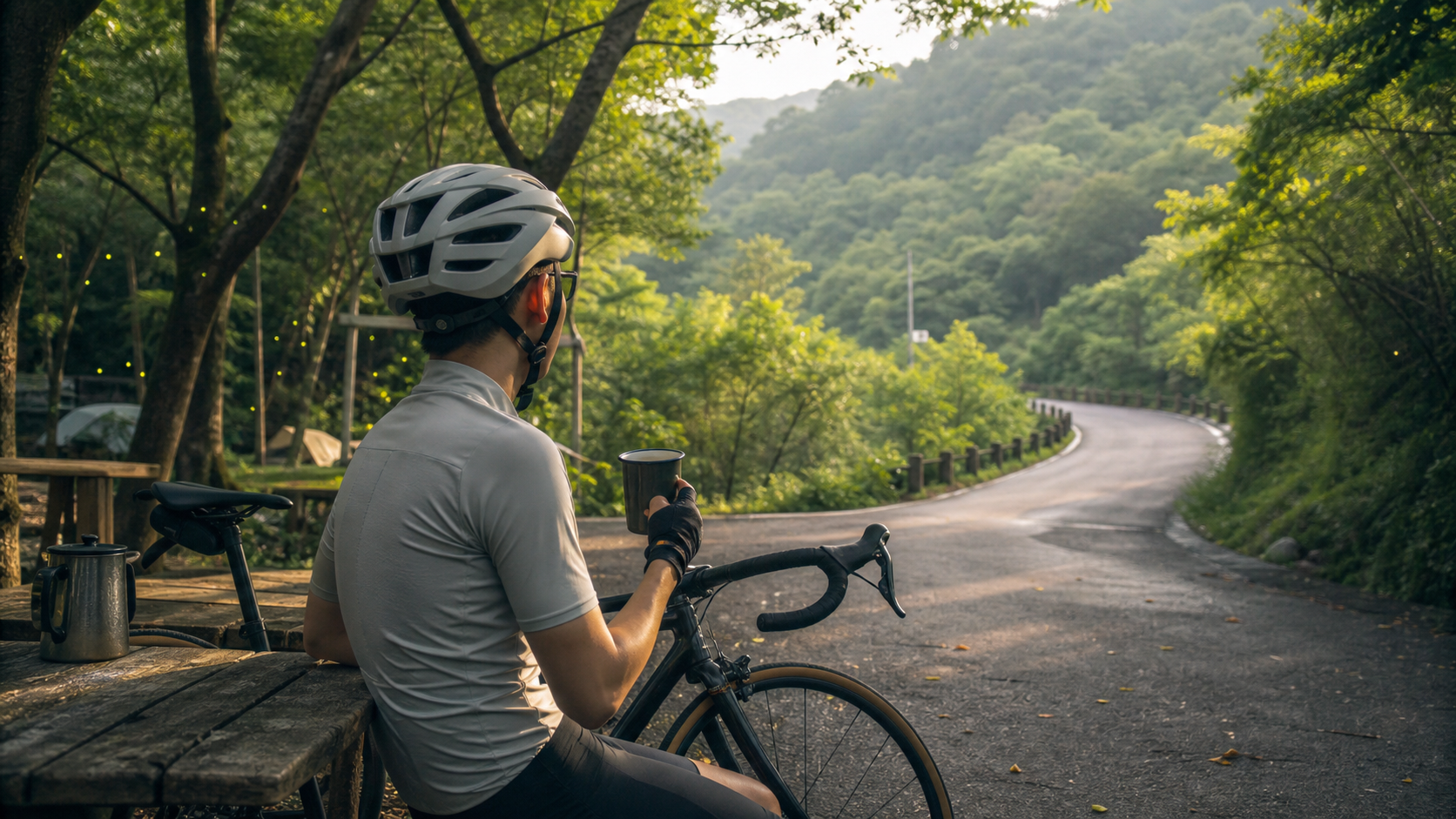
If you ask a Taichung cyclist, “Where do you go to clear your head when you’re tired?”—ten times out of ten, you’ll get the same answer: Dakeng. This forested area on the northeastern edge of Taichung City, climbing from 112 meters to 860 meters in elevation, is affectionately called “Taichung’s Yangmingshan” by locals. Among Dakeng’s many routes, the 5.84-kilometer road leading to Zhongzheng Campground is the gentlest—it doesn’t hit you with a 13% grade right off the bat like Qingshui Lane does. Instead, like an old friend who understands you, it accompanies you with an average 4.3% gradient, slowly guiding you into the embrace of the mountains.
This article won’t talk about power output or gear ratios. I want to take you at a different pace to see what this road is truly like.
Dakeng: A City’s Breathing Hole
The Dakeng Scenic Area sits on the western side of the Touke Mountain Range, a rare green lung on the edge of the Taichung Basin. It’s compared to Yangmingshan not just because of its rolling terrain and rich forest cover, but also because of its proximity to the city—starting from downtown Taichung, in less than an hour you can go from the bustling traffic of Taiyuan Road into acacia forests woven with the sounds of cicadas and insects. This intimacy of “city and mountain separated by just one slope” is exactly what makes Dakeng so captivating.
Dakeng is most famous for its network of hiking trails, numbered one through ten, plus unnumbered side paths, ranging in difficulty from beginner strolls to expert climbs. Zhongzheng Campground sits at the entrance of Trail No. 4, at an elevation of about 465 meters, and is the largest public campground in Dakeng. For cyclists, it’s a perfect “endpoint and starting point”—you can treat it as the summit of your climb and turn back, or park your bike and step onto Trail No. 4 to continue exploring on foot.
Setting Out on Beikeng Lane: The City’s Edge Recedes Behind You
I usually start this journey from Taiyuan Road. In the early morning, Taiyuan Road still carries the scent of the market waking up—the oil smoke from breakfast shops, the honking of scooters, the hurried footsteps of commuters. After pedaling through one traffic light after another, the moment I turn onto Beikeng Lane, the world suddenly goes quiet.
The first section of Beikeng Lane is very gentle—gentle enough that you have the leisure to look around. The townhouses on both sides gradually give way to orchards and vegetable plots. Occasionally an elderly man on an old steel bike rides toward you, nodding with a smile. I never rush through this stretch, because rushing would do it a disservice. The air begins to carry the scent of soil and vegetation—that’s the signal that the city’s edge is receding behind you.
The higher you go, the denser the acacia forests become. In the low-elevation hills of central Taiwan, acacia trees are the absolute protagonists. In late spring and early summer, acacia flowers bloom into a sea of golden yellow, with delicate flower clusters hanging from every branch. When the wind blows, they fall and carpet the ground, as if laying a golden blanket over the mountain road. This scenery lacks the grandeur of Alishan’s sacred trees, but it carries a homely, gentle warmth that belongs to the people of Taichung.
A Choice at the Fork: Left Means Gentleness
Beikeng Lane has a crucial fork. To the right is the steeper, harder route leading to Sifang Taizi Temple—where seasoned riders test their legs. To the left is the direction of Zhongzheng Campground—this road also leads to the well-known scenic restaurant “Xin Zhi Fang Ting” (The Heart’s Courtyard).
I almost always go left. It’s not that I can’t ride the right side—it’s that the rhythm of the left road happens to be exactly the rhythm I’m looking for when I come to Dakeng: unhurried, with a gradient that makes you breathe a little heavier and break a light sweat, yet still lets you hear the birds in the forest and see the dappled light filtering through the treetops. Sometimes cycling isn’t about getting stronger—it’s about letting yourself simply be.
The Steeper Final Stretch: A Little Self-Proof
Of course, this road isn’t flat all the way. After the widened section of Beikeng Lane, the gradient quietly picks up, with a few short steep sections exceeding 10%. At those points, the earlier leisure is interrupted—your heart rate spikes, your breathing turns heavy, and you have to stand up and push through.
But strangely enough, it’s these steep sections that give the whole journey its weight. If the entire road were gentle slopes, arriving at the campground wouldn’t feel like much. It’s precisely because of these sections where you grit your teeth that, when you finally coast into the campground and unclip your feet from the pedals, that small sense of “I did it” washes over you. That’s the magic of climbing—it asks you to give a little, then returns a little self-proof.
Zhongzheng Campground: Campfire Under the Stars
Zhongzheng Campground is the largest public campground in Dakeng, with open grassy fields and shaded groves. By day, it belongs to families and student groups, with colorful tents scattered across the green and children’s laughter rising and falling. But what truly makes it moving is the night.
When the lights of downtown Taichung glow in the distance, the sky above the campground grows darker instead, and stars emerge one by one. At 465 meters, it’s not high, but it’s enough to temporarily escape the city’s light pollution. If you come on a summer night, with luck you might spot fireflies carrying their little lanterns through the woods near the Trail No. 4 entrance—thanks to well-preserved vegetation and clean water sources, the Dakeng area is one of Taichung’s go-to spots for firefly watching. Imagine: riding up the mountain, setting up camp, and watching fireflies trace arcs of green light through the darkness—this is a luxury of romance in urban life.
The Taste at the Foot of the Mountain: A Hakka Village Dining Table
Half the joy of cycling lies in “what comes after the ride.” The Dakeng area carries on the Hakka and Hokkien culinary heritage of Taichung’s mountain towns, and hidden at the foot of the mountain are flavors that linger in your memory.
A steaming bowl of lei cha (pounded tea), a plate of savory, rice-worthy Hakka stir-fry, freshly baked bamboo tube rice, or locally sourced ponkan oranges and lychees—the Dongshan area of Dakeng is famous for its citrus and lychee harvests. When the season is right, the fruit farmers’ roadside stalls become the freshest supply stations. (I’ll be honest here: businesses change with the seasons and their operating conditions. I won’t name specific establishments, but if you just wander around the Dakeng Roundabout area, it’s hard not to be drawn in by the aroma of food.)
For many cyclists, the most ceremonial moment is that cup of coffee after the ride. In recent years, Dakeng has seen a number of scenic cafés open up. Sitting on the terrace, overlooking the Taichung Basin while the steam from your coffee fogs your glasses—all the sweat and heavy breathing from the steep climbs becomes worth it in that single sip.
Suggested Side Trips: Make the Day Last Longer
If you’re not in a hurry, Dakeng deserves a full day.
- Morning: Ride up to Zhongzheng Campground and enjoy the process of the climb.
- Noon: Descend to the Dakeng Roundabout area and find a small eatery to fill your stomach. The Dakeng Roundabout area is also a major gathering and supply point for riders heading to Xinshe or Guguan—cyclists come and go, giving the place a lively, free-spirited vibe.
- Afternoon: Park your bike and walk a section of the Dakeng trails. Trail No. 4 is right next to the campground, moderately difficult, and a great way to stretch out legs tight from riding. If you still have energy, you can visit Xin Zhi Fang Ting and soak in the leisure of its European-style gardens.
- Evening: Find a scenic café and wait for a sunset over the Taichung Basin.
What This Road Means to Cyclists
The road to Dakeng’s Zhongzheng Campground won’t appear on any hardcore “Taiwan Cycling Top 100” list. It’s too short, too gentle, not impressive enough to brag about. But precisely because of that, it’s closer to the essence of cycling.
It’s where beginners conquer a “mountain” for the first time, a sanctuary for seasoned riders who need to decompress, and a road equally suited for dates, family outings, or solitary healing. After Wuling and Daxueshan have tortured you into questioning your life choices, you’ll miss Dakeng—you’ll miss how it doesn’t push you, doesn’t test you, just quietly keeps you company and helps you fall back in love with the simple act of turning the pedals.
The people of Taichung are fortunate. Just beyond the city lies a backyard garden like this, always open, waiting for you to come up. Next time you feel tired, don’t rush to chase faster and farther—come to Dakeng. Turn left, head toward Zhongzheng Campground, and let 5.84 kilometers of acacia forest gently brush the dust from your heart.
Dakeng Through the Seasons: A Mountain That Changes Clothes
Dakeng’s beauty lies in how it changes its attire with the seasons, and cycling is the best way to experience that transformation.
Spring is the season of acacia blossoms. Between March and April, the mountainside acacia trees burst into delicate golden-yellow flower clusters, and when the wind blows, the petals fall like golden snowflakes. Riding up Beikeng Lane at this time, you’re surrounded by a sky full of yellow, with a faint floral fragrance in the air—the most romantic time of the year.
Summer is when Dakeng belongs to green. Dense foliage shades most of the sun from the mountain road, cicadas drone loudly, and the sound of water in the creek gullies is refreshing. Summer nights also bring the surprise of fireflies—thanks to well-protected ecology, the Dakeng area is one of Taichung’s secret firefly-watching spots. Riding up in the evening, waiting for darkness, and watching fireflies dance with their lanterns through the forest is a summer-exclusive romance.
Autumn, as the heat fades, is Dakeng’s most comfortable riding season. With crisp, clear air and excellent visibility, standing at the campground and looking out over the Taichung Basin, your view can stretch far into the distance. This is the season for riding slowly and looking carefully.
Winter in Taichung is dry and cold but with little rain, making it a surprisingly good riding season. Early-morning Dakeng carries a thin mist, with the acacia forests appearing and disappearing through the fog, evoking the atmosphere of an ink-wash painting. Just note that the mountain area is chilly in the morning, so bring an extra windbreaker.
Dakeng Trails: Park the Bike, Continue on Foot
When you ride up to Zhongzheng Campground, don’t rush to turn back. Right next to the campground is the entrance to Dakeng Trail No. 4. Lock up your bike and walk a section—it’s a great way to stretch and explore.
Dakeng’s trail network is renowned, with trails numbered one through ten, each with varying difficulty. Among them, Trails No. 5 through No. 8 are famous for the “Black Forest’s” primitive woodland and steep wooden boardwalks, beloved by seasoned hikers. Trails No. 1 and No. 4, on the other hand, are relatively accessible, perfect for easing tight legs after a ride. Walking along the trails, with acacia and tung tree canopies overhead and the ridgeline of the Taichung Basin’s edge underfoot, the transition from “riding” to “walking” makes a Dakeng trip feel more complete.
Xin Zhi Fang Ting: A European Corner on the Hillside
From the fork at Zhongzheng Campground, the other direction leads to “Xin Zhi Fang Ting”—a scenic garden complex surrounded by European-style landscaping. For many couples and families, it’s Dakeng’s romantic landmark. After working up a sweat on the bike, stepping into this space of flowers, stone steps, and European architecture, sipping a drink and taking photos, is a delightfully contrasting experience. (The park’s operating hours and opening status are subject to change, so it’s best to check before you go.)
The Dakeng Roundabout: A Gathering Place for Cyclists
No discussion of Dakeng is complete without mentioning the Dakeng Roundabout area. This is the “wayside inn” of Taichung’s cycling community—teams heading to Xinshe, Guguan, or taking on the “Big Three” climbs almost all gather and resupply at the convenience stores nearby. In the early morning under the arcades, a group of people in cycling jerseys refill their bottles, chat, and tease each other. That lively, human warmth is an inseparable part of Dakeng.
Even if you’re only here to ride the gentle short climb to Zhongzheng Campground, passing through the roundabout, you’ll feel the camaraderie of the cycling community. You’ll meet hardcore riders heading off to conquer big mountains, and you’ll meet kindred spirits like yourself who just want an easy ride to clear their heads. Dakeng is that kind of inclusive place—it accommodates both the driven and the laid-back, the competitive spirit chasing results and the life enthusiast who just wants to enjoy the view.
Dakeng for One Is Just Fine, Too
Although Dakeng is full of cycling community energy, it’s equally suited for coming alone.
Sometimes, when life is exhausting and your mind is too full, you don’t need company—you need quiet. That’s when Dakeng is the best place to go. Riding up Beikeng Lane alone, listening to your own breathing and the turning of the chain, watching the dappled light filter through the acacia trees, letting the 5.84-kilometer gentle slope gradually filter out the clutter in your mind. When you reach the campground, find a corner to sit, look out over the Taichung Basin, think of nothing—just be.
This “Dakeng for one” is a rare blank space in urban life. It doesn’t push you, doesn’t test you, just quietly keeps you company. When you ride back down, you’ll find that the things weighing on your mind don’t seem so hard to untangle anymore.
Dakeng’s Flavor Map: From the Foot of the Mountain to the Hillside
Half the joy of cycling is hidden in taste. The Dakeng area carries on the culinary heritage of Taichung’s mountain towns, and from the foot of the mountain to the hillside lies a flavor map that lingers in memory.
At the foot of the mountain, the Dakeng Roundabout area is the liveliest food hub. Here you’ll find traditional noodle stalls, small eateries, and drink stands—the main resupply base for cyclists. A steaming bowl of noodle soup and a plate of side dishes can quickly revive a body that’s just finished riding.
Farther into the mountains, the Dongshan area is famous for its citrus and lychees. When the season is right, the fruit farmers’ roadside stalls become the freshest supply stations—freshly picked ponkan oranges are sweet and tangy with juicy flesh, and summer lychees are sweet with a burst of juice. This “straight from the source” flavor is a freshness you can’t buy in the city. (Fruits are seasonal and stalls appear according to the harvest calendar. I won’t name specific stands, but if you go up in the right season, it’s hard to miss them.)
In recent years, Dakeng’s mountain area has also seen many scenic cafés and restaurants open. For many cyclists, the most ceremonial moment is that cup of coffee after the ride—sitting on the terrace, overlooking the Taichung Basin while the steam from your coffee fogs your glasses, all the sweat and heavy breathing from the steep climbs becomes worth it in that single sip. This small joy of “rewarding yourself with a cup of coffee” is an indispensable finish to a Dakeng ride.
The Touke Mountain Range: Dakeng’s Geographic Lineage
Dakeng’s ability to serve as Taichung’s backyard garden stems from its unique geographic lineage. It sits on the western side of the Touke Mountain Range—Touke Mountain, at about 859 meters, is the highest peak on the eastern edge of the Taichung Basin and the highest point of the Dakeng Scenic Area.
The geology of the Touke Mountain Range is known for its Huoyanshan conglomerate rock layers. This conglomerate, shaped by rainwater erosion, has created Dakeng’s distinctive steep terrain and rich trail landscapes. It’s precisely this terrain that gives Dakeng’s hiking trail network its variety—steep wooden boardwalks, primitive black forests, and ridgeline viewpoints. For cyclists, this terrain offers a diverse range of route options, from gentle to steep, from short to long.
Once you understand the lineage of the Touke Mountain Range, riding up Dakeng again, you’ll see not just a road, but a vibrant mountain forest carved by hundreds of millions of years of geological processes.
Firefly Watching: A Summer-Night-Only Green Romance
Dakeng’s most heart-stirring seasonal spectacle is the summer-night fireflies.
Every late spring to early summer (roughly April to May), thanks to well-preserved vegetation and clean creek water, the Dakeng area becomes one of Taichung’s go-to firefly-watching spots. After nightfall, near the entrance of Trail No. 4, fireflies carry their little lanterns through the woods, tracing flowing arcs of green light through the darkness, like fallen stars.
Imagine: riding up to Zhongzheng Campground in the evening, setting up camp or resting for a while, waiting for full darkness, then walking into the forest to watch swarms of fireflies flickering around you. That quiet, dreamlike scene is a luxury of romance in urban life—a gift from Dakeng to those willing to stay until night. (When watching fireflies, please stay quiet, don’t shine bright flashlights directly at them, and don’t catch them, so this beauty can continue year after year.)
Why We Need a Backyard Garden
In this era that demands speed, efficiency, and results, we need a “backyard garden” more than we realize.
Dakeng is Taichung’s backyard garden. It’s close to the city—close enough to visit after work or on a whim over the weekend. Its gradients are gentle—gentle enough that you don’t have to grit your teeth and push. Its scenery is homely—homely enough that you don’t need to make a pilgrimage to have it whenever you want. It’s not something to brag about; it’s a place to heal.
After Wuling and Daxueshan have tortured you into questioning your life choices, you’ll miss Dakeng—you’ll miss how it doesn’t push you, doesn’t test you, just quietly keeps you company and helps you fall back in love with the simple act of turning the pedals. A good backyard garden isn’t measured by how magnificent it is, but by whether it can catch you when you’re exhausted and in need. Dakeng is exactly that kind of backyard garden that can catch the people of Taichung.
Dakeng at Dawn: The Golden Hour for Cyclists
If I had to pick the most beautiful time to know Dakeng, I’d choose dawn.
Just as the sky begins to lighten, the Taichung Basin is still wrapped in a thin layer of morning mist. Riding up Beikeng Lane at this hour, the air is cool and clean, carrying the scent of dew and vegetation. The city hasn’t fully woken yet; the mountain road has few cars and fewer people—just the occasional early-rising cyclist or resident out for morning exercise. You can hear your own breathing, the turning of the chain, the birdsong in the forest.
As the sun rises, sunlight filters through the gaps in the acacia forest, scattering mottled points of light across the road. The morning mist gradually dissipates, and the Taichung Basin comes into focus beneath you, bit by bit. This experience of “watching the city wake up” is a romance unique to riding Dakeng at dawn. When you reach Zhongzheng Campground, if you’re lucky enough to catch swirling clouds and mist, the entire forest looks like a fairyland.
Dawn at Dakeng is the golden hour for cyclists. It reserves the best air of the day, the softest light, and the quietest atmosphere for those willing to rise early. Try setting an alarm and heading out before first light—you’ll fall in love with this mountain at its freshest.
Camping Overnight: Living on the Mountain
Most people ride to Zhongzheng Campground with a “go up, look around, come down” approach. But if you’re willing, why not try a different way—bring your gear, stay a night at the campground, and truly “live on” the mountain.
Zhongzheng Campground is the largest public campground in Dakeng, with open grassy fields, shaded groves, and complete facilities. Imagine: riding up in the evening, pitching your tent, cooking a simple dinner. After nightfall, the lights of downtown Taichung glow in the distance, while the sky above the campground grows darker instead, and stars emerge one by one. On summer nights, fireflies might even flicker through the woods. When it’s late, crawl into your tent and fall asleep to the sound of insects.
The next morning, wake to birdsong, watch the morning mist drift through the valley, enjoy a hot cup of coffee, then ride down to greet a new day. This experience of “living on the mountain” turns Dakeng from just a route for exercise into a getaway where body and mind can fully unwind. (Camping requires understanding the campground’s reservation and regulations in advance, and being prepared to practice Leave No Trace and pack out your trash.)
What Dakeng Taught Me About Why I Ride
The longer you ride, the easier it is to become enslaved by results, data, and rankings—chasing faster average speeds, higher power output, better placements. There’s nothing wrong with these pursuits, but sometimes, in the chase, we gradually forget why we fell in love with cycling in the first place.
And Dakeng always pulls me back to that original intention. When I’m on that gentle slope to Zhongzheng Campground, setting aside the bike computer, slowing the pace, listening to the wind in the forest and watching the dappled light, I remember again—the simplest joy of cycling is really just this: your body moving, the wind on your face, scenery flowing past your eyes, and a profound sense of freedom and calm inside.
This original intention is the most precious core of cycling. No matter how fast, how far, or how strong you ride, don’t lose it. And Dakeng is the place that can help you find it again anytime. It doesn’t push you, doesn’t compare, doesn’t score—it just quietly keeps you company and reminds you: cycling was always meant to be a joyful thing. Perhaps that’s the gentlest and most important gift this unremarkable short slope to Zhongzheng Campground can give to every cyclist in Taichung.
A Road’s Weight Isn’t in Its Length
We’re used to measuring a road’s value in numbers—how long it is, how steep, how much elevation gain. As if the longer, steeper, harder roads deserve more pride. But after all these years of riding, I’ve gradually come to understand something: a road’s weight isn’t in its length, but in the story it shares with you.
The short slope to Dakeng’s Zhongzheng Campground doesn’t rank on any hardcore challenge list. Yet it’s one of the weightiest roads in my heart. Because it accompanied me through my most exhausted days, caught me at my lowest moments, and witnessed my simplest joys. It isn’t magnificent, but it’s gentle. It isn’t difficult, but it’s healing. A road like this is closer to life, closer to the human heart, than any distant mountain.
Life is the same. What truly accompanies and supports us isn’t usually the grand, dramatic events, but the everyday, ordinary, easily accessible little warmth. A cup of coffee after a ride, the play of light and shadow in an acacia forest, a moment of solitary decompression. These seemingly trivial things are what keep life going. What Dakeng has taught me is to cherish these ordinary beauties. Next time you ride up this gentle short slope, don’t rush to pursue anything—just feel it. Feel the wind, feel the light, feel the ease of not having to prove anything. You’ll discover that the best scenery has always been right nearby.
Conclusion: The Backyard Garden Beyond the City
The road to Dakeng’s Zhongzheng Campground won’t appear on any hardcore challenge list. It’s too short, too gentle, not impressive enough to brag about. But precisely because of that, it’s closer to the essence of cycling—not about getting faster or stronger, but about rediscovering inner peace in the rhythm of the pedal stroke.
The people of Taichung are fortunate. Just beyond the city lies a backyard garden like this, changing with the seasons, always open, waiting for you to come up. Next time you feel tired, don’t rush to chase faster and farther—come to Dakeng. Turn left, head toward Zhongzheng Campground, and let the acacia forests, the fireflies, the mountain wind, and that cup of coffee you only earn after the ride gently brush the dust of life from you.
Related Reading
- Dakeng Zhongzheng Campground Climb: A Practical Guide to Taichung’s 5.8km Beginner Training Slope with Gentle-to-Steep Sections
- Taichung Dakeng Mountain Routes: Mixed Road and Gravel Riding Around Trail No. 1
- Taichung Dakeng Route Group: Cycling Climb Challenges from Trail No. 1 to Trail No. 10
- Cycling Routes Along Taichung’s Dakeng Hiking Trails
爬坡ITT實境)台中 魔王 松鼠坡 首航 6:12 大肚山 大三元 科福路
8 年前
藤枝二集團 單車行 Day1 | 南部小武嶺 | 爬坡爬到罵罵叫 | JJSC | 公路車 | CT Yeh
3 年前
台中大雪山 膏王領騎 震到都沒畫面了 公路車
5 年前
太平山單車員工旅遊 | 這樣玩CP值最高!| 公路車
5 年前
嘉義大埔、阿婆灣挑戰賽,美到以為在日本!ft. 環騎5 Cool 西拉雅188 / 公路車 / CT Yeh
7 個月前
車隊介紹) 台北 一年開團365天 車隊 Apollo Ride 晨騎 好選擇 ( 陽明山 風櫃嘴 冷水坑 平等里 聖人 關渡 大稻埕 ) 找人騎車
7 年前
一定要騎一次!阿里山最深處:里佳部落!單車旅行 | 2800m爬升 | 深度部落體驗:嗨翻晚會、螢火蟲、銀河 | feat. JJSC & 廢物伙伴 | 公路車 CT Yeh
10 個月前
觀霧 變好騎了! | 北高車友爆笑大會師 | 公路車 | 單車旅遊 Taiwan Cycling Route GuanWu
6 年前