From Dakeng to Xinshe: A Slow Day's Ride Through Mushrooms, Flower Seas, and Taichung's Mountain Town
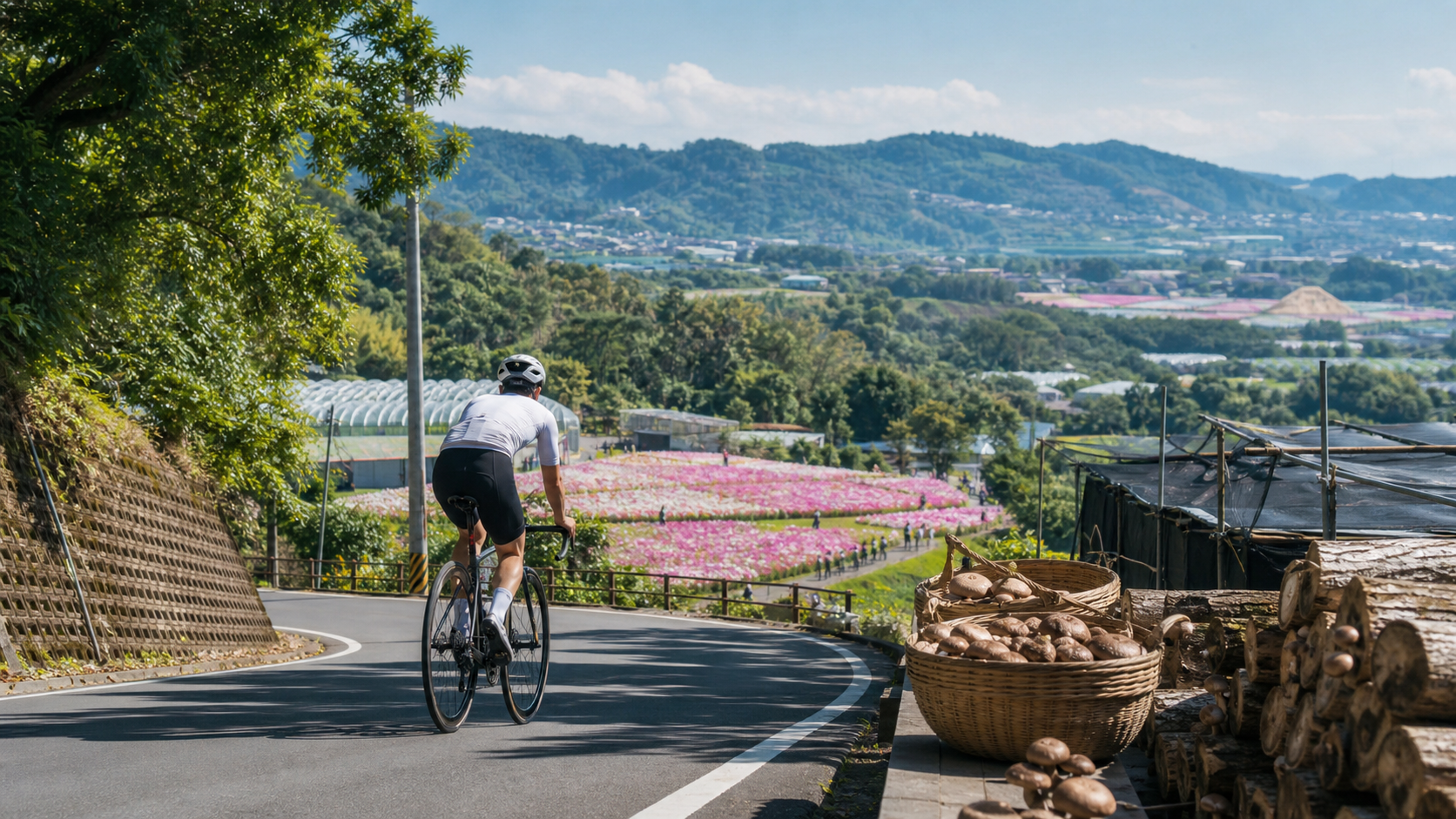
For Taichung residents, Xinshe is a name that carries a seasonal magic. When winter arrives, visitors from across Taiwan flock to the Xinshe Flower Sea, turning the entire terrace into a palette of colors. For cyclists, the 8.49-kilometer gentle climb to Xinshe—with an average gradient of just 3.6%—is an everyday joy that can be ridden year-round. It starts from the bustling Dongshan Road in Dakeng, crosses the hub of Zhongxingling, and finally delivers you into the open embrace of the Xinshe Terrace. In this article, I want to take you, at the speed of a spinning wheel, to truly get to know the scenery, flavors, and stories along this road.
Zhongxingling: The Crossroads of a Mountain Town
Climbing up from Dakeng, Zhongxingling is an unmissable landmark. Its name sounds like a mountain pass, but in reality it feels more like the crossroads of a mountain town—heading north and descending leads to Xinshe, heading east and going deeper leads to Guguan, and looking back, the entire Taichung Basin spreads out before you. No wonder cyclists call it “the well-connected Zhongxingling,” the perfect starting point for challenging mountain rides.
When I ride up to Zhongxingling, I always stop to catch my breath. It’s not that I can’t pedal any further, but rather that the scenery here deserves a pause. As altitude increases, the humidity and temperature in the air change, leaving the sweltering heat of downtown Taichung behind. Looking back, the basin unfolds at your feet; looking ahead, the road to Xinshe winds into deeper greenery. This feeling of “standing on a watershed” is something flat-road riding can never offer.
Xinshe Terrace: A Highland Carved by Streams
Crossing Zhongxingling and gliding toward Xinshe, the terrain eases and the world before you suddenly opens up. Xinshe is a river-terrace highland, shaped over the years by the cutting and depositing of the Dajia River and its tributaries. The terrace is gently sloping, with wide diurnal temperature swings and pure water quality—conditions that nurture Xinshe’s two most famous products: flower seas and mushrooms.
The winter Xinshe Flower Sea is the star—cosmos, sunflowers, and salvia spread across the terrace in vast blocks of color, making it one of Taiwan’s most renowned flower-viewing destinations. But if you think Xinshe is only beautiful in winter, you’d be underestimating it. In spring, Xinshe glows with vibrant green; in summer, rainbows often appear after afternoon thunderstorms; and in autumn, cool breezes sweep across golden rice waves. Each season gives Xinshe its own expression.
And mushrooms are Xinshe’s quiet pride. Xinshe is a major mushroom-producing region in Taiwan. Walking into the town center, you’ll see mushroom signs, mushroom-based restaurants, and creative snacks like mushroom cookies and mushroom ice cream everywhere. When you’re tired from riding, a steaming bowl of mushroom chicken soup or a plate of fried mushrooms delivers a savory sweetness that tastes of the terrace’s soil and water.
Baileng Canal: A Century-Old Water Vein That Feeds the Terrace
If you’re willing to linger a little longer in Xinshe, don’t miss the story of the Baileng Canal. Built during the Japanese colonial era, this irrigation canal was an engineering feat designed to bring water from the Dajia River up to the Xinshe Terrace. Engineers constructed inverted siphons that allowed water to cross valleys and climb against gravity—a classic achievement in Taiwan’s irrigation history. For nearly a century, the Baileng Canal has quietly nourished this terrace, transforming Xinshe from an arid highland into fertile ground for sugarcane, flowers, and mushrooms.
Riding through Xinshe and looking at this bountiful terrace, it’s hard not to feel respect for this canal. It reminds us that the beauty and food before our eyes were earned through the wisdom and sweat of those who came before us. This depth of history turns a cycling trip into something more than exercise—it becomes a dialogue with the land.
Flavors and Warmth Along the Way
The most enchanting thing about the Dakeng-to-Xinshe route is its sense of “everydayness.” It’s not a route that requires a long pilgrimage; it’s a stretch that Taichung cyclists can casually ride on a weekend. Precisely because of that, the scenery and human warmth along the way feel especially authentic.
- The 7-Eleven at Dakeng Circle: This is where every story begins. Cyclists gather here to refill water, chat, and tease each other about who’s in good form today and who drank too much last night. The arcade of this convenience store is a microcosm of Taichung’s cycling community.
- Orchards on the hillside: The Dongshan area is rich in citrus and lychees. When the season is right, roadside fruit stands offer the freshest refueling. (I won’t name specific stalls since they appear seasonally, but that freshly picked sweetness is worth slowing down to find.)
- The mushroom aroma of Xinshe: Upon arriving in Xinshe, the air itself seems to carry the umami of mushrooms. Sitting down at a local restaurant is the perfect way to end this journey.
The Meaning of Slow Riding: It’s Not About Arriving
I often feel that the Dakeng-to-Xinshe road is best suited for “slow riding.” Its gradient is gentle enough that you don’t have to grit your teeth and push through; its distance is moderate enough that you have the leisure to look around. A road like this shouldn’t be used for sprinting—it should be used for feeling.
Feel the light filtering through the acacia groves, feel the cool breeze that hits your face as you cross Zhongxingling, feel that moment of openness when the Xinshe Terrace unfolds before you, and feel the satisfaction that warms you from the stomach after a bowl of mushroom soup. The meaning of cycling has never been just about getting faster or stronger—it’s about reconnecting with the land and with your own breath in the rhythm of the pedal stroke.
Suggested Side Trips
If you’d like to turn this ride into a full day of light travel:
- Morning: Set out from Dakeng, ride slowly up to Zhongxingling, and cross over toward Xinshe. Stop often along the way—there’s no rush.
- Noon: Find a mushroom-based restaurant in Xinshe’s town center and enjoy a hearty lunch.
- Afternoon: If the season is right, visit the Xinshe Flower Sea; otherwise, explore the Baileng Canal route and appreciate the ingenuity of the irrigation works. The Xinshe area also has many European-style manors and scenic restaurants, perfect for sitting down with a cup of coffee.
- Evening: Return to Dakeng along the same route or via other country roads, making sure to descend before dark.
Xinshe’s Four Seasons: A Terrace That Changes Color
What’s most captivating about Xinshe is how its expression shifts with the seasons.
In winter, the Xinshe Flower Sea takes center stage. Every year as winter sets in, fallow farmland on the terrace is planted with cosmos, sunflowers, salvia, and other flowers, creating vast swaths of brilliant color—a nationally renowned flower-viewing event. Riding along the country roads at the edge of the flower sea, with endless flower fields on both sides, that visual impact is a gift unique to Xinshe’s winter.
In spring, the flower sea takes its final bow and the terrace returns to lush green. At this time, Xinshe’s air is fresh and the climate pleasant—one of the most comfortable seasons for cycling. Fruit trees sprout, vegetable plots turn verdant, and the entire terrace brims with vitality.
In summer, afternoon thunderstorms are common in Xinshe. After the rain, rainbows often arch over the terrace and mountain mists drift through the valleys—a favorite time for photography enthusiasts. Just be mindful of afternoon thunderstorms when riding; if rain hits on the descent toward Xinshe, be sure to slow down.
In autumn, cool breezes sweep across the terrace and golden waves of rice ripple in the wind. At this time, Xinshe carries the air of harvest—the most poetic season of the year.
The Mushroom Kingdom: A Story of Coexistence with the Land
Behind Xinshe’s status as a major mushroom-producing region in Taiwan lies a story of people and land coexisting.
The Xinshe Terrace’s wide diurnal temperature swings, pure water, and humid air create a microclimate that is ideal for mushroom cultivation. Walking into Xinshe’s town center, you’ll see mushroom signs, mushroom houses, and mushroom-based restaurants everywhere. Locals have pushed the possibilities of mushrooms to the limit—freshly harvested mushroom chicken soup, crispy fried mushrooms, mushroom cookies, and even mushroom ice cream are all taste experiences not to be missed when visiting Xinshe.
When you’re tired from riding, find a local restaurant and order a steaming bowl of mushroom chicken soup. That savory sweetness warms you from the tip of your tongue to your stomach—it’s the taste of the terrace’s soil and water, and the best fuel for any cyclist. (There are many local eateries, each with its own character. I won’t name specific restaurants—just walk through Xinshe’s town center, and it’s hard not to be drawn in by the aroma of mushrooms.)
Baileng Canal: The Legend of a Water Vein That Crosses Mountains
The Xinshe Terrace’s transformation from an arid highland into fertile soil was made possible by a marvel of hydraulic engineering built during the Japanese colonial era—the Baileng Canal.
Back then, to bring water from the Dajia River up to the higher-elevation Xinshe Terrace, engineers designed “inverted siphons”—using the principle of communicating vessels to let water descend into valleys and then climb back up, overcoming the obstacles of terrain. At the time, this was extremely advanced engineering. For nearly a century, the Baileng Canal has steadily delivered the Dajia River’s water to Xinshe, nourishing the sugarcane, flowers, and mushrooms on this terrace.
Riding through Xinshe and seeing this bountiful scene, it’s hard not to feel admiration for this canal. It reminds us that the beauty and food before our eyes were earned through the wisdom and sweat of those who came before us. Walk a stretch along the Baileng Canal and look at those waterworks that have weathered the years—you’ll gain a deeper understanding of, and affection for, this terrace.
The Philosophy of Slow Riding: Giving the Scenery Back to Speed
The road from Dakeng to Xinshe is best suited for “slow riding.” Its gradient is gentle enough and its distance moderate—it doesn’t demand that you grit your teeth and push hard, but instead gives you the leisure to look around.
I often feel that the greatest pity in cycling is treating a beautiful road as merely “a distance to be covered as quickly as possible.” When you’re fixated on speed, staring at the numbers on your bike computer, you’ll miss the light filtering through the acacia groves, the cool breeze that hits your face as you cross Zhongxing Ridge, and that instant of openness when the Xinshe Plateau unfolds before you. These are sights only those who slow down can see.
Slow riding isn’t laziness; it’s a choice—a choice to give the speed back to the scenery and your attention back to the present. On this main artery, occasionally let go of your obsession with performance, pedal at a leisurely pace, and let the scenery and the warmth of the people become the true rewards of the journey.
Xinshe’s European-Style Estates: An Exotic Corner on the Plateau
Beyond the flower seas and mushrooms, the Xinshe Plateau holds another unexpected sight—European-style estates and landscape restaurants scattered across the land.
Thanks to its pleasant climate and expansive views, this cool, elevated plateau has in recent years attracted a number of European-style manors, castle-inspired buildings, and landscape cafés. As you ride through Xinshe’s country roads, a sudden turn might reveal a castle that seems to have been transported straight from Europe, or a garden surrounded by roses and hydrangeas. This contrast of “encountering foreign charm in Taiwan’s mountains” is Xinshe’s unique appeal.
For riders, these estates make excellent rest stops. When you’re tired from climbing, find a café with a terrace, sit down, order a coffee and a dessert, and watch the greenery of the plateau and the distant mountains as the fatigue from the climb slowly melts away. This kind of “leisure earned through sweat” is more precious than anything else. (The operating status of estates and restaurants may change, so it’s advisable to check their business information before visiting.)
Zhongxing Ridge: Day and Night
Zhongxing Ridge is the soul landmark of this road, and it wears a different expression at different times of day.
Early morning belongs to the cycling community. Zhongxing Ridge is the hub for routes to Xinshe, Guguan, and Dasanyuan, and in the early hours, groups of riders often pass through, gather, and take a brief rest here. The air is cool, the visibility is clear—it’s the most comfortable time to ride, and it carries the most vibrant sense of camaraderie.
During the day, Zhongxing Ridge bustles with traffic, serving as the essential passage for sightseers heading to Xinshe. Holidays are especially lively, with tourists, cyclists, and motorcyclists all interweaving.
In the evening and at night, the Zhongxing Ridge area is also one of Taichung’s spots for viewing the night scenery. Gazing from the ridgeline toward the Taichung Basin as the city lights begin to glow, there’s a unique charm to it. However, night riding demands careful attention to lighting and safety.
The same Zhongxing Ridge, at different times of day, reveals different facets of riding, sightseeing, and scenery appreciation. This diversity is precisely what proves this road’s role as a “main artery”—it connects so many people, so many destinations, and so many stories.
One Road, Connecting a City’s Daily Life
I often feel that the most moving thing about the Dakeng-to-Xinshe road isn’t any particular scenic spot, but its existence as part of “everyday life.”
It’s not like Wuling, a sacred destination requiring a long, dedicated pilgrimage. It’s a stretch that Taichung riders can casually pedal on any weekend. Precisely because it’s so ordinary, it carries the most authentic life—riders gathering at dawn, farmers picking fruit on the mountainside, tourists heading to Xinshe, families admiring flowers, couples enjoying the night view. This road is like a blood vessel, steadily transporting and connecting the daily life of Taichung’s mountain towns, bit by bit.
Riding on this road, you’re not just climbing a slope; you’re riding the pulse of a city’s everyday life. This grounded sense of “being part of the everyday” is something those distant, magnificent mountains can’t offer. Sometimes, the best scenery is hidden on the most ordinary roads.
For Those Who Want to Ride Slow
If you want to truly experience this road, my advice is: don’t rush.
Pick a morning or afternoon with good weather, and set off at a leisurely pace. Stop at Zhongxing Ridge, take a sip of water, and enjoy the view; sit a while at one of Xinshe’s estates and have a coffee; buy some seasonal fruit at a roadside stand on the mountainside. Let this ride be more than just exercise—let it be a slow conversation with Taichung’s mountain towns. When you’re willing to slow down, this seemingly ordinary main artery will reward you with the richest beauty of everyday life.
Xinshe Flower Sea: A Winter Spectacle Captivating All of Taiwan
When talking about Xinshe, one cannot skip the flower sea spectacle that takes center stage every winter and captures nationwide attention.
Each year as winter arrives, the fallow farmland across the Xinshe Plateau is planted with cosmos, sunflowers, salvia, sage, and other colorful blooms, forming a vast patchwork of vibrant hues. Viewed from above, the entire plateau resembles a giant palette—one of Taiwan’s most famous flower-viewing destinations. Every flower season, visitors pour in from across the island, all hoping to witness this sea of blossoms.
For riders, cycling through Xinshe during flower season is a unique pleasure. You don’t have to jostle through crowds, park, and walk; instead, you pedal along the edges of the flower fields and through the country lanes. On both sides stretch endless flower farms, the breeze carries the scent of blossoms, and misty clouds wreathe the distant mountains. This experience of “viewing flowers at cycling speed” is freer and more delightful than driving or walking. (The schedule, locations, and scale of the flower sea are adjusted each year; it’s advisable to check the current year’s event information before visiting, and to be mindful of traffic management during the season.)
The Taste of Mushrooms: A Bite of the Plateau’s Freshness
A trip to Xinshe without tasting its mushrooms is a trip wasted.
Xinshe is a major mushroom-producing region in Taiwan. The plateau’s day-night temperature differences, pure water, and humid air nurture mushrooms of exceptional quality. Walking into downtown Xinshe, you’ll see mushroom signs, mushroom-house structures, and restaurants serving mushroom dishes everywhere. Locals have pushed the possibilities of mushrooms to the limit—freshly harvested mushroom chicken soup, deep-fried mushrooms, mushroom cookies, and even mushroom ice cream. The variety is endless.
When you’re tired from riding, find a local restaurant and order a steaming bowl of mushroom chicken soup. The plump mushrooms, soaked with the savory broth, burst with sweet, juicy flavor the moment you bite into them, warming you from the tip of your tongue all the way to your stomach. That taste is the essence of the plateau’s soil and water—and the finest reward for a rider who’s worked up a sweat. (There are many local eateries, each with its own character; just stroll through downtown Xinshe, and it’s hard not to be drawn in by the aroma of mushrooms.)
Scenery You Can Only See When You Slow Down
I’ve always believed that the best way to ride the Dakeng-to-Xinshe road is “slow.”
Its gradient is gentle enough and its distance moderate—it doesn’t demand that you grit your teeth and push hard, but instead gives you the leisure to look around. When you’re willing to slow down, this road rewards you with sights you’d miss at speed—the light filtering through the acacia groves, the cool breeze hitting your face as you cross Zhongxing Ridge, that instant of openness when the Xinshe Plateau unfolds before you, the smiles of fruit farmers on the mountainside, and the laughter of fellow riders under the convenience store’s awning.
These scenes and human connections are visible only to those who slow down. The greatest pity in cycling is treating a road full of character as merely “a distance to be covered as quickly as possible.” Occasionally, let go of your obsession with performance and speed, and let the scenery, the flavors, and the warmth of people become the true rewards of the journey at a leisurely pace. You’ll discover that a slow ride from Dakeng to Xinshe lingers in your memory far more than any desperate sprint. This is the gentlest invitation from this main artery of Taichung’s mountain towns.
Finding the Extraordinary in the Everyday
The road from Dakeng to Xinshe is a daily companion familiar to every Taichung rider. So familiar, in fact, that many have ridden it hundreds of times without ever truly “seeing” it. That’s a real pity—because the most moving scenery is often hidden in the everyday we take for granted; we’ve simply forgotten to stop and appreciate it.
I used to be that way too. I treated this road as a pure training stretch, thinking only of power, heart rate, and time—my eyes fixed on numbers, blind to the scenery. It wasn’t until one day, when I deliberately slowed down, that I truly saw it for the first time—the morning light on Zhongxing Ridge, the openness of the Xinshe Plateau, the smiles of fruit farmers on the mountainside, the human warmth under the convenience store’s awning. The beauty that had always been there, yet I’d overlooked, suddenly surfaced one by one.
From then on, I understood that happiness needn’t be sought far away. It isn’t in distant foreign lands or magnificent famous mountains, but in the everyday we pass through daily yet fail to see. Learning to find the extraordinary in the ordinary, learning to rediscover wonder in familiar scenery—this is both a skill and an attitude toward life. The everyday road from Dakeng to Xinshe reminds me, through its unpretentious beauty: slow down, look closely, and you’ll realize you’ve been living amidst such abundant scenery all along. This ability to “find the extraordinary in the everyday” may well be the deepest gift this road offers to every rider in Taichung.
Cycling Is a Way of Life
For me, cycling has never been just a sport—it is a way of life. The route from Dakeng to Xinshe embodies this attitude perfectly: it does not rush you, does not push you, but gently invites you to experience the beauty of this land at your own pace.
This attitude is about knowing how to slow down, how to appreciate, how to be content, and how to find happiness in the ordinary. It gives you a space in the midst of a busy life to catch your breath, to settle your thoughts, and to reconnect with yourself and the land. When you treat cycling as a way of life rather than merely a means to burn calories, you will find that every time you step on the pedals, you are putting a beautiful life into practice. May this road through the Taichung mountain towns accompany you, riding this calm and abundant way of life into your days, one day at a time.
A Leisurely Ride, a Good Mood
Life is already fast and tiring enough. Every day we are chased by schedules, drowned in messages, and overwhelmed by all kinds of pressure. That is precisely why we need a leisurely ride—a ride that does not chase time or results, but simply lets you breathe. The gentle road from Dakeng to Xinshe is the perfect choice for such a ride. It does not push you or hurry you; it simply keeps you company in silence, letting your tense nerves loosen bit by bit with each pedal stroke. May you occasionally set aside your obsession with efficiency, take a slow ride on this road, and trade the fine mountains, waters, and air for a rare good mood. You will find that the healing power of a leisurely ride surpasses a thousand words of comfort.
Conclusion
Dakeng to Xinshe: 8.49 kilometers, average grade 3.6%. These numbers define a road that is “not hard,” but they cannot define its significance. This road is the daily aorta for Taichung cyclists, a sweet corridor leading to flower seas and mushroom aromas, and a journey that lets you slow down with every pedal stroke and fall in love with the Taichung mountain towns. It has the hub of Zhongxingling, the flower seas of Xinshe, the century-old legend of the Baileng Canal, the sweetness of mushrooms, and the changing seasons of the plateau. Next time, do not just chase steeper and farther challenges—come to Dakeng, head to Xinshe, and let this gentle slope show you the softest and most flavorful side of Taichung.
Related Reading
- Rural Cycling from Dakeng to Xinshe in Taichung: The Best Easy Weekend Route in Central Taiwan
- Dakeng to Xinshe Practical Guide: An 8.5km Gentle Slope Connecting Zhongxingling, the Main Training Artery of Taichung
- Dakeng to Xinshe Flower Sea Route in Taichung: A Rolling Hills Ride Through Central Taiwan’s Floral Landscapes
- Cycling Routes Along the Dakeng Hiking Trails in Taichung
嘉義大埔、阿婆灣挑戰賽,美到以為在日本!ft. 環騎5 Cool 西拉雅188 / 公路車 / CT Yeh
7 個月前
台中大雪山 膏王領騎 震到都沒畫面了 公路車
5 年前
爬坡ITT實境)台中 魔王 松鼠坡 首航 6:12 大肚山 大三元 科福路
8 年前
新竹羅平 x 天湖部落 大禹嶺級變態陡坡! 4K超高畫質 空拍 | 公路車
5 年前
藤枝二集團 單車行 Day1 | 南部小武嶺 | 爬坡爬到罵罵叫 | JJSC | 公路車 | CT Yeh
3 年前
那瑪夏x茶山 阿里山系深山單車行 Day2 累積爬升6000M | 🥶超陡連續下坡 整路看隊友刷 | 爬升一座西進武嶺 | JJSC | 公路車 | CT Yeh
3 年前
阿里山塔塔加 兩倍特濃版!全新隧道開通! 進喔!公路車 | CT Yeh
3 年前
台北闊瀨陡坡 騎旅 / 日本單車雜誌編輯車友臨時加入!/ 髮香才是最強的 / feat. 北迴歸線小隊 / 公路車 CT Yeh
6 個月前