Dadu Wanggaoliao Climbing Guide: A 3.5km Urban Short Hard Climb at Nearly 6% and the "Blue Highway" 12% Challenge
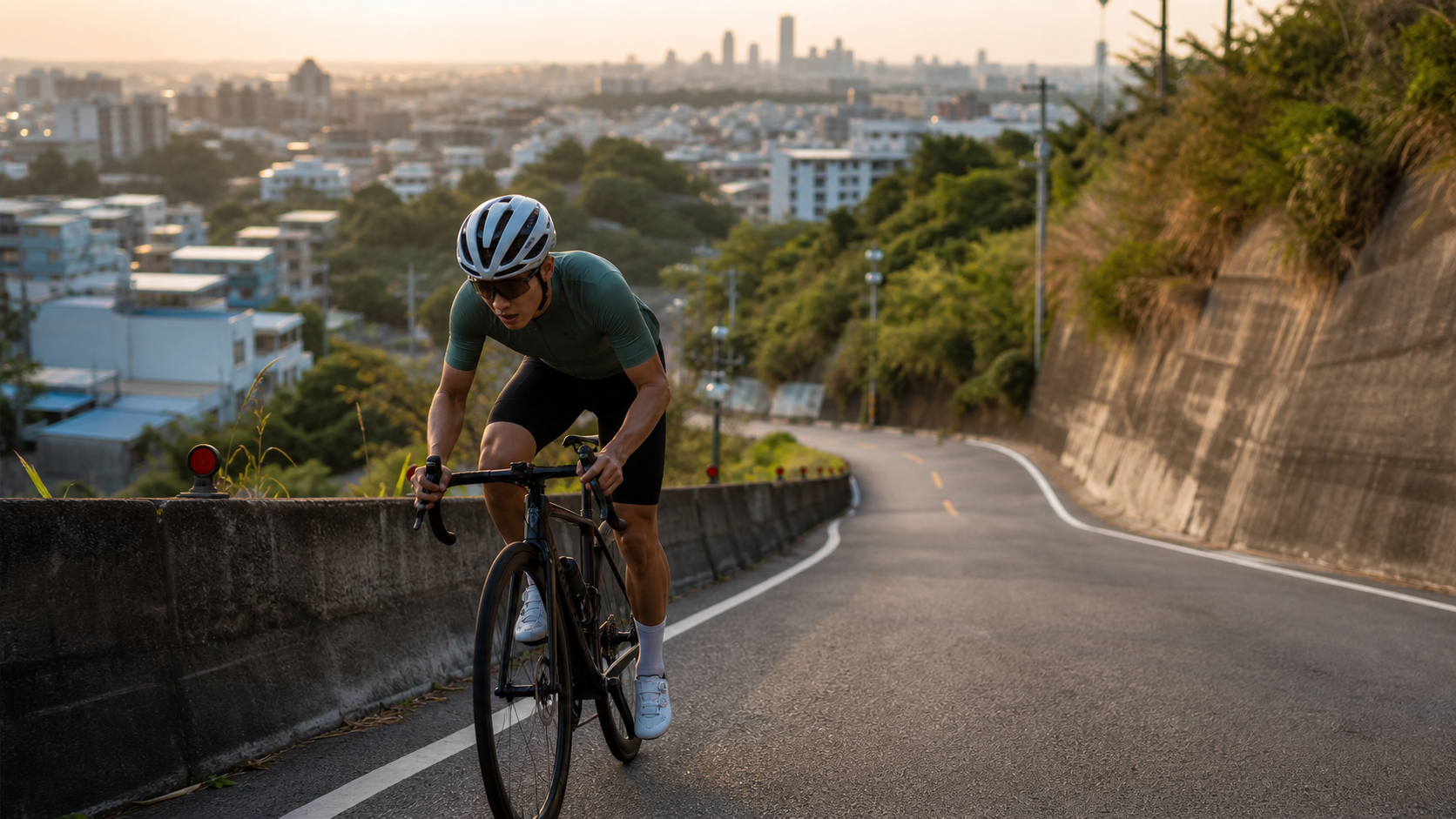
In Taichung, if you live on the coastal side, are short on time, yet want a climb that truly pushes your heart rate, the answer is likely Dadu Wanggaoliao. The route is only 3.51 km long, but features 207 meters of elevation gain and an average gradient of 5.9%, with the steepest section on Huanan Road’s “Blue Highway” approaching 12%. It’s short—short enough to ride out-and-back during a lunch break; it’s hard—hard enough to give your lactate threshold a solid beating. For urban cyclists seeking “time efficiency,” Wanggaoliao is a perfect climbing treadmill. This article uses data to help you squeeze every drop out of this short, steep climb.
Route Overview and Data Analysis
| Item | Data |
|---|---|
| Total Route Length | Approx. 3.51 km |
| Total Elevation Gain | Approx. 207 m |
| Average Gradient | 5.9% |
| Steepest Section | Huanan Road “Blue Highway,” steepest at approx. 12% |
| Location | Southern Dadu Mountain, at the border of Dadu District and Nantun District |
| High Point | Wanggaoliao Night View Park (Wangtian Cliff high point) |
| Route Category | Urban short steep climb |
Wanggaoliao sits at the high point of Wangtian Cliff on the southern side of Dadu Mountain, with steep terrain on three sides, offering panoramic views of Taichung’s eastern, western, and southern landscapes. This “high point” geography is precisely the source of its climbing intensity—in just 3.5 km, you gain over 200 meters, with an average of nearly 6% and localized 12% gradients, making for an extremely high intensity density. The “Blue Highway” on Huanan Road in front of the Motor Vehicles Office reaches a steepness of up to 12%, making it a well-known leg-strengthening route for Taichung cycling enthusiasts.
Section-by-Section Guide
Section 1: Starting from the Foothills (0–1 km, 4–5% gradient)
Starting from the Dadu Mountain foothills, the gradient begins with a 4% to 5% warm-up. This section is lined with campuses (around Ling Tung University) and residential areas, with fairly heavy traffic, so be especially cautious during school drop-off and pick-up times. Since the total length is only 3.5 km, there’s limited warm-up room, so it’s recommended to spin on flat ground for 10–15 minutes before the climb to get your body warmed up. If you hit it cold without warming up, the high intensity of this short climb will send your heart rate through the roof instantly.
Section 2: Blue Highway Steep Climb (1–2.5 km, 8–12% gradient)
This is the soul of Wanggaoliao—the “Blue Highway” on Huanan Road. The gradient ramps up relentlessly from a comfortable 5%, with the steepest sections approaching 12%. This section is where the route’s true value lies, and also where most riders “hit the wall.” Before entering the steep section, be sure to shift into your easiest gear and maintain a cadence of 60–70 rpm (a slight drop in cadence on steep climbs is normal, but don’t go below 55, or your knees will bear too much load). Shift your body weight forward to keep the front wheel down, relax your upper body, grip the tops or the hoods, and stay seated as your primary position. If you truly can’t hold on, you can briefly stand and sprint for 20–30 meters to engage a different muscle group, but sit back down immediately afterward to resume your cadence. This section is all about “dancing on the red line.”
Section 3: Finishing at the High Point (2.5–3.51 km, 5–6% gradient)
After surviving the steepest part of the Blue Highway, the gradient eases back to 5%–6% as you approach Wanggaoliao Night View Park. This final kilometer is where you’ll be tested on whether you mismanaged your pacing earlier. Upon reaching the high point, you’re greeted by the expansive vista of the Taichung Basin, the Changhua Plain, and even Taichung Port—this is Wanggaoliao’s reward for those who put in the effort.
Gear and Equipment Recommendations
Wanggaoliao is short and steep, making gear selection crucial to success:
- Chainring/Cassette: A compact crank (50/34T) paired with an 11–30T or 11–32T cassette is a solid choice. On 12% gradients, you need 34×30 or 34×32 to maintain enough cadence. If you’re a heavier rider or have had knee injuries, don’t stubbornly push big gears.
- Wheelset: For training purposes, a standard aluminum rim is sufficient. This short climb doesn’t require expensive lightweight wheels.
- Tire Pressure: Note that the descent has corners, so don’t inflate tires too high.
- Brakes: Check your brakes before descending back to the city. The Blue Highway descent is steep and winding, and brake failure would have serious consequences.
Nutrition and Hydration
- No heavy fueling needed for the short climb: A single 3.5 km ascent typically only requires a sip of water. However, the most common training method at Wanggaoliao is “repeated up-and-down intervals,” in which case you should hydrate on every lap and take in carbohydrates for sessions lasting over 60 minutes.
- Fuel up at the bottom: Convenience stores are available around Ling Tung University and Dadu—fill your bottles before departing.
- Night View Park Facilities: Public restrooms and parking spaces are available at the entrance to Wanggaoliao Night View Park, making it an excellent rest and turnaround point.
Weather and Seasons
- Rideable year-round: Wanggaoliao’s elevation is modest, making it suitable in all four seasons.
- Summer: Sun exposure on Dadu Mountain is intense; morning or evening rides are recommended. This is a well-known night-riding route, and heading up in the evening to enjoy the night view is a cherished ritual for Taichung cyclists.
- Winter: The northeast monsoon is strong on Dadu Mountain in winter, with gusty winds at the summit. The high point feels particularly cold, so dress warmly and watch for crosswinds.
- Night Riding Caution: The night view at Wanggaoliao is beautiful, but night rides require front and rear lights and reflective gear. Visibility on the Blue Highway descent is poor at night, so be sure to reduce speed.
Common Mistakes and Risks
- Hitting the climb without warming up: The short climb is high-intensity; tackling the Blue Highway cold will send your heart rate soaring and make cramping highly likely.
- Grinding too heavy a gear: Trying to conquer 12% with a big gear causes your cadence to drop below 50, leading to knee injury and forced dismounts from exhaustion.
- Neglecting lighting on night rides: Night riding at Wanggaoliao is popular, but without adequate lights and reflectors on the descent, combined with poor visibility in the hills, the risk is extremely high.
- Losing control on descending corners: The Blue Highway descent is steep and winding—this is the most dangerous part of Wanggaoliao. Be sure to control your speed.
Target Times by Rider Level (Single Ascent, 3.51 km)
| Rider Level | Reference Time | Corresponding Intensity |
|---|---|---|
| Beginner | 18–24 minutes | Goal is to complete the Blue Highway without dismounting |
| Intermediate | 13–18 minutes | Steady output on the steep section, no cramping |
| Competitive | 9–13 minutes | Nearly all-out anaerobic effort, chasing a PR |
Because the distance is short, this route is ideal for “climbing interval” workouts: sprint hard up the Blue Highway, coast down to recover, then sprint again, repeating 3–5 times—a highly efficient way to boost threshold power.
Why Short Climbs Are the Best Interval Training Ground
Wanggaoliao is only 3.51 km, and this “shortness” is precisely its greatest advantage as a training venue.
Long climbs (like Dasyueshan) build endurance and pacing discipline, while short climbs develop “anaerobic capacity” and “lactate tolerance”—the most direct path to improving FTP (Functional Threshold Power) and explosive power. The nearly 12% Blue Highway section at Wanggaoliao can push your heart rate and power to the limit in a short time, making it an ideal venue for high-intensity interval training (HIIT).
Wanggaoliao VO2max Interval Workout
- Warm up thoroughly for 15–20 minutes (including flat roads at the bottom plus a low-intensity partial ascent)
- Main set: Sprint hard up the Blue Highway steep section for 3–4 minutes (at your highest sustainable output), coast down for full recovery over 5–6 minutes, repeat 4–5 times
- Cool down for 10 minutes
This workout is highly effective for improving maximal oxygen uptake (VO2max). Because the distance is short and recovery is quick, you can complete high-quality interval stimulus within an hour, with time efficiency far surpassing that of traveling far to find a long climb.
Short-Climb Sprint (Building Anaerobic Explosiveness)
Use the steepest 30–60 seconds of the Blue Highway to sprint at near-maximal output, repeating several times. This kind of short, explosive stimulus enhances your ability to respond with bursts of power during “attacks” and “surges” in real races.
Safety Prerequisites for High-Intensity Training
The high intensity of Wanggaoliao is a double-edged sword. Used well, it brings rapid progress; used poorly, it easily leads to injury. A few safety prerequisites:
- Never skip the warm-up: The short climb is high-intensity. Going straight into the Blue Highway cold puts enormous strain on your heart and muscles, with high risk of cramps and pulls. Be sure to warm up progressively for at least 15 minutes.
- Control the number of reps: High-intensity intervals are taxing. For beginners, 3–4 reps per session is enough—don’t overdo it. Overtraining only hampers recovery and progress.
- Watch your knees: On a 12% steep climb, grinding with too heavy a gear puts extreme load on the knees. Be sure to use a light enough gear and maintain your cadence.
- Recover fully: Between reps, recover completely (heart rate back down near your normal level). Otherwise, the quality of later reps drops and injury risk increases.
The Urban Rider’s Time-Management Gem
Wanggaoliao’s greatest value lies in how friendly it is to “time-constrained urban riders.”
For riders living in Taichung’s coastal areas, Dadu, or Nantun, a quick trip to Wanggaoliao is possible after work, during lunch breaks, or even before heading out in the morning. At 3.5 kilometers, including the round trip plus warm-up and cool-down, you can complete a high-quality session within an hour. This convenience—“no long travel needed, train close to home”—is the key to why it’s a favorite among local riders.
In today’s busy modern life, being able to find a climb close by that’s hard enough, short enough, and repeatable is a blessing. Wanggaoliao is that blessing for Taichung’s coastal riders—it makes “no time to ride” no longer an excuse.
Track the Data and See Yourself Grow
Wanggaoliao is short, controllable, and repeatable—making it the perfect target for tracking progress. Each ride, record:
- Completion time for the steep section of the Blue Highway
- Average power and average heart rate for that section
- Overall average cadence
When you notice “same heart rate, faster time” or “higher power, steadier cadence,” that’s hard proof of progress. Treat Wanggaoliao as your “fitness thermometer”—test yourself there regularly, and you’ll clearly see yourself getting stronger.
Steep-Climb Technique: Riding 12% Correctly
The steepest section of Wanggaoliao’s Blue Highway approaches 12%, and this gradient demands far more technique than gentle climbs. Mastering proper steep-climb technique is the key to conquering it safely and efficiently.
Climbing steep grades seated: This is the most economical approach. Shift your hips slightly back on the saddle, lean your upper body forward, hold the tops or the top of the brake hoods lightly, and engage your core to stabilize your pelvis. Use a “pedaling in circles” motion, applying force continuously through every phase of the pedal stroke. Maintain as high a cadence as possible (60–70 rpm on a steep climb is good), and don’t let it drop below 50 and start grinding.
Climbing steep grades out of the saddle: When seated climbing becomes unsustainable, or you want to switch muscle groups, a brief out-of-saddle effort works. The key to standing climbs is “the bike moves, the body doesn’t”—let the bike sway side to side with your pedaling while your core stays relatively stable, pressing your body weight onto the pedals rather than pulling the bars with arm strength. Standing climbs are highly aerobic, so use them only on the steepest short sections, then sit back down immediately to recover.
Weight distribution: On steep climbs, the front wheel tends to feel light or even lift because your weight shifts rearward. Be sure to lean your upper body forward appropriately, distributing weight onto the front wheel to maintain control.
Wanggaoliao’s safe, repeatable short steep climb is the best training ground for these techniques.
Periodizing Your Training Around Wanggaoliao
How should you fit high-intensity Wanggaoliao sessions into your training cycle to avoid overtraining? Here’s a reference framework:
- Base phase (winter): Focus on low-cadence strength work or moderate intensity; don’t overuse Wanggaoliao’s high intensity. The priority here is building a foundation.
- Build phase (spring): Begin incorporating threshold intervals and VO2max intervals at Wanggaoliao, 1–2 times per week, gradually increasing intensity.
- Peak phase (pre-race): Add short steep sprints and high-intensity intervals simulating race effort, but be sure to allow ample recovery.
- Recovery phase: Use Wanggaoliao for low-intensity climbing or rest completely to let the body recover.
The principle of high-intensity training is “stimulus + recovery = progress.” Stimulus without recovery only accumulates fatigue and can even cause injury. Use this blade of Wanggaoliao at the right time and it will bring rapid progress; use it at the wrong time, grinding day after day, and it will harm your body instead.
Competing with Peers: Making the Most of Strava Segments
The Blue Highway at Wanggaoliao is a well-known Strava segment among Taichung riders. This adds extra fun and motivation to training—competing against peers and against your past self.
The segment leaderboard on Strava records the results of countless riders on this climb. You can treat it as a “public fitness exam”—each ride, check your ranking and compare against your personal record (PR). This gamified mechanism effectively motivates you to stay consistent and pursue improvement.
But a reminder: chasing Strava results must be built on safety. Don’t take risks on descents, weave through traffic, or skip warm-ups to break a PR. A leaderboard ranking is never worth trading for an injury or an accident. Use Strava wisely—let it be a driver of progress, not a temptation to take risks.
Common Q&A: Practical Questions on Wanggaoliao Training
Q: What if the 12% Blue Highway is too steep to ride up?
First, check whether your gearing is light enough—a compact crank with an 11–32T cassette is the baseline. If you still can’t make it, your power-to-weight ratio needs improvement. You can start by building a base on gentler routes (such as Zhongzheng Campground) before returning to take on the challenge. Dismounting and walking part of the way is fine—every bit more you ride is progress.
Q: How often should I train at Wanggaoliao?
Wanggaoliao is high-intensity, so 1–2 high-intensity interval sessions per week is plenty. Fill the rest of the time with aerobic work and recovery. High-intensity training needs full recovery to translate into progress; training hard every day only accumulates fatigue.
Q: Is night riding at Wanggaoliao safe?
With proper preparation, night riding at Wanggaoliao is feasible and even charming. Be sure to have front and rear lights bright enough, wear reflective gear, and slow down significantly on descents. Avoid going alone late at night—riding with company is safer.
Q: Is Wanggaoliao suitable as a pre-race tune-up?
Very much so. It’s short, high-intensity, and quick to execute—a great choice for maintaining intensity and waking up the body before a race. But don’t overdo it in the days before the race, to avoid carrying fatigue into race day.
Make Wanggaoliao Your Personal Testing Ground
Wanggaoliao’s greatest value is that it can become your “personal fitness testing ground.” Because it’s short, controllable, and repeatable, it’s the ideal target for tracking progress and verifying training results.
It’s recommended to schedule a “Wanggaoliao time trial” every training cycle (for example, every four to six weeks)—after a full warm-up, ride the steep Blue Highway section at full effort, recording time, average power, and average heart rate. Save this data and compare it against past records.
When you find “same heart rate, faster time” or “higher power, same completion time,” that’s hard evidence of real fitness gains. This quantifiable, visible progress is the most effective way to sustain training motivation—it lets you clearly see your efforts bearing fruit.
And when a particular test shows a decline, don’t be discouraged—it’s a signal prompting you to review: Have you been training too little lately? Not resting enough? Or is there fatigue or something off in your body? Treat Wanggaoliao as an honest testing ground—it will objectively reflect your condition and help you make smarter training decisions. A short stretch of climb, used with the right approach, can become the best coach to accompany your long-term progress.
The Physiology Behind High-Intensity Intervals
Wanggaoliao’s status as an excellent interval training ground is backed by solid physiological principles. Understanding these principles can make your training more purposeful and more efficient.
About VO2max (Maximal Oxygen Uptake): This is a measure of your body’s ability to take in and utilize oxygen, and it represents the ceiling of aerobic performance. The most effective way to improve VO2max is to perform intervals “at near-maximal VO2 intensity, lasting 3–5 minutes.” The steep sections of Wanggaoliao’s Blue Highway naturally allow you to reach and sustain this intensity while climbing, making it a natural VO2max training ground.
About Lactate Threshold: This is the highest intensity you can sustain for an extended period. Through repeated threshold intervals, you can enhance your body’s ability to clear lactate and push your threshold higher. Wanggaoliao’s length and gradient are well-suited for threshold stimulation.
About Anaerobic Capacity: Short, explosive sprints (30–60 seconds) stimulate the anaerobic system, improving explosive power and lactate tolerance. The steepest short sections of Wanggaoliao are a great place to work on this.
About Recovery: The key to interval training lies not only in the “stimulus” but also in “recovery.” Adequate recovery between reps allows you to maintain quality on the next one. The descent on Wanggaoliao’s downhill glide serves as a natural recovery interval.
With this understanding of physiology, you can design a precise Wanggaoliao workout plan based on your training goals—if you want to improve VO2max, do 3–5 minute steep-slope intervals; if you want to raise your threshold, do longer sustained threshold efforts; if you want to boost explosiveness, do short sprints. When your training has clear physiological objectives, every drop of sweat you shed at Wanggaoliao translates into the most efficient progress possible. This is the difference between “understanding the principles” and “training blindly.”
The Philosophy of the Short Climb: Focus on the Present
This short, steep climb at Wanggaoliao embodies a philosophy of “focusing on the present moment.” Because it’s so short, you have no time to get distracted, no room to let your mind wander—from the moment you step onto the Blue Highway, you must devote your full attention to the steep slope ahead, pouring all your strength and all your focus into each and every pedal stroke of the present moment.
This forced focus is, in fact, a rare form of discipline. In our daily lives, our attention is constantly fragmented by countless things—phones, work, stray thoughts, anxiety. We rarely get to truly “live in the moment.” But Wanggaoliao’s steep slope, through its intensity, forces you to pull all your attention back to the present instant. In those few minutes, there is no past, no future—only you, your breath, your pedals, and the slope before you.
This kind of extreme focus brings a peculiar sense of calm. When you are fully immersed in the present, the worries that usually linger temporarily disappear; the distracting thoughts are drowned out by the rhythm of your pedaling. You enter a state close to “flow”—pure, focused, selfless. This is the unexpected gift Wanggaoliao’s short climb offers riders beyond physical training. It teaches us: sometimes, facing the challenge before you with complete focus is itself a form of healing; and learning to live in the present is our best weapon against this chaotic world.
Beyond Intensity, Don’t Forget Why You Started
Wanggaoliao is an extremely high-intensity training route—it pushes you to sweat, to break through limits, to get stronger. But in the pursuit of intensity, of data, of progress, I want to remind every rider—don’t forget the original passion that made you fall in love with cycling in the first place.
When we first got on a bike, it usually wasn’t for power numbers or results, but for that simple joy of the wind on our faces and the feeling of freedom. Training and improvement are certainly important, but if they turn cycling into a source of stress or burden, then we’ve gotten our priorities backwards. May you, while sweating profusely and chasing breakthroughs at Wanggaoliao, occasionally stop, climb to the top of the cliff, and take in the vast scenery—to reconnect with that original, simple joy. Intensity will make you stronger, but your original passion will carry you far. Balance both, and you’ll not only grow stronger on this cycling journey, but also stay happy throughout.
Treat Every Climb as an Investment in Yourself
Every climb up Wanggaoliao is hard work. But this effort is actually the most cost-effective investment you can make in yourself. Every drop of sweat you shed on the Blue Highway, every gasp for air, every steep section you push through—all of it is quietly making you stronger: a stronger heart and lungs, more powerful legs, a more resilient will. These gains won’t show up in a single day, but over time, they will repay you bit by bit. May you treat every Wanggaoliao climb as an investment in yourself—not seeking instant results, but focusing on steady accumulation. Because the sweat you shed today will, on some future climb or in some future challenge, become your most solid foundation. This is what makes training the fairest and most fascinating endeavor: every bit of effort you put in, your body will honestly remember, and at the right moment, repay you in kind.
Conclusion
Dadu Wanggaoliao: 3.51 kilometers, average gradient 5.9%, steepest section on the Blue Highway at 12%. It’s the most convenient training climb in the pockets of Taichung’s coastal-area riders—short enough to visit anytime, intense enough to command respect every time. It’s the best interval training ground, the friendliest time-management tool, and the most honest fitness thermometer. Gear up properly, warm up thoroughly, control your cadence, log your data—use this short, steep urban climb to earn a stronger heart and more powerful legs. Reach the summit, and let the expansive view of the Taichung Basin be the finest reward for your sweat.
Related Reading
- Taichung Blue Highway Guide: Huanan Road’s Steep Climb—Averaging 3.2% Yet Hiding a 19% Short Wall
- The Night-View Steep Climb on Dadu Mountain: Blue Highway, a Post-Work Ritual for Taichung Riders
- Wanggaoliao’s Nightscape and Cliffs: Climb Dadu Mountain for a Taiwanese Take on Hakodate’s Lights
- Daxueshan 32km Long Climb Practical Guide: The 1,557-Meter Endurance Mountain from Dongshi’s Gentle Ramp
台北闊瀨陡坡 騎旅 / 日本單車雜誌編輯車友臨時加入!/ 髮香才是最強的 / feat. 北迴歸線小隊 / 公路車 CT Yeh
6 個月前
爬坡ITT實境)台中 魔王 松鼠坡 首航 6:12 大肚山 大三元 科福路
8 年前
大武山20%魔王陡坡【JJSC南台灣遊騎Day2】!屁股真的要裂開了...凡士林抹滿也沒用?神秘金教堂還有超便宜夜市
3 個月前
2015/11/28 - 大肚溪夕陽自行車道 與 藍色公路 輕鬆騎
10 年前
新竹羅平 x 天湖部落 大禹嶺級變態陡坡! 4K超高畫質 空拍 | 公路車
5 年前
大武山後門26%歡樂陡坡!JJSC南台灣單車行Day2 / 被颱風追著跑 / 公路車 / CT Yeh
2 年前
半日 小台灣 極限單車路線挑戰實錄
7 年前
萬年峽谷! 30% 超激陡坡 里佳部落DAY2 還是很硬! | 公路車 | CT Yeh
3 年前