The Night View and Cliffs of Wanggaoliao: Riding Up Dadu Mountain for a Taiwanese Hakodate Cityscape
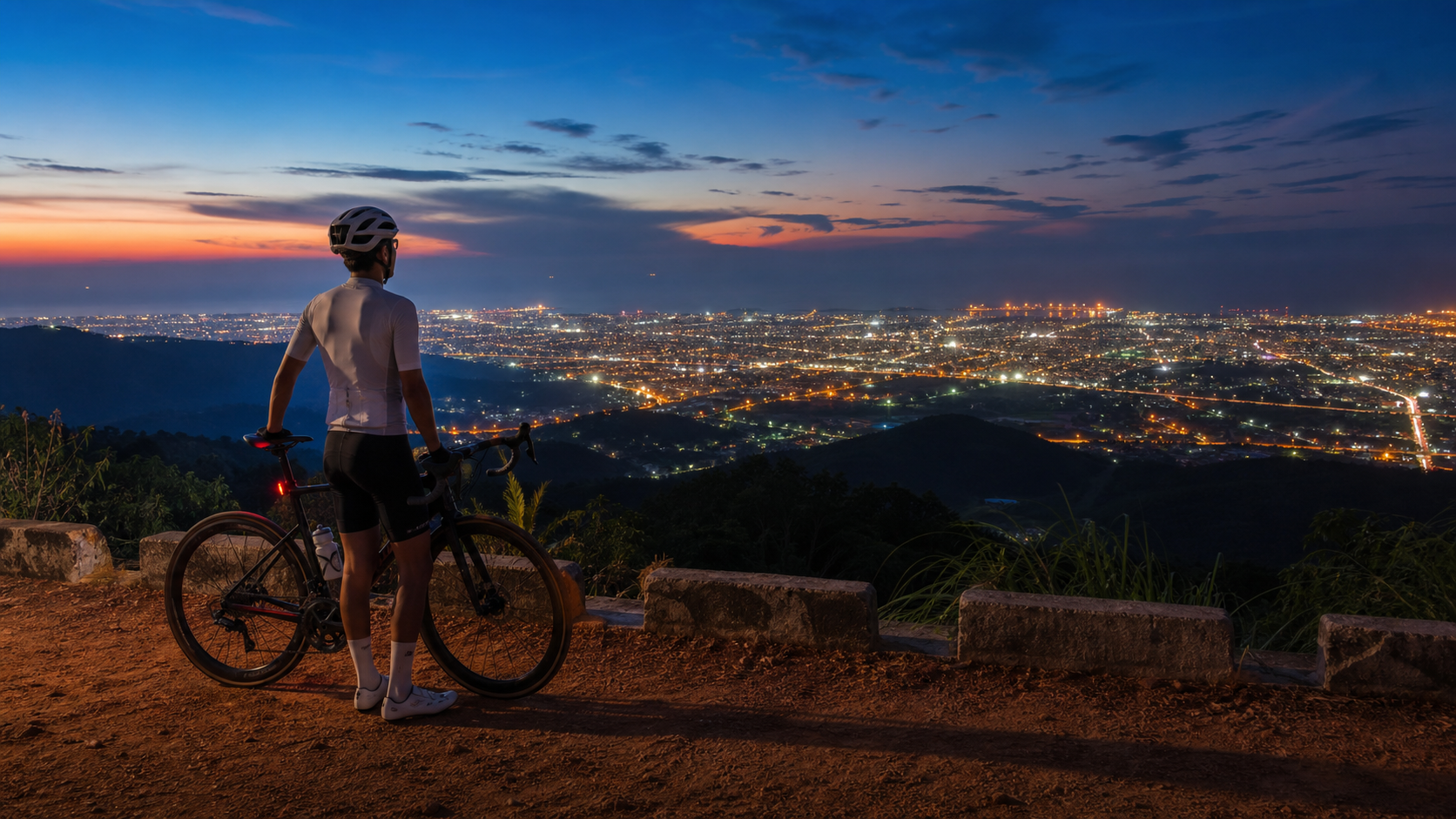
Taichung residents share an unspoken romantic landmark—Wanggaoliao. Perched at the southern edge of Dadu Mountain, at the high point of the Wangtian Cliffs, it is the first park in Taiwan themed around “night views.” Thanks to its superb elevation and panoramic views of downtown Taichung, it has earned the nickname “Taiwan’s Hakodate.” For cyclists, the 3.51-kilometer “Blue Highway” leading to Wanggaoliao—with an average gradient of 5.9% and sections approaching 12%—is a ritual of trading sweat for city lights. In this article, I want to take you beyond the bike computer and show you what truly makes Wanggaoliao moving.
Dadu Mountain: A Cliff Built of Red Soil
To understand Wanggaoliao, you first need to understand Dadu Mountain. This is an ancient laterite terrace stretching between the Taichung Basin and the coastal plain. Its surface layer is gravelly red soil stained by iron oxide. On the southwestern edge of the terrace, uplift and river downcutting have carved the steep “Wangtian Cliffs”—and Wanggaoliao stands at the very top of those cliffs.
Precisely because it sits on the cliff’s high point, Wanggaoliao’s terrain drops steeply on three sides: to the east, the Taichung cityscape unfolds; to the south, the vast Changhua Plain stretches to the coast; to the west, the entire Port of Taichung comes into view. This commanding, “all mountains look small beneath me” perspective is the fundamental reason it became a night-view mecca—and also the source of its climbing difficulty. With just 3.5 kilometers to reach the cliff top, how could it not be steep?
The Blue Highway: An Introduction Written in Leg Power
Riding up to Wanggaoliao inevitably means tackling the “Blue Highway” on Huanan Road. It’s a well-known leg-training route for Taichung cyclists, with grades up to 12%. For data-driven riders, it’s a hardcore workout; but for me, it’s more like an “introduction”—using physical effort to set the stage for the scenery at the summit.
I love pedaling up the Blue Highway in the late afternoon. The setting sun makes Dadu Mountain’s red soil even redder, sweat drips off my chin, and my breathing is as heavy as a bellows. Just when you think you can’t go on, the gradient eases, and Wanggaoliao arrives. You unclip your feet from the pedals and look up—the entire Taichung Basin is lighting up, one lamp at a time.
In that moment, all the suffering on the steep climb becomes worth it.
Taiwan’s Hakodate: A City Lighting Up One Lamp at a Time
The reason Wanggaoliao’s night view is compared to Hakodate lies in the layers of its lights. Hakodate is famous for the lights curving around a fan-shaped bay, while Wanggaoliao takes in the myriad lights of the entire Taichung Basin at a glance. As the sky shifts from blue to purple, then from purple to black, the city’s lights emerge one by one: first, the streetlights of main roads string together into golden lines; then, the window lights of high-rises and the neon of signs; finally, the whole basin becomes a flowing web of light.
Sitting at the cliff’s edge, the evening breeze blows in from the Changhua Plain, carrying the scent of the sea. In the distance, the lights of the Port of Taichung twinkle to the west; closer by, the city’s traffic flows like glowing veins. This view is Wanggaoliao’s gift to everyone willing to ride up the cliff. No wonder it’s Taichung’s most popular dating spot—countless couples have made promises to each other on this cliff, gazing at the city lights below.
Youth at the Foot of the Mountain: The Everyday Life of Lingtung and Dadu
At the base of Wanggaoliao lies Lingtung University of Science and Technology. Riding through the area, the air is always filled with a youthful energy—students leaving class, roadside snacks, young people chatting under convenience store awnings. This lively campus atmosphere forms an interesting contrast with the vast night view at the summit: on one side, the bustling human world; on the other, the serene starry sky, separated by just a 3.5-kilometer climb.
The Dadu area still retains the simplicity of a terrace settlement. Sweet potatoes grown in the red soil, traditional snacks at the foot of the mountain, old banyan trees in front of temple squares—these everyday scenes are another flavor worth slowing down to savor, beyond Wanggaoliao’s night view.
Time on the Cliff: Sunsets, New Year’s Eve, and Sunrises
What’s most enchanting about Wanggaoliao is the different faces it shows at different times.
- Sunset: Late afternoon is Wanggaoliao’s golden hour. The sun sinks toward the Taiwan Strait, setting the sky ablaze in orange and red—a paradise for photographers.
- Nightfall: As the city lights come on, the Taiwan’s Hakodate night view takes the stage—the perfect time for dates and quiet contemplation.
- New Year’s Eve and Sunrise: Every New Year’s Eve, Wanggaoliao is a popular spot for Taichung residents to welcome the first light of dawn. Watching the new year’s sun rise from beyond the mountains from the cliff’s high point is a deeply ceremonial experience.
Imagine: riding up the mountain, waiting for a sunset at the cliff’s edge, watching the city light up, then staying until the first rays of the new year—stringing together this entire passage of time with a bicycle is a romance only Wanggaoliao can offer.
What This Road Means to Cyclists
The road to Wanggaoliao isn’t long or far, yet it holds a special place in the hearts of Taichung cyclists. It’s the destination for “clearing your head after work,” the choice for “a date that shows some effort,” the solution for “no time to ride far today, but I want to break a sweat.” It gives you the most concentrated effort and the most abundant reward in the shortest distance.
More importantly, it stitches “exercise” and “life” together. You don’t need to drive, hunt for parking, or fight the crowds to see this night view; you can pedal up, sweating and gasping, trading physical labor for the vastness before your eyes. This kind of “scenery you rode up to yourself” is far more moving than any tourist’s perspective.
Suggested Itinerary
- Depart in the late afternoon: Avoid the daytime sun; hit the Blue Highway in the late afternoon and arrive just in time for sunset.
- Stay at the summit: Wanggaoliao Night View Park has viewing corridors, public restrooms, and parking spaces—a comfortable place to linger. Bring a windbreaker when viewing the night scene; the winds on the cliff are strong after dark.
- Refuel on the descent: Back in the Lingtung or Dadu area, stop by a snack shop or café to cap off the night ride.
- Safety reminder: When descending at night, be sure to turn on your lights and slow down. Visibility on the Blue Highway is poor after dark—romance aside, safety comes first.
The Story of Dadu Mountain: A Geological History Written in Red Soil
To truly read Wanggaoliao, you must first read the Dadu Mountain beneath it.
Dadu Mountain is an ancient laterite terrace stretching between the Taichung Basin and the coastal plain. Its surface is covered with a thick layer of red soil—gravel weathered over eons and stained by iron oxide. This red soil is poor and drains quickly, yet it nurtures unique vegetation and crops on Dadu Mountain (such as drought-resistant sweet potatoes).
On the southwestern edge, where Wanggaoliao sits, uplift and long-term river downcutting have formed the steep “Wangtian Cliffs.” These cliffs are Dadu Mountain’s most dramatic landform—on one side, the gentle terrace top; on the other, a sheer drop. In between, the Taichung Basin and Changhua Plain unfold before your eyes. Wanggaoliao stands at the highest point of these cliffs, a natural observation deck.
Once you understand this geological history, riding up to Wanggaoliao shows you not just a night view, but a story of the Earth written in red soil and cliffs over hundreds of millions of years.
The Name Wanggaoliao: A Memory of Ancestral Vigilance
The name “Wanggaoliao” itself holds a story.
In earlier times, this high point of Dadu Mountain—with its open views in every direction—was used by early settlers as a lookout. “Wanggaoliao” means “a hut for climbing high to keep watch.” In an era of unstable public security, the commanding view from above was a crucial vantage point for guarding the homeland and warning against bandits and invaders.
Today, Wanggaoliao has transformed from a stern watchtower into a romantic night-view park. But the geographic quality of “standing high and overlooking everything” has never changed. When you ride to the cliff top and watch the entire Taichung Basin spread out beneath you, you are standing in the same spot where your ancestors once kept watch over this land. The echo of history lives in that view.
The Blue Highway: A Cycling Culture Behind a Name
The section of Huanan Road with grades up to 12% is nicknamed the “Blue Highway” by cyclists. The origin of the name is debated, but it has become a symbol of Taichung’s cycling culture.
For cyclists on Taichung’s coastal side, “let’s go ride the Blue Highway today” is an unspoken code—it represents a short, pure self-challenge. Countless riders have trained their legs, set PRs, fallen, and gotten back up on this stretch. The Blue Highway isn’t long, yet it carries the collective memory of Taichung cyclists: those breathless mornings, those evening rides to see the lights, those moments of competing with and encouraging fellow riders.
A road earns its own name and culture because enough people have left their stories on it. The Blue Highway is exactly such a road—one that riders have “ridden into affection.”
The Romance and Discipline of Night Riding
Wanggaoliao is one of Taichung’s most famous night-riding routes. Pedaling up the Blue Highway in the late afternoon and watching the city light up from the cliff top is a romantic ritual for countless cyclists and couples. But the romance of night riding must be built on discipline.
- Lighting is a lifeline: At night, be sure to have front and rear lights bright enough to see the road and be seen by vehicles.
- Reflective gear: Reflective vests and ankle bands greatly improve nighttime visibility.
- Slow down on descents: On the Blue Highway at night, with poor visibility and hard-to-read road conditions, slow down significantly and anticipate curves.
- Ride with company: Night rides are safer with companions to look out for each other.
Romance and safety never conflict. With discipline in place, you can fully enjoy the beauty of Wanggaoliao’s night scene.
These Lights Are Reserved for Those Willing to Ride Up
I’ve always believed that the night view at Wanggaoliao is a completely different sight for those who drive up versus those who ride up.
Drivers see a beautiful sea of lights—pretty as it is, something is missing. But cyclists arrive sweating, gasping, having carried themselves up to the cliff top inch by inch with their own legs. When you finally reach the summit, unclip your feet, and watch the city’s lights flicker on one by one, your own effort and heartbeat are mixed into that glow. It’s not just scenery; it’s a reward you earned with your body.
This kind of “scenery you rode up to yourself” carries an indescribable weight. It makes Wanggaoliao’s night view deeper and more moving in your memory than any tourist’s perspective could ever be.
Taichung Seen from the Cliff: A Lesson in Urban Geography
Standing at the top of Wanggaoliao’s cliffs, what you see isn’t just a night view—it’s a three-dimensional geography lesson on Taichung.
To the east lies the Taichung Basin. The entire city spreads out beneath you—dense buildings, crisscrossing roads, twinkling lights. You can clearly discern the city’s texture: golden lines formed by main roads, bright clusters of high-rises, dark bands cut by green spaces and rivers. This is the heart of Taiwan’s second-largest city, beating before your eyes.
To the south, the view crosses the edge of Dadu Mountain and extends across the vast Changhua Plain to the coast. On clear days, you can even see the distant horizon. This plain is the breadbasket of central Taiwan.
To the west lies the direction of the Port of Taichung. In the distance, the harbor lights merge with the dusk over the Taiwan Strait. By day, you can see container ships and port facilities; by night, it’s a shimmering expanse of industrial light.
From this single point at Wanggaoliao, you can see a city, a plain, and a harbor all at once—this “three-in-one view” is a geographic gift unique to the high point of Dadu Mountain’s cliffs. Riding up here, you’re not just exercising your body; you’re reading the entire geographic layout of Taichung with your eyes.
The Red Soil Memory of Dadu Mountain
Beneath Wanggaoliao, Dadu Mountain is an ancient terrace built of red soil. This distinctive red earth records the geological memory of central Taiwan.
The red soil formed over eons as gravel weathered and iron oxide stained it. It’s poor and drains quickly, yet it nurtures drought-resistant vegetation and unique crops on Dadu Mountain—such as the famous Dadu sweet potatoes. This red-soil terrace was also an important military site and home to military dependents’ villages in modern Taiwan’s history, carrying the historical memory of recent times.
Riding across Dadu Mountain, beneath your wheels lies red soil weathered over hundreds of millions of years, overlaid with modern human history. This layering of “geological time” and “human time” gives the ride to Wanggaoliao an added depth of history.
Solitary Time on the Cliff
Wanggaoliao is a popular dating spot, always bustling with people. But what I love most is the time I spend there alone.
Avoiding the crowded weekend nights, I choose a weekday morning or dusk and ride up the Blue Highway by myself. When you reach the cliff top, if you’re lucky, the entire viewing area is yours alone. You can sit quietly at the edge, watch the sun rise or set, watch the city wake up or light up, thinking of nothing—just being there.
This solitary time on the cliff is a rare blank space in urban life. The city’s clamor is below you, and you’re up high, temporarily detached. The evening breeze blows past, carrying the scent of the Changhua Plain; in the distance, the lights of the Port of Taichung flicker on and off. In moments like these, many things that are hard to sort out in daily life suddenly become clear. Wanggaoliao isn’t just a romantic spot for dates—it’s also a healing place for solitude.
What This Cliff Taught Me
Having ridden Wanggaoliao so many times, this cliff has taught me one thing: The best scenery often has to be climbed to, inch by inch, on your own.
Those who drive up to Wanggaoliao see a ready-made night view; but those who ride up arrive sweating, gasping, having carried themselves to the cliff top with their own legs. The same sea of lights carries a completely different weight for the two. When you earn your scenery through effort, it stops being just scenery—it becomes proof of your effort, the reward for your persistence.
This principle applies beyond cycling. Many of life’s truly moving sights—a relationship, an achievement, a dream—aren’t given to you by others; you climb to them step by step yourself. The cliffs of Wanggaoliao, in the most direct way, have carved this lesson into the hearts of everyone willing to ride up.
The Seasonal Faces of Wanggaoliao
Though not high in elevation, Wanggaoliao—perched on the high point of Dadu Mountain’s cliffs with sweeping views—shows a different face in each season.
In spring, the red-soil terrace of Dadu Mountain sprouts fresh green, and the air carries a faint scent of grass. This is the season when Wanggaoliao’s climate is most pleasant for both riding and sightseeing.
In summer, Dadu Mountain is scorched by intense sun, making daytime rides up the Blue Highway especially grueling. But on summer nights, Wanggaoliao is a great place to cool off and enjoy the view—the evening breeze blows in from the Changhua Plain with a hint of coolness, and the city lights shimmer in the summer heat.
In autumn, the heat fades, the sky is high and clear, and visibility is excellent. This is the season of Wanggaoliao’s most expansive views—on clear days, you can see every corner of the Taichung Basin to the east and the horizon of the Port of Taichung and the Taiwan Strait to the west.
In winter, strong northeast monsoons sweep across Dadu Mountain, making the summit windy and chilly. But winter air is exceptionally clear, and the night view is exceptionally crisp. Every New Year’s Eve, Wanggaoliao is a popular spot for Taichung residents to welcome the first light of dawn.
The same cliff has different winds, different light, and different temperatures across the four seasons. And riding is the best way to feel these subtle changes.
When the Lights First Come On: The Most Moving Moment
If I had to pick the most moving moment of Wanggaoliao’s day, I would unhesitatingly choose “when the lights first come on.”
It’s that brief window between day and night. The sun has just sunk toward the Taiwan Strait, the sky still holds a blend of orange-red and purple-blue dusk, and the city’s lights are flickering on one by one. This process lasts only a dozen or so minutes, yet it’s Wanggaoliao’s most magical moment—the dusk in the sky and the lights on the ground exist simultaneously, warm and cool tones interweaving, the entire Taichung Basin like a flowing oil painting.
I always try to reach the summit just in time for this moment. After grinding up the Blue Highway and standing breathless at the cliff top, I catch the feast of light and shadow. Watching the sky shift from bright to dark and the lights from sparse to dense, that beauty of time flowing makes all the suffering on the steep climb pay off in an instant. This is Wanggaoliao’s most precious reward for those willing to ride up at the right moment.
One Cliff, Two Lives
Wanggaoliao’s cliff stands at the boundary between city and nature. And standing on that boundary, you gain a deep appreciation for “two lives.”
Below the cliff is the bustling, noisy city—dense buildings, crisscrossing roads, flowing traffic, myriad lights. That’s the world most of us live in day after day, with its excitement and its exhaustion.
Above the cliff is the vast, serene view—evening breeze, dusk, stars, and your own breath and heartbeat. It’s a world that lets you temporarily detach and breathe anew.
Riding up to Wanggaoliao is a brief migration from “below the cliff” to “above the cliff.” You use your legs to carry yourself from the city’s clamor to the cliff’s stillness; you stay up high for a while, let your mind settle, then ride back down to life below. This “temporary detachment and return” is the best healing Wanggaoliao offers city dwellers. It reminds us: no matter how busy or tired life gets, remember to occasionally ride up high, to give yourself a moment to breathe, a stretch of vastness, a measure of peace.
The View from Above: A Metaphor for Life
Every time I ride up to Wanggaoliao’s cliff and stand high above, looking down over the entire Taichung Basin, I feel a profound sense of insight. Down in the city, we’re surrounded by buildings, traffic, and trivialities; our view is narrow, we can’t see the whole picture, and we’re easily tripped up by the obstacles right in front of us. But once you ride up high and look down from the cliff top, everything becomes small and clear—the things that were troubling you just moments ago turn out to be so insignificant from above.
This is the meaning of “climbing high.” It’s not just a physical ascent; it’s an elevation of perspective and mindset. When you’re willing to put in the effort to carry yourself to a higher place, the way you see the world changes—you see farther, wider, and more completely, and you find it easier to let go of the entanglements that loom large up close but truly don’t matter.
Life is the same. When we’re trapped in difficulties, gasping under the weight of immediate problems, what we often need most is to “climb high”—to step outside our current perspective and re-examine our situation with a higher, farther view. You’ll find that many hurdles that seem insurmountable in the moment will, from a higher vantage, eventually pass. The cliffs of Wanggaoliao, with their vast views, remind me of this lesson again and again. They’ve taught me: when life leaves you breathless, don’t forget—ride up high, change your angle, and you’ll rediscover the courage and composure to face anything.
May You Ride Hard and Reap Abundantly
The short, steep road to Wanggaoliao distills the two most captivating sides of cycling—effort and reward. Every pedal stroke up the Blue Highway is hard, but every view from the cliff top is an abundant return. It tells you in the most direct way: effort and reward have always been proportional.
This principle applies not just to cycling, but to life. The things that reward you most abundantly are often the ones that demand the most effort and hardship. Avoiding hardship might buy you temporary ease, but it also means missing the abundance that lies beyond it. May you, on Wanggaoliao and on every slope in life, not fear hardship and be willing to put in the effort—because at the end of every hard climb, a view worth having is waiting for those willing to ride up.
Conclusion
Wanggaoliao—a night-view park standing on the Wangtian Cliffs, a sea of lights earned through 3.5 kilometers of climbing. It’s Taiwan’s Hakodate, a romantic landmark for Taichung residents, a memory of ancestral vigilance, and a love letter written in sweat by cyclists. Beneath it, Dadu Mountain holds hundreds of millions of years of geological history; its name holds the stories of early settlers; its Blue Highway holds the collective memory of Taichung cyclists. Next time night falls, don’t stay home scrolling through your phone—pedal up the Blue Highway, and let the winds of Dadu Mountain, the views of the Wangtian Cliffs, and the myriad lights of the Taichung Basin light a lamp for your evening. This scenery is reserved for those willing to ride up.
Related Reading
- The Night-View Steep Climb on Dadu Mountain: The Blue Highway, a Post-Work Ritual for Taichung Cyclists
- Dadu Wanggaoliao Climbing Guide: A 3.5km Urban Short Steep Climb at Nearly 6% and the Blue Highway’s 12% Test
- Taichung Blue Highway Guide: Huanan Road’s Steep Climb—Averaging 3.2% but Hiding a 19% Wall
- Taiwan’s Top 10 Classic Climbing Routes: A Complete Guide from Beginner to Monster Level
台北闊瀨陡坡 騎旅 / 日本單車雜誌編輯車友臨時加入!/ 髮香才是最強的 / feat. 北迴歸線小隊 / 公路車 CT Yeh
6 個月前
爬坡ITT實境)台中 魔王 松鼠坡 首航 6:12 大肚山 大三元 科福路
8 年前
新竹羅平 x 天湖部落 大禹嶺級變態陡坡! 4K超高畫質 空拍 | 公路車
5 年前
2015/11/28 - 大肚溪夕陽自行車道 與 藍色公路 輕鬆騎
10 年前
大武山20%魔王陡坡【JJSC南台灣遊騎Day2】!屁股真的要裂開了...凡士林抹滿也沒用?神秘金教堂還有超便宜夜市
3 個月前
嘉義大埔、阿婆灣挑戰賽,美到以為在日本!ft. 環騎5 Cool 西拉雅188 / 公路車 / CT Yeh
7 個月前
台中大雪山 膏王領騎 震到都沒畫面了 公路車
5 年前
#北橫 + #北進武嶺 最硬的員工旅遊 EP1 | #公路車 #拉拉山 | 明池 | 武嶺 | 武陵農場 | 雲海 | Taiwan Cycling Route Wulin
6 年前