Dasyueshan Forest Road Full Climb Guide: 20km of Uninterrupted 6.2% Gradient—A Threshold Endurance Test
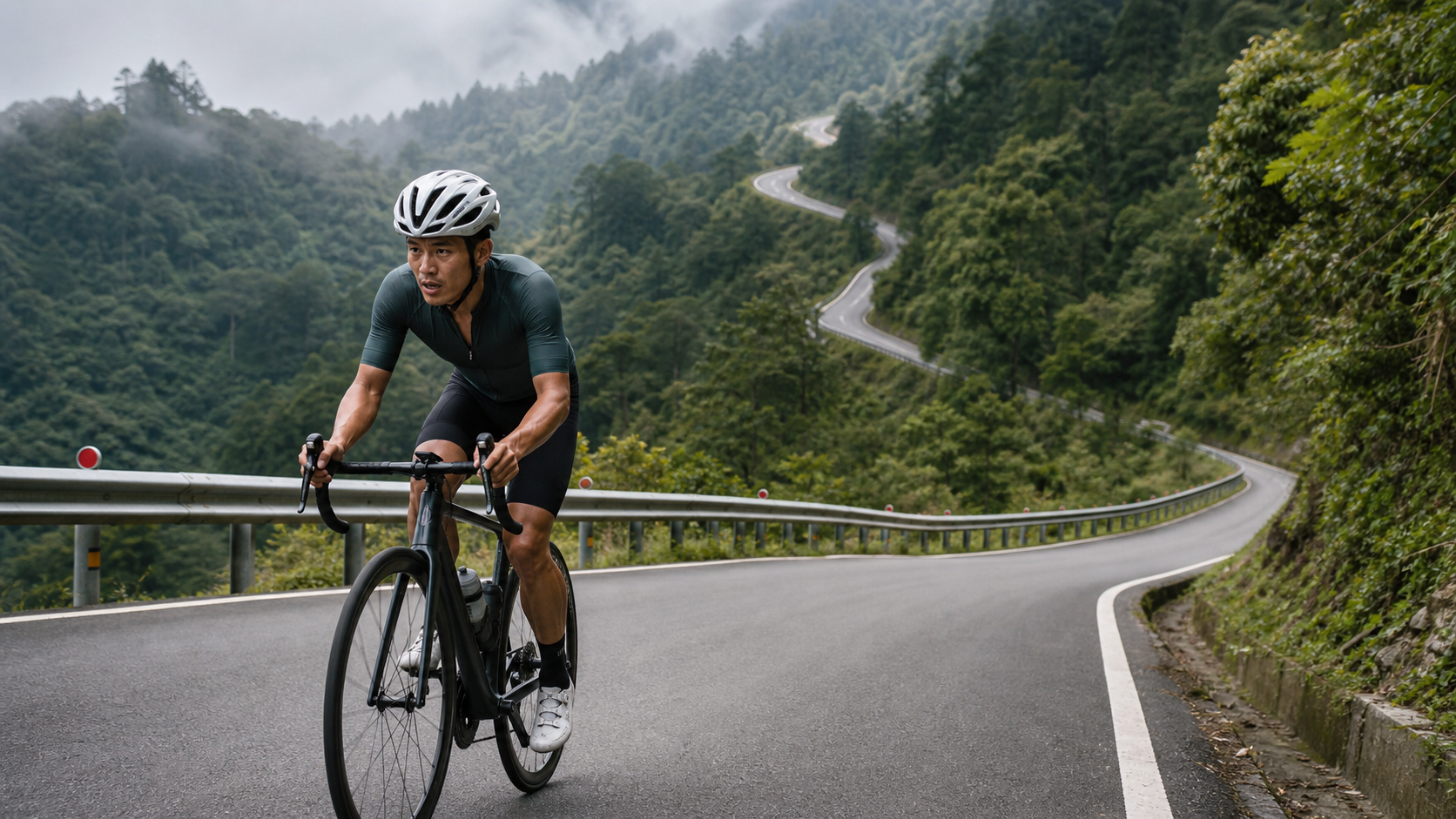
There are two ways to ride Dasyueshan Forest Road. One is the “endurance version”—a gradual 32 km grind from Dongshi. The other narrows the focus to the core section where the gradient is most concentrated: the Full Climb of Dasyueshan Forest Road: 20.12 km in length, 1243 meters of elevation gain, 6.2% average gradient. Without the dilution of the gentler early slopes, these 20 km offer almost no flat respite—a climb that is “continuous, unbroken, and relentlessly demanding.” If the gradual version tests your patience, the full climb tests your lactate threshold and willpower. This article takes an engineer’s perspective to turn this unforgiving long climb into a premium threshold training session.
Route Overview and Data Breakdown
| Item | Data |
|---|---|
| Total Route Length | Approx. 20.12 km |
| Total Elevation Gain | Approx. 1243 meters |
| Average Gradient | 6.2% |
| Gradient Character | Continuous, no significant downhill respite |
| Location | Core climbing section of Dasyueshan Forest Road |
| Route Category | Long-distance, high-intensity climb |
This 6.2% average gradient is nearly 30% steeper than the gradual version’s 4.7%, and more critically—these 20 km are almost “pure climbing,” with no downhill to recover and no flats to ease off. For a rider’s cardiovascular system and legs, this is a form of “sustained pressure” torture. The gradual version still lets you warm up lazily on the early gentle slopes, but the full climb hits you hard from the very start. This is precisely its value as a “threshold training ground”: if you can sustain a 6.2% output for 20 continuous kilometers without cracking, your power and fitness have moved up a level.
Allocating These 20 km by Power/Heart Rate Zones
Because it’s continuous pressure with no recovery points, the biggest mistake on the full climb is “going out hard and blowing up later.” It’s recommended to split the 20 km into three psychological segments:
First 1/3 (0–7 km): Restraint
The sole task of this section is to “hold back the excitement.” Fresh legs at the start make it easy to push power far beyond your threshold. Deliberately restrain yourself—keep heart rate below your lactate threshold (approximately 78–83% of max HR) and lock power at 85–90% of your FTP. Establish a rhythm at 75–85 rpm. Remember: this is a 20 km endurance battle, and every ounce of energy saved in the early section is a lifeline for the later part.
Middle 1/3 (7–14 km): Discipline
This section is the core of “maintaining discipline.” The gradient holds steady around 6%, cumulative fatigue begins to show, and mentally you’ll start to waver. At this point, rely on the bike computer rather than feel to pace yourself—watch the power or heart rate and lock it firmly near threshold, avoiding wild fluctuations. Cadence may naturally drop to 70–80, which is normal, but don’t let it fall below 65. Whether you can stay steady here determines whether you have any legs left for the final stretch.
Final 1/3 (14–20 km): Willpower
This section is the “battlefield of willpower.” Your legs have accumulated over ten kilometers of lactate, altitude is rising, air is thinning, and every pedal stroke feels heavier than the last. At this point, only discipline and willpower remain. If you paced correctly earlier, you can hold steady or even press slightly harder here; if you blew up earlier, this is where you meet “the wall.” Break the goal into smaller pieces—don’t think “6 km to go,” but rather “just make it to the next bend,” and chew through it one segment at a time.
Gear Ratio and Equipment Recommendations
With 20 km of continuous 6.2%, gearing is your survival tool:
- Chainring/Cassette: A compact crank (50/34T) paired with an 11–34T cassette is strongly recommended. The cumulative fatigue of continuous climbing will make the later 6% feel like 9%, and 34×34 lets you maintain cadence and protect your knees in the final stretch. If your FTP is modest or you’re heavier, consider even wider gearing. There are no flats on this road, so the big ring is almost never used—better to have gearing in reserve.
- Wheels: Pure climbing means lightweight is king. Low-profile lightweight wheels can significantly reduce the cumulative burden of 1243 meters of climbing.
- Weight Management: On a pure climbing route, shed every gram you can—extra gear and excessive water weight will translate into suffering later. But warmth and nutrition cannot be compromised.
- Warmth: Same as the gradual version, the temperature difference between the base and the summit is large, and hypothermia on the descent is a real risk. A windbreaker and full-finger gloves are essential.
Nutrition and Hydration
- Nutrition is the fuel for a long battle: 20 km, potentially 1.5–2.5 hours of continuous high-intensity output, depletes glycogen rapidly. Be sure to fuel at a pace of at least 60 grams of carbs per hour (alternating energy gels and bars), and don’t wait until you’re hungry—once you bonk on a high-intensity climb, there’s almost no coming back.
- Hydration: Drink every 15 minutes. High-intensity climbing causes heavy sweating, and dehydration will directly drag down your power.
- Stock up before heading up: Supply points are scarce on the forest road, so all nutrition must be prepared at the base. This is the aspect of the full climb that requires the most advance planning.
Weather and Seasons
- Spring and autumn are best: Stable weather makes these the ideal seasons to challenge your full-climb time.
- Summer: The start at the base is hot and humid, and high-intensity climbing feels even hotter. Be sure to start early and top up electrolytes to prevent cramping.
- Afternoon changes: At high altitude, fog and thunderstorms are common in the afternoon. A continuous climb takes a long time, so keep pace and don’t let yourself get caught in darkness or severe weather.
- Winter: Low temperatures and possible frost. Although continuous high-intensity climbing keeps your body warm, once you stop or descend, hypothermia sets in quickly. Not recommended for non-experienced riders.
Common Mistakes and DNF Risks
- Exceeding threshold in the early section: This is the absolute number-one cause of DNF on the full climb. On a continuous climb with no recovery points, overextending early means collapse later.
- Overly conservative nutrition: Hesitating to eat or waiting until hungry to fuel means empty glycogen and a bonk under high intensity, turning the second half of the 20 km into hell.
- Gearing too heavy: Trying to muscle through 6.2% on a mid-range gear drops cadence below 55, leading to knee injury or exhaustion and dismounting.
- Mental collapse: Being crushed by the thought of “so much further to go” in the middle-to-late section. Learn to break goals into smaller pieces and focus on the present.
- Misjudging warmth and time: Same as the gradual version, hypothermia on the descent and failing to get off the mountain before dark are real risks.
Reference Times for Riders of Different Levels (Full 20.12 km)
| Rider Level | Reference Time | Corresponding Intensity |
|---|---|---|
| Finish-oriented | 2.2–3 hours | Mostly aerobic, slightly below threshold, goal is completion |
| Advanced | 1.6–2.2 hours | Cruising steadily at threshold, no dismounting in the final stretch |
| Competitive | 1.2–1.6 hours | Close to FTP, going all-out to challenge the clock |
The full climb is an excellent FTP progress indicator—riding it faster year after year at the same heart rate means your threshold power is genuinely growing.
FTP Training Ground: Why the Full Climb Is a Premium Threshold Lesson
The character of the Dasyueshan Forest Road full climb—20 km of continuous 6.2%—makes it the ideal natural training ground for improving FTP (Functional Threshold Power).
FTP, simply put, is the maximum power you can sustain steadily for one hour, and it’s the core metric for measuring a road cyclist’s ability. One of the most effective ways to raise FTP is “prolonged threshold training”—sustaining effort at threshold intensity for 20 minutes or more. The full climb, with its absence of descents and flats and its demand for continuous pressure, is naturally the perfect venue for executing long threshold sessions. You don’t need to deliberately control your effort, worry about traffic lights, or have descents interrupt your rhythm—the road itself forces you to keep producing.
Full Climb Threshold Session
- Warm-up at the start (deliberately take it easy for the first few kilometers)
- Main set: hold threshold intensity through the middle section (heart rate at approximately 85–90% of max HR, power at approximately 95–100% of FTP) for 20–40 minutes continuously
- If fitness allows, this road is long enough to accumulate a very substantial threshold dose
- Cool down or hold steady in the final section depending on how you feel
Executed consistently over time, your FTP will genuinely move upward. And an improved FTP will show up in all your climbing and long-distance riding performance.
The Science and Prevention of Bonking
The most dreaded phenomenon on the full-climb segment is “bonking”—acute energy depletion caused by glycogen exhaustion. Once you bonk, your legs lose power instantly, dizziness sets in, and there is almost no way to recover.
How Bonking Works
The body’s glycogen stores are limited and deplete rapidly during high-intensity exercise. When glycogen runs out, the body cannot supply energy quickly, and you “bonk.” In a scenario like 20 kilometers of continuous high-intensity climbing, where glycogen burns extremely fast, the risk of bonking is especially high.
Prevention Strategies
- Fuel early and often, in small amounts: Don’t wait until you’re hungry to eat. Start replenishing carbohydrates regularly from the beginning—every 15–20 minutes, aiming for 60+ grams of carbs per hour.
- Eat well before you start: Have a carbohydrate-rich breakfast on race day to top off your glycogen stores.
- Use liquid carbs: Sports drinks and energy gels are easily absorbed and work quickly, making them ideal for high-intensity efforts.
- Back off if something feels wrong: If you notice an abnormal drop in energy, immediately reduce intensity and increase fueling. Don’t push through until you bonk.
Remember: On a high-intensity continuous climb, fueling isn’t an option—it’s a survival strategy.
The Philosophy of Gearing: Leaving Margin Beats Playing Hero
The full-climb segment has no flat roads, so the big chainring is almost never used. All the focus in gear selection is on the “climbing end.” Many people insist on using heavier gears to climb out of pride, thinking “using a big cassette is weak.” This is a completely wrong mindset.
The fatigue accumulated over 1,243 meters of climbing will make the later 6% feel like 9%. If your gearing isn’t light enough at that point, you’ll be forced to grind at a low cadence, which not only hurts your knees but accelerates exhaustion. Conversely, a large enough cassette (11–34T) lets you maintain a 70+ cadence in the latter half, distributing the load to your cardiovascular system and protecting your legs—allowing you to ride faster and farther instead.
Leaving margin in your gearing isn’t weakness—it’s wisdom. Top climbers all know to use light enough gears to maintain a high cadence. Those who play hero and grind heavy gears often don’t make it to the end.
Tracking Your Yearly Progress with the Full-Climb Segment
The full-climb segment is continuous, repeatable, and intensity-dense—making it an excellent “annual fitness benchmark.” It’s recommended to test once per training cycle (e.g., every season) and record:
- Total segment completion time
- Average power, normalized power (NP)
- Average heart rate
- Power-to-weight ratio (W/kg, the most critical metric for climbing)
When you notice “same heart rate, faster time” or “higher power, same completion time,” that’s concrete evidence of real fitness gains. Treat the full-climb segment as your annual exam—improving your score year after year is the most rewarding progress trajectory.
Breathing and Pacing Management on Continuous Climbs
A 20-kilometer continuous climb with no respite demands stricter breathing and pacing management than any other route. Mastering your breathing rhythm is the invisible weapon that gets you through the full-climb segment.
Establish a breathing rhythm: Sync your breathing with your pedaling—for example, “inhale for two pedal strokes, exhale for two pedal strokes”—to establish a steady breathing pattern. This makes oxygen delivery more efficient and prevents premature exhaustion from erratic breathing. As altitude increases, switch to deeper, slower diaphragmatic breathing to maximize oxygen intake with every breath.
Pacing over speed: The biggest mistake on the full-climb segment is surging and backing off. Find a “cruising pace” you can sustain for a long time, then hold it steadily like a metronome. Even if a steeper section slows you down, maintain the same sense of rhythm mentally—don’t break your rhythm chasing speed.
The cadence trade-off: In the latter half of a continuous climb, cadence naturally drops. Rather than forcing a high cadence, accept it and use light enough gearing to maintain a “sustainable cadence” of 65–75 rpm. A steady mid-range cadence will carry you further than one that fluctuates wildly.
Lactate Tolerance: The Core Fitness Built by the Full-Climb Segment
With its continuous 6.2% gradient and no recovery sections, the full-climb segment trains precisely “lactate tolerance”—the body’s ability to process and withstand lactate accumulation under high intensity.
When exercise intensity approaches or exceeds the lactate threshold, lactate begins to accumulate. Riders with strong lactate tolerance can sustain higher intensities for longer without falling apart. The full-climb segment’s “forced continuous pressure” environment is the most effective training ground for this ability—it forces you to keep producing output while lactate steadily builds, expanding your tolerance boundary again and again.
With long-term training on the full-climb segment, you’ll notice a clear improvement in your “climbing endurance”—where you used to bonk at 14 kilometers, you can now hold to 17; where you used to fall apart in the latter half, you can now hold steady or even push harder. This improvement in lactate tolerance will show up in all your long climbs and races—a real, tangible fitness upgrade.
The Philosophy of Weight Reduction for the Full-Climb Segment
Since the full-climb segment is pure climbing with no flats, “weight reduction” becomes the most direct means of improving performance. The physics of climbing are brutal—every extra kilogram you carry means fighting that kilogram of gravity for the entire 20 kilometers and 1,243 meters of elevation gain.
- Bike weight reduction: Lightweight wheels, frames, and components deliver the most direct benefit on pure climbs. If you’re seriously chasing a full-climb segment PR, lightweight wheels are the upgrade with the highest return on investment.
- Streamline your gear: Carry only what’s necessary. Trim excess tools and spares where possible (but never cut safety-related repair tools or warm layers).
- Water management: Water is heavy, but you can’t under-fuel either. Calculate your needs precisely and plan staged refills to avoid carrying too much water at once.
- Body composition: In the long run, power-to-weight ratio (W/kg) is the ultimate key to climbing. Maintaining an appropriate body weight and body fat percentage is a more fundamental “weight reduction” than any equipment upgrade.
But remember: The prerequisite for weight reduction is always safety. Warm layers, repair tools, and emergency supplies—anything related to safety—cannot be cut by even a single gram.
Common Q&A: Practical Questions About the Full-Climb Segment
Q: What’s the difference between the full-climb and the easier-climb version? Which should I choose?
The easier-climb version (approximately 32 km, average 4.7%) has gentler sections in the front that dilute the difficulty, testing long-distance endurance. The full-climb version (approximately 20 km, average 6.2%) is almost pure climbing with no recovery points, testing your threshold and willpower. Beginners or those wanting to build endurance should choose the easier climb; those wanting to specifically improve FTP and lactate tolerance should choose the full-climb segment. Both are excellent training grounds—use them alternately based on your goals.
Q: Is it embarrassing if I can’t finish the full-climb segment?
Not at all. The full-climb segment is 20 continuous kilometers with no respite—it’s a genuinely tough challenge, and it’s completely normal not to finish on your first attempt. Bonking and dismounting are all part of the process. Treating every “I made it a little further” as progress is the healthy mindset.
Q: How do I know when I’m ready?
If you can consistently complete around 1,000 meters or more of continuous climbing and have some threshold training foundation, you’re ready to attempt the full-climb segment. For your first time, aim for “completion” rather than chasing time.
Q: How often should I challenge the full-climb segment?
As a high-intensity long climb, it’s demanding on the body. Treat it as a periodic “major exam”—challenge it once or twice per training cycle, and use shorter climbs (such as Wanggaoliao or Zhongzheng Campground) to maintain intensity in between.
Complete Mental Tactics for the Full-Climb Segment
The hardest part of the full-climb segment is often not the body, but the mind. Here is a complete set of mental tactics:
Before starting—set reasonable expectations: Tell yourself, “This is a tough battle, and bonking is normal.” Reasonable expectations reduce the frustration of a mid-route collapse.
Early on—restrain your excitement: The biggest mental trap is surging ahead when you’re full of energy at the start. Constantly remind yourself, “This is an endurance battle—every bit of energy saved early is life-saving capital for the later stages.”
Middle section—establish rhythm, focus on the present: Don’t think about “how much farther”—it will crush you. Focus your attention on the present breath, pedal stroke, and rhythm, maintaining it steadily like a metronome.
Later stages—break down the goal: This is the battlefield of willpower. Don’t think about the finish line—only think “make it to the next corner,” “make it to that tree,” “one hundred more pedal strokes.” Break the unbearable big goal into small, achievable victories.
When bonking—accept rather than fight: When the bonk hits, don’t panic and don’t blame yourself. Accept it as part of the process, lower your intensity, fuel up faster, take deep breaths, and keep moving forward inch by inch.
After finishing—acknowledge yourself: Regardless of the result, facing this relentless climb and making it as far as you did deserves recognition. This mental resilience will become an asset for every challenge in your life.
Power-to-Weight Ratio: The Ultimate Metric for Climbing Performance
When it comes to climbing, one metric stands above all others—power-to-weight ratio (W/kg), which is your power output divided by your body weight. It is the most accurate predictor of climbing performance, and a full-climb segment like this pure ascent is the perfect proving ground for it.
Why power-to-weight ratio instead of absolute power? Because the essence of climbing is fighting gravity. A rider who can output 300 watts but weighs 90 kilograms (3.3 W/kg) will lose on a climb to a rider who outputs only 250 watts but weighs 60 kilograms (4.2 W/kg). In the world of climbing, “how much power you can produce per kilogram of body weight” is what truly matters.
There are two ways to improve your power-to-weight ratio: increase power (the numerator) or reduce weight (the denominator).
Increasing power comes from solid training—threshold work, VO2max intervals, and building your aerobic base. A full-climb segment like this, serving as a long threshold training ground, is exactly the tool you need to boost your climbing power.
Reducing weight (within healthy limits) comes from balanced nutrition and proper body-fat management. But remember, this is by no means an invitation to extreme dieting—excessive weight loss will cost you muscle, harm your health, and actually reduce your power. Maintaining a healthy, sustainable body weight is the right path.
Treat the full-climb segment as your annual exam for power-to-weight ratio. If you can ride it faster year after year at the same heart rate or perceived effort, it means your power-to-weight ratio is improving—whether because your power has grown or your weight has become leaner. By tracking changes in this metric, you can objectively see the trajectory of your climbing ability. This is the core number every climbing enthusiast should pay the most attention to.
Limits Are Meant to Be Pushed
This relentless long climb has given me a whole new understanding of the word “limit.” I used to think a limit was a fixed wall—once you hit it, that was it, you couldn’t go any further. But after challenging this full climb again and again, I discovered that a limit isn’t a wall at all—it’s a boundary that can be pushed further and further back.
The first time I rode the full climb, I hit the wall halfway, ran out of energy, and had to put a foot down. Back then, I thought that was my limit. But with training and repeated attempts, I found myself able to go further and further—the spot where I cracked last time, I could now pass with ease; the goal that seemed impossible last time, I somehow achieved this time. It turns out that what we call a limit is often just “the boundary of our current ability,” and that boundary can be pushed outward again and again through effort.
This discovery completely changed how I face difficulties. When I encounter what seems like an insurmountable obstacle in life, I no longer easily say “I can’t.” Because the full climb taught me: the limit you think you have is often just a boundary you haven’t broken through yet. As long as you’re willing to accumulate step by step and try again and again, that seemingly unbreachable wall will eventually be pushed back—or even toppled. Limits are not meant to be surrendered to; they are meant to be expanded. This belief is the most powerful gift this brutal long climb has given me—it makes me believe that human potential runs far deeper, wider, and more boundless than we ever imagine.
May You Ride Through the Wall and See Yourself Clearly
In the end, this relentless long climb isn’t here to hand you a finishing time—it’s here to give you a chance to see yourself clearly. In front of that wall, in that extreme suffering, you will see your true self when facing adversity—and seeing clearly is precisely where change and growth begin.
May you have the courage to face that wall again and again, to challenge your limits. May you, in the process of riding through the wall, also see yourself more and more clearly—clear about your weaknesses, and clear about your strengths; clear about where you will shrink back, and clear about how far you can push. When you can both ride through the wall and see yourself clearly, you become not just a stronger rider, but a person who understands yourself better and can better steer your own life. This is the deepest blessing this brutal long climb has to offer.
Conclusion
The full climb of Dasyueshan Forest Road—20.12 kilometers, 1,243 meters of elevation gain, 6.2% average gradient, and not a single descent to catch your breath. It is the very definition of “hard” among Taichung cyclists, a top-tier threshold training ground for raising your FTP, and a dual examination of both your lactate threshold and your willpower. What it teaches you is how to maintain discipline amid sustained suffering, how to fight off hitting the wall with scientific fueling, and how to preserve your reserves with smart gear selection. Stock up on supplies, choose your gearing wisely, hold back the urge to go too hard in the early section, and take down this relentless continuous climb kilometer by kilometer with discipline and willpower. When you finish it, your threshold, your endurance, and your mental fortitude will all be pushed to an entirely new level.
Related Reading
- 20 Kilometers in Dialogue with the Wall: The Full Climb of Dasyueshan Forest Road, a Battle of Will Between One Man and a Mountain
- Dasyueshan 32km Long Climb Practical Guide: An Endurance Mountain from Dongshi’s Gentle Ramp to 1,557 Meters
- Dasyueshan Forest Road Cycling Challenge: A Primitive Forest Climb in Taichung’s Hidden Gem
- Xuejian Sima Limit Forest Road Guide: Full Breakdown of the 24.94km Forest Road Climb—Data, Gearing, and Fueling Strategy
半日 小台灣 極限單車路線挑戰實錄
7 年前
#公路車 #西進武嶺 配速配瓦實驗 坡度分析 四小時內攻略 建大盃 NeverStop #西進武嶺攻略
6 年前
台北闊瀨陡坡 騎旅 / 日本單車雜誌編輯車友臨時加入!/ 髮香才是最強的 / feat. 北迴歸線小隊 / 公路車 CT Yeh
6 個月前
萬年峽谷! 30% 超激陡坡 里佳部落DAY2 還是很硬! | 公路車 | CT Yeh
3 年前
大武山後門26%歡樂陡坡!JJSC南台灣單車行Day2 / 被颱風追著跑 / 公路車 / CT Yeh
2 年前
單車 梅山36灣 坡度介紹 路段介紹 空拍 (相關遊記影片,請參考說明或我的頻道喔,歡迎訂閱)
6 年前
西進武嶺各路段 前8000名 大數據分析 配速攻略/功率/心律/推力比/維持率/踏頻/踏瓦比/牽車率 大公開 | 建大盃 NeverStop 可參考 | 公路車 | CT Yeh
5 年前
台中大雪山 膏王領騎 震到都沒畫面了 公路車
5 年前