Baimao Mountain Practical Guide: The Second Leg of Taichung's "Big Three," a Tough 8km Climb at Nearly 5% in Xinshe
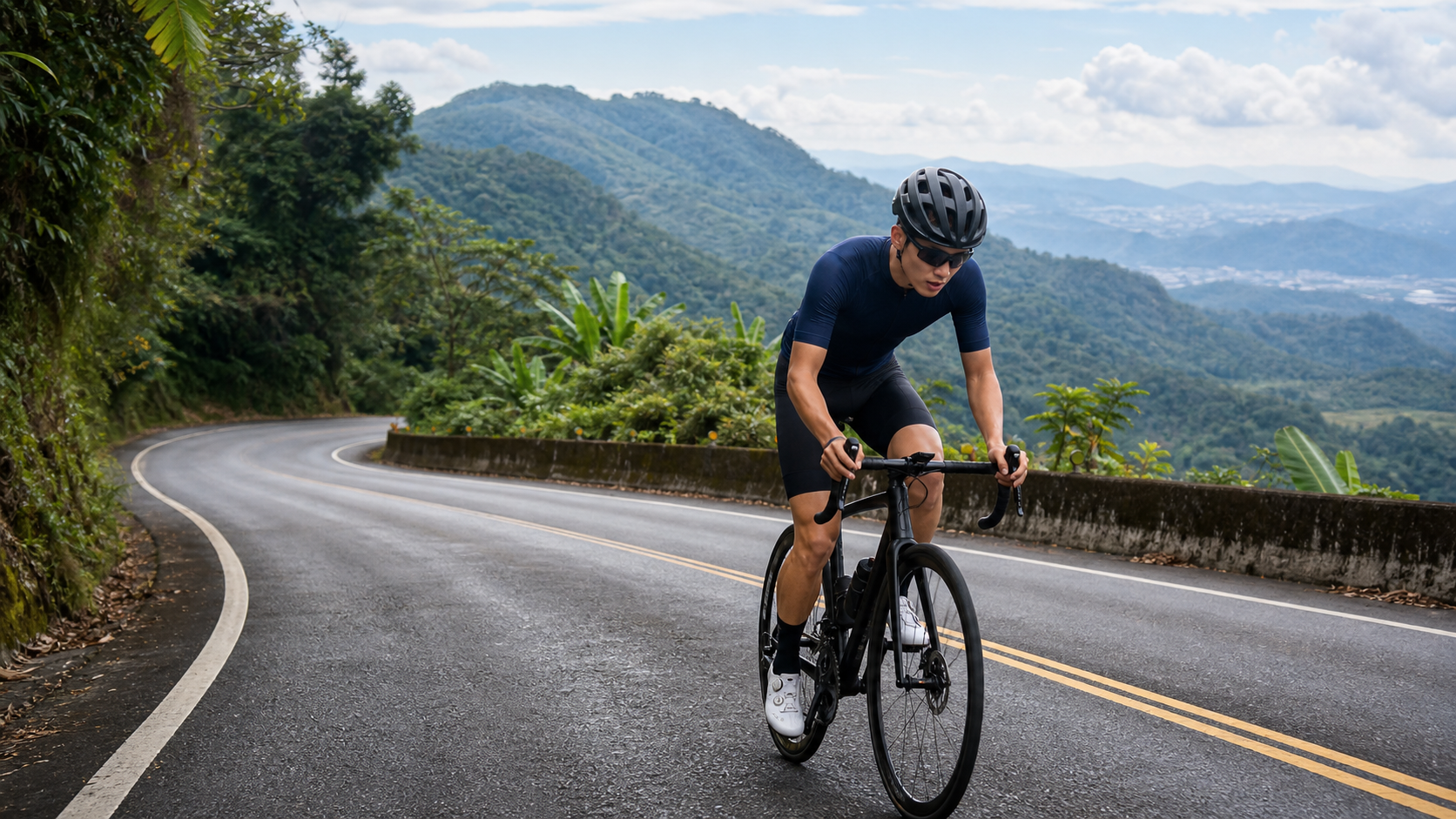
In the training bible of Taichung cyclists, there’s a signature route called the “Big Three” — Zhongxingling, White Hair Mountain, and Chikanding, three peaks strung together in a loop, totaling about 89 kilometers with roughly 1,552 meters of climbing. It’s one of central Taiwan’s most classic mid-distance training routes. And the subject of this article, White Hair Mountain (Guoxing Main Climb), is the “Second Peak (2nd P)” of the Big Three: 8.03 kilometers long, with about 383 meters of climbing and an average gradient of 4.6%. The gradient isn’t brutal, but it sits at a critical position in the Big Three itinerary, making it the hinge that determines whether you finish the whole ride beautifully. This article takes an engineer’s perspective, breaking down White Hair Mountain itself while also placing it in the broader context of the Big Three, helping you steadily conquer this tough Xinshe climb.
Route Overview and Data Analysis
| Item | Data |
|---|---|
| Total Route Length | Approximately 8.03 km |
| Total Climbing | Approximately 383 meters |
| Average Gradient | 4.6% |
| Position | Second Peak of Taichung’s Big Three |
| Starting Point | Xinshe Area |
| Route Category | Mid-Distance Climb |
First, let’s look at White Hair Mountain itself: 8 kilometers at an average gradient of 4.6% makes it a structurally stable mid-distance climb with no extreme steep sections, suitable for maintaining a steady output. But its real difficulty comes from its position within the Big Three. The classic clockwise configuration of the Big Three (from easy to hard) is: First Peak Zhongxingling (climb of about 8.4km, 327m elevation gain), Second Peak White Hair Mountain (climb of about 6.8km, 349m elevation gain), and Third Peak Chikanding (climb of about 12.3km, 576m elevation gain). In other words, when you climb White Hair Mountain, your legs already carry the fatigue from Zhongxingling; and after finishing White Hair Mountain, the hardest climb at Chikanding still awaits. White Hair Mountain is the pivotal peak that connects the past and the future — it determines how much leg power you have left when you enter Chikanding.
Section-by-Section Strategy (White Hair Mountain Itself)
Section 1: Starting from Xinshe (0–3 km, 4–5% gradient)
From the Xinshe area, you connect to the starting point of the White Hair Mountain climb. By now, your legs have already ridden Zhongxingling and carry some fatigue, so avoid pacing as if you have “fresh legs.” Be restrained at the start, use a light gear ratio and high cadence (80–90 rpm) to re-establish your rhythm, letting already-worked muscle groups smoothly transition into White Hair Mountain’s climb. If you pace this section steadily, you won’t blow up later.
Section 2: Core Climbing (3–6 km, around 5% gradient)
This is the main body of White Hair Mountain, with the gradient holding steady around 5% and the road winding upward. The task in this section is to “efficiently accumulate elevation without overdrawing.” Keep your heart rate below the lactate threshold and maintain 75–85 rpm. Constantly remind yourself: this is only the second peak of the Big Three — Chikanding ahead is the real boss, so you absolutely cannot go all-out here. Along the way, you’ll pass through the mountain forests of the Xinshe and Guoxing areas, with pleasant scenery.
Section 3: The Finish (6–8.03 km)
The final section has some undulations in gradient, serving as the closing stretch of White Hair Mountain. If you’ve paced well, you should still have room to spare here. Reaching the high point of the White Hair Mountain section means you’ve cleared the second gate of the Big Three. The most important judgment at this moment is: honestly assess how much leg power you have left, and decide your pacing strategy for Chikanding. Honest self-assessment is the wisdom of completing the Big Three.
Pacing Strategy for White Hair Mountain Within the Big Three
If you’re here for the complete Big Three, you can’t pace White Hair Mountain in isolation — you need to factor in the full 89 kilometers and 1,552 meters of climbing:
- Zhongxingling (First Peak): The easiest, but this is where the mistake of “fresh legs pushing too hard” most often happens. Be sure to restrain yourself, treat it as a warm-up, and don’t drain your entire day’s legs on the first peak.
- White Hair Mountain (Second Peak / subject of this article): Connects the past and future. Maintain discipline, accumulate elevation efficiently, and preserve strength for Chikanding.
- Chikanding (Third Peak): A climb of about 12.3km with 576m of elevation gain — the hardest peak of the Big Three. Every bit of effort you save at Zhongxingling and White Hair Mountain is meant to keep you from collapsing here.
The philosophy of completing the Big Three can be condensed into one sentence: “Save money on the first two peaks, spend it on the third.” White Hair Mountain is the most critical savings step in this financial plan.
Gear Ratio and Equipment Recommendations
- Chainring/Cassette: Compact crank (50/34T) paired with an 11–32T or 11–34T cassette. If you’re tackling the full Big Three, with 1,552 meters of accumulated climbing and 89 kilometers of distance, a wide gear range is a lifesaver on the Chikanding section later.
- Wheelset: Balancing climbing and flat-road travel, a lightweight mid-to-low profile wheelset is more suitable (the Big Three includes plenty of connecting flats and descents).
- Nutrition Gear: For a long route, carry enough bottle cages and storage for supplies on the bike.
Nutrition and Hydration
- 7-Eleven at Dakeng Roundabout: A gathering and resupply point on the Big Three route toward Xinshe and Guguan. Rides typically start from here or pass through for supplies — make good use of it.
- Xinshe/Guoxing Area: The settlements around White Hair Mountain have convenience stores and local food stalls, serving as mid-route resupply points.
- Long-Ride Rhythm: If you’re completing the full Big Three (89km), follow a rhythm of 30–60 grams of carbs per hour with regular hydration — don’t wait until you’re hungry to refuel. If you’re only training on White Hair Mountain alone, the resupply needs are much lower.
Weather and Seasons
- Spring/Autumn: The most comfortable riding seasons and the peak time for tackling the Big Three.
- Summer: The mountain areas of Taichung are hot and humid. Start early in the morning and bring plenty of electrolytes to prevent cramps (with the Big Three’s long distance, cramping is a common reason for DNFs).
- Winter: Relatively dry and cool, good for riding, but mountain mornings are cold and descents bring wind chill — bring a windbreaker.
- Common to All: Afternoon thunderstorms are frequent. For long rides, be sure to manage your time well and avoid riding in the dark or in rain on descents.
Common Mistakes and DNF Risks
- Pushing too hard on Zhongxingling: The number one cause of DNFs on the Big Three. Going all-out on the first peak means you start losing speed on White Hair Mountain and collapse completely at Chikanding.
- Poor pacing on White Hair Mountain: Using everything you have on the second peak leaves you with no legs when you reach Chikanding.
- Insufficient nutrition/hydration: Underestimating the needs of an 89-kilometer ride leads to bonking or cramping mid-route.
- Poor time management: The Big Three, including rest stops, can take 5–6 hours. Not managing time well can leave you riding in the dark.
- Viewing White Hair Mountain in isolation: Treating it as an independent short climb and underestimating it, while forgetting it’s part of a long-distance ride.
Reference Times for Riders of Different Levels (White Hair Mountain Section, 8.03 km)
| Rider Level | Reference Time | Corresponding Intensity |
|---|---|---|
| Finish-Oriented | 40–55 minutes | Preserve strength, no dismounting |
| Advanced | 30–40 minutes | Steady cruising, saving legs for Chikanding |
| Race-Level | 22–30 minutes | Near threshold, but still holding back |
If you’re training on White Hair Mountain alone (not as part of the Big Three), you can ride more aggressively; but as part of the Big Three, “leaving something in reserve” is the smart way to ride.
The Finance of the Big Three: The Art of Saving and Withdrawing
Imagining the Big Three as a financial exercise is the best metaphor for understanding pacing on White Hair Mountain. Over the full 89 kilometers with 1,552 meters of climbing, your physical energy is a finite “deposit,” and the three peaks are three withdrawals of different natures.
- Zhongxingling (First Peak) = Fixed Deposit: This peak is the easiest — it’s your time to save. Ride at an intensity far below your limit and treat it as a warm-up. The worst thing is to “withdraw early” here — many riders push too hard on the first peak, spending their principal right from the start.
- White Hair Mountain (Second Peak / subject of this article) = Mid-Plan Fund Rebalancing: This peak is neither saving nor withdrawing; the key is “maintaining a stable balance.” Ride with disciplined sub-threshold intensity, accumulate elevation efficiently, neither slacking off and wasting effort nor overdrawing your principal. This is the step in the entire financial plan that requires the most composure.
- Chikanding (Third Peak) = Large Withdrawal: This is the hardest peak (climb of about 12.3km, 576m elevation gain) — your time to spend. Every bit of effort you saved on the first two peaks is meant to give you enough “balance” here to avoid bankruptcy.
The philosophy of completing the Big Three in one sentence: save on the first two peaks, spend on the third. And White Hair Mountain is precisely the most critical “mid-plan rebalancing” in this financial plan — rebalance well, and you’ll have the capital for a large withdrawal at Chikanding without overdrawing.
Cramps: The Hidden Killer of Long-Distance Riding
The most common reason for DNFs on the Big Three isn’t being unable to ride — it’s “cramping.” With 89 kilometers of distance, 1,552 meters of climbing, and the hot, humid conditions of Taichung’s mountain areas, cramping is a lurking hidden killer. White Hair Mountain, as the midpoint, is exactly when cramps are most likely to strike — fatigue from the earlier section has accumulated, and electrolytes are starting to deplete.
Preventing Cramps
- Electrolyte Replacement: Water alone isn’t enough. Heavy sweating depletes sodium, potassium, magnesium, and other electrolytes. Use electrolyte tablets or sports drinks, and make sure to top up, especially in summer.
- Don’t Surge: Sudden high-intensity loads on muscles can easily trigger cramps. Maintain a steady output — avoid alternating between fast and slow.
- Train Adequately in Normal Times: Cramps often occur when you exceed your usual training load. If you normally ride 40 kilometers and suddenly challenge the 89-kilometer Big Three, your muscles may not handle it and cramp easily. Progression is important.
- What to Do When Cramping: The moment a cramp hits, stop immediately, stretch, and replenish electrolytes and water. Don’t push through and let it worsen.
Gear Ratio and Equipment: Preparing for the Hardest Peak, Chikanding
White Hair Mountain itself can be handled with a standard compact crank and an 11–32T cassette. But since it’s part of the Big Three, your gear configuration should be planned around “the hardest section of the whole ride, Chikanding”:
- Leave Room in Your Cassette: An 11–34T is recommended. When you reach Chikanding with 60 kilometers of fatigue already in your legs, that 12.3-kilometer climb will feel especially heavy, and the 34T large cog can save your knees and your willpower.
- All-Round Wheelset: The Big Three includes climbs, flat connecting sections, and descents. Choose a wheelset that balances climbing lightness with flat-road momentum.
- Storage for Supplies: Over an 89-kilometer ride, your bike needs to carry enough water (at least two bottles) and nutrition. Top tube bags and saddle bags are both great helpers.
Time Management: Don’t Let Yourself Ride in the Dark
The full Big Three, including rest, resupply, and photo stops, can take 5–6 hours. Time management is key to finishing safely:
- Start Early: Depart at dawn to avoid afternoon thunderstorms and darkness, and to steer clear of the hottest part of the day.
- Set Cutoff Times: Give yourself a “latest pass time” for each peak. If you’re seriously behind, assess early whether to shorten the route.
- Budget Time for Descents and the Return: Don’t calculate your time down to the minute — mountain descents and the long ride back to the city both need buffer.
Progression: How to Prepare for Your First Big Three
The Big Three’s 89 kilometers and 1,552 meters of climbing aren’t a challenge you conquer overnight. And White Hair Mountain, as one of its peaks, shouldn’t be your starting point either. To complete your first Big Three safely and beautifully, you need progressive preparation.
Stage One: Build a Foundation on Individual Climbs. First, train the three peaks of the Big Three separately — ride Zhongxingling, White Hair Mountain, and Chikanding each until you know them well, understanding each peak’s gradient character and your own performance. At this stage, the focus is accumulating basic climbing fitness.
Stage Two: Link Two Peaks. Try linking Zhongxingling + White Hair Mountain in one ride to experience “climbing the second mountain with fatigue.” This is a key step in understanding Big Three pacing — you’ll personally feel the lesson of “pushing too hard on the first peak and losing speed on the second.”
Stage Three: The Full Challenge. When you can consistently complete the two-peak link and your fitness can handle roughly 90 kilometers of distance, then take on the full Big Three. At this point, integrate all the pacing wisdom, nutrition rhythm, and cramp prevention you’ve learned in practice.
With progression, you can turn the Big Three from “an unreachable challenge” into “an achievement that comes naturally.” And White Hair Mountain is the pivotal lesson in that growth process.
Choosing Your Direction on the Big Three: Clockwise vs. Counterclockwise
The Big Three can be ridden clockwise or counterclockwise, and the difficulty distribution differs completely between the two directions.
Clockwise (Easy to Hard): First Zhongxingling, then White Hair Mountain, and finally Chikanding. This is the classic, most recommended direction because difficulty builds progressively — you warm up on the easiest peak, Zhongxingling, transition through White Hair Mountain, and finally face the hardest peak, Chikanding, after your body has been properly primed. This “easy to hard” arrangement aligns with the logic of energy expenditure and gives you ample room for pacing adjustments.
Counterclockwise (Hard to Easy): You tackle the hardest peak, Chikanding, first. This approach suits advanced riders who want “the bitter before the sweet” or who want to challenge the hardest section while their energy is freshest. But the risk is — if Chikanding drains you too much, the subsequent White Hair Mountain and Zhongxingling may become extraordinarily difficult.
For first-time challengers, a clockwise ride is strongly recommended. Putting the hardest peak, Chikanding, last, combined with the rhythm and experience accumulated over the first two peaks, is the safest strategy for finishing. And White Hair Mountain, in the clockwise logic, is precisely that indispensable midpoint that connects the past and the future.
Resupply Planning: An Energy Blueprint for 89 Kilometers
The full Big Three covers nearly 90 kilometers and takes 5–6 hours, making resupply planning a real skill. Here’s a reference energy blueprint:
- Before Departure (7-Eleven at the Roundabout): Eat a solid breakfast, fill your bottles, and stock up on all the energy supplies and electrolytes for the entire ride.
- After the First Peak: While heading toward Xinshe after climbing Zhongxingling, refill water and have your first snack.
- Xinshe/Guoxing Area: Around White Hair Mountain, there are convenience stores and local food stalls — an important mid-route resupply point where you can refill water and have a meal or snacks.
- Before the Third Peak: Before entering Chikanding, make sure to top up water and energy, because this is the hardest section and resupply points may be scarcer.
- Overall Principle: Consume 30–60 grams of carbs per hour, hydrate on a schedule, and add electrolytes in summer. Don’t wait until you’re hungry, thirsty, or cramping to refuel — by then it’s too late.
A good resupply blueprint is the fuel guarantee for completing the Big Three. Plan it well, and you’ll have enough energy to sustain you through the midpoint of White Hair Mountain and the decisive battle at Chikanding.
Common Q&A: Practical Questions About White Hair Mountain and the Big Three
Q: Do I have to ride the full Big Three? Can I ride only White Hair Mountain?
Of course you can ride only White Hair Mountain. It’s a solid mid-distance climb on its own (8 km, 4.6% average gradient), and training on it alone can improve your climbing fitness. When treating it as a standalone route, you can ride more aggressively; when treating it as part of the Big Three, you should leave something in reserve. Use it flexibly based on your goals and fitness.
Q: Can the Big Three be completed in one day?
For riders with regular training, completing the Big Three in one day (89 km, 1,552 meters of climbing) is feasible, taking about 5–6 hours including rest. But for first-time challengers, be sure to assess your long-distance ability and progress gradually — don’t attempt it rashly.
Q: Where do people most often DNF on the Big Three?
The most common DNF point is the final peak, Chikanding — because of excessive expenditure earlier, cramping, or bonking. And the root of the problem often lies in poor pacing on the first two peaks (especially Zhongxingling). So the mid-route restraint at White Hair Mountain is crucial.
Q: What kind of fitness do I need to challenge the Big Three?
It’s recommended that you first be able to consistently complete rides of about 80–90 kilometers in a day with over 1,000 meters of climbing before taking on the Big Three. Fitness is the foundation; pacing wisdom and nutrition strategy are the keys to finishing.
Equipment and Resupply Checklist for the Big Three
Before challenging the Big Three, use this checklist for a final check to ensure everything is in order:
Bike Check:
- Gear ratio configuration (recommended: compact crank + 11–34T, leaving room for Chikanding)
- Tire pressure and tread wear
- Brake feel (the Big Three has multiple descents)
- Shifting smoothness
- Chain lubrication
Resupply Preparation:
- Plenty of water (dual bottles, refill at convenience stores along the way)
- Energy supplies (gels, bars, bananas, at 30–60 grams of carbs per hour)
- Electrolytes (especially important in summer, to prevent cramps)
Safety and Repair:
- Spare inner tubes, tire levers, inflation tools, basic tool kit
- Phone (fully charged), cash
- Helmet, gloves, bike lights (in case it gets dark)
Clothing:
- Breathable cycling jersey and bibs
- Windbreaker (for mountain descents and chilly mornings)
- Add or remove thermal layers by season
Go through this checklist item by item, and you’ll be able to set off from the 7-Eleven at the roundabout with peace of mind and confidence, steadily riding toward Zhongxingling, crossing the midpoint of White Hair Mountain, conquering the decisive battle at Chikanding, and completing your own Taichung Big Three. Being well-prepared is the first step to finishing — and a way of taking responsibility for your own safety.
Fatigue Management: The Hidden Subject of Long-Distance Riding
In the 89-kilometer, 1,552-meter-climbing expedition of the Big Three, White Hair Mountain as the midpoint most tests your “fatigue management” — the most invisible yet most critical subject in long-distance riding.
Understanding Fatigue Accumulation: Fatigue in long-distance riding isn’t linear; it accelerates. In the first 30 kilometers you might feel completely fine, but past a certain threshold, fatigue accumulates like a snowball. White Hair Mountain sits right in this “fatigue begins to accelerate” zone — you must consciously manage fatigue here and not let it spiral out of control.
Fatigue Management Strategies:
- Even Pacing: Maintain a steady output throughout, avoiding alternating between fast and slow. Fluctuating pace accelerates glycogen depletion and fatigue accumulation.
- Active Recovery: Make good use of descents and flats to relax moderately, refuel, and take deep breaths, giving your body chances for micro-recovery.
- Refuel Early: Don’t wait until fatigue is obvious to refuel — by then it’s too late. Refuel on a regular schedule from the start to maintain energy levels.
- Mental Energy Conservation: In long-distance riding, your mind gets tired too. Use “goal decomposition” (first reach White Hair Mountain, then Chikanding) to lighten the mental load.
Listen to Your Body: The core of fatigue management is listening to your body’s signals. When you feel your legs getting heavier, your focus dropping, or your mood turning irritable, these are warning signs of accumulating fatigue. Adjust promptly — slow down, refuel, or even assess whether to shorten the route.
Manage fatigue well, and you’ll maintain reserve at the midpoint of White Hair Mountain and have strength available for the decisive battle at Chikanding. The masters of long-distance riding aren’t necessarily the strongest — they’re the ones who best understand fatigue management. This invisible lesson is the key to completing the Big Three, and indeed all long-distance challenges.
The Middle Way: Neither Overdrawing Nor Slackening
White Hair Mountain, as the midpoint of the Big Three, embodies a very Eastern wisdom — the Middle Way. It’s not the easiest peak, Zhongxingling, where you can relax completely; nor is it the hardest, Chikanding, that forces you to give everything. It sits in between, demanding that you neither overdraw nor slacken, but move steadily forward with a rhythm that is just right.
This “just right” is actually the hardest thing to calibrate. Push too hard, and you overdraw your strength for the later stages; hold back too much, and you waste time and opportunity. You must find that most delicate balance between the two — exert effort, but not excessively; conserve, but not passively. This precise calibration of “degree” is the essence of the Middle Way, and the deepest test of White Hair Mountain as a midpoint.
And this wisdom extends far beyond cycling. Many things in life require this kind of Middle Way calibration — the balance between work and life, the trade-off between giving and holding back, the weighing of ambition and contentment. Going to extremes is always easy; the hard part is finding that just-right middle point and holding it steadily. White Hair Mountain, through its role as a midpoint, taught me this lesson of “neither overdrawing nor slackening.” It reminds me: life is a long journey, and those who make it to the end are often not the ones who surge hardest in a moment, nor those who hold back entirely, but those who understand the Middle Way, understand balance, and know how to move steadily forward at a sustainable pace. This wisdom is the most valuable gift this unremarkable midpoint mountain has given me.
May You Learn to Appreciate Every Midpoint
White Hair Mountain, this unremarkable midpoint mountain, perhaps most wants to teach us “to appreciate every midpoint.” Life is full of such midpoint moments — not exciting enough to thrill, not difficult enough to alarm, so ordinary they’re easily overlooked, rushed through, or taken for granted.
Yet it’s precisely these ordinary midpoints that make up the vast majority of our lives, and they often determine how far we ultimately go. May you, after riding over White Hair Mountain, learn to treat every midpoint of life with care — not slackening because of its ordinariness, not dismissing it because it’s unremarkable. Because when you learn to appreciate and manage every ordinary midpoint, you grasp the secret to moving steadily and abundantly toward the distance. This is the most ordinary yet most profound blessing this midpoint mountain offers to every rider.
Conclusion
White Hair Mountain (Guoxing Main Climb), 8.03 kilometers, 383 meters of climbing, 4.6% average gradient, is the second peak of Taichung’s Big Three. It isn’t the fiercest climb on its own, but it’s the hinge that determines the success of the entire Big Three — it carries the fatigue from Zhongxingling and preserves strength for the decisive battle at Chikanding. Remember that financial mantra: save on the first two peaks, spend on the third; remember to replenish electrolytes to prevent cramps, equip a light enough gear ratio for Chikanding, and manage your time so you don’t ride in the dark. Ride White Hair Mountain smartly, with discipline and reserve, and you’ll have the confidence to fully consume this signature dish of Taichung’s Big Three. Train on it alone, and it’s a solid mid-distance climbing session; slot it into the Big Three, and it’s that most critical mid-plan rebalancing.
Related Reading
- The Midpoint of Taichung’s Big Three: White Hair Mountain, a Journey of Connecting Past and Future Hidden in Xinshe’s Forests
- Dakeng to Xinshe Practical Guide: An 8.5km Gentle Climb Linking Zhongxingling, the Main Artery of Taichung Cycling Training
- Zhongzheng Mountain Practical Guide: Data Analysis and Pacing Strategy for the 3.12km Yangmingshan Climbing Route
- Daxueshan 32km Long Climb Practical Guide: An Endurance Mountain Climbing 1,557 Meters from Dongshi
爬坡ITT實境)台中 魔王 松鼠坡 首航 6:12 大肚山 大三元 科福路
8 年前
台北闊瀨陡坡 騎旅 / 日本單車雜誌編輯車友臨時加入!/ 髮香才是最強的 / feat. 北迴歸線小隊 / 公路車 CT Yeh
6 個月前
大武山20%魔王陡坡【JJSC南台灣遊騎Day2】!屁股真的要裂開了...凡士林抹滿也沒用?神秘金教堂還有超便宜夜市
3 個月前
台中大雪山 膏王領騎 震到都沒畫面了 公路車
5 年前
藤枝二集團 單車行 Day1 | 南部小武嶺 | 爬坡爬到罵罵叫 | JJSC | 公路車 | CT Yeh
3 年前
大武山後門26%歡樂陡坡!JJSC南台灣單車行Day2 / 被颱風追著跑 / 公路車 / CT Yeh
2 年前
台中大三元 計時賽 爆笑關主ALL IN 拚了 | NEKO'S FUN | 公路車 | Taiwan Cycling Route
6 年前
那瑪夏x茶山 阿里山系深山單車行 Day2 累積爬升6000M | 🥶超陡連續下坡 整路看隊友刷 | 爬升一座西進武嶺 | JJSC | 公路車 | CT Yeh
3 年前