Lileng Return Trip Practical Guide: Pacing and Gear Ratio Breakdown for the 7% River Valley Steep Climb on Provincial Highway 8
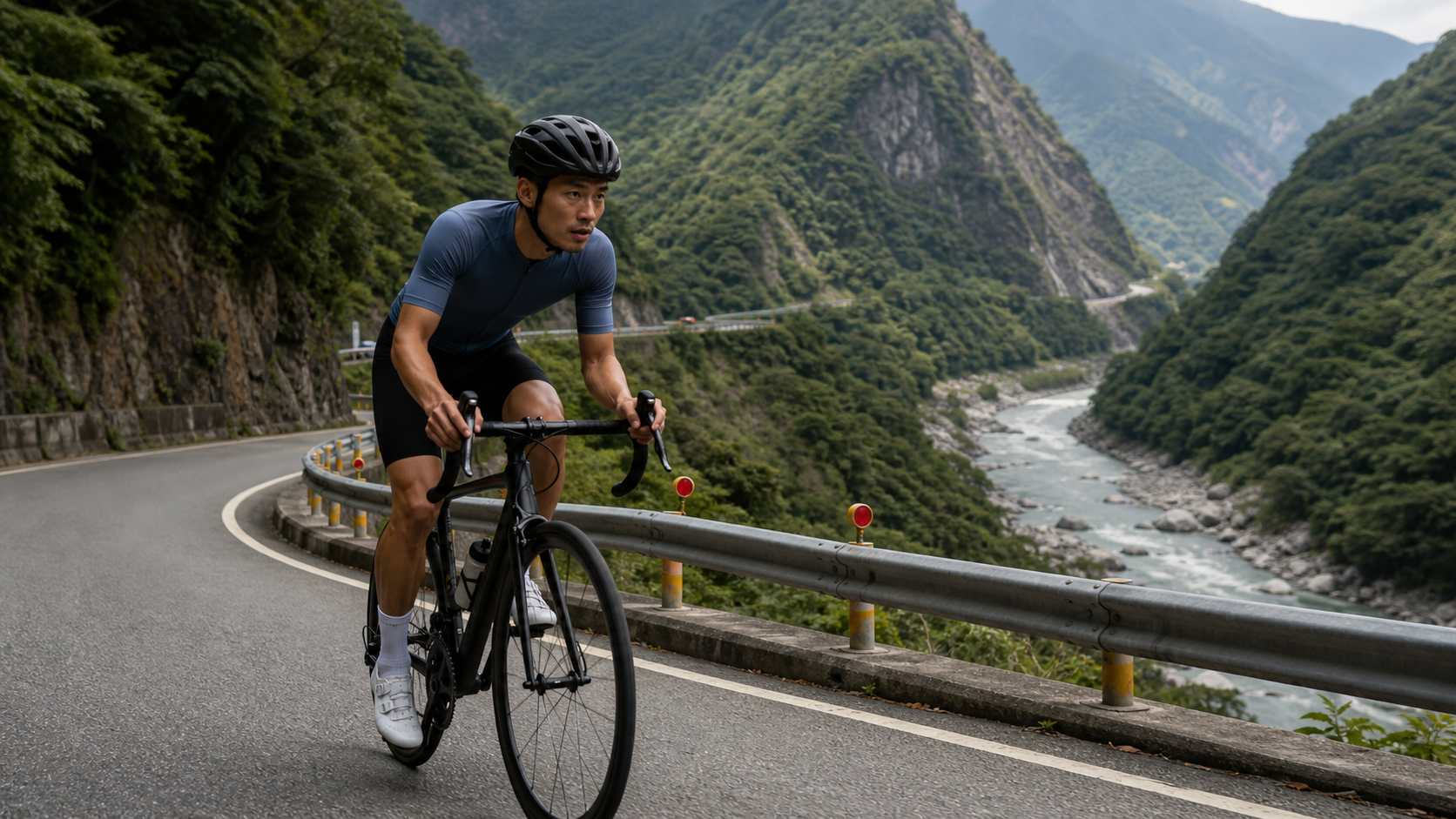
The Lileng section on the western segment of Provincial Highway 8 is an important piece of the “Guguan training combo” for many cyclists in Taichung and Nantou. This segment, marked by Strava as Lileng Return (segment 22300632), is approximately 7.98 km long with 562 meters of total elevation gain and an average gradient of 7.0%, classified as a Category 3 medium-intensity climb. The numbers look mild on paper, but in reality, this is a section with broken rhythm and fluctuating gradients—a “fake gentle slope with a tough core.” That’s precisely what makes it valuable as a training ground.
This article takes an engineer’s approach, breaking down this 7.98 km into executable pacing and gear ratio strategies, so you won’t be led astray by the undulations along the Dajia River on your next attempt.
Route Overview: The Underestimated 7% Average Gradient
Let’s lay out the real data first:
| Item | Data |
|---|---|
| Segment Distance | 7,984 meters (approx. 7.98 km) |
| Total Elevation Gain | 562.4 meters |
| Average Gradient | 7.0% |
| Strava Category | Category 3 |
| Location | Heping District, Taichung City / Western segment of Provincial Highway 8 (often administratively listed near Nantou) |
| Reference Landmarks | Lileng Tribe (approx. 26K on Provincial Highway 8), Songhe Tribe, Guguan |
A 7.0% average gradient looks similar to many beginner climbs on paper, but the key to this section isn’t the “average”—it’s the “variation.” Provincial Highway 8 is carved along the Dajia River bed and the Bajian Mountain cliffs, making it a typical river valley road—up and down, steep then gentle. The average is dragged down by brief flat sections and slight descents in between, meaning the actual climbing sections often have instantaneous gradients far exceeding 7%. This is the common trap of all river valley routes: if you pace yourself with a “7% average” mindset, you’ll blow up instantly when you hit sections above 10%.
Section Strategy 1: Warm-Up Start (0 – 2 km)
The first 2 kilometers of the Lileng section are typically a relatively gentle transition zone, with gradients mostly between 3%–5%, interspersed with a few nearly flat stretches. The tactical goal for this section is clear: don’t push.
- Pacing Principle: Keep your power (or heart rate) at 75%–80% of your FTP, or below 80% of your maximum heart rate.
- Cadence: Maintain a high cadence of 85–95 rpm to get your muscles working first, avoiding hard pulls with a big gear from the start.
- Common Mistake: Many people are misled by the “only 7% average” and start with a 40-tooth chainring, only to blow up with lactic acid at the steep section around the 4 km mark. These 2 kilometers are your only chance to “save up”—hold the line.
Section Strategy 2: The Real Gradient (2 – 5 km)
Entering the middle section, the gradient starts to fluctuate. This is the most concentrated climbing area of the entire segment, with multiple short steep sections of 8%–12% appearing in succession, punctuated by brief recovery stretches. This is the core that determines your overall performance.
- Gear Ratio Advice: For average amateur cyclists, a compact crankset 50/34T paired with an 11-32T or 11-34T cassette is recommended. On sections above 10%, switch directly to 34×28 or 34×32, maintaining rhythm with cadence rather than muscling through with a big gear.
- Pacing Strategy: Adopt an interval-style rhythm for this section—“slightly above threshold on short steep sections, recover on gentler slopes.” Allow power to reach 90%–95% of FTP at steep points, but actively downshift and relax your upper body as soon as you pass the steep point, letting your heart rate come back down.
- Pedaling Technique: Shift your center of gravity forward on steep sections and stay seated. Reserve standing out-of-saddle sprints for true short walls exceeding 12%, and keep them under 10 seconds to avoid spiking your heart rate.
Section Strategy 3: River Valley Undulations (5 – 7 km)
The characteristic of Provincial Highway 8 along the Dajia River—slight descents and repeated small undulations—shows up in this section. On the surface it looks “easy,” but this is exactly where you’re most likely to lose speed and make mistakes.
- Don’t Rest on Micro-Descents: When hitting short descents, shift to a bigger gear and keep pedaling to maintain output, capitalizing on this “free speed” rather than coasting. Average speed often separates riders here.
- Undulation Rhythm: Treat the small rollers as cadence training, passing them at a steady power output to avoid wasting energy from large speed swings.
Section Strategy 4: Final Sprint (7 – 7.98 km)
In the last kilometer, if you still have energy in reserve, this is where you can push your average power up. Good management earlier is what gives you the capital to do this.
- Pacing: If your goal is to set a Strava PR, you can enter the anaerobic zone at 105%–115% of FTP for the final 500 meters.
- Judgment: If you’ve already blown up in the middle section, the principle for the finish is “don’t lose speed, ride it out smoothly,” avoiding cramps before the finish line.
Gear Ratio and Equipment Recommendations
| Rider Level | Recommended Chainring | Recommended Cassette | Notes |
|---|---|---|---|
| Beginner / Recreational | 50/34T Compact | 11-34T | Cadence first, plenty of bailout gears |
| Intermediate | 50/34T | 11-32T | Balances flats and steep climbs |
| Competitive | 52/36T | 11-30T | For those with sufficient leg strength, pursuing power efficiency |
Other equipment priorities:
- Tires: 25c–28c, adjust pressure based on body weight (approx. 6.5–7.0 bar for 70 kg). Mountain roads occasionally have gravel, so don’t inflate too hard.
- Bottles: At least two. Supply points along Provincial Highway 8 are concentrated in the tribes and Guguan, with virtually no convenience stores in between.
- Brakes: On the descent back, watch for crosswinds and slippery surfaces in the Dajia River valley. Disc brakes are preferred; if using rim brakes, be sure to check the brake pads.
Nutrition and Hydration Strategy
The Atayal tribes of Lileng and Songhe are important supply nodes along Provincial Highway 8. The tribes have shops, homestays, and local eateries, and about 4 km toward Guguan brings you to the vicinity of the Bajian Mountain National Forest Recreation Area.
- Before the Climb: Top up on water and energy gels in Guguan or Dongshi first.
- Mid-Ride: Make good use of the supply points in the Lileng and Songhe tribes, especially replenishing electrolytes during summer heat.
- Classic Refuel: The Baileng popsicles along the way are the veteran riders’ “revival pill”—stop to cool off and continue.
Weather and Seasons
- Spring/Autumn (March–May, October–November): The most ideal riding seasons, with comfortable temperatures and clear visibility.
- Summer: The river valley terrain is muggy and hot; set off early in the morning to avoid afternoon thunderstorms. The mountain area of Provincial Highway 8 is prone to fog and rain in the afternoon.
- Winter: Cold morning temperatures; bring a windbreaker and full-finger gloves, and watch for hypothermia on descents.
- Caution: After typhoons and heavy rain, the western segment of Provincial Highway 8 occasionally has rockfalls and landslide closures. Always check the Directorate General of Highways real-time road conditions before departure.
Common Mistakes and DNF Risks
- Misled by the “7% average”: This is the most fatal mistake. Pace yourself with the mindset that “short steep sections will hit 10%+.”
- Starting too hard: Pushing too fast in the first 2 km leads to a direct loss of speed in the middle section.
- Coasting on micro-descents: Gliding without pedaling in the river valley undulations drags down your average speed.
- Insufficient supplies: Underestimating the gaps between supply points in the mountains leads to dehydration and cramps.
- Underestimating the descent: Mishandling crosswinds and slippery surfaces on the return descent is the real source of injury risk.
Target Times for Different Rider Levels
The following are reference completion times for the 7.98 km, 562-meter climb (for training comparison only; adjust based on daily conditions and wind):
| Rider Level | Reference Time | Average Speed |
|---|---|---|
| Competitive Racer | 22–26 min | 18–21 km/h |
| Intermediate Rider | 27–33 min | 14–17 km/h |
| General Rider | 34–42 min | 11–14 km/h |
| Recreational Beginner | 43+ min | Below 11 km/h |
Treat the Lileng section as a mirror: it doesn’t crush you with high altitude and length like Wuling does, but rather tests your ability to “read gradients” and “pacing discipline” through broken rhythm. Master this section, and you’ll find your performance improves on all river valley climbs. That’s its true value as a pocket training route for Taichung cyclists.
The Physics of River Valley Climbs: Why “Variation” Matters More Than “Average”
To truly understand the Lileng section, you first need to grasp a core concept—the nonlinear relationship between power demand and gradient. When you ride at a fixed speed, the power required to overcome gravity is proportional to the gradient; but because climbing speeds are slow, air resistance’s share drops while gravity’s share skyrockets. This means on a 12% grade, the power you need far exceeds twice that of a 6% grade.
Although the average gradient of the Lileng section is 7.0%, it’s “averaged out” from many short steep sections of 10%–13% interspersed with nearly flat or even slightly descending stretches. This road profile has a fatal pacing trap: if you try to maintain a fixed speed, the power required on steep sections spikes instantly, far exceeding your threshold; if you try to maintain fixed power, your speed drops significantly on steep sections and recovers on gentler ones. The correct strategy is the latter—maintain a relatively steady power output and accept speed fluctuations. This sounds simple, but executing it requires strong discipline because human nature tends to push hard on steep sections and relax on gentle ones, which is exactly opposite to the most efficient strategy. The Lileng section is an excellent teaching tool for training this kind of “power discipline.”
Advanced Pacing: Estimating Your Performance with Power-to-Weight Ratio (W/kg)
Climbing speed primarily depends on your power-to-weight ratio (W/kg). Here’s a rough reference (practical experience values accounting for bike weight, air resistance, and other factors):
| Power-to-Weight Ratio (sustained climbing output) | Estimated Speed on 7% Grade | Corresponding Rider |
|---|---|---|
| 4.5 W/kg and above | 18–21 km/h | Competitive Racer |
| 3.5–4.5 W/kg | 14–17 km/h | Intermediate Rider |
| 2.5–3.5 W/kg | 11–14 km/h | General Rider |
| Below 2.5 W/kg | Below 11 km/h | Beginner Rider |
Improving your performance on Lileng essentially means improving your power-to-weight ratio—either by increasing sustained power (through threshold training), reducing body weight (through diet management), or both. This is why many cyclists treat Lileng as a “progress checkpoint”: if your completion time on the same segment shortens, it means your W/kg has improved.
Incorporating Lileng into Periodized Training
The 7.98 km, 25–40 minute completion time of Lileng makes it well-suited as a vehicle for the following workout types:
- Threshold Intervals: Ride the full segment at near-FTP intensity, training your ability to sustain high output. Ideal for base building before the race season.
- Sweet Spot Training: Ride at 88%–94% of FTP, balancing intensity and volume—the most efficient zone for building your aerobic engine.
- Hill Repeats: If time allows, ride up and down multiple times, recovering on the descents between efforts, accumulating elevation gain and muscular endurance.
- VO2max Short Intervals: Deliberately push output to 110%–120% of FTP on steep sections, recovering on gentler ones, simulating the ability to handle gradient changes in real racing.
A practical suggestion: make Lileng your “monthly benchmark test.” Pick a day with stable weather and no wind, ride it all-out, and record your time and average power as a baseline for long-term progress.
Descent Technique: The Return Is the Real Risk
The name “Lileng Return” reminds us that the descent back on this section deserves equal attention. Along the Dajia River valley on Provincial Highway 8, there are several descent risk points:
- Crosswinds: River valley terrain is prone to crosswinds, which affect bike stability at high descending speeds, especially noticeable with deep-section wheels. When hitting crosswind sections, reduce speed, lower your center of gravity, and grip the drops firmly with both hands.
- Slippery Surfaces: Grip decreases on bridge decks, shaded areas, and sections splashed by stream water. Brake early before corners.
- Rockfalls and Gravel: Mountain roads occasionally have rockfalls and loose gravel; stay focused and leave reaction distance.
- Oncoming Traffic: Mountain roads are narrow; never cross the centerline in corners and always anticipate vehicles or motorcycles coming the other way.
Correct descending posture: shift your center of gravity back, lift slightly off the saddle, hands on the drops, using index and middle fingers to apply “feathered” braking rather than prolonged dragging, which can overheat rims or rotors. In corners, use the “outside pedal down, inside hand guiding” technique to let the bike lean naturally through the turn.
The Science of Cadence, Gear Ratios, and Knee Protection
On a section with fluctuating gradients like Lileng, cadence management is key to protecting your knees and maintaining efficiency. The pressure on your knee joints is proportional to the force you apply with each pedal stroke. When you muscle through with too heavy a gear at low cadence (e.g., below 50 rpm), each stroke requires enormous torque, and that force concentrates on the knee joints—a long-term breeding ground for chronic knee pain and overuse injuries. Conversely, maintaining a higher cadence (70–90 rpm recommended for climbing) spreads the total power across more pedal strokes, making each stroke lighter and easier, significantly reducing knee strain.
On Lileng’s steep sections (10%–13%), maintaining an ideal cadence requires a light enough gear. With a 34T small chainring paired with a 32T or 34T large cassette cog, even average amateur cyclists can sustain 65–75 rpm on a 12% grade. If you find your cadence dropping below 50 rpm on steep sections, with every stroke feeling like a weightlifting rep, that’s a clear signal—your gearing isn’t light enough, and it’s time to consider upgrading your cassette.
Precision Timing of Nutrition
Although Lileng itself is only 25–40 minutes, a complete Lileng outing—including the approach and return—can stretch to 2–3 hours. This duration requires a systematic nutrition plan:
- 2 hours before departure: A normal meal focused on carbohydrates to ensure adequate glycogen stores.
- 15 minutes before departure: A banana or an energy bar to stabilize blood sugar.
- Every 40–45 minutes during riding: Consume 30–60 grams of carbohydrates (about one energy gel or half an energy bar). If you know a tough climb is coming, fuel up in advance, as your body’s digestion capacity decreases under high intensity.
- Hydration: Take small sips every 15–20 minutes, adding electrolytes in hot weather. Avoid gulping large amounts at once, and don’t wait until you’re thirsty to drink.
A practical mantra is “small amounts, frequent, in advance.” Don’t wait until you’re hungry, thirsty, or bonked to think about fueling—by then it’s often too late.
FAQ
Q: I’m a beginner. What should I pay attention to on my first Lileng ride?
A: Set your goal as “complete the ride without putting a foot down” rather than chasing a time. Bring a lighter gear (11-34T), resist the urge to push in the early section, use cadence to maintain rhythm on the middle steep sections, and when you can’t hold on, it’s better to go slow than to stop.
Q: Do I definitely need a power meter?
A: Not necessarily. Without a power meter, you can use heart rate and perceived exertion (RPE) as substitutes. The principle is the same: keep your heart rate in the aerobic zone in the early section, allow it into the threshold zone in the middle, and avoid sustaining “can’t speak” maximal intensity for too long throughout.
Q: What other sections pair well with Lileng?
A: Lileng is part of the Provincial Highway 8 Guguan training combo. It can be linked with the climb up to Guguan and routes toward Wuling to form a full-day western Central Cross-Island Highway epic.
Q: What supplies should I prepare?
A: At least two bottles of water (one can include electrolytes), and 2–3 energy gels or bars. Supply points along the route are concentrated in the tribes, with longer gaps in between, so be sure to bring your own.
Conclusion: Make Lileng Your Old Friend
The 7.98 km of Lileng Return won’t make you famous overnight, but through day-after-day training, it will quietly make you stronger. It teaches you to read gradients, to pace yourself, to hold discipline amid broken rhythm, and to find your own cadence amid the sound of the Dajia River. Treat it like an old friend—visit often, record your data each time, and observe your progress. One day when you look back, you’ll find that this unremarkable river valley climb has shaped you into a cyclist who understands pacing and riding better. That’s the most solid gift Lileng Return offers to every rider who takes it seriously.
Deep Dive: The Approach Section from Dongshi to Lileng
Before actually entering the 7.98 km timed section of Lileng, most riders depart from the Dongshi or Fengyuan area, heading along Provincial Highway 8 toward Guguan. This approach section is itself a warm-up with considerable undulation, and understanding it helps you arrive at the Lileng section in optimal condition.
Departing from Dongshi, Provincial Highway 8 climbs gently along the Dajia River valley, passing through settlements like Shigang and Baileng. While this stretch isn’t the focus of the timed effort, its undulations affect your physical state when you enter Lileng. The smart approach: treat the approach section as a progressive warm-up—cruise easily in the first half, then gradually bring your heart rate up to the climbing working range in the second half, so that by the time you reach the start of the Lileng segment, your muscles are fully activated and your cardiovascular system is ready. This way you can perform from the very beginning of the timed section without wasting the first kilometer or two on warming up. It’s worth noting that the road surface quality and traffic conditions on this approach are relatively friendly, making it a good opportunity to assess your day’s condition. If your legs feel heavy and your breathing is off on the approach, pace yourself more conservatively once you enter Lileng; conversely, if you’re feeling great, consider going all-out on the timed section.
Applying Heart Rate Zones and Perceived Exertion
For riders without a power meter, heart rate and RPE (Rating of Perceived Exertion, 1–10 scale) are the most practical pacing tools. Here’s a recommended reference for each section of the Lileng ride:
| Section | Heart Rate Zone | RPE | Perceived Sensation |
|---|---|---|---|
| Warm-Up Start (0–2km) | 75%–82% of max HR | 5–6 | Can speak in full sentences, breathing smooth |
| The Real Gradient (2–5km) | 85%–90% of max HR | 7–8 | Can only speak short phrases, breathing deepens |
| River Valley Undulations (5–7km) | 82%–88% of max HR | 6–7 | Rhythm fluctuates, actively controlled |
| Final Sprint (7–7.98km) | 90%+ of max HR | 8–9 | Barely able to speak, all-out |
A common mistake is “heart rate lag”—at the start of a climb, your heart rate hasn’t caught up yet, making you think you have more in reserve and push too hard, only for your heart rate to catch up and enter the red zone. Therefore, in the start section, err on the conservative side based on feel, giving your heart rate a buffer to ramp up.
The Practical Impact of Weather on Pacing
Mountain weather is changeable, and its impact on the Lileng section shouldn’t be underestimated:
- Temperature: High heat significantly reduces your climbing performance because your body diverts more blood flow to cooling, reducing the blood available to muscles. Riding Lileng at summer noon, your completion time could be 10–20% slower than on a cool morning.
- Humidity: River valley terrain has high humidity, making sweat evaporation less efficient, reducing cooling effectiveness, and making it feel more muggy. Be diligent with electrolyte replenishment.
- Wind Direction: The Dajia River valley produces winds that blow either with or against the valley. A headwind while climbing makes the gradient feel steeper, so pace more conservatively.
- Barometric Pressure: Before rain, when pressure is low, many people feel unusually weak—this is a normal physiological phenomenon, so don’t doubt your progress.
Therefore, if you’re using Lileng for progress testing, be sure to choose days with similar weather conditions (e.g., both early morning, no wind, similar temperatures) to get meaningful comparisons.
Action Plans for Different Rider Goals
Goal One: First Completion (no foot down)—Prepare an 11-34T bailout gear, keep intensity capped at “can sustain conversation” throughout, spin the easiest gear slowly on the middle steep sections, and don’t chase speed. A target time of 40+ minutes is fine; finishing is the victory.
Goal Two: Setting a Personal Best (PB)—Choose a cool, windless day, warm up thoroughly, hold back in the early section, settle into threshold in the middle, don’t coast on micro-descents, and go all-out at the finish. Use a power meter or heart rate monitor to record data and review your pacing distribution afterward.
Goal Three: Using Lileng as a Training Workout—Choose intensity based on your weekly training goals (threshold / sweet spot / VO2max), and consider hill repeats to increase training volume. Remember to refuel and recover adequately after training.
Whatever your goal, Lileng Return will honestly reflect your preparation. It won’t get easier just because you’re in a good mood today, and it won’t go easy on you because you’ve been slacking. That honesty is its most precious quality as a training ground. Ride it until you know it inside out, and your overall ability in the mountains will grow along with these 7.98 kilometers.
A Bike Suited for Lileng: How to Choose and Set Up
While any road bike can ride Lileng, proper bike setup will make you ride more comfortably and safely. On climbing sections, the three most critical settings are gearing, tires, and cockpit. Gearing has been covered in detail earlier; here we’ll discuss tires and cockpit. For tires, 25c to 28c is the sweet spot for mountain climbing—enough grip and comfort without being too heavy. Adjust pressure based on body weight; a 70 kg rider should run about 6.5 to 7.0 bar. Mountain roads occasionally have gravel and potholes, so slightly lower pressure increases grip and comfort while reducing the risk of flats.
Cockpit setup affects comfort during prolonged climbing. Saddle height must be correct—too high causes tightness behind the knees, too low puts pressure on the front of the knees. Don’t have too large a drop between the handlebar and saddle; on climbs, a more upright upper body is preferable, and an overly aggressive aero position actually hinders breathing. If you ride mountains frequently, consider slightly raising the angle of the shift/brake levers so your wrists are more natural on the hoods, reducing numbness during long climbs. These details may seem trivial, but on a section like Lileng where you need to maintain position for extended periods, the accumulated difference is considerable. A well-fitted bike lets you focus your attention on pacing and enjoyment rather than being distracted by physical discomfort.
Related Reading
- Lileng Creek Forest Road Practical Guide: A 4.57 km, 378 m Climb at 8.3% Average Gradient in the Deep Mountains of Guguan
- The Sound of Water in Lileng Tribe and Baileng Popsicles: A Riding Memory in the Bend of the Dajia River
- Hyogo Prefectural Route 6 Driveway Complete Guide: 4.7 km at 8.8% Average Gradient—Segment Pacing, Gear Ratios, and Steep Wall Strategy
- Ura-Rokko Guide: 7.7 km at 6.5% Average Gradient—Endurance Pacing, Gear Ratios, and Using 100-Meter Markers
台北闊瀨陡坡 騎旅 / 日本單車雜誌編輯車友臨時加入!/ 髮香才是最強的 / feat. 北迴歸線小隊 / 公路車 CT Yeh
6 個月前
爬坡ITT實境)台中 魔王 松鼠坡 首航 6:12 大肚山 大三元 科福路
8 年前
半日 小台灣 極限單車路線挑戰實錄
7 年前
萬年峽谷! 30% 超激陡坡 里佳部落DAY2 還是很硬! | 公路車 | CT Yeh
3 年前
一定要騎一次!阿里山最深處:里佳部落!單車旅行 | 2800m爬升 | 深度部落體驗:嗨翻晚會、螢火蟲、銀河 | feat. JJSC & 廢物伙伴 | 公路車 CT Yeh
10 個月前
西進武嶺各路段 前8000名 大數據分析 配速攻略/功率/心律/推力比/維持率/踏頻/踏瓦比/牽車率 大公開 | 建大盃 NeverStop 可參考 | 公路車 | CT Yeh
5 年前
新竹羅平 x 天湖部落 大禹嶺級變態陡坡! 4K超高畫質 空拍 | 公路車
5 年前
#公路車 #西進武嶺 配速配瓦實驗 坡度分析 四小時內攻略 建大盃 NeverStop #西進武嶺攻略
6 年前